
Market Overview
| Study Period | 2020 - 2031 |
|---|---|
| Forecast Data Period | 2026 - 2031 |
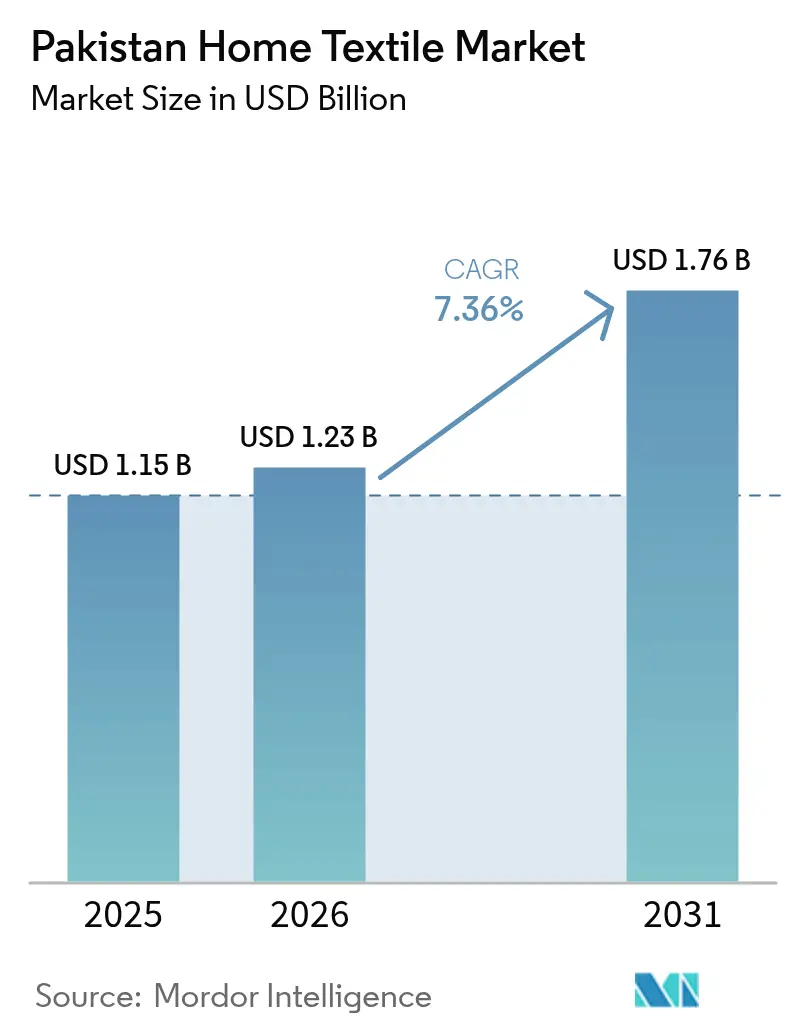
| Base Year Market Size (2025) | USD 1.15 Billion |
| Market Size (2026) | USD 1.23 Billion |
| Market Size (2031) | USD 1.76 Billion |
| Growth Rate (2026 - 2031) | 7.36 % |
| Market Concentration | Low |
Major Players *Disclaimer: Major Players sorted in no particular order Image © Mordor Intelligence. Reuse requires attribution under CC BY 4.0. | |
Pakistan Home Textile Market Analysis by Mordor Intelligence
The Pakistan home textile market size was valued at USD 1.15 billion in 2025 and estimated to grow from USD 1.23 billion in 2026 to reach USD 1.76 billion by 2031, at a CAGR of 7.36% during the forecast period (2026-2031). Healthy export receipts, vertically integrated mills, and an expanding urban middle class support this trajectory even as manufacturers grapple with electricity shortages and intensifying competition from Bangladesh and India. Pakistan remains the world’s fourth-largest cotton producer; however, domestic output slipped from 11.9 million bales in 2018 to 4.5 million bales in 2021, compelling firms to import larger volumes and to increase polyester and modal blending as a hedge against raw-material volatility [1]Kashif Shahzad et al., “Progress and Perspective on Cotton Breeding in Pakistan,” Journal of Cotton Research, jcottonres.biomedcentral.com. Faster broadband adoption, hotel construction pipelines, and escalating demand for Global Organic Textile Standard (GOTS)-certified merchandise add further lift, while the government’s duty-drawback scheme cushions price rivalry in key European and North American destinations. Headwinds stem from climate-related crop swings, steep power tariffs, and a looming 29% United States levy that could redirect trade flows.
Key Report Takeaways
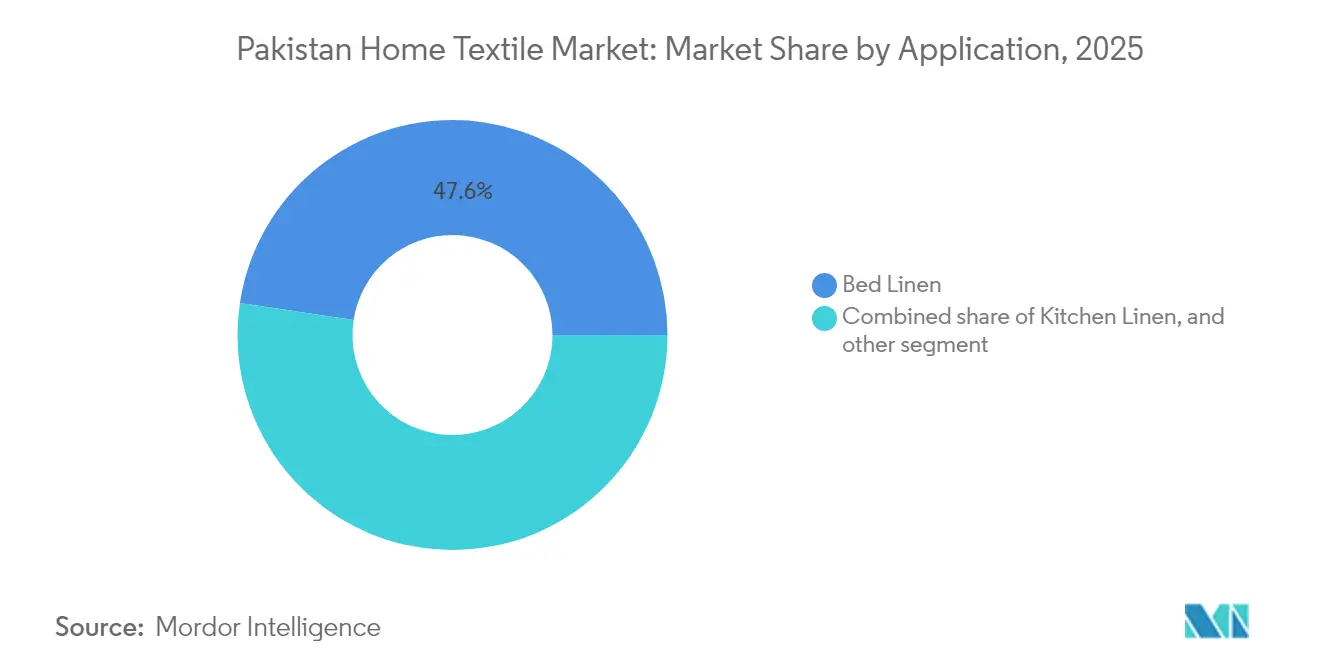
- By application, bed linen led with 47.62% of Pakistan home textile market share in 2025; upholstery is forecast to log an 11.52% CAGR through 2031.
- By material, cotton captured 63.78% of the Pakistan home textile market size in 2025, while synthetic fibers are rising at a 13.41% CAGR.
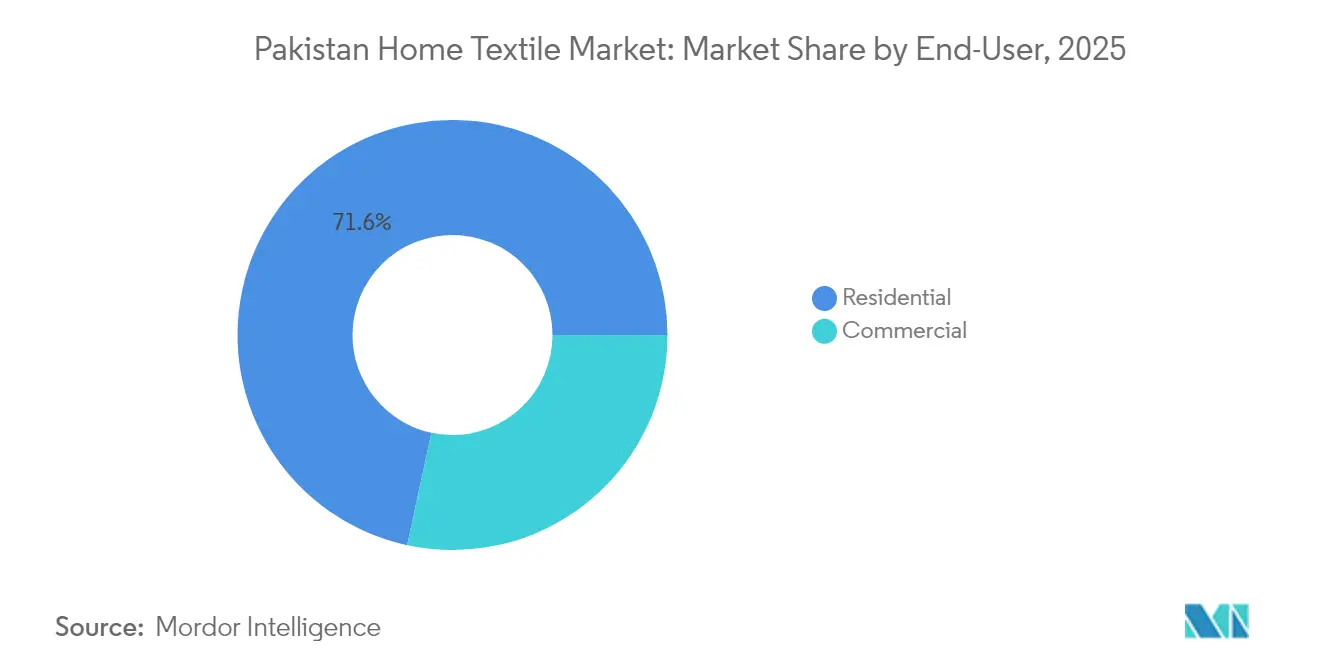
- By end-user, the residential segment accounted for 71.62% of the Pakistan home textile market revenue in 2025, whereas commercial demand is advancing at an 11.02% CAGR.
- By distribution channel, offline retail retained 81.74% share of the Pakistan home textile market in 2025, yet online sales are scaling at a 16.1% CAGR.
- By geography, Punjab delivered a 41.12% share of the Pakistan home textile market in 2025; Khyber Pakhtunkhwa is on track for a 13.32% CAGR.
Note: Market size and forecast figures in this report are generated using Mordor Intelligence’s proprietary estimation framework, updated with the latest available data and insights as of 2026.
Pakistan Home Textile Market Trends and Insights
Drivers Impact Analysis*
| Driver | (~) % Impact on CAGR Forecast | Geographic Relevance | Impact Timeline |
|---|---|---|---|
| E-commerce penetration is accelerating domestic sales | +1.2% | Punjab, Sindh, Islamabad Capital Territory | Short term (≤ 2 years) |
| Rising hospitality and tourism investments | +0.8% | Punjab, Sindh, Islamabad Capital Territory | Medium term (2-4 years) |
| Government duty-drawback scheme for textile exports | +1.5% | National concentration in Punjab and Sindh | Long term (≥ 4 years) |
| Surge in eco-friendly fibre certifications | +0.9% | Global export markets; Punjab manufacturing clusters | Medium term (2-4 years) |
| Water-saving dyeing technologies adoption | +0.7% | Punjab, Sindh textile clusters | Long term (≥ 4 years) |
| Demand for customizable products | +0.6% | Urban centers: Karachi, Lahore, Islamabad | Short term (≤ 2 years) |
| Source: Mordor Intelligence | |||
E-commerce Penetration Accelerating Domestic Sales
Online channels are climbing at a 16.76% CAGR, even though brick-and-mortar stores still dominate overall revenue. Consumers in Karachi, Lahore, and Islamabad rely on Daraz, Shopify storefronts, and brand-owned apps that now feature augmented-reality room visualizers and GSM disclosure tables. The Pakistan home textile market gains from cash-on-delivery services and micro-logistics fleets that reduce fulfilment times to less than forty-eight hours within Tier 1 cities. Digital shops also permit made-to-order sizing, embroidery, and monogramming, which lifts average order values and trims finished goods inventory. Small mills connect directly to households, capturing margins that formerly belonged to wholesalers and unlocking data analytics on color preference and reorder frequency. The government’s Digital Pakistan initiative has cut customs paperwork for e-commerce parcels, accelerating cross-border sample dispatch and shortening export sales cycles.
Rising Hospitality and Tourism Investments
Pakistan welcomed more than 1 million international visitors in 2024, and pipeline hotel keys are forecast to rise 14% by 2030, creating durable demand for high-thread-count bedding and institutional terry. Developers in Lahore’s central business district specify flame-resistant duvets and colorfast drapery, shifting procurement toward vertically integrated local mills that guarantee compliance. The Pakistan home textile market benefits because commercial buyers place year-round replenishment orders that stabilize spindle utilization and justify capital expenditure on shuttle-less looms. Boutique resorts in Gilgit-Baltistan now champion locally woven throws to highlight regional identity, strengthening domestic value addition. Event-led tourism, including ICC cricket fixtures, further raises linen turnover rates in metropolitan hotels. Consequently, commercial demand delivers higher margins than residential sales and creates a pull effect across spinning, weaving, and finishing segments.
Government Duty-Drawback Scheme for Textile Exports
Rebates of 5% on home textile invoice value shave production costs by up to USD 0.30 per kilogram, equating to a 1.5 percentage-point lift in projected CAGR. Although delays in processing once tied up PKR 30 billion in unpaid claims, a 2023 Federal Board of Revenue (FBR) circular introduced electronic submissions and expedited audits [2]Imran Rana, “PTEA Criticises Non-Payment of Tax Rebates and Duty Drawback,” The Express Tribune, tribune.com.pk. The Pakistan home textile market now sees improved liquidity that finances larger cotton-import letters of credit and broadens yarn inventory buffers ahead of peak European buying seasons. Duty-drawback continuity also signals policy stability to foreign buyers, sustaining multi-year sourcing contracts. Industry associations lobby for extending the scheme through 2030 to counter India’s Production Linked Incentive (PLI) rebates, which could otherwise erode Pakistan’s price edge. Consistent payouts amplify exporters’ confidence to invest in automated cutting lines and wastewater treatment plants.
Surge in Eco-friendly Fiber Certifications
More than fifteen mills have achieved GOTS or OEKO-TEX Standard 100 labels, enabling access to Scandinavian furniture chains and U.S. specialty retailers [3]ICEA, “GOTS Certified List,” icea.bio. Certification audits necessitate pesticide-free cotton, traceable supply chains, and zero-liquid-discharge effluent systems, raising capital intensity but commanding price premiums of 8-10%. The Pakistan home textile market thus pivots toward organic cotton, bamboo viscose, and Tencel lyocell to satisfy environmentally conscious end buyers. Marketing campaigns spotlight carbon-neutral weaving and solar-powered stitching floors, attracting Gen-Z consumers who attribute value to provenance. Certification also lowers compliance costs during U.S. Customs Withhold Release Orders, mitigating reputational risks. Over the medium term, adoption is expected to cascade into Tier 2 suppliers, embedding sustainability as a market entry prerequisite.
Restraints Impact Analysis*
| Restraint | (~) % Impact on CAGR Forecast | Geographic Relevance | Impact Timeline |
|---|---|---|---|
| Chronic energy shortages and high tariffs | –2.1% | National, acute in Punjab and Sindh | Short term (≤ 2 years) |
| Cotton crop volatility driven by climate change | –1.8% | Major cotton belts across the country | Medium term (2-4 years) |
| Fragmented domestic logistics | -0.9% | Nationwide, rural–urban corridors | Long term (≥ 4 years) |
| Regional price undercutting | -1.3% | Key export markets | Short term (≤ 2 years) |
| Source: Mordor Intelligence | |||
Chronic Energy Shortages and High Tariffs
Industrial electricity tariffs hover at 13-15 cents per kWh, nearly double subsidized rates in competing South Asian hubs. Unscheduled load shedding shaved 10% off sectoral output in FY 2024, hampering time-sensitive export deliveries. The Pakistan home textile market’s larger mills now install 5-10 MW rooftop solar arrays and lithium-ion storage systems that cover 30-40% of peak usage. Energy-intensive wet-processing units reschedule dyeing shifts to off-peak slots, yet capacity under-utilization erodes gross margins. Government packages that cap tariffs at USD 0.09 for export-oriented units lapse intermittently, breeding uncertainty for financial projections. Without grid reforms, mills risk deferring upgrades and losing share to Bangladeshi suppliers that enjoy steadier power at USD 0.07 per kWh.
Cotton Crop Volatility Driven by Climate Change
Heat stress episodes and pest infestations cut lint yields by 26% between 2020 and 2024, forcing Pakistan to import 1.192 million U.S. bales in 2024, the highest worldwide [4]Amjad Mahmood, “Pakistan Becomes Largest Importer of US Cotton,” Dawn, dawn.com. The Pakistan home textile market faces inflated working-capital needs because imported cotton requires cash-margin letters of credit priced in USD. Currency depreciation widens landed-cost gaps, prompting mills to blend polyester at record levels to protect price points. Farm-level pilot programs for heat-resistant seed varietals show promise but need three to five cropping cycles before widespread adoption. Meanwhile, buyers shift toward fixed-price orders with escalation clauses, transferring some raw-material risk back to suppliers. Climate-driven volatility, therefore, constrains forward-contracting appetite and complicates capacity planning for export-aligned firms.
*Our forecasts treat driver/restraint impacts as directional, not additive. The impact forecasts reflect baseline growth, mix effects, and variable interactions.
Segment Analysis
By Application: Bed Linen Sustains Volume Leadership while Upholstery Fast-Tracks Premium Growth
The Pakistan home textile market size attributable to bed linen stood at USD 0.55 billion in 2025, representing 47.62% of the overall value. European retailers replenish Pakistani cotton sheeting every season due to consistent shrinkage control and competitive free-on-board pricing. Larger orders let mills operate ring-spinning frames at 92-95% utilization, spreading overhead and sharpening cost curves. Value-addition through wrinkle-free chemical finishing and antimicrobial treatments lifts average selling prices without major loom reconfiguration. Export dependability cements long-term vendor agreements that smooth revenue cycles.
Upholstery, although only 8.52% of 2025 sales, advances to an 11.52% CAGR and is forecast to double its contribution by 2031. Rising urban incomes stimulate the domestic sofa and mattress market, where buyers demand stain-resistant jacquard and chenille weaves. Pakistan's home textile market size in upholstery is also propelled by contract furnishing for four-star hotels and co-working offices that standardize design palettes, enabling longer production runs. Air-jet looms and digital jacquard heads produce intricate patterns with shorter setup times, keeping changeover costs low. Pakistan’s access to polypropylene staple fiber in nearby Gulf markets further supports competitive input pricing for performance upholstery.


By Material: Cotton Retains Majority Share, yet Synthetic Fiber Blends Accelerate
Cotton accounted for 63.78% of Pakistan's home textile market share in 2025 on the strength of decades-old ginning networks and established farmer-mill relationships. Mills leverage long-staple imported lint to spin 40’s to 80’s count yarns for premium sateen and percale. However, lint price spikes and climate swings nurture polyester-cotton blends that clock a 13.41% CAGR. Spinners tailor 60/40 yarns that preserve cotton’s breathability while imparting wrinkle recovery, meeting U.S. hospitality benchmarks.
Pakistan's home textile market size attached to synthetic fibers is further buoyed by duty-free access to imported polyester under regional trade agreements, trimming raw-material differential versus pure cotton. Linen, bamboo, and hemp remain niche at less than 3.00% share, yet command unit prices 2-3 times cotton sheeting, underscoring potential for margin lift through eco-friendly storytelling.
By End-User: Residential Anchor Meets a Surging Commercial Stream
Residential purchases contributed 71.62% to the 2025 value, undergirded by Pakistan’s 240 million population and cultural predisposition for dowry sets comprising twelve-piece bedding assortments. Frequent festive sales events accelerate replacement cycles and create cross-sell opportunities for towel and kitchen linen bundles. Retailers deploy deferred payment plans to nudge average ticket sizes higher in Tier 2 cities.
Commercial customers—hotels, hospitals, universities, and corporate facility management firms—expand at an 11.02% CAGR through 2031. Institutional buyers stipulate tensile strength, bleach resistance, and ISO 9001 quality assurance, propelling mills to integrate laboratory testing and statistical process control. Higher contract volumes in the Pakistan home textile market translate into predictable loom loading, allowing manufacturers to amortize capital-intensive shuttle-less machines over larger throughput. Additionally, commercial demand elevates the value perception of Pakistan-origin goods, reinforcing international brand partnerships.
By Distribution Channel: Physical Stores Still Rule but Click-and-Deliver Gains Momentum
Offline formats retained an 81.74% share in 2025 due to consumer reliance on tactile inspection and same-day purchase gratification. Factory outlets clustered along Lahore’s Ferozepur Road liquidate export surplus, attracting footfall with bundle discounts and loyalty apps. Department stores partner with mills on shop-in-shop concepts that showcase coordinated bedding and curtain ensembles.
Online revenue, climbing to a 16.1% CAGR, benefits from skyrocketing smartphone penetration and simplified digital wallets like Easypaisa. Domestic direct-to-consumer labels offer free swatch delivery and 360-degree thread-count explainers, mitigating the sensory gap. Cross-border e-commerce pilots deliver cushion covers to Gulf expatriate communities within seventy-two hours, giving the Pakistan home textile market a diaspora-led growth lever. Live stream selling on social platforms also converts younger demographics, amplifying brand storytelling at minimal cost.
Geography Analysis
Punjab booked 41.12% of 2025 revenue, reflecting its dense value-chain ecosystem across Faisalabad, Lahore, and Multan. Integrated clusters host spinning, weaving, processing, and accessory units within a fifty-kilometer radius, minimizing freight and turnaround. The provincial government subsidizes Effluent Treatment Plants through soft loans, helping mills meet zero-discharge criteria demanded by Scandinavian buyers. Nonetheless, rising minimum wages and elevated grid tariffs motivate some manufacturers to scout new sites.
Sindh leverages Karachi’s Port Qasim and deep-draft berths, facilitating cotton imports from the United States and polyester staple fiber from the Gulf. Textile parks around Landhi export high-end terry towels and jacquard blankets to big-box retailers abroad. Local buying houses and testing labs compress sample lead times, anchoring foreign procurement teams in the city. Government incentives for solar installations further reduce effective energy costs for Sindh-based mills.
Khyber Pakhtunkhwa, expanding at a 13.32% CAGR, attracts investment via the Rashakai Special Economic Zone, which offers ten-year tax holidays and one-stop customs clearance. Hydel power availability slashes electricity bills by up to 25% versus Punjab, giving early movers a clear cost advantage. However, supply-chain depth is still maturing; mills must transport chemicals and dyes from Karachi, adding logistical complexity. Workforce training institutes backed by GIZ and local chambers now churn out sewing machine operators and lab technicians to bridge skill gaps.
Regulatory Landscape
Regulation of Pakistan's home textile ecosystem spans product standards, cotton quality, and export-facing compliance requirements. The Pakistan Standards and Quality Control Authority (PSQCA), established under Act-VI of 1996, anchors national textile standardization through its National Standards Committee for Textiles and publishes Pakistan standards used for conformity assessment across textile products.
On the raw-material side, the Pakistan Cotton Standards Institute (PCSI) under the Ministry of Commerce and the Textile Division administers cotton quality and standardization under the Cotton Standardization Ordinance 2002, shaping grading consistency for spinners and exporters. International certifications such as GOTS and OEKO-TEX are not legal export prerequisites, but they operate as de facto market-access requirements for many European and North American buyers. This influences mill investment into traceability, chemical management, and audited social and environmental controls.
Value Chain Analysis
Pakistan's home textile value chain is largely vertically integrated, connecting cotton cultivation and ginning to spinning, weaving/knitting, dyeing/printing, finishing, and cut-and-sew into finished bedding, towels, curtains, and upholstery fabrics. Integrated groups such as Nishat Mills, Gul Ahmed Textile Mills, Yunus Textile Mills, Sapphire Textile Mills, and Al-Karam operate multiple steps of the chain, giving them tighter control over lead times, quality testing, and compliance documentation needed by export buyers.
Upstream volatility in cotton availability has increased reliance on imported lint and pushed higher blending with manmade fibers. Downstream competitiveness depends on wet-processing capabilities (colorfastness, shrinkage control, and finishing) and packaging and logistics execution through Karachi gateways and inland corridors. Export performance remains a throughput driver for the chain, and the sector has faced pressure with month-to-month volatility around mid-2026, reinforcing the need for efficiency upgrades and stronger order planning from fiber to finished goods.
Competitive Landscape
The Pakistan home textile market hosts more than twenty sizable mills, yet the leading firms now control the majority share of export receipts. Interloop Limited, originally a hosiery specialist, diversified into bedding and posted PKR 147 billion in FY 2024 textile exports, underscoring scale economies. Nishat Mills invested USD 20 million in automated cut-and-sew units linked to an enterprise resource planning platform that reduces fabric wastage by 8%.
Sustainability credentials differentiate suppliers in buyer shortlists. Kamal Textile and Al-Karam commissioned zero-liquid-discharge plants, achieving 90% water recycling. Gul Ahmed added a 30 MW solar park that trims scope-2 emissions and cushions against unpredictable grid outages. These moves align with European retailer scorecards that now allocate up to twenty compliance points to carbon footprint metrics.
Technology is accelerating. Digital color-matching cameras cut shade approval from forty-eight to six hours, while AI-driven defect-detection systems slash second-grade fabric by 3%. Product innovation centers on cotton-poly blends, water-repellent table linen, and hypoallergenic pillow protectors. Some firms pilot blockchain-based yarn tracing, offering QR codes that confirm farm origin. Prospective 29% U.S. tariffs spur scenario planning; exporters hedge with free-trade-agreement markets like Canada and the United Kingdom while eyeing joint ventures in Türkiye to exploit EU Customs Union preferences.
Pakistan Home Textile Industry Leaders
Nishat Mills Ltd.
Gul Ahmed Textile Mills Ltd.
Yunus Textile Mills Ltd.
Sapphire Textile Mills Ltd.
Al-Karam Textile Mills (Pvt) Ltd.
- *Disclaimer: Major Players sorted in no particular order


Market Opportunities and Future Outlook
Branded and design-led home textiles offer a clear differentiation path beyond commodity sheeting and towels. This shift aligns with the report context of an online channel that is already scaling at a mid-teens CAGR, where digital-first selling via platforms such as Daraz, brand-owned apps, and Shopify storefronts reduces dependence on wholesalers. It also supports customization (sizing, embroidery, monogramming) and improves demand sensing for replenishment programs across Karachi, Lahore, and Islamabad.
Sustainability and circularity initiatives are also expanding sourcing conversations with overseas partners. Beddinghouse, a Dutch company, is establishing a permanent corporate presence in Pakistan focused on building a circular textile value chain tied to post-consumer waste recycling, complementing ongoing uptake of GOTS and OEKO-TEX style requirements across export supply chains. International trade exposure remains a practical route to commercialization, with Heimtextil 2026 highlighted as a major buyer-engagement venue, while industry bodies such as PTEA have pointed to surplus industrial capacity and additional USD 4-5 billion export headroom contingent on a supportive ecosystem. This framing supports investment toward higher value-added programs rather than volume-only expansion.
Recent Industry Developments
- July 2026: Gul Ahmed Textile Mills Limited partnered with Living Ink Technologies to integrate Algae Ink, a bio-based pigment, into its home textile product lines. The collaboration supports product differentiation through lower-impact coloration narratives that resonate with sustainability scorecards used by export buyers. It also signals deeper supplier-buyer alignment on traceable inputs beyond fiber, extending into dyes and printing chemistry.
- May 2026: Yunus Textile Mills Limited published its first annual FY25 Sustainability Report aligned with GRI Standards. The disclosure formalizes ESG performance communication on topics such as climate action and resource efficiency, which increasingly influences supplier selection and audit frequency. It strengthens procurement readiness for customers that require structured reporting alongside certification and testing documentation.
- November 2024: Pakistan became the world's largest importer of U.S. cotton, with 1.192 million bales shipped, as mills sought longer staple and lower contamination fiber for export-grade home textiles. This purchasing pattern underscored the supply risk from domestic crop swings and linked mill economics more tightly to FX and landed-cost volatility. It also reinforced the strategic role of blending and inventory planning across spinners and integrated home textile exporters.


Research Methodology Framework and Report Scope
Market Definition and Coverage
We define the Pakistan home textiles market as the value of home furnishing textile products sold for residential and selected commercial use in Pakistan through organized and unorganized channels, captured at prevailing selling prices during the year.
Scope exclusions: It excludes apparel textiles and technical or industrial textiles that are not intended for home furnishing use.
Segmentation Overview
- By Application
- Bed Linen
- Bath Linen
- Kitchen Linen
- Upholstery
- Others (Carpets and Area Rugs)
- By Material
- Cotton
- Linen
- Synthetic Fibers
- Other Materials (Wool, Hemp, Silk, Jute, Bamboo etc.)
- By End-User
- Residential
- Commercial
- By Distribution Channel
- Offline
- Online
- By Geography
- Punjab
- Sindh
- Khyber Pakhtunkhwa
- Balochistan
- Islamabad Capital Territory
- Rest of Pakistan
Data Sources, Market Sizing, and Validation
Desk Research
Desk work starts with trade and production signals that are publicly visible, because Pakistan is closely linked to global home textile supply. We refer to sources such as UN Comtrade and Pakistan Bureau of Statistics for trade and macro indicators, and we also use State Bank of Pakistan publications to align currency movements, inflation, and demand conditions.
To keep product boundaries realistic, we also use Pakistan government and export promotion publications (including TDAP sector notes), customs and tariff classification guidance, and relevant research articles that describe material use and product trends in home textiles. Company annual reports, investor presentations, and reputable press are used to understand portfolio mix and channel exposure, and then a paid subscription for company financials and another for shipment level import-export checks are used selectively to validate direction and scale. The desk sources listed here are illustrative only, and we used many other public and paid references to clarify and cross-check assumptions.
Primary Interviews and Surveys
Interviews and surveys with mills, exporters, distributors, retailers, hospitality buyers, and public-sector specialists in Pakistan clarify demand levels, realized prices, capacity use, and channel mix. Respondents also help identify gaps in informal retail data and assess whether secondary export and domestic-demand indicators align with conditions in Pakistan.
Distribution of primary research fieldwork respondents
| Company type | Respondent position |
|---|---|
| Top tier: 28% | CXOs: 18% |
| Mid tier: 50% | Functional/Unit leaders: 30% |
| Smaller Players: 22% | Managers: 52% |
Market-Sizing & Forecasting
The sizing logic is built by reconstructing the demand pool using Pakistan level production and trade series, and then converting that pool into value through product mix and price assumptions that reflect what is sold locally. After the structure is set, we check it with selective top-down and bottom-up steps so the total stays practical and repeatable.
Key inputs that move the model include home textile export momentum (as a proxy for capacity and product specialization), import levels for finished items, cotton and synthetic fiber price direction, household spending and urbanization signals, and channel shifts toward modern retail and online. Pricing is handled through average selling price ladders by major product groups, and then we stress-test these ladders in interviews so we do not overstate premiumization in a price sensitive market.
For forecasting, scenario analysis is used to translate expected changes in input costs, demand conditions, and mix into a base case view, and then the year-to-year path is smoothed so it matches how retail categories usually behave. Where supplier roll-ups cannot cover smaller firms, we fill gaps by applying validated channel level mix and typical price bands, and then we re-check totals against import-export direction and industry feedback before finalizing.
Data Validation & Update Cycle
Validation is done through repeated cross-checks across independent signals, and any sharp variance is reviewed before figures are signed off. We compare the final model against trade direction, price movements in key fibers, and observed shifts in product mix, and then we re-contact sources when the implied story does not align with what the market is seeing.
Each release goes through multi-step analyst review, which includes unit consistency checks, currency conversion timing checks, and outlier screening at the product and channel level. Reports are refreshed annually, and interim updates are triggered when material events occur, such as policy changes affecting textile trade, large pricing shocks in cotton, or sudden demand swings. Before delivery, an analyst performs a fresh pass so clients receive the latest updated view.
Mordor Intelligence's Pakistan Home Textiles Market Size Compared Against Other Published Estimates
Published market values for Pakistan home textiles can look far apart, even when the topic name sounds similar. The gaps usually come from what gets counted as home textiles, which selling price point is used, and whether the estimate is anchored in trade and production checks or only in broad consumer spending assumptions.
Export led signals, import direction for finished home textile items, and channel pricing checks are the evidence points that tie Mordor Intelligence's estimate to a realistic Pakistan demand pool that can be revisited year after year. Differences also come from whether commercial uses like hospitality linens are included, how floor coverings are treated, and how currency conversion timing is handled in years with notable PKR movement.
Benchmark comparison
| Source | Market Size | Gaps in Research Methodology |
|---|---|---|
| Mordor Intelligence | USD 1.15 B (2025) | |
| Trade Journal A | USD 0.81 B (2025) | Often narrows the scope to domestically consumed finished linens sold through formal retail, which can undercount smaller channels and omit parts of upholstery and floor covering linked demand. |
| Industry Association B | USD 1.60 B (2024) | Typically leans on export value as a proxy for total market, and then applies broad uplifts, which can overstate local consumption when export orders rise faster than domestic buying. |
The spread in the table is mainly explained by scope boundaries and by how trade related signals are translated into local consumption and prices. Our approach stays traceable because the market total is built from observable production and trade direction, and then it is adjusted using product mix and pricing checks that can be repeated in the next update.


Key Questions Answered in the Report
How large is the Pakistan home textile market in 2026?
The Pakistan home textile market size is USD 1.23 billion in 2026 and is projected to reach USD 1.76 billion by 2031.
What is the expected growth rate for Pakistani home textiles?
The market is forecast to grow at a 7.36% CAGR between 2026 and 2031.
Which application generates the most revenue?
Bed linen leads with 47.62% of 2025 revenue due to established export relationships and high reorder frequency.
Why are synthetic fiber blends gaining share?
Polyester-cotton blends mitigate cotton price volatility and deliver wrinkle recovery, supporting a 13.41% CAGR for synthetic fibers.
What geographic region is expanding fastest?
Khyber Pakhtunkhwa is poised for a 13.32% CAGR through 2031, propelled by economic-zone incentives and lower energy costs.
How are energy shortages being addressed by mills?
Leading manufacturers install rooftop solar arrays and lithium-ion storage systems, covering up to 40% of peak consumption to counter tariffs at 13-15 cents per kWh.
Page last updated on:


 Your data is secure and never sold or shared.


