
Market Overview
| Study Period | 2020 - 2031 |
|---|---|
| Forecast Data Period | 2026 - 2031 |
| Base Year Market Size (2025) | USD 3.44 Billion |
| Market Size (2026) | USD 3.55 Billion |
| Market Size (2031) | USD 4.14 Billion |
| Growth Rate (2026 - 2031) | 3.12 % |
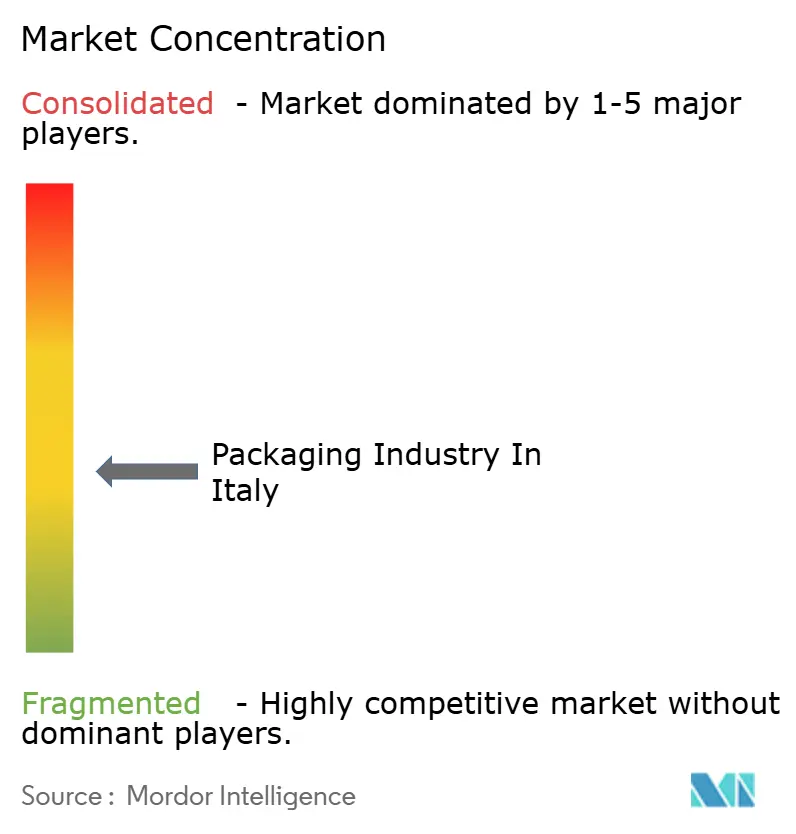
| Market Concentration | Medium |
Major Players *Disclaimer: Major Players sorted in no particular order Image © Mordor Intelligence. Reuse requires attribution under CC BY 4.0. | |
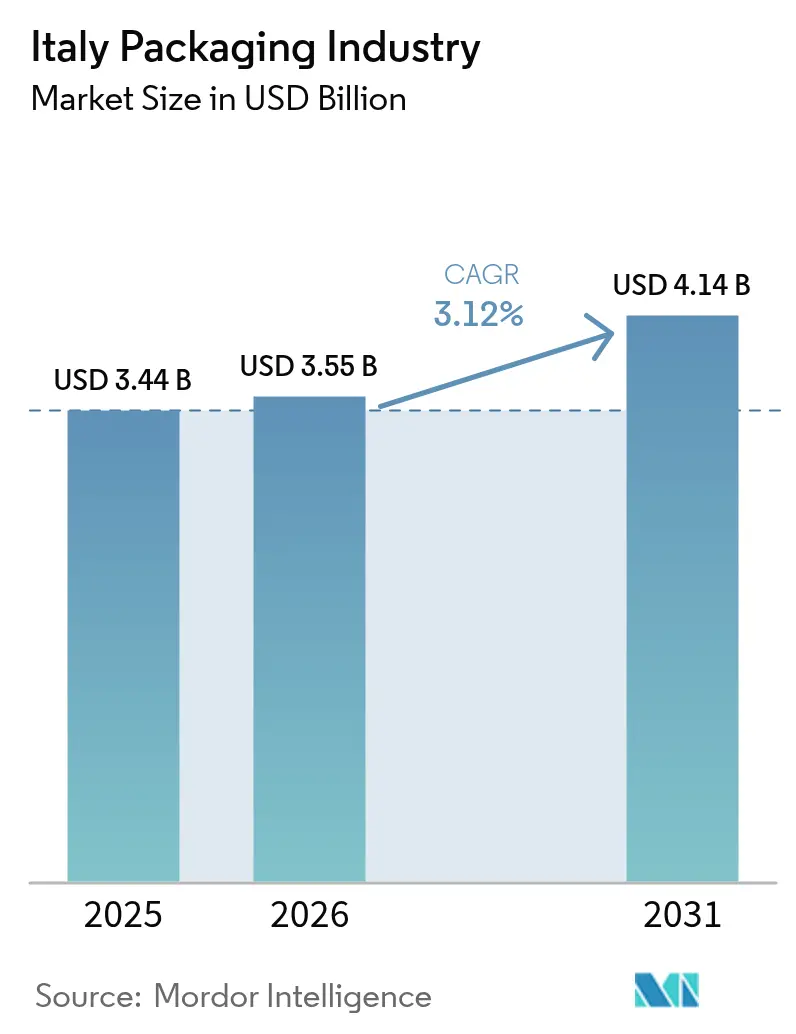
Italy Packaging Industry Analysis by Mordor Intelligence
The packaging industry in Italy market size is expected to grow from USD 3.44 billion in 2025 to USD 3.55 billion in 2026 and is forecast to reach USD 4.14 billion by 2031 at 3.12% CAGR over 2026-2031. The measured expansion reflects Italy’s alignment with the European Union’s Packaging and Packaging Waste Regulation (PPWR) that entered force in February 2025, steering converters toward materials that meet mandatory recycled-content thresholds. Growth is amplified by a EUR 58.8 billion (USD 64.1 billion) domestic e-commerce sector that rose 4% in 2024, creating sustained demand for shipping-ready formats. Competitive strategies now prioritize mono-material designs, lightweighting, and AI-enhanced recycling, while opportunities emerge for suppliers that can bridge the North–South recycling-infrastructure gap and insulate customers from raw-material price volatility.
Key Report Takeaways
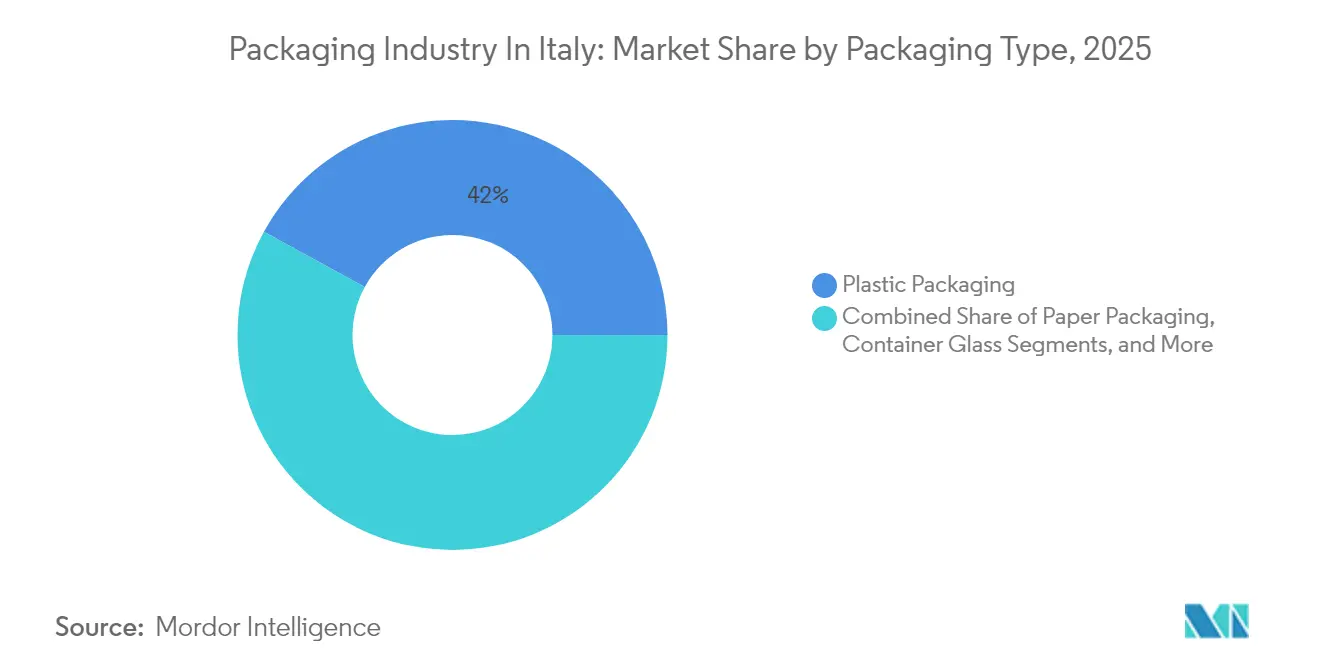
- By packaging type, plastic retained a 42.03% share of the packaging industry in Italy market in 2025, whereas paper is forecast to expand at a 4.55% CAGR through 2031.
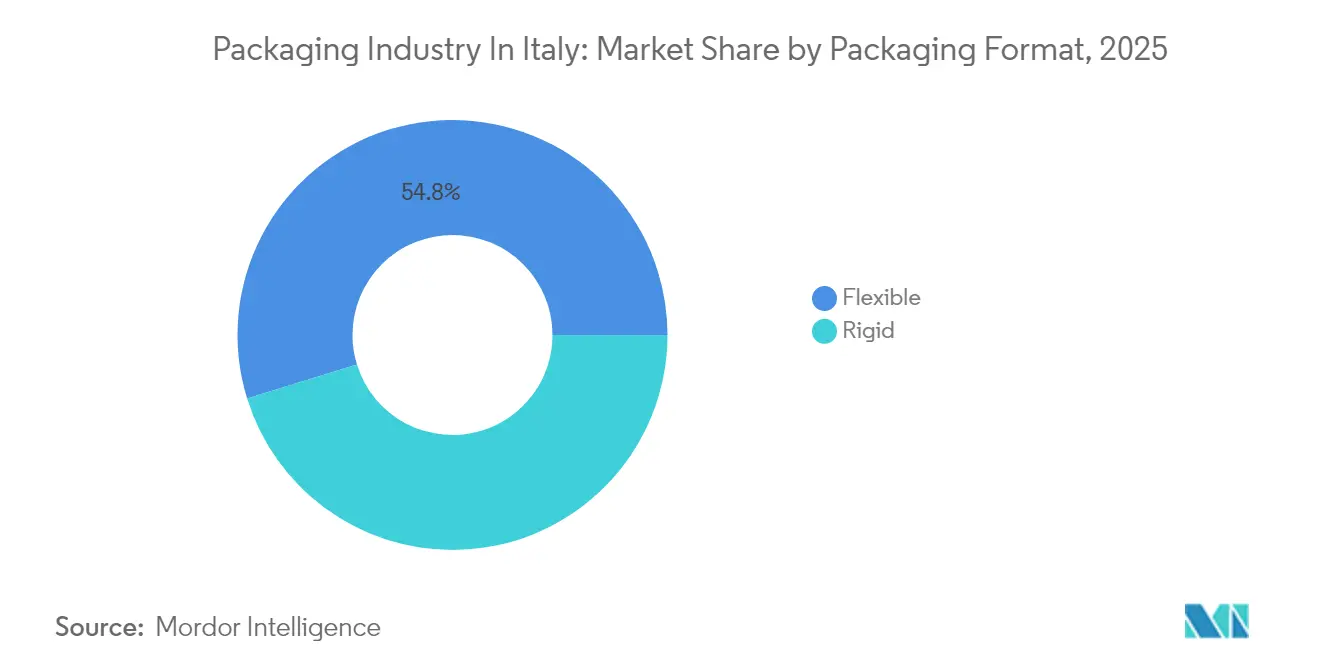
- By packaging format, flexible solutions accounted for 54.78% of the packaging industry in Italy market size in 2025 and are expected to grow at a 4.87% CAGR to 2031.
- By end-use industry, food led with 30.12% of the packaging industry in Italy market share in 2025, while e-commerce packaging shows the fastest 5.85% CAGR.
Note: Market size and forecast figures in this report are generated using Mordor Intelligence’s proprietary estimation framework, updated with the latest available data and insights as of 2026.
Italy Packaging Industry Trends and Insights
Drivers Impact Analysis*
| Driver | (~) % Impact on CAGR Forecast | Geographic Relevance | Impact Timeline |
|---|---|---|---|
| Growing adoption of lightweight and recyclable materials | +0.8% | Italy; spillover to EU markets | Medium term (2-4 years) |
| Surge in e-commerce parcel volumes | +1.2% | National; Northern Italy logistics hubs | Short term (≤ 2 years) |
| EU PPWR and EPR compliance accelerating sustainable packaging | +0.9% | Nationwide within EU framework | Long term (≥ 4 years) |
| AI-driven sorting and quality control in recycling facilities | +0.4% | Initially Northern Italy, expanding southward | Medium term (2-4 years) |
| Heat-pump manufacturing boom driving EPS demand | +0.6% | Northern industrial districts | Short term (≤ 2 years) |
| Source: Mordor Intelligence | |||
Growing Adoption of Lightweight and Recyclable Materials
Converters accelerate material innovation as the EUR 0.45/kg plastic tax and brand-owner sustainability scorecards converge. Lavazza achieved 76% recyclable packaging in 2023 and targets full recyclability by 2025, illustrating food-sector leadership. Casa Optima commercialized 100% recyclable polypropylene packs in 2024, showcasing the technical viability of mono-material solutions. Investments in barrier coatings that remove multilayer complexity enable drop-in replacements without sacrificing shelf life. Retail penalties for non-recyclable formats now influence upstream product-development decisions, creating measurable competitive advantages for firms with R&D capabilities that shorten qualification cycles. As national retailers elevate recyclability thresholds annually, lightweight and recyclable designs become prerequisites for shelf access and export clearance.
Surge in E-commerce Parcel Volumes
Online retail worth EUR 58.8 billion (USD 64.1 billion) in 2024 has redefined shipment profiles, especially for food and grocery, which reached EUR 4.6 billion (USD 6.39 billion) with 8% year-over-year growth. Corrugated suppliers see spikes around Northern logistics hubs, prompting capacity expansions and just-in-time satellite plants that lower transit costs. Dimensional-weight pricing pushes right-sizing software, expandable mailers, and cushioning that tolerates two-way journeys under circular commerce models. Return-ready designs for electronics and apparel add new revenue lines for converters specializing in tear-strip and reseal features. These packaging requirements increasingly dictate upstream material choice, favoring lightweight paper and mono-polyolefin films that align cost, protection, and recyclability.
EU PPWR and EPR Compliance Accelerating Sustainable Packaging
Effective February 2025, the PPWR obliges companies to meet recycled-content floors and design-for-recycling targets verified under EN 13432 standards.[1]European Commission, “PPWR Implementation,” ec.europa.eu Italian brand owners already face higher EPR fees when specifications fall short, elevating the cost of non-compliance. Verallia’s 2024 EBITDA uptick to EUR 326 million (USD 384.20 million) partly stems from higher recycled glass content in response to the new rules. Early movers that exceed thresholds secure multi-year supply contracts as customers rush to prequalify packaging that will remain market-compliant through 2030. Regional disparities in infrastructure make compliance easier in the North, yet PNRR funding is earmarked to lift Southern recycling capacity above 70%, strengthening national supply chains over the forecast horizon.
AI-Driven Sorting and Quality Control in Recycling Facilities
A2A reported 95% sorting accuracy after rolling out Greyparrot vision systems in 2024, raising polypropylene recovery and lowering contamination below 2%.[2]A2A Group, “AI Sorting Deployment,” a2a.eu TOMRA’s GAINnext platform achieved 97% purity for food-grade PP streams, permitting closed-loop reuse that fulfills stringent EU food-contact rules. Northern plants piloting the technology recover investment within two years through higher bale prices and reduced landfill levies. Algorithms learning from packaging design features create feedback that informs converters on optimal color, label, and adhesive choices, ultimately closing the loop between design and recycling. Competitive advantages accrue to waste managers that can supply traceable, high-purity recyclate at contracted volumes during virgin-material price spikes.
Restraints Impact Analysis*
| Restraint | (~) % Impact on CAGR Forecast | Geographic Relevance | Impact Timeline |
|---|---|---|---|
| Volatility in virgin polymer and paper pulp prices | -0.7% | Italy; linked to global commodity markets | Short term (≤ 2 years) |
| Plastic packaging tax (EUR 0.45/kg) squeezing margins | -0.5% | National; regional variations | Medium term (2-4 years) |
| North–South disparities in recycling infrastructure | -0.3% | Primarily affecting Southern Italy | Long term (≥ 4 years) |
| Source: Mordor Intelligence | |||
Volatility in Virgin Polymer and Paper Pulp Prices
Global petrochemical swings raised polymer quotes above five-year averages in 2024, while pulp costs held firm after Nordic supply disruptions. Versalis shuttered cracking units in Brindisi and Priolo, lifting import reliance and exposing converters to freight and FX risk. Smaller operators with limited hedging absorb immediate EBITDA erosion, triggering M&A as firms seek scale procurement power. Paper converters face certification ceilings that curb raw-fiber availability, reinforcing recycled-fiber investment but tying prices to virgin-pulp trajectories. Buyers now request indexed contracts or mixed-material packs to buffer volatility, occasionally delaying innovation rollouts until cost stability returns.
Plastic Packaging Tax Squeezing Converter Margins
Italy’s plastic tax, active since January 2023, levies EUR 0.45/kg on single-use plastics, instantly trimming margins on films, wraps, and pouches. Converters shift toward paper or ultra-thin mono-polypropylene yet incur extra capex for new machinery and qualification. Northern plants, benefiting from 80% recycling rates, partially offset costs via recycled content credit, while Southern peers pay higher net levies due to 60% recovery, widening regional cost gaps.[3]CONAI, “Recycling Statistics 2024-2025,” conai.orgBrands diversify supplier bases to maintain continuity, strengthening companies with cross-material portfolios. Ultimately, the tax accelerates lightweighting but compresses short-term profitability, especially for SMEs financed on thin operating cash flows.
*Our forecasts treat driver/restraint impacts as directional, not additive. The impact forecasts reflect baseline growth, mix effects, and variable interactions.
Segment Analysis
By Packaging Type: Paper Gains Ground Despite Plastic Dominance
Plastic retained a 42.03% share of the packaging industry in the Italian market in 2025, anchored by the barrier performance sought in food and personal-care categories. The segment’s expansion remains steady, though the packaging industry in the Italian market for paper alternatives is projected to grow at a 4.55% CAGR to 2031 on the back of e-commerce and PPWR-driven substitution.
Paper converters win orders from online retail, corrugated boxes, and molded-fiber containers exempt from the plastic tax. Hybrid innovations, such as water-based coatings that replace polyethylene liners, shorten the payback for brand owners seeking recyclable claims. Glass maintains premium niches in beverages and cosmetics; Verallia’s Italian division posted EUR 1.53 billion (USD 1.80 billion) H1 2024 revenue, aided by recycled-glass surcharges passed onto buyers. Metal cans, prized for infinite recyclability, benefit from consumer trust in shelf-stable food during geopolitical supply disruptions. Firms straddling multiple materials hedge policy risks while servicing customers migrating between substrates.


By Packaging Format: Flexible Solutions Drive Market Evolution
Flexible packs dominated with 54.78% share in 2025 and are forecast to grow at a robust 4.87% CAGR, underscoring the format’s coexistence of leadership and momentum. In volume terms, the packaging industry in the Italian market size for flexible applications outpaces rigid competitors as brands convert tubs and jars into stand-up pouches to reduce shipping weight.
Energy-price volatility strengthens the case for film-based formats that lower freight loads, particularly for household cleaners and condiments distributed via omnichannel networks. Rigid formats remain entrenched in glass bottles for wine and aluminum aerosols under stringent pressure standards, yet their growth trails flexible variants. Lavazza’s Tablì dispenser even sidesteps packaging, but most of its SKUs move toward mono-material films slated for 2025 recyclability targets. Dimensional-weight fees in parcel delivery reinforce flexible mailers equipped with gussets that expand during packing but ship flat inbound, illustrating how e-commerce redefines format economics.
By End-use Industry: E-commerce Reshapes Traditional Hierarchies
Food products accounted for 30.12% of the packaging industry in the Italian market in 2025, bolstered by Italy’s globally renowned processed-food and specialty-pasta sectors. Yet the e-commerce channel posts the fastest 5.85% CAGR through 2031 as Italian consumers migrate to online grocery and direct-to-consumer luxury exports.
Beverages sustain glass and aluminum demand as DOC-certified wine exports depend on perceived authenticity. Pharmaceutical packs enjoy recession-proof status, aided by EU serialization mandates that drive uptake of tamper-evident closures. Personal-care labels chase recyclable aesthetics; Guala Closures invested EUR 60 million to develop premium, recyclable whisky closures serving both on-trade and e-commerce gifting. Industrial users adopt tailored crates and EPS cushions aligned with heat-pump manufacturing clusters in the North, where safe transit of fragile compressors justifies higher unit costs.
Geography Analysis
Northern regions such as Lombardy, Veneto, and Emilia-Romagna host 70% of national packaging capacity and boast recycling rates above 80%, giving local converters a compliant feedstock loop. These industrial corridors link seamlessly with Central European highways, easing the export of corrugated and flexible rolls to Germany and France.
Southern Italy, while lagging at roughly 60% recycling, is set to receive PNRR-backed MRF upgrades, potentially injecting 1.2 million tonnes of recovered material annually by 2027. The gap creates arbitrage for converters locating near new facilities to secure recycled feedstock before Northern incumbents. Sardinia and Sicily leverage port access for Mediterranean exports, shipping canned tuna and specialty wines in Italian-made Glass.
Italy’s geographic mid-Mediterranean position positions the packaging industry in Italy market as a conduit to North African growth economies seeking EU-compliant packaging. EPS demand clusters around Northern heat-pump factories, consuming a third of the 155,000-tonne national EPS market and generating consistent orders for molded-foam boxes.
Regulatory Landscape
Italy's packaging regulatory framework is being reset around Regulation (EU) 2025/40 (PPWR), which entered into force on February 11, 2025 and is scheduled to apply from August 12, 2026, making recyclability design criteria and recycled-content requirements directly relevant for packaging placed on the Italian market. During the transition, companies operate in a dual compliance environment that combines PPWR obligations with existing national rules under Legislative Decree 152/2006, including packaging and packaging-waste provisions and environmental labelling requirements overseen by the Ministero dell'Ambiente e della Sicurezza Energetica (MASE), supported by MASE Decree 360 (2022) labelling guidelines.
National alignment is being driven through Italy's EU Delegation Law 36/2026, whose Article 14 mandates the Council of Ministers to adopt legislative decrees to align national legislation (including Legislative Decree 152/2006) with PPWR by December 9, 2026. CONAI guidance is used by brand owners and converters to translate prevention measures, design-for-recycling criteria, and EPR-linked contributions into packaging specifications, so compliance costs and eco-modulation increasingly shape material choice, downgauging decisions, and mono-material redesigns.
Value Chain Analysis
Italy's packaging value chain begins with raw materials (virgin and recycled polymers, paper and recovered fiber, glass cullet, and metals), followed by converting and packaging-equipment-intensive manufacturing clusters that include the Emilia-Romagna packaging valley and other northern industrial districts. Sector associations such as Istituto Italiano Imballaggio, UCIMA (packaging machinery), Giflex (flexibles), and Associazione Italiana Scatolifici (corrugated) influence technical practices, supplier qualification, and competitiveness, while large players with integrated footprints combine upstream material sourcing, converting, and regional distribution to serve food, beverage, pharma, and e-commerce demand.
Downstream, distribution and service networks support nationwide fulfillment, with logistics hubs and packaging distributors extending coverage beyond northern production centers into southern regions. End-of-life collection, sorting, and recycling is coordinated through Italy's EPR architecture, with CONAI as a central industry system actor, and investment is being pulled toward higher-quality recovered-material streams, including AI-enabled sorting and modernization projects supported by circular-economy programs tied to the National Strategy for the Circular Economy (SEC) and NRRP/PNRR-linked waste-management upgrades. The North-South infrastructure gap remains a bottleneck affecting recycled feedstock availability and the economics of compliant formats.
Competitive Landscape
The packaging industry in Italy market comprises multinationals such as Mondi, Sealed Air, and Verallia alongside domestic specialists like Carton Pack and Zignago Vetro. Capital-intensive glass and aluminum segments lean toward oligopoly, whereas flexibles and corrugated remain fragmented with family-owned firms under EUR 200 million (USD 235.71 million) turnover.
Sustainability credentials now decide tender outcomes; Mondi’s EUR 200 million (USD 235.71 million) Duino containerboard mill adds 420,000 tonnes of recycled capacity, winning e-commerce box contracts from fashion platforms. A2A’s AI-backed recyclate supply grants converters traceable PCR resin, differentiating their bids to FMCG giants.
Technology suppliers also shape rivalry: TOMRA’s 97% PP purity ensures compliance with food-contact loops, while IMA sells high-speed pouch lines to converters pivoting from rigid cups. SMEs seek niche insulation by offering bespoke design services or rapid tooling for seasonal SKUs, yet rising EPR fees may trigger horizontal consolidation as compliance costs climb toward EUR 150/tonne by 2026.
Italy Packaging Market Leaders
Tetra Pak International SA
International Paper Company
Mondi plc
Stora Enso Oyj
Smurfit WestRock
- *Disclaimer: Major Players sorted in no particular order

Market Opportunities and Future Outlook
The PPWR application date of August 12, 2026 and Italy's December 9, 2026 national-alignment deadline under Law 36/2026 concentrate near-term opportunity in compliance-enabling redesign and materials substitution, particularly mono-material structures, recycled-content integration, and packaging configurations that simplify sorting and deliver traceable recyclate streams. Tetra Pak and Sterilgarda Alimenti launching a 1-litre aseptic carton with a paper-based barrier, moving away from the traditional aluminum layer to lift renewable content, illustrates where barrier technologies can help maintain performance while improving recyclability across food and beverage applications.
Circularity-linked fee structures and EPR practices also create commercial space in categories where contributions and design criteria are becoming more granular. CONAI's announcement of a dedicated environmental contribution for compostable coffee capsules effective August 12, 2026 signals demand for verified compostable solutions paired with clear end-of-life pathways, and projects such as SOWISE+ in Treviso (CBE JU-supported) point to interest in converting urban biowaste into bio-based polymers (e.g., PHBV), giving Italian converters a route to alternative materials where fossil-based input volatility and recycled-content thresholds intersect. Operationally, bridging the North-South recycling-infrastructure disparity remains central, with localized collection, sorting, and offtake contracts helping stabilize recycled-fiber and PCR supply for converters serving fast-growing e-commerce and regulated end uses.
Recent Industry Developments
- July 2026: CONAI announced a new EUR 45.00/ton environmental contribution (CAC) for compostable coffee capsules, effective August 12, 2026. The move tightens cost discipline around compostable packaging claims and increases the need for brand owners to document end-of-life pathways more rigorously. It also sets a clearer price signal for capsule formats, influencing material selection and supplier qualification in a high-volume FMCG niche.
- April 2025: Mondi successfully started up its recycled containerboard machine at the Duino mill near Trieste following a EUR 200 million investment, adding 420,000 tonnes of annual capacity. This strengthens domestic availability of recycled containerboard and supports e-commerce and retail corrugated demand that depends on stable fiber supply. The ramp-up also increases competitive pressure on smaller converters that rely on imported paper grades or spot procurement.
- July 2024: Smurfit Westrock's Italian operations confirmed integration into the newly formed Smurfit Westrock group following the merger of Smurfit Kappa and WestRock. The combination broadened scale in paper-based packaging and recycling-linked capabilities, reshaping procurement leverage and customer coverage across Italy. It also created a platform for further circular-economy investments in Italian mills and recovered-fiber infrastructure.


Research Methodology Framework and Report Scope
Market Definition and Coverage
For this methodology, the Italy packaging market is counted as revenue generated from packaging products sold in Italy, across the main materials and formats used to pack and protect goods for distribution and end use.
Scope exclusions: Packaging machinery and automation equipment, as well as printing-only services and logistics services, are not treated as part of the packaging market value unless they are bundled into packaging product revenue.
Segmentation Overview
- By Packaging Type
- Plastic Packaging
- By Type
- Rigid Plastic Packaging
- By Material Type
- Polyethylene (PE)
- Polypropylene (PP)
- Polyethylene Terephthalate (PET)
- Polyvinyl Chloride (PVC)
- Polystyrene (PS) and Expanded Polystyrene (EPS)
- Other Material Types
- By Product Type
- Bottles and Jars
- Caps and Closures
- Trays and Containers
- Other Product Types
- By End-use Industry
- Food
- Beverage
- Pharmaceutical
- Cosmetics and Personal Care
- Industrial
- Other End-use Industry
- By Material Type
- Flexible Plastic Packaging
- By Material Type
- Polyethylene (PE)
- Biaxially Oriented Polypropylene (BOPP)
- Cast Polypropylene (CPP)
- Other Material Types
- By Product Type
- Pouches and Bags
- Films and Wraps
- Other Product Types
- By End-use Industry
- Food
- Beverage
- Pharmaceutical
- Cosmetics and Personal Care
- Industrial
- Other End-use Industry
- By Material Type
- Rigid Plastic Packaging
- By Product Type
- Bottles and Jars
- Pouches and Bags
- Bulk-Grade Products
- Other Product Types
- By End-use Industry
- Food
- Beverages
- Cosmetics and Personal Care
- Pharmaceuticals
- Industrial
- Other End-use Industry
- By Type
- Paper Packaging
- By Product Type
- Folding Carton
- Corrugated Boxes
- Liquid Paperboard
- Other Product Type
- By End-use Industry
- Food
- Beverages
- E-commerce
- Other End-use Industry
- By Product Type
- Container Glass
- By Color
- Green
- Amber
- Flint
- Other Colors
- By End-use Industry
- Food
- Beverage
- Alcoholic
- Non-Alcoholic
- Personal Care and Cosmetics
- Pharmaceuticals (excluding Vials and Ampoules)
- Perfumery
- By Color
- Metal Cans and Containers
- By Material Type
- Steel
- Aluminum
- By Product Type
- Cans
- Drums and Barrels
- Caps and Closures
- Other Product Type
- By End-use Industry
- Food
- Beverage
- Chemicals and Petroleum
- Industrial
- Paints and coatings
- Other End-use Industry
- By Material Type
- Plastic Packaging
- By Packaging Format
- Flexible
- Rigid
- By End-use Industry
- Food
- Beverage
- Pharmaceuticals and Healthcare
- Personal Care and Cosmetics
- Industrial
- E-commerce
- Other End-use Industry
Data Sources, Market Sizing, and Validation
Desk Research
Desk research is used to anchor the size of the addressable demand pool in Italy and to keep the model tied to observable production and consumption signals. We typically refer to public sources such as Eurostat for manufacturing and trade series, the Italian National Institute of Statistics (ISTAT) for industrial output indicators, and European Commission publications for packaging waste and policy direction that influences material shifts.
To refine assumptions, we also review sources such as customs trade statistics for packaging-related imports and exports, patent databases to sanity check innovation intensity in recyclable materials, and peer reviewed journals that track recycling rates and material substitution. Company annual reports, investor presentations, and trusted association websites are used to understand capacity changes and announced investments. Select paid subscriptions are used only where needed for standardized company financials, shipment level import and export checks, and structured news and filings, and then the numbers are cross-checked back to public signals. This list is indicative and many other sources are also consulted for data collection, validation, and clarification during the analysis.
Primary Interviews and Surveys
Interviews with packaging converters, material suppliers, brand-side buyers, and channel managers in Italy clarify shipment direction, utilization, selling-price movement, import exposure, and demand from food, beverage, pharmaceutical, personal care, and e-commerce users. Expert interviews and surveys are used to test secondary data and close gaps before assumptions are triangulated.
Distribution of primary research fieldwork respondents
| Company type | Respondent position |
|---|---|
| Top tier: 29% | CXOs: 18% |
| Mid tier: 46% | Functional/Unit leaders: 31% |
| Smaller Players: 25% | Managers: 51% |
Market-Sizing & Forecasting
Sizing starts from a top-down build where packaging demand is reconstructed using Italy specific indicators such as manufacturing output by end-use industries, packaged food and beverage production trends, pharma output signals, and trade movement for packaging materials and finished packs. Because pricing moves differently across paper, plastics, metal, and glass, average selling price direction is handled by tracking resin and pulp price cycles, energy cost pass-through, and the mix shift between rigid and flexible formats.
Once the total is formed, we corroborate it with selective bottom-up approximations so the number stays realistic, including sampled converter revenues, channel checks on typical pack formats, and sanity checks on volumes multiplied by plausible price bands for common packaging items. Where coverage is uneven (for example, smaller private players with limited disclosures), gaps are handled through ratio based extrapolation using output and employment intensity, followed by interview validation.
For forecasting, scenario analysis is used to reflect how regulation timing and substitution (such as mono-material moves and lightweighting) can change mix, followed by an exponential smoothing layer to avoid over-reacting to a single year spike in raw material costs. Final growth paths are reviewed against expert expectations on e-commerce packaging intensity, recycling infrastructure readiness, and announced capacity additions.
Data Validation & Update Cycle
Outputs are checked against independent signals, including direction of packaging material production, import and export momentum, and whether end-use manufacturing is expanding or slowing in the same period. Large variances trigger deeper review, where assumptions like price progression, mix by material, and demand elasticity are revisited and then rechecked with primary contacts.
Before sign-off, a second analyst reviews the model logic, unit consistency, and year-over-year movements to spot anomalies that do not align with known events. The report is refreshed annually, and interim updates are made when material events occur, such as major regulation milestones, sharp feedstock price swings, or meaningful capacity changes. Right before delivery, we run a final pass to ensure the latest public updates are reflected in the numbers clients receive.
Mordor Intelligence's Italy Packaging Market Size Versus Other Published Estimates
Published market numbers for Italy packaging can look far apart, even when the topic sounds the same, because the counted value pool is often not consistent. Differences usually come from what is treated as packaging, whether the figure reflects packaging products or packaging related equipment and services, and how currency and inflation are applied to historical years.
The main gap comes from mixing packaging product revenue with packaging machinery turnover, where Mordor Intelligence keeps the value limited to packaging materials and packaging formats sold in Italy and does not fold in equipment exports or technology sales. Another common driver is whether a source reports a broad turnover style figure that includes wider industrial activity, versus a model that is built from material and format demand linked to end-use production and trade indicators. Refresh cadence also matters, since resin, pulp, and energy costs can swing the market value even when physical volumes move only slightly.
Benchmark comparison
| Source | Market Size | Gaps in Research Methodology |
|---|---|---|
| Mordor Intelligence | USD 3.44 B (2025) | |
| Industry Report Publisher A | USD 28.30 B (2025) | Uses a much broader packaging market value that likely captures a wider turnover pool across Italy, and the scope appears to extend beyond packaging product revenue into adjacent counted activity, which expands the total substantially. |
| Trade Journal B | USD 43.30 B (2024) | Cites sector turnover in euros for a single year and is not presented as a packaging-products-only demand model, so the figure can include broader industry turnover and is also sensitive to currency conversion timing. |
The spread in the table is mainly explained by what gets counted and how the value is constructed for Italy. By tying the market total to observable demand indicators and then cross-checking pricing and mix through interviews, the resulting number stays easier to trace, repeat, and update when conditions shift.


Key Questions Answered in the Report
How large is the packaging industry in Italy market today?
The packaging industry in Italy market size equals USD 3.55 billion in 2026 and is set to reach USD 4.14 billion by 2031.
What CAGR is expected for Italian packaging through 2031?
Forecasts call for a 3.12% CAGR between 2026 and 2031, driven by PPWR compliance and e-commerce growth.
Which packaging format grows fastest across Italian applications?
Flexible formats show the highest 4.87% CAGR, owing to lightweight designs that cut transport costs.
How is the PPWR affecting Italian converters?
The PPWR mandates recycled-content floors and design-for-recycling, pushing firms toward mono-material solutions and chemical-recycling partnerships.
Why is AI important in Italian recycling plants?
AI-based vision systems raise sorting accuracy above 95%, improving recyclate quality and lowering contamination fees for converters.
What role does e-commerce play in shaping packaging demand?
A EUR 58.8 billion e-commerce market fuels demand for right-sized corrugated boxes and protective flexibles suited to parcel delivery.
Page last updated on:


 Your data is secure and never sold or shared.


