
Packaging Foams Market Size and Share
Market Overview
| Study Period | 2020 - 2031 |
|---|---|
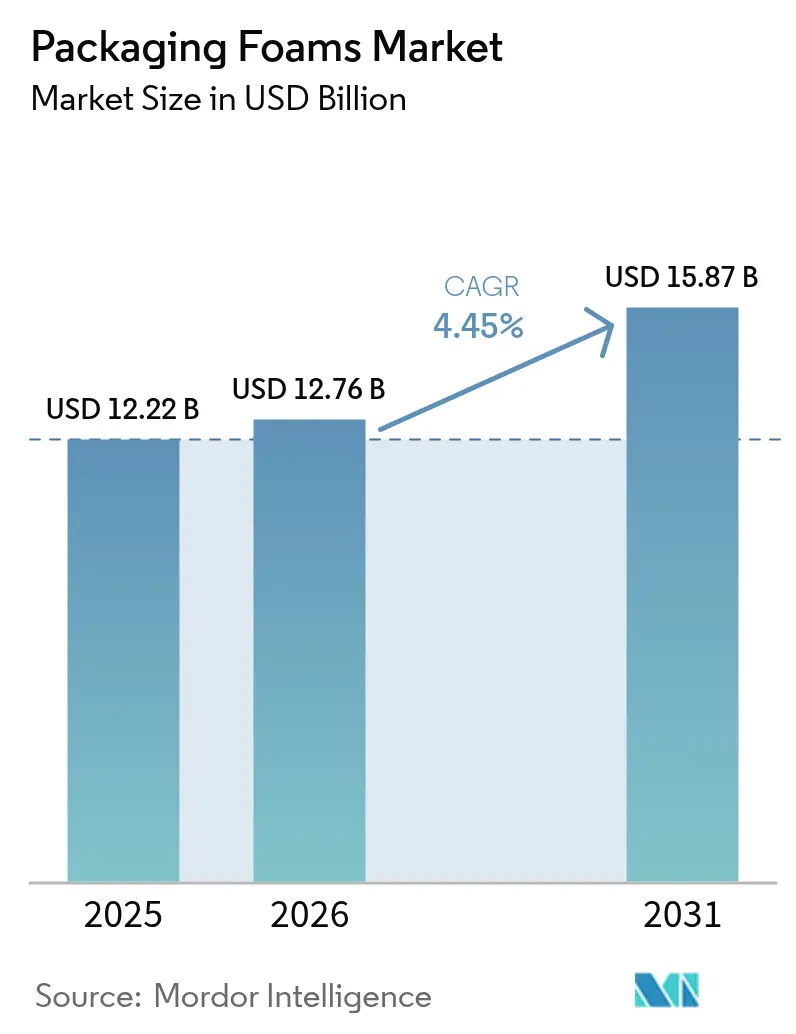
| Market Size (2026) | USD 12.76 Billion |
| Market Size (2031) | USD 15.87 Billion |
| Growth Rate (2026 - 2031) | 4.45 % |
| Fastest Growing Market | Asia Pacific |
| Largest Market | Asia Pacific |
| Market Concentration | Medium |
Major Players *Disclaimer: Major Players sorted in no particular order Image © Mordor Intelligence. Reuse requires attribution under CC BY 4.0. | |
Packaging Foams Market Analysis by Mordor Intelligence
The Packaging Foams Market size was valued at USD 12.22 billion in 2025 and estimated to grow from USD 12.76 billion in 2026 to reach USD 15.87 billion by 2031, at a CAGR of 4.45% during the forecast period (2026-2031). Growth is rooted in rising e-commerce shipping volumes, corporate lightweighting strategies, and stricter environmental mandates that accelerate material substitution toward recyclable and bio-based foams. Asia-Pacific drives both demand and innovation thanks to surging food-delivery services and expanded vaccine cold-chain logistics, while North America and Europe emphasize advanced formulations that comply with evolving chemical regulations. Raw-material volatility, notably styrene and isocyanate price swings, remains a persistent cost challenge that spurs manufacturers to diversify feedstocks and pursue vertical integration. At the same time, merger activity—such as Novolex’s purchase of Pactiv Evergreen—signals a maturing competitive landscape where scale economies and circular-economy capabilities determine strategic advantage.
Key Report Takeaways
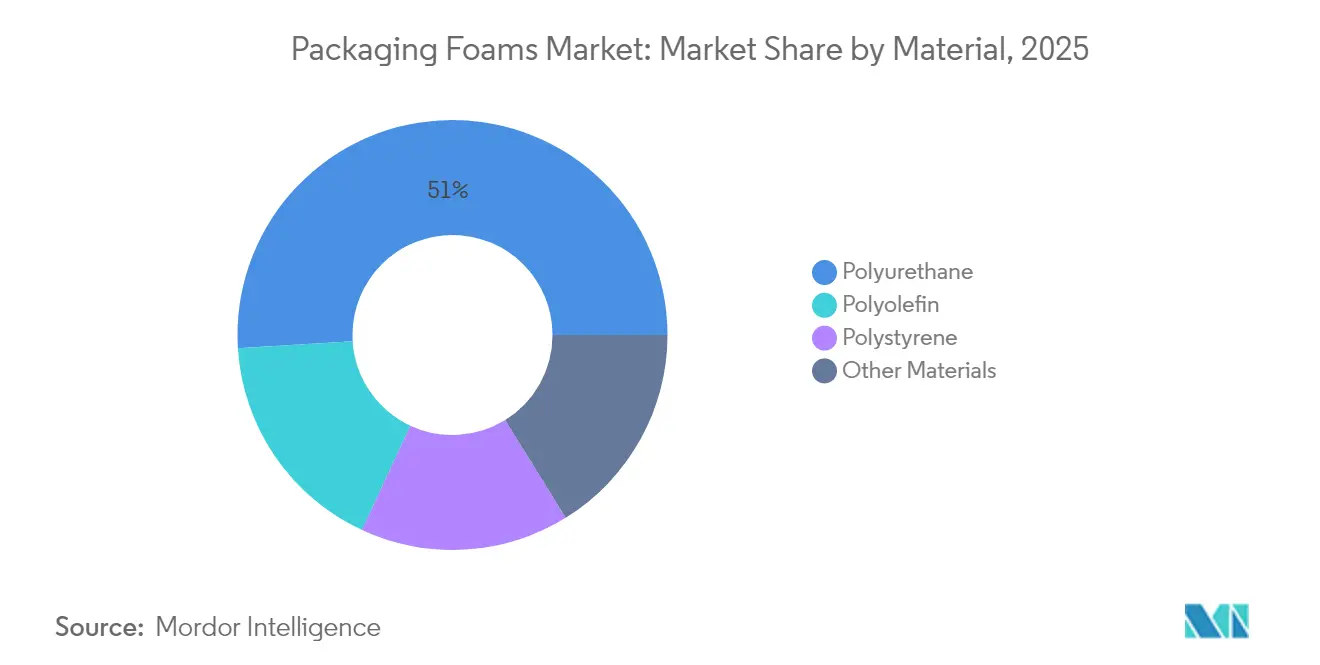
- By material, polyurethane led with 50.98% revenue share in 2025, while polyolefin recorded the highest projected CAGR at 5.43% through 2031.
- By structure, flexible foam captured 60.25% of the packaging foam market share in 2025 and is advancing at a 4.74% CAGR through 2031.
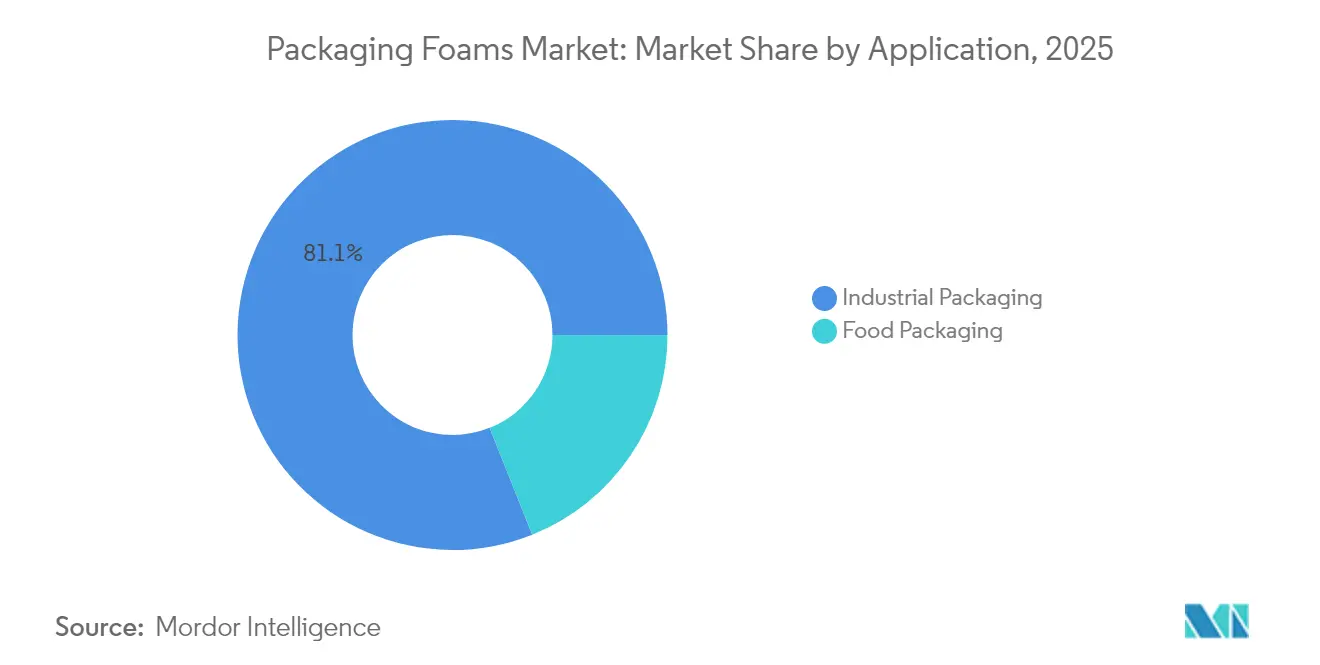
- By application, industrial packaging accounted for 81.05% share of the packaging foam market size in 2025, whereas food packaging is projected to expand at 5.31% CAGR between 2026-2031.
- By geography, Asia-Pacific commanded 40.10% share in 2025 and is forecast to grow at 5.56% CAGR to 2031.
Note: Market size and forecast figures in this report are generated using Mordor Intelligence’s proprietary estimation framework, updated with the latest available data and insights as of 2026.
Global Packaging Foams Market Trends and Insights
Drivers Impact Analysis*
| Driver | (~) % Impact on CAGR Forecast | Geographic Relevance | Impact Timeline |
|---|---|---|---|
| Rising e-commerce led demand for protective shipping foam | +1.20% | Global, with concentration in North America and Asia-Pacific | Medium term (2-4 years) |
| 24-hour food-delivery boom in Asia requiring insulated foam packs | +0.80% | Asia-Pacific core, spill-over to emerging markets | Short term (≤ 2 years) |
| Logistics lightweighting initiatives to cut freight costs | +0.70% | Global, early adoption in North America and Europe | Medium term (2-4 years) |
| Rapid adoption of bio-based polyols for low-carbon foams | +0.60% | Europe and North America leading, Asia-Pacific following | Long term (≥ 4 years) |
| Cold-chain vaccine infrastructure build-out in emerging markets | +0.50% | Africa, Latin America, Southeast Asia | Long term (≥ 4 years) |
| Source: Mordor Intelligence | |||
Rising E-commerce Led Demand for Protective Shipping Foam
Automated fulfillment networks handle rising parcel volumes that frequently contain fragile electronics and personal-care items. Operators replace plastic air pillows with engineered foam inserts that absorb shock, resist compression, and meet recycling targets. Dimensional-weight pricing by parcel carriers incentivizes thinner, lightweight cushions that cut freight charges while protecting products. Machine-learning design platforms generate right-sized foam interiors and deliver up to 25% transport savings for shippers. Electronics brand owners specify polyurethane, polyethylene, and EVA foams with embedded ESD protection to maintain warranty compliance. North American adoption has accelerated since 2024 and parallels rapid e-commerce expansion in Southeast Asia, boosting regional shipment volumes that favor compact, sustainable cushioning solutions.
24-Hour Food-Delivery Boom in Asia Requiring Insulated Foam Packs
App-based food aggregators promise full-day delivery windows that stress temperature management across variable climates. Operators therefore adopt multi-layered foam packs integrating reflective films and phase-change inserts that keep meals within 2 °C of target for up to 24 hours. Vietnam’s single-use polystyrene taxes and upcoming plastic bans provoke a pivot toward bio-derived insulation formats, pushing suppliers to qualify compliant polyolefin or cellulose foams. Chinese regulators have tightened migration testing for food-contact materials, reinforcing demand for formulations with low VOC and minimal residual monomer content. In Singapore, temperature thresholds above 100 °C outlined by the Food Agency oblige suppliers to validate foam container safety across hot-food use cases. These directives collectively advance premium, regulation-ready solutions across Asia’s fast-growing meal-delivery networks.
Logistics Lightweighting Initiatives to Cut Freight Costs
Retailers and CPG firms embed “skinny design” principles that minimize package cube and mass while preserving shelf appeal. Hershey’s shift to one-piece display-ready cases eliminated 3.12 million lb of corrugate and reduced associated logistics CO₂ by 1,340 t. Polyethylene foam profiles containing 95% recycled content win favor because they satisfy plastic-tax exemptions and lower fuel use for outbound loads. Automotive suppliers pursue lightweight synthetic leather options built on foamed polyolefin elastomers to trim interior mass and enhance vehicle efficiency. European pet-food brand Mera cut logistics expense 40% after switching from rigid tubs to corrugated formats enabled by automated foam inserts that stabilize loads and reduce manual handling.
Rapid Adoption of Bio-Based Polyols for Low-Carbon Foams
Polyurethane formulators increasingly replace petroleum polyols with lignin, vegetable oil, or castor-oil derivatives that reduce embodied carbon without sacrificing density or compression strength. University of Liège researchers reported isocyanate-free foams that include 70-90% bio-content and expand at ambient temperature in under two minutes[1]. Wanhua’s plant-based polyether polyols lower VOC emissions and improve compression resistance, offering attractive drop-in alternatives for furniture and appliance makers. Policy targets such as the US goal to reach 25% bio-based chemical substitution by 2030 accelerate commercialization pipelines, while EU frameworks drive 6-12% replacement of fossil feedstocks. Construction suppliers deploy bio-circular polyiso foam panels to satisfy green-building credits, signaling mainstream acceptance across insulation markets.
Restraints Impact Analysis*
| Restraint | (~) % Impact on CAGR Forecast | Geographic Relevance | Impact Timeline |
|---|---|---|---|
| City-level bans on single-use polystyrene | -0.90% | Global, with early implementation in Asia-Pacific and Europe | Short term (≤ 2 years) |
| Styrene & isocyanate price volatility | -0.60% | Global, with particular impact in Europe and North America | Medium term (2-4 years) |
| Rapid advances in molded-pulp & mushroom packaging substitutes | -0.40% | Europe and North America leading, gradual global adoption | Long term (≥ 4 years) |
| Source: Mordor Intelligence | |||
City-Level Bans on Single-Use Polystyrene
Municipal restrictions accelerate material transition by limiting expanded-polystyrene foodservice items and enforcing eco-fee structures that raise cost parity with bio-based formats. California’s SNAP-aligned prohibitions on specific hydrofluorocarbons in foam cushions further reduce polystyrene competitiveness[2]. The EU-backed PolyStyreneLoop facility validates dissolution recycling routes but still requires costly collection systems, adding complexity for converters Vietnam’s staged plastic bans from 2026-2031 intensify regional momentum toward recyclable and compostable foams. As local mandates broaden, packaging producers diversify portfolios to preserve market access and mitigate compliance risks.
Styrene & Isocyanate Price Volatility
Feedstock turbulence stems from plant shutdowns, shipping constraints, and shifting trade flows that move Europe from net exporter to net importer of styrene. Trinseo raised polystyrene list prices by EUR 55/t in January 2025 to absorb elevated benzene costs, squeezing converter margins. In the US, supply tightness intersects with robust e-commerce demand, prompting procurement managers to lock multi-quarter contracts or blend bio-polyols to hedge exposure. Asia remains a demand anchor, with China importing 35% of traded polystyrene volumes and exerting upward price pressure on global indices. Volatility complicates budgeting for converters and encourages evaluation of feedstock-agnostic formulations.
*Our forecasts treat driver/restraint impacts as directional, not additive. The impact forecasts reflect baseline growth, mix effects, and variable interactions.
Segment Analysis
By Material: Polyurethane Dominance Faces Polyolefin Challenge
Polyurethane held 50.98% of the packaging foam market share in 2025, benefiting from well-established supply chains and adaptable density ranges that suit both cushioning and insulation. Polyolefin, however, is projected to capture expanding demand with a 5.43% CAGR through 2031, supported by formulations containing up to 95% recycled content that comply with plastic-tax exemptions. Bio-based polyurethane research—such as lignin-reinforced foams retaining 0.0289 W/m·K thermal conductivity—indicates future growth potential while addressing greenhouse-gas goals. Regulatory pressure on polystyrene deepens its volume decline, although dissolution recycling projects may moderate the pace in select EU regions. Specialty phenolic foams leveraging hydrofluoroolefin blowing agents emerge in high-temperature cold-chain packaging where low global-warming potential is valuable.
The polyurethane segment of the packaging foam market is anticipated to achieve significant growth, while the polyolefin sub-segment is expected to witness notable expansion over the forecast period. These trajectories underscore a gradual but material shift toward chemistries that lower carbon intensity, improve recyclability, and align with brand-owner pledges on post-consumer content. As new bio-polyol capacity comes onstream, formulators anticipate incremental cost parity that could accelerate substitution in the outer years of the forecast.

By Structure: Flexible Foam Maintains Dual Leadership
Flexible variants accounted for 60.25% of the packaging foam market size in 2025, reflecting their suitability for convoluted shapes and rapid cushioning in automated lines. Rigid foams remain essential in temperature-controlled logistics, yet their market share is limited by higher density and disposal complexity. Expancel BIO microspheres enable thinner flexible cushions with no loss in compression set while delivering up to 15% weight savings, bolstering performance leadership. Bio-based rigid foams integrating kraft lignin exhibit improved fire resistance and VOC profiles that support uptake in medical coolers and pharmaceutical shippers.
Flexible foam is forecast to sustain a 4.74% CAGR to 2031, sustained by electronics, cosmetics, and omni-channel retail packaging. The packaging foam market share trend suggests continued dominance for flexible formats, though regulatory scrutiny on end-of-life recycling may favor rigid options with closed-loop recovery schemes in certain jurisdictions.
By Application: Industrial Packaging Scale Versus Food Packaging Growth
Industrial goods, encompassing automotive parts, electronics, and appliance components, represented 81.05% of 2025 demand, confirming the historical focus of foam cushioning on high-value freight. Food packaging, although smaller in tonnage, is projected as the fastest-expanding niche at 5.31% CAGR thanks to explosive on-demand meal delivery and cold-chain penetration. Electronics assemblers increasingly specify ESD-safe polyurethane inserts that remain functional through multiple shipping cycles, thereby supporting circular supply programs.
Packaging foam market size for food applications is expected to increase by 2031, generating incremental volume that offsets slowing growth in legacy industrial segments. Thermal-insulation films containing silica aerogel for chocolate shipments illustrate the sophistication required to maintain product integrity over extended delivery windows. As retail grocery shifts to omnichannel models, temperature-sensitive foam liners will capture expanded share within urban micro-fulfillment networks.
Geography Analysis
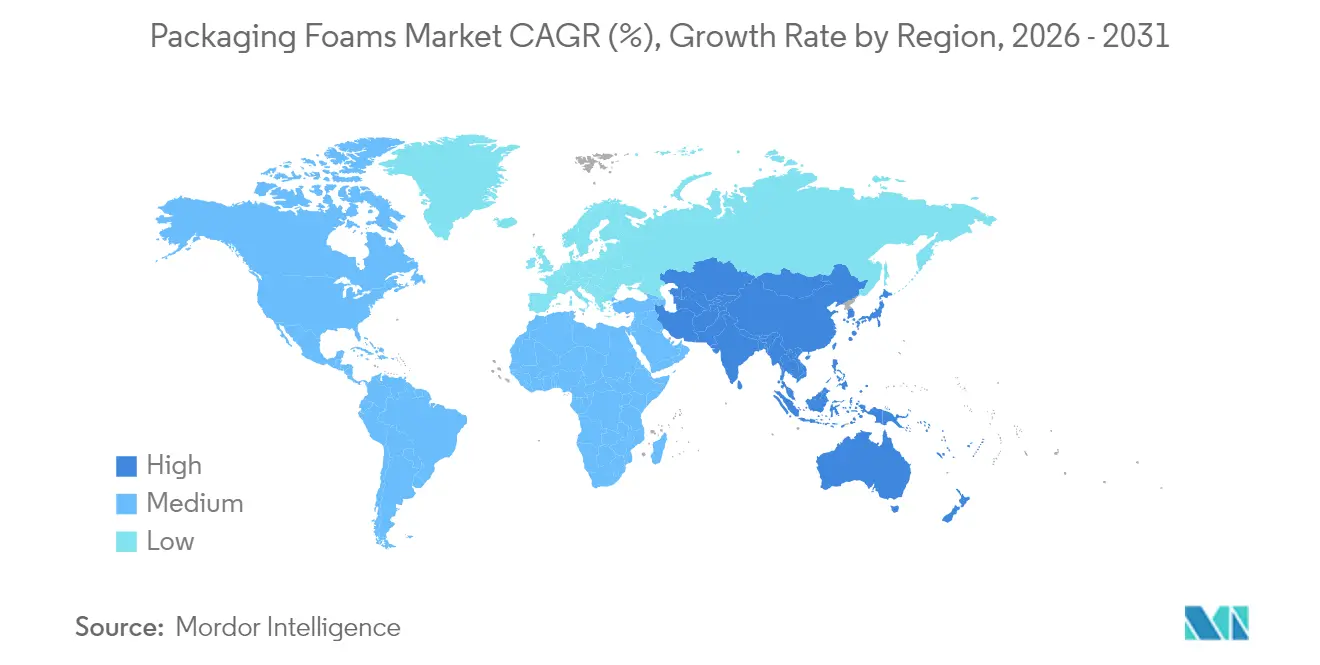
Asia-Pacific leads with 40.10% share and a forecast 5.56% CAGR, propelled by robust e-commerce ecosystems, burgeoning meal-delivery services, and government investment in cold-chain vaccine capacity. Despite setting domestic recycling targets, China remains a significant importer of polystyrene, emphasizing strong regional demand for the raw material. Vietnam’s taxation of single-use styrofoam accelerates substitution toward polyolefin and mushroom-derived foams in Southeast Asia, while Japan and South Korea pursue hydrogen-blown polyurethane for lower GWP profiles.
North America commands a sizable slice of the packaging foam market, supported by sophisticated fulfillment infrastructure and aggressive sustainability roadmaps by leading retailers. Amazon’s exit from air pillows in 2024 nudged the supply base toward recyclable cushions and validated high-volume production scaling. Nouryon’s Wisconsin expansion reflects local demand for lightweight fillers that cut freight intensity while maintaining protective performance. Federal SNAP approvals of next-generation blowing agents provide regulatory certainty for bio-based and low-GWP chemistries.
Europe grapples with elevated feedstock costs and strict chemical regulations, yet remains a hotspot for bio-innovation and circular-economy pilots. Stora Enso’s Papira trials in Germany confirm market appetite for cellulose foams capable of replacing EPS across furniture and consumer-electronics channels. The region’s transition from net exporter to importer of styrene highlights structural supply challenges driving volatility. Eastern European converters increasingly explore molded-pulp formats to comply with single-use directives, while maintaining niche EPS demand in specialty insulation.
South America, the Middle East, and Africa contribute modest but rising shares to the global footprint. Brazil’s e-commerce acceleration fosters adoption of lightweight PE foams in electronics, whereas Gulf Cooperation Council countries apply polyurethane insulation for vaccine transport across desert climates. Africa’s vaccine logistics investments, co-funded by multilateral donors, prioritize recyclable rigid foams that sustain performance in high-temperature corridors, laying groundwork for future demand expansion.
Value Chain Analysis
The packaging foams value chain starts with upstream feedstocks from petrochemicals and bio-based sources, including styrene for EPS and related styrenics, polyols and isocyanates such as MDI/TDI for polyurethane foams, and olefin polymers for polyethylene and expanded polypropylene. Resin and additive suppliers then support converters with blowing agents, nucleating agents, flame retardants, and performance modifiers such as ESD and low-VOC packages for electronics and food-contact use. Recent shifts in styrenics supply are already affecting procurement and logistics decisions, including INEOS Styrolution planning to close its 455,000 tpa styrene monomer plant in Sarnia, Canada by June 2026, alongside broader reductions in European styrene capacity that increase reliance on imports and tighten lead times for foam producers.
In the midstream, foam producers compound and convert materials into beads, sheets, blocks, and engineered inserts, and then fabricate these into protective and insulating packaging for industrial goods, e-commerce fulfillment, food delivery, and cold-chain logistics. In the downstream, distribution runs through packaging distributors, OEM/contract packers, 3PLs, and large brand owners, which increasingly set design-for-recycling and recycled-content requirements for foam components. End-of-life pathways vary by material and region, with mechanical recycling more established for certain polyolefin streams, while chemical recycling routes, including depolymerization of polyurethane back to polyols, are being developed to support closed-loop models aligned with emerging recycled-content and recyclability requirements, particularly in jurisdictions tightening packaging rules such as the EU.
Competitive Landscape
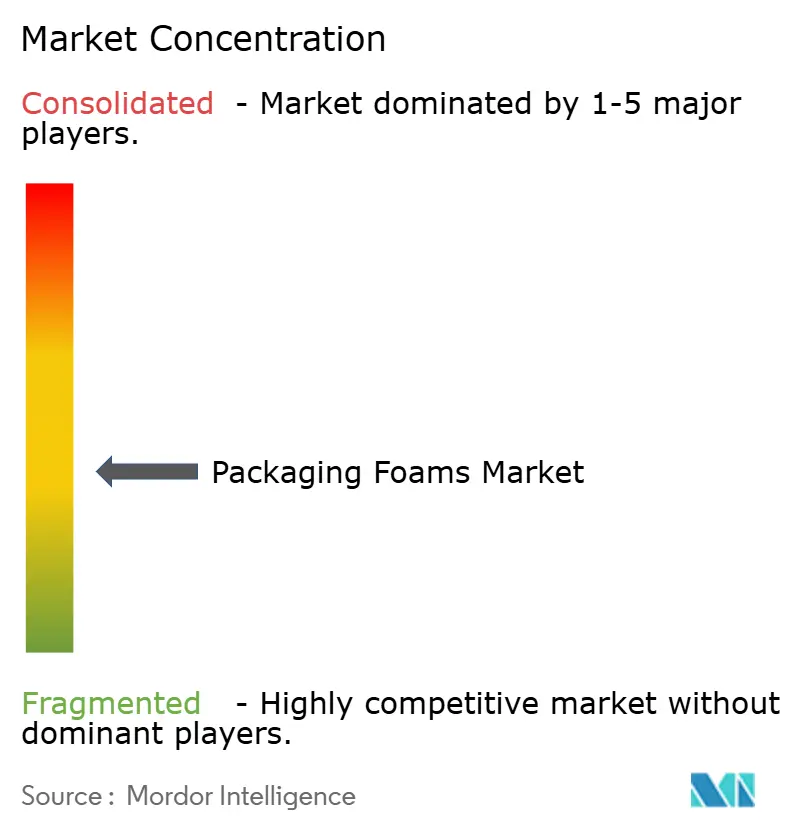
The packaging foam market exhibits moderately fragmented concentration. Industry consolidation is underway as firms chase economies of scale and R&D synergies. Strategic investment in bio-based capacity marks a second competitive axis. BASF earmarked EUR 19.50 billion for capital projects through 2027, including an MDI expansion in Louisiana and a TPU plant in Zhanjiang to tap Asian demand. Armacell’s full purchase of its aerogel joint venture improves control over high-performance insulation pivotal for cold-chain applications. Dow partners with Sealed Air to commercialize REVOLOOP post-consumer resin foams, facilitating circularity and reinforcing brand commitments to recycled content.
Technology differentiation continues as a third lever. Fraunhofer’s heat-activated shape-memory polyurethane foil promises space-saving logistics and reduced storage footprints for converters. Suppliers lacking the capital to pivot toward such innovation risk erosion of share as brand owners adopt multi-criteria supplier scorecards that favor low-carbon and curbside-recyclable solutions.
Packaging Foams Industry Leaders
-
Armacell
-
BASF SE
-
Carpenter Engineered Foams Belgium BV
-
Sealed Air
-
Zotefoams PLC
- *Disclaimer: Major Players sorted in no particular order
Market Opportunities and Future Outlook
A major whitespace is forming around compliant replacement materials and retrofit-ready foam formats for bans and restrictions targeting EPS and broader difficult-to-recycle packaging, especially in foodservice and cold-chain applications. Regulatory triggers are creating near-term pull for alternative foams that can run on existing equipment or fit into established collection systems, including the EU Packaging and Packaging Waste Regulation (EU) 2025/40, which enters full application on 12 August 2026, and US state actions such as New York expanding its foam restrictions to include certain cold storage containers effective January 1, 2026, and Virginia’s EPS food container ban taking effect July 1, 2026. These measures are raising incentives for both brand owners and converters to qualify non-EPS solutions across multiple markets.
The opportunity also extends into circularity-enabling technologies and drop-in bio-based chemistries that lower the switching barrier. Evidence of product and project activity in 2026 includes Fraunhofer CCPE progressing its xPBS extrusion foam initiative and follow-on xPBS-food work to adapt PBS-based foams for food packaging, and TotalEnergies Corbion introducing Luminy FOAM 50F, a high-melt strength PLA grade positioned for extrusion foaming as an alternative to polystyrene in fresh food applications. Chemical recycling pathways for polyurethane foams are also moving from pilots toward broader deployment, supported by initiatives such as Evonik’s hydrolysis-based work at Hanau and H&S Anlagentechnik’s depolymerization approach for converting foam scrap back into chemical feedstocks, which is helping align packaging foam portfolios with tighter recyclability and recycled-content requirements in key regions.
Recent Industry Developments
- May 2026: BASF collaborated with UPM Specialty Materials to develop recyclable, fiber-based packaging concepts using BASF's Joncryl HPB barrier technology. The work targets higher-performance barrier structures that can remain compatible with paper recycling systems, supporting brand-owner transitions away from hard-to-recycle multilayer packaging formats.
- July 2025: Stora Enso partnered with Germany-based Novapor to pilot Papira, a cellulose-based foam packaging material intended to replace conventional fossil-based foams. The pilot strengthened the market pathway for wood-fiber cushioning in Europe, where circularity requirements and substitution away from EPS are shaping material selection.
- March 2025: EFP announced a USD 31.5 million investment to expand operations in Lee County, South Carolina, to increase capacity for advanced EPS and EPP solutions, with full operations slated to commence by April 2026. The expansion adds regional supply for molded protective packaging used in industrial and cold-chain applications, improving lead times for North American customers.
Research Methodology Framework and Report Scope
Market Definition and Coverage
For this study, the packaging foams market value covers foam materials used for cushioning, protection, void fill, and insulation in packaged goods during storage and transportation, across both flexible and rigid foam structures.
Scope exclusions: We exclude non-packaging uses of foams such as building insulation, furniture and bedding cushioning, and automotive seating applications.
Segmentation Overview
- By Material
- Polystyrene
- Polyurethane
- Polyolefin
- Other Materials
- By Structure
- Flexible
- Rigid
- By Application
- Food Packaging
- Industrial Packaging
- Transportation Components
- Electrical and Electronics
- Personal Care
- Pharmaceutical
- Other Industrial Packaging
- By Geography
- Asia-Pacific
- China
- India
- Japan
- South Korea
- Rest of Asia-Pacific
- North America
- United States
- Canada
- Mexico
- Europe
- Germany
- United Kingdom
- France
- Italy
- Russia
- Rest of Europe
- South America
- Brazil
- Argentina
- Rest of South America
- Middle East and Africa
- Saudi Arabia
- United Arab Emirates
- South Africa
- Rest of Middle East and Africa
- Asia-Pacific
Data Sources, Market Sizing, and Validation
Desk Research
Desk research was used to set the market boundary and build the first version of the demand and supply picture by region. We mainly relied on public statistics and technical references, such as US Census Bureau manufacturing data, USITC and UN Comtrade trade flows for relevant polymers, Eurostat industrial indicators, and publications from organizations such as the American Chemistry Council.
To keep assumptions practical, we also reviewed company annual reports, investor presentations, sustainability reports, and credible press coverage that discusses packaging demand shifts. Patent databases were checked to understand material substitution activity, for example moves toward recyclable structures. In addition, we used a paid subscription for company financials and news to validate expansion plans, plant changes, and M&A timelines. The sources listed here are illustrative, and many other public references were used for data collection, cross-checks, validation, and research clarification.
Primary Interviews and Surveys
Primary work was done to confirm what portion of foam output is truly going into packaging, and how pricing and mix are moving across materials and structures. We spoke with stakeholders across raw material supply, foam converting, packaging distribution, and large end users, and the mix of responses was balanced across regions so regional differences in regulations and demand cycles were reflected in the model.
Distribution of primary research fieldwork respondents
| Company type | Respondent position | Region |
|---|---|---|
| Top tier: 33% | CXOs: 14% | APAC: 45% |
| Mid tier: 51% | Functional/Unit leaders: 40% | EMEA: 29% |
| Smaller Players: 16% | Managers: 46% | Americas: 26% |
Market-Sizing & Forecasting
Sizing started with a top-down build that reconstructs packaging-foam demand using packaging activity indicators and polymer-linked supply signals, and then applies packaging-appropriate foam intensity and value per unit. Once that ceiling was formed, selective bottom-up checks were used, such as sampled supplier revenues tied to packaging end uses and channel-level pricing checks, and then totals were adjusted where the two views did not align.
Key inputs included flexible versus rigid mix, material split across polyurethane, polystyrene, polyolefin, and other materials, and the share of industrial versus food packaging usage. Pricing was treated carefully by tracking resin and chemical feedstock movements and translating them into realistic foam ASP progression, then filtered through primary inputs on pass-through timing. For the forecast, we used scenario analysis around e-commerce shipment growth, cold-chain and food-delivery expansion, and sustainability-led substitution, and then selected the final path based on the consensus of interview feedback. Where direct data was thin, gap areas were handled using regional analogs and transparent assumptions that could be re-tested in later refreshes.
Data Validation & Update Cycle
Outputs were checked against independent signals, such as regional packaging demand direction, trade patterns for relevant polymers, and visible price movements that should show up in foam ASPs. If a region or material line item moved too far from these signals, the drivers were re-tested and, when needed, interview follow-ups were triggered to confirm the situation on the ground.
Before sign-off, the model goes through multiple analyst reviews focused on variance checks, unit consistency, and whether assumptions are stated clearly enough to be repeated. The report is refreshed annually, and interim updates are made when material events occur, such as large capacity additions, policy shifts on packaging waste, or major feedstock disruptions. Right before delivery, an analyst performs a fresh pass so clients receive the latest updated view.
Mordor Intelligence's Packaging Foams Market Size Measured Against Other Published Estimates
It is normal to see different published values for packaging foams because not everyone counts the same products, end uses, or years, even when the titles look similar. Differences also come from how pricing is treated, how much regional detail is built in, and how often the model is updated.
Trade signals for polymer-linked inputs, plus primary checks on flexible versus rigid mix and the industrial versus food packaging split, are the evidence used to keep Mordor Intelligence aligned to packaging consumption and to exclude non-packaging foam demand that some broader totals can still include.
Benchmark comparison
| Source | Market Size | Gaps in Research Methodology |
|---|---|---|
| Mordor Intelligence | USD 12.22 B (2025) | |
| Trade Journal A | USD 19.29 B (2024) | Uses a wider foam packaging framing and a different base year, and the narrative suggests adjacent foam uses can be counted alongside packaging, which can lift the stated value when pricing cycles are strong. |
| Global Consultancy B | USD 16.03 B (2025) | Applies a broader end-use lens across industries and can attribute more foam volumes to packaging than what channel checks typically support, which increases the total versus a packaging-only demand pool. |
The spread across the three numbers is mainly explained by scope and allocation differences, along with the year used for the headline value. When the market is rebuilt from clear mix assumptions, realistic pricing pass-through, and packaging demand signals, the result is easier to trace and re-check in future updates.
Key Questions Answered in the Report
What is the current value of the packaging foam market?
The packaging foam market size is USD 12.76 billion in 2026.
How fast is the packaging foam market expected to grow?
The market is projected to register a 4.45% CAGR between 2026 and 2031, reaching USD 15.87 billion.
Which material dominates the packaging foam market?
Polyurethane leads with 50.98% market share in 2025, thanks to its versatility across cushioning and insulation applications.
Which region shows the fastest growth in packaging foam demand?
Asia-Pacific records the highest forecast growth at 5.56% CAGR through 2031, driven by e-commerce and food-delivery expansion.
What key factor is driving adoption of bio-based foams?
Regulatory pressure to reduce greenhouse-gas footprints and replace fossil feedstocks accelerates the deployment of lignin- and vegetable-oil-based polyols.
How are logistics cost-saving strategies influencing foam design?
Companies optimize package dimensions and deploy lightweight foam inserts, delivering up to 25% freight savings and lowering CO₂ emissions.