
Oxygen Scavengers Market Size and Share
Market Overview
| Study Period | 2020 - 2031 |
|---|---|
| Market Size (2026) | USD 3.44 Billion |
| Market Size (2031) | USD 4.29 Billion |
| Growth Rate (2026 - 2031) | 4.55 % |
| Fastest Growing Market | Asia Pacific |
| Largest Market | Asia Pacific |
| Market Concentration | High |
Major Players *Disclaimer: Major Players sorted in no particular order Image © Mordor Intelligence. Reuse requires attribution under CC BY 4.0. | |
Oxygen Scavengers Market Analysis by Mordor Intelligence
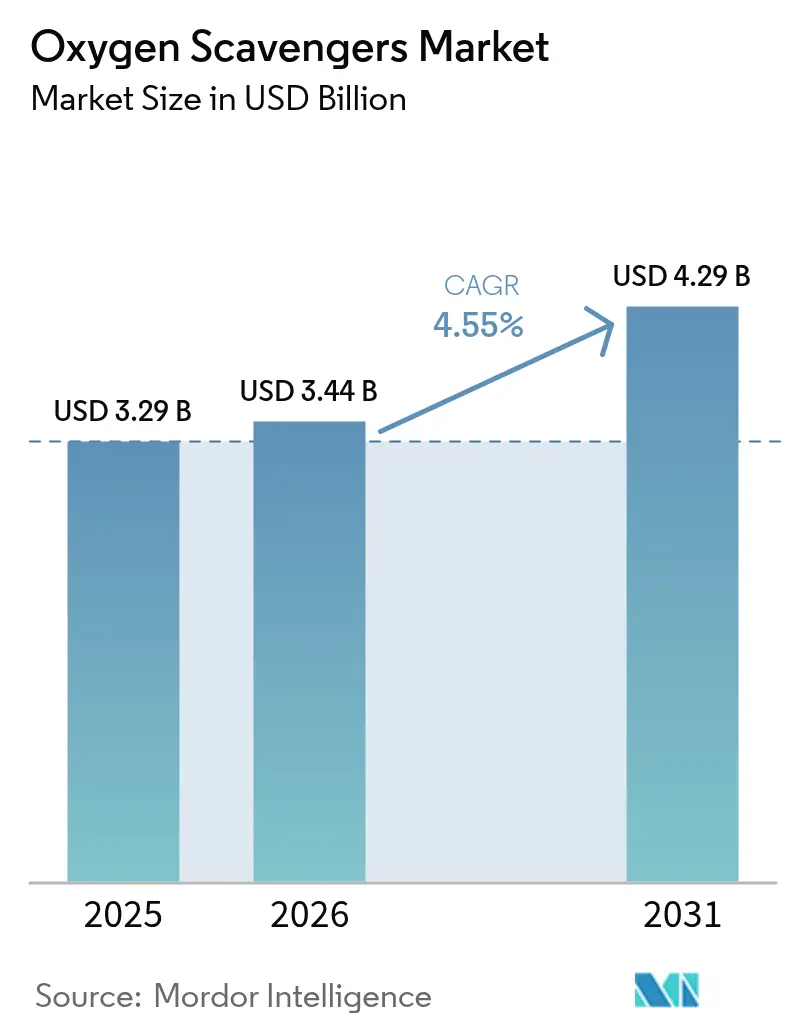
The Oxygen Scavengers market size is expected to grow from USD 3.29 billion in 2025 to USD 3.44 billion in 2026 and is forecast to reach USD 4.29 billion by 2031 at 4.55% CAGR over 2026-2031. Demand pivots from conventional iron powders toward polymer-integrated and enzyme-based systems that help brand owners satisfy stricter shelf-life, purity and recyclability targets. Asia-Pacific represents the core production base for multilayer packaging films while North America drives high-value pharmaceutical applications, and both regions influence raw-material sourcing strategies for global suppliers. Regulations such as the FDA’s Human Foods Program and EU Regulation 2025/40 are amplifying the shift toward non-metallic formulations that avoid metal-ion migration. Across end-uses, the e-commerce boom forces brand owners to choose oxygen management technologies that remain effective during weeks-long journeys through complex fulfilment networks, sustaining medium-term growth for the oxygen scavengers market.
Key Report Takeaways
- By product type, metallic formulations commanded 57.12% of oxygen scavengers market share in 2025, whereas non-metallic alternatives are forecast to expand at a 7.99% CAGR through 2031.
- By end-user industry, food and beverages led with 33.02% revenue share in 2025; pharmaceutical packaging is projected to advance at a 7.55% CAGR to 2031.
- By geography, Asia-Pacific held 37.62% of the oxygen scavengers market share in 2025 and is set to grow at a 7.21% CAGR between 2026 and 2031.
Note: Market size and forecast figures in this report are generated using Mordor Intelligence’s proprietary estimation framework, updated with the latest available data and insights as of 2026.
Market Trends and Insights
Drivers Impact Analysis of Oxygen Scavengers Market*
| Driver | (~) % Impact on CAGR Forecast | Geographic Relevance | Impact Timeline |
|---|---|---|---|
| Rapid growth in fresh-ready & chilled packaged meals | +1.2% | Global, with concentration in North America & Europe | Medium term (2-4 years) |
| Stricter pharmacopeia limits on residual oxygen in drug packs | +0.8% | Global, led by US FDA and EU EMA regulations | Long term (≥ 4 years) |
| Expansion of aseptic cold-chain meal-kit logistics | +0.6% | North America & Europe, expanding to APAC | Medium term (2-4 years) |
| Commercialization of nanocomposite polymer scavengers | +0.4% | Global, with early adoption in developed markets | Long term (≥ 4 years) |
| E-commerce demand for longer transit shelf-life | +0.7% | Global, with highest impact in APAC and North America | Short term (≤ 2 years) |
| Source: Mordor Intelligence | |||
Rapid Growth in Fresh-Ready & Chilled Packaged Meals
Shifts in consumer habits toward convenience foods have widened deployment of active oxygen management across meat, seafood and deli categories. Brand owners integrate sachet-free scavenging layers into thermoformed trays so products remain color-stable throughout extended chilled storage and retail display. Regional supermarket chains cite reduced waste and improved merchandising flexibility as key benefits, prompting co-packers to specify solutions that activate rapidly at low temperatures. Equipment suppliers are therefore adapting high-speed tray-sealing lines to accommodate multilayer films pre-loaded with scavenging resins that do not compromise seal integrity. This adoption dynamic feeds a steady order pipeline for film extruders located in the United States and Germany, reinforcing baseline growth for the oxygen scavengers market.
Stricter Pharmacopeia Limits on Residual Oxygen in Drug Packs
The latest USP and EMA guidelines cap residual oxygen in parenteral and solid-dose packs, urging drug makers to validate barrier systems that sustain ≤0.5% oxygen throughout the stated shelf life. Polymer-based scavengers such as Colorcon’s PharmaKeep series can function across 10–90% relative humidity, addressing drug-product moisture sensitivity while avoiding metal-ion risks. the European regulations are following similar trajectories, with the EU's revised food contact material regulations effective March 2025 introducing enhanced purity requirements and migration limits that affect pharmaceutical packaging materials [1].Contract development organizations embed such additives directly into polyolefin blisters, which simplifies line qualification versus separate sachets. These advances are most visible in biologics, where trace oxygen can catalyze protein degradation, and in moisture-reactive small-molecule therapies that require multi-year stability data.
Expansion of Aseptic Cold-Chain Meal-Kit Logistics
Meal-kit platforms operating subscription models now service multi-day delivery radii, demanding packaging that curtails microbial growth without freezing ingredients. Producers employ oxygen scavenger-lined pouches inside insulated shippers so vegetables, sauces and protein components remain organoleptically stable during 72-hour transits. Logistics data show temperature excursions of 2-5 °C are common, elevating oxygen permeability of standard films; integrated scavenging layers offset this effect and preserve sensory quality. The resulting customer-experience gains reinforce reorder rates for platforms and translate into recurring demand for specialized pouches, supporting regional converters in Japan, the United Kingdom and the United States.
Commercialization of Nanocomposite Polymer Scavengers
Nanocomposite chemistries blend reactive polyesters with dispersible catalysts that trigger oxygen removal once bottles or films are exposed to ambient moisture. Avient’s ColorMatrix Amosorb 4020L, for instance, enables lightweight PET bottles to meet carbonated-beverage oxygen ingress targets without a separate foil-liner or coated closure. Film processors value such drop-in concentrates because they run on existing extrusion equipment and simplify downstream recycling streams compared with multilayer barrier structures. Accelerated-aging studies show these systems maintain haze levels below 3% and retain mechanical strength, allowing brand owners to pursue clear-package aesthetics alongside extended shelf life.
Restraints Impact Analysis of Oxygen Scavengers Market*
| Restraint | (~) % Impact on CAGR Forecast | Geographic Relevance | Impact Timeline |
|---|---|---|---|
| Metal-ion contamination & sensory-taint concerns | -0.9% | Global, with highest impact in pharmaceutical applications | Medium term (2-4 years) |
| Cost-effective and high-barrier film substitutes | -0.6% | Global, with concentration in cost-sensitive markets | Short term (≤ 2 years) |
| Volatile iron-ore and specialty catalyst price swings | -0.4% | Global, with highest impact on metallic scavenger producers | Short term (≤ 2 years) |
| Source: Mordor Intelligence | |||
Metal-Ion Contamination & Sensory-Taint Concerns
Iron-based sachets release trace ions that can catalyze oxidative reactions in sensitive nutraceuticals and lead to metallic off-notes in premium teas and coffees. Regulatory auditors now require migration testing under worst-case humidity, prompting some brand owners to exclude ferrous systems entirely for high-value SKUs. Polymer encapsulation methods lower direct contact risk, yet they raise raw-material costs that smaller manufacturers struggle to absorb. This trade-off tempers near-term penetration of traditional sachets in pharmaceutical and specialty-food channels, restraining a portion of the oxygen scavengers market.
Cost-Effective and High-Barrier Film Substitutes
Multi-layer films employing EVOH and bio-based coatings deliver oxygen transmission rates low enough for moderate-sensitivity products, reducing perceived need for active scavengers. A recent MDPI study demonstrated oxygen permeability reductions by up to 550 times when thin-film polypropylene received plasma-applied SiO₂ coatings. As converters scale such barrier technologies, private-label food brands in cost-conscious regions are likely to favor the simpler passive option, especially for products with six-month or shorter shelf lives. Active scavenger suppliers must therefore communicate value in terms of extended distribution reach and reduced spoilage rather than barrier performance alone.
*Our forecasts treat driver/restraint impacts as directional, not additive. The impact forecasts reflect baseline growth, mix effects, and variable interactions.
Oxygen Scavengers Market Segment Analysis
By Type:
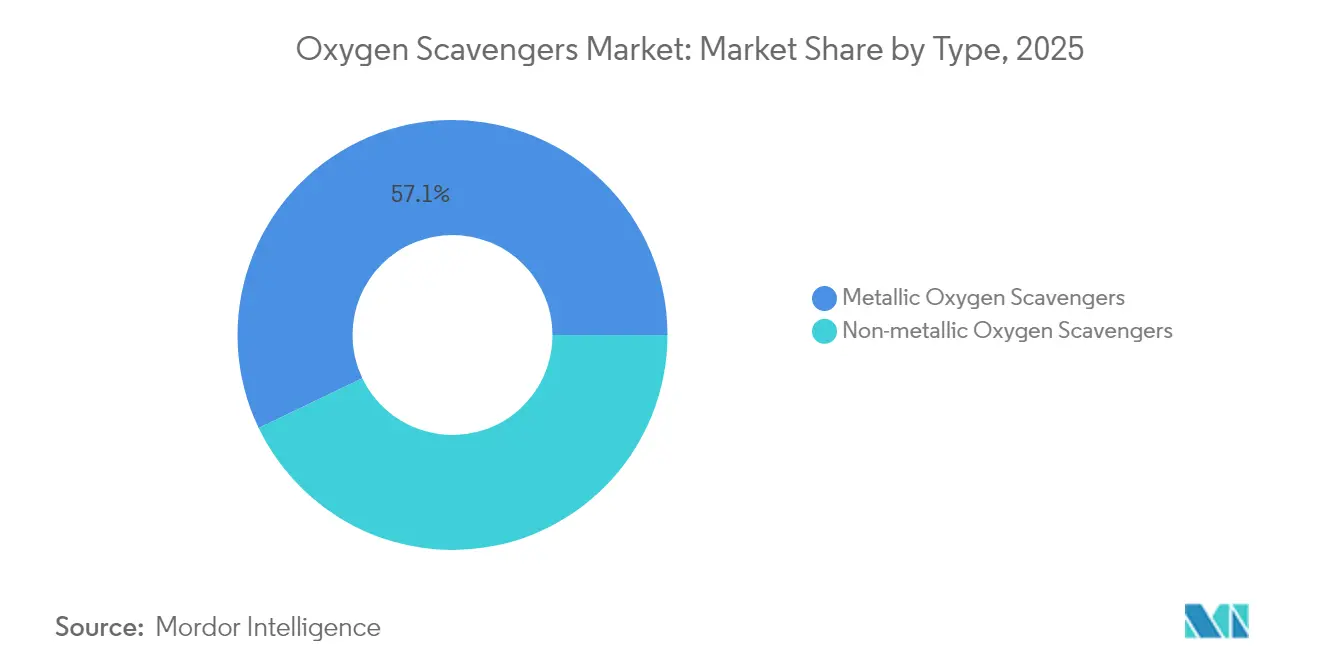
Non-Metallic Innovation Challenges Metallic DominanceMetallic formulations retained 57.12% oxygen scavengers market share in 2025 thanks to established supply chains, rapid absorption kinetics and low unit cost. The segment’s scale advantage translates into volume contracts with global meat processors and snack producers, anchoring the oxygen scavengers market size for entry-level applications. However, non-metallic systems are growing at an 7.99% CAGR, the fastest among all material groups. Polymer-integrated variants eliminate the need for end-of-line sachet insertion, which shortens changeover time on high-speed fill-and-seal lines. Enzyme and ascorbic-acid formulations further widen options for halal, kosher and clean-label brands that restrict metallic additives. Pharmaceutical audits increasingly cite polymer systems’ compatibility with humidity-controlled warehouses, encouraging blister-film extruders to adopt Amosorb and PharmaKeep concentrates. Continuous R-&D around nanocomposite catalysts suggests non-metallic solutions could erode iron’s lead beyond 2031, especially if unit prices align with mainstream snack food budgets. Collectively, these dynamics reinforce material-segment diversity within the oxygen scavengers market.
Second-generation chemistries also align with recycling mandates because they embed scavenging capacity in mono-material PET or PP structures rather than laminated foil, an approach that supports circular-economy targets under EU Regulation 2025/40. Resin suppliers have demonstrated bottle-to-bottle recyclability with minimal haze increase, satisfying beverage-brand commitments to 30% recycled content by 2030. Meanwhile, metallic sachet makers counter by optimizing powder particle size and adding moisture-absorbing buffers that delay premature activation during ocean transit. Competition across material platforms therefore centers on balancing activation control, unit economics and downstream recycling performance, a contest that will shape procurement decisions for both converters and global CPG buyers in the oxygen scavengers market.

By End-User Industry:
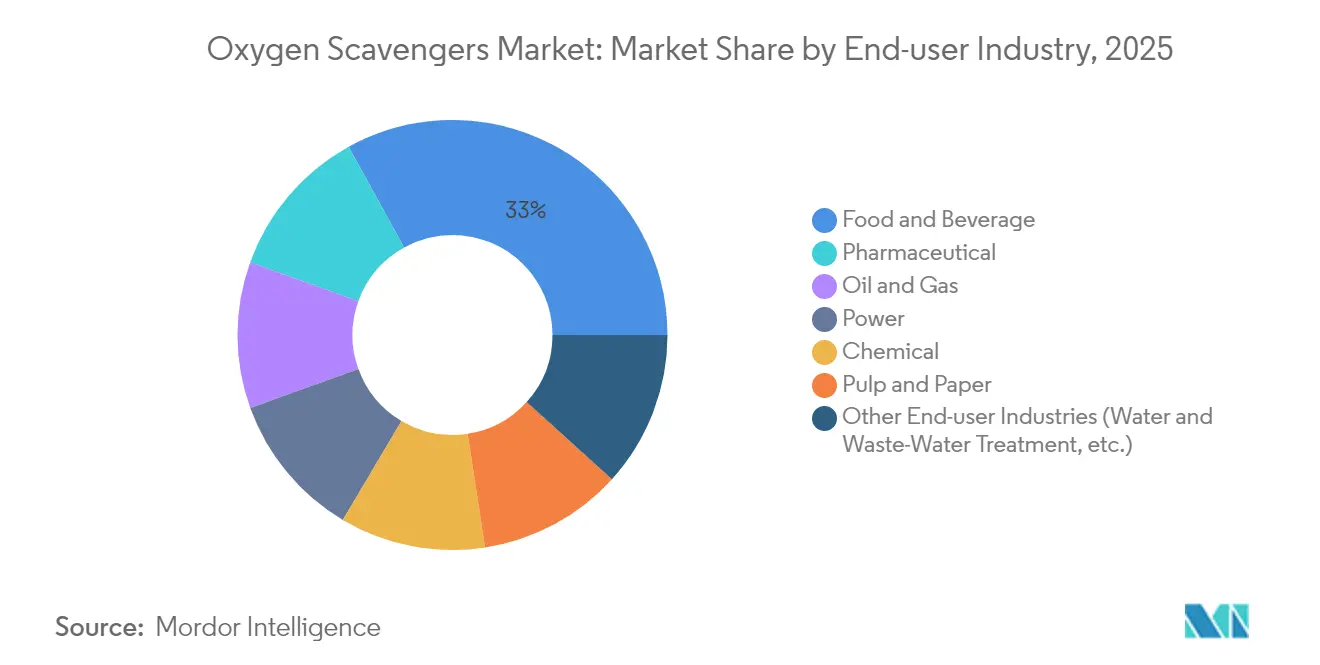
Pharmaceutical Growth Outpaces Food DominanceFood and beverages accounted for 33.02% of the oxygen scavengers market in 2025, cementing their role as volume anchor for sachet producers and multilayer film extruders. Use cases span high-protein snacks, roasted coffee, dehydrated noodles and case-ready meats. Retailers leverage oxygen management to reduce markdowns and align with food-waste reduction pledges, sustaining baseline demand. The segment also benefits from e-commerce grocery adoption, where fulfilment centres favor packaging that withstands temperature fluctuations without losing barrier properties. Despite this dominance, growth in food applications moderates as saturation rises in developed markets.
Pharmaceutical packaging posts the fastest 7.55% CAGR through 2031, expanding the oxygen scavengers market size for high-margin polymer additives. Complexity of biologics, orphan drugs and personalized therapies pushes drug sponsors toward multi-layer blisters and vial stoppers containing scavengers that maintain ≤0.2 ppm dissolved oxygen throughout distribution. Regulatory dossiers now include real-time stability data that demonstrate scavenger efficacy over three-year study periods, incentivizing early design-stage integration. Downstream, contract packagers invest in in-line oxygen measurement sensors to verify batch compliance, tightening supply-chain feedback loops. As a result, polymer-additive suppliers secure multi-year exclusivity agreements, creating sticky revenue streams and partially insulating this end-use from commodity price swings that affect iron powder inputs in the wider oxygen scavengers market.
Geography Analysis
APAC Oxygen Scavengers Market
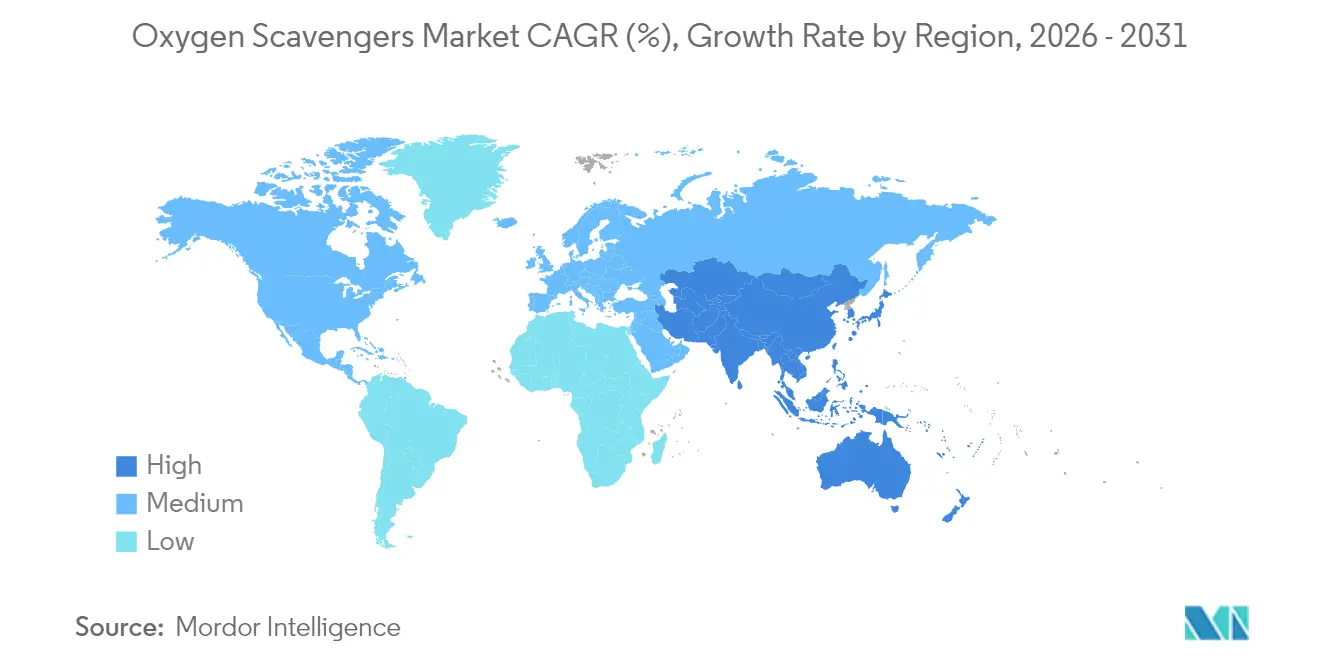
Asia-Pacific accounted for 37.62% of 2025 demand and is projected to deliver a 7.21% CAGR to 2031, underpinned by China’s expanding pharmaceutical export base and India’s rapid capacity additions in flexible-film conversion. Governments across the region continue to subsidize cold-chain logistics and set national targets for food-waste reduction, stimulating adoption of active barrier solutions. The region benefits from established supply chains for raw materials and growing demand from food processing industries that serve both domestic and export markets. Mitsubishi Gas Chemical's strong presence in the region through subsidiaries like MGC AGELESS Co., Ltd. in Japan and AGLESS (THAILAND) CO., LTD. demonstrates the established infrastructure supporting oxygen scavenger production and distribution.
North America Oxygen Scavengers Market
North America represents a mature but technically advanced arena for the oxygen scavengers market. Stringent FDA oversight mandates exhaustive migration testing and drives demand for fully documented polymer formulations. Brand owners prioritize solutions compatible with mechanical recycling targets under state-level extended producer responsibility rules. Canadian meat processors, dealing with export voyages toward Asia, specify high-capacity sachets and automated insertion equipment, sustaining steady replacement demand. Mexico’s rising convenience-food sector further supports regional growth, although cost pressures favour a mix of passive and active barriers.
EMEA and South America Oxygen Scavengers Market
Europe mirrors North American regulatory drivers but layers additional circular-economy ambitions. EU Regulation 2025/40 will require all packaging to be recyclable by 2030, spurring investments in mono-material structures with embedded scavenging capability. Large beverage groups in France and Germany pilot PET bottle preforms containing non-metallic additives, aligning oxygen protection with deposit-return systems. Eastern European film extruders increasingly import polymer concentrates from Western suppliers, bridging technology gaps and spreading adoption. The Middle East & Africa and South America trail in absolute volume yet show accelerating interest as modern grocery retail formats expand. Across these emerging regions, demonstration projects funded by development banks illustrate the spoilage-reduction benefits of active oxygen management, pointing toward steady medium-term demand inflows for the oxygen scavengers market.
Value Chain Analysis
The value chain covers upstream feedstocks and intermediates, including iron powders and salts for metallic sachets, and polymer resins, catalysts, and organic reducers such as sulfite-based, carbohydrazide, erythorbate, and methylethylketoxime for liquid and additive formats. These materials move through formulation and conversion into finished formats such as sachets/labels, polymer concentrates for PET/PP packaging, and water-treatment dosing products. Formulators and packaging-material suppliers coordinate with film extruders, bottle and preform makers, and OEMs for automated insertion or in-line compounding, while industrial water-treatment providers integrate scavengers into boiler-feedwater and closed-loop treatment programs. Distribution typically runs through specialty chemical distributors and direct key-account supply to large food, pharma, oil and gas, and power sites.
Downstream demand comes from brand owners, contract packers, and industrial facilities that test performance against defined oxygen targets and compliance constraints. This increasingly drives supplier prequalification, documentation, and lot-to-lot quality controls. Bottlenecks often track raw-material price volatility, especially iron and specialty catalysts, along with logistics disruptions that affect on-time delivery of critical treatment chemicals, and product-quality deviations that can trigger revalidation or treatment noncompliance. In response, market participants use dual sourcing and regional safety stocks, while additive suppliers, converters, and end users collaborate more closely to align activation kinetics, handling safety, and compatibility with high-speed packaging operations and high-pressure boiler requirements.
Competitive Landscape
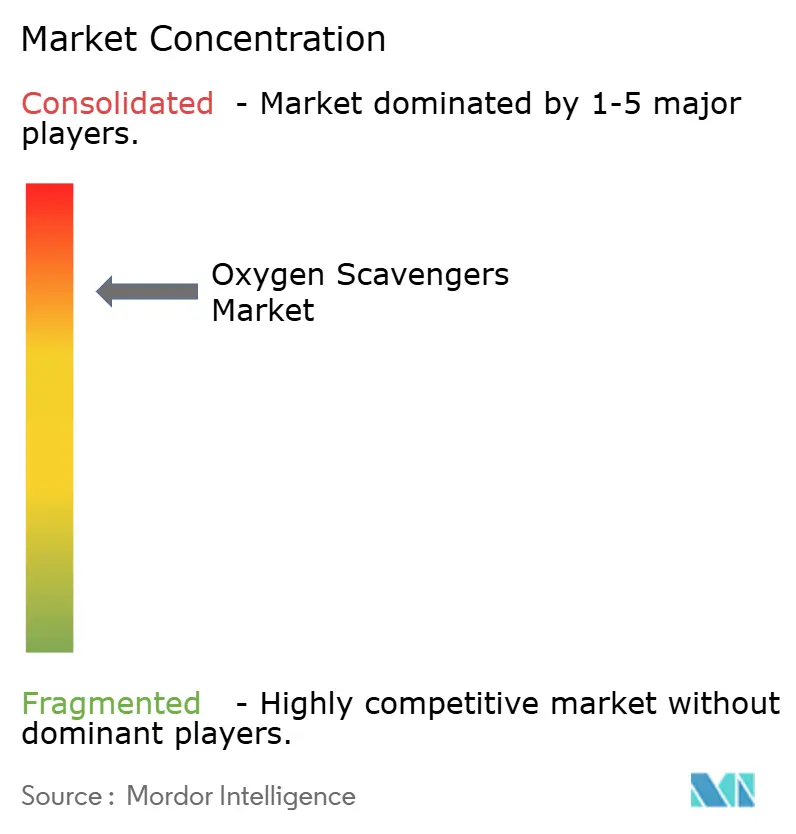
The oxygen scavengers market remains consolidated. Mitsubishi Gas Chemical leverages its AGELESS brand and Asian production to lead in iron sachets. BASF’s acquisition of the Alsachimie polyamide precursor site strengthens backward integration in specialty films, mitigating feedstock price volatility. Suppliers collaborate with recyclers and brand owners to validate closed-loop PET bottle streams with scavenger concentrates, aligning with recycling guidelines. Avient’s Amosorb 4020L highlights the shift to resin-embedded scavenging. Success in this market hinges on regulatory readiness, sustainability metrics, and integration across the packaging value chain.
Oxygen Scavengers Industry Leaders
-
MITSUBISHI GAS CHEMICAL COMPANY INC.
-
Clariant
-
Arkema
-
BASF
-
Multisorb
- *Disclaimer: Major Players sorted in no particular order
Oxygen Scavengers Market Companies Covered in this Report
- Accepta Water Treatment
- Arkema
- Avient Corporation
- BASF
- Clariant
- Desiccare Inc.
- Ecolab
- MITSUBISHI GAS CHEMICAL COMPANY, INC.
- Multisorb
- Solenis
- Veolia
Market Opportunities and Future Outlook
Opportunity is emerging around chemical-free or reduced-chemical oxygen removal for industrial water and boiler systems, where handling and discharge constraints tighten for legacy scavenging chemistries. In March 2026, Watch Water GmbH announced the commercial launch of OXYLOCK, positioned as an adsorption-based oxygen elimination system intended to replace conventional dosing chemistries such as hydrazine, sulfite, and DEHA in industrial boiler and water-treatment applications. This supports an adoption pathway for retrofits and service contracts that bundle equipment, monitoring, and consumables, while it raises differentiation requirements for chemical suppliers through lower-toxicity formulations, improved dosing control, and integrated service models.
On the technology frontier, peer-reviewed research activity in 2026 points to non-traditional deoxygenation routes that can be translated into pilot programs for decentralized treatment and high-spec applications. Nature Communications reported an electrochemical environmental deoxygenation system with materially lower energy use than nitrogen-purging pressure swing adsorption, while Chemical Engineering Science described nanobubble-driven near-complete dissolved-oxygen removal under standard conditions. For packaging-led oxygen scavengers, the near-term opportunity clusters around mono-material and recyclable structures that embed scavenging in resins to reduce the need for sachet insertion. Avient ColorMatrix Amosorb 4020L and pharma-focused polymer systems such as Colorcon PharmaKeep provide more concrete qualification pathways for converters and brand owners targeting higher-value additive solutions in PET bottles and regulated drug packs.
Recent Industry Developments in Oxygen Scavengers Market
- May 2026: Mitsubishi Gas Chemical highlighted continued emphasis on its LivingTech and Hygiene Solutions business, which includes the AGELESS oxygen absorber franchise, in its corporate disclosure. The update reinforced overseas sales as a key lever for the segment and underscored ongoing competitive pricing dynamics that influence supplier positioning and product-mix decisions.
- April 2026: Clariant expanded its portfolio by launching continuous strip desiccant packet reels designed for high-speed automated packaging lines, initially targeting the Americas. The format supports higher-throughput insertion and more consistent application in pharma and food packaging operations, complementing oxygen and moisture management strategies used to protect shelf life.
- August 2024: Mitsubishi Gas Chemical announced an update tied to its AGELESS oxygen absorber business via its corporate news flow, signaling continued product and market-development activity around oxygen-absorption solutions. The communication supported ongoing commercialization efforts in packaged goods and regulated applications where documentation, safety, and performance validation shape procurement.
Oxygen Scavengers Market Report Scope and Research Methodology
Market Definition and Coverage
This market covers chemical and material solutions used to remove or bind oxygen in a controlled way, so corrosion is reduced in water systems and shelf life is extended in packaged products. It includes scavengers supplied as additives, sachets, labels, films, and related formats sold into industrial and packaging use.
Scope exclusions: We exclude oxygen barrier packaging materials that only block oxygen transfer (without scavenging action) and general corrosion inhibitors that do not target dissolved oxygen removal.
Segments Covered in This Report
- By Type
- Metallic Oxygen Scavengers
- Non-metallic Oxygen Scavengers
- By End-user Industry
- Food and Beverage
- Pharmaceutical
- Oil and Gas
- Power
- Chemical
- Pulp and Paper
- Other End-user Industries (Water and Waste-Water Treatment, etc.)
- By Geography
- Asia-Pacific
- China
- India
- Japan
- South Korea
- Thailand
- Indonesia
- Vietnam
- Malaysia
- Philippines
- Rest of Asia-Pacific
- North America
- United States
- Canada
- Mexico
- Europe
- Germany
- United Kingdom
- France
- Italy
- Spain
- Russia
- NORDIC Countries
- Turkey
- Rest of Europe
- South America
- Brazil
- Argentina
- Colombia
- Rest of South America
- Middle East and Africa
- Saudi Arabia
- United Arab Emirates
- Qatar
- South Africa
- Nigeria
- Egypt
- Rest of Middle East and Africa
- Asia-Pacific
Data Sources, Market Sizing, and Validation
Desk Research
Desk research was used to build the initial demand and supply picture and to set realistic boundaries around what is counted as an oxygen scavenger sale. Public sources such as the US EPA, the US Geological Survey, the US Census Bureau manufacturing and trade series, and customs trade statistics help us frame water treatment activity, industrial output, and cross border movement of relevant inputs.
We also reviewed sources such as patent databases for active packaging and scavenger chemistries, peer reviewed journals for performance and dosage ranges, and trade association websites tied to packaging and water treatment. Company filings, investor presentations, and credible press coverage were then used to confirm end use exposure and product positioning. These sources are illustrative only, and many other references were used for data collection, cross checks, and clarification.
Primary Interviews and Surveys
Primary inputs were gathered through expert interviews and structured surveys with manufacturers, distributors, formulators, and large end users across packaging and industrial water systems. We used these discussions to confirm application splits, typical dosing and replacement behavior, pricing direction, and adoption constraints, and then we checked the logic across APAC, EMEA, and the Americas so regional totals stayed realistic.
Distribution of primary research fieldwork respondents
| Company type | Respondent position | Region |
|---|---|---|
| Top tier: 31% | CXOs: 13% | APAC: 52% |
| Mid tier: 47% | Functional/Unit leaders: 41% | EMEA: 29% |
| Smaller Players: 22% | Managers: 46% | Americas: 19% |
Market-Sizing & Forecasting
Sizing starts from a top-down build where industrial production and trade indicators, plus packaging activity signals, are used to reconstruct the addressable spend that typically needs oxygen removal. That pool is then filtered by penetration rates for scavenging solutions across major use cases, which is where we use primary discussions to keep assumptions practical.
To corroborate totals, selective bottom-up approximations were run using sampled supplier revenues, channel checks for typical price bands, and a volume times average selling price logic where public units can be inferred. Key inputs that were tracked include packaged food and beverage output trends, active packaging adoption signals, boiler and industrial water treatment chemical demand markers, import export movement for relevant chemical categories, and price movement for common scavenger chemistries. Forecasts were built using scenario analysis supported by expert views on regulation pressure, shelf life requirements, and industrial uptime priorities, and then the scenarios were blended into a single base case. Where bottom-up visibility was thin in smaller countries, gaps were handled by using proxy indicators such as manufacturing output and packaging throughput, followed by a reasonableness check against nearby markets.
Data Validation & Update Cycle
Validation is done through stepwise checks so the final number does not depend on one data stream. Analysts compare model output against independent signals such as trade direction, industrial activity trends, and price movement expectations, and then outliers are reviewed before sign-off.
If a large variance shows up by region or application, key assumptions are rechecked, sensitivity is rerun on the main inputs, and selected experts are recontacted to confirm whether a demand shift or pricing change is real. Reports are refreshed annually, with interim updates triggered when a material event impacts demand, supply, or pricing. Before delivery, an analyst performs a fresh pass on the model and the assumptions so clients receive the latest updated view.
Mordor Intelligence's Oxygen Scavengers Market Estimate Compared With Other Published Estimates
Published market sizes for oxygen scavengers often differ because the counted applications are not always the same, and pricing logic can move totals quickly when volumes are converted into value. Differences also show up when one publisher reports a base year and another reports an estimated year, which changes what gets captured as the current market.
Import export movement for relevant chemical categories, packaged food and beverage output trends, and interview feedback on typical dosing and replacement cycles are the checks that keep Mordor Intelligence tied to the combined packaging plus industrial demand pool, with oxygen barrier-only materials left outside scope and with year labeling kept consistent.
Benchmark comparison
| Source | Market Size | Gaps in Research Methodology |
|---|---|---|
| Mordor Intelligence | USD 3.44 B (2026) | |
| Global Consultancy A | USD 3.52 B (2025) | Uses an earlier headline year and a broader counted basket that can blend scavengers with adjacent active packaging additives, and the value build is sensitive to assumed price escalation. |
| Industry Publisher B | USD 2.35 B (2025) | Applies a narrower counted set that appears to underweight packaging formats and focuses more on selected industrial applications, which reduces the implied demand pool in value terms. |
Once the year, included applications, and price conversion steps are lined up, the spread across sources becomes easier to explain. Our process keeps each assumption traceable to observable activity signals and repeatable checks, which helps keep the final market number stable across updates.
Key Questions Answered in the Report
What is the current size of the oxygen scavengers market?
The oxygen scavengers market stands at USD 3.44 billion in 2026 and is forecast to reach USD 4.29 billion by 2031, expanding at a 4.55% CAGR.
Which region contributes the largest demand for oxygen scavengers?
Asia-Pacific leads with 37.62% share in 2025 and is also the fastest-growing region, advancing at 7.21% CAGR through 2031.
Which end-user sector is growing fastest?
Pharmaceutical packaging shows the highest growth at 7.55% CAGR as biologics and specialty drugs require ultra-low residual oxygen levels.
What impact do new FDA and EU rules have on oxygen scavenger adoption?
Stricter migration and purity limits under the FDA Human Foods Program and EU Regulation 2025/40 push brand owners toward fully documented, non-metallic scavengers that meet long-term safety requirements.