
Over-the-counter (OTC) Analgesics Market Size and Share
Market Overview
| Study Period | 2020 - 2031 |
|---|---|
| Market Size (2026) | USD 31.37 Billion |
| Market Size (2031) | USD 37.93 Billion |
| Growth Rate (2026 - 2031) | 3.87 % |
| Fastest Growing Market | Asia-Pacific |
| Largest Market | North America |
| Market Concentration | Medium |
Major Players *Disclaimer: Major Players sorted in no particular order Image © Mordor Intelligence. Reuse requires attribution under CC BY 4.0. | |
Over-the-counter (OTC) Analgesics Market Analysis by Mordor Intelligence
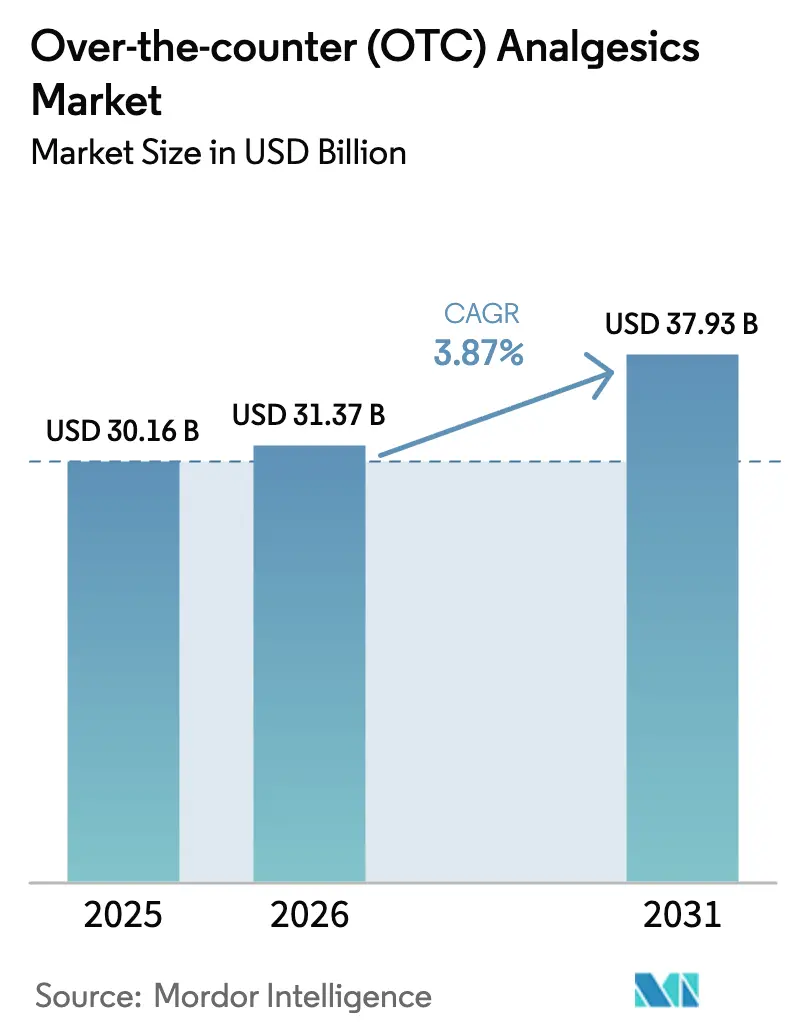
The Over-the-counter Analgesics Market size is expected to grow from USD 30.16 billion in 2025 to USD 31.37 billion in 2026 and is forecast to reach USD 37.93 billion by 2031 at 3.87% CAGR over 2026-2031.
Behind the steady headline growth, regulators are fast-tracking prescription-to-over-the-counter (OTC) switches. At the same time, payers favor topical and fast-dissolving formats that lower systemic risk and improve adherence. The U.S. Food and Drug Administration’s ACNU pathway, launched in December 2024, allows certain analgesics to shift to OTC status without a complete New Drug Application, reinforcing self-care and easing emergency-department pressures. Supply dynamics have tightened: acetaminophen active pharmaceutical ingredient prices rose 12% in early 2025 after Chinese output cuts, straining both generic and branded margins. Meanwhile, hospital pharmacies still dominate the distribution market; however, the rapid expansion of e-pharmacies and the introduction of same-day delivery are eroding their convenience advantage. Competitive intensity is escalating as consumer-health spin-offs such as Haleon and Kenvue battle regional generics firms that leverage low-cost production and direct-to-chemist reach.
Key Report Takeaways
- By drug type, non-steroidal anti-inflammatory drugs led with 38.61% over-the-counter analgesics market share in 2025, and salicylates are projected to post the fastest 6.06% CAGR through 2031.
- By formulation, oral products accounted for 68.42% of 2025 volume, while topical formats are advancing at an 8.72% CAGR to 2031.
- By distribution channel, hospital pharmacies captured 58.73% of 2025 sales; online platforms hold the strongest growth outlook at 9.79% CAGR.
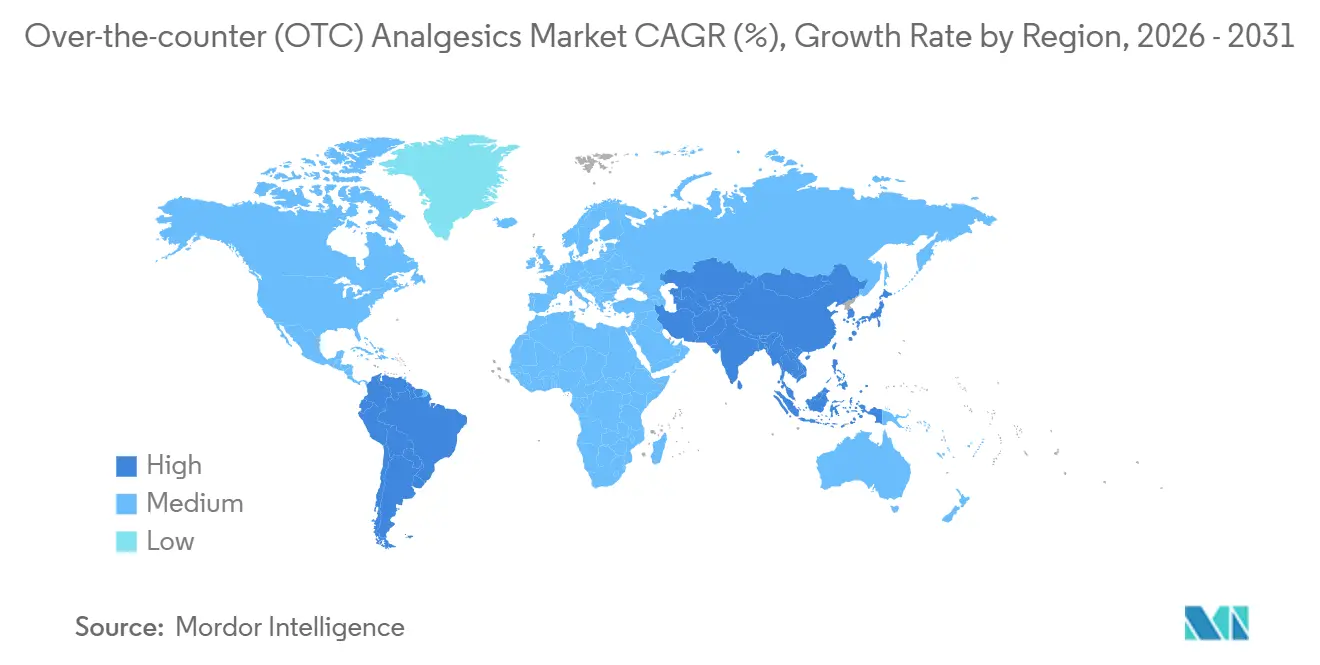
- By geography, North America retained 39.24% revenue share in 2025; Asia-Pacific is forecast to expand at a 7.53% CAGR to 2031.
Note: Market size and forecast figures in this report are generated using Mordor Intelligence’s proprietary estimation framework, updated with the latest available data and insights as of January 2026.
Market Trends and Insights
Drivers Impact Analysis of Over-the-counter (OTC) Analgesics Market*
| Driver | (~) % Impact on CAGR Forecast | Geographic Relevance | Impact Timeline |
|---|---|---|---|
| Increasing Demand for Topical Analgesics | +0.9% | North America, Europe | Medium term (2-4 years) |
| Growing Geriatric Population & Musculoskeletal Disease Burden | +0.7% | Asia-Pacific, Europe | Long term (≥ 4 years) |
| Cost-Efficiency and Convenience of OTC Pain Medicines | +0.5% | Global | Short term (≤ 2 years) |
| Rapid Expansion of E-Commerce & Online Pharmacies | +0.8% | North America, Asia-Pacific | Medium term (2-4 years) |
| Opioid-Reduction Initiatives Accelerating Non-Opioid OTC Uptake | +0.6% | North America, Europe | Short term (≤ 2 years) |
| Breakthrough Transdermal & Fast-Dissolve Delivery Technologies | +0.4% | North America, Japan | Long term (≥ 4 years) |
| Source: Mordor Intelligence | |||
Increasing Demand for Topical Analgesics
Topical gels, patches, and sprays appeal to users who seek localized relief and prefer to avoid hepatic metabolism. European registrations for topical NSAIDs increased by 22% year-over-year in 2025, reflecting endorsements from regulators and employers.[1] Hisamitsu’s Salonpas patch posted JPY 38 billion (USD 255 million) fiscal-year sales, helped by wider U.S. retail placement. Employers are steering workers' compensation cases toward non-systemic therapy to limit downtime. Microneedle patches in early trials promise therapeutic plasma levels with far lower systemic exposure. Together, these factors underpin the segment’s sustained momentum.
Growing Geriatric Population & Musculoskeletal Disease Burden
The world is expected to have 1.4 billion people aged 60 and above by 2030, while the prevalence of osteoarthritis is projected to reach 528 million cases by 2025. Japan reports that seniors spend 14% more per capita on OTC analgesics than adults under 50.[2] India’s elderly-care program subsidizes NSAIDs in rural clinics, adding millions of new users. Dysphagia, present in roughly 30% of nursing-home residents, tilts demand toward patches, gels, or melt-in-mouth films. Collectively, demographic and disease trends create a durable consumption base.
Cost-Efficiency and Convenience of OTC Pain Medicines
OTC analgesics typically cost 40%-60% less per dose than prescription alternatives, helping consumers manage out-of-pocket spend. U.S. primary care wait times reached 14 days in 2025, making self-care an attractive option. Store-brand ibuprofen and acetaminophen, priced 25% below national brands, have expanded their share at large pharmacy chains. Telehealth visits now frequently conclude with non-prescription recommendations; Teladoc disclosed that 18% of its pain-related sessions resulted in OTC guidance in 2025. These dynamics highlight the economic and practical appeal of OTC solutions.
Rapid Expansion of E-Commerce & Online Pharmacies
Regulatory shifts are enabling online channels to flourish. The U.S. Drug Enforcement Administration’s 2024 rule, which clarified e-pharmacy operations, mainstreamed digital fulfillment. China issued 47 new e-pharmacy licenses in 2025, nearly doubling the number from the previous year.[3] Amazon Pharmacy’s 2025 subscription bundle enrolled 47,000 members in its first month, pairing analgesic auto-delivery with wearable pain tracking. Online convenience and rapid shipping are threatening the dominance of hospitals and retail pharmacies.
Restraints Impact Analysis of Over-the-counter (OTC) Analgesics Market*
| Restraint | (~) % Impact on CAGR Forecast | Geographic Relevance | Impact Timeline |
|---|---|---|---|
| Drug Tolerance, Dependence, Misuse & Abuse Risks | -0.4% | North America | Short term (≤ 2 years) |
| Hepatotoxicity and GI / CV Risks | -0.5% | Global | Medium term (2-4 years) |
| Volatile Menthol / API Prices Squeezing Manufacturer Margins | -0.3% | Asia-Pacific, North America | Short term (≤ 2 years) |
| Emerging Non-Pharma Pain Devices Diverting Consumer Spend | -0.2% | North America, Europe | Medium term (2-4 years) |
| Source: Mordor Intelligence | |||
Drug Tolerance, Dependence, Misuse & Abuse Risks
Short-pack regulations are tightening. The UK limited codeine-containing packs to a 3-day supply in 2024 after data showed 8% of chronic users met substance-use-disorder criteria. U.S. emergency departments recorded 56,000 acetaminophen-related visits in 2024. The FDA plans to implement a standardized Drug Facts label for acetaminophen, which is expected to cost the industry an estimated USD 120 million. Retailers, such as CVS, piloted point-of-sale limits on high-dose ibuprofen in 2025. These measures signal rising scrutiny that could temper demand for OTC products.
Hepatotoxicity and GI / CV Risks
Acetaminophen remains the leading cause of acute liver failure; the American Liver Foundation cites 1,600 U.S. cases annually. NSAID cardiovascular warnings mandated by the European Medicines Agency in 2025 resulted in a 9% decline in ibuprofen sales in Germany and France. Long-term NSAID use raises cardiovascular event risk by up to 30% according to a 2024 meta-analysis in The Lancet. Gastrointestinal bleeding leads to roughly 100,000 U.S. hospitalizations each year, costing over USD 2 billion. Safety issues push some consumers toward non-pharmaceutical pain devices.
*Our forecasts treat driver/restraint impacts as directional, not additive. The impact forecasts reflect baseline growth, mix effects, and variable interactions.
Over-the-counter (OTC) Analgesics Market Segment Analysis
By Drug Type:
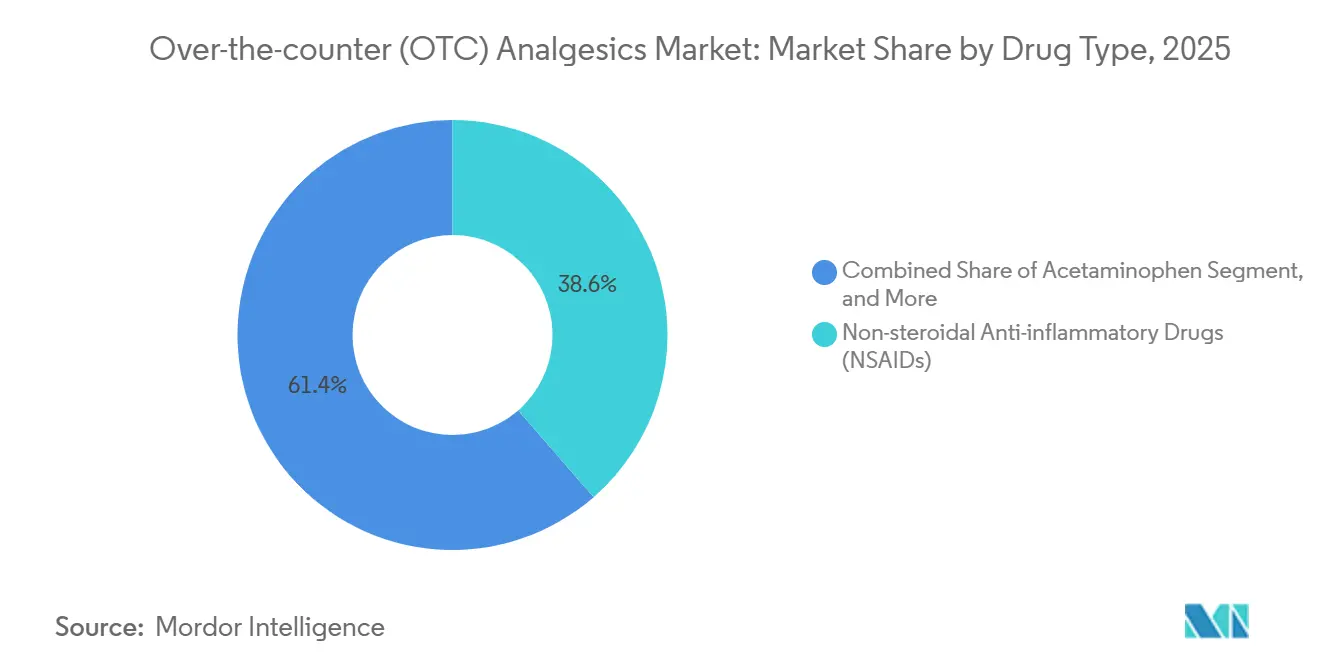
Salicylates Gain on Dual-Use AppealNon-steroidal anti-inflammatory drugs (NSAIDs) accounted for 38.61% of the over-the-counter analgesics market share in 2025, driven by their broad efficacy in treating inflammatory pain. Salicylates, however, are expected to grow at 6.06% annually through 2031, outpacing overall growth as low-dose aspirin anchors chronic preventive use and topical methyl salicylate addresses localized pain needs. Aspirin’s low unit cost keeps it competitive in price-sensitive economies. Sun Pharmaceutical’s 75 mg aspirin plus vitamin D line earned INR 320 million (USD 3.8 million) in its first six months. The over-the-counter analgesics market size for salicylates is projected to rise steadily through both cardiovascular and pain pathways. NSAIDs face internal segmentation, with ibuprofen dominating acute use and naproxen gaining in chronic cohorts. Acetaminophen performance is plateauing amid hepatotoxicity warnings, though it remains preferred for patients with GI contraindications to NSAIDs.
Salicylates also benefit from regulatory clarity. The FDA cleared a more potent diclofenac gel for OTC use in 2024, intensifying competition within NSAIDs. Aspirin offers the lowest cost per dose, making it essential in India and Brazil. Growing wellness interest supports capsaicin and menthol products within “Other Analgesics,” yet growth there remains moderate. Future momentum will hinge on innovation that differentiates delivery and mitigates safety concerns.

By Formulation:
Topical Surge Driven by Safety and AdherenceOral products held 68.42% of the over-the-counter analgesics market share in 2025, thanks to their familiarity and large-scale manufacturing. Topical patches, gels, and sprays, however, are projected to accelerate at an 8.72% CAGR to 2031, as payers and prescribers favor non-systemic therapies to mitigate hepatotoxicity and gastrointestinal events. Controlled-delivery patches ensure eight-hour dosing and reduce pill burden; a Pain Medicine study found that half of chronic-pain patients forget or refuse to take multiple daily tablets. Sprays and roll-ons captured 12% of the topical subset in 2025, growing at the fastest rate in humid Asia-Pacific climates, where patch adhesion is problematic.
Dissolvable films are gaining traction in pediatric and geriatric segments. Johnson & Johnson’s children’s ibuprofen strip reached USD 18 million in U.S. sales within six months. Oral liquid-gel capsules that claim a faster onset are expanding their share within the oral category. Sustainability is an emerging theme: Reckitt plans to convert 30% of Nurofen tablet packs to paper by 2027. The over-the-counter analgesics market size for topical formats is expected to expand as technology and safety preferences converge.
By Distribution Channel:
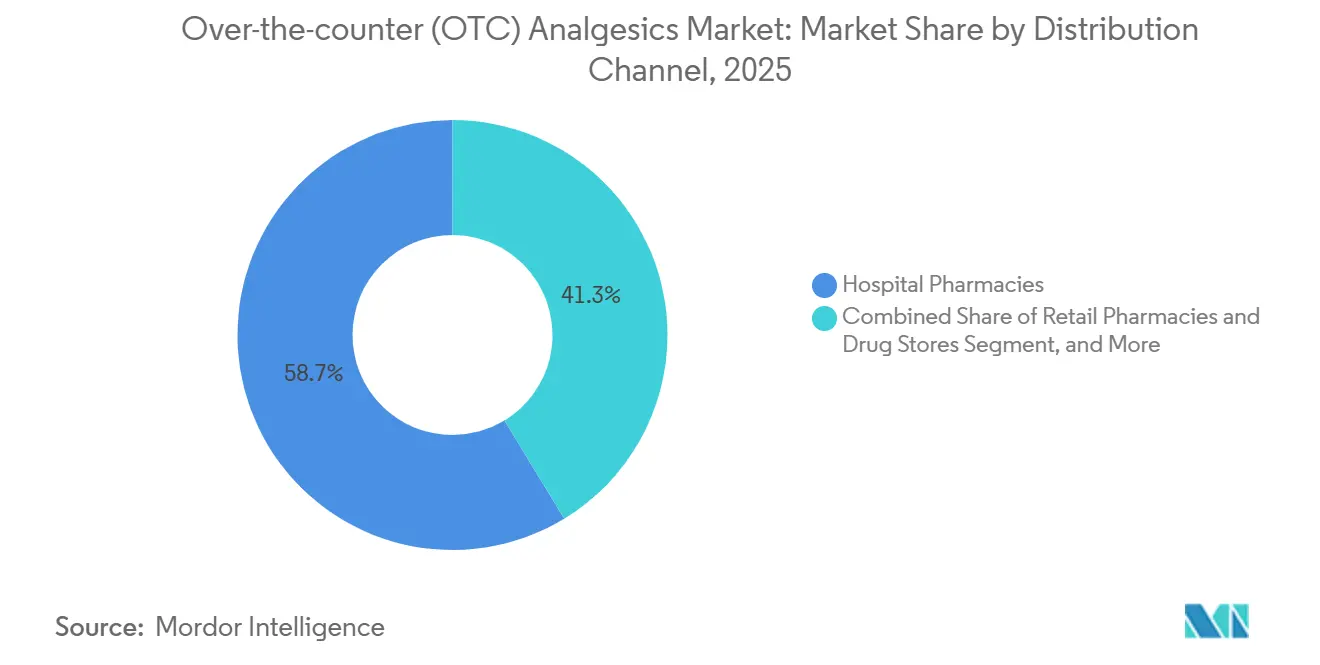
E-Commerce Disrupts Hospital DominanceHospital pharmacies accounted for 58.73% of global distribution in 2025, primarily due to formulary lock-in and group-purchase contracts. However, online platforms are advancing at a 9.79% CAGR through 2031. China’s 2024 relaxation of pharmacist-verification rules spurred a surge in e-pharmacy volume. Amazon Pharmacy’s bundled subscription illustrates how digital entrants can flank traditional price structures. Retail chains are responding with omnichannel plays; Walgreens’ telehealth add-on generated USD 47 million incremental analgesics revenue in Q1 2025.
Group-purchasing discounts continue to bolster hospital pharmacies; however, the Veterans Affairs mobile-refill pilot may reduce its in-house volume by 15% by 2028. Dollar stores and mass merchandisers widen access for price-sensitive shoppers. Direct-to-consumer brands that market exclusively online continue to fragment the channel landscape.
Geography Analysis
North America Over-the-counter (OTC) Analgesics Market
North America accounted for 39.24% of the revenue in the over-the-counter analgesics market in 2025. Growth moderates as opioid-reduction gains level off and generic competition compresses pricing. Canada’s planned reclassification of low-dose codeine will steer CAD 85 million (USD 63 million) toward non-codeine OTC products. Mexico is growing faster, driven by pharmacy chain consolidation and a 2024 rule that empowers pharmacists to recommend analgesics without a physician's visit.
APAC Over-the-counter (OTC) Analgesics Market
Asia-Pacific is forecast to deliver a 7.53% CAGR to 2031. India’s OTC switch for select NSAIDs adds roughly 180 million potential users. China’s online analgesic sales jumped 41% in 2025, thanks to Alibaba Health and JD Health, which were aided by provincial pilots that eliminated in-person verification. Japan’s super-aged population spends JPY 4,200 (USD 28) per capita on OTC pain products. Australia shifted higher-strength ibuprofen to pharmacy-only OTC in 2024, moving AUD 32 million (USD 21 million) from prescription channels.
EMEA and South America Over-the-counter (OTC) Analgesics Market
Europe sees slower expansion amid strict pack-size limits. Germany’s ibuprofen sales declined 3.2% in 2025 following the introduction of cardiovascular warning labels, while topical diclofenac sales increased 11%. France maintains pharmacist gatekeeping that curbs impulse purchases. Middle East and Africa remain small but gain from Saudi Arabia’s expanded dispensing rights; the Saudi Food and Drug Authority cleared 23 new OTC registrations in 2024. South America’s leading market, Brazil, saw private-label share reach 28% in 2025 amid economic headwinds.
Regulatory Landscape
In the United States, the regulatory environment for OTC analgesics is shifting toward enabling more nonprescription access while preserving safe self-selection. A key anchor is the FDA final rule establishing requirements for nonprescription drug products with an Additional Condition for Nonprescription Use (ACNU), published in December 2024 and effective January 27, 2025. The rule creates a pathway to support OTC availability using conditions such as labeling, technology-enabled checks, or other measures to assure appropriate use.
Across Europe and the United Kingdom, regulators are tightening safety governance for higher-risk ingredients and combinations while also signaling openness to reclassification. The EMA and the CMDh endorsed measures for metamizole-containing products in 2024 to reduce agranulocytosis risk, and implementation work continues through updates to product information for certain analgesic combinations, including scheduled 2026 updates that add stronger warnings for opioid-related risks in combination products. In the UK, DHSC communications in February 2025 highlighted pain management and migraine among areas where reclassification applications are being encouraged via the MHRA, while post-EU-exit frameworks (including Windsor Framework-related changes effective in 2025) add operational complexity for licensing and labeling across Great Britain and Northern Ireland.
Competitive Landscape
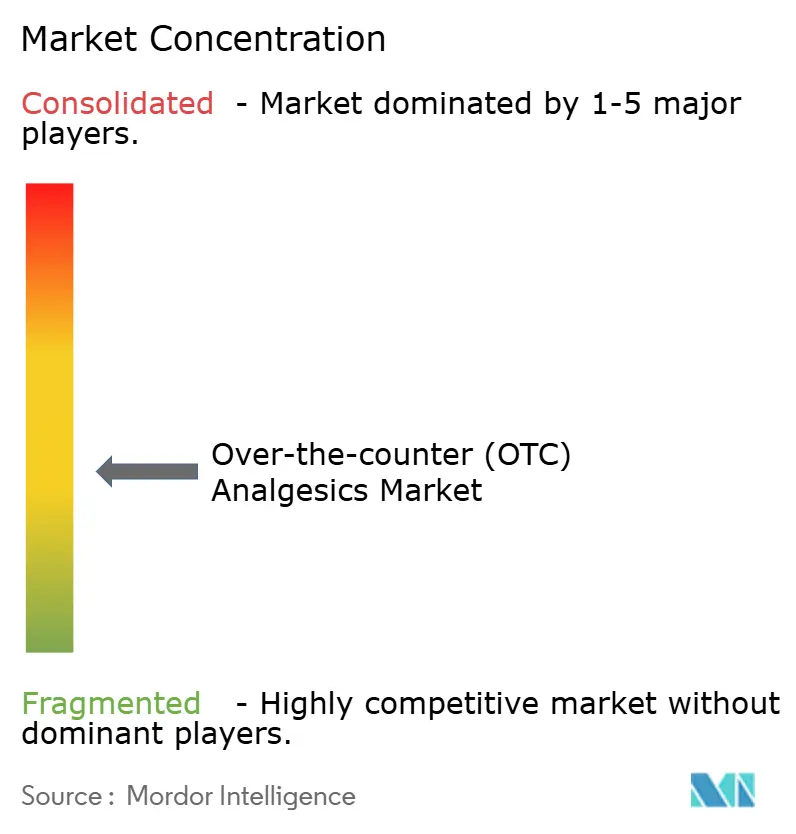
The over-the-counter analgesics market is moderately concentrated. The top five vendors - Haleon, Kenvue, Bayer, Reckitt, and Sanofi - accounted for a significant share of 2025 revenue. Haleon generated GBP 3.8 billion (USD 4.8 billion) from analgesics, with sales in emerging markets growing by 9.2%. Multinationals invest in premium delivery to sustain price premiums, while regional players such as Mankind Pharma and Cipla compete on cost and direct distribution. Bayer’s 2025 launch of an Aleve-linked pain-tracking app amassed 1.2 million downloads, strengthening consumer engagement. Patent activity centers on transdermal systems, with 47 filings in 2024 led by Hisamitsu and 3M. Digital-first brands and wearable-device makers intensify competition by offering bundled solutions. Regulatory agility around the FDA’s ACNU pathway provides first-mover advantages, as illustrated by Voltaren’s rapid OTC ramp after its 2020 switch.
Over-the-counter (OTC) Analgesics Industry Leaders
-
Bayer AG
-
Reckitt Benckiser Group PLC
-
Johnson & Johnson
-
Haleon PLC
-
Viatris Inc.
- *Disclaimer: Major Players sorted in no particular order
Over-the-counter (OTC) Analgesics Market Companies Covered in this Report
- Bayer
- Boehringer Ingelheim
- Cipla
- Dr. Reddy’s Laboratories
- Endo International
- GlaxoSmithKline
- Haleon PLC
- Hisamitsu Pharmaceutical
- Johnson & Johnson
- Mankind Pharma Ltd.
- Novartis
- Perrigo Company
- Pfizer
- PGT Healthcare LLP
- Reckitt Benckiser Group
- Sanofi
- Sun Pharmaceuticals Industries
- Taisho Pharmaceutical Holdings Co., Ltd.
- Teva Pharmaceutical Industries
- Viatris
Read Analysis of Over-the-counter (OTC) Analgesics Companies
Market Opportunities and Future Outlook
Regulatory modernization and scale-up investments are creating whitespace for manufacturers that can combine compliance, supply resilience, and differentiated formats. The FDA ACNU framework (effective January 2025) supports new routes for certain prescription-to-OTC transitions where additional conditions can manage safe use, which broadens the opportunity set beyond traditional switches. Policy focus on the OTC monograph system also stayed in view in 2025 through FDA testimony on reauthorization of the OTC Monograph Drug User Fee Program (OMUFA II) for fiscal years 2026 to 2030, reinforcing a development and maintenance pathway that underpins large OTC analgesics portfolios.
On the supply and execution side, large consumer health players are committing capital to increase essential analgesic capacity and regionalize production, which creates room for contract manufacturing, local sourcing, and export-oriented hubs. Haleon announced investments in Pakistan in January 2026 to upgrade technology and expand Panadol output, including a USD 12 million Jamshoro expansion to increase Panadol capacity to 8.0 billion tablets, alongside a separate board-approved investment to modernize and expand Panadol Liquid manufacturing. North American capacity moves also point to localized manufacturing as a strategic lever, including Kenvue completing an expansion in Guelph, Ontario (November 2024) to increase production capacity for Tylenol and other OTC brands, and Bayer opening a 70,000 square foot expansion at Myerstown, Pennsylvania in April 2025 supported by a USD 44 million investment. Alongside these footprints, process and formulation innovation, such as reported time reductions using continuous granulation and research into biphasic-release multiple-unit tablets, offers a practical route to faster throughput, tighter quality control, and differentiated onset-and-duration profiles that can support premium OTC positioning.
Recent Industry Developments in Over-the-counter (OTC) Analgesics Market
- January 2026: Haleon Pakistan Limited approved a GBP 3.58 million capital investment to modernize and expand Panadol Liquid manufacturing operations in Pakistan. The upgrade improves local supply availability for a high-volume OTC analgesic franchise and strengthens operational resilience amid periodic API and packaging volatility.
- September 2025: Bayer launched the Aspirina brand in the United States, extending the brand beyond its established footprint in Mexico and other Latin American markets. The initiative broadens Bayer’s OTC analgesics shelf presence in a highly competitive market where brand equity and retail distribution scale influence switching and repeat purchase.
- February 2024: Hikma Pharmaceuticals PLC announced the US launch of COMBOGESIC IV, an opioid-free intravenous pain relief medicine combining acetaminophen and ibuprofen. Although positioned for acute care settings, the launch reinforces the broader shift toward non-opioid analgesic strategies that also support consumer preference for non-opioid OTC pain solutions.
Over-the-counter (OTC) Analgesics Market Report Scope and Research Methodology
Market Definition and Coverage
For this methodology, the OTC analgesics market covers non-prescription pain and fever relief medicines sold through authorized channels and bought without a new doctor prescription, measured as sales revenue in USD across major regions.
Scope exclusions: We exclude prescription-only analgesics, illicit opioids, and in-hospital administered pain medicines that are not sold as OTC products.
Segments Covered in This Report
- By Drug Type
- Acetaminophen
- Non-steroidal Anti-inflammatory Drugs (NSAIDs)
- Salicylates
- Other Analgesics
- By Formulation
- Oral Formulations
- Topical Formulations
- Creams & Gels
- Sprays & Roll-ons
- Transdermal Patches
- Dissolvable / Fast-melt Strips
- By Distribution Channel
- Hospital Pharmacies
- Retail Pharmacies & Drug Stores
- Online Pharmacies & E-commerce Platforms
- By Geography
- North America
- United States
- Canada
- Mexico
- Europe
- Germany
- United Kingdom
- France
- Italy
- Spain
- Rest of Europe
- Asia-Pacific
- China
- Japan
- India
- Australia
- South Korea
- Rest of Asia-Pacific
- Middle East & Africa
- GCC
- South Africa
- Rest of Middle East & Africa
- South America
- Brazil
- Argentina
- Rest of South America
- North America
Data Sources, Market Sizing, and Validation
Desk Research
Desk work starts with setting the OTC boundary country by country, since the same ingredient can be OTC in one place and prescription-only in another. We reference public sources such as the US FDA OTC monographs and labeling rules, CDC health statistics for pain-related conditions, WHO health and medicines publications, OECD health indicators, and national medicines agencies where OTC status and safety actions are posted.
To ground the commercial side, we also review company annual reports, earnings decks, and official product labeling and recall notices, along with association websites and reputable press coverage around pharmacy retail and e-commerce sales. Where needed, we use paid subscriptions that track company financials, news, patent filings, and shipment-level trade signals to support cross-checks. The sources named here are illustrative only, and many other public and official references were used for collection, validation, and research clarification.
Primary Interviews and Surveys
Primary work is used to confirm what is actually sold as OTC in each country, how pricing behaves by pack size and dosage strength, and how channels split between retail pharmacies and online pharmacies. We speak with a mix of manufacturers, distributors, pharmacists, and category managers across APAC, EMEA, and the Americas, and then we revisit outliers to close gaps before finalizing assumptions.
Distribution of primary research fieldwork respondents
| Company type | Respondent position | Region |
|---|---|---|
| Top tier: 38% | CXOs: 12% | APAC: 39% |
| Mid tier: 47% | Functional/Unit leaders: 34% | EMEA: 34% |
| Smaller Players: 15% | Managers: 54% | Americas: 27% |
Market-Sizing & Forecasting
Sizing is built using a top-down approach where population, self-medication adoption, and treated episodes are translated into an addressable OTC demand pool, which is then converted into value using typical pack sizes and observed price points. To keep totals realistic, results are corroborated with selective bottom-up approximations, such as sampled retail price checks by molecule, channel checks with pharmacists, and a light roll-up of key suppliers where financial disclosures allow.
A few inputs that matter in OTC analgesics are the mix between acetaminophen and NSAIDs, the shift toward combination products, average selling price movement by dosage strength and pack count, the split between retail pharmacies and online pharmacies, and country-level OTC eligibility and labeling changes. When gaps show up, like limited visibility on informal retail, assumptions are anchored to the closest regulated channel shares and then tested again through expert feedback.
For forecasting, we rely on multivariate regression supported by scenario checks, because demand is influenced by aging, self-care behavior, and channel expansion at the same time. The final outlook is adjusted using practitioner views on price inflation, private label intensity, and expected regulatory actions that can reclassify products between OTC and prescription status.
Data Validation & Update Cycle
Outputs are checked through triangulation across independent signals, including ingredient-level demand direction, channel mix shifts, and price movement ranges that are reasonable for consumer health products. If a country estimate breaks expected relationships, such as unusually high value per capita or a sudden ingredient share jump, we re-check the inputs and re-contact relevant respondents to understand the variance.
Before sign-off, the model goes through multi-step analyst review so assumptions, math, and definitions stay consistent across countries and years. Reports are refreshed annually, and interim updates are triggered when there are material events like major recalls, regulatory changes, or sharp currency swings. Right before delivery, a final pass is completed so clients receive the latest updated view.
Mordor Intelligence's Otc Analgesics Market Sizing Compared With Other Published Estimates
Published market sizes for OTC analgesics do not always line up because the definition of what counts as OTC, the way prices are averaged, and the timing of currency conversion can vary across sources. Differences also come from whether a figure reflects retail value at the shelf or manufacturer-level value, and from how quickly older assumptions get replaced after major events.
When pack sizes shift, promotions change, or exchange rates move, the updated ASP-by-pack logic and currency timing can materially change the total, and those refresh checks are applied before numbers are finalized in Mordor Intelligence.
Benchmark comparison
| Source | Market Size | Gaps in Research Methodology |
|---|---|---|
| Mordor Intelligence | USD 30.16 B (2025) | |
| Global Consultancy A | USD 36.33 B (2026) | Uses a different valuation point in the value chain and a different base year, which can lift totals versus retail-revenue style counting, and it may also include related services. |
| Industry Publisher B | USD 32.96 B (2026) | Uses a different base year and forecast window, and its scope language can blur OTC-only boundaries across countries, which shifts ingredient coverage and channel weighting. |
Across the three figures, most of the spread is explained by year selection, where revenue is counted, and how pricing and currency inputs are kept current. By tying the model to clear OTC eligibility, channel mix, and repeatable price and volume checks, the result stays easy to trace back to practical drivers.
Key Questions Answered in the Report
What will be the size of the over-the-counter analgesics market by 2031?
The over-the-counter analgesics market size is projected to reach USD 37.93 billion by 2031, growing at a 3.87% CAGR.
Which formulation is growing fastest in global pain-relief sales?
Topical patches, gels, and sprays are advancing at an 8.72% CAGR, almost double the growth of oral formats.
Why are salicylates expected to outpace overall market growth?
Dual positioning for cardiovascular prophylaxis and localized pain relief supports a 6.06% CAGR for salicylates through 2031.
What drives demand for OTC pain medicines in the Asia-Pacific region?
Regulatory liberalization, expanding e-commerce, and an aging population support a 7.53% regional CAGR.
How are online pharmacies changing analgesic distribution?
E-pharmacy licenses and same-day delivery are enabling 9.79% CAGR for online channels while pressuring hospital pharmacies to adapt.