Oscillator Market Size and Share
Market Overview
| Study Period | 2020 - 2031 |
|---|---|
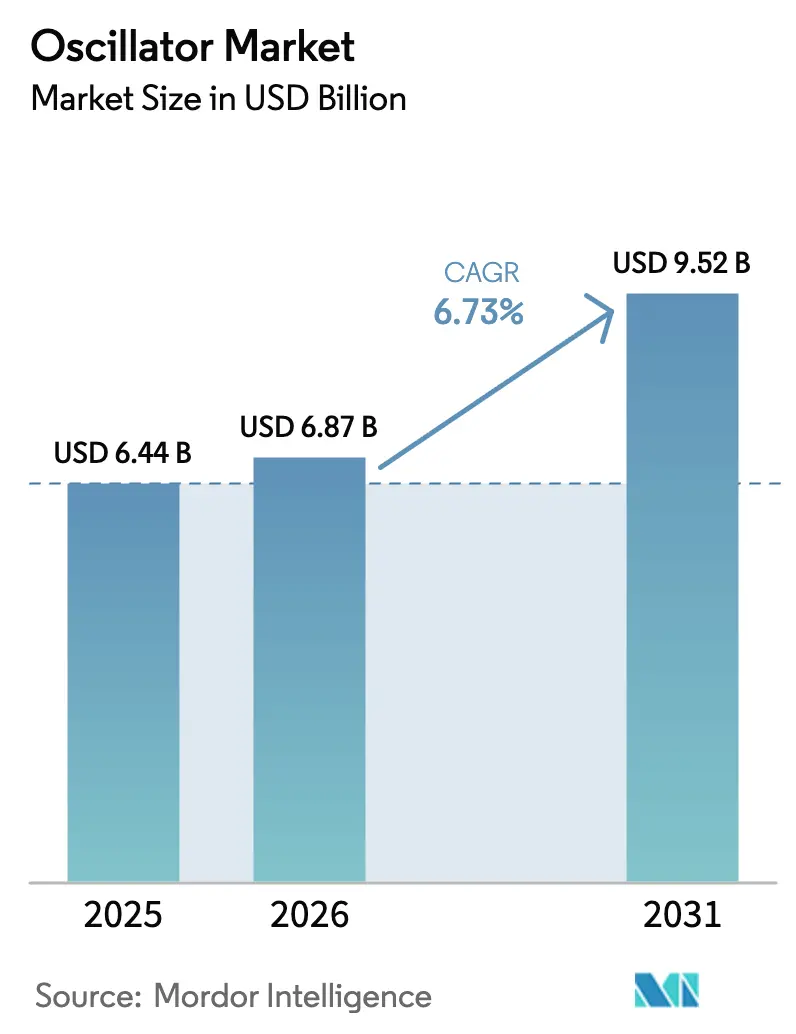
| Market Size (2026) | USD 6.87 Billion |
| Market Size (2031) | USD 9.52 Billion |
| Growth Rate (2026 - 2031) | 6.73% CAGR |
| Fastest Growing Market | Middle East and Africa |
| Largest Market | Asia Pacific |
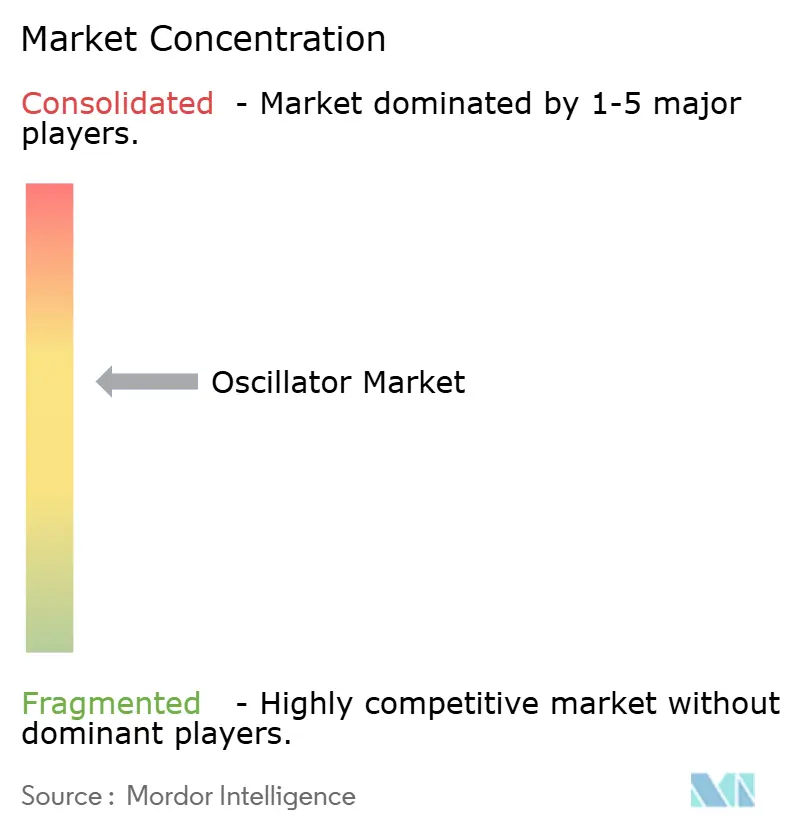
| Market Concentration | Medium |
Major Players *Disclaimer: Major Players sorted in no particular order Image © Mordor Intelligence. Reuse requires attribution under CC BY 4.0. | |
Oscillator Market Analysis by Mordor Intelligence
oscillator market size in 2026 is estimated at USD 6.87 billion, growing from 2025 value of USD 6.44 billion with 2031 projections showing USD 9.52 billion, growing at 6.73% CAGR over 2026-2031. Growth has hinged on widening 5G roll-outs, the rapid electrification of vehicle electronics, and rising low-Earth-orbit satellite deployments that all require tighter timing accuracy. Device makers also benefited from demand for ultra-low-jitter clocks in AI data-center GPUs and from automotive migration toward zonal architectures that favor robust MEMS timing. Meanwhile, concerns over quartz blank concentration in Japan encouraged many original-equipment manufacturers (OEMs) to validate multi-sourced silicon-based alternatives.[1]SiTime, “Why MEMS Outperforms Quartz in Precision Timing,” sitime.com
Key Report Takeaways
- By product type, Temperature-Compensated Crystal Oscillators led with 33.60% of oscillator market share in 2025, while MEMS oscillators are expected to expand at 17.4% CAGR through 2031.
- By mounting scheme, surface-mount devices commanded 76.40% share of the oscillator market size in 2025 and are projected to grow at 6.05% CAGR to 2031.
- By material, quartz retained 89.30% share in 2025, yet silicon-MEMS clocks are projected to post the same 17.4% CAGR that makes them the fastest material class.
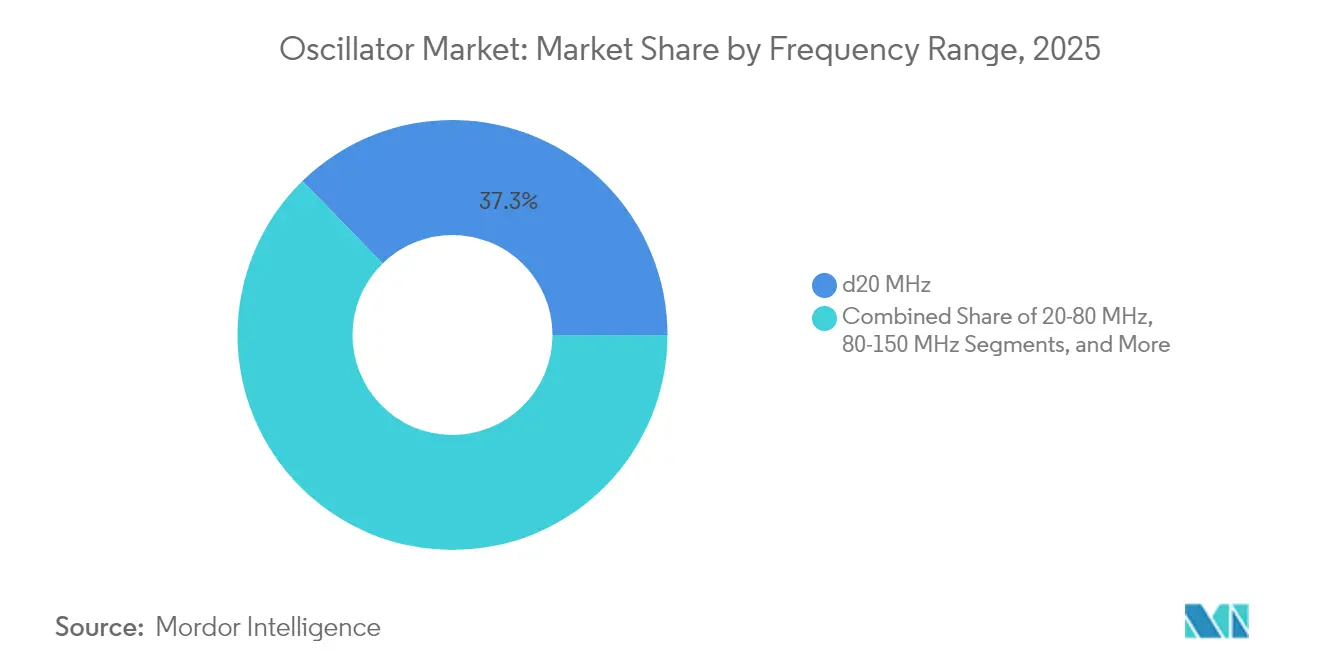
- By frequency range, the ≤20 MHz category captured 37.30% of oscillator market share in 2025; the >150 MHz tier shows the quickest 10.1% CAGR through 2031.
- By end-user industry, consumer electronics accounted for 37.60% of the oscillator market size in 2025 whereas automotive is advancing at an 8.6% CAGR to 2031.
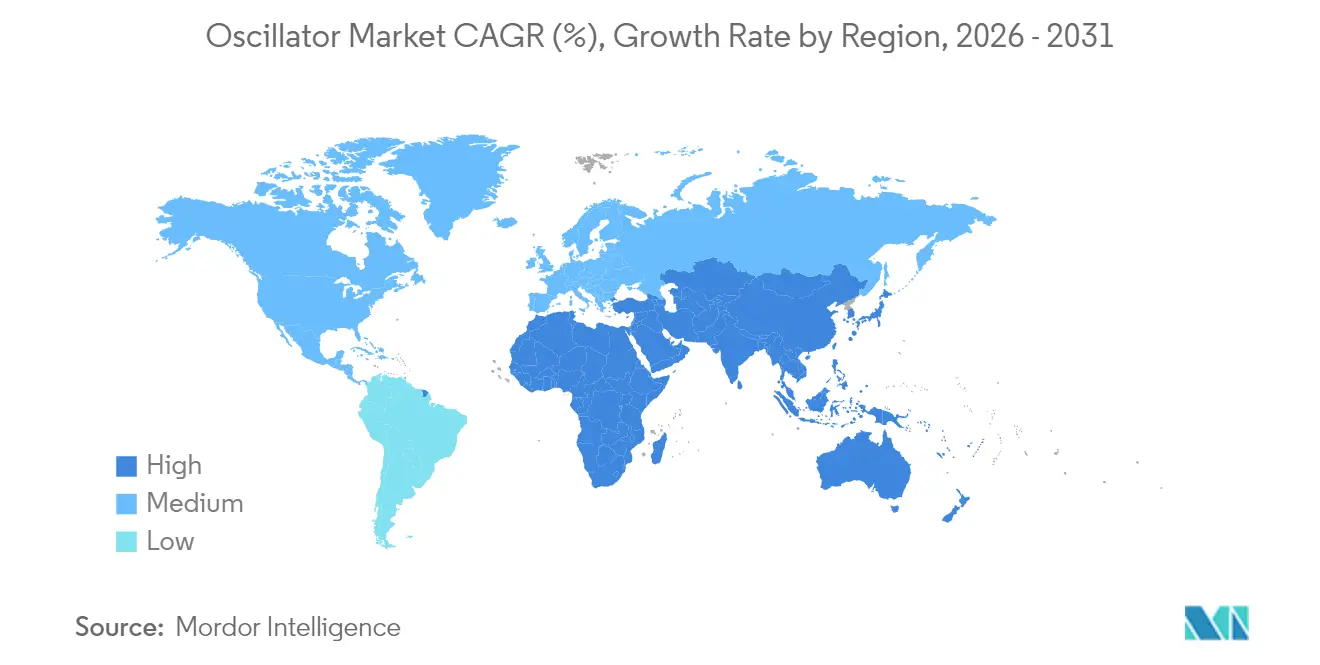
- By geography, Asia-Pacific dominated with 58.50% revenue share in 2025, and the Middle East and Africa region is forecast to post a 9.05% CAGR for 2026-2031.
Note: Market size and forecast figures in this report are generated using Mordor Intelligence’s proprietary estimation framework, updated with the latest available data and insights as of 2026.
Global Oscillator Market Trends and Insights
Drivers Impact Analysis*
| Driver | ( ~ ) % Impact on CAGR Forecast | Geographic Relevance | Impact Timeline |
|---|---|---|---|
| 5G small-cell roll-outs requiring ultra-low-jitter TCXOs | +1.8% | Asia-Pacific, North America, Europe | Short term (≤ 2 years) |
| Electrification of ADAS domain controllers elevating MEMS oscillator ASPs | +1.5% | North America, Europe, Japan, South Korea | Medium term (2-4 years) |
| Migration from legacy MCU clocks to programmable XOs in over-the-air updatable IoT modules | +1.2% | Global, with emphasis on North America, Europe, China | Medium term (2-4 years) |
| Aerospace LEO-satellite fleet expansion fueling OCXO demand | +0.9% | North America, China, Europe | Long term (≥ 4 years) |
| SC-Cut crystal adoption for mmWave backhaul links | +0.7% | Europe, North America, Japan | Medium term (2-4 years) |
| Emergence of automotive Ethernet-TSN synchronisation driving VCXO volumes | +0.6% | Japan, South Korea, Europe, North America | Medium term (2-4 years) |
| Source: Mordor Intelligence | |||
5G Small-Cell Roll-outs Requiring Ultra-Low-Jitter TCXOs
Extensive 5G densification forced operators to deploy millions of small cells, each needing timing accuracy of ±130 ns. Manufacturers, therefore, designed TCXOs with ≤0.1 ppm jitter, such as CTS Corporation’s 535/536 series, which sustained stability from −40 °C to +105 °C. Asia led these installations, with China and South Korea consuming the bulk of premium clocks. Migration from GPS-disciplined timing in 4G toward IEEE 1588 PTP widened addressable demand, while network operators in North America and Europe mirrored Asian specifications to maintain interoperability. Resulting pull-through volumes steadily enlarged the oscillator market across both quartz and MEMS variants.
Electrification of ADAS Domain Controllers Elevating MEMS Oscillator ASPs
Vehicle OEMs replaced multiple distributed electronic control units with centralized ADAS domain controllers that consolidate sensor fusion workloads. The Renesas R-Car V4H SoC integrates a programmable clock generator to support 34 TOPS of AI inferencing, illustrating rising oscillator precision requirements.[2]Renesas Electronics, “R-Car V4H,” renesas.com MEMS devices gained preference because their single-crystal silicon structure survives 30,000 g shock and offers low g-sensitivity—attributes essential in harsh automotive environments. As vehicles move to zonal architectures, timing components per car increase, tilting the oscillator market mix toward higher-margin MEMS products.
Migration from Legacy MCU Clocks to Programmable XOs in Over-the-Air Updatable IoT Modules
IoT suppliers moved beyond fixed-frequency crystals to field-programmable XOs that permit cloud-based firmware to retune clock speed. Silicon Labs’ EFR32xG21 platform incorporates multiple on-chip oscillators that can be trimmed remotely, allowing power optimisation without physical recalls. This flexibility extends device life cycles in smart-metering, asset-tracking, and industrial monitoring deployments, broadening global oscillator market penetration. Cloud-managed timing also provided a cybersecurity benefit by mitigating timing-side-channel vulnerabilities post-deployment.
Aerospace LEO-Satellite Fleet Expansion Fueling OCXO Demand
Constellations such as Starlink and OneWeb collectively orbited hundreds of LEO satellites, each demanding oven-controlled crystal oscillators that sustain sub-ppb stability for inter-satellite links. FrontierSI identified position-navigation-timing services as a new use case that compounds precision requirements. MEMS OCXOs like SiTime’s Endura family offered 50 × lower acceleration sensitivity than quartz, conforming to MIL-PRF-55310 standards critical for launch survivability. Steady launch cadence pushed long-term demand, anchoring a strategic growth pillar within the oscillator market.
Restraints Impact Analysis*
| Restraint | ( ~ ) % Impact on CAGR Forecast | Geographic Relevance | Impact Timeline |
|---|---|---|---|
| Supply-chain single-source dependency on quartz blanks from Japan | −0.7% | Global, highest impact on North America, Europe | Medium term (2-4 years) |
| MEMS-XO phase-noise limitation below 100 kHz offset in 5G infrastructure | −0.5% | Asia-Pacific, North America, Europe | Short term (≤ 2 years) |
| Design-in cycles >5 years in tier-1 automotive ECUs | −0.4% | Global, emphasis on Europe, Japan, North America | Long term (≥ 4 years) |
| Export-control regimes on OCXO/EMXO for military end-use | −0.3% | North America, Europe, Middle East | Medium term (2-4 years) |
| Source: Mordor Intelligence | |||
Supply-Chain Single-Source Dependency on Quartz Blanks from Japan
Roughly 80% of high-grade quartz blanks came from Japan, exposing global manufacturers to geopolitical or natural-disaster disruptions Seiko. Lengthy crystal-growing and polishing cycles further constrained recovery speeds when incidents occurred. Device vendors countered by dual-sourcing with MEMS oscillators fabricated in standard semiconductor fabs located across North America, Europe, and Asia. Nevertheless, mission-critical clients that still require legacy quartz grades retained conservative qualification policies, limiting short-term substitution in parts of the oscillator market.
MEMS-XO Phase-Noise Limitation Below 100 kHz Offset
While MEMS clocks excelled in vibration and temperature stability, silicon resonators historically lagged quartz in ultra-low phase noise at <100 kHz offsets, an attribute vital for 5G basestations. Network planners worried that elevated noise floors would degrade error-vector-magnitude performance in high-order modulation schemes. Suppliers responded with digitally compensated “super-TCXO” architectures that combine temperature control and DSP filtering to approach quartz noise floors. Continued research and development are expected to narrow the gap, yet this constraint presently tempers adoption in premium telecom infrastructures.
*Our forecasts treat driver/restraint impacts as directional, not additive. The impact forecasts reflect baseline growth, mix effects, and variable interactions.
Segment Analysis
By Type: MEMS Reshapes Timing Hierarchy
TCXOs retained the largest 33.60% slice of oscillator market share in 2025 because telecom OEMs valued their cost-to-performance balance. MEMS devices, however, recorded an 17.4% CAGR outlook that is steering future oscillator market expansion toward silicon-based designs. Reliability at 50 × quartz levels, coupled with micro-packaged form factors below 2 mm², makes MEMS attractive for wearables, drones, and EVs. OCXOs still dominate satellite payloads where ±5 ppb stability is non-negotiable. SPXOs serve price-sensitive gadgets, whereas VCXOs supply video broadcast equipment requiring frequency pullability.
The oscillator industry witnessed a migration from construction-based labels toward application-centred definitions; aerospace now requests radiation-tolerant EMXOs, and IoT integrators demand field-programmable FCXOs. This re-categorisation helped smaller innovators target niches rather than compete head-on with large quartz companies. Consequently, competitive dynamics shifted as MEMS-centric firms secured design wins in spaces once monopolised by quartz. The oscillator market benefits from this specialization because each performance envelope—be it vibration, radiation or temperature extremes—receives a tailored solution set rather than a one-size-fits-all device.


By Mounting Scheme: Surface-Mount Sustains Miniaturisation Momentum
Surface-mount packages controlled 76.40% of the oscillator market in 2025, owing to pick-and-place efficiency and reduced board real estate. The 6.05% projected CAGR illustrates how OEM roadmaps favour ever-smaller footprints, such as 1.6 × 1.2 mm outlines introduced for wearable sensors. Through-hole parts remained in rail, avionics and heavy-industrial platforms where board rigidity outranks size.
Advanced packaging merged multiple resonators, voltage regulators and dividers into single system-in-package blocks, slashing component counts for designers. Automotive and medical customers championed such integration to shrink bill-of-material line items while raising reliability via reduced solder joints. Over the forecast horizon, automated optical inspection thresholds and reflow temperature constraints will further push the oscillator market toward surface-mount exclusivity except where severe vibration or serviceability dictates sockets.
By Material: Silicon Challenges Quartz’s Historical Stronghold
Quartz represented 89.30% of 2025 market share yet MEMS silicon resonators are pegged for the quickest 17.4% CAGR. Automotive contracts accelerated the shift because MEMS withstand high-G crash events and −40 °C to +125 °C ranges without aging drift. Ceramic and SAW substrates filled specialist roles such as microwave front-ends that need high-Q performance.
Materials science innovation continued on both fronts; quartz laboratories reported 10 × sensitivity gains in biosensing via elliptical electrodes. MEMS manufacturers refined epi-seal vacuum encapsulation to trap resonators in hermetic silicon cavities, halving motional resistance and extending lifetime. The oscillator market therefore no longer views material categories as binary rivals but as complementary toolkits to match application trade-offs around cost, power and stability.
By Frequency Range: Demand Climbs Into High-GHz Territory
The ≤20 MHz bracket accounted for 37.30% of the oscillator market size in 2025, anchored by wristbands, remote controls, and basic MCU timing. Yet the >150 MHz slice is set for 10.1% CAGR through 2031 as 5G backhaul, millimetre-wave radars and multi-core processors crave higher carrier frequencies. Middle tiers between 20 MHz and 150 MHz serviced fiber-optic modules and networking cards that need moderate speeds with low phase noise.
Emerging 27.5–29.5 GHz antenna arrays for 6G research magnify the importance of cutting-edge SC-cut crystals and hybrid MEMS-SAW combinations that keep noise floors at bay. Consequently, oscillator suppliers offer family lines optimised for discreet frequency windows instead of stretching a single architecture across decades of bandwidth. This segmentation lets the oscillator market capture value by aligning price points, size and operating temperature to each band’s technical ceiling.
By End-User Industry: Automotive Surges While Consumer Holds Volume Crown
Consumer electronics maintained 37.60% revenue share in 2025 as every smartphone uses dozens of timing nodes. Connected vehicles, however, are racing ahead with an 8.6% CAGR thanks to ADAS, battery-management systems and in-vehicle infotainment. Telecom carriers remained vital patrons, particularly for ultra-stable clocks inside 5G gNodeBs. Aerospace and defense clients demanded the highest-grade OCXOs and newly qualified MEMS parts for CubeSats.
Industrial automation and factory Ethernet synchronisation also gathered pace, reinforcing growth beyond cyclical consumer gadgets. Automotive ethernet PHYs such as Texas Instruments’ DP83TC818S-Q1, highlighted how hardware designers now embed time-sensitive networking features that depend on sub-µs clock precision. As each vertical deepens electronic content, the oscillator market benefits from a broader mix of margin profiles, buffering suppliers against single-sector downturns.
Geography Analysis
Asia-Pacific dominated 58.50% of 2025 revenue, propelled by China’s smartphone production hubs, Japan’s quartz supply dominance and South Korea’s early adoption of 5G small cells. Taiwan’s foundries and timing-component vendors such as TXC Corporation anchored regional self-sufficiency, while India attracted greenfield fabs from companies like Rakon to diversify supply. Strong local demand plus export momentum kept the oscillator market growth curve steep despite pockets of trade tension.
North America ranked second; its defense primes and New-Space launch providers bought premium OCXOs and radiation-tolerant MEMS. Data-center operators pursued super-TCXOs that cut GPU idle cycles in AI clusters, reinforcing domestic development funding. Automotive tier-1s based in the United States and Canada validated MEMS clocks for centralised ADAS compute, further enlarging the regional oscillator market.
Europe remained influential, particularly within Germany’s vehicle ecosystem and the continent’s strong industrial automation base. SC-cut crystals gained popularity in mmWave backhaul links to meet European Commission spectrum mandates. Export-control frameworks occasionally slowed shipment cycles for high-precision military oscillators, yet domestic champions in France and the United Kingdom kept specialty production alive. The Middle East and Africa recorded the fastest 9.05% CAGR outlook as Gulf smart-city projects and African telecom expansions modernised infrastructure. South America, led by Brazil, showed steady but modest uptake tied to 4G/5G network upgrades. Collectively, these regional patterns ensured the oscillator market retained a geographically diverse demand structure.

Regulatory Landscape
Oscillator shipments that support telecom, automotive, aerospace, and defense are shaped by cross-border trade compliance and evolving semiconductor supply-chain governance. Export-control regimes and end-use screening can restrict distribution of high-stability OCXO/EMXO grades used in military or dual-use applications. Suppliers therefore separate civil versus defense part numbering and tighten documentation through the channel.
SEMI highlighted risk-based export controls and sustained tax and R&D incentives in its 2026 U.S. policy strategy, reflecting an industry focus on balancing security with commercial availability for advanced timing components. In Europe, the European Commission advanced supply-chain resilience initiatives, including a proposal for a Business-to-Business Semiconductor Supply Chain Platform (digital-twin style monitoring) to improve visibility into disruption risks. At the company level, major oscillator and component vendors such as Murata and Kyocera cite geopolitical factors, economic-security policies, and import/export restrictions as operational risks, reinforcing the need for multi-region manufacturing, compliant sourcing, and traceability across quartz and silicon-MEMS timing portfolios.
Value Chain Analysis
The oscillator value chain begins with raw materials and substrates, including high-grade quartz blanks, silicon wafers, and ceramics/SAW materials, then moves into resonator formation and device fabrication. Quartz devices depend on crystal growth, blanking, cutting (including SC-cut variants for low phase noise), electrode patterning, and packaging. MEMS oscillators use semiconductor-style photolithography and wafer-level processes, with wafer-level packaging (WLP) increasingly used to improve yield and cost. Frequency control and compensation stages (TCXO/OCXO control loops and DSP calibration for programmable XOs) add material and test complexity, and they require precision metrology for jitter, phase noise, and temperature stability.
Downstream, assembly, test, and qualification feed distribution via IDMs, catalog distributors, and module makers, which then sell to OEM/EMS customers across consumer electronics, networking, automotive, and aerospace. Supply-chain strategies are also blending quartz sourcing with semiconductor-fab capacity for silicon-MEMS, including steps such as Known Good Die (KGD) screening for high-frequency devices and higher automation in final test to manage tight timing tolerances. SEMI standards (over 1,000 international standards) support interoperability in equipment, materials handling, and manufacturing practices across the broader electronics supply chain that oscillator makers rely on for scaling and quality control.
Competitive Landscape
Incumbent quartz manufacturers sought to preserve their share by refining frequency stability and offering extended temperature grades, whereas MEMS-centric challengers emphasized reliability, integration, and shorter lead times. SiTime’s Epi-Seal technology sealed its resonators in vacuum cavities to eliminate particulate contamination, yielding 50 × reliability gains over quartz SiTime. Microchip Technology extended its footprint by acquiring BAW and SAW specialists, allowing the bundling of mixed resonator portfolios for 5G timing decks.
Merger and Acquisition momentum continued: Infineon bought Marvell’s automotive Ethernet business for USD 2.5 billion, aligning timing with in-vehicle networking silicon. VIAVI announced plans to acquire Spirent Communications to strengthen 5G testing capabilities that depend on precision clocks. Such moves illustrate how timing products increasingly intertwine with complete subsystems rather than remaining stand-alone components.
Regulatory shifts shaped strategy as well. The U.S. Bureau of Industry and Security expanded the Foreign-Produced Direct Product Rule to cover advanced timing devices, compelling exporters to tighten compliance pipelines. Suppliers responded by delineating civil versus defense part numbers and re-shoring assembly lines. Overall, the oscillator market continues to see technology-driven competition where speed of innovation and flexible manufacturing outrank mere volume scale.
Oscillator Industry Leaders
Murata Manufacturing Co. Ltd
Seiko Epson Corp.
Nihon Dempa Kogyo (NDK) Co., Ltd.
Kyocera Corporation
SiTime Corporation
- *Disclaimer: Major Players sorted in no particular order

Market Opportunities and Future Outlook
AI servers, high-speed optical links, and edge infrastructure are pushing demand toward higher-frequency, lower-jitter timing. This creates whitespace for differential clock oscillators and compact OCXOs that balance performance and power. In June 2026, Kyocera expanded monthly production capacity of its X Series differential clock crystal oscillators from 200,000 units to 2 million units, citing generative AI server needs. Seiko Epson also introduced the OG7050CAN OCXO for AI, edge, and communications infrastructure in June 2026, emphasizing reduced power consumption and a smaller form factor aimed at rack-level thermal and density constraints.
Automotive electronics continues to drive timing vendors toward smaller packages and wider temperature grades, supporting opportunities in automotive-grade SPXO/TCXO and integrated timing solutions that simplify qualification. Murata promoted a set proposal in April 2026 combining a crystal unit with a thermistor for automotive UWB applications such as digital keys and wireless battery management, reflecting demand for application-ready timing subsystems. On the production roadmap, planned mass production milestones for higher-speed and specialty oscillators also point to a pipeline of new outputs and interfaces for networking and high-speed digital systems. These include Daishinku (KDS) scheduling mass production of 156.25 MHz and 312.5 MHz Arkh.2G oscillators for July 2026 and Epson targeting Q4 2026 mass production for Gen 3 WA-LVDS oscillators.
Recent Industry Developments
- June 2026: Seiko Epson announces the OG7050CAN OCXO for AI/edge and infra, designed to be low power and compact with 56% lower power and 85% smaller volume. The launch expands high-end timing offerings for data centers and networks and strengthens Epson's MEMS/OCXO mix for timing decks in Mission-critical environments.
- April 2026: Murata Manufacturing proposes a timing solution pairing XRCGE55M200MZF1BR0 crystal unit with NCU03XH103F6SRL thermistor for automotive UWB. The initiative advances automotive timing integration for UWB and wireless security applications and bolsters Murata's automotive timing ecosystem while aligning with multi-component timing strategies for auto electronics.
- April 2026: Nihon Dempa Kogyo (NDK) Co., Ltd. schedules mass production of NX1612SA crystal oscillator (1.6 x 1.2 mm, ±40 ppm, -40C to +125C) for automotive. The move enhances NDK's automotive timing portfolio and supports high-volume auto electronics timing needs.


Research Methodology Framework and Report Scope
Market Definition and Coverage
For this methodology, the oscillator market covers electronic frequency and timing components sold into end-use equipment, with revenue counted at the component level. The sizing tracks demand across major electronics and industrial value chains, and it is expressed in USD at current prices for the stated years.
Scope exclusions: We exclude full system clock modules and downstream equipment value. We also exclude pure semiconductor IC revenue when it is not sold as an oscillator component.
Segmentation Overview
- By Product Type
- Temperature-Compensated XO (TCXO)
- Voltage-Controlled XO (VCXO)
- Oven-Controlled XO (OCXO)
- Simple-Packaged XO (SPXO)
- Frequency-Controlled XO (FCXO)
- MEMS Oscillator (Si-MEMS)
- Evacuated Miniature XO (EMXO)
- By Mounting Scheme
- Surface-Mount Device (SMD)
- Through-Hole
- By Material
- Quartz
- Silicon-Based MEMS
- Ceramic / SAW
- By Frequency Range
- ≤20 MHz
- 20–80 MHz
- 80–150 MHz
- >150 MHz
- By End-User Industry
- Consumer Electronics
- Telecom and Networking
- Automotive
- Aerospace and Defense
- Industrial and Manufacturing
- Medical and Research
- Other End-Users
- By Geography
- North America
- United States
- Canada
- Mexico
- South America
- Brazil
- Argentina
- Rest of South America
- Europe
- Germany
- United Kingdom
- France
- Italy
- Spain
- Rest of Europe
- Asia-Pacific
- China
- Japan
- Taiwan
- South Korea
- India
- Rest of Asia-Pacific
- Middle East and Africa
- Middle East
- GCC Countries
- Turkey
- Saudi Arabia
- Turkey
- Rest of Middle East
- Africa
- South Africa
- Nigeria
- Rest of Africa
- Middle East
- North America
Data Sources, Market Sizing, and Validation
Desk Research
Desk research is used to set market boundaries, collect base indicators, and draft realistic ranges before we pressure-test assumptions with industry participants. We rely on public, non-paywalled sources such as ITU updates on telecom network expansion, FCC filings and spectrum releases, UN Comtrade trade flows for relevant electronic components, and OECD or World Bank macro indicators that help normalize electronics cycles.
We also review technical standards and adoption signals from bodies such as IEEE and IETF (mainly for timing and networking context). For end-market exposure, we use public industrial and automotive production statistics from agencies such as the US Bureau of Economic Analysis and Eurostat. Company annual reports, investor presentations, and reputed press are then used to cross-check capacity commentary, end-market exposure, and inventory patterns. For financial detail where needed, we selectively use paid subscriptions for company financials and intelligence, news and financials, patent databases, and shipment-level import-export records when those records add clarity. The desk sources listed here are illustrative and not exhaustive, and many other references were used for data collection, validation, and clarification.
Primary Interviews and Surveys
Primary work focuses on validating what drives unit demand and pricing in real purchase decisions, including device makers, component suppliers, distributors, and engineering-led buyers who specify timing performance. These discussions are used to confirm where oscillators are designed-in, how supply lead times and qualification cycles affect ordering, and which end uses are changing faster across APAC, EMEA, and the Americas.
Distribution of primary research fieldwork respondents
| Company type | Respondent position | Region |
|---|---|---|
| Top tier: 25% | CXOs: 15% | APAC: 45% |
| Mid tier: 57% | Functional/Unit leaders: 28% | EMEA: 36% |
| Smaller Players: 18% | Managers: 57% | Americas: 19% |
Market-Sizing & Forecasting
The model starts with a top-down build where electronics production and trade signals are used to reconstruct the addressable demand pool for oscillators by end-use equipment type and region, and then it is translated into value using practical price bands. To keep totals realistic, we corroborate this with selective bottom-up approximations, such as sampled ASP multiplied by unit volumes for key device categories. Where the two views do not reconcile, we adjust the assumptions and re-check the implied totals.
Inputs that matter most include 5G and network infrastructure rollouts, vehicle electronics content trends, industrial automation investment cycles, and data center build-outs that raise timing performance requirements. We also track indicators such as export-import movements for relevant components, observed lead-time pressure, and typical pricing changes tied to material availability and product mix (for example, shifts toward higher stability parts). When public unit indicators have gaps, we fill assumptions using interview-based ranges and stress-test the impact so one weak data point does not over-drive the final number.
For forecasting, scenario analysis is applied around the most sensitive variables, mainly electronics cycle recovery timing, automotive and telecom capex direction, and the speed of adoption for higher performance timing solutions. When the near-term path looks noisy, we smooth the curve using simple time-series checks so the forecast stays explainable and repeatable.
Data Validation & Update Cycle
Validation is done through multiple checks so the final outputs do not rely on a single assumption. We compare model results with independent signals such as regional electronics output, trade movement direction, and stated demand conditions from industry participants, and then we flag large variances for deeper review.
Before sign-off, the work is reviewed step-by-step, and re-contact is triggered when pricing, lead times, or end-market demand conditions change materially from what was assumed. Reports are refreshed annually, with interim updates for major events that can shift demand or pricing. A final pre-delivery pass is completed so clients receive the latest updated view.
Mordor Intelligence's Oscillator Market Size Measured Against Other Published Estimates
Published market sizes for oscillators can vary even when the topic label matches, because each publisher draws the line on what counts as an oscillator component and which years anchor the calculation. The most common drivers are differences in included product families, the year used as the estimate year, and how pricing is treated when mix shifts toward higher performance parts.
Gaps also show up when a model relies mainly on broad electronics revenue proxies rather than linking demand to concrete build indicators such as telecom rollout activity, vehicle electronics content, and industrial automation spend. Currency conversion timing and refresh cadence matter too, since lead times and pricing can change quickly, which can widen spreads around inventory adjustments.
Benchmark comparison
| Source | Market Size | Gaps in Research Methodology |
|---|---|---|
| Mordor Intelligence | USD 6.87 B (2026) | |
| Trade Publisher A | USD 7.68 B (2025) | Uses a different base year and a longer horizon, and it likely applies a broader oscillator definition that can blend adjacent timing and frequency components, which raises the total. |
| Industry Report B | USD 3.34 B (2024) | Targets quartz crystals and oscillators rather than the full oscillator set, so non-quartz solutions are not fully captured and the value total stays lower. |
The table suggests scope selection and base-year choice explain most of the spread, followed by how average selling prices are carried forward when product mix changes. Keeping revenue at the oscillator component level and reconciling it against end-use build signals (telecom deployments, vehicle electronics content, and industrial activity) is what makes the yearly totals comparable, and that constraint is enforced in the model by Mordor Intelligence.


Key Questions Answered in the Report
What is the current size and projected growth of the global oscillator market?
The oscillator market stood at USD 6.87 billion in 2026 and is forecast to reach USD 9.52 billion by 2031, advancing at a 6.73% CAGR.
Which oscillator type shows the strongest growth outlook?
MEMS oscillators hold the fastest trajectory with an 17.4% CAGR expected for 2026-2031, driven by superior shock resistance, compact size and high reliability.
How do 5G roll-outs influence oscillator demand?
Dense 5G small-cell networks require ultra-low-jitter TCXOs with ±130 ns accuracy, steadily lifting volumes for precision timing components across Asia, North America and Europe.
Why are automotive applications accelerating oscillator adoption?
Centralised ADAS domain controllers, zonal vehicle architectures and Automotive Ethernet-TSN protocols together push oscillator use in vehicles, resulting in an 8.6% CAGR for the automotive segment.
What supply-chain risks should executives watch?
Around 80% of high-grade quartz blanks originate in Japan, creating a single-source bottleneck that encourages dual-sourcing with silicon-based MEMS alternatives.
Which geographic market is set to grow the fastest?
The Middle East and Africa region shows the highest expansion rate, with a projected 9.05% CAGR from 2026-2031 as telecom and industrial automation investments rise.
Page last updated on: