
Organic Farming Market Size and Share
Organic Farming Market Analysis by Mordor Intelligence
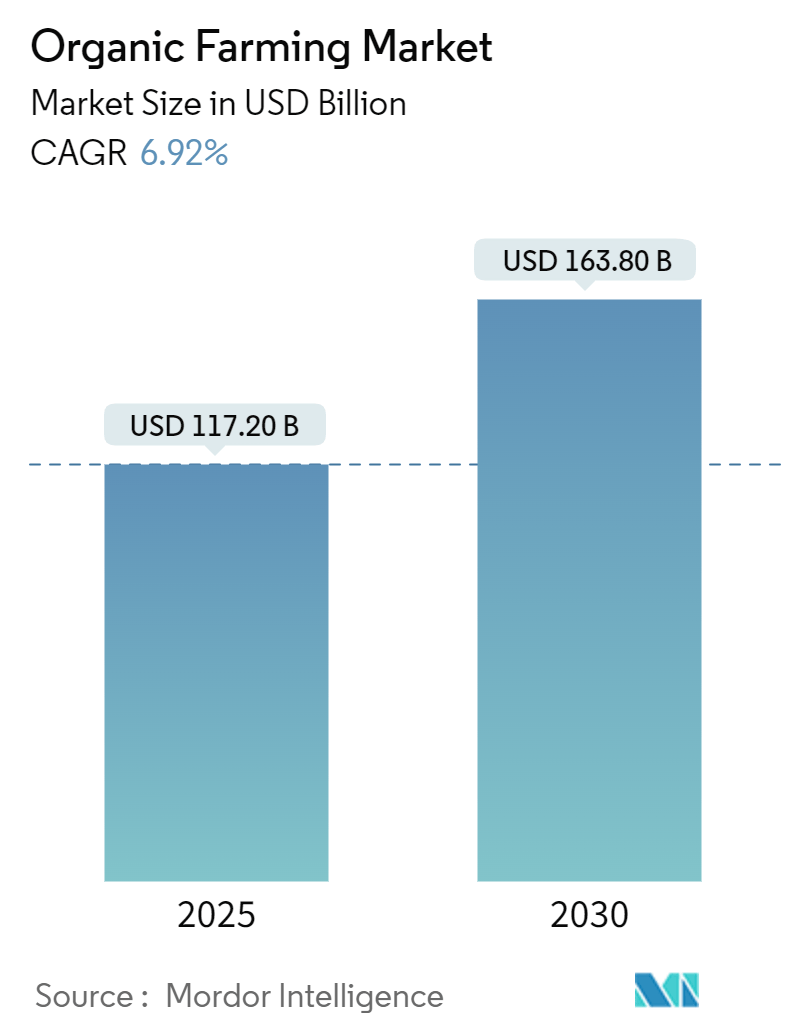
The Organic Farming Market size is estimated at USD 117.20 billion in 2025, and is expected to reach USD 163.80 billion by 2030, at a CAGR of 6.92% during the forecast period (2025-2030).
As consumers increasingly prioritize healthy lifestyles, the demand for nutritious, chemical-free diets surges, propelling the organic fruits and vegetables market. This market's expansion is further bolstered by rising sales of organic foods. Data from IFOAM - Organics International reveals that global sales of organic food climbed from USD 132 billion in 2021 to USD 134 billion in 2022, underscoring the escalating demand for organic produce.
Fresh produce leads the organic sales, trailed by grocery sales and beverages. In 2023, these categories in the United States saw growth rates of 2.6%, 4.1%, and 3.9%, respectively, according to the Organic Trade Association of the United States. With rising demand from millennials and Gen-Z, the appetite for organic products is set to expand even more in the coming years.
Government support to promote organic agriculture is one of the major factors driving the market across the world. In 2024, the French government unveiled a €90 million (USD 97.4 million) aid package aimed at bolstering organic farms grappling with economic hurdles. This initiative, part of broader government efforts to champion organic farming, specifically supports farms either dedicated to organic practices or in the midst of transitioning. These initiatives, coupled with the rising consumption of organic food, are set to propel the market forward.
Global Organic Farming Market Trends and Insights
Growing Adoption of Organic Farming Across the World
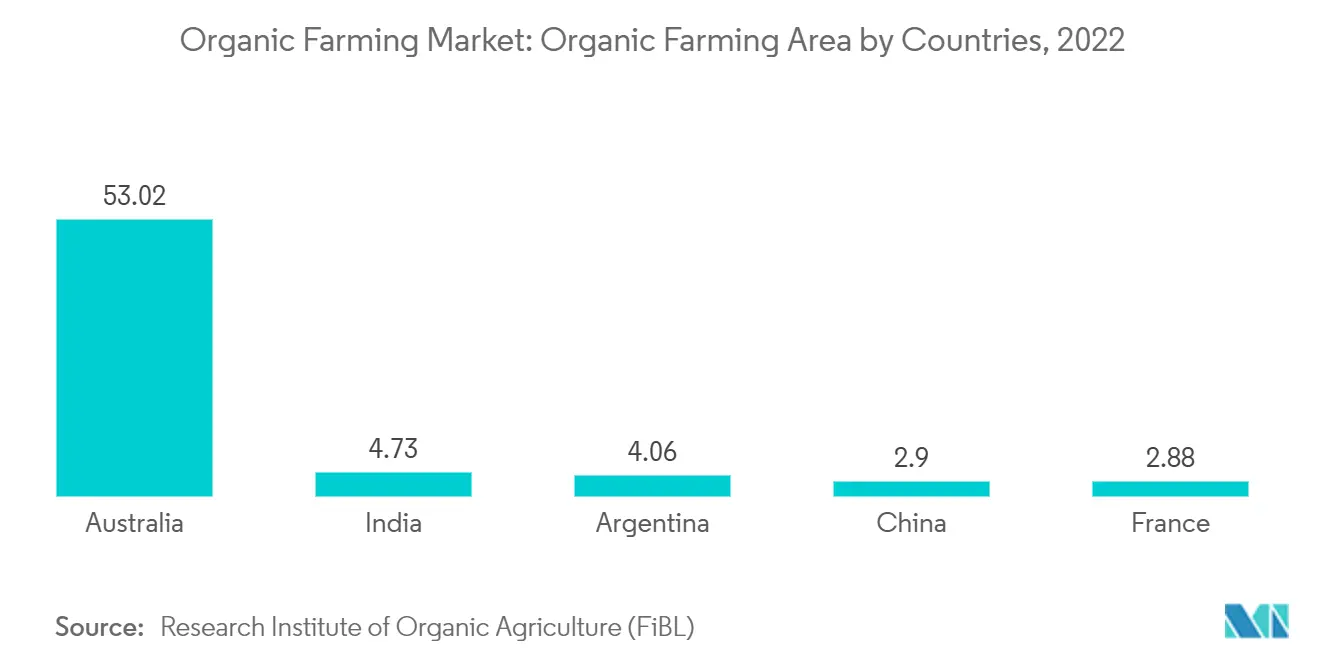
In response to escalating global demand for organic food and mounting environmental challenges posed by conventional agriculture, governments worldwide have increasingly prioritized sustainable practices and a shift towards organic farming. The "World of Organic Agriculture 2024" report, released by the Research Institute of Organic Agriculture (FiBL) and IFOAM – Organics International, highlights that by the close of 2022, organic management spanned 96.4 million hectares, marking a notable 26.6% surge (or an addition of 20.3 million hectares) from 2021 figures.
Australia and India led the charge in 2022, with organic farming expanding by 17.3 million hectares and 4.7 million hectares respectively, as detailed in the report. This expansion means that over half of the global organic farming area is now in Oceania, trailed by Europe at 18.5 million hectares and Latin America at 9.5 million hectares. In 2023, IFOAM – Organics International unveiled a strategy championing regenerative organic farming. This initiative underscores the principles of health, ecology, fairness, and care. By equipping the organic community with essential resources and promoting its development, the strategy seeks to elevate organic agriculture as a pivotal solution to pressing global challenges which is anticipated to drive the organic farming market in the coming years.


Increasing Consumption of Organic Food Products
Over the past decade, the consumption of organic food products has surged, driven by heightened health consciousness, growing awareness of organic offerings, and increased disposable incomes in both developed and developing nations. In recent years, a steady and escalating interest in organic products has grown among Millennials and Gen Z. Having been raised amidst the organic and sustainability movements, these generations prioritize the health of both individuals and the planet. These generations are increasingly conscious of the ethical implications of their food choices and are looking for products that align with their values, such as animal welfare, fair trade, and support for organic farmers.
In the world's largest organic market, the United States, consumption of organic products has risen, even amidst economic challenges and sector fluctuations. The 2024 Organic Industry Survey by the Organic Trade Association (OTA) reports that certified organic product sales in 2023 reached USD 70 billion, marking a 3.4 percent increase from the prior year. For instance, the import of Organic Blueberries have increased from 32.7 thousand metric tons to 38.8 thousand metric tons during the period 2020-2023 according to ITC Trade Map. A similar increase in imports of other organic fruits such as Avocado, Blackberries, Apples, etc is noticed during the The global demand for organic products is expected to rise in the coming years, driving increased production and expansion of the organic farming market worldwide.

Recent Industry Developments
- May 2024: The United States Department of Agriculture's (USDA) Agricultural Marketing Service (AMS) allocated USD 75.2 million in funding to 93 projects nationwide. These initiatives aim to expand organic product markets and support producers transitioning to organic production methods.
- October 2024: Brazil's Federal Government has unveiled the 3rd edition of its National Plan for Agroecology and Organic Production, aiming to bolster the production, handling, and processing of organic and agroecological products, thereby propelling the organic farming market in the years ahead.


Global Organic Farming Market Report Scope
Organic farming, often referred to as organic agriculture, ecological farming, or biological farming, without the usage of synthetic products commonly employed in conventional agricultural practices. The Organic Farming Market is segmented by Type (Cereals, Fruits and Vegetables, Oil Seeds and Pulses) and Geography (North America, Europe, Asia-Pacific, South America, and Africa). The report offers market size and forecasts in terms of value (USD) for all the above segments.
| Cereals |
| Fruits and Vegetables |
| Oil Seeds and Pulses |
| North America | US |
| Canada | |
| Mexico | |
| Rest of North America | |
| Europe | Germany |
| UK | |
| France | |
| Russia | |
| Spain | |
| Rest of North America | |
| Asia Pacific | India |
| China | |
| Australia | |
| Rest of Asia Pacific | |
| South America | Brazil |
| Argentina | |
| Rest of South America | |
| Middle East and Africa | Uganda |
| Ethiopia | |
| Rest of Middle East and Africa |
| Type | Cereals | |
| Fruits and Vegetables | ||
| Oil Seeds and Pulses | ||
| Geography | North America | US |
| Canada | ||
| Mexico | ||
| Rest of North America | ||
| Europe | Germany | |
| UK | ||
| France | ||
| Russia | ||
| Spain | ||
| Rest of North America | ||
| Asia Pacific | India | |
| China | ||
| Australia | ||
| Rest of Asia Pacific | ||
| South America | Brazil | |
| Argentina | ||
| Rest of South America | ||
| Middle East and Africa | Uganda | |
| Ethiopia | ||
| Rest of Middle East and Africa | ||


Key Questions Answered in the Report
How big is the Organic Farming Market?
The Organic Farming Market size is expected to reach USD 117.20 billion in 2025 and grow at a CAGR of 6.92% to reach USD 163.80 billion by 2030.
What is the current Organic Farming Market size?
In 2025, the Organic Farming Market size is expected to reach USD 117.20 billion.
Which is the fastest growing region in Organic Farming Market?
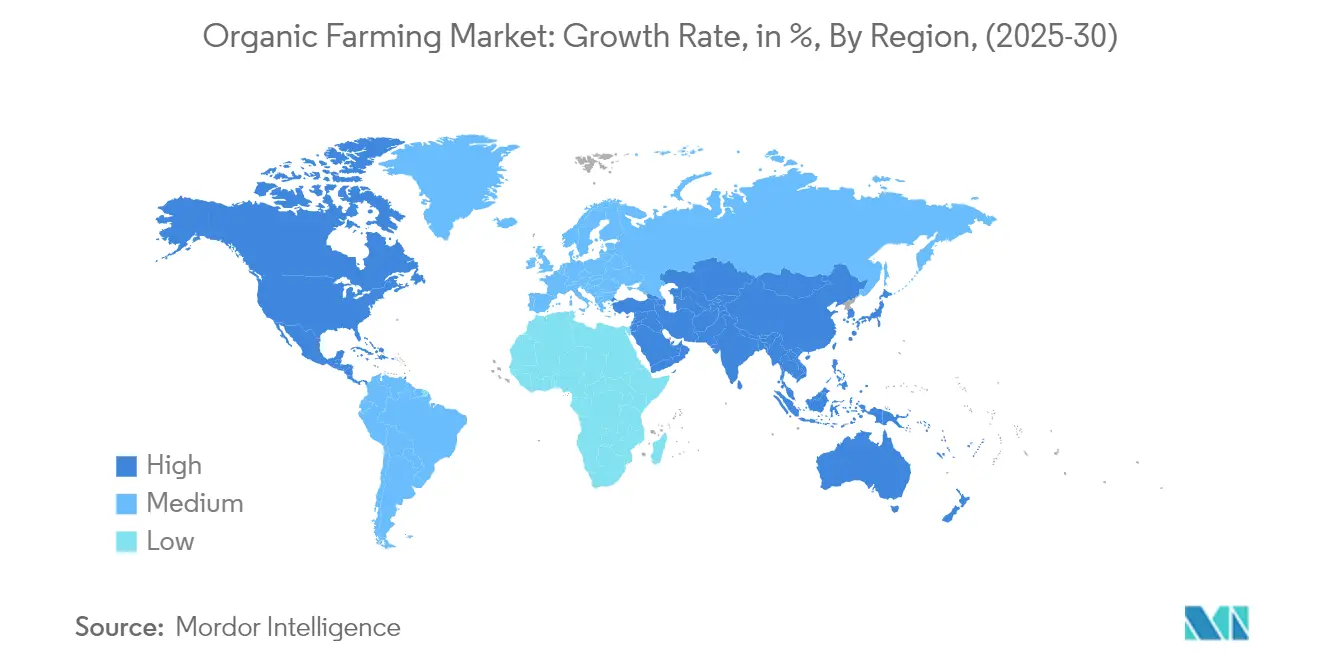
Asia Pacific is estimated to grow at the highest CAGR over the forecast period (2025-2030).
Which region has the biggest share in Organic Farming Market?
In 2025, the North America accounts for the largest market share in Organic Farming Market.
What years does this Organic Farming Market cover, and what was the market size in 2024?
In 2024, the Organic Farming Market size was estimated at USD 109.09 billion. The report covers the Organic Farming Market historical market size for years: 2019, 2020, 2021, 2022, 2023 and 2024. The report also forecasts the Organic Farming Market size for years: 2025, 2026, 2027, 2028, 2029 and 2030.
Page last updated on:
Organic Farming Market Report
Statistics for the 2025 Organic Farming market share, size and revenue growth rate, created by Mordor Intelligence™ Industry Reports. Organic Farming analysis includes a market forecast outlook for 2025 to 2030 and historical overview. Get a sample of this industry analysis as a free report PDF download.


 Your data is secure and never sold or shared.


