
Online Doctor Consultation Market Size and Share
Market Overview
| Study Period | 2020 - 2031 |
|---|---|
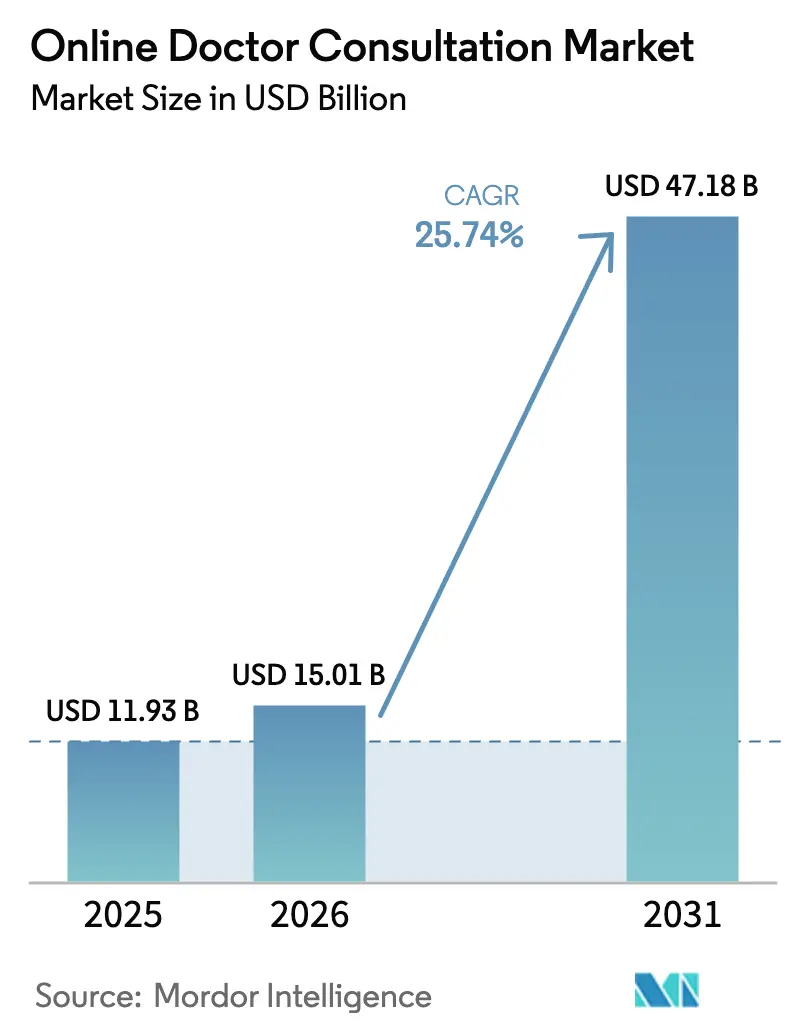
| Market Size (2026) | USD 15.01 Billion |
| Market Size (2031) | USD 47.18 Billion |
| Growth Rate (2026 - 2031) | 25.74 % |
| Fastest Growing Market | Asia Pacific |
| Largest Market | North America |
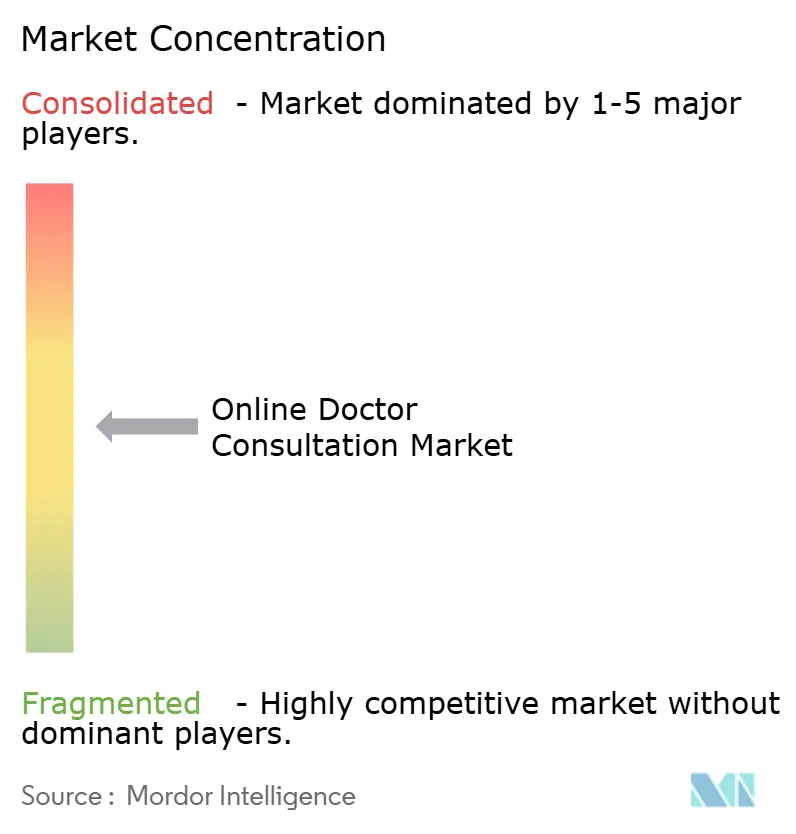
| Market Concentration | Medium |
Major Players *Disclaimer: Major Players sorted in no particular order Image © Mordor Intelligence. Reuse requires attribution under CC BY 4.0. | |
Online Doctor Consultation Market Analysis by Mordor Intelligence
Online doctor consultation market size in 2026 is estimated at USD 15.01 billion, growing from 2025 value of USD 11.93 billion with 2031 projections showing USD 47.18 billion, growing at 25.74% CAGR over 2026-2031. This sustained growth reflects the transition from pandemic-driven telehealth surges to routine, integrated virtual care. 5G roll-outs facilitate real-time high-definition video visits, governments in Europe and Asia now reimburse a wider range of e-health services, and corporate “virtual-first” health plans in North America shift millions of covered lives to online entry points. North America led with a 38% revenue share in 2024, yet Asia-Pacific recorded the quickest regional expansion at 12.3% CAGR as public platforms such as India’s eSanjeevani scale to hundreds of millions of consultations. Mobile apps commanded 70% of all visit volume in 2024, while video consultations accounted for 60% of encounters, underscoring patient and clinician preferences for visually rich interactions. Competitive intensity remains moderate: global incumbents add mental-health, chronic-care, and remote screening capabilities through acquisitions, whereas regional specialists differentiate on language support, local regulatory compliance, and pharmacy fulfillment.
Key Report Takeaways
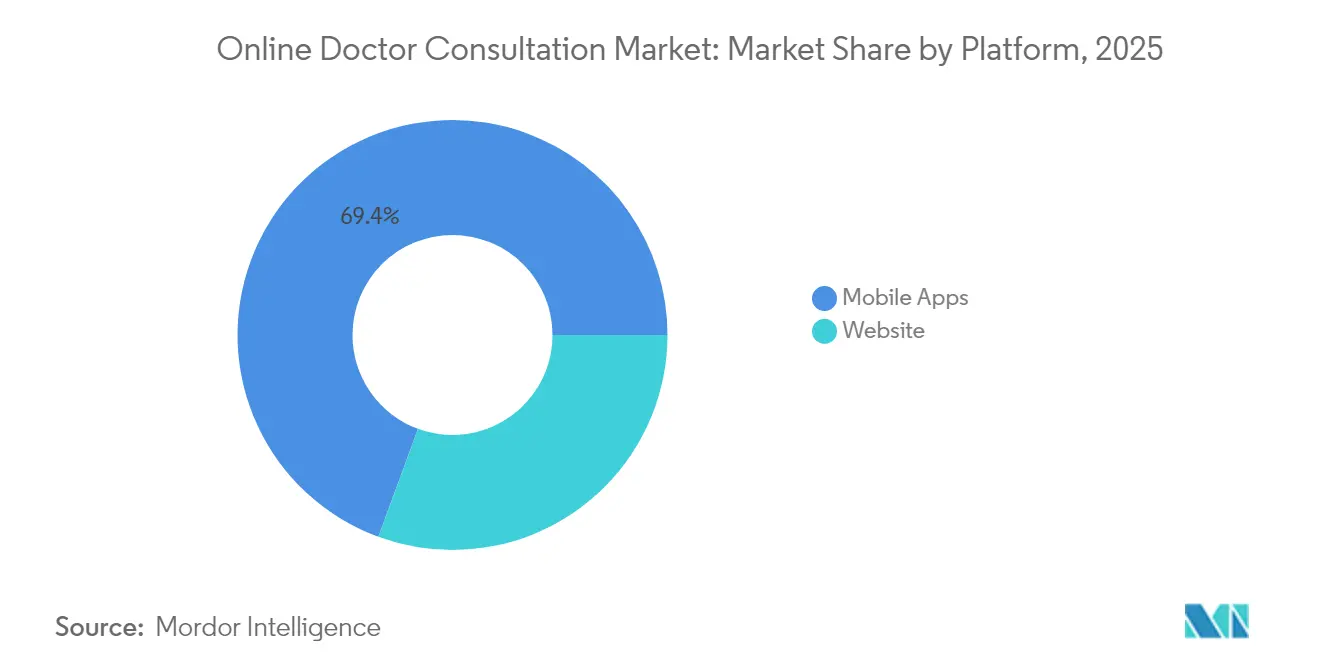
- By platform, mobile apps held 69.40% of the Online doctor consultation market share in 2025.
- By consultation type, video chat accounted for 59.20% share of the Online doctor consultation market size in 2025 and is forecast to register an 24.3% CAGR to 2031.
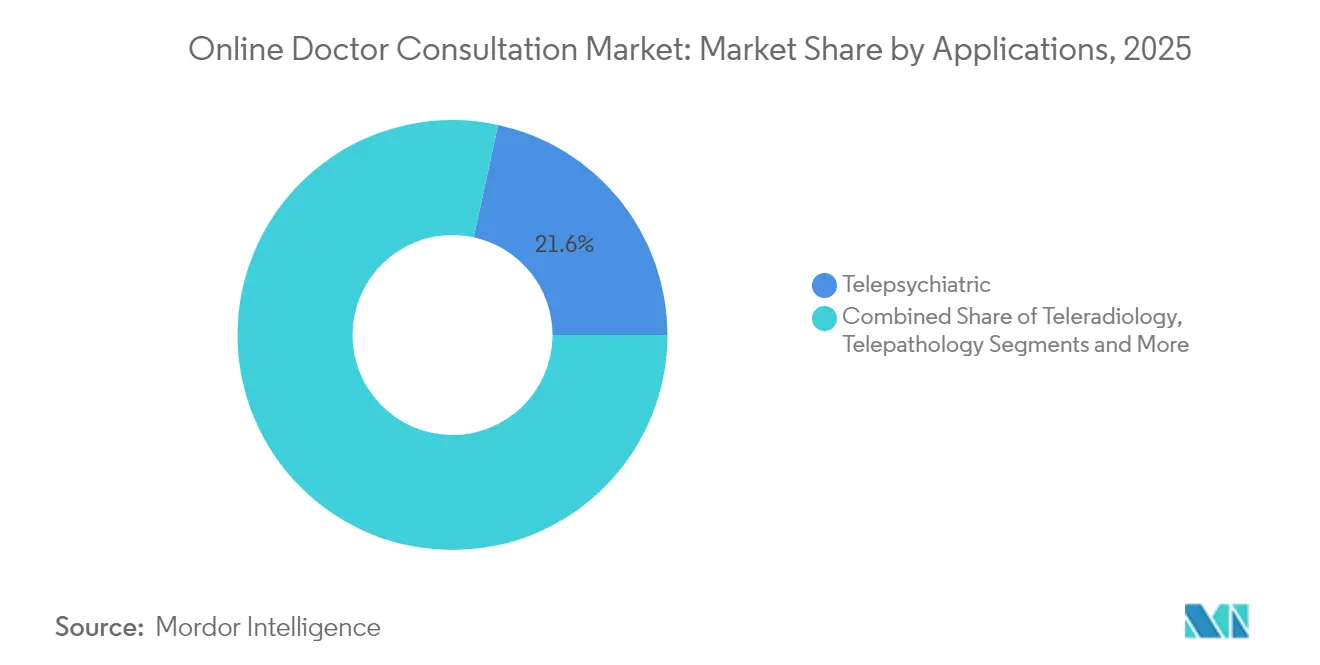
- By application, telepsychiatric services led with a 21.60% revenue share in 2025; the segment is advancing at a 28.6% CAGR through 2031.
- By end user, independent consultants captured 13.25% of the Online doctor consultation market size growth trajectory between 2026-2031, outpacing hospitals.
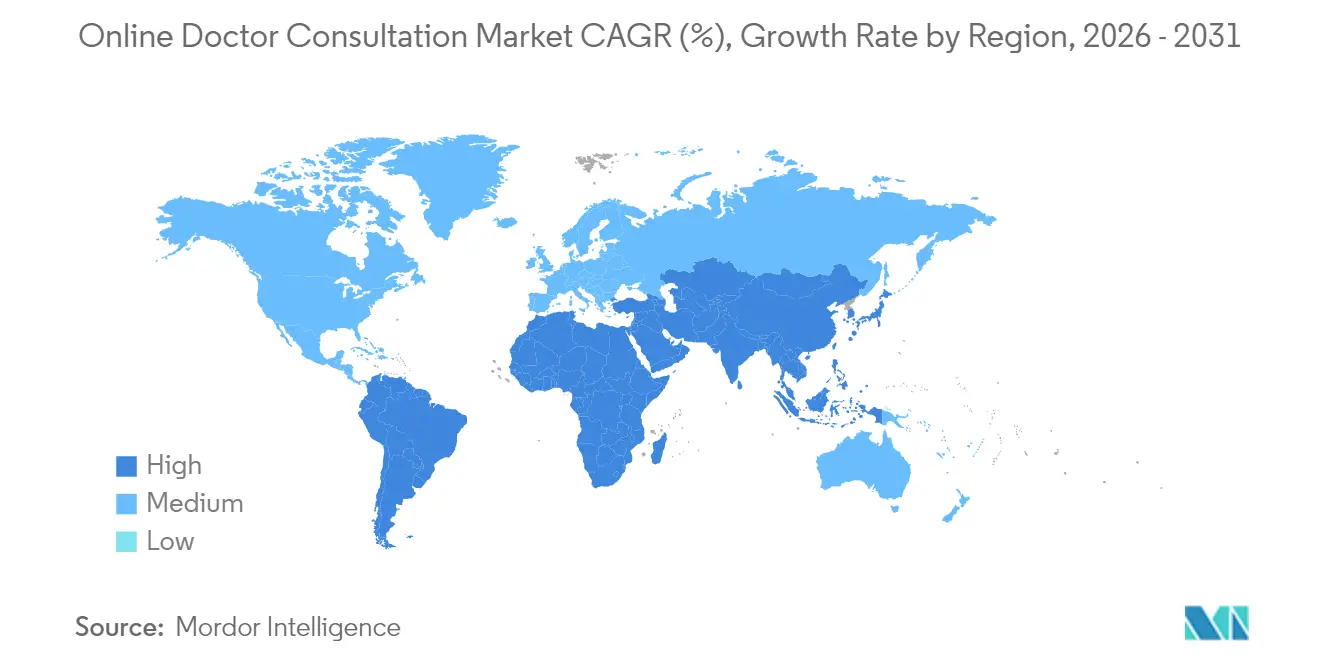
- By geography, North America led with a 37.60% share in 2025, while Asia-Pacific is the fastest-growing region at a 28.40% CAGR.
Note: Market size and forecast figures in this report are generated using Mordor Intelligence’s proprietary estimation framework, updated with the latest available data and insights as of 2026.
Market Trends and Insights
Drivers Impact Analysis of Online Doctor Consultation Market*
| Driver | (~) % Impact on CAGR Forecast | Geographic Relevance | Impact Timeline |
|---|---|---|---|
| Proliferation of 5G & Low-Latency Networks Enabling Real-time Video Visits | +1.8% | Global, with early gains in North America, Europe, and urban Asia-Pacific | Medium term (2-4 years) |
| Expansion of National e-Health Reimbursement Codes in Europe & Asia | +1.5% | Europe & Asia-Pacific core, spill-over to emerging markets | Long term (≥ 4 years) |
| Employer Adoption of Virtual-First Health Plans in North America | +1.2% | North America, with expansion to multinational corporations globally | Short term (≤ 2 years) |
| Inclusion of Mental-Health Teleconsults in Public Insurance in Japan and Australia | +0.9% | Asia-Pacific, with policy replication potential in developed markets | Medium term (2-4 years) |
| AI-Triage Chatbots Driving First-Contact Consult Volumes | +1.1% | Global, with faster adoption in tech-forward markets | Short term (≤ 2 years) |
| Source: Mordor Intelligence | |||
Proliferation of 5G and Low-Latency Networks
Ultra-high-bandwidth coverage eliminates video lags and supports streaming of continuous biometric data during online consultations, enabling telestroke triage and remote ICU monitoring in real time. [1] Rural facilities now access metropolitan specialists across multiple disciplines, reducing medical travel and bolstering local outcomes. 5G also underpins emerging virtual-reality therapies and augmented-reality surgical guidance, broadening the clinical scope of the Online doctor consultation market. Network operators and hospital systems co-invest in edge-computing hubs that process sensitive clinical data locally, maintaining privacy while meeting latency requirements.
Expansion of National e-Health Reimbursement Codes
Germany removed the ceiling on reimbursable video visits in 2024, and Singapore, Korea, and Japan activated dedicated telepsychiatry billing codes, creating a stable revenue model for providers. [2] Standardized coding aligns payment parity with in-person services, encouraging hospitals to integrate telehealth as a front-door service rather than an ancillary offering. Reimbursement harmonization also enables cross-border second opinions within regional economic blocs, amplifying addressable patient pools for platform operators.
Employer Adoption of Virtual-First Health Plans
Large employers now embed virtual visits as the first touchpoint, cutting emergency room spending by up to 30% and shortening time-to-appointment from weeks to hours. Plans route employees to Teladoc-powered primary care or chronic-disease programs before physical referrals, driving predictable volumes to platform partners. Insurers replicate the model, bundling unlimited virtual consultations with high-deductible policies to enhance perceived value while containing claims costs.
AI-Powered Triage Chatbots
Health systems deploying conversational AI document 35% shorter call-center queues and 30% more completed virtual visits as chatbots automate symptom capture and scheduling. [3] Pre-visit histories delivered to clinicians streamline workflows, lifting per-hour consult capacity. Early-phase pilots at Mayo Clinic validate 94% diagnostic concordance, reinforcing clinician confidence.
Restraints Impact Analysis of Online Doctor Consultation Market*
| Restraint | (~) % Impact on CAGR Forecast | Geographic Relevance | Impact Timeline |
|---|---|---|---|
| Fragmented E-Prescription Integration Across Cross-Border Consults | -1.3% | Global, with acute challenges in EU cross-border scenarios | Long term (≥ 4 years) |
| Physician Licensing Restrictions in South-East Asia & Middle East | -0.8% | South-East Asia & Middle East, limiting regional expansion | Medium term (2-4 years) |
| Low Digital Literacy in 65+ Segment Slowing Adoption | -0.7% | Global, with higher impact in rural and developing regions | Long term (≥ 4 years) |
| High Platform Churn Due to Freemium Pricing Wars | -0.5% | Global, with concentration in competitive urban markets | Short term (≤ 2 years) |
| Source: Mordor Intelligence | |||
Fragmented E-Prescription Integration
Divergent national drug formularies and incompatible electronic prescription standards create compliance costs that erode platform margins and slow international expansion. Telehealth providers must maintain multiple pharmacy integrations and perform country-specific validation steps, stretching IT resources and prolonging onboarding times for new markets. Progress toward a single EU eRx data set is under discussion but full convergence remains distant.
Physician Licensing Restrictions
Only 23 of 51 Asian countries have binding telemedicine rules; several require in-country licensure for every online consultation, splitting the addressable clinician pool and limiting scale economies. Platforms therefore establish separate legal entities and provider panels in each jurisdiction, raising overhead and delaying break-even timelines. Regulatory harmonization initiatives led by ASEAN health ministers could mitigate the barrier but agreement on malpractice coverage and data sovereignty remains challenging.
*Our forecasts treat driver/restraint impacts as directional, not additive. The impact forecasts reflect baseline growth, mix effects, and variable interactions.
Online Doctor Consultation Market Segment Analysis
By Platform:
Mobile Apps Accelerate Patient EngagementMobile applications represented USD 8.27 billion of revenue and 69.40% market share in 2025 within the Online doctor consultation market. Usage is projected to climb at an 26.4% CAGR as smartphones become the default health gateway. Push notifications drive appointment adherence, while integration with wearable sensors enables continuous glucose, blood-pressure, or sleep-quality feeds during consults. Patient-portal research shows 51% of US adults accessed health data via apps in 2024, up from 38% in 2020. Websites retain relevance for complex chart reviews and large-screen imaging but edge toward niche use among older or low-vision populations. The Online doctor consultation market size for website-based services is forecast to grow modestly at 18.2% CAGR, sustained by enterprise workflows such as multi-disciplinary tumor boards.
The competitive dynamic favors app-centric entrants that iterate consumer features quickly, including bilingual symptom checkers and one-click prescription refills. Yet mobile platforms must maintain rigorous security to retain clinician trust: two-factor authentication, end-to-end encryption, and device biometrics are now baseline expectations. App marketplaces also impose commission fees that website operators avoid, prompting some providers to promote progressive-web apps as cost-saving hybrids.

By Consultation Type:
Video Dominance Meets Asynchronous DisruptionVideo visits generated 59.20% of service volume in 2025, equal to USD 7.06 billion, and will expand at 24.3% CAGR as broadband and 5G coverage deepen. Synchronous video allows physicians to observe non-verbal cues and perform limited physical assessments, preserving the bedside dynamic. Audio-only calls serve follow-ups or counseling in low-bandwidth regions, while asynchronous modalities—secure text, images, and AI-guided Q&A—grow fastest at 28.1% CAGR. The Online doctor consultation market size for text-first encounters is small today but attracts cost-conscious younger demographics who value immediacy over face-to-face interaction.
AI-driven triage funnels many routine cases through chatbots that resolve queries or escalate to physicians only when clinical judgment is required. Hybrid workflows lower physician burden and monetize AI licenses, creating new revenue streams. Platform strategists therefore bundle unlimited messaging with monthly subscriptions, cross-selling premium video slots for complex issues.
By Applications:
Mental-Health LeadershipTelepsychiatry captured a 21.60% revenue share in 2025—USD 2.58 billion—within the Online doctor consultation market and is growing 28.6% annually as pandemic-related stress and workforce shortages converge. Public insurers in Japan and Australia now reimburse virtual counseling on parity with in-person sessions, unlocking latent demand. Teleradiology and telepathology contribute consistent enterprise revenue streams, while teledermatology benefits from high-resolution smartphone cameras. Telecardiology gains momentum through remote patient-monitoring bundles for hypertension and heart-failure care.
Competitive differentiation hinges on specialty depth: mental-health platforms add AI sentiment analysis and 24/7 crisis interventions, whereas imaging-focused services integrate PACS connectivity and DICOM viewers. The Online doctor consultation market share of niche fields such as teleophthalmology remains below 3% due to equipment requirements, but innovations in phone-based visual acuity testing could spark future expansion.
By End User:
Independent Consultants Gain MomentumHospitals owned 34.50% of revenue in 2025 yet face margin pressure as independent consultants grow at 26.8% CAGR, riding physician dissatisfaction with facility employment models. The Online doctor consultation market size attributable to independents is projected to surpass USD 12.34 billion by 2031 as direct-pay telehealth and concierge models proliferate. Hospitals, however, retain complex care pathways and insurer networks that independents cannot easily replicate. Rehabilitation centers and retail clinics build hybrid models, blending brick-and-mortar therapy with virtual check-ins to maintain continuity.
Platform vendors now tailor practice-management suites with scheduling, payment, and malpractice coverage features that lower administrative barriers for physicians launching solo telehealth practices. Cloud-based EHR integration ensures continuity as patients transition between independent and hospital-based providers, reinforcing ecosystem stickiness.
Geography Analysis
North America Online Doctor Consultation Market
North America generated 37.60% of global revenue in 2025, underpinned by Medicare’s expanded telehealth codes (now extended through 2025) and employer-sponsored virtual-first plans that cover tens of millions of workers. US consumer surveys reveal 64% of adults prefer online visits for routine issues, citing convenience and time savings. Canada integrates telehealth to bridge remote-community physician gaps, while Mexico’s Seguro Popular successor program tests mobile e-health pilots. Despite mature infrastructure, broadband deserts and low digital literacy among seniors still cap universal uptake, requiring targeted subsidy and education programs.
Europe Online Doctor Consultation Market
Europe’s progress is steady but heterogeneous. Germany abolished online-visit volume caps, and the European Health Data Space aims to standardize cross-border record exchange. Nordic countries approach full reimbursement parity, whereas Eastern Europe faces budget and infrastructure headwinds. The Online doctor consultation market benefits from pan-EU migration, with expatriates seeking specialists in their language across borders. GDPR compliance imposes rigorous data-security obligations that favor well-capitalized incumbents.
APAC and Middle East Online Doctor Consultation Market
Asia-Pacific advances fastest, at 28.40% CAGR, propelled by population scale and government initiatives. India’s eSanjeevani has logged more than 275 million visits, demonstrating low-cost telehealth scalability. China’s “Internet + Healthcare” ecosystem blends AI triage, electronic prescriptions, and couriered medicines. Australia’s Medicare subsidizes virtual mental-health sessions, addressing rural shortages. Regulatory fragmentation persists—only 23 of 51 Asian nations have binding telehealth laws—but ASEAN working groups are drafting mutual-recognition frameworks. The Middle East liberalizes slowly, yet the Gulf Cooperation Council funds national telehealth platforms to manage chronic-disease burdens amid expatriate populations.
Regulatory Landscape
Regulation for online doctor consultation continues to move from interim pandemic-era allowances toward codified telehealth standards, with reimbursement, prescribing, and documentation rules shaping platform design. In the United States, CMS policy updates effective January 1, 2026 removed telehealth frequency limits for certain inpatient, nursing facility, and critical care contexts, supporting ongoing utilization where providers rely on Medicare payment rules. In Europe and parts of Asia, reimbursement and coding expansion remain key commercialization levers (for example, Germany removing ceilings on reimbursable video visits in 2024). Privacy and consent requirements, including GDPR compliance in the EU, also favor platforms with mature security, auditability, and clinical governance.
Emerging and city-state style regulators are formalizing operational standards that affect cross-border service models. Dubai Health Authority (DHA) telehealth standards specify expectations around patient consent and teleconsultation modalities (including chat-based options), which shapes how providers onboard patients and manage records for remote encounters. In Africa, the Medical Council of Malawi issued Regulations and Standards for Telehealth effective April 1, 2026, setting requirements around documentation and the practitioner-patient relationship, which increases compliance needs for platforms entering new jurisdictions. Australia also tightened telehealth prescribing and identity verification expectations through AHPRA-aligned guidance, pushing platforms to incorporate real-time identity checks and contemporaneous record-keeping into clinician workflows.
Competitive Landscape
Global leadership is contested by Teladoc Health, Amwell, Ping An Good Doctor, Practo, Doctor Anywhere, and several regional specialists. Consolidation accelerates capability expansion: Teladoc purchased UpLift Health (USD 30 million) for mental-health depth and Catapult Health (USD 65 million) for at-home screenings in 2025. Amwell divested its psychiatric unit to Avel eCare, reallocating capital to core platform R&D and enterprise integrations. Asian players focus on consumer market-share grabs through multilingual chatbots and embedded pharmacy delivery.
Competitive vectors increasingly revolve around:
1. Clinical-outcome evidence—platforms publish peer-reviewed reductions in HbA1c or depression scores;
2. AI differentiation—first-contact triage, auto-documentation, and risk prediction;
3. Omnichannel fulfillment—integrating diagnostics, labs, and same-day prescription shipping.
Partnership ecosystems matter: Teladoc’s alignment with Amazon Health provides seamless enrollment of chronic-care programs to Prime members. Australian insurer Medibank selected Amwell for preventative initiatives, demonstrating B2B2C reach. Start-ups attack white spaces, such as language-specific marketplaces serving migrant workers or AI-only asynchronous consults for dermatology.
Pricing competition remains measured; most platforms pivot from freemium to subscription bundles for unlimited primary-care access. That shift lowers churn and improves lifetime value. Hardware integration—sphygmomanometers, glucometers, wearables—creates additional lock-in and data moat advantages.
Online Doctor Consultation Industry Leaders
-
Babylon Health
-
Practo Technologies Pvt. Ltd
-
Alibaba Health Information Technology Limited
-
Doctor Anywhere
-
Amwell Inc.
- *Disclaimer: Major Players sorted in no particular order
Online Doctor Consultation Market Companies Covered in this Report
- Doctor Anywhere
- Amwell Inc.
- Babylon Health
- Doctor On Demand Inc.
- Practo Technologies Pvt. Ltd.
- Teladoc Health Inc.
- Ping An Good Doctor
- Alibaba Health Information Technology Ltd.
- Kry International AB'
- HealthTap Inc.
- MDLive
- The GP Service
- LiveHealth Online
- CallHealth
- 1mgInc.
- Zocdoc Inc.
- PlushCare Inc.
- Teladoc (BetterHelp – Mental-Health)
Market Opportunities and Future Outlook
Near-term opportunity centers on aligning virtual care workflows to regulator-backed reimbursement and documentation requirements, while using AI to raise clinician throughput without weakening governance. Policy anchors such as CMS telehealth rules effective January 1, 2026 and formal telehealth standards from bodies including Dubai Health Authority and Malawi's Medical Council create clearer compliance checklists. That, in turn, opens whitespace for platform vendors offering audit-ready consent capture, identity verification, and standardized encounter documentation as configurable modules for hospitals and independent clinicians. Cross-border e-prescription and formulary integration remains another bottleneck, since fragmentation continues to raise cost and friction for multi-country platforms serving expatriate and migrant populations.
In Asia-Pacific, government-led digital health rails and large-scale public utilization support commercialization paths for platforms that integrate identity, records, and payments into mobile-first patient journeys. India is a prominent example, where initiatives such as Ayushman Bharat Digital Mission (ABDM) standardize digital health infrastructure, supporting ecosystem integration for providers and marketplaces operating alongside scaled public teleconsultation usage (for example, eSanjeevani). Competitive activity also points to ongoing investment capacity for expansion and product depth. Practo has discussed preparatory steps toward evaluating a potential IPO in the second half of 2026 and a domicile shift to support domestic listing compliance, while incumbents continue to invest in AI triage and enterprise integrations. Together, these signals support opportunities for platforms that pair specialty depth, notably mental health and chronic care, with compliant AI-assisted intake, documentation, and care navigation across employer, payer, and public-channel demand.
Recent Industry Developments in Online Doctor Consultation Market
- July 2026: Doctor Anywhere partnered with Financial Alliance Pte Ltd to provide healthcare services, including screening and navigation, to consultants and their clients. The collaboration expands access to paid corporate healthcare offerings in APAC and enhances care navigation capabilities. The arrangement strengthens near-term revenue stability through payer and enterprise contracts and extends Doctor Anywhere's home-based services footprint.
- July 2026: Doctor Anywhere - Partnered with Financial Alliance Pte Ltd to provide healthcare services, including screening and navigation, to consultants and their clients. The move broadens enterprise access in APAC and strengthens the company's distribution network. It reinforces revenue diversification by adding payer driven demand and expanding care navigation capabilities.
- May 2026: Alibaba Health Information Technology Limited launched Hydrion, a large language model designed for doctors and medical researchers, integrating AI with Internet healthcare services. It introduces AI assisted clinical workflows within online doctor platforms. The development enables AI enabled clinical triage and documentation, expanding platform differentiation and potential regulatory interactions.
Online Doctor Consultation Market Report Scope and Research Methodology
Market Definition and Coverage
For this study, the market covers paid, remote consultations where a licensed clinician delivers medical advice, triage, and follow up through digital channels, and revenue is counted when the consultation service is delivered and billed.
Scope exclusions: Remote patient monitoring subscriptions, connected devices, and pure e-pharmacy order value are excluded unless they are priced and sold as part of a consultation encounter.
Segments Covered in This Report
- By Platform
- Website
- Mobile Apps
- By Consultation Type
- Video Chat
- Audio Chat
- Other Consultation Types
- By Applications
- Telepyschiatric
- Teleradiology
- Telepathology
- Teledermatology
- Telecardiology
- Other Applications
- By End User
- Hospitals
- Independent Consultants
- Rehabilitation Centers
- Other End-users
- By Geography
- North America
- United States
- Canada
- Mexico
- Europe
- United Kingdom
- Germany
- France
- Nordics
- Rest of Europe
- Asia-Pacific
- China
- India
- Japan
- South Korea
- Rest of Asia-Pacific
- South America
- Brazil
- Argentina
- Rest of South America
- Middle East
- United Arab Emirates
- Saudi Arabia
- Kuwait
- Rest of Middle East
- Africa
- South Africa
- Nigeria
- Rest of Africa
- North America
Data Sources, Market Sizing, and Validation
Desk Research
Desk research is used to set the market boundary, map the care settings where virtual visits are permitted, and anchor the model with comparable health system and digital adoption indicators. We reviewed public sources such as CDC telehealth briefs, CMS fee schedule and utilization releases, WHO digital health guidance, OECD health statistics, and World Bank population and connectivity series, since these help normalize demand potential across countries.
To translate activity into revenue, we also used company filings, investor presentations, audited annual reports, and reputable press coverage to understand visit mix, pricing approach, and payer channel changes. Where available, paid subscriptions for company financials and paid patent database access were used to cross-check growth narratives and platform feature direction. This list is illustrative only, and many other public and paid sources were consulted to collect, validate, and clarify data points.
Primary Interviews and Surveys
Primary work focused on validating what actually gets billed as an online consultation, how pricing differs by specialty and channel, and how repeat visits and follow ups are treated in revenue reporting. We spoke with provider side leaders, platform operations teams, and payer adjacent experts across major regions so assumptions on utilization and pricing could be corrected before final totals were locked.
Interviews also helped resolve gaps when public reporting was limited, including the split of video versus audio visits, the share of paid visits versus promotional offers, and how cross border consultations are handled for currency conversion and invoicing timing.
Distribution of primary research fieldwork respondents
| Company type | Respondent position | Region |
|---|---|---|
| Top tier: 30% | CXOs: 13% | APAC: 47% |
| Mid tier: 53% | Functional/Unit leaders: 31% | EMEA: 32% |
| Smaller Players: 17% | Managers: 56% | Americas: 21% |
Market-Sizing & Forecasting
Sizing starts with a top-down build that reconstructs the addressable visit pool by country using digital access readiness, outpatient visit intensity, and the share of encounters that can be shifted to virtual care under prevailing rules. Once that demand pool is set, revenue is estimated using a visit mix and average price logic, then checked against selective bottom-up signals such as sampled provider revenue disclosures, platform reported paid visit volumes, and channel checks with clinics.
Key model inputs included the split of video versus audio consultations, specialty mix (for example behavioral health versus general practice), payer versus self-pay share, average consultation fee ranges and discounting patterns, and observed utilization seasonality around flu periods and public health events. Forecasting was run using scenario analysis supported by exponential smoothing on utilization trendlines, with assumptions tuned using what interviewees expect on reimbursement stability, clinician supply, and consumer repeat behavior. Where data gaps existed for smaller countries, proxy rates were used from comparable markets and adjusted using internet penetration and physician density differences.
Data Validation & Update Cycle
Model outputs are reviewed through multiple checks so totals do not drift away from real world signals. We compare implied paid visits, implied revenue per visit, and regional growth rates against independent indicators such as reimbursement changes, reported platform performance, and health system utilization releases, and then outliers are reworked or removed.
Before sign-off, another analyst reviews assumptions and recalculations so variance drivers are clearly documented. The report is refreshed annually, with interim updates triggered when material items occur (for example policy shifts, major price resets, or large demand shocks). Before delivery, a final update pass is completed so clients receive the latest aligned view.
Mordor Intelligence's Online Doctor Consultation Market Sizing Compared With Other Published Estimates
Published market sizes for online doctor consultation often differ because groups do not count revenue in the same way, and the timing of price and currency conversion can change the number even when usage trends look similar. Differences also come from whether the estimate is built around paid visit value, broader telehealth bundles, or a mix of services adjacent to consultations.
A refresh-led point matters here because telehealth pricing and visit reimbursement can change during the year, and the model reacts differently depending on when average prices are updated and when exchange rates are applied. By running periodic checks on implied revenue per paid visit and updating currency timing assumptions alongside new utilization signals, Mordor Intelligence keeps the market total aligned to what is being billed for consultation encounters rather than inflated by adjacent digital health revenue.
Benchmark comparison
| Source | Market Size | Gaps in Research Methodology |
|---|---|---|
| Mordor Intelligence | USD 15.01 B (2026) | |
| Global Consultancy A | USD 12.59 B (2025) | Uses an earlier base year and applies a flatter average fee curve, which can understate revenue when video consult share and payer coverage expand. |
| Trade Journal B | USD 38.87 B (2028) | Reports growth as an absolute increase over a period, and the implied base can fold in broader telehealth services beyond consultation-only billing. |
The comparison shows that timing and scope boundaries explain most of the spread, not just different growth views. When the counted revenue is limited to billed consultation encounters and pricing and exchange-rate timing are kept current, the resulting total stays easier to trace back to paid visits, mix, and average fee assumptions that can be repeated and rechecked.
Key Questions Answered in the Report
What is the current size of the Online doctor consultation market?
The market stands at USD 15.01 billion in 2026 and is on track to reach USD 47.18 billion by 2031, reflecting a 25.74% CAGR.
Which region is growing fastest?
Asia-Pacific posts the highest growth at a 28.40% CAGR, driven by large-scale public platforms and supportive reimbursement in Japan, India, and Australia.
What platform type dominates usage?
Mobile applications led with 69.40% of global visit volume in 2025 thanks to smartphone penetration and integrated wearable-sensor data.
How are employers influencing adoption?
North American corporations implement virtual-first benefit plans that route employees to online primary care, cutting ER spending by up to 30% and boosting predictable telehealth volumes.
Which specialty segment shows the strongest growth?
Telepsychiatry leads with a 21.60% revenue share and a 28.6% CAGR as mental-health demand surges and parity reimbursement expands.
What are the main regulatory hurdles?
Cross-border e-prescription incompatibility and fragmented physician licensing in parts of Asia and the Middle East limit international scaling, shaving as much as 1.3 percentage points off forecast CAGR.