
Market Overview
| Study Period | 2020 - 2031 |
|---|---|
| Forecast Data Period | 2026 - 2031 |
| Base Year Market Size (2025) | USD 206.19 Million |
| Market Size (2026) | USD 214.64 Million |
| Market Size (2031) | USD 261.28 Million |
| Growth Rate (2026 - 2031) | 4.09 % |
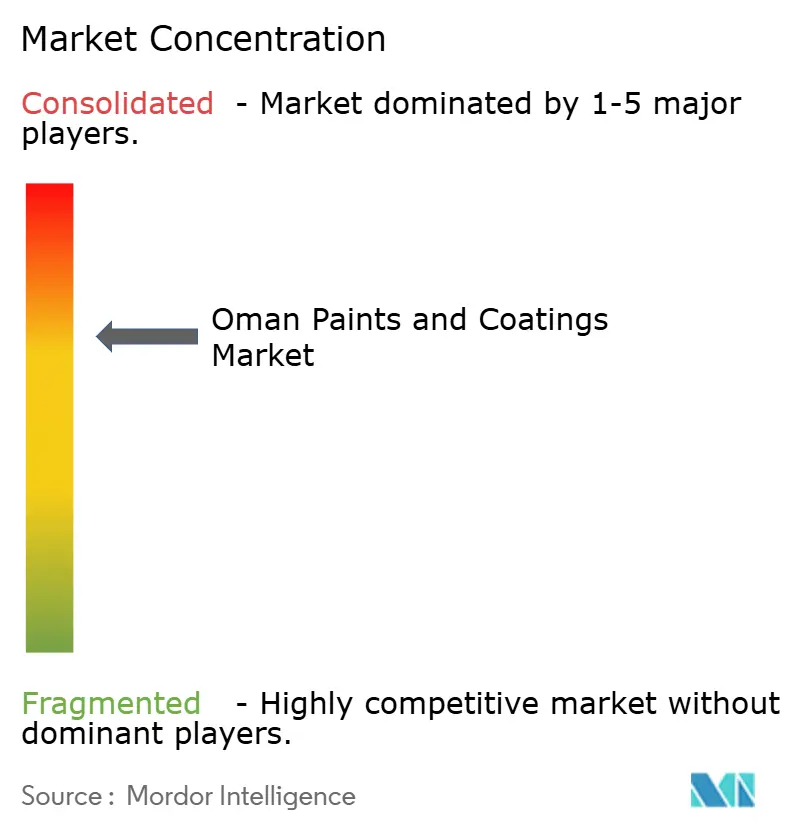
| Market Concentration | Medium |
Major Players *Disclaimer: Major Players sorted in no particular order Image © Mordor Intelligence. Reuse requires attribution under CC BY 4.0. | |
Oman Paints And Coatings Market Analysis by Mordor Intelligence
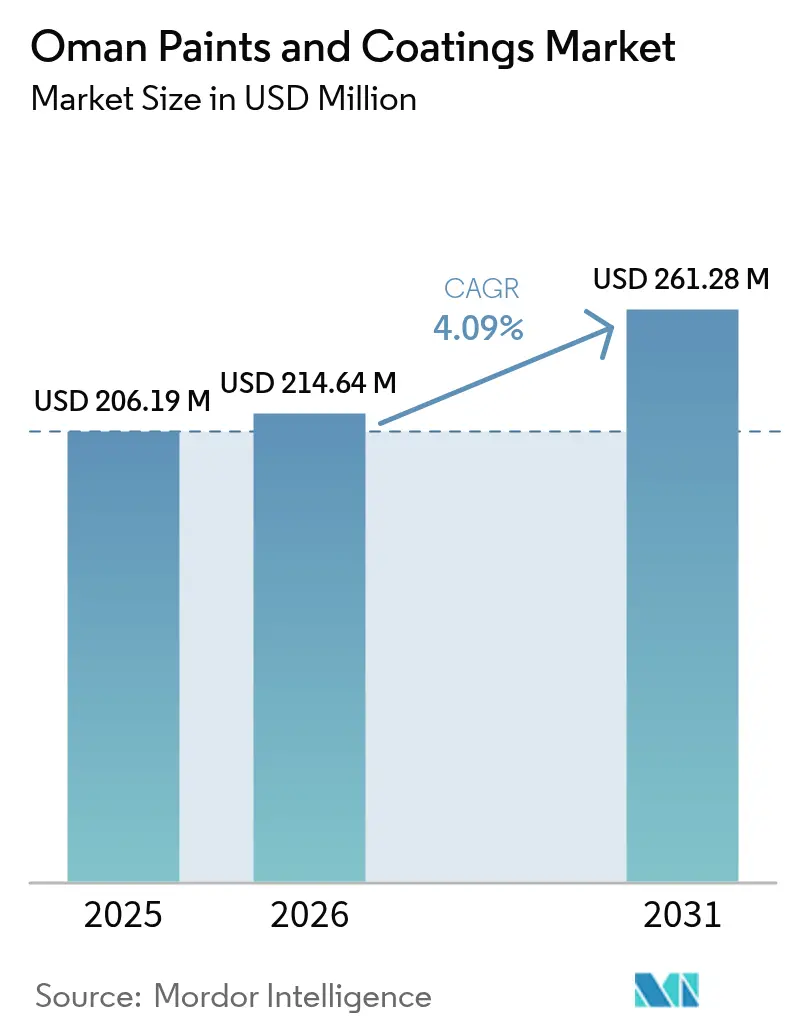
Oman Paints And Coatings Market size in 2026 is estimated at USD 214.64 million, growing from 2025 value of USD 206.19 million with 2031 projections showing USD 261.28 million, growing at 4.09% CAGR over 2026-2031. Robust capital spending on housing, transport corridors, industrial zones, and tourism complexes keeps the Oman paints and coatings market steadily growing. Residential programs led by the Ministry of Housing and Urban Planning, the expansion of special economic zones at Duqm and Sohar, and a rising pipeline of luxury resorts all translate into firm demand for decorative, protective, and specialty finishes. Tighter national VOC (Volatile Organic Compound) limits promote faster adoption of water-borne technologies, while the rising profile of green hydrogen and large-scale solar projects unlocks niche opportunities in high-performance protective systems. Competition remains intense as global majors defend their share with sustainability-aligned portfolios and local producers leverage cost advantages and proximity to public-sector buyers. Supply-chain vulnerability to imported specialty resins tempers the outlook, yet expanding domestic petrochemicals capacity offers a partial buffer.
Key Report Takeaways
- By resin type, acrylic captured 40.77% of the Oman paints and coatings market share in 2025. Polyurethane is projected to expand at a 4.29% CAGR through 2031.
- By technology, water-borne products led with 61.92% revenue share in 2025. UV-cured systems are forecast to post the fastest 4.71% CAGR to 2031.
- By end-user industry, architectural applications accounted for 55.86% of the Oman paints and coatings market in 2025. Wood coatings are advancing at a 4.58% CAGR to 2031.
Note: Market size and forecast figures in this report are generated using Mordor Intelligence’s proprietary estimation framework, updated with the latest available data and insights as of 2026.
Oman Paints And Coatings Market Trends and Insights
Drivers Impact Analysis*
| Driver | (~) % Impact on CAGR Forecast | Geographic Relevance | Impact Timeline |
|---|---|---|---|
| Government-led Housing Projects Boosting Decorative Paints Demand | +1.2% | National, concentrated in Muscat, Al Batinah, Dhofar | Medium term (2-4 years) |
| Infrastructure Investments Under “Oman Vision 2040” | +1.5% | National, with focus on Duqm, Sohar, Salalah economic zones | Long term (≥ 4 years) |
| Rising need for Corrosion-resistant Coatings in Oil and Gas Assets | +0.8% | Concentrated in petroleum-producing regions, offshore facilities | Short term (≤ 2 years) |
| Tourism-driven Hotel Construction Fuelling Premium Coatings Uptake | +0.6% | Coastal areas, Muscat, Salalah, mountain tourism zones | Medium term (2-4 years) |
| New Low-VOC Regulations Accelerating Switch to Water-borne Systems | +0.9% | National, with stricter enforcement in industrial zones | Short term (≤ 2 years) |
| Source: Mordor Intelligence | |||
Government-led Housing Projects Boosting Decorative Paints Demand
Ongoing public housing and school construction is the largest single demand engine for the Oman paints and coatings market. Twelve new government-funded schools with 40 classrooms and completion deadlines extending to 2028 ensure multi-year procurement cycles for interior and exterior architectural finishes. Concurrently, 4,800 integrated residential units are under development, and heritage authorities require breathable mineral coatings on more than 100 fort and castle restoration sites[1]. These specifications favor high-grade, water-borne acrylics that satisfy durability, color-fastness, and historical authenticity requirements, securing predictable volumes for compliant suppliers. Long-term horizons enhance production planning accuracy and inventory optimization.
Infrastructure Investments Under “Oman Vision 2040”
A USD 25 billion project pipeline covering highways, rail, ports, and metro systems underpins the long-term expansion of the Oman paints and coatings market. The 400 km Adam-Haima-Thumrait dual carriageway, the Sohar-Abu Dhabi rail link, and Muscat metro plans demand road-marking, bridge protection, and anti-corrosion products. The Duqm Special Economic Zone’s refinery, petrochemical, and port assets drive uptake of marine and chemical-resistant systems. Large-scale solar farms targeting a 30% renewable mix by 2030 require UV-stable structural coatings. The breadth of infrastructure assets sustains baseline consumption while creating specialist niches that reward technically advanced suppliers.
Rising Need for Corrosion-Resistant Coatings in Oil and Gas Assets
Mature upstream fields, high-salinity pipelines, and high-temperature separators accelerate corrosion, keeping protective volumes resilient. Block 61’s Khazzan and Ghazeer phases illustrate scale: over 500 km of coated pipe, extensive separators, heat exchangers, and storage tanks specified for epoxy and polyurethane systems rated above 80 °C. Plans for more than 1 million tpa of green hydrogen capacity introduce hydrogen-compatible linings. Global majors leverage proven offshore track records, while local applicators gain share through competitive labor and quick mobilization. The segment remains sensitive to oil-price swings but benefits from mandatory maintenance cycles that cannot be deferred indefinitely.
Tourism-Driven Hotel Construction Fuelling Premium Coatings Uptake
The USD 500 million Trump International Oman resort and a USD 2.4 billion mountain destination project headline an expanding luxury pipeline that stimulates premium decorative, wood, and protective systems. Salalah’s khareef season drew over 1 million visitors in 2024, prompting more resort permits that stipulate weather-proof, UV-resistant façades and marine-grade deck finishes. Elevated altitude developments at 2,400 m require coatings capable of large thermal‐cycle tolerance and enhanced UV durability. International hotel chains impose global brand standards, pushing demand toward high-performance, warranty-backed product lines where multinationals enjoy a competitive edge.
Restraints Impact Analysis*
| Restraint | (~) % Impact on CAGR Forecast | Geographic Relevance | Impact Timeline |
|---|---|---|---|
| Volatile Crude-oil-based Raw-material Prices | -0.7% | Global supply chain impact, affecting all regions | Short term (≤ 2 years) |
| Slow Recovery of Domestic Automotive OEM Production | -0.4% | National, concentrated in industrial zones | Medium term (2-4 years) |
| Import Dependence for Specialty Resins Causing Supply Risk | -0.5% | National, affecting all manufacturers and distributors | Short term (≤ 2 years) |
| Source: Mordor Intelligence | |||
Volatile Crude-Oil-Based Raw-Material Prices
Petroleum-derived inputs account for roughly 30% of formulation costs and move with Brent benchmarks; every USD 10 per-barrel fluctuation shifts average unit costs by 2-3%. Upstream entities reported higher gas expenses in early 2025, amplifying cost pass-through pressure. European anti-dumping duties on Asian epoxy suppliers further tightened global availability, prompting local manufacturers to negotiate alternate sources at premium levels. Price uncertainty encourages long-term supply contracts and indexed pricing, but these arrangements erode competitiveness in fixed-price government tenders.
Slow Recovery of Domestic Automotive OEM Production
Oman’s modest assembly base remains below pre-pandemic output, constraining original-equipment volumes for automotive topcoats, primers, and electro-deposition products. While aftermarket refinishing sustains baseline consumption, subdued original equipment manufacturer (OEM) demand keeps utilization rates at dedicated coating lines below break-even thresholds. Manufacturers redirect capacity toward industrial or wood-coating batches to maintain asset productivity, yet product-mix shifts dilute margins and limit innovation budgets earmarked for next-generation auto finishes.
*Our forecasts treat driver/restraint impacts as directional, not additive. The impact forecasts reflect baseline growth, mix effects, and variable interactions.
Segment Analysis
By Resin Type: Acrylic Leadership Anchored in Coastal Durability
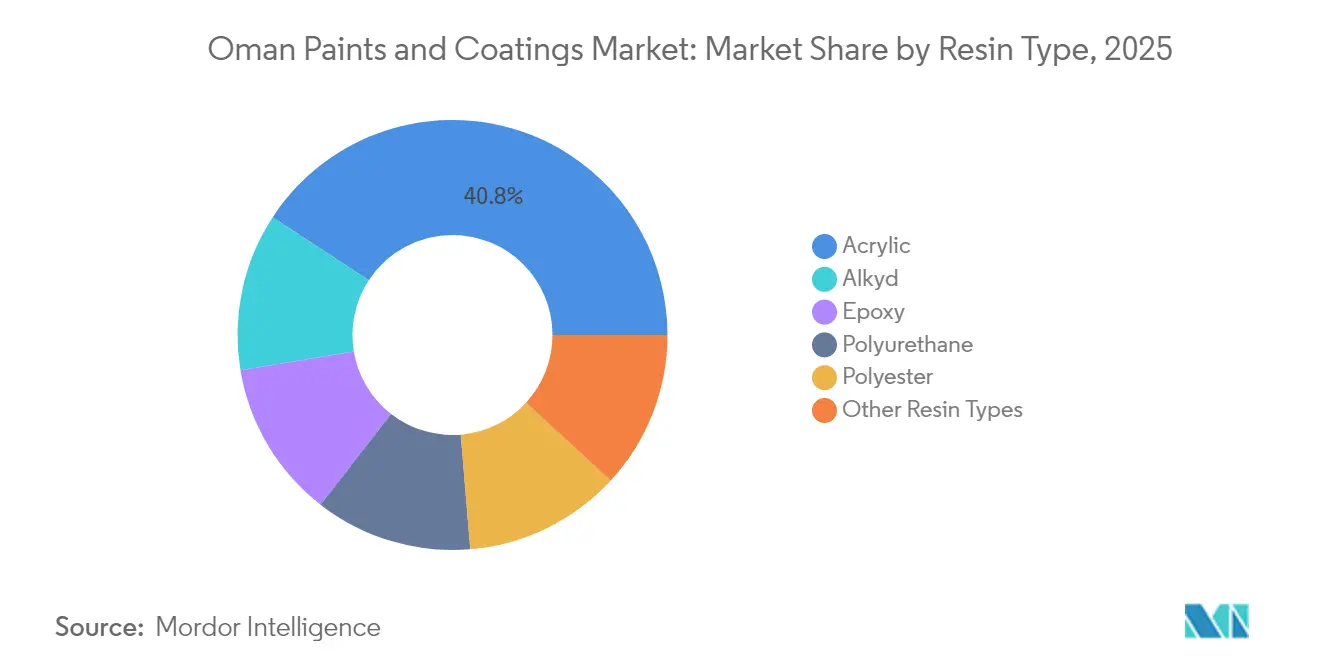
Acrylic systems generated 40.77 % of the Oman Paints and Coatings market share in 2025, thanks to superior salt-spray resistance, color retention, and fast drying that satisfy coastal housing and public-works specifications. The Oman paints and coatings market continues to favor acrylics in both flat and glossy sheens for exterior façades, while interior spaces migrate toward low-odor, water-borne variants that ease on-site application. Alkyds remain in budget interior segments, yet regulatory VOC pressure accelerates substitution. Epoxies serve mid-film and tank-lining uses where solvent-free or high-solids formulations meet stringent chemical-resistance requirements in hydrocarbon processing plants.
Polyurethane registers the fastest 4.29% CAGR through 2031, buoyed by rising furniture manufacturing, parquet flooring, and long-life industrial topcoat demand. Polyesters carve out niches in powder-coated façades, handrails, and HVAC louvers that adorn Muscat’s skyline. Specialty silicone, polysiloxane, and fluoropolymer chemistries gain traction in marquee projects demanding 15-year color warranties. Capital investment in OQ’s polymer complex could feedstock locally produced intermediates, yet specialty resin production remains mostly imported, anchoring international supplier relationships in high-performance segments of the Oman paints and coatings market.

By Technology: Water-Borne Dominance Under Environmental Mandates
Water-borne systems held 61.92% of the Oman Paints and Coatings market size in 2025 as stricter VOC ceilings and growing consumer health awareness converged. National enforcement and architectural contractor preference for low-odor job sites convert previously solvent-rich segments into latex acrylics and self-crosslinking polyurethane dispersions. Solvent-borne alkyds and epoxies persist in niche roles where ambient-cure performance or deep-penetrating primers are indispensable, but manufacturers now deploy higher-solids versions to reduce emissions footprints.
Powder coatings benefit from a near-zero VOC status, expanded by local metal-fabrication demand for cladding, window frames, and railing systems. UV-cured formulations record the quickest 4.71% CAGR, driven by high-throughput wood lines serving furniture exporters and regional joinery workshops. Capital outlays for UV lamps and inert-atmosphere tunnels remain barriers for small job shops, yet large players offset upfront costs via productivity gains, shorter takt times, and reduced floor space. The technology mix underscores how environmental regulation reshapes competitive advantage across the Oman paints and coatings market.
By End-User Industry: Architectural Spending Sets the Pace
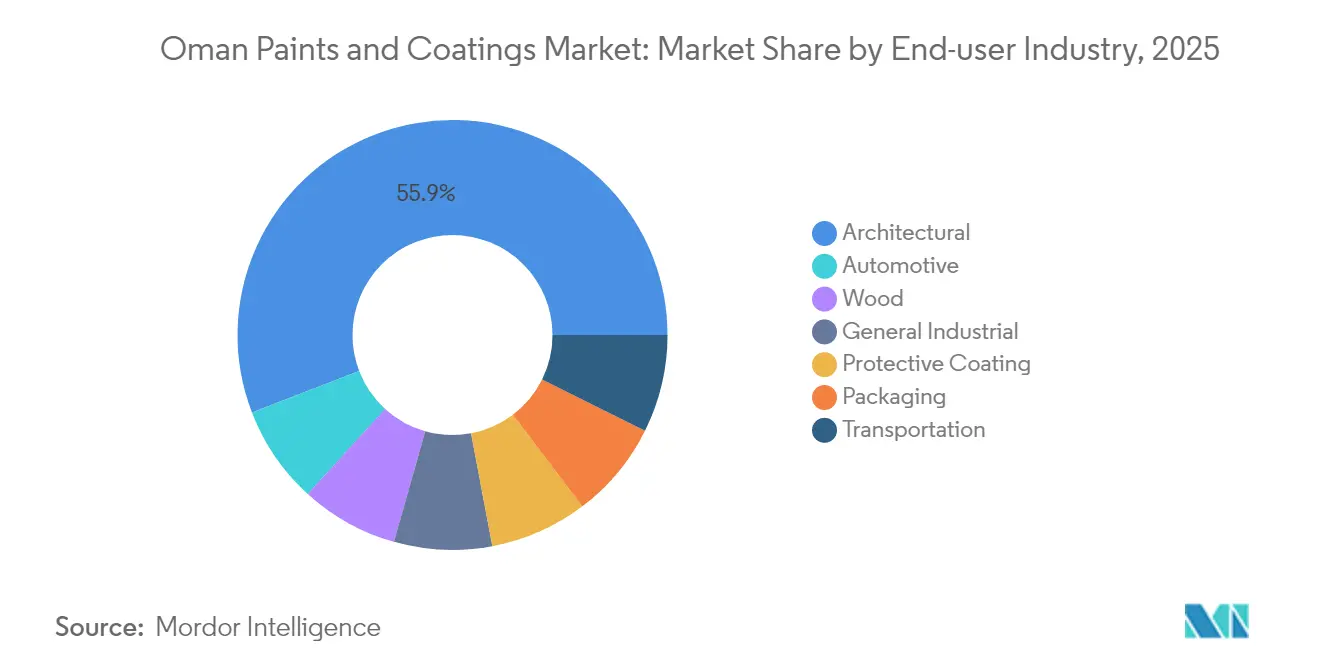
The architectural sector contributed 55.86% of 2025 revenue as public housing, educational facilities, and hospitality complexes dominated project pipelines. Government budget visibility to 2028 secures demand for steady base coats, putties, and finish coats. Mid-to-high-end decorative lines now integrate anti-microbial additives and solar-reflective pigments to meet emerging green-building codes and thermal-comfort targets.
Wood coatings post a leading 4.58% CAGR, propelled by furniture clusters in Sohar and Salalah that supply hotel fit-outs and residential refurbishments. Protective coatings remain indispensable for pipelines, storage tanks, and port structures, sustaining recurring demand cycles even during oil-price downturns. General industrial volumes track broader manufacturing activity, expanding with downstream metals processing and food-packaging facilities. Automotive consumption improves gradually via import vehicle refinishing centers rather than OEM lines, while transportation coatings await the Sohar-Abu Dhabi rail and fleet renewal programs to unlock future upside for the Oman paints and coatings market.
Geography Analysis
Muscat Governorate anchors consumption, underpinned by flagship hospitality investments such as the USD 500 million Trump International resort and a vibrant expatriate real-estate market that logged OMR 545.6 million in foreign property contracts during H1 2024. High-rise residential towers, premium retail malls, and office fit-outs ensure diversified coatings pull-through, while well-established distributor networks shorten delivery lead times. Large applicator companies headquartered in the capital command robust bargaining power, influencing product specification and driving early adoption of low-VOC and color-retention technologies in the Oman paints and coatings market.
Al Batinah North and South rank as the fastest-growing regions to 2031. Sohar’s deep-sea port, free-zone incentives, and the USD 300 million polymer plant bolster industrial coatings uptake for storage tanks, conveyor frames, and process equipment. Proximity to raw-material imports via port facilities lowers logistics costs and attracts further fabrication activity that consumes primers, mid-coats, and heat-resistant finishes. Concurrently, Al Batinah’s coastal resorts and mid-income housing estates lift decorative volumes, cementing the governorate’s status as a dual-track growth engine.
Dhofar Governorate leverages the khareef monsoon season to expand hotel capacity, resort villas and supporting infrastructure. High humidity and salt-laden breezes necessitate specialized anti-fouling and weather-resistant systems, differentiating supplier offerings in the Oman paints and coatings market. Construction at Salalah Free Zone and a methane-to-blue-ammonia complex supports protective demand, while plans for the Duqm-Salalah economic corridor promise improved logistics that could further integrate Dhofar into national distribution grids. Interior governorates, including Ad Dakhiliyah and Ash Sharqiyah, benefit from highway corridors like Adam-Haima-Thumrait and the scattered school-building program, yet thinner contractor networks and longer transit distances constrain volume density. Musandam’s strategic fuel-storage initiatives provide niche opportunities but remain limited by small population and challenging topography.
Regulatory Landscape
Oman regulates paints and coatings through mandatory product standards, import controls, and facility-level environmental permitting. The Directorate General of Specifications and Metrology (DGSM) under the Ministry of Commerce, Industry and Investment Promotion (MoCIIP) oversees conformity assessment, including mandatory Omani standards such as OS 197/2021 for emulsified paints and OS 240/2021 for alkyd-based paints, with harmonization to Gulf Standards Organization (GSO) requirements where applicable.
On the trade side, importing paints requires a permit process via the Directorate General of Customs, supported by shipment documentation including a manufacturer/importer declaration of conformity and product test reports from accredited laboratories. On the environmental side, the Environment Authority (EA) governs industrial environmental compliance and permitting, with procedural requirements for obtaining environmental permits set out under Decision 107/2023 alongside broader controls on air pollutants and hazardous chemicals referenced in ministerial decisions such as MD 118/2004 and MD 50/2023. These requirements influence technology choices, particularly around lower-emission formulations and compliant handling of hazardous inputs.
Value Chain Analysis
The Oman paints and coatings value chain begins with mostly imported binders, pigments, additives, and specialty resins, followed by local and regional blending or manufacturing, then distribution through dealers, tinting centers, and contractor-linked supply networks. Multinational suppliers (such as Jotun, AkzoNobel, Hempel, and Asian Paints Berger) and regional or local manufacturers (including National Paints Factories and other local entities) compete across decorative, protective, marine, and industrial segments. Manufacturing and warehousing are clustered around established industrial areas and logistics nodes.
Regulatory compliance is built into the chain and affects lead times and working capital. Importers must manage shipment-level documentation through the Directorate General of Customs permit-to-import process, supported by conformity certificates, declarations, and test reports aligned with DGSM-managed mandatory standards, notably OS 197/2021 and OS 240/2021. Downstream, sales execution depends on nationwide retail and contractor channels for architectural volumes and on specification-driven supply for oil and gas assets, ports, and industrial zones, where applicator capability and on-site technical service shape brand selection and product mix.
Competitive Landscape
The Oman Paints and Coatings market is consolidated. AkzoNobel, Jotun, and BASF defend decorative leadership through premium branding, nationwide tinting systems, and compliance credentials that satisfy public-sector tender criteria. Local champions such as Gulf Paints and National Paints Factories exploit proximity to projects, quick color-match turnaround, and aggressive pricing to penetrate value-driven segments. Price competition remains fiercest in government housing and education projects, where tender rules emphasize the lowest cost compliant bid. Conversely, premium tourism developments and energy infrastructure favor lifecycle-cost arguments that reward high-performance products, balancing the opportunity portfolio across the Oman paints and coatings market.
Oman Paints And Coatings Industry Leaders
-
Jotun A/S
-
AkzoNobel N.V.
-
National Paints Factories
-
Hempel A/S
-
Oasis Paints
- *Disclaimer: Major Players sorted in no particular order
Market Opportunities and Future Outlook
Opportunities are emerging around local content, tighter product compliance, and industrial diversification programs that support demand for higher-performance systems. MoCIIP, together with ESCWA, ran a two-day workshop in June 2026 to review the construction materials sector, including paint and coating products, with a focus on competitiveness and the regulatory framework. This kind of review supports whitespace for suppliers that can document compliance, standard-conformance testing, and sustainable product attributes that match evolving procurement requirements.
A second opportunity area involves raw-material and intermediate supply localization linked to Sohar and other industrial hubs. In July 2026, construction began on a USD 50 million zinc recycling park at Sohar Port and Freezone, targeting outputs including zinc ingots and zinc oxide used across specialty chemical value chains. This can link into coatings demand in primers and corrosion-protection formulations. In parallel, industrial strategy initiatives under Oman Vision 2040 and the Industrial Strategy 2040, together with in-country value requirements in government-led projects (including large urban developments), create entry points for locally present manufacturers and for global brands that invest in local testing, tinting, and contractor support infrastructure.
Recent Industry Developments
- July 2026: Construction started on Oman Zinc Companys USD 50 million zinc recycling park at Sohar Port and Freezone to produce refined zinc products, including zinc oxide for downstream industrial use. This adds a new domestic pathway for key mineral inputs connected to corrosion protection and primer formulations, supporting supply-chain resilience around industrial coatings demand centers in Sohar.
- April 2025: National Paints Factories published an Environmental Product Declaration (EPD) covering manufacturing processes at its Sharjah facility as part of broader sustainability disclosure across its regional operations. This strengthens tender-readiness where buyers and project owners request verified environmental documentation, reinforcing differentiation beyond price in specification-led segments.
- November 2024: PPG Industries secured its 50th order for electrostatic marine fouling control coatings, with the project executed at Asyad Drydock Company shipyard in Oman on the VLCC SIDR managed by Bahri Ship Management. This highlights continued adoption of advanced marine coating technologies in Omani drydocking activity, supporting demand for premium antifouling and related maintenance coating systems.
Research Methodology Framework and Report Scope
Market Definition and Coverage
For this study, the market is defined as the value of paints and coatings sold for use in Oman across decorative and industrial applications, counted at the point where product is supplied into the local market.
Scope exclusions: We exclude upstream raw materials (such as resins and pigments), application labor services, and painting tools and equipment.
Segmentation Overview
- By Resin Type
- Acrylic
- Alkyd
- Epoxy
- Polyurethane
- Polyester
- Other Resin Types
- By Technology
- Water-borne
- Solvent-borne
- Powder Coating
- UV-cured Coating
- By End-user Industry
- Architectural
- Automotive
- Wood
- General Industrial
- Protective Coating
- Packaging
- Transportation
Data Sources, Market Sizing, and Validation
Desk Research
Desk work started by aligning product boundaries and units, so price and volume could be combined in a consistent way. Public sources were used to understand construction activity and industrial demand in Oman, then to cross-check what a realistic coatings demand pool looks like.
We referred to sources such as Oman National Centre for Statistics and Information releases, UN Comtrade trade statistics, World Bank macro indicators, and public standards and guidance from bodies such as ISO and ASTM (for common coating classifications and test language). We also reviewed technical papers in peer reviewed journals for technology shifts like water borne and powder coatings, plus public company filings and investor presentations for revenue mix clues. Paid subscriptions were used selectively for company financials and intelligence, shipment-level import and export views, and patent lookups to support technology mapping. These desk sources are illustrative, and we also checked other public datasets and documents for collection quality, validation, and clarification.
Primary Interviews and Surveys
Primary work was used to pressure-test volumes, pricing, and mix for Oman, since published public data rarely splits coatings by end use in a usable way. We spoke with a mix of manufacturers, distributors, applicators, and large buyers across construction, general industrial, and protective uses, then reconciled gaps on import reliance, typical pack sizes, and water borne adoption patterns.
Distribution of primary research fieldwork respondents
| Company type | Respondent position |
|---|---|
| Top tier: 31% | CXOs: 14% |
| Mid tier: 55% | Functional/Unit leaders: 38% |
| Smaller Players: 14% | Managers: 48% |
Market-Sizing & Forecasting
Sizing was built with a top-down demand reconstruction tied to Oman end markets, then checked with selective bottom-up approximations. Construction activity (new build and refurbishment), industrial output signals, and trade flows were used to form an initial consumption pool, then split into major coating needs before values were calculated.
We treated a few practical inputs as core drivers, such as built-up area additions and maintenance cycles for architectural coatings, the import versus local supply split, the technology mix shift between water borne and solvent borne, and the share moving into protective and general industrial applications. Typical price bands were set using sampled market quotes and distributor inputs, then applied to implied volumes (including volume expressed in kilotons where it helped sanity check the totals). Where direct volume indicators were thin, gaps were filled with ratio-based proxies like coatings per square meter for building repainting and typical industrial coating intensity by project type, which were validated through expert calls.
For the forecast, we used scenario analysis anchored to construction pipeline timing, infrastructure spending expectations, and observed price movement patterns for finished coatings. Assumptions were adjusted only after primary respondents converged on direction for technology mix, end use momentum, and realistic pass-through of cost changes into pricing.
Data Validation & Update Cycle
Validation was done by triangulating model outputs against independent signals such as import values, construction indicators, and the implied volume trajectory for key coating uses. When large variances showed up, the underlying drivers were rechecked, and follow-up outreach was triggered to confirm whether the issue came from mix, pricing, or an end-market assumption.
Before sign-off, results go through a multi-step review so math, units, and scope logic stay consistent across years. The report is refreshed annually, and interim updates are made when material events occur, such as policy changes affecting VOC compliant products or major project starts and delays. Right before delivery, a final pass is completed so clients receive the latest view aligned to the most recent data points.
Mordor Intelligence's Oman Paints and Coatings Market Estimate Compared With Other Published Estimates
Published market sizes for Oman paints and coatings can look far apart even when they appear to measure the same thing. The spread usually comes from how each publisher treats scope, which year is used as the base, and whether volume and pricing are tied back to real demand signals.
Some estimates fold adjacent items into the total, or they apply a broad regional price curve to Oman without checking local mix differences between architectural, protective, and general industrial needs. Others may also convert currencies using different timing, or they keep older assumptions for technology mix (water borne versus solvent borne) and repaint cycles, which shifts the total when updated. The main gap often shows up when protective and industrial coatings are counted only when supplied into Oman, and then validated against import flows and end-user consumption signals, which is the check applied by Mordor Intelligence.
Benchmark comparison
| Source | Market Size | Gaps in Research Methodology |
|---|---|---|
| Mordor Intelligence | USD 206.19 M (2025) | |
| Industry Association A | USD 189.40 M (2025) | Often reflects only architectural coatings shipped through member channels, which can undercount protective and general industrial demand and smaller importer flows. |
| Trade Journal B | USD 236.00 M (2025) | May use a wider category that blends coatings with adjacent finishing materials, and it can apply generalized pricing that does not fully reflect Oman mix by technology and end use. |
Looking across the figures, the lower number is typically explained by narrower channel coverage, while the higher number usually comes from a wider product definition or a more aggressive pricing curve. Our approach keeps the total traceable to clear demand drivers, and then it is adjusted only when interviews confirm the local mix and the trade and construction signals line up.
Key Questions Answered in the Report
How fast is the Oman paints and coatings market expected to grow through 2031?
The market is projected to expand from USD 214.64 million in 2026 to USD 261.28 million by 2031, showing a 4.09% CAGR.
Which resin type leads national demand?
Acrylic resins command 40.77% share in 2025 thanks to superior durability in Oman's coastal climate.
What share do water-borne technologies hold?
Water-borne coatings accounted for 61.92% of 2025 revenue and continue to rise under stricter VOC limits.
Which end-user segment is growing the fastest?
Wood coatings lead with a 4.58% CAGR, driven by expanding furniture production for hospitality and housing projects.
Where is regional demand expanding most quickly?
Al Batinah governorates, anchored by Sohar’s industrial base, post the highest regional growth through 2031.