Market Overview
| Study Period | 2020 - 2031 |
|---|---|
| Forecast Data Period | 2026 - 2031 |
| Base Year Market Size (2025) | USD 5.96 Billion |
| Market Size (2026) | USD 6.42 Billion |
| Market Size (2031) | USD 9.75 Billion |
| Growth Rate (2026 - 2031) | 8.73% CAGR |
| Market Concentration | Medium |
Major Players *Disclaimer: Major Players sorted in no particular order Image © Mordor Intelligence. Reuse requires attribution under CC BY 4.0. | |
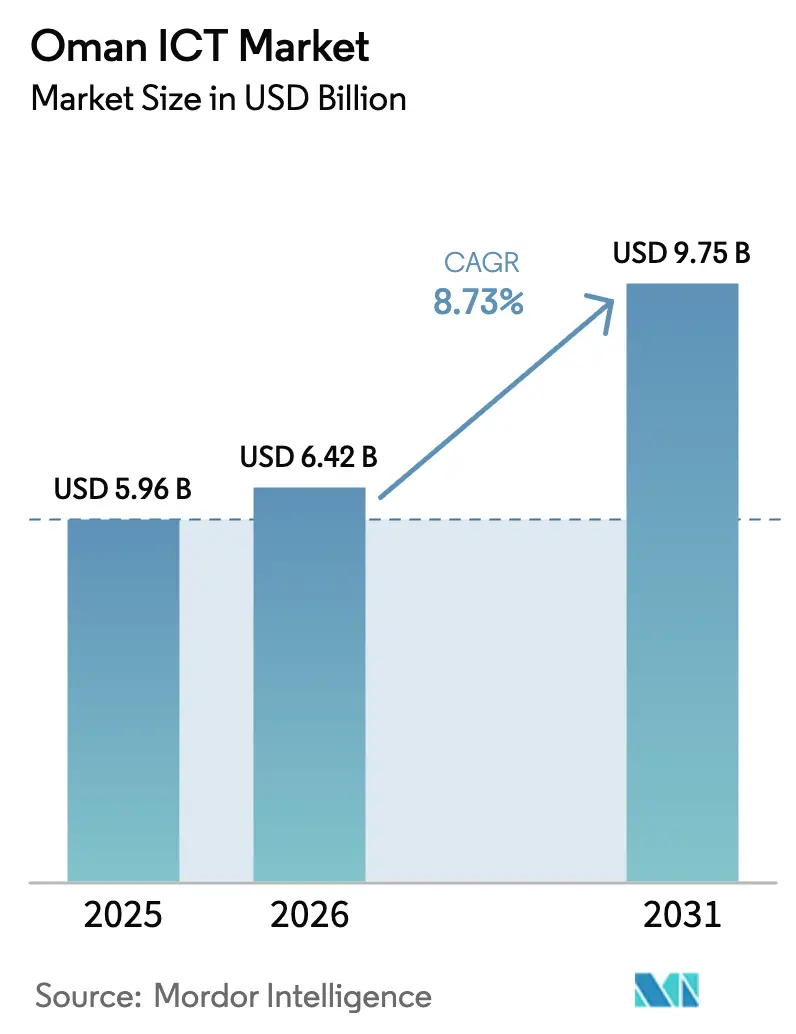
Oman ICT Market Analysis by Mordor Intelligence
The Oman ICT market size is expected to increase from USD 5.96 billion in 2025 to USD 6.42 billion in 2026 and reach USD 9.75 billion by 2031, growing at a CAGR of 8.73% over 2026-2031. Robust public-sector digitization programs, sovereign-cloud mandates, and the emergence of a domestic semiconductor cluster are widening demand beyond legacy connectivity and driving premium spending on cloud, cybersecurity, and artificial intelligence. Momentum is strongest in segments that lower operating costs for ministries, shorten time-to-market for banks and retailers, and improve data-sovereignty compliance for multinational firms. Vendors that bundle professional services with cloud, analytics, and edge solutions are winning larger deals because enterprises are grappling with complex hybrid architectures. Competition is healthy but not fragmented; three mobile operators dominate access networks while a handful of sovereign-cloud providers control hyperscale computing capacity.
Key Report Takeaways
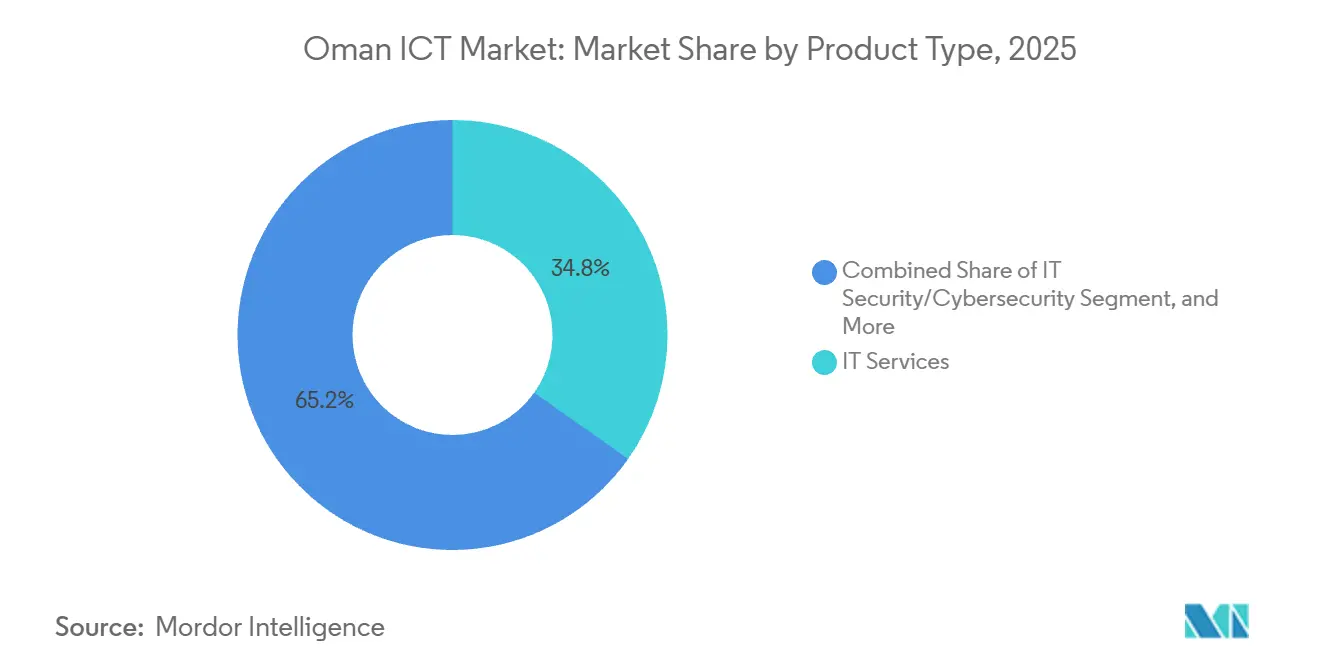
- By product type, IT services led with 34.78% revenue share in 2025, while IT security and cybersecurity is projected to record a 9.12% CAGR through 2031.
- By enterprise size, large enterprises contributed 54.21% of market share in 2025, whereas small and medium-sized enterprises are set to post a 9.42% CAGR over the same horizon.
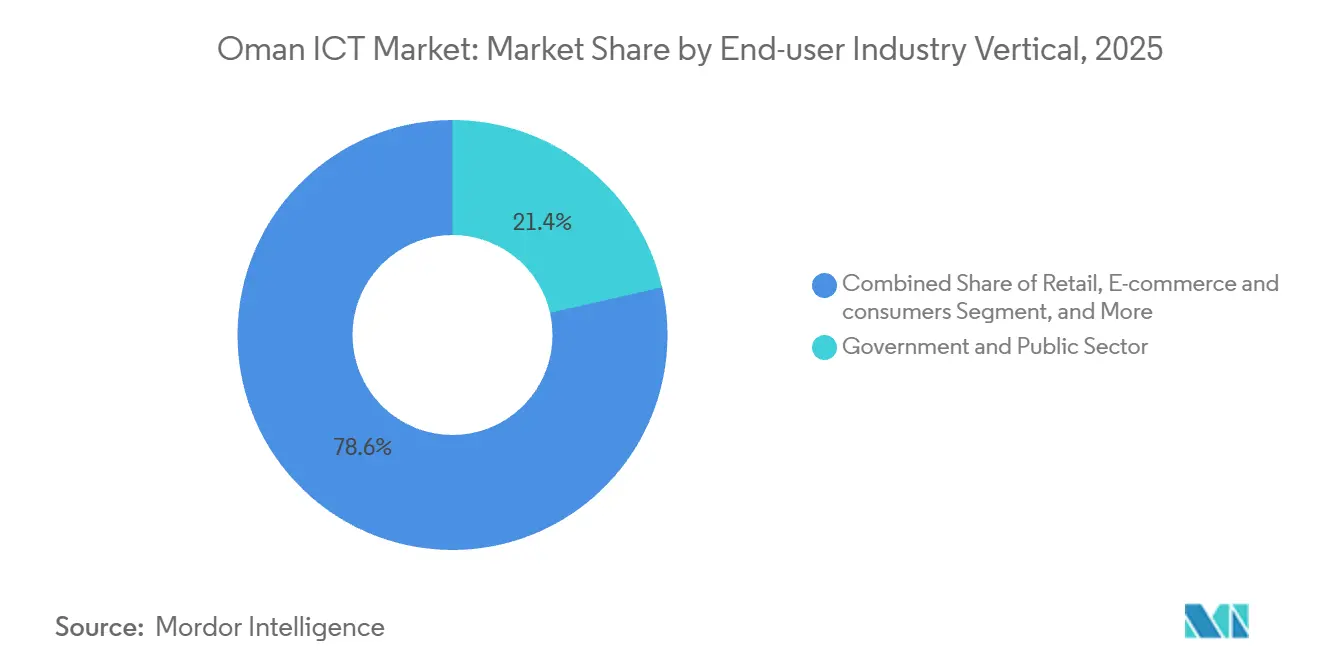
- By end-user industry, the government and public sector accounted for 21.44% of market share in 2025 expenditure, but retail, e-commerce, and consumers are forecast to expand at a 9.65% CAGR through 2031.
Note: Market size and forecast figures in this report are generated using Mordor Intelligence’s proprietary estimation framework, updated with the latest available data and insights as of January 2026.
Oman ICT Market Trends and Insights
Drivers Impact Analysis*
| Driver | (~) % Impact on CAGR Forecast | Geographic Relevance | Impact Timeline |
|---|---|---|---|
| Government Digital Transformation Program and Vision 2040 | +2.1% | National, early gains in Muscat and Dhofar governorates | Medium term (2-4 years) |
| Nationwide 5G and Fiber Broadband Expansion | +1.8% | National, prioritizing urban centers and industrial zones | Short term (≤ 2 years) |
| Growing Cloud Adoption and Data Center Investments | +1.5% | National, concentrated in Muscat, Ibri, Salalah, Duqm | Medium term (2-4 years) |
| Rising Internet Penetration and Smartphone Usage | +1.2% | National | Short term (≤ 2 years) |
| Green AI Data Centers and Oman Digital Triangle Initiative | +1.0% | Barka, Duqm, Sur | Long term (≥ 4 years) |
| National Semiconductor Program Spurring Local Tech Manufacturing | +0.9% | Salalah and Muscat | Long term (≥ 4 years) |
| Source: Mordor Intelligence | |||
Government Digital Transformation Program and Vision 2040
Oman’s Vision 2040 and the Tahawul transformation roadmap have shifted public procurement toward shared digital platforms, reducing duplication and favoring vendors that can deliver end-to-end suites. Twenty-five of 36 Tahawul projects were delivered by November 2024, and 74% of priority public services moved online, signaling a decisive break from siloed IT systems.[1]Oman.om, “Tahawul Project Status Update,” oman.om The Oman Business Platform processed 2.8 million transactions by September 2025, which validates citizens' appetite for frictionless e-services and lifts demand for workflow automation tools. Digital Transformation Management Company, an ITHCA subsidiary, leveraged this shift by winning 12 government contracts in 2024, underscoring that scale advantages accrue to firms that master public-sector processes. The National Open Data Portal launched in September 2025 with more than 350 datasets, opening a pipeline for analytics and AI workloads hosted on sovereign clouds. Oman’s UN E-Government Development Index improved to 0.8576 in 2024, confirming infrastructure readiness and lowering deployment risk for systems integrators.
Nationwide 5G and Fiber Broadband Expansion
Vodafone Oman completed over 2,572 5G sites by February 2025 and exceeded 98% population coverage, demonstrating that accelerated roll-outs can reset competitive baselines and push enterprises toward low-latency IoT applications.[2]Vodafone Oman, “Network Achievements 2025,” vodafone.om Omantel’s January 2026 upgrade to 5G Standalone introduced network slicing and Voice-over-5G, enabling differentiated enterprise SLAs for autonomous port logistics and public-safety analytics. Oman Broadband Company achieved 93.4% fiber coverage in Muscat by 2024, but only 45.2% in other urban areas, highlighting regional gaps that open opportunities for wholesale access platforms. The open-access model eases capital outlay for smaller service providers and accelerates multi-tenancy adoption. Ooredoo’s 2Africa subsea cable landing connects Oman to a 45,000-km global network, lowering bandwidth costs and supporting hybrid-cloud strategies for multinationals.
Growing Cloud Adoption and Data Center Investments
Mandatory data-residency rules are fragmenting the hyperscaler field and rewarding providers that localize capacity. Oman Data Park launched Oracle Cloud Infrastructure’s secondary dedicated region in Ibri in October 2025, providing automatic failover over 10 Gbps links to Muscat and guaranteeing compliance for regulated workloads. Omantel’s agreement with AWS in March 2024 created a Cloud Center of Excellence that trains local architects to align global platforms with national rules. OQ partnered with SAP in May 2025 to run S/4HANA in a local private cloud, illustrating how industrial firms are re-platforming ERP stacks inside sovereign facilities. Power remains a gating factor; Oman Data Park’s capacity will double to 20 MW by 2030, and its joint project with Solar Wadi adds 1.4 MW of solar generation to offset the 10-fold power draw of AI racks. The Oman Digital Triangle agreement with the International Data Center Authority in September 2025 targets gigawatt-scale green centers in Barka, Duqm, and Sur, signaling that renewable energy and coastal access will define the next wave of capacity.
Green AI Data Centers and Oman Digital Triangle Initiative
Oman is channeling large-scale AI compute into purpose-built, green facilities that integrate solar, wind, and seawater cooling. The Digital Triangle’s three planned data centers will aggregate up to one gigawatt of capacity, dwarfing the country’s existing 40 MW footprint and positioning Oman as an alternative landing point for African and South Asian workloads. Early designs specify PUE targets below 1.3 and direct-subsea fiber links, enabling hyperscalers to meet both carbon and latency mandates. Local municipalities in Barka, Duqm, and Sur have earmarked land adjacent to renewable-energy farms, lowering power transmission losses and accelerating permitting cycles. Domestic equipment suppliers expect a pull-through effect on battery storage, modular hydrogen fuel cells, and high-density cooling rigs. Investors view the project as a hedge against power-price shocks that threaten inland data centers in neighboring Gulf economies.
Restraints Impact Analysis*
| Restraint | (~) % Impact on CAGR Forecast | Geographic Relevance | Impact Timeline |
|---|---|---|---|
| Acute Shortage of Advanced ICT Skills | -1.3% | National, most acute in AI, cybersecurity and data science | Medium term (2-4 years) |
| Heightened Cybersecurity and Data Privacy Concerns | -0.9% | National, spillover to cross-border data flows | Short term (≤ 2 years) |
| Regulatory Uncertainty on Data Localization and Telecom Law Revisions | -0.6% | National, affecting multinational enterprises | Medium term (2-4 years) |
| Funding Gap for Growth-Stage Tech Startups | -0.5% | National, Muscat startup ecosystem | Long term (≥ 4 years) |
| Source: Mordor Intelligence | |||
Acute Shortage of Advanced ICT Skills
Omanisation in the ICT sector climbed to 62.02% in 2024, yet enterprises still depend heavily on expatriate specialists for AI, cybersecurity, and data engineering projects. The Makeen program aims to upskill 10,000 Omanis by the end of 2025, but focuses on entry-level literacy rather than advanced model fine-tuning or zero-trust design. Omantel Academy, launched in January 2026, plans to create 1,200 training slots and 500 new jobs over four years, but this figure pales in comparison to the 1,728 ICT positions created in Q3 2024 alone, suggesting a supply deficit more than threefold. The Irtiqa leadership scheme focuses on mid-career officials at 57 ministries, leaving junior engineering roles unfilled and forcing systems integrators to import talent. An IMF assessment in April 2025 concluded that Oman must invest more to match Gulf peers on digital skills, confirming that labor scarcity remains a binding constraint.[3]IMF, “Oman Economic Assessment 2025,” imf.org
Heightened Cybersecurity and Data Privacy Concerns
Cyber-fraud incidents jumped 50% in H1 2025, and Royal Oman Police data showed a 35% quarter-on-quarter rise in fraud cases driven by deepfakes and spoofed e-commerce sites. The Oman Computer Emergency Response Team handled 136 events in the first nine months of 2024, but private-sector disclosure is voluntary, creating an information gap that hampers risk underwriting. The Telecommunications Regulatory Authority mandated 72-hour breach notifications in September 2024, yet penalty schedules are still pending, leaving compliance budgets uncertain. Healthcare networks are vulnerable; over 50% of facilities lack picture-archiving systems, and 60% operate on sub-500 Mbps links, exposing patient data to ransomware. Although Oman achieved Tier-1 status on the ITU Global Cybersecurity Index, small and medium enterprises without 24/7 SOC coverage remain easy targets, hindering digital service adoption.
*Our forecasts treat driver/restraint impacts as directional, not additive. The impact forecasts reflect baseline growth, mix effects, and variable interactions.
Segment Analysis
By Product Type: Cybersecurity Outpaces Legacy IT Services
IT services generated 34.78% of 2025 Oman ICT revenue, anchored by enterprise resource planning rollouts, multicloud migration consulting and managed networks. The Oman ICT market size attribution emphasizes how change-management projects and application modernization remain profit pools. Managed security and cloud-platform support drive sticky recurring fees that differentiate integrators from hardware resellers.
The IT security segment is forecast to deliver a 9.12% CAGR, expanding its Oman ICT market share as data-localization mandates and ransomware events fuel zero-trust spending. Hardware margins narrow because buyers shift to operating-expense cloud capacity, while software-as-a-service for customer relationship management and supply-chain analytics gains traction. Communication services face price compression but offset this through wholesale capacity tied to new submarine cables.


By Enterprise Size: SME Digitalization Accelerates
Large enterprises captured 54.21% of spending in 2025 as state energy, banking and telecom entities launched multi-year cloud, Internet of Things and AI programs. These flagship projects bundle infrastructure, applications and managed services in five-year contracts, reinforcing vendor lock-in but ensuring steady cash flows.
Small and medium-sized enterprises are projected to grow at a 9.42% CAGR, lifting their Oman ICT market share by 2031. Future Fund Oman’s USD 364 million allocation subsidizes cloud subscriptions and e-commerce platforms. Visa research showed 65% of digital-payment retailers saw higher revenue, proving that point-of-sale digitalization translates into turnover gains. SMEs gravitate toward subscription bundles that package inventory, payments and analytics, reducing integration burden.
By End-User Industry Vertical: Retail And E-Commerce Surge
Government and public sector delivered 21.44% of expenditure in 2025 after automating 267 services and centralizing tenders online. These projects underpin the Oman ICT market through guaranteed multi-year maintenance budgets and steady refresh cycles.
Retail, e-commerce and consumers are forecast to register a 9.65% CAGR through 2031, driven by smartphone ubiquity, a national payment gateway and supportive e-commerce legislation. Oil and gas entities such as Petroleum Development Oman invested over USD 1 billion in predictive analytics, Internet of Things sensors and private 5G networks. Banking adopts cloud-native cores to launch mobile products and comply with anti-money-laundering rules, while manufacturing and utilities rely on IoT telemetry for process optimization.
Geography Analysis
Muscat continues to host most fiber routes, data center racks, and enterprise headquarters, making it the anchor of the Oman ICT market. Oman Broadband passed 427,904 homes in the capital by 2024 versus 464,431 elsewhere, indicating an infrastructure gap that second-tier cities are racing to close. The Digital Triangle pact of September 2025 will plant green, gigawatt-scale data centers in Barka, Duqm, and Sur, shifting capacity toward coastal hubs with easy access to subsea cables.
Salalah is morphing into a compute hub after Ooredoo’s 2Africa cable landing in 2024, which trims latency to East Africa and South Asia and invites CDN and cloud-interconnect providers. Duqm’s special economic zone pairs industrial IoT pilots with edge nodes, creating field labs for logistics, petrochemicals, and metals. The government’s open-access fiber regulation reduces capex for new entrants, which should lift coverage outside Muscat to near parity over the forecast period.
Within the Gulf Cooperation Council, Oman positions itself as a neutral, sovereign cloud corridor. Its ITU Tier-1 cybersecurity status and growing hyperscale footprint attract enterprises wary of data concentration in the UAE and Saudi Arabia. Cross-border ventures such as the SONIC corridor with STC and bilateral agreements with Meeza, Salam, and BNet further embed Oman in regional data routes. As these links deepen, the Oman ICT market will benefit from transit fees, interconnect traffic, and managed services export opportunities.
Regulatory Landscape
Oman’s ICT policy direction is led by the Ministry of Transport, Communications and Information Technology (MTCIT) under Vision 2040, with the National Digital Economy Program (NDEP) and the government digital transformation agenda shaping priorities around cloud, data use, and digital public services. Telecommunications and postal services are overseen by the Telecommunications Regulatory Authority (TRA), an autonomous regulator that also sets operational compliance requirements, including the September 2024 mandate for 72-hour breach notifications that increased incident-response and reporting obligations for operators and service providers.
Across procurement and industrial participation, MTCIT’s local content stimulation (ICT ICV) requirements push vendors to embed Omani goods, services, and human capital in delivery plans, which influences bid design for government and regulated-industry tenders. Foundational legal enablers, including the Cybercrime Law and the E-Transactions Law, support digital service expansion, while practical market rules around data residency and regulated workload hosting continue to steer hyperscalers and systems integrators toward in-country infrastructure and locally governed delivery models.
Competitive Landscape
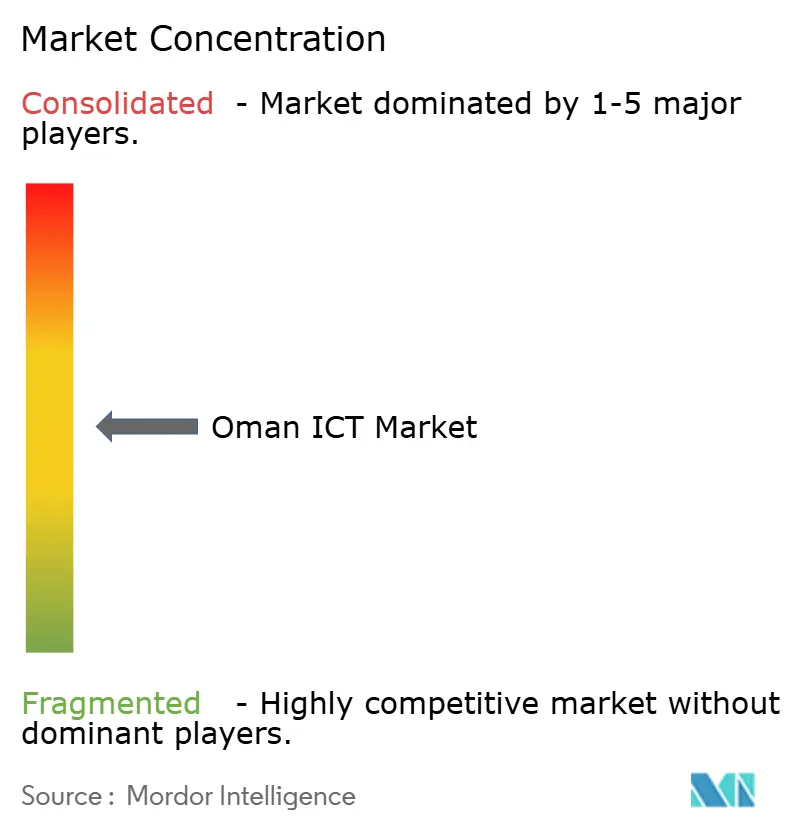
Competition is healthy but not fragmented. Three licensed mobile players split access revenues, yet differentiation is rising. Vodafone Oman seized roughly 10% of the market share within two years and won 11 of 14 Opensignal quality awards in January 2025, proving that aggressive capex and local financing can disrupt incumbent duopolies. Omantel’s 5G Standalone launch in January 2026 delivers voice over 5G and sub-10 ms slices, enabling premium SLAs for autonomous vehicles and telehealth. Ooredoo Oman leads on network availability at 97.6% and leverages the 2Africa cable for wholesale bandwidth.
In sovereign cloud, Oman Data Park controls more than 70% of public-sector workloads and partners with Oracle for a dual-region footprint, creating high switching costs for ministries. AWS, Microsoft, and Huawei must pursue joint ventures or dedicated regions to penetrate regulated verticals, as seen in the Omantel-AWS Cloud Center of Excellence. Niche disruptors include ITHCA portfolio firms such as Onsor Technologies, which delivered 600 IoT charging carts to schools, and Space Communication Technologies, which reached break-even in 2024 with satellite broadband subscribers.
Cybersecurity demand is concentrating with providers that run domestic SOCs. Incumbents bundle 24/7 monitoring with cloud hosting and fiber links, crowding out pure-play resellers. Barriers to entry climbed after TRA required operator permits and local data residency for Levels 3-4 data, effectively shielding domestic data centers from offshore rivals but also raising compliance stakes for hyperscalers.
Oman ICT Industry Leaders
IBM Corporation
Microsoft Corporation
Huawei Investment & Holding Co., Ltd.
Oracle Corporation
Wipro Limited
- *Disclaimer: Major Players sorted in no particular order

Market Opportunities and Future Outlook
Sovereign digital infrastructure build-out is creating whitespace for cloud, cybersecurity, and managed services that target regulated and latency-sensitive workloads. Demand signals already point to this direction, including the National Open Data Portal launch in September 2025 with more than 350 datasets, which expands analytics and AI use cases. The Oman Business Platform processed 2.8 million transactions by September 2025, increasing requirements for identity, application modernization, and secure API integration.
NDEP also provides a long-horizon anchor, with a stated goal to increase ICT contribution to GDP from 2% to 10% by 2040 and a 2025 allocation of USD 15 million for AI-related projects. Connectivity and edge enablement outside Muscat remain another focus area, given fiber coverage disparities (93.4% in Muscat versus 45.2% in other urban areas as of 2024) and the enterprise use cases supported by 5G Standalone capabilities, including Omantel’s January 2026 upgrade enabling network slicing. The ICT ICV program also opens partnering options for global vendors to scale through local integrators and workforce development commitments, linking delivery capacity to Omanisation and public procurement requirements.
Recent Industry Developments
- June 2026: The Government of Oman and EDF Power Solutions signed a Memorandum of Understanding to develop a 1,000 MW sustainable digital infrastructure platform to support AI and cloud services. The initiative advances sovereign AI and cloud capacity and strengthens the national digital backbone.
- May 2026: Oracle Corporation launched its second OCI Dedicated Region in Oman, located in Ibri City and hosted by ITHCA Group. The expansion strengthens data residency and hyperscale compute for public and regulated sectors.
- January 2026: Astranis and MB Group entered a strategic agreement for Oman’s first dedicated MicroGEO satellite, part of a $200 million investment. The initiative broadens the communications backbone and data backhaul for Oman’s ICT market.


Research Methodology Framework and Report Scope
Market Definition and Coverage
For this methodology, the Oman ICT market is counted as spending in Oman on telecom services and on IT products and services that enable connectivity, computing, software use, cybersecurity, and day to day digital operations across public and private end users.
Scope exclusions: We exclude consumer electronics that are not purchased for IT or connectivity use cases, and we exclude non-ICT construction works even when they support telecom or data center sites.
Segmentation Overview
- By Product Type
- IT Hardware
- Computer Hardware
- Networking Equipment
- Peripherals
- IT Software
- IT Services
- IT Consulting and Implementation
- IT Outsourcing (ITO)
- Business Process Outsourcing (BPO)
- Managed Security Services
- Cloud and Platform Services
- IT Infrastructure
- IT Security/Cybersecurity
- Application Security
- Cloud Security
- Data Security
- Network Security
- Endpoint Security
- Infrastructure Protection
- Integrated Risk Management
- Identity and Access Management (IAM)
- Communication Services
- IT Hardware
- By Enterprise Size
- Small and Medium-sized Enterprises
- Large Enterprises
- By End-user Industry Vertical
- BFSI
- Government and Public Sector
- Oil and Gas
- IT and Telecom
- Retail, E-commerce and consumers
- Manufacturing and Industrial
- Energy and Utilities
- Healthcare
- Other End-user Industry Verticals (Includes Transportation, Logistics, Education, Hospitality etc.)
Data Sources, Market Sizing, and Validation
Desk Research
Desk research was used to set the outer guardrails of demand and supply before speaking with market participants. We mostly relied on official and open sources such as Oman Ministry of Transport, Communications and Information Technology releases, National Center for Statistics and Information (NCSI) datasets, ITU indicators, World Bank data series, and WTO trade statistics for context on devices and equipment flows.
We also reviewed operator and technology provider public filings, investor presentations, and reputable local and regional business press to map investment cycles and major program timing. Where required, we used paid subscriptions for company financials and intelligence, news and financials, patents, and shipment-level import and export checks to validate directionality and to avoid over-counting overlapping revenue pools. These desk sources are illustrative only, and many other public references were used for data collection, validation, and clarification.
Primary Interviews and Surveys
Primary work focused on validating what the desk inputs could not fully explain, mainly the split between telecom services and IT spending, and how fast cloud, security, and services are being adopted in Oman. We spoke with a mix of operators, systems integrators, distributors, enterprise buyers, and public sector stakeholders. The inputs were then used to confirm adoption rates, pricing direction, and the timing of large contracts before model totals were finalized.
Distribution of primary research fieldwork respondents
| Company type | Respondent position | Region |
|---|---|---|
| Top tier: 36% | CXOs: 13% | |
| Mid tier: 49% | Functional/Unit leaders: 31% | |
| Smaller Players: 15% | Managers: 56% |
Market-Sizing & Forecasting
Market sizing starts from a top-down demand reconstruction, where national ICT spend signals are rebuilt using telecom service revenue pools, public budget and program direction, device and equipment import patterns, and enterprise IT spending benchmarks that are localized through interviews. Once the demand pool is framed, selective bottom-up checks are applied, such as sampled ASP times volume for key hardware categories, channel feedback on sell-through, and services revenue reasonableness checks using supplier disclosures.
In practice, a few variables carry most of the model weight, including mobile and fixed broadband uptake, 5G and fiber rollout pace, data center and cloud capacity additions, cybersecurity compliance pressure in regulated sectors, and the timing of government digitization programs. For forecasting, we primarily used scenario analysis supported by short time-series smoothing. This approach fits because the market is influenced by program start dates and procurement cycles. We then stress-tested scenarios with expert views on pricing progression and adoption speed. Where bottom-up signals were incomplete, we bridged gaps through conservative penetration assumptions that were re-tested in interviews and adjusted only when multiple stakeholders aligned on the direction.
Data Validation & Update Cycle
Outputs are checked through multiple steps so that large jumps are questioned before final sign-off. We compare totals against independent signals like telecom service revenue trends, budget announcements tied to digital programs, and visible infrastructure rollouts, and then we re-check any segment that moves faster than the underlying drivers.
A second analyst review is used to test assumptions, formulas, and year to year consistency, followed by targeted re-contact when a key input looks out of line. Reports are refreshed annually, with interim updates when material events change the demand outlook. Before delivery, a final pass is completed so clients receive the latest updated view.
Mordor Intelligence's Oman Ict Market Size Versus Other Published Estimates
Published market sizes for Oman ICT can differ even when the topic label looks similar, because the included spend buckets are not always the same and the timing of the base year can shift. It is also common to see different treatments of telecom services versus IT, which changes the total even if the growth story is broadly aligned.
Evidence such as telecom service revenue direction, device and network equipment trade signals, and public program rollouts are the checks that keep Mordor Intelligence tied to a defined Oman ICT spend pool, instead of blending in adjacent digital economy items or narrow IT-only spend views.
Benchmark comparison
| Source | Market Size | Gaps in Research Methodology |
|---|---|---|
| Mordor Intelligence | USD 5.96 B (2025) | |
| Industry Promotion Platform A | USD 5.96 B (2025) | The figure is presented as a high-level sector snapshot and does not clearly separate telecom services from IT categories, which limits repeatability when rebuilding the total by spend buckets. |
| Trade Journal B | USD 5.60 B (2024) | This estimate is stated as ICT spending for a prior year and appears to be driven by a single spend narrative, so the year shift and the narrower spend framing can create a lower total versus broader ICT definitions. |
Across the three figures, the spread is mainly explained by year selection and by whether telecom services, IT products, and IT services are all counted together with clear boundary rules. When the market is rebuilt from visible demand signals and then checked with practical bottom-up sanity tests, the resulting value is easier to track and update as conditions change.


Key Questions Answered in the Report
How large is the Oman ICT market in 2026 and what is the growth outlook to 2031?
The Oman ICT market size reached USD 6.42 billion in 2026 and is projected to hit USD 9.75 billion by 2031, registering an 8.73% CAGR.
Which product category is expanding fastest?
IT security and cybersecurity is expected to grow at a 9.12% CAGR driven by data-localization mandates and escalating ransomware risks.
What fuels SME technology spending in Oman?
Future Fund Oman subsidies, a national payment gateway and affordable SaaS bundles are propelling SME ICT outlays at a 9.42% CAGR.
How will number portability affect telecom competition?
Full rollout in 2026 will lower switching costs and push carriers to differentiate with bundled 5G, cloud storage and cybersecurity services.
Why are data-center operators investing in solar power?
Renewable cooling cuts operating expenses 10-15% and aligns with environmental, social and governance mandates for carbon-neutral hosting.
What talent gap threatens ICT project timelines?
Only 8% of the workforce possesses advanced ICT skills, creating project delays and higher costs for AI, blockchain and analytics deployments.
Page last updated on: