
Oman Blood Glucose Monitoring Market Size and Share
Market Overview
| Study Period | 2021 - 2032 |
|---|---|
| Forecast Data Period | 2027 - 2032 |
| Base Year Market Size (2026) | USD 10.94 Million |
| Market Size (2027) | USD 11.99 Million |
| Market Size (2032) | USD 18.97 Million |
| Growth Rate (2027 - 2032) | 9.60 % |
| Market Concentration | Medium |
Major Players *Disclaimer: Major Players sorted in no particular order Image © Mordor Intelligence. Reuse requires attribution under CC BY 4.0. | |
Oman Blood Glucose Monitoring Market Analysis by Mordor Intelligence
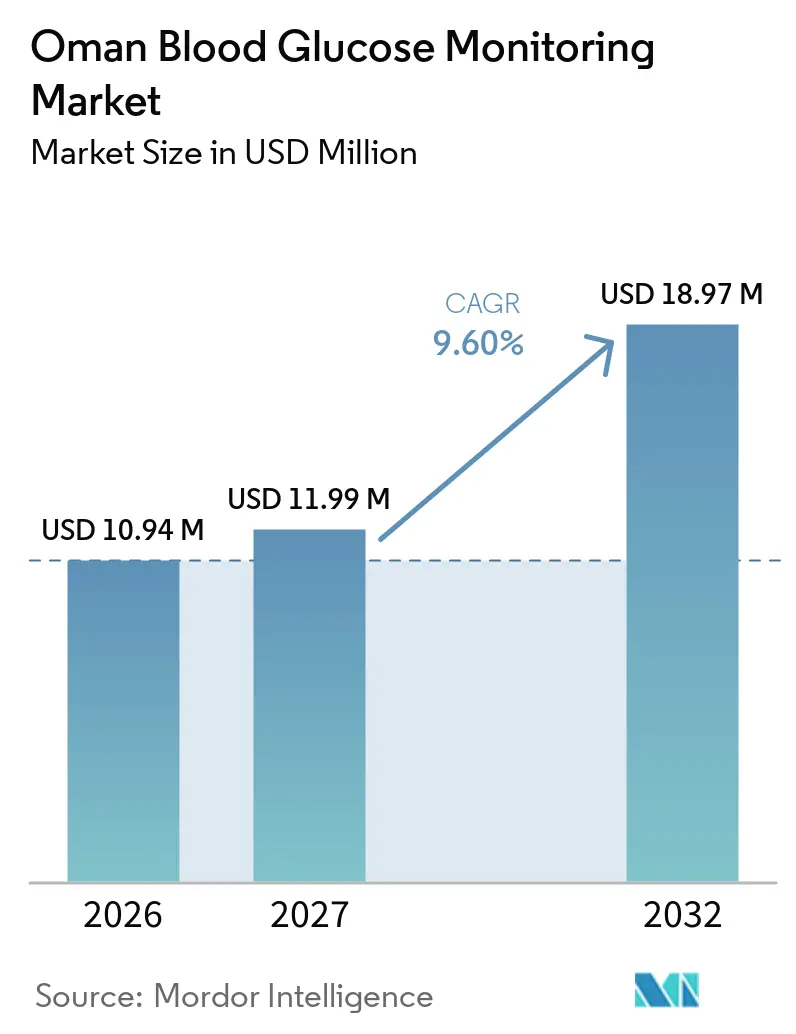
The Oman Blood Glucose Monitoring Market size is projected to expand from USD 10.94 million in 2026 and USD 11.99 million in 2027 to USD 18.97 million by 2032, registering a CAGR of 9.60% between 2027 and 2032.
Diabetes patients were at a higher risk of being extremely unwell if infected with the virus during the COVID-19 pandemic. Obesity, the main risk factor for incident type 2 diabetes, was more common in patients with critical forms of COVID-19 requiring invasive mechanical ventilation. Diabetes was a risk factor for developing severe and critical forms of infection and was among the most frequently reported comorbidities in patients infected with COVID-19. As a result, the demand for blood glucose monitoring devices to monitor and maintain optimum blood glucose levels increased during the pandemic.
Oman's ongoing efforts to decentralize diabetes management from hospitals to community and home-care settings have strengthened the uptake of blood glucose monitoring solutions. The growing availability of monitoring devices through retail pharmacies and healthcare facilities, coupled with increasing patient awareness regarding complication prevention, is contributing to the expansion of the blood glucose monitoring market in Oman.
Pharmacologic therapy such as oral medicines and insulin, as well as non-pharmacologic therapies such as lifestyle changes, are modern approaches for diabetes management. These therapies are only possible through proper blood glucose monitoring and self-care. Oman Ministry of Health recently participated in the virtual launch of the WHO Global Diabetes Compact, organized jointly by the World Health Organization and the government of Canada aimed at raising awareness level about diabetes as a global disease, in addition to expanding prevention and treatment as part of primary health care and universal health coverage. Furthermore, the Omani Ministry of Health recommends integrating patient-centered careprinciples into its healthcare system to address chronic conditions engaging nurses as members of the primary care team who can deliver effective health promotion and patient education.
Note: Market numbers in this report are based on Mordor Intelligence's proprietary estimation framework, which combines nine months of actuals with Q4 projections for base year 2026.
Oman Blood Glucose Monitoring Market Trends and Insights
Rising diabetes prevalence
In Oman, Diabetes Population is expected to increase with a CAGR greater than 10.4% over the forecast period.
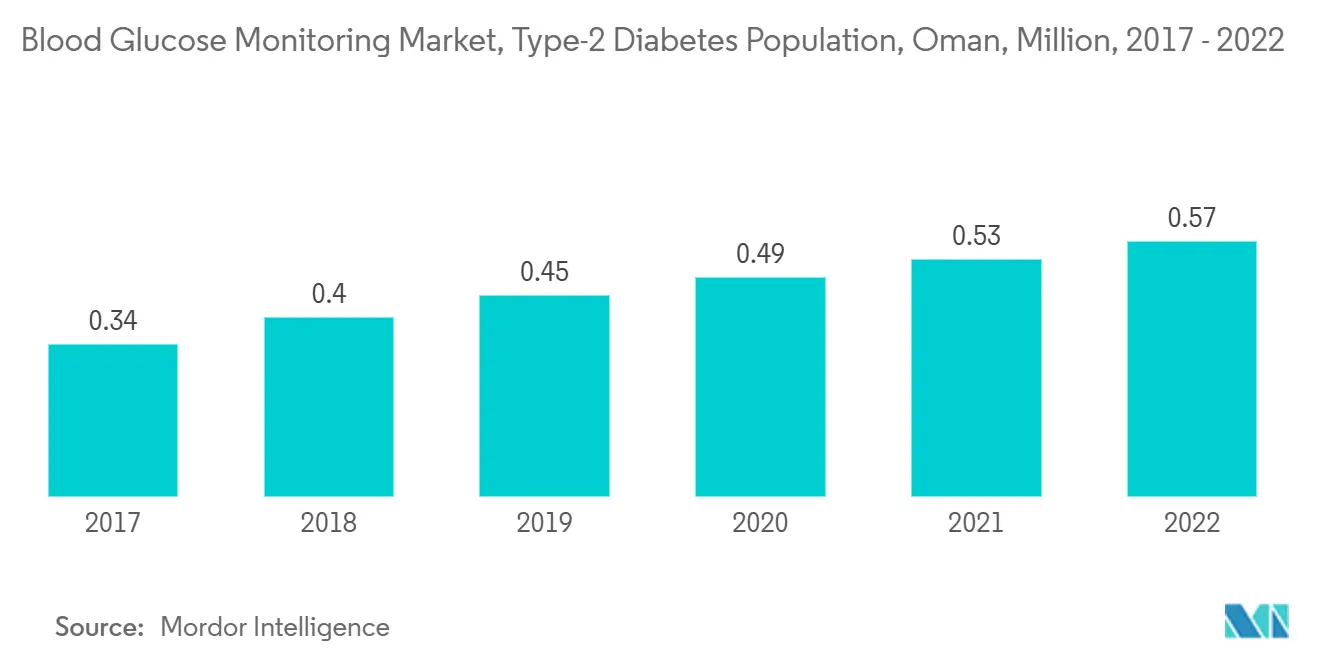
According to Mordor Intelligence, the type-2 diabetic population in Oman increased to 0.57 million in the current year and it is expected to reach 0.84 million during the forecast period. Although the current numbers show that the existence of diabetes is comparatively lesser in Oman, the growth rate of the diabetic population is projected to be higher in the country. Moreover, the number of new cases among children is about 60 cases annually. According to local studies and reports on good diabetes control, the rate in adult patients ranges from 32-35%, whereas reaches 10-12% among children and adolescents. The Government is working on increasing awareness of diabetes, in addition, to access to sugar monitors to improve good diabetes control for children.
Various local studies suggest that the changing lifestyle of the Omani population has led to increased obesity which contributes to the rising cases of diabetes. Omanis are less engaged in physical activity and consume more sugar and saturated fats. Traditionally, Omani people consume unhealthy foods, sweets, sugary beverages, and high-carbohydrate foods.
According to IDF latest annual report, 73 million adults (20-79) are living with diabetes in the IDF MENA Region. This figure is estimated to increase to 95 million by 2030. Diabetes poses an emerging healthcare burden across the country and is one of the leading causes of premature death, morbidity, and loss of economic growth. Technological development is gaining momentum in the glucose monitoring market. Over the years, several technological innovations have been developed that have led to the creation of new types of devices that are much less cumbersome and more comfortable for patients compared to traditional ones. Such advantages have helped the rise in the adoption of these products in the market.
The Continuous Glucose Monitoring Segment is Expected to Witness Highest Growth Rate Over the Forecast Period
The Continuous Glucose Monitoring Segment is expected to further increase with a CAGR of more than 10.84% during the forecast period.
A continuous Glucose Monitoring Device is a compact medical system that continuously monitors blood glucose levels in real time. A small sensor is inserted into the abdomen or arm with a cannula penetrating the top layer of skin. An adhesive patch holds the sensor in place, allowing it to take glucose readings throughout the day and night. Generally, the sensor must be replaced every 7 to 14 days. A small reusable transmitter connected to the sensor allows the system to send real-time readings wirelessly to a monitor device or a smartphone app that displays blood glucose data. These devices eliminate the need for regular fingerstick tests and serve as important outpatient blood sugar management options for reducing A1C. They help increase the user’s time-in-range (TIR), the overall percentage of time spent in a healthy glucose range, and are beneficial for active children and adults, for ensuring safety during physical activity and nighttime glucose fluctuations.
According to Oman Diabetes Association, diabetes is a costly chronic illness that needs control of blood sugar levels using medical devices. This imposes a challenge for low-income and social security patients. Thus, an initiative has been designed to reduce the burden on these targeted groups, consequently promoting sugar control. Oman under the ODA initiative is trying to aware diabetes patients about the usage of blood glucose devices. The Ministry of Health, Oman is strategically planning to contain the growing burden of diabetes and invest in all means to control it, stating “our work needs to ensure equitable and affordable access to treatment, and it is essential that we advocate for investments in diabetes education and prevention programs”.
The blood glucose monitoring market in Oman is benefiting from the gradual shift toward advanced diabetes management technologies. Healthcare providers are increasingly incorporating CGM systems and smartphone-connected glucose monitoring devices to improve patient adherence and reduce diabetes-related complications. This trend, combined with rising awareness of continuous glucose tracking among diabetes patients, is expected to drive market growth over the forecast period.
Competitive Landscape
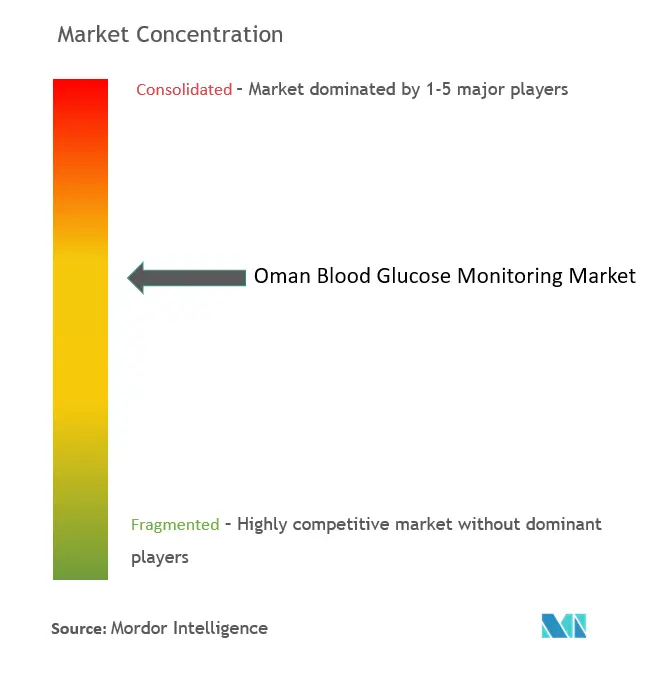
The Oman Blood Glucose Monitoring Market is semi-consolidated with a few significant players namely Medtronic, Abbott, and other generic players.
Oman Blood Glucose Monitoring Industry Leaders
-
Roche
-
Dexcom
-
Abbott
-
OneTouch
-
Medtronic
- *Disclaimer: Major Players sorted in no particular order
Recent Industry Developments
- September 2023: Nemaura Medical completed a 100-patient study of the non-invasive and flexible continuous glucose monitor sugarBEAT. The study was carried out in the Middle East and included four cohorts with an equal number of male and female subjects aged 18 to 75 years. Out of the total patients, 20 had type 1 diabetes and the remaining had type 2 diabetes. The Class IIb medical device was approved in Europe and Saudi Arabia for a wear period of 14 hours.
- May 2023: LifeScan announced positive data from a study of real-world evidence supporting its Bluetooth-connected blood glucose meter. Evidence from more than 55,000 people with diabetes demonstrated sustained improvements in readings in range. The analysis focuses on changes over 180 days. LifeScan published results in the peer-reviewed journal Diabetes Therapy. The company’s OneTouch Bluetooth-connected blood glucose meter and mobile diabetes app provide simplicity, accuracy, and trust.
Oman Blood Glucose Monitoring Market Report Scope
Blood glucose monitoring devices are used for measuring the concentration of glucose in the blood for effective diabetes management. The Oman Blood Glucose Monitoring Market is segmented into Type (Self-monitoring Blood Glucose Devices and Continuous Glucose Monitoring Devices) and Component (Glucometer Devices, Test Strips, Lancets, Sensors, and Durables). The report offers the value (in USD) and volume (in Units) for the above segments.
| Glucometer Devices |
| Test Strips |
| Lancets |
| Sensors |
| Durables (Receivers and Transmitters) |
| Self-monitoring blood glucose devices | Glucometer Devices |
| Test Strips | |
| Lancets | |
| Continuous blood glucose monitoring devices | Sensors |
| Durables (Receivers and Transmitters) |
Key Questions Answered in the Report
How big is the Oman Blood Glucose Monitoring Market?
The Oman Blood Glucose Monitoring Market size is expected to reach USD 11.99 million in 2027 and grow at a CAGR of 9.60% to reach USD 18.97 million by 2032.
What is the Oman Blood Glucose Monitoring Market size in 2026?
In 2026, the Oman Blood Glucose Monitoring Market size is expected to reach USD 10.94 million.
Who are the key players in Oman Blood Glucose Monitoring Market?
Roche, Dexcom, Abbott, OneTouch and Medtronic are the major companies operating in the Oman Blood Glucose Monitoring Market.
What years does this Oman Blood Glucose Monitoring Market cover, and what was the market size in 2025?
In 2025, the Oman Blood Glucose Monitoring Market size was estimated at USD 9.98 million. The report covers the Oman Blood Glucose Monitoring Market historical market size for years: 2021, 2022, 2023, 2024, 2025, and 2026. The report also forecasts the Oman Blood Glucose Monitoring Market size for years: 2027, 2028, 2029, 2030, 2031, and 2032.