
Olive Market Analysis by Mordor Intelligence
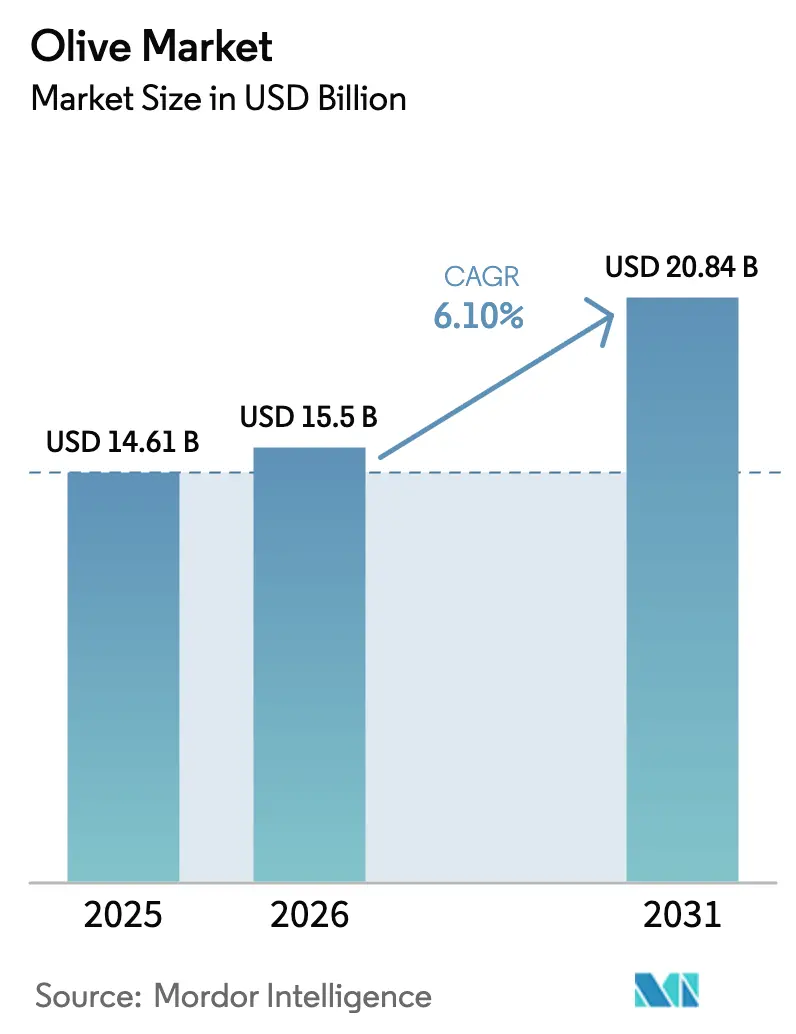
The Olive Market size was valued at USD 14.61 billion in 2025 and is estimated to grow from USD 15.5 billion in 2026 to reach USD 20.84 billion by 2031, at a CAGR of 6.10% during the forecast period (2026-2031). The growth of the olive market is driven by efforts to mitigate cardiometabolic diseases, alongside the adoption of the Mediterranean diet and super-high-density (SHD) grove technology, which helps lower production costs and stabilize yields. While abundant olive harvests in North Africa are temporarily reducing prices, the use of blockchain for provenance and the premium positioning of extra-virgin olive oil are increasing margins for traceable products. Additionally, capital investments in California and Australia, along with sustainability subsidies from the European Union, are altering competitive dynamics across regions. At the same time, labor shortages in Mediterranean countries are accelerating the mechanization of olive farming. These intersecting forces suggest that the olive market is transitioning from fragmented, labor-intensive traditions to data-driven, scale-oriented production systems.
Key Report Takeaways
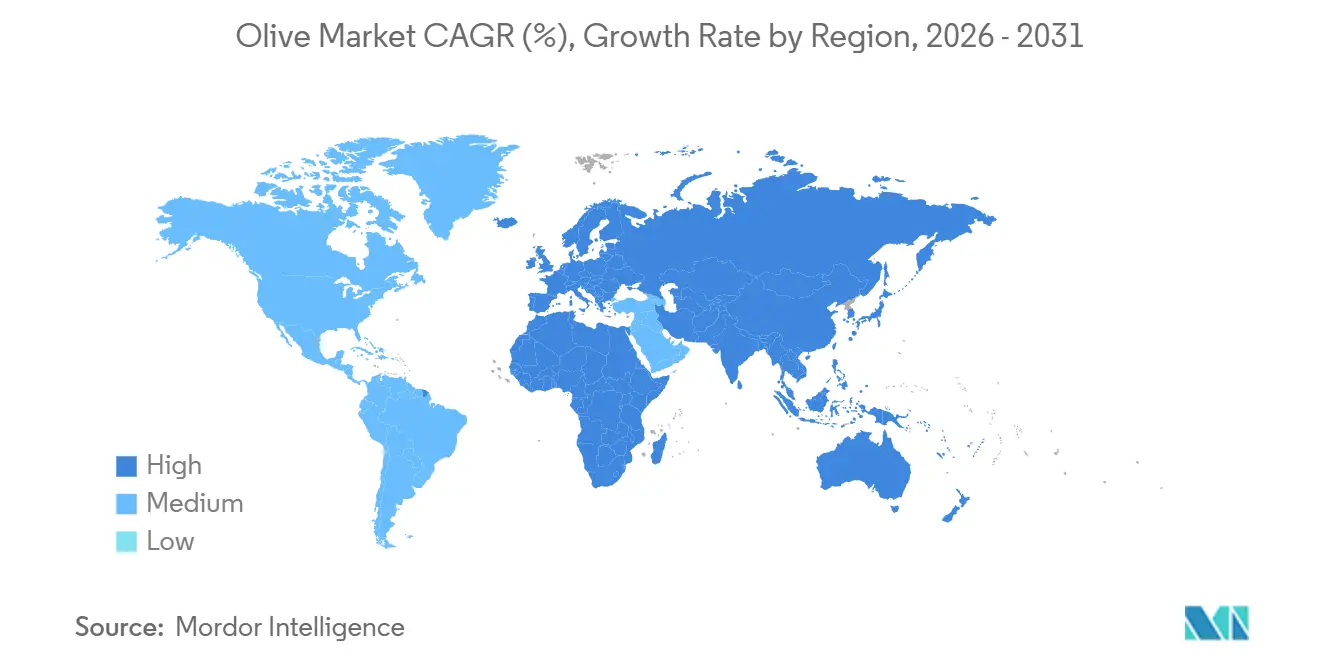
- By geography, Europe led with 69% olive market share in 2025, while Asia-Pacific is forecast to expand at a 7.4% CAGR through 2031.
Note: Market size and forecast figures in this report are generated using Mordor Intelligence’s proprietary estimation framework, updated with the latest available data and insights as of January 2026.
Market Trends and Insights
Drivers Impact Analysis of Olive Market*
| Driver | (~) % Impact on CAGR Forecast | Geographic Relevance | Impact Timeline |
|---|---|---|---|
| Diet-linked shift toward Mediterranean diet | +1.2% | Global, with concentrated adoption in North America, Northern Europe, and urban Asia-Pacific | Medium term (2-4 years) |
| Rapid expansion of premium extra-virgin olive exports | +0.9% | Europe (Spain, Italy, and Greece) exporting to North America, Asia-Pacific, and Middle East | Medium term (2-4 years) |
| Rising cardiometabolic disease burden boosting demand | +1.5% | Global, particularly acute in North America, Western Europe, and emerging Asia-Pacific markets | Long term (≥ 4 years) |
| Government sustainability subsidies for perennial crops | +0.7% | Europe (CAP framework), with spillover to Mediterranean basin and select South American markets | Long term (≥ 4 years) |
| Under-irrigated arid land conversion to super-high-density (SHD) groves | +0.8% | Spain, Portugal, California, Australia, Chile, with expansion into North Africa | Medium term (2-4 years) |
| Blockchain-based provenance premiums in specialty auctions | +0.6% | Europe (Italy, Spain, and Greece) and premium segments in North America and Asia-Pacific | Short term (≤ 2 years) |
| Source: Mordor Intelligence | |||
Diet-linked Shift Toward Mediterranean Diet
Clinical evidence indicates that a daily intake of 25 grams of olive oil reduces cardiovascular risk by 16%, type 2 diabetes incidence by 22%, and all-cause mortality by 11%[1]Source: “Olive Oil and Cardiovascular Health,” MDPI Nutrients, mdpi.com. These findings have prompted national health agencies in Canada and Germany to add extra-virgin olive oil (EVOO) to dietary guidelines, spurring hospital food-service contracts and employer wellness programs that specify olive oil as the default culinary fat. Consumption is rising fastest where baseline intake is low, particularly in the urban corridors of the United States and China. Retailers now merchandise olive oil in functional-food aisles alongside probiotics and omega-3 supplements, signaling a shift in the category from culinary staple to health product. Continued medical validation suggests that the olive market could outpace the baseline healthcare systems in adopting diet-centric interventions.
Rapid Expansion of Premium Extra-Virgin Olive Exports
Spain, Italy, and Greece exported more than 1 million metric tons of olive oil in 2024, with approximately 70% qualifying as extra-virgin olive oil (EVOO), which fetched premiums of 40%–60% over refined blends. Protected Designation of Origin (PDO) certification restricts labels to specific terroirs, creating scarcity that keeps prices firm even when North African bulk output surges. California producers follow this playbook. 75% of the state’s 162,500 metric tons of the 2024 harvest were crushed for premium oil rather than canned as table olives. A blockchain Quick Response (QR) code can authenticate polyphenol content at the point of sale, deepening consumer trust. Fraudulent labeling remains a hurdle because 20% of sampled EVOO in 2024 failed legal quality standards in random European tests, underscoring the need for third-party verification that raises transaction costs yet further differentiates authentic suppliers.
Rising Cardiometabolic Disease Burden Boosting Demand
Cardiovascular disease and diabetes collectively affect more than one billion people and account for 30% of global disability-adjusted life years. A 2024 meta-analysis equated the preventive effect of olive oil with that of moderate-dose statin therapy, motivating insurers in the United States to pilot reimbursement programs for the Mediterranean diet. The European Food Safety Authority (EFSA) confirmed in 2025 that olive polyphenols protect blood lipids from oxidative stress[2]Source: “Blockchain and IoT Integration for Olive Oil Traceability,” IEEE Xplore, ieeexplore.ieee.org, enabling on-label health claims across the European Union. These regulatory tailwinds open institutional channels, such as school lunch systems, broadening demand beyond retail. Since olive oil substitutes for saturated fats rather than adding calories, sustained growth depends on shifting overall dietary patterns, underscoring the strategic importance of nutrition education campaigns.
Government Sustainability Subsidies for Perennial Crops
The European Union’s Common Agricultural Policy (CAP) 2023-2027 allocates EUR 386.6 billion (USD 406 billion) to agriculture, with olive farming eligible for direct payments that reward carbon sequestration and biodiversity. Italy’s National Olive Plan, launched in 2025, commits EUR 80 million (USD 84 million) to modernize mills and plant 5,000 hectares of Xylella-resistant groves in Apulia. Subsidies favor large estates that can meet complex compliance rules, accelerating consolidation. Similar frameworks in Portugal and Chile co-finance drip irrigation and super-high-density (SHD) systems, thereby lowering capital hurdles and tilting production toward highly mechanized operators that can lock in future premium contracts with retailers.
Restraints Impact Analysis of Olive Market*
| Restraint | (~) % Impact on CAGR Forecast | Geographic Relevance | Impact Timeline |
|---|---|---|---|
| Climate-induced biennial bearing volatility | -0.8% | Mediterranean basin (Spain, Italy, and Greece), with spillover to California and Chile | Medium term (2-4 years) |
| Spread of Xylella fastidiosa and Verticillium wilt pathogens | -1.2% | Southern Europe (Italy, Spain, and France), with containment efforts in Greece and emerging detections in California | Long term (≥ 4 years) |
| Price compression from large North-African bumper crops | -0.6% | Global pricing impact, most acute in Europe and Middle East import markets | Short term (≤ 2 years) |
| Rising agri-labor shortages in Mediterranean basin | -0.9% | Spain, Italy, Greece, and Portugal, with secondary effects in Turkey and North Africa | Medium term (2-4 years) |
| Source: Mordor Intelligence | |||
Climate-induced Biennial Bearing Volatility
Spain’s 2024–2025 harvest collapsed to 1.26 million metric tons, the lowest in a decade, after drought limited fruit set by 40%. Climate models predict 15%–20% higher inter-annual yield variability by 2030, challenging long-term supply contracts. Deficit irrigation can smooth yields but requires real-time soil moisture data and variable-rate systems that many smallholders cannot finance. Dual-sourcing has become standard among bottlers, diluting loyalty to traditional suppliers. Without large-scale irrigation investments, some Mediterranean groves may become economically untenable within ten years.
Spread of Xylella fastidiosa and Verticillium Wilt Pathogens
Xylella fastidiosa has caused the death of approximately 20 million Italian olive trees since its first detection in 2013, resulting in losses exceeding EUR 1 billion (USD 1.05 billion). Verticillium wilt persists in soils for decades, forcing growers to either replant with resistant varieties or abandon fields. Quarantine zones restrict plant movement and depress land values by up to 50%, deterring new investment. Early-detection tools using Clustered Regularly Interspaced Short Palindromic Repeats (CRISPR) diagnostics show promise but await regulatory approval and the deployment of extension services.
*Our forecasts treat driver/restraint impacts as directional, not additive. The impact forecasts reflect baseline growth, mix effects, and variable interactions.
Geography Analysis
Europe Olive Market
Europe’s 69% olive market share in 2025 masks mounting structural fragility. Italy’s volumes fell to 240,000 metric tons, and mill utilization has slipped below 50% as growers abandon pathogen-stricken groves. Greece maintains a premium positioning through Protected Designation of Origin (PDO) oils, such as Kalamata and Koroneiki, which command price premiums of 30%–40%, but volume growth remains flat. Portugal’s Alentejo region saw a 15% expansion in planted area between 2020 and 2025. Output below 150,000 metric tons leaves the country unable to offset broader Mediterranean declines.
APAC, Middle East and South America Olive Market
The Asia-Pacific region is projected to experience the fastest growth, with a CAGR of 7.4% in the olive market size through 2031. China’s 2024 imports exceeded 60,000 metric tons after a 28% year-over-year surge[3]Source: “China Customs Import Statistics,” General Administration of Customs of the People’s Republic of China, customs.gov.cn. India consumes approximately 15,000 metric tons annually. Expanding distribution beyond tier-1 cities could potentially increase demand to 50,000 metric tons by 2030. Australia harvested 20,000 metric tons in 2024 and channels most of its output into high-polyphenol extra-virgin olive oil (EVOO), which sells at USD 25–40 per liter. Iranian consumption is increasing by 8% annually, although sanctions limit export potential. The regional trade balance hinges on whether China or India develops cost-competitive domestic groves and, in the absence of that shift, Mediterranean and South American exporters will dominate supply.
North America Olive Market
North America accounts for approximately 8% of global consumption, importing over 350,000 metric tons annually. Domestic supply accounts for less than 2% of needs, providing premium California EVOO a protected niche. California’s 2024 harvest of 162,500 metric tons was worth USD 144 million. By 2027, Acesur and Cobram Estate plan to merge and increase their combined capacity by 2 million liters. Canada’s imports approach 40,000 metric tons and are growing at a rate of 5% annually, signaling incremental volume for European bulk shippers. Demand resilience stems from health branding rather than price, enabling traceable oils to secure higher shelf premiums that protect producers from commodity price fluctuations.


Regulatory Landscape
Regulatory oversight for olives and olive oil trade is anchored by the International Olive Council (IOC) trade and testing standards, which many producing and importing countries use for classification and quality parameters in cross-border transactions. In the European Union, marketing and conformity requirements for olive oil are implemented under the Common Market Organisation framework (Regulation (EU) No 1308/2013) and the EU marketing standards and conformity-check regulations (Regulations (EU) 2022/2104 and 2022/2105), with member states responsible for risk-based controls and penalties for mislabeling or non-compliance.
In 2026, the EU formalized its position for IOC technical updates via Council Decision (EU) 2026/711, supporting changes that include adding the Coratina variety to monovarietal sterol footnotes and adopting an updated IOC method for peroxide value determination (COI/T.20/Doc. No 38). These changes increase the need for laboratory alignment and documentation for exporters and bottlers, particularly in premium extra-virgin segments where authenticity and analytical proof points shape market access and pricing.
Value Chain Analysis
The global olive value chain begins with nursery stock and orchard inputs (irrigation systems, fertilizers, crop protection), followed by cultivation in traditional or super-high-density groves, harvesting (manual to fully mechanized), and primary handling. Olives then go either to table-olive processors or to mills for crushing, after which bulk oil is stored, blended, and routed to bottling and branding operations. Large re-export and bottling hubs, mainly across the Mediterranean, assemble consistent specifications for retail and foodservice channels.
The tightest constraints sit upstream, where supply is concentrated in the Mediterranean basin and is exposed to drought-driven yield swings and disease shocks, notably Xylella fastidiosa. Quality assurance and fraud mitigation also raise testing, traceability, and segregation costs for exporters. Trade regimes and processing logistics affect flows, including the EU-Tunisia Association Agreement duty-free quota of 56,700 tonnes per year and the EU Inward Processing Regime for importing bulk oil for processing and re-export, which can favor operators with scale, storage, and documentation capacity.
Competitive Landscape
The olive market is experiencing the emergence of two strategic models. On the one hand, vertically integrated giants such as Deoleo leverage blockchain for traceability at scale, adding 10%–15% premiums to approximately 4 million bottles annually. On the other hand, SHD estate developers such as Cobram Estate and Acesur deploy capital to secure land in climates less prone to Xylella and drought, targeting yield efficiency through mechanization. Cobram Estate raised AUD 175 million (USD 116 million) in 2025 to acquire 1,600 hectares in California, aiming for an annual output of nine million liters of olive oil. Acesur planted 450,000 SHD trees in Woodland, California, and will commission an on-site mill by 2027, confirming that Mediterranean leaders view geographic diversification as a risk insurance strategy.
Mid-tier disruptors focus on terroir and provenance. Italian cooperatives that adopted the blockchain Quick Response code achieved sales gains of 15%–25% in specialty stores. In Spain, SHD operators utilize UAV-mounted hyperspectral imaging to optimize irrigation, achieving 5% of ideal evapotranspiration while balancing yield and sustainability credentials. North African producers hold cost advantages but struggle with port and customs delays that thin margins during bumper years.
Traditional smallholders across Mediterranean hillsides face shrinking viability because labor costs and compliance paperwork outstrip potential price realizations. Many consider co-operative consolidation or organic certification as survival strategies. Overall, the competitive environment is tilting toward operators that align scale, technology, and brand storytelling. Precision agriculture suppliers, including sensor makers and data analytics platforms, are becoming essential partners, while bottlers that fail to offer verifiable quality risk being relegated to low-margin bulk segments.
Market Opportunities and Future Outlook
A key opportunity centers on modernization and vertical integration in origin countries and in emerging non-Mediterranean hubs, where investments are aimed at cost-per-liter reduction, tighter quality control, and greater value capture across milling, storage, and packaging. Recent proof points include Priordei (Agro Foods and Commerce) announcing a EUR 4 million investment in February 2026 to build a new mill and bottling plant in La Palma dEbre, Spain, expanding milling capacity from 1.2 million kg to 5 million kg by 2031, and Pietro Coricelli inaugurating a new Spoleto, Italy facility in July 2026 following a EUR 13 million investment that added 4,200 tons of storage and on-site photovoltaic systems (640 kWp). Together, these projects highlight demand for upgraded processing, energy efficiency, and centralized storage that supports specification-driven contracts.
Another opportunity is verifiable provenance and compliance-driven differentiation, where standards and methods updates (IOC analytical methods and EU conformity checks) reinforce demand for testing, traceability, and documentation along the chain. At the farm level, mechanization and precision irrigation systems can help manage labor scarcity and stabilize yields in SHD groves, while downstream operators can convert analytical proof, including chemical parameters and organoleptic quality, into clearer segmentation between bulk commodity flows and premium, auditable lots for retail and institutional buyers.
Recent Industry Developments in Olive Market
- July 2026: Pietro Coricelli inaugurated a new production facility in Spoleto, Italy, following a EUR 13 million investment that added 4,200 tons of storage and photovoltaic capacity (640 kWp). The upgrade strengthens industrial-scale storage and energy efficiency, supporting tighter quality control and lower operating intensity for branded supply chains.
- September 2025: Cobram Estate completed an AUD 175 million institutional placement and an AUD 10 million share purchase plan to fund the acquisition and development of 1,600 hectares of olive plantations in California. The capital raise underpins geographic diversification away from Mediterranean climate and labor risks while expanding the company's supply base for premium extra-virgin positioning in North America.
- October 2024: Spain signaled a sharp rebound in olive oil output, with a projected 48% recovery to about 1.26 million tonnes, easing the scarcity conditions that drove elevated prices in prior seasons. A larger crop shifts competitive intensity toward branding, traceability, and channel execution as more volume returns to international trade flows.


Olive Market Report Scope and Research Methodology
Market Definition and Coverage
For this methodology, the olive market is counted as the commercial value of fresh or chilled green and black olives traded for direct eating or for further crushing into oil, tracked on a global basis across key producing and consuming regions.
Scope exclusions: Processed olive products such as canned, pickled, frozen, or dried olives, and stand-alone bottled olive oil retail value, are excluded from this market count.
Segments Covered in This Report
- By Geography
- North America
- United States
- Production Analysis (Area Harvested, Yield, and Production Volume)
- Consumption Analysis (Consumption Value and Volume)
- Import Market Analysis (Import Value, Volume, and Key Supplying Markets)
- Export Market Analysis (Export Value, Volume, and Key Destination Markets)
- Wholesale Price Trend Analysis and Forecast
- Regulatory Framework
- List of Key Players
- Logistics and Infrastructure
- Seasonality Analysis
- Canada
- Production Analysis (Area Harvested, Yield, and Production Volume)
- Consumption Analysis (Consumption Value and Volume)
- Import Market Analysis (Import Value, Volume, and Key Supplying Markets)
- Export Market Analysis (Export Value, Volume, and Key Destination Markets)
- Wholesale Price Trend Analysis and Forecast
- Regulatory Framework
- List of Key Players
- Logistics and Infrastructure
- Seasonality Analysis
- United States
- Europe
- Spain
- Production Analysis (Area Harvested, Yield, and Production Volume)
- Consumption Analysis (Consumption Value and Volume)
- Import Market Analysis (Import Value, Volume, and Key Supplying Markets)
- Export Market Analysis (Export Value, Volume, and Key Destination Markets)
- Wholesale Price Trend Analysis and Forecast
- Regulatory Framework
- List of Key Players
- Logistics and Infrastructure
- Seasonality Analysis
- Greece
- Production Analysis (Area Harvested, Yield, and Production Volume)
- Consumption Analysis (Consumption Value and Volume)
- Import Market Analysis (Import Value, Volume, and Key Supplying Markets)
- Export Market Analysis (Export Value, Volume, and Key Destination Markets)
- Wholesale Price Trend Analysis and Forecast
- Regulatory Framework
- List of Key Players
- Logistics and Infrastructure
- Seasonality Analysis
- Italy
- Production Analysis (Area Harvested, Yield, and Production Volume)
- Consumption Analysis (Consumption Value and Volume)
- Import Market Analysis (Import Value, Volume, and Key Supplying Markets)
- Export Market Analysis (Export Value, Volume, and Key Destination Markets)
- Wholesale Price Trend Analysis and Forecast
- Regulatory Framework
- List of Key Players
- Logistics and Infrastructure
- Seasonality Analysis
- Portugal
- Production Analysis (Area Harvested, Yield, and Production Volume)
- Consumption Analysis (Consumption Value and Volume)
- Import Market Analysis (Import Value, Volume, and Key Supplying Markets)
- Export Market Analysis (Export Value, Volume, and Key Destination Markets)
- Wholesale Price Trend Analysis and Forecast
- Regulatory Framework
- List of Key Players
- Logistics and Infrastructure
- Seasonality Analysis
- France
- Production Analysis (Area Harvested, Yield, and Production Volume)
- Consumption Analysis (Consumption Value and Volume)
- Import Market Analysis (Import Value, Volume, and Key Supplying Markets)
- Export Market Analysis (Export Value, Volume, and Key Destination Markets)
- Wholesale Price Trend Analysis and Forecast
- Regulatory Framework
- List of Key Players
- Logistics and Infrastructure
- Seasonality Analysis
- Germany
- Production Analysis (Area Harvested, Yield, and Production Volume)
- Consumption Analysis (Consumption Value and Volume)
- Import Market Analysis (Import Value, Volume, and Key Supplying Markets)
- Export Market Analysis (Export Value, Volume, and Key Destination Markets)
- Wholesale Price Trend Analysis and Forecast
- Regulatory Framework
- List of Key Players
- Logistics and Infrastructure
- Seasonality Analysis
- Russia
- Production Analysis (Area Harvested, Yield, and Production Volume)
- Consumption Analysis (Consumption Value and Volume)
- Import Market Analysis (Import Value, Volume, and Key Supplying Markets)
- Export Market Analysis (Export Value, Volume, and Key Destination Markets)
- Wholesale Price Trend Analysis and Forecast
- Regulatory Framework
- List of Key Players
- Logistics and Infrastructure
- Seasonality Analysis
- Spain
- Asia-Pacific
- China
- Production Analysis (Area Harvested, Yield, and Production Volume)
- Consumption Analysis (Consumption Value and Volume)
- Import Market Analysis (Import Value, Volume, and Key Supplying Markets)
- Export Market Analysis (Export Value, Volume, and Key Destination Markets)
- Wholesale Price Trend Analysis and Forecast
- Regulatory Framework
- List of Key Players
- Logistics and Infrastructure
- Seasonality Analysis
- Australia
- Production Analysis (Area Harvested, Yield, and Production Volume)
- Consumption Analysis (Consumption Value and Volume)
- Import Market Analysis (Import Value, Volume, and Key Supplying Markets)
- Export Market Analysis (Export Value, Volume, and Key Destination Markets)
- Wholesale Price Trend Analysis and Forecast
- Regulatory Framework
- List of Key Players
- Logistics and Infrastructure
- Seasonality Analysis
- India
- Production Analysis (Area Harvested, Yield, and Production Volume)
- Consumption Analysis (Consumption Value and Volume)
- Import Market Analysis (Import Value, Volume, and Key Supplying Markets)
- Export Market Analysis (Export Value, Volume, and Key Destination Markets)
- Wholesale Price Trend Analysis and Forecast
- Regulatory Framework
- List of Key Players
- Logistics and Infrastructure
- Seasonality Analysis
- China
- South America
- Chile
- Production Analysis (Area Harvested, Yield, and Production Volume)
- Consumption Analysis (Consumption Value and Volume)
- Import Market Analysis (Import Value, Volume, and Key Supplying Markets)
- Export Market Analysis (Export Value, Volume, and Key Destination Markets)
- Wholesale Price Trend Analysis and Forecast
- Regulatory Framework
- List of Key Players
- Logistics and Infrastructure
- Seasonality Analysis
- Brazil
- Production Analysis (Area Harvested, Yield, and Production Volume)
- Consumption Analysis (Consumption Value and Volume)
- Import Market Analysis (Import Value, Volume, and Key Supplying Markets)
- Export Market Analysis (Export Value, Volume, and Key Destination Markets)
- Wholesale Price Trend Analysis and Forecast
- Regulatory Framework
- List of Key Players
- Logistics and Infrastructure
- Seasonality Analysis
- Argentina
- Production Analysis (Area Harvested, Yield, and Production Volume)
- Consumption Analysis (Consumption Value and Volume)
- Import Market Analysis (Import Value, Volume, and Key Supplying Markets)
- Export Market Analysis (Export Value, Volume, and Key Destination Markets)
- Wholesale Price Trend Analysis and Forecast
- Regulatory Framework
- List of Key Players
- Logistics and Infrastructure
- Seasonality Analysis
- Chile
- Middle East
- Egypt
- Production Analysis (Area Harvested, Yield, and Production Volume)
- Consumption Analysis (Consumption Value and Volume)
- Import Market Analysis (Import Value, Volume, and Key Supplying Markets)
- Export Market Analysis (Export Value, Volume, and Key Destination Markets)
- Wholesale Price Trend Analysis and Forecast
- Regulatory Framework
- List of Key Players
- Logistics and Infrastructure
- Seasonality Analysis
- Turkey
- Production Analysis (Area Harvested, Yield, and Production Volume)
- Consumption Analysis (Consumption Value and Volume)
- Import Market Analysis (Import Value, Volume, and Key Supplying Markets)
- Export Market Analysis (Export Value, Volume, and Key Destination Markets)
- Wholesale Price Trend Analysis and Forecast
- Regulatory Framework
- List of Key Players
- Logistics and Infrastructure
- Seasonality Analysis
- Egypt
- Africa
- Morocco
- Production Analysis (Area Harvested, Yield, and Production Volume)
- Consumption Analysis (Consumption Value and Volume)
- Import Market Analysis (Import Value, Volume, and Key Supplying Markets)
- Export Market Analysis (Export Value, Volume, and Key Destination Markets)
- Wholesale Price Trend Analysis and Forecast
- Regulatory Framework
- List of Key Players
- Logistics and Infrastructure
- Seasonality Analysis
- Tunisia
- Production Analysis (Area Harvested, Yield, and Production Volume)
- Consumption Analysis (Consumption Value and Volume)
- Import Market Analysis (Import Value, Volume, and Key Supplying Markets)
- Export Market Analysis (Export Value, Volume, and Key Destination Markets)
- Wholesale Price Trend Analysis and Forecast
- Regulatory Framework
- List of Key Players
- Logistics and Infrastructure
- Seasonality Analysis
- Algeria
- Production Analysis (Area Harvested, Yield, and Production Volume)
- Consumption Analysis (Consumption Value and Volume)
- Import Market Analysis (Import Value, Volume, and Key Supplying Markets)
- Export Market Analysis (Export Value, Volume, and Key Destination Markets)
- Wholesale Price Trend Analysis and Forecast
- Regulatory Framework
- List of Key Players
- Logistics and Infrastructure
- Seasonality Analysis
- Morocco
- North America
Data Sources, Market Sizing, and Validation
Desk Research
Desk work starts by mapping the supply and trade footprint because olives are strongly shaped by harvest cycles and cross border flows. We lean on public agriculture and trade series such as FAOSTAT, UN Comtrade HS trade tables (including HS-070992 where relevant), national agriculture ministries, and the International Olive Council for production, yield, and crop year direction. Price context is then checked through official inflation and currency series, along with customs unit values and reputable press coverage of harvest quality and weather impacts.
On the company side, filings, investor presentations, and association sites help validate where the big demand pools sit and how product moves through channels. Patent databases are used selectively to understand processing and handling improvements that can affect usable yield and wastage assumptions, and an import/export shipment-level database is used as a spot check when trade data is lagged or unusually volatile. These desk sources are illustrative, and many other public documents and datasets were also used for data collection, cross-checks, and clarification.
Primary Interviews and Surveys
Primary calls and surveys were used to pressure test the desk assumptions, especially around farm gate to wholesale price spreads, crop variability, and how much fruit is directed to table use versus crushing in each region. We spoke with a mix of growers, processors, traders, and downstream buyers across Americas, EMEA, and APAC so that the model reflects real buying behavior and not only published crop statistics.
Distribution of primary research fieldwork respondents
| Company type | Respondent position | Region |
|---|---|---|
| Top tier: 39% | CXOs: 17% | APAC: 42% |
| Mid tier: 40% | Functional/Unit leaders: 32% | EMEA: 37% |
| Smaller Players: 21% | Managers: 51% | Americas: 21% |
Market-Sizing & Forecasting
Sizing starts from a top-down build where production and trade data reconstruct the addressable fresh or chilled olive value pool by region, and then it is translated into value using region-specific price signals. In parallel, we corroborate totals using selective bottom-up approximations such as sampled exporter and importer price points, channel checks on bulk versus branded movement, and volume to value conversions based on typical pack-out and wastage.
Inputs that matter in olives include harvested area and yield per hectare, crop year swings driven by weather and alternate bearing, the split between table olives and crushing olives, import dependency in key consuming markets, and average unit values from customs and wholesale trade. Forecasts are run using scenario analysis because supply shocks and price normalization can move the market quickly, and the scenarios are anchored through expert views on expected harvest recovery, inventory tightness, and near-term consumption resilience. Where bottom-up checks have gaps, we fill them using conservative ranges tied to the closest observable trade flows and then re-test the output with interview feedback.
Data Validation & Update Cycle
Validation is done through cross-checking model outputs against independent signals such as crop year production updates, trade balances, and observed unit value movements, and then the biggest variances are reviewed before sign-off. If an output looks out of line, we re-check the underlying conversion factors and price assumptions, and we may re-contact market participants to confirm what changed.
Reports are refreshed annually, and interim updates are made when material events occur, such as a large harvest revision, sudden tariff changes, or a sharp currency shift that impacts traded value. Before delivery, a final analyst pass is completed so clients receive the most current view available at that time.
Mordor Intelligence's Olive Market Size Versus Other Published Estimates
Published olive market numbers can differ widely because studies do not always count the same products, use different crop year assumptions, and apply different price points when converting volume into value. Differences also show up when one source reports a farm-level view while another leans toward retail value, and when the refresh timing misses a major harvest swing.
The main gap comes from product scope, where Mordor Intelligence keeps the count limited to fresh or chilled olives traded for direct use or crushing, while some estimates fold in olive oil, extracts, and wider personal care applications that can lift the headline value. Another driver is how prices are handled, because customs unit values and wholesale prices can move quickly when harvest size changes, and slower refresh cycles may carry forward an older ASP level. Currency conversion timing and whether a source uses a conservative or aggressive scenario for the next crop year can further widen the spread.
Benchmark comparison
| Source | Market Size | Gaps in Research Methodology |
|---|---|---|
| Mordor Intelligence | USD 15.50 B (2026) | |
| Global Consultancy A | USD 26.57 B (2024) | Uses a broader definition that includes olive-derived products across multiple applications, which moves the estimate closer to a mixed olives plus olive oil value pool rather than traded fresh/chilled olives. |
| Industry Publisher B | USD 15.80 B (2025) | Appears to bundle processing and olive-derived categories into one number and extends the horizon, and the price and currency timing assumptions are not clearly tied back to crop year and trade unit values. |
The table points to scope as the biggest reason numbers do not line up, and then pricing and refresh timing explain most of the remaining difference. By keeping the model tied to observable production and trade signals and by converting volumes using clearly defined unit value checks, the outcome stays easier to reproduce and track over time.


Key Questions Answered in the Report
How big is the global olive market in 2026?
The olive market size stands at USD 15.50 billion in 2026, and forecasts indicate USD 20.84 billion by 2031.
Which region leads demand for olive oil today?
Europe holds 69% olive market share in 2025, driven by Spain, Italy, and Greece, although growth is moderating because of climate and pathogen challenges.
Why is Asia-Pacific considered the fastest-growing geography?
Rising urban incomes in China and expanding distribution in India push the region toward a 7.4% CAGR through 2031.
What technology is most disruptive to olive production?
Super-high-density groves paired with precision irrigation and blockchain traceability reduce labor costs, improve yields, and command price premiums.
How are pathogens like Xylella fastidiosa affecting supply?
Xylella has killed 20 million Italian olive trees and cut European output, prompting replanting with resistant cultivars and raising production costs.
Are labor shortages likely to persist in Mediterranean groves?
Yes, wages have risen by up to 30% since 2020 and mechanization remains limited on traditional farms, making labor scarcity an ongoing restraint.
Page last updated on:


 Your data is secure and never sold or shared.


