
Oculoplastic Surgery Market Size and Share
Market Overview
| Study Period | 2020 - 2031 |
|---|---|
| Market Size (2026) | USD 11.61 Billion |
| Market Size (2031) | USD 16.07 Billion |
| Growth Rate (2026 - 2031) | 6.72 % |
| Fastest Growing Market | Asia-Pacific |
| Largest Market | North America |
| Market Concentration | Medium |
Major Players *Disclaimer: Major Players sorted in no particular order Image © Mordor Intelligence. Reuse requires attribution under CC BY 4.0. | |
Oculoplastic Surgery Market Analysis by Mordor Intelligence
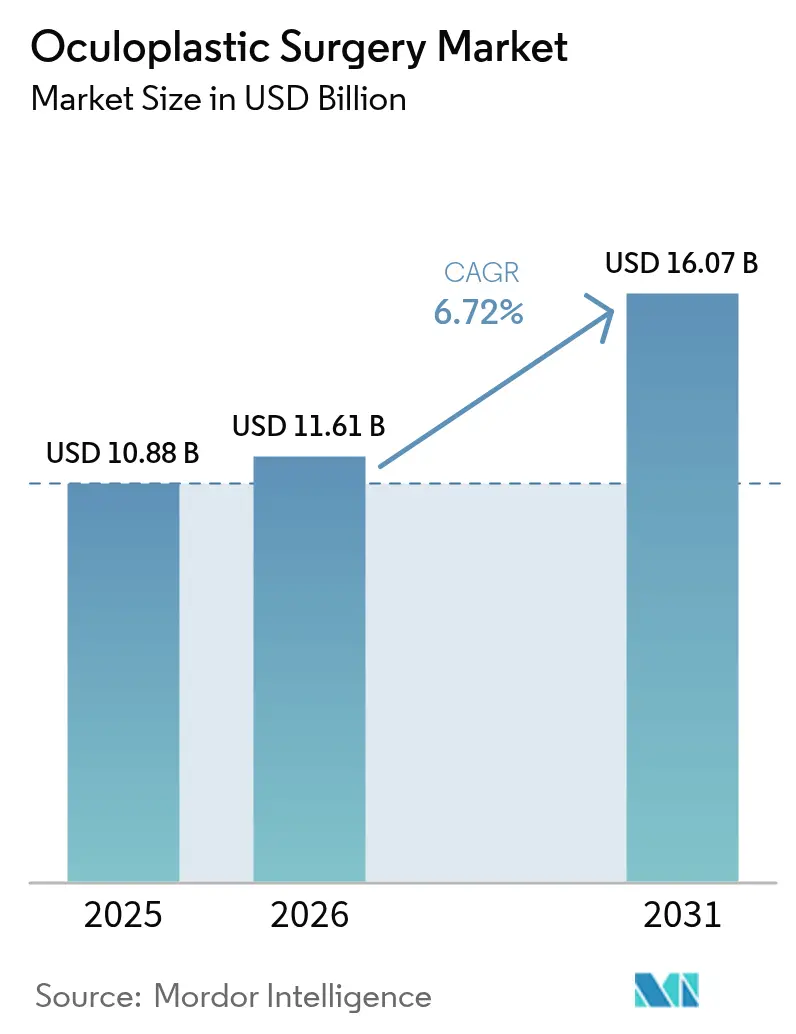
The Oculoplastic Surgery Market size is expected to grow from USD 10.88 billion in 2025 to USD 11.61 billion in 2026 and is forecast to reach USD 16.07 billion by 2031 at 6.72% CAGR over 2026-2031.
Consistent demand from aging populations, the rapid roll-out of AI-assisted surgical planning, and continuing patient preference for procedures that improve both function and appearance underpin this expansion. Technology lowers recovery times while improving accuracy, which broadens patient acceptance and strengthens reimbursement arguments. Consolidation among device makers and specialty providers allows the largest firms to bundle implants, imaging, and practice-management tools, thereby locking in surgeons and capturing recurring revenue. Finally, social-media-driven cosmetic consciousness, especially in younger cohorts, turns elective interventions into lifestyle purchases that propel global procedure volumes.
Key Report Takeaways
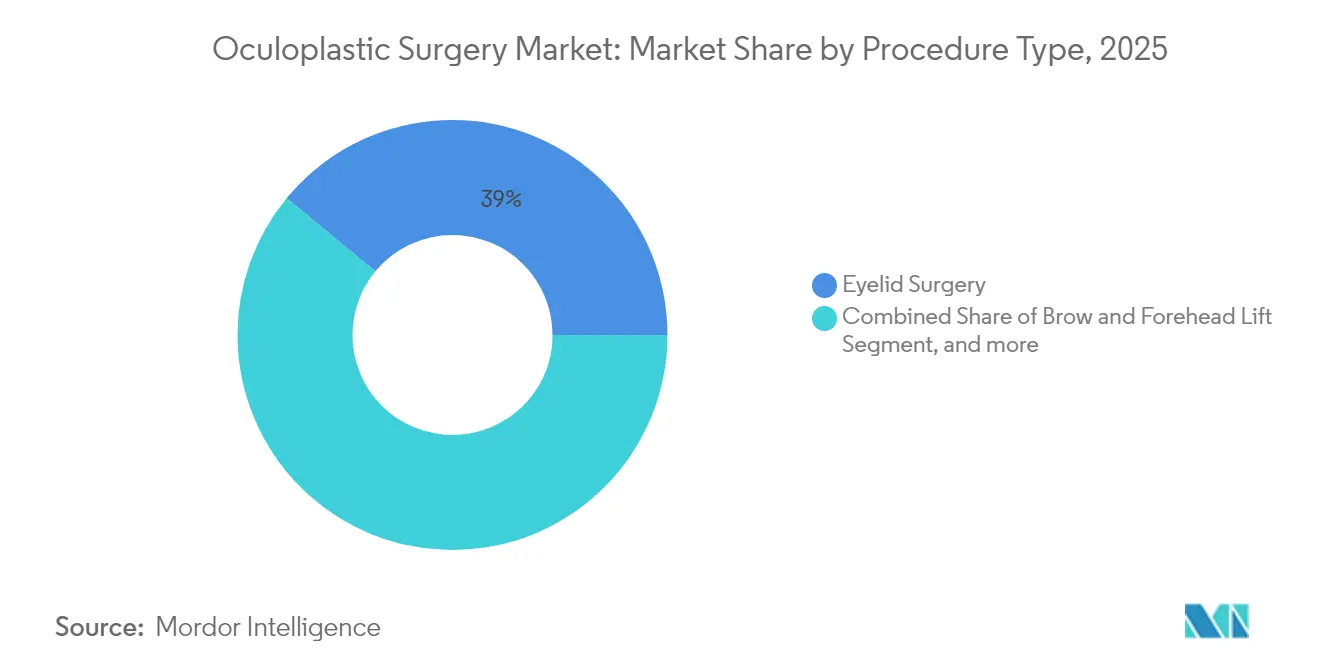
- By procedure type, eyelid surgery led with 39.02% of oculoplastic surgery market share in 2025, while brow & forehead lift recorded the fastest CAGR at 8.64% through 2031.
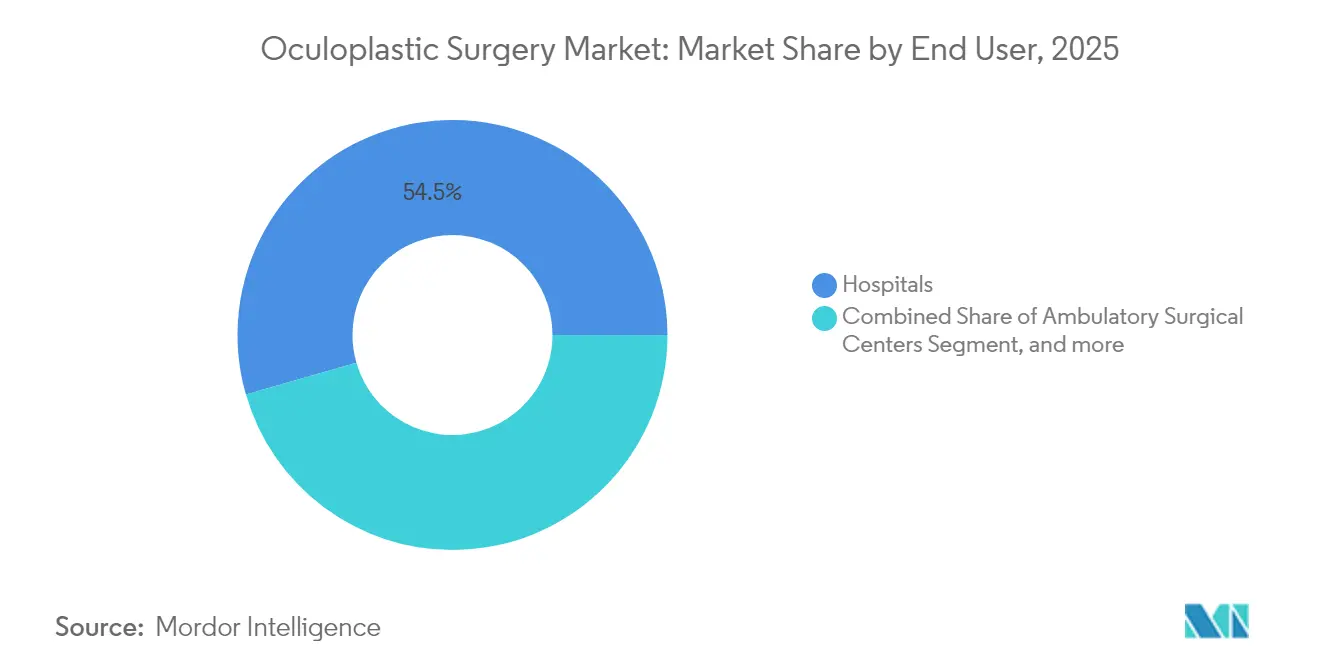
- By end user, hospitals held 54.47% share of the oculoplastic surgery market size in 2025, whereas ambulatory surgical centers are projected to expand at 9.11% CAGR to 2031.
- By geography, North America dominated with 36.25% share of the oculoplastic surgery market in 2025, but Asia Pacific is advancing at a 7.55% CAGR through 2031.
Note: Market size and forecast figures in this report are generated using Mordor Intelligence’s proprietary estimation framework, updated with the latest available data and insights as of 2026.
Market Trends and Insights
Drivers Impact Analysis of Oculoplastic Surgery Market*
| Driver | (~) % Impact on CAGR Forecast | Geographic Relevance | Impact Timeline |
|---|---|---|---|
| Rising geriatric population with eyelid needs | +1.8% | North America and Europe dominant | Long term (≥ 4 years) |
| Growing incidence of thyroid eye disease | +1.2% | Higher prevalence in developed markets | Medium term (2-4 years) |
| Uptake of minimally invasive blepharoplasty | +1.5% | North America and Europe lead, Asia Pacific follows | Short term (≤ 2 years) |
| AI-assisted pre-operative planning | +0.9% | Early use in North America and Europe, global diffusion | Medium term (2-4 years) |
| Human amniotic graft adoption | +0.7% | Primarily North America and Europe | Medium term (2-4 years) |
| Social-media-driven cosmetic demand | +1.4% | Asia Pacific, Latin America, Middle East | Short term (≤ 2 years) |
| Source: Mordor Intelligence | |||
Rising Geriatric Population with Functional & Aesthetic Eye-Lid Concerns
The surge in individuals aged 65 and above adds millions of potential candidates for functional eyelid repair and cosmetic enhancement. In the United States alone, this population will grow from 56.1 million in 2020 to 73.1 million by 2030, expanding the core patient base that seeks blepharoplasty to restore superior visual fields and facial harmony. Techniques such as the minimally invasive eyelid lift preserve orbital fat and minimize bruising, aligning clinical outcomes with the recovery expectations of older adults. Because Medicare reimburses functional blepharoplasty when documented visual field loss is improved, surgeons can justify intervention despite fee-schedule pressure. Longer life expectancy further extends the window during which patients expect clear vision and a refreshed appearance, generating repeat business for touch-up procedures and adjunct treatments. Practices that integrate pre-surgical ocular surface optimization and post-operative dry-eye management are best placed to capture this demographic tailwind.[1]American Academy of Ophthalmology, “Minimally Invasive Eyelid Lift Technique Shows Faster Recovery,” aao.org
Growing Incidence of Thyroid Eye Disease & Orbital Tumors
Thyroid eye disease now benefits from targeted biologics that calm inflammation, allowing surgery to be timed when tissue is less friable and results are more predictable. Post-biologic decompressions remove 3.5–7.6 mm of proptosis with lower diplopia rates, reinforcing surgeon confidence and raising patient satisfaction. TED often requires staged lid, strabismus, and orbital work, which lifts revenue per case while creating barriers to entry for non-specialists. Orbital tumors, although less common, demand high-resolution imaging and navigation systems that large device firms bundle into integrated platforms. Centers that can provide same-day endocrine and oculoplastic consultation capture referrals from community endocrinologists and primary-care physicians. Regional variations in iodine sufficiency shape disease clustering and create opportunities for branded centers of excellence in Europe, East Asia, and parts of the Gulf states.[2]Ophthalmic Plastic & Reconstructive Surgery, “Endoscopic Orbital Decompression Outcomes,” journals.lww.com
Rapid Uptake of Minimally Invasive Blepharoplasty & Brow-Pexy Techniques
Barbed PDO sutures, 2–3 mm access ports, and transconjunctival fat repositioning allow surgeons to treat functional dermatochalasis and cosmetic concerns without lengthy incisions. Recovery now averages 7 days instead of 14, which eliminates the career downtime that once deterred younger professionals. Training courses offered by device makers create revenue, but more importantly build surgeon loyalty to specific platforms. Most minimally invasive cases shift from hospital operating rooms to accredited office suites, lifting surgeon control of scheduling and ancillary income. High satisfaction rates translate into positive online reviews that lower marketing spend per lead and compound local demand. The diffusion curve mirrors LASIK adoption two decades earlier, suggesting that the oculoplastic surgery market will continue redistributing volume toward lower-acuity sites in urban and suburban settings
AI-Assisted Pre-Operative Planning Improving Surgical Outcomes
Machine learning models now map periorbital distances, simulate outcomes at multiple incision points, and forecast lid height to within 0.5 mm. These predictive tools shorten chair-time consultations and support informed consent with photographic renders that set realistic expectations. Artificial intelligence also flags CPT combinations, reducing under-billing and payor denials that erode practice margins. Large practices refine proprietary algorithms with each case, creating data moats that discourage commoditization. Regulators have begun issuing guidance on algorithm change control, so early compliance will protect first-mover advantage. Younger patients actively request AI visualization during consultations, framing the technology as a standard of care rather than a novelty.[3]Plastic and Reconstructive Surgery – Global Open, “AI-Based Coding Automation in Oculoplastic Practice,” journals.lww.com/prsgo
Restraints Impact Analysis of Oculoplastic Surgery Market*
| Restraint | (~) % Impact on CAGR Forecast | Geographic Relevance | Impact Timeline |
|---|---|---|---|
| High procedure cost and limited reimbursement | -1.4% | Acute in emerging markets | Short term (≤ 2 years) |
| Shortage of trained oculoplastic surgeons | -0.8% | Sub-Saharan Africa, Southeast Asia, Latin America | Long term (≥ 4 years) |
| Peri-operative infection risk costs | -0.6% | Higher impact in developing health systems | Medium term (2-4 years) |
| Competition from nonsurgical alternatives | -1.1% | North America and Europe, rising in Asia Pacific | Short term (≤ 2 years) |
| Source: Mordor Intelligence | |||
High Procedure Cost & Limited Reimbursement
The 5.4% cut to the 2024 Medicare conversion factor forces U.S. oculoplastic practices to chase volume or pivot toward cash-pay cosmetic work. Similar dynamics occur in Europe where diagnosis-related-group payments lag inflation. Hospitals respond by moving lower-risk cases into ambulatory centers, thus retaining surgeons while shedding inpatient overhead. In Asia Pacific and Latin America, partial insurance coverage leaves many patients self-funding, which suppresses uptake of multi-step reconstructions. Price disparities have fueled a medical-tourism circuit that routes cost-sensitive patients to centers in Turkey, Thailand, and Colombia. Digital platforms that quote all-inclusive surgical packages are altering competitive boundaries by shifting demand across borders.
Shortage of Fellowship-Trained Oculoplastic Surgeons in Low-Income Regions
Global ophthalmology faces a projected 30% clinician deficit by 2035, with the shortfall felt most acutely in rural provinces and low-income countries. Fellowship seats remain limited, and matching rates hover below 55%, constraining graduate output. The vacuum invites task-shifting to general ophthalmologists, although complex orbit cases remain beyond their scope. Tele-mentoring and AI-driven diagnostics extend specialist reach, yet legal liability and bandwidth gaps slow adoption. International non-governmental organizations fund regional training hubs, but retention is difficult when graduates migrate to urban private practice. Scalable solutions may hinge on modular fellowships that blend virtual reality simulators with brief on-site intensives.
*Our forecasts treat driver/restraint impacts as directional, not additive. The impact forecasts reflect baseline growth, mix effects, and variable interactions.
Oculoplastic Surgery Market Segment Analysis
By Procedure Type:
Eyelid Dominance and Brow AccelerationEyelid Surgery accounted for 39.02% of oculoplastic surgery market size in 2025, confirming longstanding dominance that blends functional necessity with cosmetic demand. Upper-lid blepharoplasty remains covered by many payors when visual-field testing proves obstruction, which preserves a reliable reimbursement stream. Surgeons have refined incision placement beneath natural folds, while fat-preservation philosophies limit hollowing that once compromised aesthetics. Concurrently, rising uptake of laser skin tightening enhances results without added incisions.
The brow & forehead lift category is expanding at 8.64% CAGR toward 2031, making it the fastest segment inside the oculoplastic surgery market. Endoscopic platforms now permit 1 cm hairline incisions that anchor the brow on absorbable screws, cutting convalescence to under 10 days. Younger patients seek subtle brow elevation paired with toxin maintenance, building a pipeline for eventual surgical conversion. Cross-selling opportunities emerge when surgeons coordinate upper-lid and brow work in a single sitting, optimizing theatre time and improving per-case revenue. These dynamics maintain eyelid dominance yet position brow procedures to capture an outsized growth share.


By End User:
Hospital Stronghold Meets ASC MomentumHospitals held 54.47% of oculoplastic surgery market size in 2025 because they manage high-acuity cases such as orbital decompression that need intensive monitoring. Integrated imaging, pathology, and intensive-care resources remain persuasive for complex cases, even as cost scrutiny mounts. Academic centers also sustain demand by running fellowship programs that funnel trainees through operating lists, guaranteeing procedure flow and device utilization.
Ambulatory Surgical Centers will grow 9.11% CAGR to 2031 and are reshaping the oculoplastic surgery market with nimble scheduling and lower overhead. Procedural migration accelerates as insurers approve site-of-service differentials that share savings with patients. Surgeons gain autonomy over staff selection and postoperative protocols, while bundled implant pricing further lifts margins. Specialty eye clinics and office-based suites bridge hospital capability and ASC efficiency, offering advanced anesthesia and sterile environments without the bureaucracy of large systems. The competitive map will hinge on which setting can validate safety equivalence while maintaining price advantage.
Geography Analysis
North America Oculoplastic Surgery Market
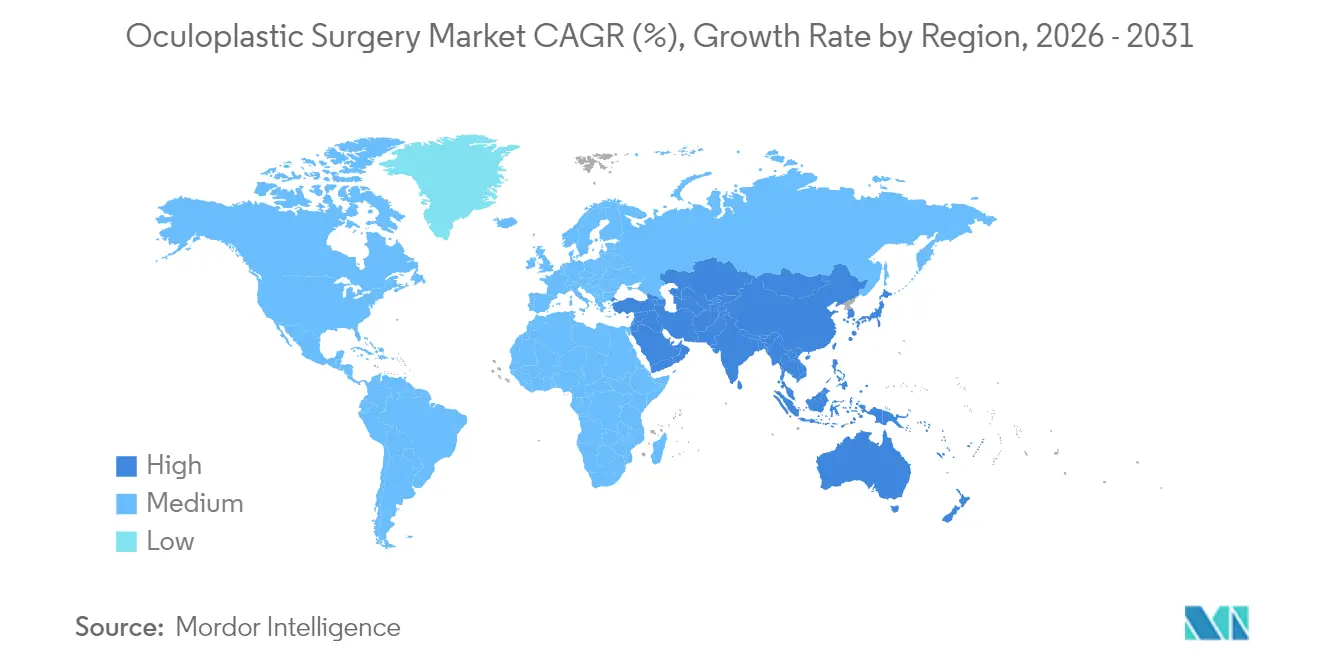
North America commands 36.25% of the oculoplastic surgery market share in 2025 and continues to benefit from strong fellowship pipelines, high awareness, and sophisticated payor networks. Conversion-factor cuts in 2024 encourage practices to add cash-pay cosmetic lids and brow lifts, smoothing revenue volatility. Office-based surgery suites, representing 2.2% of procedures in Q1 2023, provide surgeons with facility fees once captured by hospitals, reinforcing regional leadership. Consolidators backed by private equity expand multi-state networks that negotiate supply contracts at scale and invest in AI imaging to lure referrals.
APAC Oculoplastic Surgery Market
Asia Pacific registers the fastest regional CAGR at 7.55% through 2031 as expanding middle classes prioritize appearance in professional and social contexts. Government-supported universal health schemes in South Korea and Japan reimburse functional blepharoplasty, while private payment covers cosmetic add-ons. Device leaders such as Alcon dedicate USD 828 million in 2023 R&D toward lens and imaging products tuned to Asian anatomy, signaling a long-term commitment. Meanwhile, China’s National Medical Products Administration tightens device approval timelines, ensuring quality but lengthening market-entry planning cycles.
EMEA and South America Oculoplastic Surgery Market
Europe maintains moderate growth based on universal coverage and strong clinical governance. Aging demographics push functional lids and brow lifts upward, yet austerity measures cap reimbursement growth. Innovative techniques like anterior ptosis repair remain favored by 66% of surgeons surveyed in the United Kingdom. The Middle East & Africa and South America trail in share yet display pockets of rapid adoption. Brazilian surgeons pioneer microscope-integrated optical coherence tomography that improves macular visualization and demonstrates the region’s capacity to leapfrog with advanced tools.

Competitive Landscape
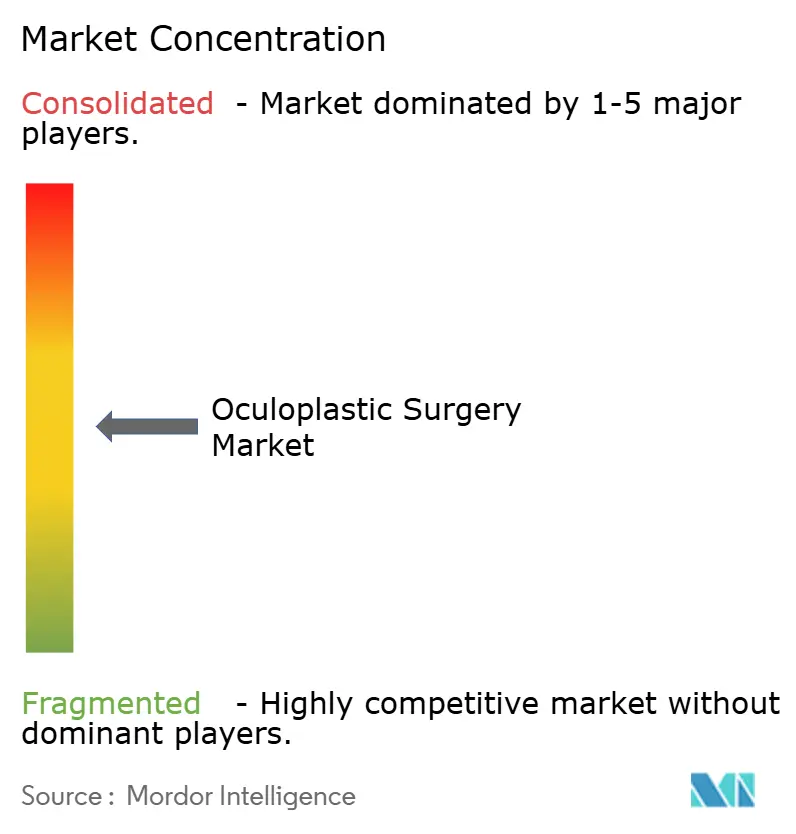
The oculoplastic surgery market features moderate fragmentation with global device multinationals, specialty pharmaceutical firms, and nimble startups all vying for surgeon loyalty. Alcon, Johnson & Johnson Vision, and Carl Zeiss Meditec use broad portfolios and global sales teams to influence procedure technique and product choice. Alcon’s USD 430 million LENSAR acquisition and majority stake in Aurion Biotech illustrate a strategy to wrap femtosecond lasers and regenerative cell therapy into one ecosystem, raising switching costs for surgeons.
Technology leadership remains the central battleground. Carl Zeiss Meditec lifted first-half fiscal-year revenue 10.9% to EUR 1,050.5 million after acquiring Dutch Ophthalmic Research Center, which broadened the refractive and retina line-up. KARL STORZ’s purchase of Asensus Surgical adds the LUNA system with intra-operative augmented intelligence, signaling a push into robotics that promises tremor-free dissection and sub-millimeter precision. Startups focusing on AI-driven pre-operative planning or bioresorbable implants attract venture funding but often partner with larger players for distribution muscle.
Regulatory compliance is a potent differentiator. An FDA warning letter to Integra LifeSciences over quality-system lapses halted implant shipments and opened doors for competitors that could certify uninterrupted supply. Providers increasingly demand post-market surveillance data, pressuring vendors to finance long-term registries. In emerging economies, the first vendor to navigate local approval frameworks and organize surgeon training often captures entrenched share. Intense merger activity is likely to continue as strategic buyers fill product gaps and startups monetize innovations.
Oculoplastic Surgery Industry Leaders
TEKNO-MEDICAL Optik-Chirurgie GmbH
B. Braun Melsungen AG
Katena (Blink Medical Ltd.)
Karl Storz SE & Co. KG
Integra LifeSciences Holdings Corporation
- *Disclaimer: Major Players sorted in no particular order
Oculoplastic Surgery Market Companies Covered in this Report
- Tekno-Medical Optik-Chirurgie
- Zimmer Biomet
- Integra LifeSciences
- B. Braun
- Katena Products
- Karl Storz
- Bolton Surgical
- Alcon
- Johnson & Johnson
- Carl Zeiss
- Allergan Aesthetics
- Bausch Health
- Glaukos
- EssilorLuxottica
- Stryker
- Medtronic
- Smiths Group
- AmbioDisk LLC

Market Opportunities and Future Outlook
White-space in oculoplastic surgery is developing around office-based and adjunct technologies that reduce surgical burden while managing lid laxity and ocular-surface comorbidities that complicate periocular procedures. One near-term opening is the convergence of dry-eye management with eyelid interventions, supported by device authorization milestones such as Lumenis receiving Health Canada authorization in May 2026 for OptiLIFT (Dynamic Muscle Stimulation) to address evaporative dry eye and lower lid laxity. This setup gives specialty eye clinics and ASCs a more straightforward way to bundle perioperative ocular-surface optimization with functional and aesthetic eyelid workflows, expanding revenue beyond the OR.
A second opportunity is in regenerative and biologic adjuncts aimed at lowering revision rates and supporting tissue healing, consistent with the report scope that includes implants and procedure-bundled equipment. Cellution Biologics entered the ocular market in April 2026 with OptiCover, a shelf-stable, lyophilized amniotic graft positioned for ocular surface protection, reinforcing ongoing adoption of amniotic graft solutions referenced in clinical practice. Separately, broader AI-assisted pre-operative planning adoption appears less limited by model performance and more by standardization, validation criteria, and liability frameworks discussed in peer-reviewed literature and professional bodies; vendors and provider networks that operationalize governance (change control, documentation, and workflow integration) can differentiate through predictable outcomes, faster consultations, and cleaner coding and pre-authorization pathways.
Recent Industry Developments in Oculoplastic Surgery Market
- June 2026: Medtronic and KARL STORZ announced a strategic collaboration in the United States to expand access to integrated ENT surgical solutions by combining Medtronic technologies with KARL STORZ visualization and endoscopy instrumentation. The collaboration reinforces the broader shift toward integrated surgical solutions that can be cross-leveraged into adjacent surgical specialties that share endoscopic and visualization requirements, including periocular and orbital workflows.
- March 2025: Alcon announced an agreement to acquire LENSAR, Inc. for approximately USD 356 million, adding the ALLY Robotic Cataract Laser Treatment System and Streamline software to its surgical portfolio. This consolidates high-value capital equipment and software into larger ophthalmic platforms, shaping procurement behavior at hospitals and ASCs that often co-invest across anterior-segment and periocular procedure capabilities.
- April 2024: Integra LifeSciences completed the acquisition of Acclarent, Inc., expanding its footprint in ENT surgical interventions. The acquisition supports broader portfolio bundling strategies among surgical device suppliers, which can affect purchasing decisions for oculoplastic-adjacent instruments and implants through consolidated contracting and distribution reach.


Oculoplastic Surgery Market Report Scope and Research Methodology
Market Definition and Coverage
This market covers the value of oculoplastic surgical care delivered around the eyelids, orbit, and lacrimal system, including related procedure tools, implants, and equipment used in hospitals, ambulatory surgery centers, and specialty clinics.
Scope exclusions: Stand-alone non-surgical injectables that are not delivered as part of an oculoplastic surgical episode are excluded.
Segments Covered in This Report
- By Procedure Type
- Eyelid Surgery
- Brow & Forehead Lift
- Facelift Adjacent Oculoplastic
- Lacrimal & Orbital Decompression
- Pediatric Oculoplastic
- Others Procedure Type
- By End User
- Hospitals
- Ambulatory Surgical Centers
- Specialty Eye Clinics
- Cosmetic Surgery Centers
- By Geography
- North America
- United States
- Canada
- Mexico
- Europe
- Germany
- United Kingdom
- France
- Italy
- Spain
- Rest of Europe
- Asia-Pacific
- China
- Japan
- India
- Australia
- South Korea
- Rest of Asia-Pacific
- Middle East & Africa
- GCC
- South Africa
- Rest of Middle East & Africa
- South America
- Brazil
- Argentina
- Rest of South America
- North America
Data Sources, Market Sizing, and Validation
Desk Research
Desk work starts with public health and utilization signals that can be checked year over year. We typically lean on sources such as the World Health Organization and the US Centers for Disease Control and Prevention, plus the World Bank for population and aging indicators, and inputs from national health ministries to frame care access and capacity context.
To keep procedure and setting assumptions realistic, we pull additional inputs from peer reviewed ophthalmology and plastic surgery journals, reimbursement and coding references, and medical device regulatory databases (for product clearances). We also use professional society publications on eyelid and lacrimal disorders to confirm terminology and condition groupings. Company filings, investor decks, and reputable press are reviewed to understand capacity expansion, product launches, and geographic focus, with selective use of paid subscriptions for company financials, patent lookups, and shipment level import and export checks. These sources are illustrative, and many other public references were also used for data collection, validation, and research clarification.
Primary Interviews and Surveys
Primary work is used to confirm what actually gets counted in the market and what does not, especially when procedures overlap with broader facial aesthetics. We spoke with clinicians, hospital and ASC administrators, distributors, and product specialists across key regions, and then used those inputs to test volumes, typical procedure mixes, and pricing ranges before locking assumptions.
Distribution of primary research fieldwork respondents
| Company type | Respondent position | Region |
|---|---|---|
| Top tier: 39% | CXOs: 16% | APAC: 41% |
| Mid tier: 42% | Functional/Unit leaders: 39% | EMEA: 35% |
| Smaller Players: 19% | Managers: 45% | Americas: 24% |
Market-Sizing & Forecasting
Sizing starts from a top-down demand pool, where procedure incidence and treatable cohorts are built using aging population trends, diagnosed eyelid and lacrimal condition prevalence, and setting level adoption in hospitals and ASCs. Those totals are then translated into value using typical procedure mix splits (for example eyelid surgery versus lacrimal and orbital work) and blended pricing that reflects anesthesia, facility fees, and device use.
To reduce the risk of a purely theoretical result, we also run selective bottom-up checks, such as sampling average selling prices for key instruments and implants, distributor channel feedback on unit movement, and sanity checks on surgeon throughput by setting. Where data is thin for smaller countries, gaps are handled using comparable market proxies, followed by adjustments for income levels, specialist availability, and reimbursement intensity.
For forecasting, we use scenario analysis with a multivariate view, since demand is influenced by more than one driver. Inputs we track include the 60+ population share, elective procedure willingness, ambulatory surgery migration, regulatory approvals for supporting devices, and pricing pressure from payer mix changes. The resulting curve is then reviewed with experts so we do not overstate short-term adoption jumps.
Data Validation & Update Cycle
Validation is done through multiple cross-checks so that one noisy input does not drive the outcome. Model outputs are compared against independent signals like procedure mix shares, end user splits, and region level growth patterns, and any large variance is reviewed before sign-off.
A second analyst review is completed for calculations, assumptions, and year-on-year movements, and respondents are re-contacted when a number moves beyond a reasonable band or when definitions appear to be interpreted differently. Reports are refreshed annually, and interim updates are made when material events occur, with a final pre-delivery pass so clients receive the latest updated view.
Mordor Intelligence's Oculoplastic Surgery Market Size Measured Against Other Published Estimates
Published market values for oculoplastic surgery do not always line up, even when they sound like they cover the same procedures. The differences usually come from what gets counted inside the treatment basket, the year used as the reference point, and how pricing and procedure mix are built into the model.
Procedure mix shares, setting splits (hospital versus ASC), and region growth patterns are the evidence checks that keep Mordor Intelligence tied to surgical oculoplastics only. This is also why estimates that fold injectables into facial rejuvenation can land lower or higher depending on what is bundled. Another driver is timing, since some publishers use a 2024 or 2025 starting point and then apply a single CAGR, even though reimbursement intensity and elective demand can move unevenly across regions.
Benchmark comparison
| Source | Market Size | Gaps in Research Methodology |
|---|---|---|
| Mordor Intelligence | USD 10.88 B (2025) | |
| Industry Publisher A | USD 9.86 B (2024) | Uses an earlier reference year and a different revenue boundary that is more product-led, which can undercount procedure-linked service value and shift the mix across care settings. |
| Industry Publisher B | USD 9.80 B (2025) | Includes adjacent facial rejuvenation items like injectables within the oculoplastic bucket, and the broader inclusion can change the total depending on how non-surgical volumes and pricing are treated. |
Taken together, the spread in figures is mostly explained by scope boundaries and year alignment, not by a single arithmetic issue. When the counted procedures, settings, and pricing logic are stated clearly and then tested against external signals, the final number becomes easier to trace and repeat in future refresh cycles, which is what we aim for in this study.


Key Questions Answered in the Report
What is the projected value of the oculoplastic surgery market by 2031?
The oculoplastic surgery market size is expected to reach USD 16.07 billion by 2031, underpinned by a 6.72% CAGR.
Which procedure currently dominates the market?
Eyelid Surgery leads, accounting for 39.02% of oculoplastic surgery market share in 2025.
Why are ambulatory surgical centers growing faster than hospitals?
ASCs deliver lower costs, shorter scheduling delays, and physician control, and they are forecast to expand at 9.11% CAGR through 2031.
Which geographic region is growing the fastest?
Asia Pacific is forecast to grow at 7.55% CAGR due to rising middle-class spending and social-media-driven aesthetic demand.
How is artificial intelligence changing oculoplastic practice?
AI now simulates surgical outcomes, optimizes incision planning, and automates billing, all of which cut revision rates and boost practice margins.
What are the main restraints on market growth?
High procedure costs with limited reimbursement and a shortage of fellowship-trained surgeons in low-income regions slow overall expansion.
Page last updated on:


 Your data is secure and never sold or shared.


