
Market Overview
| Study Period | 2020 - 2031 |
|---|---|
| Forecast Data Period | 2026 - 2031 |
| Base Year Market Size (2025) | USD 2.37 Billion |
| Market Size (2026) | USD 2.47 Billion |
| Market Size (2031) | USD 3.03 Billion |
| Growth Rate (2026 - 2031) | 4.16 % |
| Market Concentration | Medium |
Major Players *Disclaimer: Major Players sorted in no particular order Image © Mordor Intelligence. Reuse requires attribution under CC BY 4.0. | |
Norway Facility Management Market Analysis by Mordor Intelligence
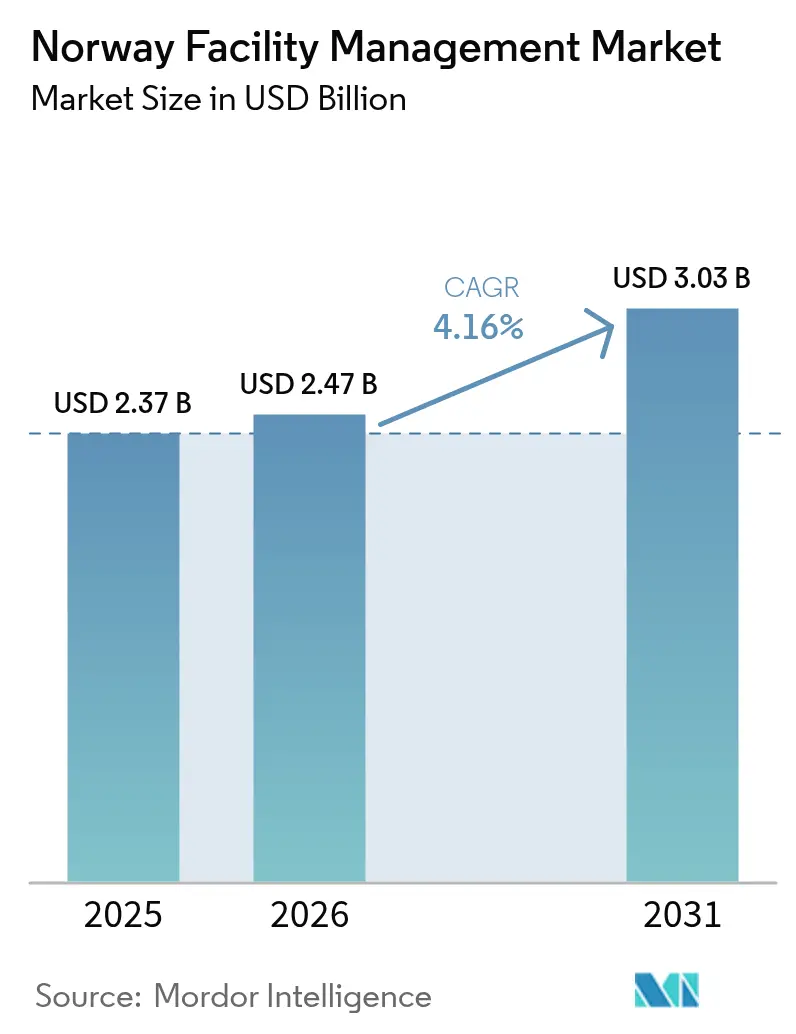
Norway facility management market size in 2026 is estimated at USD 2.47 billion, growing from 2025 value of USD 2.37 billion with 2031 projections showing USD 3.03 billion, growing at 4.16% CAGR over 2026-2031. This growth outlook reflects resilient demand across private and public real-estate portfolios, the country’s strict energy-efficiency mandates, and a decisive pivot toward integrated service models. Norway’s universal fiber connectivity underpins rapid PropTech integration, while mandatory ESG disclosure under the Climate Act accelerates adoption of data-rich facility management platforms. Oslo’s dominance in office transactions and infrastructure investment funnels a large share of new contracts into the capital region, yet Bergen, Stavanger, and a cluster of secondary cities are closing the gap by capitalizing on offshore energy projects, university expansion, and smart-building grants. Competitive intensity has sharpened after Compass Group’s 2025 purchase of 4Service, a move that triggered capability upgrades and price realignments among incumbents seeking Nordic scale. Providers able to demonstrate measurable carbon reductions and verifiable cost savings now command premium, multi-year integrated facility management agreements.
Key Report Takeaways
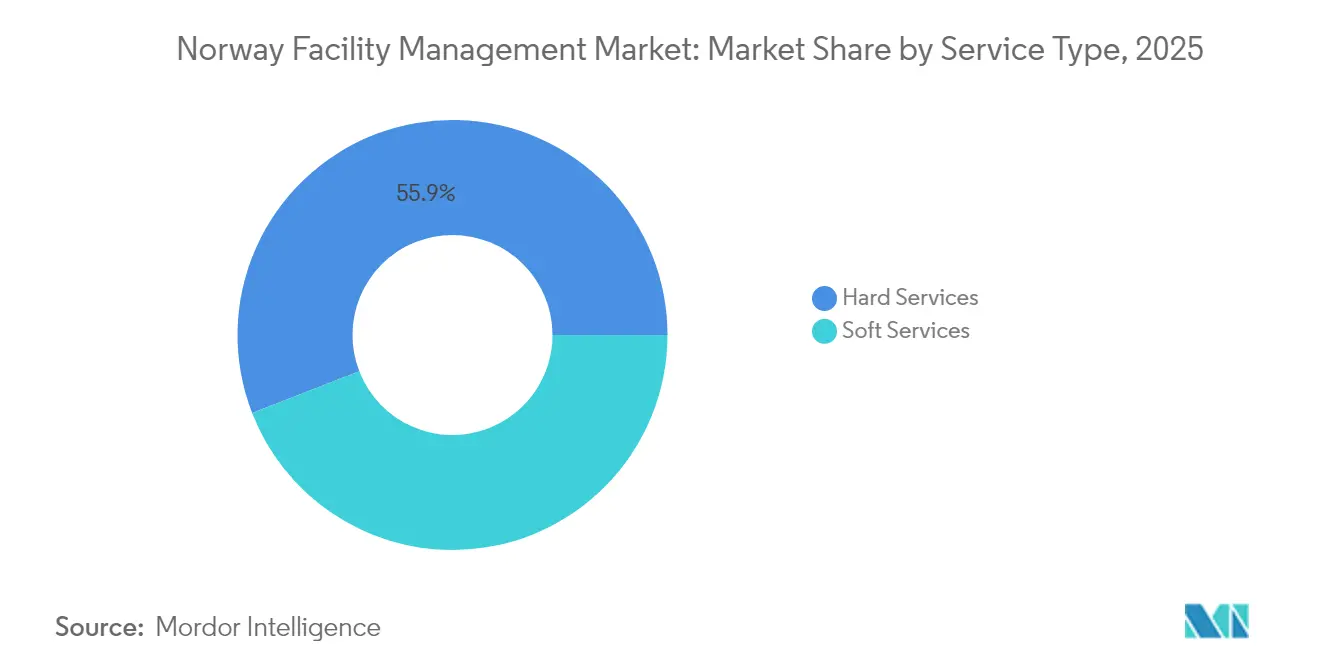
- By service type, hard services captured 55.90% of Norway facility management market share in 2025, whereas soft services are advancing at a 4.92% CAGR through 2031.
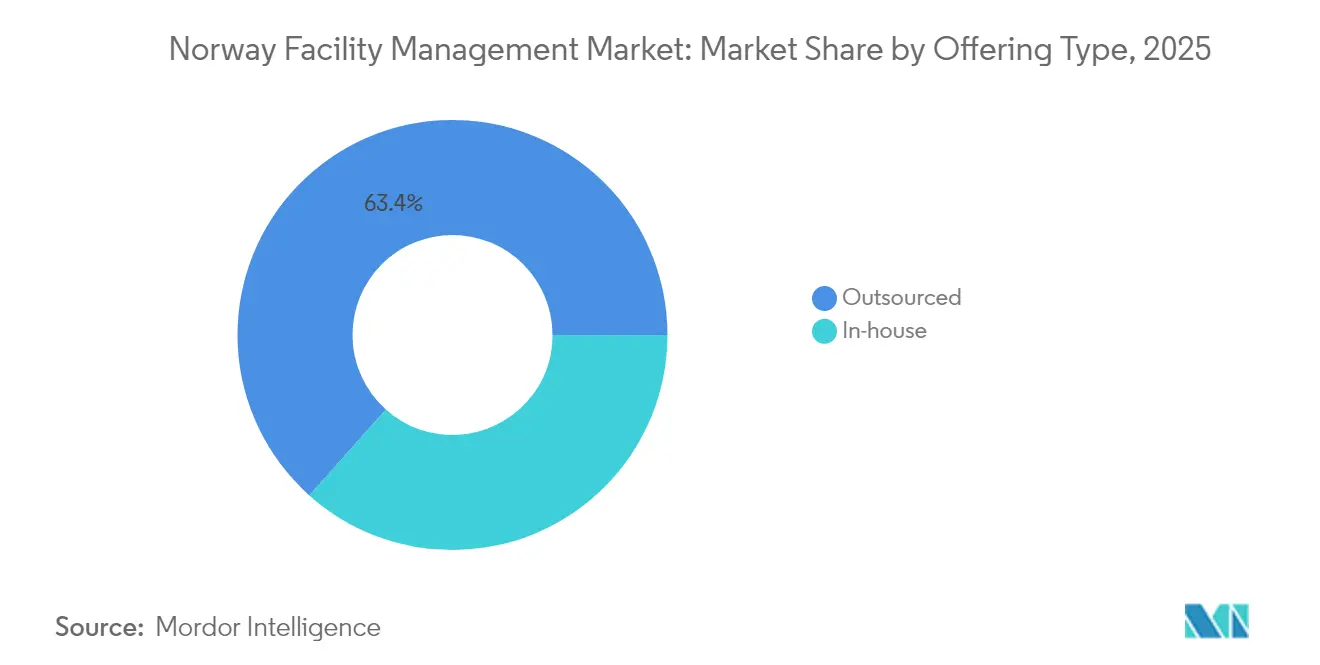
- By offering type, the outsourced model accounted for 63.40% of Norway facility management market size in 2025, while integrated FM contracts are projected to expand at 4.62% CAGR between 2026 and 2031.
- By end-user industry, the institutional and public-infrastructure segment is expanding at the fastest 4.73% CAGR to 2031; the commercial sector retained a 39.20% revenue share in 2025.
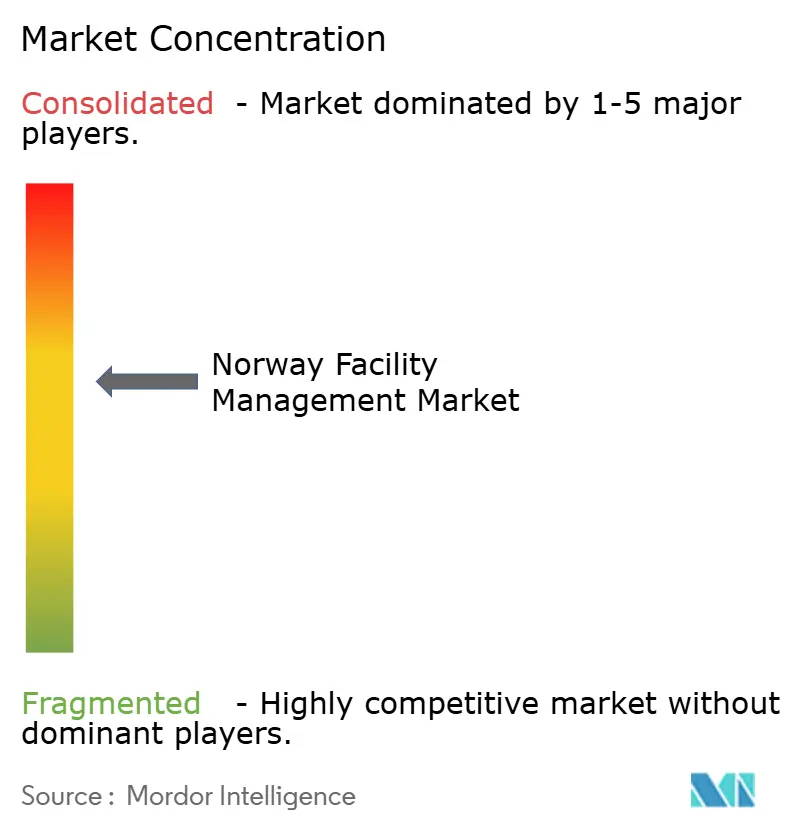
- ISS, Coor, and Compass Group collectively held just above 40% of the domestic revenue pool in 2024, underscoring a moderately concentrated competitive structure.
Note: Market size and forecast figures in this report are generated using Mordor Intelligence’s proprietary estimation framework, updated with the latest available data and insights as of 2026.
Norway Facility Management Market Trends and Insights
Drivers Impact Analysis*
| Driver | (~) % Impact on CAGR Forecast | Geographic Relevance | Impact Timeline |
|---|---|---|---|
| Surge in retrofit demand to meet Norway’s 2030 energy-efficiency directive targets | +1.2% | National; strongest in Oslo, Bergen, Stavanger | Medium term (2-4 years) |
| Government “Nye Veier” & Statsbygg outsourcing policies fuel large public-sector IFM contracts | +0.8% | National; major infrastructure corridors | Long term (≥ 4 years) |
| Mandatory ESG & carbon reporting under Norway’s Climate Act boosts data-driven FM services | +0.7% | National; priority in urban centers | Short term (≤ 2 years) |
| Tight labour market & high wage levels accelerate FM outsourcing for cost control | +0.9% | National; acute in Oslo, Stavanger | Medium term (2-4 years) |
| PropTech adoption enabled by nationwide fiber connectivity & smart-building grants | +0.6% | Urban centers, spreading to secondary cities | Medium term (2-4 years) |
| Integrated FM demand from offshore oil & gas platforms seeking single-vendor HSE compliance | +0.4% | Stavanger, Bergen, offshore installations | Long term (≥ 4 years) |
| Source: Mordor Intelligence | |||
Surge in Retrofit Demand to Meet Norway's 2030 Energy-Efficiency Directive Targets
Norway’s legally binding goal of cutting greenhouse-gas emissions 55% by 2030 has unleashed unprecedented demand for building retrofit projects, and this demand feeds directly into the Norway facility management market.[1]Government-funded initiatives spotlight digital monitoring and space optimization to trim the building sector’s sizeable energy footprint. Facility managers increasingly deploy building-automation control systems, delivering up to 24% energy savings when paired with comprehensive envelope and plant upgrades. Urban projects favor such digital retrofits because dense sites impose physical limits on deep envelope interventions. Oslo and Bergen commercial landlords report shorter payback periods when automation is layered onto mechanical, electrical, and plumbing (MEP) upgrades, making energy retrofits a core driver of hard-service revenues.
Government “Nye Veier” & Statsbygg Outsourcing Policies Fuel Large Public-Sector IFM Contracts
Nye Veier’s EUR 25 billion, 20-year infrastructure pipeline and Statsbygg’s wholesale shift to outsourced non-core operations are reshaping public-sector procurement toward bundled and integrated contracts. [2]Municipalities collectively direct more than NOK 500 billion of annual procurement, and recent tender specifications stress ESG scorecards and circular-economy compliance. Vendors that document CO₂ avoidance, waste diversion, and social-impact metrics gain scoring advantages. Integrated facility management agreements with performance-based clauses now replace fragmented single-service deals, especially along new highway corridors and in government office clusters. These policies lengthen contract tenors and raise lifetime revenue visibility for service providers capable of delivering end-to-end solutions.
Mandatory ESG & Carbon-Reporting Under Norway's Climate Act Boosts Data-Driven FM Services
The Climate Act and the Transparency Act require large Norwegian companies to furnish detailed ESG disclosures, driving a surge in demand for IoT-enabled carbon-tracking solutions. Facility managers have responded by installing sensor arrays across lighting, HVAC, and metering systems, capturing granular consumption data for automated compliance reporting. Deployments such as Sundvolden Hotel’s 1 GWh energy-saving program illustrate real-time analytics’ ability to translate data into clear cost and carbon reductions. Early adopters cite faster audit cycles and improved tenant engagement as additional benefits, reinforcing data-driven FM models as a competitive necessity.
Tight Labour Market & High Wage Levels Accelerate FM Outsourcing for Cost Control
Norway’s unemployment rate of just above 2% and average monthly salaries nearing 60,000 NOK translate into some of Europe’s highest facility payroll costs.[3]Union density and collectively bargained overtime premiums further inflate budgets, making internally managed soft and technical services cost-prohibitive for many occupiers. Real wage growth of 1.9% in 2024 intensified these pressures, prompting corporations to pass responsibility for staffing, scheduling, and technology investment to specialist providers. Outsourcing also mitigates recruitment challenges in scarce technical disciplines, supporting the long-term shift toward bundled and integrated FM contracts.
Restraints Impact Analysis*
| Restraint | (~) % Impact on CAGR Forecast | Geographic Relevance | Impact Timeline |
|---|---|---|---|
| Stringent tender regulations (Public Procurement Act) raise bid costs & lengthen sales cycles | -0.5% | National; applies to all public contracts | Long term (≥ 4 years) |
| Cap-ex freeze in commercial real-estate amid high interest rates curtails new FM contracts | -0.3% | Oslo and Bergen CBDs | Short term (≤ 2 years) |
| Volatility in offshore oil & gas maintenance budgets creates revenue swings for technical FM providers | -0.4% | National; applies to all public contracts | Long term (≥ 4 years) |
| High unionisation rates limit flexible workforce allocation and inflate overtime expenses | -0.2% | National, acute in Oslo, Stavanger | Medium term (2-4 years) |
| Source: Mordor Intelligence | |||
Stringent Tender Regulations Raise Bid Costs & Lengthen Sales Cycles
Norway’s Public Procurement Act prescribes exhaustive documentation, transparent evaluation criteria, and appeal windows that often stretch bid cycles for public-sector FM contracts. Providers must invest in detailed ESG documentation, life-cycle cost analyses, and digital reporting frameworks even before shortlist selection. The rigorous process disadvantages smaller domestic firms lacking dedicated bid teams and lifts compliance costs for larger incumbents. Delays between tender issue and contract award can exceed 12 months, compressing near-term revenue visibility, particularly where incumbent agreements expire during the evaluation phase.
Cap-Ex Freeze in Commercial Real Estate Amid High Interest Rates Curtails New FM Contracts
A rapid rise in interest rates during 2024 increased capital costs for real-estate investors, leading many Oslo and Bergen landlords to defer new-build and major retrofit projects. With pipeline developments postponed, contract generation for construction-phase facility services slowed, translating into a short-term drag on Norway facility management market growth. Landlords now prioritize operating-expense optimization over expansion, heightening price competition in soft-service tenders until financing conditions ease.
*Our forecasts treat driver/restraint impacts as directional, not additive. The impact forecasts reflect baseline growth, mix effects, and variable interactions.
Segment Analysis
By Service Type: Hard Services Drive Market Share Despite Soft-Service Growth Acceleration
Hard services commanded a dominant 55.90% Norway facility management market share in 2025 due to aging infrastructure, severe climatic stress on building envelopes, and mandatory energy audits that favor sophisticated MEP and HVAC upgrades. Fire-safety systems form a critical sub-segment in offshore platforms where nonstop monitoring is compulsory. Owners increasingly request asset-management overlays to extend equipment life, a trend reinforced by rising financing costs. Soft services, by contrast, controlled 44.10% of 2025 revenues yet are projected to scale at a brisk 4.92% CAGR through 2031 as occupiers embrace wellness-oriented workplace strategies. Digital work-order apps, ESG-compliant cleaning protocols, and app-based user-experience features position soft-service providers for rapid expansion inside bundled and integrated delivery models.
Across both categories, integrated packages that merge technical maintenance with hospitality-style amenity management are gaining traction, especially in high-rise multi-tenant assets where occupants demand seamless service experiences. Providers that blend certified Nordic Swan cleaning, AI-led space analytics, and energy-performance guarantees are closing larger, longer contracts, underscoring cross-selling potential between hard and soft domains.

By Offering Type: Outsourced Models Dominate as Integration Complexity Increases
The outsourced delivery model accounted for 63.40% of Norway facility management market size in 2025 and is on track to grow at 4.62% CAGR to 2031 as organizations double down on core-business focus and labor-cost risk transfer. Single-service contracts are receding, particularly in corporate headquarter campuses where fragmented vendors hamper portfolio-wide ESG reporting. Mid-market occupiers gravitate toward bundled FM because it balances coordination gains with manageable contract complexity, while larger groups push straight to fully integrated deals.
Integrated FM is delivering double digit pipeline growth, bolstered by ISS extending its Barclays mandate and Coor’s PostNord renewal. Providers leverage self-perform platforms for high-volume soft services and strategic sub-contractor ecosystems for specialist technical tasks, enabling flexible cost structures. The 36.60% in-house segment remains material in petrochemical, defense, and high-security sites where statutory or operational constraints limit third-party access, but even these holdouts increasingly carve out non-core tasks for external partners.
By End-User Industry: Commercial Sector Leadership Challenged by Institutional Growth
The commercial estate cluster retained 39.20% of 2025 revenue, powered by Oslo’s thriving technology scene and omnichannel retail networks that demand temperature-controlled warehousing and resilient data-center infrastructure. Operators such as Bulk Infrastructure have rolled out energy-efficient colocation sites, generating a steady stream of technical FM assignments. Yet the institutional and public-infrastructure segment is accelerating at a 4.73% CAGR, propelled by steady public expenditure and systematic outsourcing under Nye Veier and Statsbygg frameworks.
Hospitals, universities, and transport hubs leverage building-information-modeling workflows to enforce asset-performance warranties, nudging facility management vendors into data-centric service delivery. Industrial campuses, while cyclical, continue to require predictive-maintenance packages that minimize unplanned downtime for energy and process equipment. Meanwhile the hospitality sector adopts IoT-driven climate and occupancy controls that simultaneously cut utility bills and elevate guest comfort, signaling additional upside for solution-rich FM providers.
Geography Analysis
Greater Oslo, home to roughly 1.4 million residents, constitutes the single largest addressable cluster for the Norway facility management market. Prime CBD offices command rents near EUR 500/m², and 2023 absorption reached 870,000 m², generating a large volume of high-spec technical and soft-service contracts. The city’s data-center corridor amplifies demand for mission-critical maintenance and 24/7 monitoring. Second in momentum, Bergen recorded 13.1% property-value growth in 2024 and channels offshore-sector synergies into FM requirements for supply bases, crew accommodation, and maritime logistics.Stavanger’s energy heritage produces a deep pool of brown-field platform-support work, while several floating wind and carbon-capture pilots add specialist service opportunities.
Trondheim and Tromsø deliver steady institutional demand backed by university estates, student housing, and government northern-development programs. Ubiquitous fiber connectivity allows these secondary markets to adopt the same IoT-rich facility standards as the capital, shrinking the service-quality gap and expanding the reachable client base for national FM providers. Further afield, coastal towns with strong aquaculture and shipping activity require tailored HSE-focused FM solutions for hatcheries, cold-storage plants, and harbors, adding niche diversification opportunities for agile vendors. Collectively, these geographic dynamics reinforce a moderately concentrated yet regionally balanced growth profile for the Norway facility management market.
Regulatory Landscape
Norway facility management providers operate under a compliance stack that increasingly blends building, labor, and digital-infrastructure requirements, particularly where FM scopes include building automation, connectivity, and data center operations. Under the updated Electronic Communications Act framework implemented in late 2024, data centers are pulled more explicitly into critical digital infrastructure oversight, with mandatory registration requirements applying to facilities above 500 kW capacity, bringing FM operations closer to the Norwegian Communications Authority (Nkom) security and resilience expectations. On the execution side, companies performing installation and maintenance of electronic communications networks must hold valid authorizations under the Autorisasjonsforskriften, which affects FM delivery on smart buildings that integrate internal networks, sensors, and BMS connectivity. In parallel, the National Digitalisation Strategy 2024-2030 elevates minimum expectations for secure, resilient digital services across the public sector, reinforcing procurement emphasis on documented cyber hygiene, access control, and transparency in outsourced operations that touch public buildings and mission-critical sites.
Value Chain Analysis
The Norway facility management value chain begins with asset owners and occupiers (commercial real estate, public agencies, universities, transport, offshore and industrial sites) defining service outcomes that blend statutory compliance, uptime, and ESG reporting. Demand flows into procurement channels dominated by framework agreements and public tenders (municipal and state buyers), then to prime FM contractors (integrated, bundled, or single-service) that self-perform high-volume soft services while orchestrating specialist subcontractors for MEP, fire and safety, and regulated installations. Technology and data form a second, increasingly central layer of the chain: PropTech and FM software vendors provide CAFM/IWMS, building operating systems, sensor platforms, and analytics that integrate HVAC, lighting, metering, and security into portfolio reporting. Interoperability requirements show up in practice through public-sector digitization tenders for property and maintenance systems, while partnerships linking building-system software with smart lighting and sensors illustrate how OEMs and software firms feed performance-based hard-service delivery. Downstream, service delivery closes the loop through work-order execution, condition monitoring, and ESG and carbon reporting outputs that are increasingly embedded into integrated FM contract governance.
Competitive Landscape
ISS, Coor, and the newly enlarged Compass Group-4Service entity account for just over 40% of national revenues, defining a market structure that is neither oligopolistic nor highly fragmented. ISS has funneled investment into AI-guided workflow engines and an employee-experience app suite, winning multi-country deals such as the Barclays renewal that alone represents 2.5% of group turnover. Coor pursues a Nordic regional-scale thesis, integrating sustainability dashboards across its PostNord contract to prove emissions savings. Compass Group’s 2025 acquisition of 4Service grants instant soft-service density plus a digital ordering platform that scales efficiently across pan-European accounts.
Below the top tier, regional champions such as GK and Multiconsult exploit deep engineering know-how and local compliance mastery to defend technical niches. PropTech start-ups including Soundsensing and Sensorita supply modular, API-ready solutions that incumbents white-label inside integrated offerings, raising the technological bar for market entry. Competitive differentiators increasingly revolve around closed-loop sustainability reporting, predictive-maintenance accuracy, and contractual risk-sharing models that tie vendor remuneration to energy- and labour-cost savings.
Norway Facility Management Industry Leaders
-
ISS Facility Services
-
Toma Facility Services AS
-
Coor Service Management
-
Ability FM
-
Sodexo
- *Disclaimer: Major Players sorted in no particular order
Market Opportunities and Future Outlook
A primary opportunity in Norway is the expansion of technology-led integrated FM that combines hard services execution with verifiable energy and carbon reporting, aligning with the National Digitalisation Strategy 2024-2030 and mandatory ESG disclosure practices referenced in the market context. The direction is visible in large portfolio digital rollouts, for example Thon Gruppen initiating a four-year framework agreement (February 2026) to deploy Piscada's Foresight intelligence platform across about 500 properties for automated energy optimization and operational monitoring, signaling concrete buyer willingness to fund portfolio-scale monitoring and performance management. Public-sector standardization and interoperability requirements create whitespace for vendors that can connect BIM/IFC data, legacy building systems, and FM workflows into a unified operating model. This is reinforced by active procurement activity such as Nordland fylkeskommune issuing a tender (July 2026) for a digital property platform integrating BIM and IFC for lifecycle management, and by Statsbyggs 2026 mandate that emphasizes accelerating automation and digital solutions for operational efficiency, space utilization, and energy reduction. Commercial real estate and industrial buyers also support outcome-based contracting structures that tie service governance to measurable performance, raising the premium on open-API integration (across HVAC, lighting, and security) and on vendors that can deliver auditable reporting alongside day-to-day service execution.
Recent Industry Developments
- May 2026: ISS signed an agreement to acquire Tomagruppen AS, a facility services provider operating in Norway and Denmark. The transaction adds scale across core FM service lines and is subject to approval by the Norwegian Competition Authority, making it a notable consolidation step in a moderately concentrated market.
- October 2025: ISS was selected by the Norwegian Government Security and Service Organization (DSS) as strategic partner for catering and guest services in the new government quarter (Regjeringskvartalet). The award anchors ISS deeper into long-tenor public-sector delivery, where tender requirements and security expectations influence service design and operating processes.
- September 2024: ISS won a 7-year UK government integrated FM contract (DKK 1.2 billion per year), strengthening its reference base for outcome-based, multi-service delivery. Such large-scale IFM credentials support bid competitiveness in Norway as public agencies and large occupiers migrate from single-service scopes to integrated models with performance and reporting obligations.
Research Methodology Framework and Report Scope
Market Definition and Coverage
This market covers facility management services delivered to keep buildings and sites running in Norway, including hard services (technical upkeep) and soft services (people-facing support). The value reflects service revenues generated from both outsourced contracts and in-house delivery that is organized as a defined FM function.
Scope exclusions: we exclude pure real estate buying and selling, construction and major refurbishments, and standalone product sales where no FM service is provided.
Segmentation Overview
- By Service Type
- Hard Services
- Asset Management
- MEP and HVAC Services
- Fire Systems and Safety
- Other Hard FM Services
- Soft Services
- Office Support and Security
- Cleaning Services
- Catering Services
- Other Soft FM Services
- Hard Services
- By Offering Type
- In-house
- Outsourced
- Single FM
- Bundled FM
- Integrated FM
- By End-user Industry
- Commercial (IT and Telecom, Retail and Warehousing)
- Hospitality (Hotels, Eateries and Restaurants)
- Institutional and Public Infrastructure (Government, Education, Transport)
- Healthcare (Public and Private Facilities)
- Industrial and Process (Manufacturing, Energy, Mining)
- Other End-user Industries (Multi-housing, Entertainment, Sports and Leisure)
Data Sources, Market Sizing, and Validation
Desk Research
Desk work starts by mapping how large Norway's building and services base is, then narrowing it into what is reasonably counted as facility management. We use public sources such as Statistics Norway (SSB) for business activity and employment series, Eurostat for comparable service classifications, the Norwegian Labour Inspection Authority for workplace-related signals, and the Norwegian Directorate for Civil Protection (DSB) for safety and compliance context that shapes demand for hard services.
To keep the numbers grounded, we also review company annual reports and filings, investor presentations, and public procurement portals that show how contracts are structured and which services are bundled. In a few cases, paid subscriptions for company financials and news are used to fill gaps on revenue split logic and contract timing. An import and export shipment-level database is used only when it helps validate equipment-driven maintenance activity, for example HVAC parts flow. The sources listed here are illustrative, and many other public documents were reviewed to collect, cross-check, and clarify assumptions.
Primary Interviews and Surveys
Expert interviews and surveys with facility directors, property managers, procurement leaders, service providers, and operating managers in Norway are used to test outsourcing shares, contract values, service mix, wage pressure, and renewal timing. Respondent input helps fill gaps in public turnover data, particularly where bundled contracts make service revenue difficult to isolate. When a response conflicts with secondary evidence, the respondent is re-contacted before the final assumptions are triangulated.
Distribution of primary research fieldwork respondents
| Company type | Respondent position |
|---|---|
| Top tier: 25% | CXOs: 18% |
| Mid tier: 55% | Functional/Unit leaders: 32% |
| Smaller Players: 20% | Managers: 50% |
Market-Sizing & Forecasting
Sizing is built from a top-down view where Norway service output and workforce indicators are filtered into an FM demand pool, and then split by hard and soft services using interview-led allocation checks. The model is then corroborated with selective bottom-up approximations, such as sampled contract values from public tenders, supplier roll-ups for major service categories, and a simple ASP times volume check for recurring activities like cleaning hours or preventive maintenance visits.
A few inputs that matter in this market include the stock of commercial and public buildings under professional management, outsourcing penetration by end-user type, typical contract term and rebid cadence, wage and labor availability signals for cleaning and security roles, and energy efficiency and safety compliance activity that pulls demand into MEP, HVAC, and fire systems maintenance. For forecasting, we rely on scenario analysis supported by a light multivariate regression, where drivers like building area growth, public spending signals, and service wage inflation are combined and then adjusted using expert views on outsourcing momentum. When bottom-up signals are incomplete, for example smaller local contracts that do not publish values, we use coverage ratios from the tender sample and correct them using interview-based benchmarks before totals are finalized.
Data Validation & Update Cycle
Before final numbers are signed off, our team compares model output against independent checks, such as public contract awards, workforce trends, and shifts in service mix that show up in provider reporting. Outliers are reviewed in a second pass, and if a variance cannot be explained by a clear change in scope or timing, we re-contact sources to confirm assumptions.
The report is refreshed annually, and we also run interim updates when material events occur, such as major outsourcing waves, regulatory changes affecting hard services, or unusual cost inflation. Right before delivery, an analyst performs a final review pass so clients receive an updated view aligned to the latest available data.
Mordor Intelligence's Norway Facility Management Market Estimate Compared With Other Published Estimates
Published market sizes for Norway facility management can look far apart, even when they sound like they cover the same topic, because each publisher sets its own scope rules and conversion logic. Differences usually come from what is treated as FM versus adjacent building services, how in-house activity is counted, and whether the stated year reflects a calendar-year view or a shifted base year.
The biggest gap drivers in Norway tend to be whether bundled contracts are split cleanly into hard and soft services, how public sector and institutional coverage is handled, and how inflation and wage pass-through are modeled into service pricing. Some estimates also apply a faster growth curve without checking it against tender renewal timing and outsourcing penetration, which can overstate the near-term jump.
Benchmark comparison
| Source | Market Size | Gaps in Research Methodology |
|---|---|---|
| Mordor Intelligence | USD 2.37 B (2025) | |
| Industry Data Publisher A | USD 2.50 B (2024) | This estimate appears to lean more on a broad building services view and may not separate FM from nearby cleaning and landscaping activity consistently, which can lift the total when compared year to year. |
| Global Consultancy B | USD 3.03 B (2026) | This figure is presented for a later year and likely assumes a higher outsourcing and price escalation path across major service lines, without tying the step-up to observed rebid cadence and contract mix in Norway. |
The table shows that timing and scope choices explain most of the spread, especially when building services get blended into FM or when a later year is compared to an earlier base. By keeping bundled FM services separated from adjacent activities and validating price and outsourcing assumptions with contract signals, the 2025 value stays traceable to repeatable checks, which is the approach applied by Mordor Intelligence.
Key Questions Answered in the Report
What is the current size and growth outlook for the Norway facility management market?
The market is valued at USD 2.47 billion in 2026 and is projected to reach USD 3.03 billion by 2031, reflecting a 4.16% CAGR over the 2026-2031 forecast period.
Which service category dominates market revenue?
Hard services account for 55.90% of 2025 revenue, driven by mandatory energy-efficiency upgrades and aging infrastructure.
Why are integrated facility management (IFM) contracts gaining traction?
Clients prefer single-vendor models to streamline ESG reporting, cut coordination costs, and secure long-term performance guarantees, especially on large public-sector projects under Nye Veier and Statsbygg frameworks.
How is Norway’s tight labour market influencing outsourcing decisions?
Unemployment near 2% and high unionised wage levels raise in-house staffing costs, encouraging organisations to outsource both soft and technical services for cost control.
Which geographic areas offer the fastest growth opportunities?
Bergen leads regional growth with 13.1% property-value gains in 2024, while secondary cities such as Trondheim and Tromsø are ramping up smart-building deployments aided by nationwide fibre connectivity.
What key technologies are reshaping facility management service delivery?
IoT sensors, AI-driven predictive maintenance, and cloud-based analytics platforms (for example, ClevAir and GK Cloud) are enabling 24%–40% energy savings and improving asset performance reporting.