Market Overview
| Study Period | 2021 - 2031 |
|---|---|
| Forecast Data Period | 2026 - 2031 |
| Base Year Market Size (2025) | USD 26.84 Billion |
| Market Size (2026) | USD 30.41 Billion |
| Market Size (2031) | USD 56.73 Billion |
| Growth Rate (2026 - 2031) | 13.28% CAGR |
| Market Concentration | Medium |
Major Players
*Disclaimer: Major Players sorted in no particular order Image © Mordor Intelligence. Reuse requires attribution under CC BY 4.0. |
|
North America Video Surveillance Systems Market Analysis by Mordor Intelligence
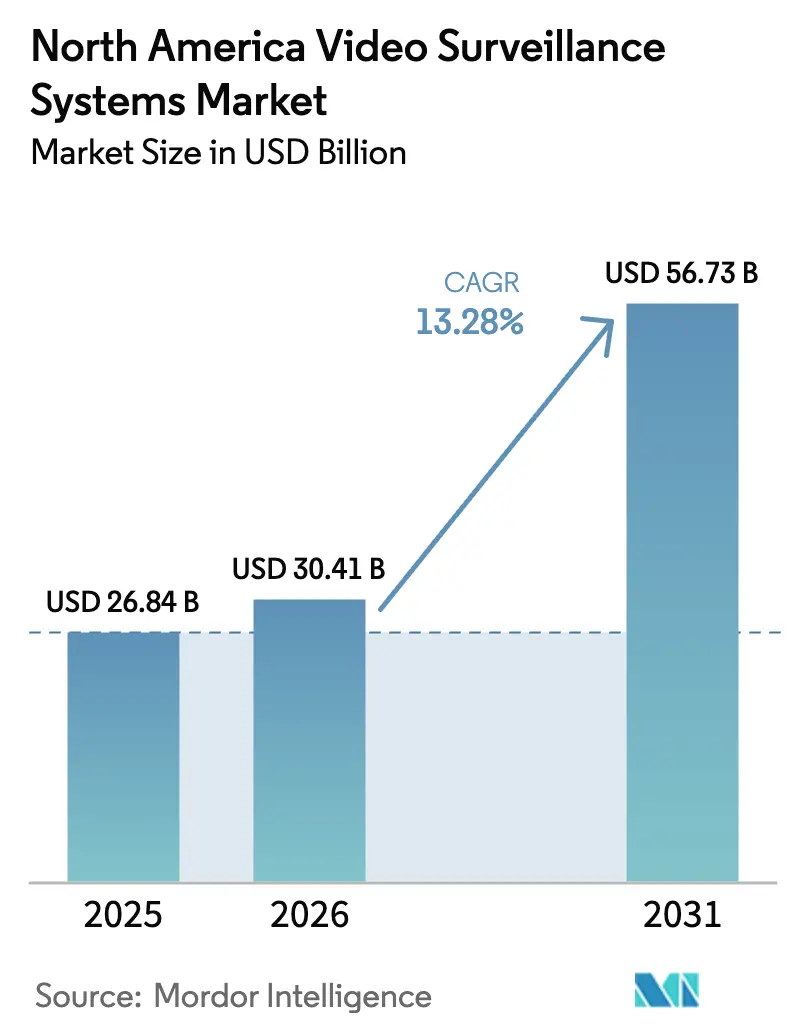
North America video surveillance systems market size in 2026 is estimated at USD 30.41 billion, growing from 2025 value of USD 26.84 billion with 2031 projections showing USD 56.73 billion, growing at 13.28% CAGR over 2026-2031. Rising demand for AI-enabled analytics, wider availability of edge computing chips, and the migration toward cloud-delivered Video Surveillance as a Service are reshaping customer expectations. Organizations now treat cameras as data-generating sensors that feed real-time business intelligence platforms, trimming bandwidth needs and lowering total cost of ownership. Rapid 5G roll-outs are unlocking previously unreachable outdoor and mobile use cases, while multi-sensor and 4K cameras are becoming standard in critical infrastructure and smart city deployments. Deepening consolidation among hardware incumbents and the arrival of cloud-native specialists are intensifying competition and accelerating the pace of software-centric innovation.
Key Report Takeaways
- By component, hardware retained a 69.20% share of the North America video surveillance systems market in 2025; Video Surveillance as a Service is forecast to grow at a 15.5% CAGR through 2031.
- By deployment mode, on-premises solutions held 84.10% of the North America video surveillance systems market share in 2025, whereas cloud deployments are projected to register a 15.9% CAGR between 2026 and 2031.
- By connectivity, wired installations accounted for 74.20% of the North America video surveillance systems market size in 2025; wireless connectivity is the fastest-growing segment at a 15.2% CAGR over the same period.
- By resolution, Full HD systems controlled 34.50% of the North America video surveillance systems market in 2025, while 4K & Above cameras are set to expand at a 15.5% CAGR to 2031.
- By end-user industry, the commercial sector commanded 39.30% of the North America video surveillance systems market size in 2025; infrastructure applications are forecast to post a 15.6% CAGR through 2031.
- By geography, the United States dominated with a 89.40% share of the North America video surveillance systems market in 2025, whereas Mexico is the fastest-growing national market at a 13.7% CAGR to 2031.
- The top five suppliers together controlled roughly 21-32% of the North America video surveillance systems market share in 2025.
Note: Market size and forecast figures in this report are generated using Mordor Intelligence’s proprietary estimation framework, updated with the latest available data and insights as of 2026.
North America Video Surveillance Systems Market Trends and Insights
Drivers Impact Analysis*
| Driver | (~) % Impact on CAGR Forecast | Geographic Relevance | Impact Timeline |
|---|---|---|---|
| Advances in edge-AI chips reducing TCO | +3.2% | United States, Canada | Medium term (2-4 years) |
| Mandated body-worn & in-vehicle cameras for U.S. law-enforcement agencies | +2.1% | United States | Short term (≤ 2 years) |
| Integration of video surveillance with POS & inventory systems in big-box retail chains | +2.5% | North America | Medium term (2-4 years) |
| Accelerated uptake of cloud-native VSaaS among SME multi-site franchises | +2.8% | United States, Canada, Mexico | Medium term (2-4 years) |
| Surge in federal & state funding for school security modernization | +1.9% | United States | Short term (≤ 2 years) |
| Growing adoption of thermal & multi-sensor cameras at North-American critical infrastructure | +1.7% | North America | Long term (≥ 4 years) |
| Source: Mordor Intelligence | |||
Advances in Edge-AI Chips Reducing Total Cost of Ownership (TCO) in U.S. Installations
Specialized AI processors embedded inside cameras shift analytics from central servers to the edge, cutting bandwidth needs by up to 70% and lowering storage requirements. [1]ADLINK Technology Inc., "ADLINK Boosts Edge AI Solutions with NVIDIA at COMPUTEX 2024", adlinktech.com Platforms powered by NVIDIA Jetson Orin demonstrate how real-time object detection, smart parking, and perimeter monitoring can run locally, eliminating costly back-end appliances. The architectural change is meaningful for retailers, campuses, and multisite enterprises where centralized analytics previously required heavy capital spending. As component prices fall and chipsets attain higher thermal efficiency, adoption is expected to climb across small and mid-sized projects, driving incremental demand for subscription-based software updates.
Mandated Body-Worn & In-Vehicle Cameras for U.S. Law-Enforcement Agencies
Statutory requirements at federal, state, and municipal levels are turning mobile video capture into a non-discretionary line item for public-safety budgets. Body-worn and vehicle-mounted devices now integrate with central evidence management systems that automate chain-of-custody tracking and facilitate rapid disclosure under freedom-of-information rules. Departments experimenting with cellular backhaul have shown crime-deterrent benefits and reduced citizen complaints. These mandates ripple through adjacent segments such as secure cloud storage, digital-evidence software, and data-protection services, enlarging the overall revenue pool.
Integration of Video Surveillance with POS & Inventory Systems in Big-Box Retail Chains
Large retailers overlay transaction data onto live video streams to detect fraud, reduce shrinkage, and improve merchandise placement. Video analytics correlate scan times, basket size, and customer dwell time, yielding insights that sharpen staffing models and marketing campaigns. Deployments indicate up to 40% improvement in loss-prevention efficacy when visual verification is linked directly to point-of-sale exceptions.[2]Lumana, "Best AI Video Analytics Solution for 2025: Top Platforms Compared.", lumana.aiThe convergence is redefining store security as part of a broader operational-intelligence stack, encouraging vendors to bundle video software with analytics dashboards that speak the language of retail operations rather than physical security alone.
Accelerated Uptake of Cloud-Native VSaaS among SME Multi-Site Franchises
Subscription-based video surveillance enables smaller chains to centralize monitoring without on-prem servers. Case studies report three-year savings of nearly USD 60,000 per location, chiefly through lower hardware outlays and reduced IT labor.[3]Micron, "Securing Your Business While Lowering TCO with VSaaS.", securityworldmarket.comHybrid architectures—local recording paired with cloud management—help customers navigate bandwidth constraints while still enjoying automatic firmware updates and AI enhancements. These economics make VSaaS an attractive alternative at the natural replacement cycle of analog DVRs, fueling double-digit growth.
Restraints Impact Analysis*
| Restraint | (~) % Impact on CAGR Forecast | Geographic Relevance | Impact Timeline |
|---|---|---|---|
| State-level “surveillance-sanctuary” legislation limiting facial recognition use | -1.2% | United States (select states) | Medium term (2-4 years) |
| Escalating cyber-insurance premiums for cloud-connected cameras | -0.8% | North America | Short term (≤ 2 years) |
| Supply-chain re-shoring raising hardware costs | -1.1% | North America | Medium term (2-4 years) |
| Video data-retention rules driving up storage OPEX for municipalities | -0.9% | United States, Canada | Long term (≥ 4 years) |
| Source: Mordor Intelligence | |||
State-Level “Surveillance-Sanctuary” Legislation Limiting Facial Recognition Use
Patchwork bans on biometric analytics across multiple jurisdictions create compliance complexity and legal exposure. Enterprises operating nationwide must deploy redaction tools that blur faces or automatically toggle algorithms by location, increasing software and process overhead. Uncertainty about federal standards prolongs procurement cycles for projects that rely on advanced analytics, restraining revenue growth in the interim.
Escalating Cyber-Insurance Premiums for Cloud-Connected Cameras
Higher premiums and stricter underwriting requirements are prompting buyers to reassess the risk-reward calculus of cloud connectivity. Insurers now insist on end-to-end encryption, zero-trust architectures, and third-party penetration testing, adding cost layers that may delay smaller deployments. While stringent controls ultimately improve ecosystem security, they also raise the entry threshold for resource-constrained users.
*Our forecasts treat driver/restraint impacts as directional, not additive. The impact forecasts reflect baseline growth, mix effects, and variable interactions.
Segment Analysis
By Component: Hardware Dominance Faces VSaaS Challenge
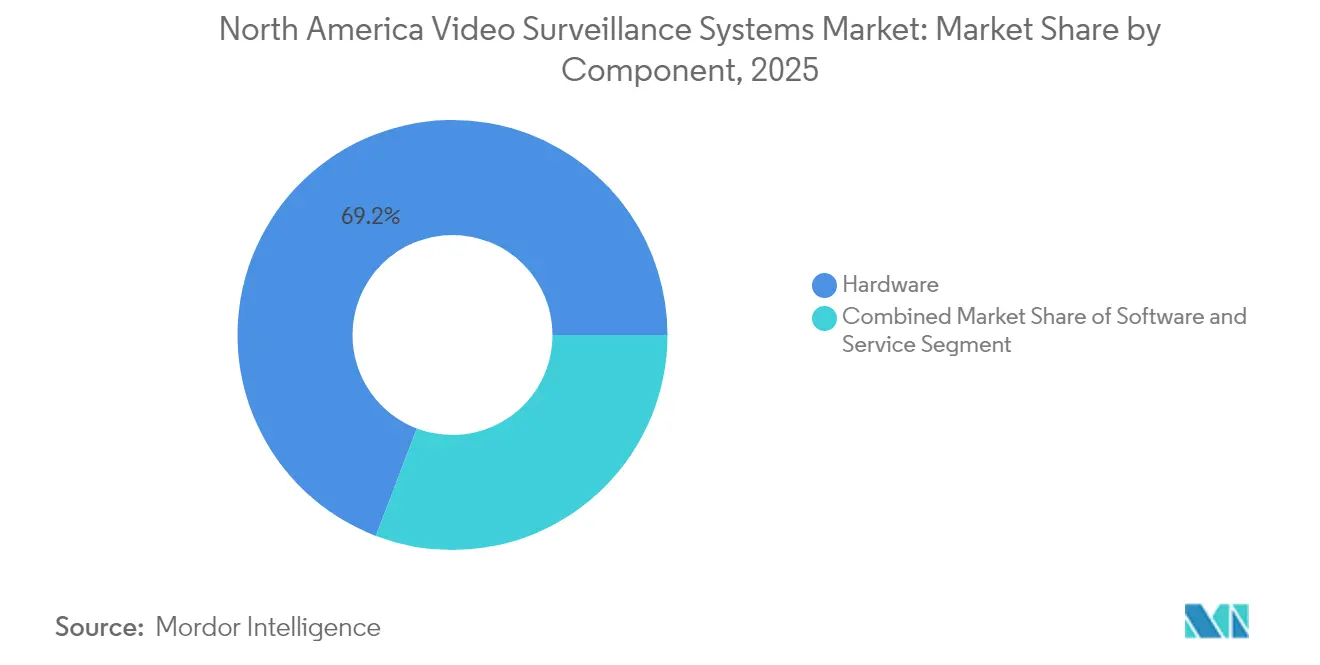
The North America video surveillance systems market size for hardware stood at USD 18.57 billion in 2025 and captured 69.20% of total revenue, reflecting ongoing large-scale camera roll-outs across retail chains, campuses, and utilities. IP cameras, network video recorders, and multi-sensor devices drive the bulk of spending thanks to higher resolution and analytics readiness. Suppliers differentiate through low-light performance, cybersecurity hardening, and open-API design that simplifies integration with access-control and building-management platforms. Despite near-term resilience, the hardware share is expected to erode gradually as customers favor asset-light procurement models.
During 2026-2031, Video Surveillance as a Service is projected to post a 15.5% CAGR, outstripping all other component categories. Cloud subscriptions decouple software capabilities from replacement cycles, letting users activate new AI modules without buying fresh cameras. This shift diverts budget away from capital equipment toward recurring operating expenditure, challenging hardware-centric vendors to reinvent go-to-market strategies and bundle managed services.


By Deployment Mode: Cloud Adoption Accelerates Beyond Security Applications
On-premises installations represented 84.10% of the North America video surveillance systems market share in 2025, anchored by industries that prize deterministic performance and data sovereignty. Large retailers and airports historically favored local servers to avoid latency and bandwidth constraints. Yet the cost and complexity of scaling such infrastructures are prompting a reassessment, especially as cloud-native platforms demonstrate rapid feature release cycles.
Cloud deployments are forecast to grow 15.9% annually through 2031, propelled by centralized policy management, elastic storage, and integration with enterprise analytics workloads. The hybrid model—edge recording combined with cloud orchestration—offers a pragmatic migration path, delivering uptime assurance while exposing APIs that feed corporate dashboards with real-time insights on occupancy, queue length, or asset utilization.
By Connectivity: Wireless Expansion Enables New Deployment Scenarios
Wired Ethernet and PoE architectures held a dominant 74.20% revenue share in 2025, favored for reliability, consistent throughput, and predictable power delivery. Multi-gigabit switching and improved compression allow existing cabling to support 4K streams without forklift upgrades, extending the lifespan of baseline infrastructure. Structured cabling standards continue to evolve, encouraging facility owners to invest in Cat6A or fiber backbones that future-proof campus networks.
Wireless connectivity is seeing the fastest growth, with the North America video surveillance systems market expected to add 15.2% CAGR in this segment. Introduction of Reduced Capability (RedCap) 5G modules strikes a cost-performance balance ideal for battery-powered cameras, construction sites, and remote substations. Complementary technologies such as Wi-Fi 6/7 and 60 GHz mesh links further diversify deployment options, enabling agile, event-driven coverage that can be relocated as needs change.
By Resolution: 4K Adoption Drives Analytics Capabilities
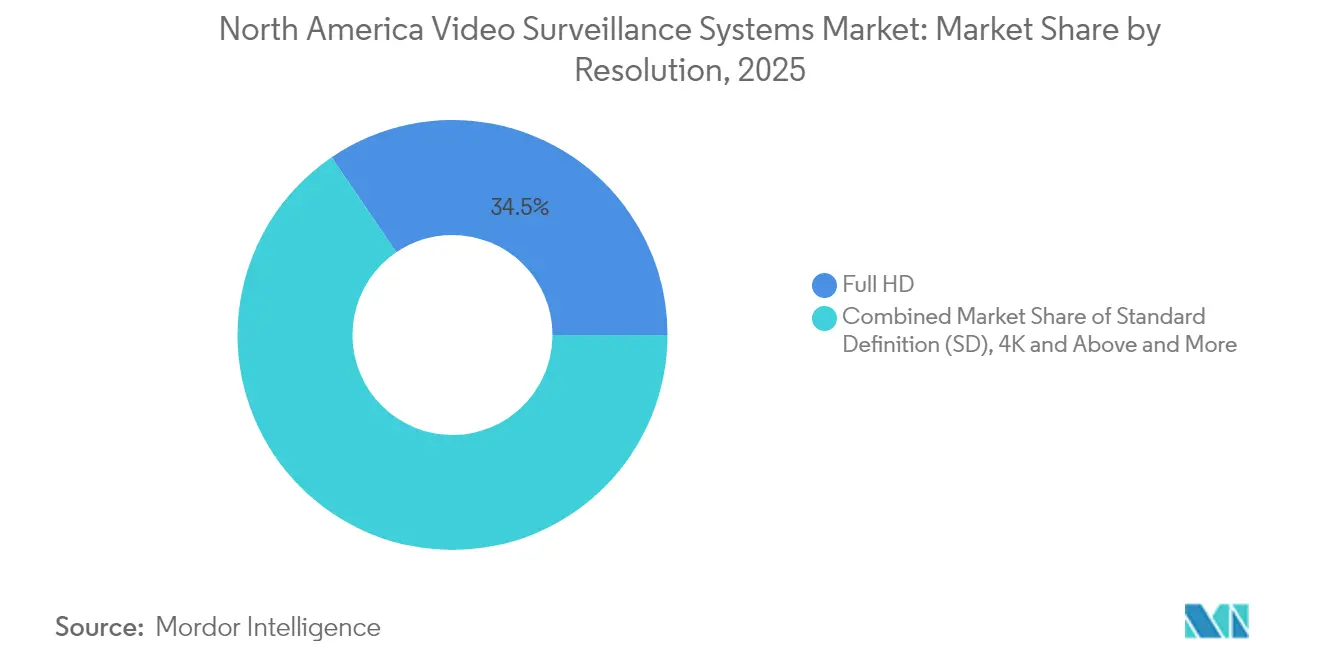
Full HD (1080p) systems remained the volume leader with 34.50% of 2025 revenue, offering sufficient clarity for conventional surveillance tasks while keeping storage overhead manageable. Continuous improvements in H.265/H.266 compression let operators record longer retention periods without expanding server capacity, sustaining Full HD’s appeal in cost-conscious deployments.
The 4K & Above cohort is forecast to grow at 15.5% CAGR thanks to smart city programs, stadium upgrades, and critical-infrastructure mandates that demand high pixel density for forensic inquiries. Edge AI mitigates bandwidth penalties by transmitting metadata instead of raw video, allowing higher resolution without overwhelming networks. As lens, sensor, and SoC prices fall, 4K is expected to become the default spec for new projects, while 8K trials in rail and border security hint at the next frontier.
By End-User Industry: Infrastructure Growth Outpaces Commercial Dominance
Commercial facilities accounted for 39.30% of 2025 spending, driven by retail, banking, and hospitality chains that integrate surveillance with point-of-sale and customer-experience systems. Healthcare providers are increasing orders for privacy-compliant solutions that segment patient areas and automate access auditing. Vendors serving these verticals must navigate specialized compliance regimes, tailoring analytics to operational key performance indicators beyond security.
Infrastructure projects—transport hubs, smart corridors, and energy plants—are projected to expand at a 15.6% CAGR, the fastest among all verticals. Governments fund networked camera grids to enhance perimeter defense, traffic optimization, and environmental monitoring. Contracting cycles are lengthy, but deal values are large and include multi-year maintenance revenue, rewarding suppliers that master complex tender requirements and open-platform interoperability.
Geography Analysis
The United States anchors the North America video surveillance systems market with a 89.40% revenue share and is set to climb from USD 24.00 billion in 2025 to USD 50.72 billion by 2031. Federal infrastructure bills, state-level school-safety grants, and private-sector demand for AI-enabled loss-prevention sustain a robust pipeline of projects. Approximately 26.1 million CCTV cameras are expected to ship nationally in 2030, reflecting both greenfield installations and analog-to-IP retrofits. Buyers increasingly specify NDAA-compliant hardware and zero-trust architectures, reshaping supplier shortlists and accelerating domestic manufacturing initiatives.
Mexico, while smaller in absolute terms, delivers the fastest pace of expansion at a 13.7% CAGR through 2031. Smart city blueprints in Mexico City, Guadalajara, and Monterrey showcase large-scale deployments that integrate license-plate recognition, facial authentication, and crowd analytics. The North America video surveillance systems market size for Mexico is benefiting from nearshoring trends that entice global manufacturers to build facilities requiring stringent security perimeters. Government incentives for public-private partnerships further broaden the addressable base, especially in transport and energy corridors linking to the United States.
Canada presents a steady yet privacy-sensitive environment. Provinces enforce stringent personal-data regulations under PIPEDA, obliging operators to adopt redaction, data-minimization, and transparent governance controls. Municipalities from Vancouver to Toronto are overlaying camera networks with multi-modal sensors—acoustic, environmental, and traffic—to produce integrated situational-awareness dashboards. Extreme weather conditions and vast remote areas spur demand for ruggedized, low-maintenance equipment, creating niches for specialized vendors.
Regulatory Landscape
In the United States, procurement and supply-chain restrictions continue to shape compliance for video surveillance deployments into federal and many state or critical-infrastructure environments. FAR 52.204-25 (Section 889) restricts executive-agency procurement and use of covered telecommunications and video surveillance equipment and services, which influences shortlists away from named covered manufacturers such as Hikvision and Dahua. Buyers and integrators commonly use the FCC Covered List as a screening reference.
Regulatory activity in 2026 added more detail and incremental obligations. In May 2026, federal agencies initiated a public comment process to extend the information-collection approval tied to the contracting prohibition through December 2026, reinforcing contractor disclosure and compliance workflows. In January 2026, the FCC updated its Covered List to add additional categories, including those referenced in the FY2025 NDAA. A July 2026 Federal Register notice described an FCC action that temporarily suspended certain prohibitions for already-authorized covered equipment in non-covered commercial uses pending further definition of critical infrastructure, creating a time-bound compliance interpretation issue for suppliers. At the state level, California introduced AB-2062 in the 2025-2026 session to regulate how security surveillance companies handle data and provide third-party access to video content, increasing scrutiny of consent, retention, and downstream sharing practices beyond hardware-origin compliance.
Value Chain Analysis
The North America video surveillance systems value chain spans upstream semiconductor and optics suppliers (CMOS sensors, SoCs, memory, lenses) through camera and recorder OEMs/ODMs, then to VMS and analytics software providers, and finally to distributors and security integrators that design, install, and maintain systems for end users across commercial, infrastructure, institutional, and government segments. A material portion of device value is tied to globally sourced components, and advances in edge AI depend on OEM access to compute roadmaps linked to Asian foundry and packaging capacity.
Regional camera assembly remains limited relative to unit consumption, so the supply chain relies heavily on imports for finished devices and key subassemblies. Mexico also functions as an assembly and logistics hub under USMCA-linked trade flows. Channel partners and large integrators such as Convergint Technologies, Johnson Controls, and Securitas influence specification, cybersecurity hardening, and bid documentation, particularly where NDAA/FAR-related screening is mandatory. Tariffs and covered-vendor restrictions have pushed diversification of manufacturing footprints and bill-of-material choices, and some vendors have absorbed cost shocks to keep integrator pricing and project continuity stable.
Competitive Landscape
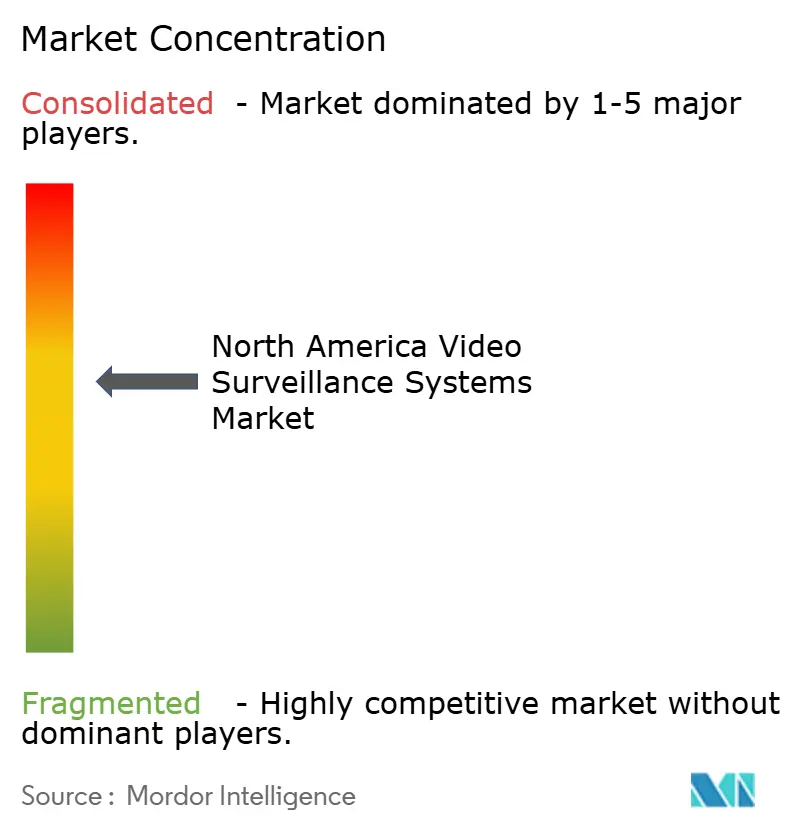
The North America video surveillance systems market demonstrates moderate concentration, with the leading five suppliers collectively controlling an estimated 21-32% revenue in 2024. Incumbents such as Motorola Solutions leverage acquisitions to bolster end-to-end portfolios, integrating cameras, video management, and analytics into single-vendor stacks that appeal to public-sector buyers seeking procurement simplicity. Cloud-native challengers position subscription models that convert capital budgets into predictable operating expenses, narrowing the gap with entrenched hardware brands.
Strategic themes revolve around ecosystem breadth, AI differentiation, and compliance readiness. Bosch’s divestiture of its Building Technologies security unit to Triton Partners underscores a sharpening focus on core competencies, while Axis and i-PRO double down on edge-based analytics to raise the value of each device in the field. Chinese manufacturers continue to participate actively, but NDAA restrictions encourage U.S. federal agencies and many state entities to vet supply chains more rigorously, indirectly benefiting domestic and European brands.
Partnerships with cloud hyperscalers, access-control specialists, and 5G carriers are proliferating. Vendors bundle API access, software development kits, and low-code toolkits so customers can integrate video feeds into broader digital-transformation programs. Go-to-market teams now include vertical-industry consultants who speak the language of retail operations, refinery safety, or sports-venue guest experience, reflecting the transition of surveillance from pure security to multi-disciplinary data utility.
North America Video Surveillance Systems Industry Leaders
-
Honeywell International Inc.
-
Genetec Inc.
-
Avigilon (Motorola Solutions)
-
Axis Communications AB
-
Johnson Controls International plc
- *Disclaimer: Major Players sorted in no particular order

Market Opportunities and Future Outlook
A primary opportunity is in compliance-led refresh cycles, where buyers require NDAA/FAR-aligned sourcing and clearer supply-chain provenance for cameras, recorders, and related services. Maintenance of the FCC Covered List and the continued use of FAR 52.204-25 in federal contracting keep vendor eligibility in focus. That, in turn, supports demand for alternative hardware lines, documented component traceability, and integrator services that package compliance evidence alongside cybersecurity controls such as encryption, identity, and patch governance.
Cloud-managed and hybrid architectures also create room for platforms that reduce multi-site operating overhead while meeting data retention and privacy obligations. In March 2026, Honeywell partnered with Rhombus to integrate AI-driven cloud video management into Honeywell building security offerings, reflecting enterprise demand for converged video, access, and building workflows delivered through cloud software. The same month, Johnson Controls introduced updates including C-CURE IQ 3.2 and a new C-CURE IQ VMS, along with releases such as exacqVision 26.0 and EntraPass 9.10, pointing to continued investment in interoperability and unified management for commercial deployments. Regulatory attention on downstream data handling, including the California AB-2062 proposal for security surveillance companies, further supports demand for privacy-by-design capabilities such as role-based access, third-party sharing controls, and auditability in VMS and VSaaS bundles.
Recent Industry Developments
- May 2026: Genetec reported that Security Center Synergis access control, Synergis Cloud Link, and an STid secure I/O module received ANSSI high-assurance cybersecurity qualification. The certification strengthens Genetecs positioning for security-sensitive deployments where formal cyber assurances influence vendor selection and solution architecture.
- March 2026: Honeywell and Rhombus announced a strategic partnership to integrate AI-powered cloud video management with Honeywells access control and building security ecosystem, with an initial North America focus. The move accelerates cloud-delivered video adoption pathways for enterprise building portfolios that want unified video and access workflows without a full rip-and-replace of legacy systems.
- April 2025: i-PRO Americas secured a framework agreement with E&I Cooperative Services to supply security solutions to its member educational institutions. The agreement streamlines purchasing for schools and supports faster, standardized rollouts of camera and related surveillance upgrades aligned with school security modernization programs.


Research Methodology Framework and Report Scope
Market Definition and Coverage
For this study, the North America video surveillance systems market is measured as the revenue earned from camera and recording systems, related software, and associated services used to capture, store, manage, and view video for security and monitoring across the region.
Scope exclusions: We exclude stand-alone video analytics software that is not bundled with a camera, recording, or video management solution.
Segmentation Overview
-
By Component
-
Hardware
-
Cameras
- Analog
- IP
- Hybrid
- Storage
- Monitors
- Accessories
-
Cameras
-
Software
- Video Analytics
- Video Management Software
-
Services
-
VSaaS
- Hosted
- Managed
- Installation and Integration
- Maintenance and Support
-
VSaaS
-
Hardware
-
By Deployment Mode
- On-Premises
- Cloud
-
By Connectivity
- Wired
- Wireless
-
By Resolution
- Standard Definition (SD)
- High Definition (HD)
- Full HD
- 4K and Above
-
By End-User Industry
-
Commercial
- Retail
- BFSI
- Hospitality and Entertainment
- Healthcare
-
Infrastructure
- Transportation (Airports, Rail, Ports)
- Smart Cities
- Energy and Utilities
-
Industrial
- Manufacturing
- Oil and Gas
- Mining
-
Institutional
- Education
- Religious Buildings
- Residential
- Government and Law Enforcement
-
Commercial
-
By Country
- United States
- Canada
- Mexico
Data Sources, Market Sizing, and Validation
Desk Research
Desk work starts by mapping demand-side signals that explain where installations and refresh cycles are coming from in North America. We typically rely on public sources such as the US Census Bureau construction and spending series, Statistics Canada releases, Mexico INEGI statistics, and government procurement portals that show security modernization plans and budget direction.
We then layer in supply-side context from company annual reports and investor presentations, product catalogs, and reputable press coverage to understand what is being sold and how pricing is moving. Patent databases are also checked to see where analytics, edge processing, and storage innovations are concentrating, and import and export shipment-level database extracts are used selectively to sanity-check trends for key hardware categories moving into the region. The sources listed here are illustrative only, and many other public and paid references were also used for data collection, validation, and clarification.
Primary Interviews and Surveys
Primary work was used to pressure-test the desk assumptions around replacement cycles, cloud adoption, and bundled pricing, since these items can shift totals quickly. We spoke with a mix of installers, distributors, enterprise security teams, and service providers across the United States, Canada, and Mexico to confirm volume direction, typical deal structures, and where spending is being deferred or accelerated.
Distribution of primary research fieldwork respondents
| Company type | Respondent position | Region |
|---|---|---|
| Top tier: 27% | CXOs: 20% | |
| Mid tier: 51% | Functional/Unit leaders: 25% | |
| Smaller Players: 22% | Managers: 55% |
Market-Sizing & Forecasting
Sizing is built using a top-down approach where construction activity, installed base expansion in key end users, and public safety infrastructure programs are translated into likely system demand, and then split into hardware, software, and services using observed mix patterns. To keep the totals realistic, the model is cross-checked with selective bottom-up approximations such as sampled camera and recorder shipments into channel, installer project run-rate checks, and an ASP x unit method for a few representative use cases.
Inputs that mattered most in this market included the on-premises versus cloud mix (including VSaaS), typical camera refresh cycles and replacement rates, channel pricing moves for IP cameras and NVRs, storage intensity trends driven by resolution and retention requirements, and the service attach rate for monitoring and managed video. Where bottom-up indicators were incomplete for Mexico or smaller verticals, gaps were handled by applying validated ratios from similar project types and then re-testing the outputs with local interviews.
Forecasts were produced using scenario analysis supported by simple trend models on the key drivers, and the final outlook was aligned to what practitioners expect for cloud migration pace, cybersecurity-driven upgrades, and project funding timing.
Data Validation & Update Cycle
Outputs are validated through multiple passes that compare the model to independent signals such as country shares, hardware-to-service mix, and observed cloud adoption rates, which helps catch totals that drift outside practical buying behavior. When large variances appear, assumptions are revisited, outliers are explained, and interview follow-ups are triggered to confirm whether the change is real or a data artifact.
Before sign-off, the work is reviewed by another analyst for logic consistency, unit economics, and arithmetic checks, and then it is reconciled back to the market definition so adjacent categories are not pulled in by accident. Reports are refreshed annually, with interim updates when material events occur, and a final pre-delivery check is completed so clients receive the latest view.
Mordor Intelligence's North America Video Surveillance Systems Market Size Measured Against Other Published Estimates
Published market sizes for video surveillance in North America often diverge because the numbers are sensitive to refresh timing, currency conversion points, and whether recurring cloud revenue is treated as a service stream or left out. Small differences in how average selling prices are trended, especially during rapid shifts toward higher resolution and AI-enabled devices, can move the final value more than many readers expect.
A common gap driver is the handling of VSaaS and related managed services, since some estimates focus mainly on physical hardware shipments and only partly reflect subscription renewals. Another reason is geography, where some publishers effectively represent the United States only, and then generalize it to the region without rechecking Canada and Mexico demand signals. By refreshing currency timing and price-mix assumptions close to publication and validating the cloud share with channel and user-side interviews, Mordor Intelligence keeps the 2025 total aligned to how systems are actually bought and billed in the region.
Benchmark comparison
| Source | Market Size | Gaps in Research Methodology |
|---|---|---|
| Mordor Intelligence | USD 26.84 B (2025) | |
| Regional Consultancy A | USD 18.84 B (2024) | Uses a US-heavy scope and treats most cloud video subscriptions as software only, which reduces service revenue recognition for North America. |
| Trade Journal B | USD 12.34 B (2024) | Primarily tracks hardware shipments and does not fully adjust for ASP uplift from higher resolution, retention needs, and service attach in enterprise deployments. |
The spread in the table mainly comes down to timing and what gets counted when systems shift from a one-time box sale to a mix of hardware plus recurring service. Our approach stays traceable because the totals are built from clear demand drivers, then corrected using practical checks on pricing, mix, and cloud adoption that can be repeated each year.


Key Questions Answered in the Report
What is the projected value of the North America video surveillance systems market by 2031?
The market is forecast to reach USD 56.73 billion by 2031, growing at a 13.28% CAGR.
Which component category is expanding fastest?
Video Surveillance as a Service is the fastest-growing component, set to post a 15.5% CAGR between 2026 and 2031.
How much of the market do cloud deployments currently represent?
Cloud deployments accounted for 15.90% of revenue in 2025 and are projected to rise swiftly at a 15.9% CAGR.
Which country is the fastest-growing national market in North America?
Mexico is expanding at a 13.7% CAGR, propelled by smart city initiatives and infrastructure investment.
Why are edge-AI cameras gaining traction?
Embedded processors cut bandwidth by up to 70% and eliminate costly servers, lowering total cost of ownership and enabling real-time analytics.
What impact do new privacy regulations have on the market?
State-level restrictions on facial recognition and stricter federal data-protection rules raise compliance costs and slow analytics adoption in certain jurisdictions.
Page last updated on: