
Market Overview
| Study Period | 2019 - 2031 |
|---|---|
| Forecast Data Period | 2026 - 2031 |
| Base Year Market Size (2025) | USD 42.61 Billion |
| Market Size (2026) | USD 45.72 Billion |
| Market Size (2031) | USD 67.49 Billion |
| Growth Rate (2026 - 2031) | 8.10 % |
| Market Concentration | Medium |
Major Players *Disclaimer: Major Players sorted in no particular order Image © Mordor Intelligence. Reuse requires attribution under CC BY 4.0. | |
North America Vehicle Rental Market Analysis by Mordor Intelligence
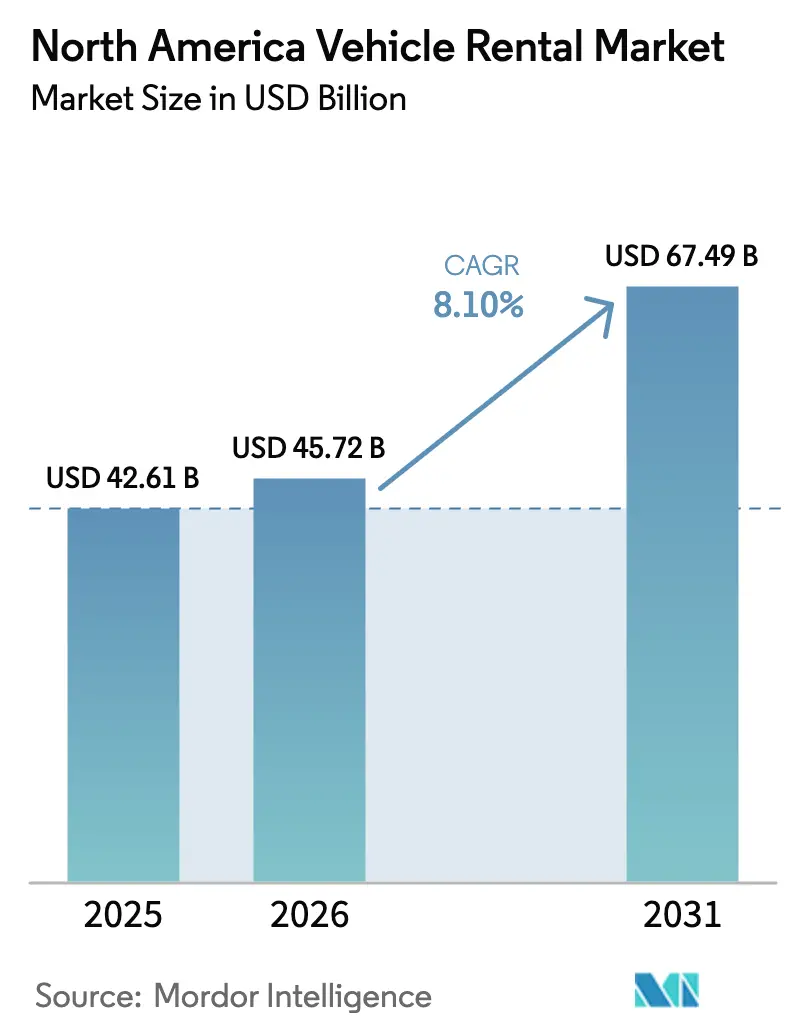
The North American vehicle rental market size was valued at USD 42.61 billion in 2025 and estimated to grow from USD 45.72 billion in 2026 to reach USD 67.49 billion by 2031, at a CAGR of 8.10% during the forecast period (2026-2031). The market’s expansion rests on a rebound in leisure and corporate travel, major airport infrastructure upgrades, and stronger online distribution that lifts utilization and revenue per available car. Operators are accelerating electrification to capture federal and provincial incentives, though residual-value risk and charging-network gaps threaten profitability. Peer-to-peer platforms widen supply without owning fleets, intensifying price competition and compelling incumbents to refine dynamic-pricing engines. Fleet-cost inflation, rising insurance premiums, and airport concession fees remain structural cost headwinds, but product innovation, subscription rentals, contactless pickup, and AI-driven upsells create incremental revenue streams that can offset margin pressure.
Key Report Takeaways
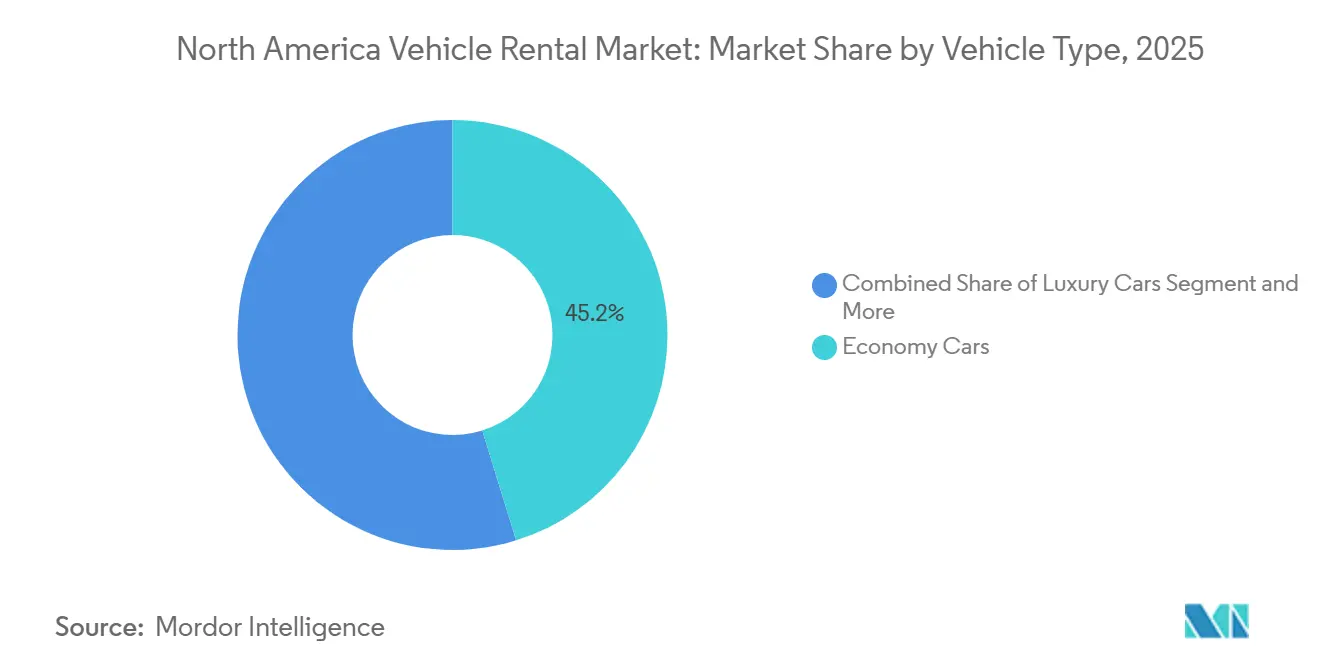
- By vehicle type, economy cars led with 45.18% revenue share in 2025, while sport utility vehicles and crossovers are projected to expand at a 10.68% CAGR to 2031.
- By application type, leisure travel captured 53.62% of 2025 revenue and is advancing at an 11.92% CAGR through 2031.
- By rental duration, short-term contracts held 79.94% of market revenue in 2025, whereas long-term and subscription offerings are forecast to grow at a 13.35% CAGR to 2031.
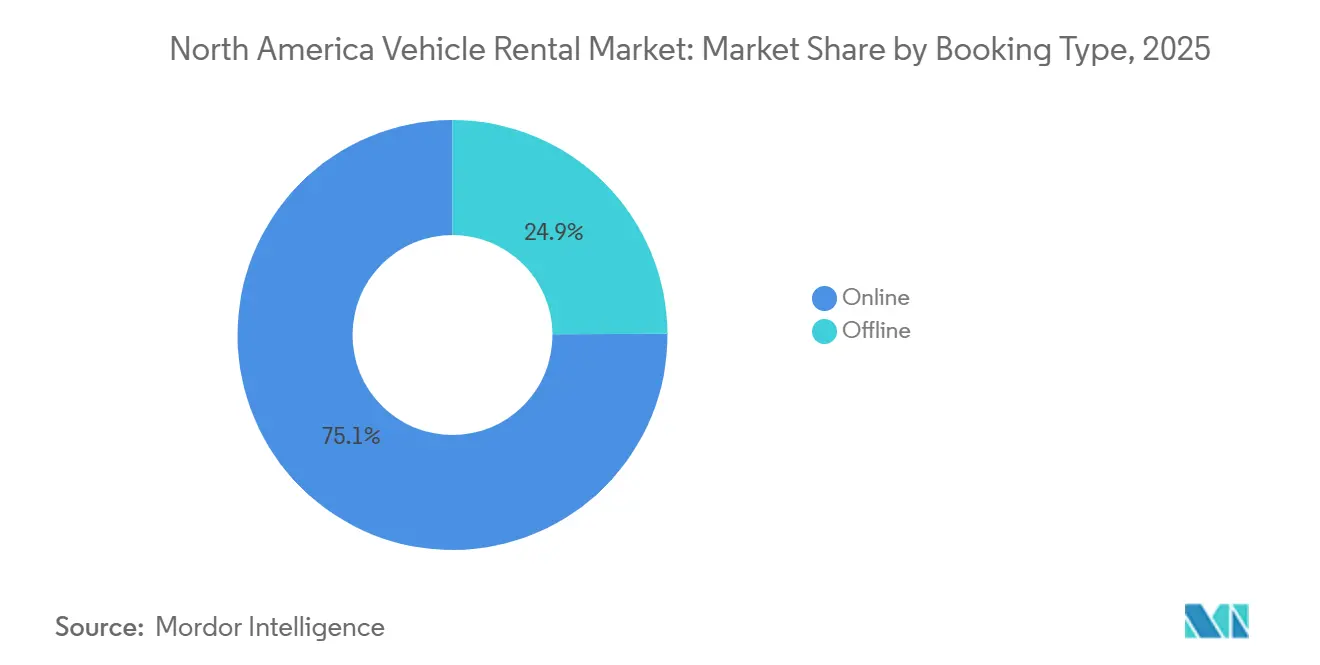
- By booking type, online reservations accounted for 75.08% of 2025 transactions and are expanding at a 13.84% CAGR through 2031.
- By customer type, individual renters generated 66.87% of 2025 revenue, and the segment is also rising at a 12.21% CAGR to 2031.
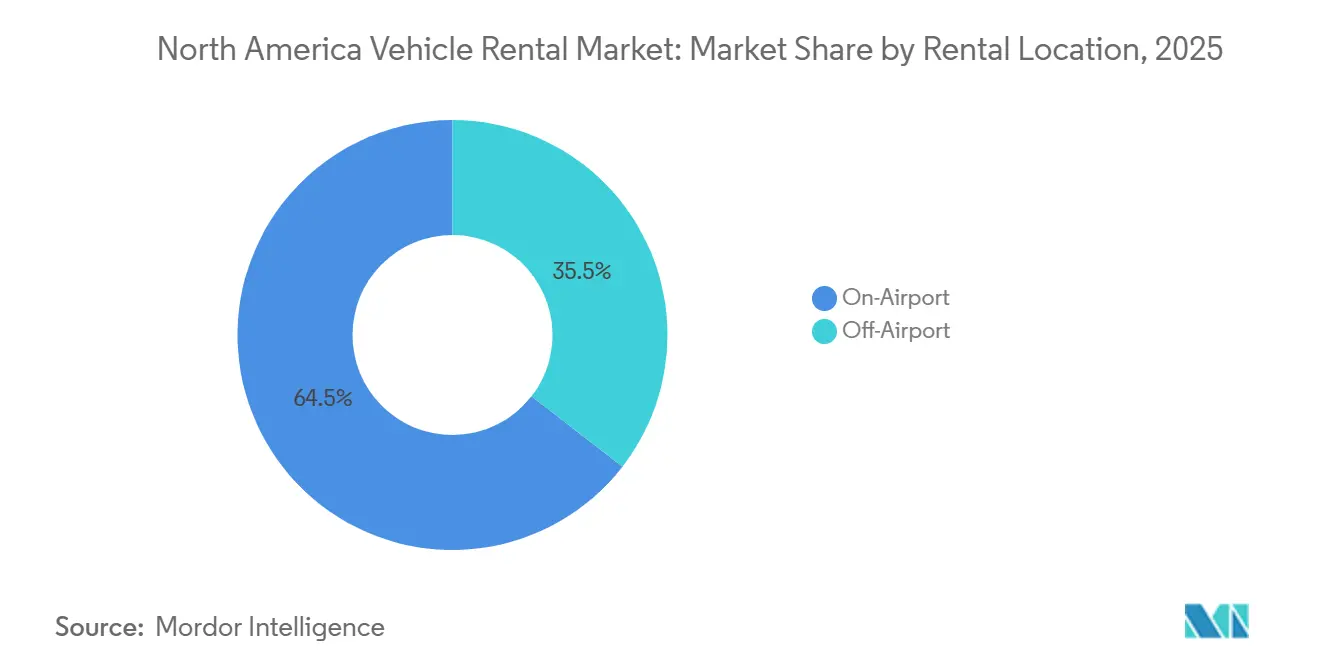
- By rental location, on-airport facilities commanded 64.48% of market revenue in 2025, and are projected to grow at a 13.26% CAGR through 2031.
- By fuel type, internal-combustion vehicles retained 86.21% of the 2025 fleet share, whereas battery-electric models are poised to climb at a 14.42% CAGR to 2031.
- By country, the United States contributed 87.54% of regional revenue in 2025, while Canada is expected to post a 6.58% CAGR through 2031.
Note: Market size and forecast figures in this report are generated using Mordor Intelligence’s proprietary estimation framework, updated with the latest available data and insights as of January 2026.
North America Vehicle Rental Market Trends and Insights
Drivers Impact Analysis*
| Driver | (~) % Impact on CAGR Forecast | Geographic Relevance | Impact Timeline |
|---|---|---|---|
| Rise in Inbound Leisure Travel | +2.5% | North America, with strongest gains in Florida, California, Nevada tourism corridors | Short term (≤ 2 years) |
| Strong Rebound of Corporate Road-Warrior Segment | +2.0% | North America, concentrated in major business hubs and airport locations | Medium term (2-4 years) |
| Airport Infrastructure Modernization | +1.5% | Global, with early adoption in North American urban markets | Medium term (2-4 years) |
| EV-Focused Fleet Incentives | +1.2% | North America, focused on Tier 1 airports with ConRAC investments | Long term (≥ 4 years) |
| Peer-to-Peer Car-Sharing Platforms Unlocking Latent Supply | +1.0% | United States and Canada, with state-level variations in incentive structures | Long term (≥ 4 years) |
| AI-Driven Dynamic Pricing | +0.8% | North America, concentrated in urban centers with high vehicle ownership | Medium term (2-4 years) |
| Source: Mordor Intelligence | |||
Rise in Inbound Leisure Travel Post-COVID-19
Passenger throughput at Transportation Security Administration checkpoints reached 904 million in 2024[1], the highest annual total on record. The surge restored confidence in airport rentals and maintained leisure’s 53.62% share of the North America vehicle rental market, with a projected 11.92% CAGR through 2031. Gateway airports such as Los Angeles, Miami, and Orlando benefited disproportionately from recovering trans-Atlantic and Latin American traffic, translating to higher multi-day sport utility vehicle (SUV) bookings. Canadian destinations also logged double-digit growth in overnight visitors during the 2024 summer peak. Extended “bleisure” stays among millennial and Gen Z travelers lengthened average rental durations and supported yield improvements.
Strong Rebound of Corporate Road-Warrior Segment
Corporate travel volumes reached about 90% of 2019 benchmarks by Q4 2024. High-frequency road warriors chose premium sedans and loyalty perks, enabling operators to deploy dynamic pricing and earn higher ancillary revenue. Enterprise Holdings and Avis Budget Group reported sequential gains in corporate account bookings during 2024. Large conventions such as CES 2025 drove short-notice spikes that AI-based pricing captured, lifting revenue per available car even with modest fleet growth.
Airport Infrastructure Modernization Boosting On-Airport Rentals
Completion of the USD 2 billion[2] Los Angeles ConRAC and the USD 420 million Orlando facility integrated rental counters into terminal circulations, reducing shuttle wait times and elevating customer satisfaction. Similar projects in Reno, Sacramento, and Detroit expanded consolidated facilities by early 2025. These upgrades underpin the 64.48% on-airport share in 2025 and a 13.26% forecast CAGR, as long-term concession agreements ensure incumbents retain prime positions.
EV-Focused Fleet Incentives Under United States Inflation Reduction Act (IRA) and the Canadian Zero-Emission Vehicle (ZEV) Mandates
The United States Inflation Reduction Act provides commercial credits up to USD 40,000 for qualifying battery-electric vehicles. Canada mandates 20% zero-emission sales by 2026 and 60% by 2030[3], supported by federal incentives up to CAD 5,000 (USD 3,700). Large operators leverage bulk purchase agreements, such as Sixt’s framework with Stellantis for up to 250,000 vehicles, to accelerate fleet turnover and secure residual-value guarantees. Hertz’s 2024 divestiture of about 20,000 EVs highlighted resale-value volatility when charging access lags expectations.
Restraints Impact Analysis*
| Restraint | (~) % Impact on CAGR Forecast | Geographic Relevance | Impact Timeline |
|---|---|---|---|
| OEM Vehicle Supply Constraints and High Acquisition Costs | -1.5% | North America, with particular impact on domestic OEM supply chains | Short term (≤ 2 years) |
| Rising Insurance Premiums | -1.2% | North America, with state-level variations in regulatory environments | Medium term (2-4 years) |
| Urban Modal Shift Toward Ride-Hailing | -0.8% | North America urban centers, concentrated in cities with established alternative transportation | Long term (≥ 4 years) |
| Airport Surcharges and Environmental Levies | -0.5% | North America, focused on major airport hubs with high fee structures | Medium term (2-4 years) |
| Source: Mordor Intelligence | |||
OEM Vehicle Supply Constraints and High Acquisition Costs
Semiconductor shortages curbed 2024 fleet deliveries, forcing operators to extend holding periods and negotiate residual-value guarantees. Average new-vehicle transaction prices in the United States hovered near USD 48,000 in 2024, increasing capital requirements. Operators narrowed depreciation per unit by replacing aging sedans with customer-preferred sport utility vehicles, yet acquisition costs remain a drag while original equipment manufacturers retool for electrification.
Rising Insurance Premiums and Liability-Claims Inflation
Higher accident severity and litigation frequency in tort-friendly states drove double-digit premium hikes during 2024. Operators disclosed year-over-year rises in direct operating expense per transaction day tied to insurance cost escalation. Marketplace players integrate credit-based risk scoring and telematics to blunt losses, but coverage remains a growing cost line.
*Our forecasts treat driver/restraint impacts as directional, not additive. The impact forecasts reflect baseline growth, mix effects, and variable interactions.
Segment Analysis
By Vehicle Type: Sport Utility vehicles Drive Premium Segment Growth
Economy vehicles hold a significant position in North America's vehicle rental market, accounting for a 45.18% share in 2025. This dominance is primarily driven by corporate contracts and the demand from cost-sensitive leisure travelers. However, sport utility vehicles and crossovers are rapidly gaining traction as the fastest-growing segment. They are projected to grow at a 10.68% CAGR through 2031, fueled by the preferences of families and inbound tourists who prioritize space, comfort, and all-weather reliability.
Operators are increasingly adjusting their fleet composition to include more sport utility vehicles, despite the higher costs associated with acquisition and insurance. These vehicles offer better utilization rates and command higher average daily rates, making them a lucrative choice. Premium and luxury vehicles, although representing a smaller share of the market, deliver higher margins, particularly in urban and resort areas. Additionally, multi-purpose vehicles and light vans continue to address the specific needs of group travel and commercial mobility niches.

By Application Type: Leisure Travel Dominates Growth Trajectory
Leisure travel has established itself as the leading segment in the market, holding a significant 53.62% share in 2025. This segment is anticipated to grow at an impressive 11.92% CAGR through 2031, driven by robust inbound tourism and the increasing trend of extended holiday travel. Additionally, the rise of "bleisure" travel, which combines business and leisure, is further extending rental durations and directly enhancing revenue per transaction.
On the other hand, business travel has stabilised as a reliable secondary demand pillar, contributing steady weekday volumes and generating a higher yield per rental. Although corporate travel levels remain below pre-pandemic peaks, operators benefit from margin stability supported by negotiated accounts and loyalty-driven repeat usage.
By Rental Duration: Subscription Models Reshape Long-Term Segment
In 2025, short-term rentals commanded a significant 79.94% share of the market, underscoring their appeal to both leisure and business travelers, who favor daily and weekly bookings. These rentals adeptly leverage dynamic pricing, capitalizing on seasonal peaks and surges driven by major events. The dominance of short-term rentals is further supported by their ability to cater to last-minute bookings and provide a wide range of options, from economy cars to premium vehicles, making them a preferred choice for diverse traveler needs.
Long-term rentals, alongside subscription models, are set to expand at a robust 13.35% CAGR. This growth is fueled by a consumer shift towards valuing flexibility over traditional ownership and a rising demand from the gig economy. Additionally, the increasing adoption of remote work has amplified the demand for long-term rental solutions, as individuals and families seek adaptable living arrangements. Furthermore, operators are enhancing customer retention and securing stable, recurring revenue through bundled pricing that encompasses insurance and maintenance services, which also adds convenience and value for consumers.
By Booking Type: Digital Transformation Accelerates Online Dominance
In 2025, online bookings made up 75.08% of total reservations and are projected to grow at a 13.84% CAGR, fueled by mobile apps, comparison platforms, and direct-to-consumer channels. These digital bookings not only facilitate quicker price discovery but also enhance the uptake of ancillary services, such as insurance, GPS rentals, and additional driver options, which contribute to higher revenue streams for operators.
As operators shrink their counter footprints, offline bookings wane, nudging customers towards self-service platforms. This shift not only reduces operational costs but also aligns with evolving consumer preferences for convenience and speed. Furthermore, data harvested from online channels powers AI-driven pricing engines, bolstering revenue per available car and refining yield management by enabling dynamic pricing strategies and better inventory allocation.
By Customer Type: Individual Segment Drives Market Expansion
In 2025, individual customers held a dominant 66.87% share of the market. Forecasts predict this segment will expand at a robust 12.21% CAGR through 2031, buoyed by a resurgence in leisure travel and broader digital access. This growth is driven by increasing affordability of travel options, the proliferation of online booking platforms, and the rising preference for personalized travel experiences. While this segment propels volume, it exhibits heightened sensitivity to pricing, requiring operators to adopt competitive pricing strategies and targeted marketing efforts to retain and attract customers.
Operators leverage long-term contracts and loyalty programs to steady revenues, countering the fluctuations often seen with individual renters. Additionally, corporate customers benefit from tailored services, such as streamlined booking processes, dedicated account management, and flexible rental terms, which further enhance their value to operators. This segment's predictable demand and higher spending capacity make it a critical focus area for sustained profitability in the market.
By Rental Location: On-Airport Facilities Maintain Strategic Advantage
In 2025, on-airport rentals commanded a dominant 64.48% market share, with projections indicating a robust 13.26% CAGR, buoyed by ongoing airport modernization and the establishment of integrated rental facilities. These facilities are increasingly designed to enhance customer experience by offering seamless booking processes, faster vehicle pick-up and drop-off services, and proximity to terminals. Despite the burden of elevated concession fees, the allure of high passenger throughput and convenience prevails, making on-airport rentals a preferred choice for both business and leisure travelers.
Off-airport locations primarily serve local replacements and value-seeking customers, providing competitive pricing. However, they grapple with elevated customer acquisition costs due to the need for extensive marketing and partnerships to attract customers. Nonetheless, these outlets play a pivotal role in optimising fleet utilisation during non-peak travel times by catering to demand from local residents and businesses. Additionally, they often offer flexible rental terms and a wider variety of vehicle options, further appealing to cost-conscious consumers.
By Fuel Type: Electric Vehicle Adoption Accelerates Despite Challenges
In 2025, internal-combustion engine vehicles commanded a dominant 86.21% share of the fleet market, buoyed by a well-established refuelling infrastructure and their lower upfront costs. These internal combustion engine vehicles are still the go-to choice for long-distance journeys and multi-day rentals, as they offer greater convenience and reliability in regions where charging infrastructure for electric vehicles remains underdeveloped. Additionally, the widespread availability of fuel stations and the familiarity of maintenance processes further reinforce their dominance in the market.
Battery-electric vehicles are set to surge at a robust 14.42% CAGR, fueled by regulatory incentives and a global push towards sustainability. Governments worldwide are implementing stricter emission standards and offering subsidies to encourage the adoption of electric vehicles, which is driving this growth. Despite facing hurdles like residual-value concerns and charging infrastructure issues, the momentum for fleet electrification is undeniable. Companies are increasingly investing in charging networks and battery technology advancements to address these challenges, further accelerating the transition to electric fleets.
Geography Analysis
The United States commanded 87.54% of the North American vehicle rental market share in 2025, aided by 904 million TSA screenings and extensive airport modernisation that embeds rental facilities inside terminal footprints. Infrastructure upgrades at Los Angeles, Orlando, Reno, Sacramento, and Detroit improve customer flow and protect incumbents through long-term concessions. Corporate volumes approached 90% of 2019 levels by late 2024, boosting premium-vehicle demand, yet elevated concession fees and insurance premiums weigh on profitability. Inflation Reduction Act (IRA) credits accelerate electrification, though Hertz’s write-downs highlight residual-value uncertainty.
Canada is advancing at a 6.58% CAGR to 2031, supported by Zero-Emission Vehicle (ZEV) mandates and up to CAD 5,000 (approximately USD 3,700) federal purchase incentives. Overnight visitor arrivals grew in double digits during the 2024 peak, yet harsh winters suppress utilization, necessitating seasonal fleet redeployment. Sixt’s Stellantis framework positions it to meet Canadian zero-emission requirements while leveraging residual-value guarantees.
Mexico and select Caribbean destinations account for a marginal share, limited by lower incomes and fragmented regulations. United States operators serve resort areas but face higher credit risk and currency volatility. The geographic split underscores the strategic importance of defending United States airport concessions and navigating provincial and state regulations that shape fleet mix and profitability.
Regulatory Landscape
The regulatory environment combines federal liability rules, consumer-protection requirements, and public-sector travel procurement standards. In the United States, 49 U.S. Code 30106 (the Graves Amendment) generally limits rental operators' vicarious liability for renter-caused harm when the owner is not negligent, shaping insurance structuring and claims exposure across states. For government travel, the Defense Travel Management Office administers the U.S. Government Rental Car Agreement 5, which sets ceiling rates and service terms, including unlimited mileage and restrictions on blackout dates, creating a compliance-driven channel with standardized operating requirements.
Fee and disclosure scrutiny is tightening as well, including the Federal Trade Commission's Rule on Unfair or Deceptive Fees (16 C.F.R. Part 464), which took effect May 12, 2025 and reinforces up-front pricing transparency principles for advertised rates and mandatory charges. At the state level, California's AB-1374 targets third-party rental passenger vehicle transactions by requiring clearer disclosure of total charges and mileage conditions in ads and quotes, adding compliance burden for intermediated distribution. In 2026, the American Car Rental Association highlighted policy priorities tied to the Surface Transportation Reauthorization, including recall-completion reporting and vehicle-data-access positions, which influence fleet safety processes and telematics-enabled operations.
Value Chain Analysis
The value chain begins with fleet acquisition and financing, where operators source vehicles through OEM programs (including bulk agreements), manage residual-value risk, and fund fleets using credit facilities and asset-backed structures. Vehicles then move through preparation and lifecycle management (upfitting, registration, safety and recall management, cleaning, maintenance, repair, and remarketing), supported by service depots and third-party vendors. Insurance and claims administration runs across the operating model as a major cost and risk-control layer.
Demand capture and distribution are driven by direct digital channels (apps and websites), airport concessions and consolidated facilities, corporate and government accounts, and travel intermediaries that affect price transparency and ancillary attach rates. Beyond core rentals, operators increasingly provide fleet services such as charging, cleaning, and depot maintenance to other mobility fleets. For example, Hertz created Oro Mobility in 2026 to deliver integrated fleet management for autonomous and driver-led operations, including servicing Lucid robotaxis for Uber. Dynamic pricing, telematics, and automation increasingly connect procurement, utilization, and customer experience, tightening feedback loops that support RevPAC while raising the importance of data access and compliance-ready reporting.
Competitive Landscape
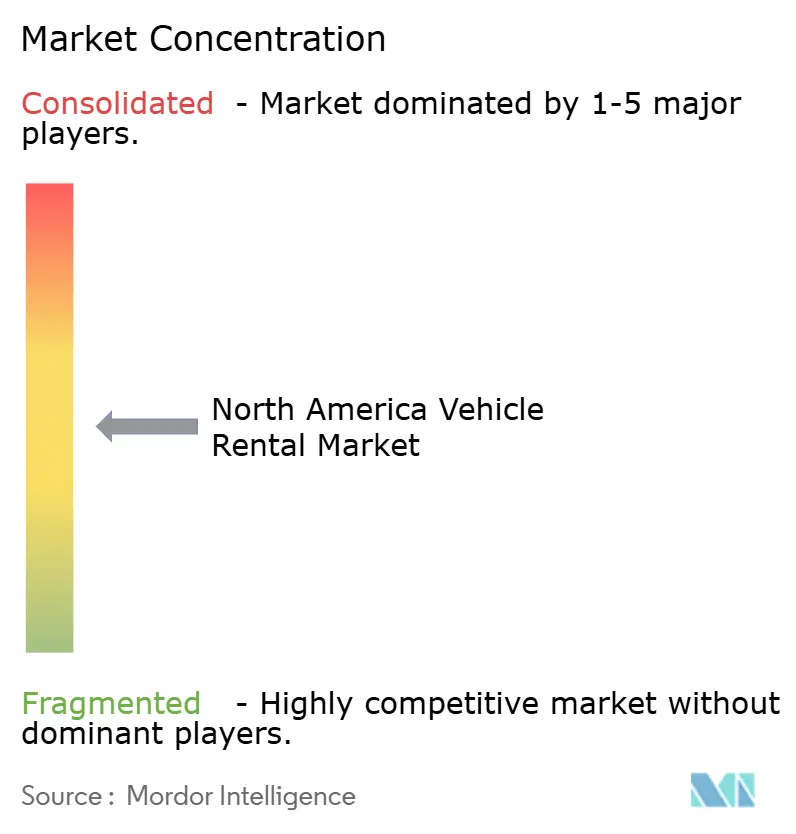
Market concentration is moderate: Enterprise Holdings, Avis Budget Group, and Hertz Global control a major chunk of airport revenue, while peer-to-peer platforms and subscription services dilute share off-airport. Incumbents leverage fleet scale, original equipment manufacturer discounts, and loyalty programs to defend margins. Sixt’s long-term Stellantis pact secures electrified supply and residual-value protection.
Turo’s Uber partnership exposes 2.5 million peer-to-peer vehicles to ride-hailing users, challenging incumbents on price and convenience. Getaround integrates credit-based insurance scoring to cut claim frequency, while Kyte and Vay pursue remote delivery and tele-operation models that reduce capital intensity.
Legacies respond with AI-driven pricing, contactless pickup, and expanded ancillary offerings. Hertz reported sequential RevPAC gains in 2025 despite softer demand, crediting algorithmic yield, and fleet-mix optimization. The interplay of regulatory moats, technology adoption, and capital structure will shape share distribution as the market scales toward USD 69.51 billion by 2031.
North America Vehicle Rental Industry Leaders
-
Sixt SE
-
Turo Inc.
-
Hertz Global Holdings, Inc.
-
Avis Budget Group, Inc.
-
Enterprise Holdings, Inc.
- *Disclaimer: Major Players sorted in no particular order
Market Opportunities and Future Outlook
Electrification is creating near-term whitespace where incentives and mandates intersect with constrained rental supply and uneven charging access. In the United States, the Inflation Reduction Act's commercial clean-vehicle credit (up to USD 40,000 for qualifying EVs), and Canada's ZEV sales targets (20% by 2026 and 60% by 2030) are pushing fleet planning toward BEVs. Reported gaps in EV availability at rental counters point to execution opportunities around vehicle sourcing, charging partnerships, and turnaround processes at high-throughput airport locations. Avis Budget Group's addition of more than 5,000 EVs to its North American fleet in Q1 2026 shows that scale players are allocating capital to EV availability, but residual-value volatility and repair-cost inflation keep profitability dependent on disciplined fleet mix and remarketing.
A second opportunity is monetizing operator capabilities as fleet-services infrastructure for adjacent mobility models, not just daily rentals. Hertz's launch of Oro Mobility and its Uber partnership for robotaxi and driver-led fleet operations show incumbents using depot networks, maintenance, and charging as revenue-producing services, while also supporting utilization and asset productivity. Direct digital engagement and loyalty programs also remain a practical lever to reduce acquisition costs and lift ancillary sales: SIXT launched the SIXT ONE rewards program in Canada in May 2026, tying mobile check-in and benefits to the market's shift toward online reservations (75.08% of 2025 transactions) and supporting repeat usage without expanding physical counter footprints.
Recent Industry Developments
- July 2026: SIXT placed a EUR 500 million benchmark bond maturing in January 2031 to fund fleet expansion, network growth, and technology investments. The financing supports faster fleet refresh cycles and branch rollout capacity, which can improve availability at premium locations and strengthen direct-channel execution.
- May 2026: SIXT launched the SIXT ONE rewards program in Canada, adding a structured loyalty layer with benefits such as upgrades and mobile check-in. The move reinforces digital-first bookings and helps operators shift demand toward direct channels, supporting improved attach rates for ancillaries and lower customer acquisition costs.
- March 2025: SIXT United States of America opened a new branch at the Seminole Hard Rock Hotel & Casino in Hollywood, Florida through a partnership with Hard Rock International and Seminole Gaming. The location targets hotel-driven leisure demand and provides a branded channel for premium vehicle upsell and loyalty-linked discounts beyond airport counters.
Research Methodology Framework and Report Scope
Market Definition and Coverage
For this study, the North America vehicle rental market covers revenue earned from renting passenger cars and light commercial vans to consumers and businesses for a fee, across short and longer rental durations. The market is measured in value terms at retail rental prices across North America.
Scope exclusions: We exclude peer-to-peer rentals where private owners rent out personal vehicles, chauffeur-driven services, and long-term vehicle leasing that is structured as a finance product.
Segmentation Overview
- By Vehicle Type
- Luxury Cars
- Economy Cars
- SUVs and Crossovers
- Multi-Purpose Vehicles (MPV)
- Light Commercial Vans
- By Application Type
- Leisure Travel
- Business/Commercial Travel
- Local Usage (In-city)
- Outstation/Inter-city
- By Rental Duration
- Short-Term (Under 30 days)
- Long-Term/Subscription (30 days or more)
- By Booking Type
- Online
- Offline
- By Customer Type
- Individual
- Corporate Fleet Accounts
- By Rental Location
- On-Airport
- Off-Airport
- By Fuel Type
- Internal Combustion Engine (ICE)
- Hybrid
- Battery Electric Vehicle (BEV)
- By Country
- United States
- Canada
- Rest of North America
Data Sources, Market Sizing, and Validation
Desk Research
Desk research was used to set clear market boundaries and build the first demand and supply checks for how a rental market should behave. Public sources were reviewed to understand travel flows, where rental activity is concentrated, and which cost items tend to move rental pricing over time.
Sources referenced include public datasets and releases such as the US Bureau of Transportation Statistics, Statistics Canada, and the US Census Bureau, along with travel indicators from agencies such as UN Tourism and airport traffic publications where available. We also used company annual reports and investor presentations, reputable press coverage, and association websites to capture fleet strategy changes, channel shifts, and revenue mix. For cross-checking fleet scale and corporate footprints, we selectively referenced paid databases for company financials and news intelligence, and an import or export shipment-level database when trade signals helped validate fleet replenishment patterns. The desk sources listed here are illustrative only, and many other public and paid references were also used to collect, validate, and clarify data points.
Primary Interviews and Surveys
Primary work focused on confirming what is actually counted as rental revenue across North America, and how pricing, utilization, and fleet availability shift by season and location type (airport versus neighborhood). We spoke with a mix of rental operators, fleet and procurement leads, channel partners, and travel ecosystem participants so gaps in public data could be closed and assumptions could be aligned to realistic rate and utilization ranges.
Distribution of primary research fieldwork respondents
| Company type | Respondent position |
|---|---|
| Top tier: 25% | CXOs: 13% |
| Mid tier: 61% | Functional/Unit leaders: 28% |
| Smaller Players: 14% | Managers: 59% |
Market-Sizing & Forecasting
Sizing was built using a top-down and bottom-up combination. Travel and mobility indicators were translated into a rental demand pool, then converted into revenue using observed pricing and utilization patterns. The output was checked against selective bottom-up approximations, such as sampled average daily rate times rental days, channel checks on airport versus neighborhood mix, and roll-ups from disclosed revenues where they were comparable to the study scope.
Key inputs (illustrative) included passenger traffic and travel volumes, fleet availability and replacement cycles, rental day trends by season, utilization ranges, and average daily rate movement including insurance and fee pass-throughs. Since supply constraints can temporarily cap demand, gaps were handled by applying conservative utilization ceilings in periods where fleet replenishment was reported as tight, then relaxing those ceilings when availability normalized. For forecasting, scenario analysis was used, supported by regression-style checks that link demand to travel volumes and price levels, and then refined using what interviewees expected for fleet costs, rate discipline, and booking channel shares over the forecast period.
Data Validation & Update Cycle
Validation is done by triangulating model outputs against independent signals, so the market total stays aligned with real demand and supply behavior. We run variance checks across countries, booking channels, and rental duration patterns, and we review outliers like sudden rate jumps or utilization spikes to confirm they are consistent with fleet shortages, travel shocks, or fee changes.
Before sign-off, the model and assumptions go through multi-step analyst reviews where calculation logic, unit consistency, and currency timing are rechecked. When a material mismatch is seen versus public indicators or interview feedback, follow-up conversations are triggered and assumptions are tightened. The report is refreshed annually, with interim updates for major events that can move travel demand or fleet availability, and a final pre-delivery pass is completed so clients receive the latest updated view.
Mordor Intelligence's North America Vehicle Rental Market Sizing Compared With Other Published Estimates
Published market sizes for vehicle rental can look far apart even when they describe a similar region, because the line between rental, leasing, and adjacent mobility services is not drawn the same way. Differences also come from how fees and taxes are treated, whether estimates lean heavily on airport transactions, and how local revenues are converted into a common USD year.
The benchmark table shows a spread that is mostly explained by what is included in revenue and which geographies are counted, followed by how pricing is projected when fleet availability tightens or eases. Under Mordor Intelligence's scope, the total reflects paid rental revenue for passenger cars and light commercial vans across North America while excluding peer-to-peer rentals, and that exclusion is a common reason some published totals come out higher.
Benchmark comparison
| Source | Market Size | Gaps in Research Methodology |
|---|---|---|
| Mordor Intelligence | USD 42.61 B (2025) | |
| Trade Journal A | USD 40.60 B (2025) | Often reflects US-only revenue tallies and may undercount Canada and Mexico, and it can also rely on reported operator revenues that treat fees and ancillary items differently. |
| Regional Consultancy B | USD 53.80 B (2026) | Typically uses a broader definition that can fold in leasing-like long-duration products or adjacent mobility revenue, and it may apply uniform rate growth that does not fully reconcile to utilization ceilings during fleet tightness. |
Taken together, the three figures show how quickly totals shift when adjacent products or partial geographies are added, even if the core rental activity is similar. Our approach keeps the number traceable to travel demand, fleet availability, utilization, and observable rate movement, which makes the result easier to repeat and audit as conditions change.
Key Questions Answered in the Report
What is driving the fastest growth in rentals?
Online bookings and on-airport locations are expanding quickest, with digital channels growing at a 13.84% CAGR and airport sites at 13.26% through 2031.
How significant are electric vehicles in rental fleets?
Battery-electric models represented 13.79% of fleets in 2025 and are forecast to grow at a 14.42% CAGR, supported by United States and Canadian incentives.
Which vehicle class is gaining share the fastest?
SUVs and crossovers are projected to expand at a 10.68% CAGR, outpacing economy and luxury categories.
Are subscription rentals becoming mainstream?
Subscription and long-term rentals still account for one-fifth of transaction days but are advancing at a 13.35% CAGR as consumers seek flexible access.
How concentrated is the competitive landscape?
Enterprise, Avis Budget, and Hertz collectively hold about 72% of airport revenue, indicating moderate concentration but rising digital disruption.