
Market Overview
| Study Period | 2020 - 2031 |
|---|---|
| Forecast Data Period | 2026 - 2031 |
| Base Year Market Size (2025) | USD 47.15 Billion |
| Market Size (2026) | USD 48.91 Billion |
| Market Size (2031) | USD 58.76 Billion |
| Growth Rate (2026 - 2031) | 3.74 % |
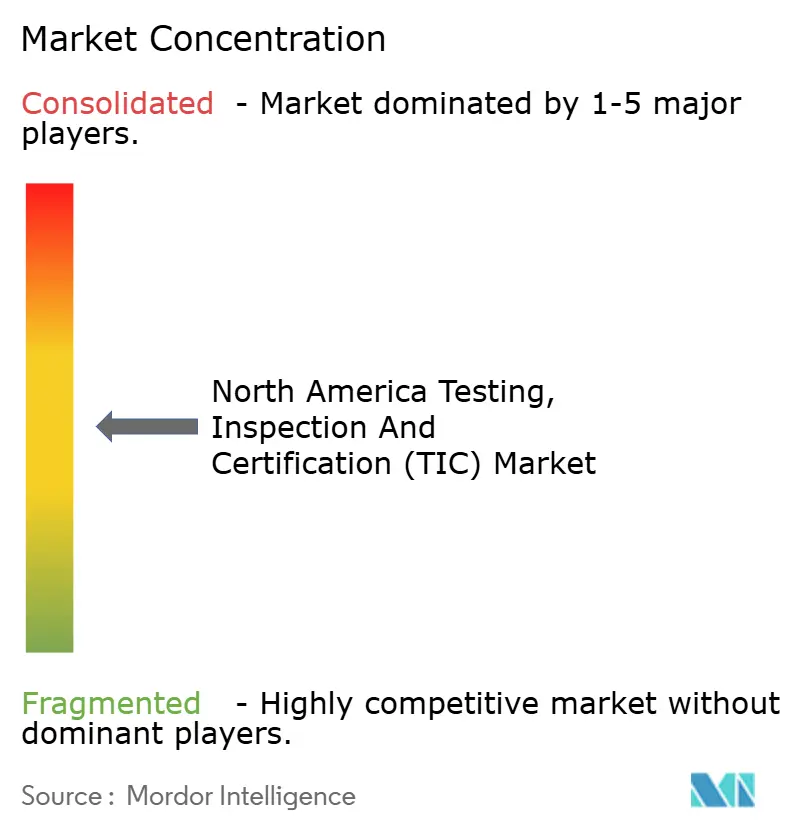
| Market Concentration | Medium |
Major Players *Disclaimer: Major Players sorted in no particular order Image © Mordor Intelligence. Reuse requires attribution under CC BY 4.0. | |
North America Testing, Inspection and Certification (TIC) Market Analysis by Mordor Intelligence
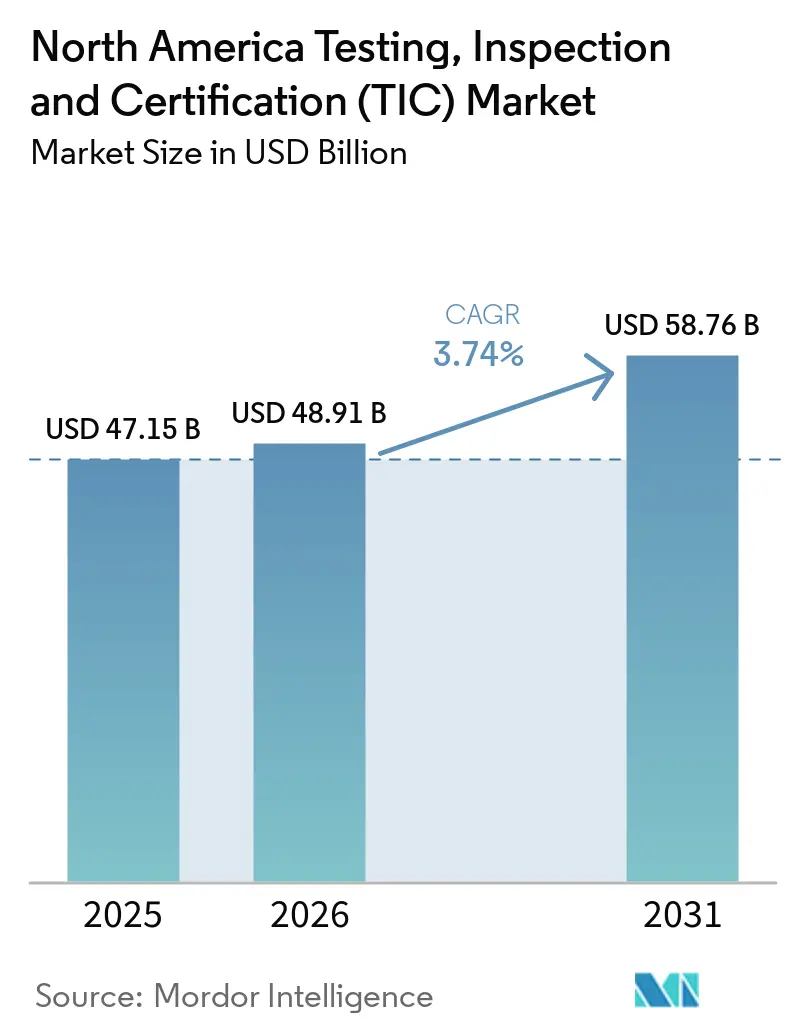
North America TIC market size in 2026 is estimated at USD 48.91 billion, growing from 2025 value of USD 47.15 billion with 2031 projections showing USD 58.76 billion, growing at 3.74% CAGR over 2026-2031. The trajectory highlights sustained demand created by stringent regulatory frameworks, digital transformation of service delivery, and rapid electrification of transportation assets. Heightened chemical-safety rules from the EPA and OSHA, accelerating battery production, and embedded-carbon verification for exporters all reinforce a stable pipeline of third-party testing engagements.[1] At the same time, major providers use acquisitions and digital platforms to lift productivity, offset price pressure, and deepen customer stickiness, keeping the North America TIC market on a steady expansion path. Remote inspection tools, cloud-based compliance analytics, and data-integrated supply-chain audits now serve as competitive differentiators in the North America TIC market, while nearshoring into Mexico widens geographic demand diversity.[2] Electric-vehicle battery laboratories, expanded PFAS capabilities, and additive-manufacturing certifications create new revenue pools that complement the mature industrial base in the North America TIC market.
Key Report Takeaways
- By service type, testing captured 61.12% of the North America TIC market share in 2025, and certification is projected to lead growth at a 4.41% CAGR through 2031.
- By sourcing type, outsourced services accounted for 69.82% of the North America TIC market size in 2025, while the same segment is forecast to expand at a 4.53% CAGR to 2031.
- By industry vertical, industrial manufacturing commanded 19.28% revenue of the North America TIC market in 2025; life sciences and healthcare is advancing at a 4.96% CAGR through 2031.
- By mode of service delivery, on-site services held a 49.08% share of the North America TIC market in 2025, and remote-digital services are poised for a 4.78% CAGR to 2031.
- By country, the United States led with an 80.62% share of the North America TIC market in 2025, while Mexico recorded the highest 4.97% CAGR through 2031.
Note: Market size and forecast figures in this report are generated using Mordor Intelligence’s proprietary estimation framework, updated with the latest available data and insights as of 2026.
Market Trends and Insights
Drivers Impact Analysis of North America Testing, Inspection and Certification (TIC) Market*
| Driver | (~) % Impact on CAGR Forecast | Geographic Relevance | Impact Timeline |
|---|---|---|---|
| High compliance burden due to stringent North American regulatory frameworks | +1.2% | United States and Canada | Long term (≥ 4 years) |
| Rising complexity of manufacturing supply chains and distributed sourcing | +0.8% | North America and Mexico | Medium term (2-4 years) |
| Digital transformation driving demand for data-integrated testing and inspection services | +0.6% | Global | Medium term (2-4 years) |
| Surge in electric-vehicle and battery production requiring specialized TIC | +0.5% | United States and Mexico | Long term (≥ 4 years) |
| Carbon-border adjustment policies prompting embedded-carbon verification | +0.3% | North America exports to EU | Short term (≤ 2 years) |
| Proliferation of additive-manufacturing service bureaus needing certification | +0.2% | United States and Canada | Long term (≥ 4 years) |
| Source: Mordor Intelligence | |||
High Compliance Burden Due to Stringent North American Regulatory Frameworks
Escalating cross-border rules obligate manufacturers to maintain rigorous third-party verification. The EPA’s 2024 TSCA solvent rules introduced exposure limits dramatically below earlier OSHA thresholds, triggering extensive monitoring requirements. OSHA’s 2024 Hazard Communication update aligned labels with GHS Rev 7, adding re-classification projects that funnel fresh work to laboratories. Canada matched U.S. formaldehyde limits for composite wood in 2025, preserving accredited-lab testing mandates while easing trade frictions. Cosmetic and pharmaceutical companies now face FDA-proposed asbestos testing protocols using standardized methods, further lifting sample volumes. As a result, the North America TIC market consistently benefits from a regulatory environment that demands documented, independent proof of compliance.
Rising Complexity of Manufacturing Supply Chains and Distributed Sourcing
Multi-tier supplier networks heighten quality-assurance risk, especially when critical components originate in dispersed plants. University of Cambridge research links supply-chain complexity to higher product-safety incidents, underscoring the need for specialized audits. SGS responded with Supplier Evaluation and Qualification Solutions that blend digital dashboards, self-assessment questionnaires, and on-site verifications to close visibility gaps. Automotive, aerospace, and electronics firms deploy such programs to uncover tier-2 weaknesses before they reach assembly. North American nearshoring adds new facilities in Mexico, forcing original equipment manufacturers to validate unfamiliar partners quickly. Consequently, the North America TIC market secures long-term demand by acting as a risk-mitigation partner for distributed production models.
Digital Transformation Driving Demand for Data-Integrated Testing and Inspection Services
Boston Consulting Group forecasts that digital tools will influence 40-60% of TIC activities this decade. Providers now leverage augmented-reality headsets, 360-degree video, and cloud platforms to reduce travel, shorten cycle times, and widen access to scarce experts. Bureau Veritas notes that remote inspection lowers carbon footprints while keeping audit rigor intact, integrating seamlessly with its case-management system. TÜV Rheinland’s Virtual Expert allows real-time annotations and guidance across multiple participants, expanding the addressable market for remote services. Automation laboratories and predictive analytics dashboards have begun shifting providers from reactive testers to proactive ecosystem orchestrators. This modernization reshapes customer expectations and enlarges the value captured by the North America TIC market.
Surge in Electric-Vehicle and Battery Production Requiring Specialized TIC
Rapid electrification has spawned highly technical battery-safety and performance protocols such as UN 38.3, UL 2580, and SAE J2929. UL Solutions opened an 89,000 sq ft battery laboratory near Detroit to run abuse, fire, and environmental tests on cells, modules, and packs. SGS upgraded its Georgia site to 100 V and 1,200 A capacity, accommodating light-EV and energy-storage applications. Southwest Research Institute supports transport-certification tests that OEMs need before shipping lithium-ion systems internationally. These investments expand capacity just as the North America TIC market faces a wave of gigafactory projects, solid-state innovations, and stricter EPA range-certification procedures.
Restraints Impact Analysis of North America Testing, Inspection and Certification (TIC) Market*
| Restraint | (~) % Impact on CAGR Forecast | Geographic Relevance | Impact Timeline |
|---|---|---|---|
| High cost pressure and price competition among TIC providers | -0.7% | North America | Medium term (2-4 years) |
| Shortage of skilled inspectors and laboratory technicians in specialized domains | -0.4% | United States and Canada | Long term (≥ 4 years) |
| Ambiguity in jurisdiction over remote/digital inspection results | -0.2% | North America | Short term (≤ 2 years) |
| Corporate sustainability self-declarations reducing third-party certification demand | -0.3% | Global, with North America focus | Medium term (2-4 years) |
| Source: Mordor Intelligence | |||
High Cost Pressure and Price Competition among TIC Providers
Global players vie aggressively for high-volume, standardized projects, compressing margins even as demand grows. UL Solutions, holding roughly 7% of outsourced product services, targets a 24% EBITDA margin but currently hovers near 20%, reflecting efficiency headwinds. SGS added environmental and connectivity labs via multiple acquisitions to drive scale economies. Bureau Veritas purchased Maxxam Analytics for USD 485 million, integrating it to broaden Canadian coverage and dilute fixed costs. Commoditized chemical screens and repetitive safety audits leave little room for differentiation, forcing providers to negotiate bundled contracts and multi-year price locks. Persistent consolidation tempers the growth rate of the North America TIC market, even as volumes trend upward.
Shortage of Skilled Inspectors and Laboratory Technicians in Specialized Domains
Clinical laboratories, battery test centers, and advanced-materials facilities all face sizable talent gaps. The U.S. Bureau of Labor Statistics sees over 24,000 lab-technologist vacancies annually, compared with only 5,000 two decades ago. Surveys show just 12% of technicians are highly likely to remain in the field, citing pay dissatisfaction and high burnout. Similar deficits permeate wire-and-cable and additive-manufacturing inspections, where fewer experienced engineers manage ever more complex evaluations. Providers invest in automation, knowledge-capture systems, and augmented-reality guidance to ease bottlenecks, yet mission-critical tests still hinge on seasoned staff. This scarcity slows project throughput and marginally tempers the CAGR of the North America TIC market.
*Our forecasts treat driver/restraint impacts as directional, not additive. The impact forecasts reflect baseline growth, mix effects, and variable interactions.
North America Testing, Inspection and Certification (TIC) Market Segment Analysis
By Service Type:
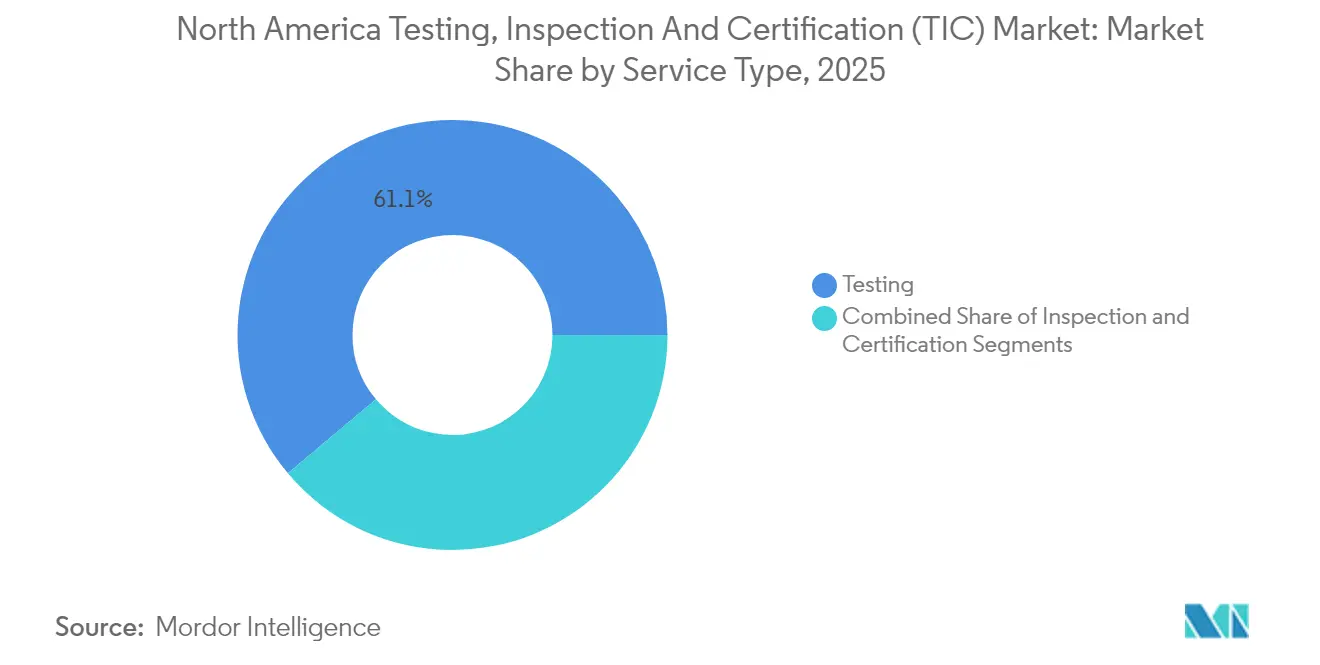
Testing Commands Market LeadershipTesting services accounted for 61.12% of the North America TIC market size in 2025, underlining the foundational role laboratory verification plays across regulatory compliance and product development. Certification, while smaller, is forecast to record a 4.41% CAGR through 2031, aided by rules that increasingly demand documented conformity beyond raw data. The North America TIC market continues to rely on large-scale chemical, environmental, and material analyses as new PFAS, battery-safety, and additive-manufacturing standards emerge.
Certification growth reflects OSHA’s GHS alignment and EPA’s PFAS mandates, which compel manufacturers to secure accredited sign-offs before shipments. Aerospace and maritime fire-testing upgrades, such as SGS’s ISO/IEC 17025-accredited Farmingdale facility, demonstrate how integrated testing-plus-certification packages add value. As aircraft production ramps faster than accredited capacity expands, the aerospace TIC market continues to face schedule risk from testing queues that delay qualification, certification, and supplier approvals. Providers bundling both services can capture wallet share and create stickier client relationships, reinforcing competitive positioning within the North America TIC industry.

By Sourcing Type:
Outsourced Services Dominate Market DynamicsOutsourced engagements represented 69.82% of the North America TIC market share in 2025, rising as companies focus on core competencies and grapple with capital-intensive lab investments. Forecasts show the outsourced segment growing at 4.53% through 2031 as regulations proliferate and specialized instrumentation costs escalate. Consequently, the North America TIC market aligns with strategic procurement patterns, shifting quality control from in-house teams to external experts.
Digital remote-inspection platforms accelerate outsourcing adoption. Bureau Veritas reports faster project cycles and smaller carbon footprints when customers pivot to hybrid audit models combining on-site sampling with virtual oversight. UL Solutions’ CableBuilder software augments this trend by digitizing documentation flows, reducing rework for manufacturers facing skilled-labor gaps. These examples illustrate how outsourced providers deploy technology to amplify value and cement their role as extensions of client quality teams.
By Industry Vertical:
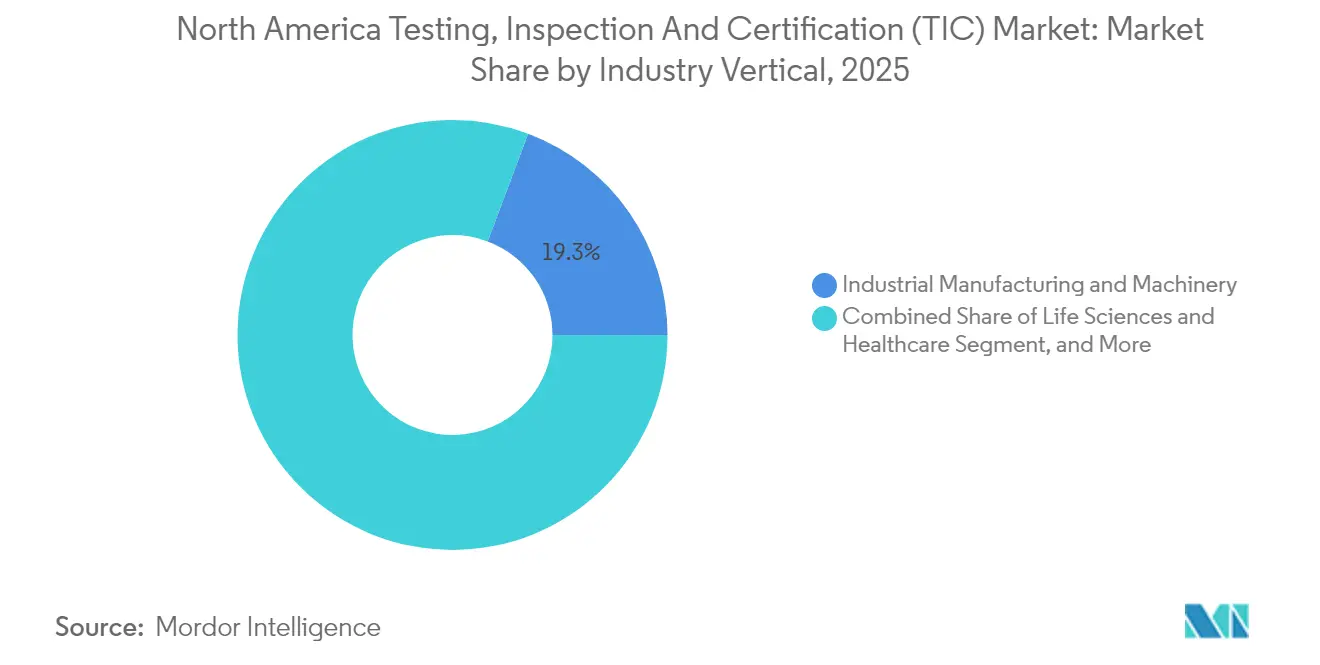
Industrial Manufacturing Leads while Life Sciences AcceleratesIndustrial manufacturing and machinery generated 19.28% of 2025 revenue, reflecting broad-based equipment certification, non-destructive testing, and materials analysis. Life sciences and healthcare, though smaller, carry the fastest 4.96% CAGR to 2031, propelled by medical-device certifications and stricter cosmetic-safety assessments. Both verticals draw on the North America TIC market for specialized, accredited evaluations that satisfy FDA, OSHA, and international standards.
Pharmaceutical serialization audits, PFAS water-testing mandates, and medical-battery safety validations combine to bolster the life sciences pipeline. Meanwhile, additive-manufacturing qualification paths under the Pressure Equipment Directive show how industrial OEMs converge on standardized TIC protocols to unlock production efficiencies. The cross-pollination of digital twins, material-traceability systems, and predictive maintenance analytics widens the service scope and reinforces growth prospects within the North America TIC industry.
By Mode of Service Delivery:
On-Site Services Lead with Remote Gaining MomentumOn-site inspections held 49.08% of 2025 revenue, covering asset-integrity checks, construction verifications, and factory audits that mandate physical presence. Remote-digital services, however, are primed for a 4.78% CAGR to 2031, buoyed by bandwidth advances and regulator acceptance of virtual methods. The North America TIC market now blends physical and digital workflows to match risk levels and budget constraints.
TÜV Rheinland completed over 5,000 remote audits using its Virtual Expert tool, confirming that real-time guidance and cloud-based evidence capture satisfy most conformity-assessment needs. SGS’s QiiQ mobile app offers 360-degree video, smart-glasses integration, and secure data storage, illustrating how providers replicate on-site rigor without travel. Nonetheless, destructive tests, fire-safety trials, and high-voltage battery abuses still demand laboratory or field presence, preserving a balanced delivery mix across the North America TIC market.
Geography Analysis
United States Testing, Inspection and Certification (TIC) Market
The United States generated 80.62% of 2025 revenue for the North America TIC market, sustained by expansive federal and state regulations, dense manufacturing clusters, and leading technology ecosystems. EPA solvent restrictions, OSHA hazard-communication revisions, and FDA battery-range certifications alone feed a robust pipeline of high-value tests. Global providers maintain flagship laboratories from New York to California, ensuring rapid turnaround for domestic clients.
Canada Testing, Inspection and Certification (TIC) Market
Canada contributes a steady share, supported by resource-sector assays, environmental testing, and harmonized rules with the U.S. Formaldehyde emissions alignment in 2025 minimizes duplicate testing, yet accredited laboratories remain mandatory, anchoring services in the North America TIC market. Bureau Veritas’ acquisition of Maxxam Analytics enlarged its Canadian portfolio, signaling that consolidation elevates scale and specialization.
Mexico Testing, Inspection and Certification (TIC) Market
Mexico stands out with a 4.97% forecast CAGR to 2031 as nearshoring shifts automotive, electronics, and industrial machinery production southward. Manufacturers depend on cross-border auditors for supplier verification, PFAS water-testing, and battery-component certifications. U.S. International Trade Commission data on aluminum extrusions highlights Mexico’s rising role in regional supply chains, confirming strong opportunities for TIC providers. Together, these dynamics diversify revenue streams and fortify long-run growth for the North America TIC market.
Regulatory Landscape
North America TIC demand is anchored to formal conformity-assessment and accreditation requirements across federal and national regulators. In the United States, OSHA-recognized Nationally Recognized Testing Laboratories (NRTLs) underpin workplace product-safety acceptance for many categories, while the FCC equipment authorization framework requires RF devices with higher interference potential to be tested by FCC-recognized accredited laboratories and certified through Telecommunications Certification Bodies (TCBs). In May 2026, the FCC adopted final measures to strengthen the integrity and security of its Equipment Authorization Program, including a fast-track priority review pathway for applications tested in Trusted Test Labs (in the United States or economies covered by applicable MRAs/trade agreements). This adds a timeliness and location-of-testing dimension that influences lab selection.
Canada maintains a parallel, rules-driven system under Innovation, Science and Economic Development Canada (ISED). It recognizes testing laboratories and certification bodies through REC-LAB and REC-CB procedures that reference ISO/IEC 17025:2017 for lab competence and align with broader international conformity practices. For cross-border TIC providers, this framework keeps accreditation and recognition status (U.S. NRTL/recognized lab pathways and Canadian ISED recognition) central to ongoing eligibility, and the 2025-2026 security-oriented updates in telecom equipment authorization keep compliance, reporting, and governance obligations in scope for labs and TCBs.
Value Chain Analysis
The TIC value chain starts with manufacturers, asset owners, operators, and technology vendors defining compliance and risk requirements (regulatory, industry standard, and customer specifications). This is followed by test plan design, sampling and field data capture (on-site and remote), laboratory analysis and functional testing, inspection and audit execution, and then certification/attestation with ongoing surveillance. Accredited laboratories, TCBs/certification bodies, and inspectors are supported by accreditation bodies and standards setters (for example, UL/ANSI and CSA/IEC-aligned frameworks), with a toolchain of instrumentation, calibration, software platforms, and secure evidence management used for remote or hybrid delivery.
Execution capacity is shaped by global TIC groups (SGS, Intertek, Bureau Veritas, UL Solutions, and TUV organizations) alongside specialized laboratories that provide niche validation in wireless/IoT compliance, high-speed connectivity, and advanced materials or environmental analytics. Regulatory process design also affects workflow choices. The FCCs May 2026 equipment authorization updates introduced a fast-track route tied to Trusted Test Labs, which can pull testing volume toward qualified domestic or MRA-recognized facilities and increase the value of recognized lab networks. Consolidation remains a recurring mechanism for adding capability and throughput, with large providers using acquisitions to extend North American footprints in specialized testing domains.
Competitive Landscape
Market leadership is moderately concentrated among global multinationals, yet niches remain for regional specialists. UL Solutions ranks first with roughly 7% of outsourced product services, leveraging deep standards expertise and aggressive M&A to expand hydrogen, battery, and wire-and-cable offerings. SGS, Bureau Veritas, and Intertek collectively pursue bolt-on acquisitions, enlarging capacity in environmental testing, renewables consulting, and minerals analysis.
Digitalization has become the new battleground. Providers roll out augmented-reality inspections, asset-monitoring dashboards, and AI-powered document reviews to differentiate on speed and insight. Checkfirst’s TICC AI Innovator Program claims a 2.1× ROI boost for adopters, signaling that data analytics may soon reshape pricing and productivity benchmarks.[4] The North America TIC market, therefore, rewards firms that blend scale, specialization, and technology.
The terminated USD 33 billion merger talks between SGS and Bureau Veritas in January 2025 illustrate ongoing consolidation pressures. Acquisitions such as SGS’s purchase of RTI Laboratories for PFAS capabilities and Bureau Veritas’ buyout of ArcVera Renewables show a pivot toward high-growth verticals. As regulatory mandates intensify and supply-chain complexity grows, strategic forays into cybersecurity, battery safety, and carbon-verification segments are expected to accelerate.
North America Testing, Inspection and Certification (TIC) Industry Leaders
-
SGS SA
-
Bureau Veritas SA
-
Intertek Group plc
-
TÜV SÜD AG
-
TÜV Rheinland AG
- *Disclaimer: Major Players sorted in no particular order
North America Testing, Inspection and Certification (TIC) Market Companies Covered in this Report
- SGS SA
- Bureau Veritas SA
- Intertek Group plc
- TÜV SÜD AG
- TÜV Rheinland AG
- DEKRA SE
- Applus Services S.A.
- UL Solutions Inc.
- CSA Group
- Eurofins Scientific SE
- DNV AS
- Lloyd's Register Group Limited
- ALS Limited
- Element Materials Technology Group
- BSI Group
- Mistras Group Inc.
- Kiwa NV
- NSF International
- SAI Global Pty Limited
- RINA S.p.A.
- NTS (National Technical Systems)
- Core Laboratories Inc.
- Phenova Inc.
- Envirotest Laboratories Inc.
Read Analysis of North America Testing, Inspection and Certification (TIC) Companies
Market Opportunities and Future Outlook
Telecom and connectivity compliance is creating a tangible whitespace for TIC capacity that spans RF performance, interoperability, cybersecurity assurance, and evidence-traceable workflows. The FCCs May 2026 action to strengthen the Equipment Authorization Program, including fast-track priority review for applications tested in Trusted Test Labs (effective June 15, 2026), raises the commercial value of North America-based or MRA-recognized testing infrastructure. It also favors providers that can bundle accredited lab testing with documentation, governance, and post-market support. In parallel, NISTs published guidance work on applying 5G cybersecurity and privacy capabilities offers enterprises and integrators a practical reference point for validation activities, supporting demand for test methods that link network security requirements to repeatable assurance services.
Automation and on-demand testing environments are another near-term opportunity area, particularly for Open RAN and advanced antenna systems, where developers need repeatable lab-based verification without building full internal facilities. VIAVI Solutions expanded its VALOR Automated Lab-as-a-Service in Chandler, Arizona in April 2026 with added over-the-air Massive MIMO and beamforming capability, which points to active investment in test capacity aimed at shortening cycles for ecosystem participants. Consolidation that widens wireless testing breadth also supports unmet-need coverage across Wi-Fi 4-7 and wireless power certification, as reflected in Element Materials Technologys July 2026 acquisition of CETECOM Inc., which broadened North American wireless and cellular device test capacity and strengthens one-stop market-access propositions for device makers shipping across the United States, Canada, and Mexico.
Recent Industry Developments in North America Testing, Inspection and Certification (TIC) Market
- March 2026: SGS completed the acquisition of Granite River Labs Services (GRL), expanding its Digital Trust and Connectivity offering with specialist capability in validating high-speed wired data connections. The transaction strengthens SGS positioning in compliance and performance verification for increasingly complex connectivity hardware and digital infrastructure programs.
- November 2025: Intertek acquired Professional Testing Laboratory, a US-based flooring products testing company. The deal expands Interteks materials testing footprint and adds capacity aligned with regulated building products and quality assurance requirements across North American supply chains.
- November 2024: Bureau Veritas acquired Versatec Energy B.V. to strengthen its renewables consulting capabilities. The move broadens its service portfolio that supports project assurance needs for energy transition investments, complementing testing and inspection activity linked to renewables deployment.
North America Testing, Inspection and Certification (TIC) Market Report Scope and Research Methodology
Market Definition and Coverage
For this study, the market covers third party and in-house testing, inspection, and certification services used to verify product quality, safety, and regulatory compliance across North America, with revenue counted from service delivery and related assurance activities.
Scope exclusions: We exclude in-house internal quality work that is not priced or accounted as a TIC service, along with pure consulting or training that is sold without a test, inspection, or certificate outcome.
Segments Covered in This Report
- By Service Type
- Testing
- Inspection
- Certification
- By Sourcing Type
- In-house
- Outsourced
- By Industry Vertical
- Consumer Goods and Retail
- ICT and Telecom
- Automotive and Transportation
- Aerospace and Defense
- Oil, Gas and Petrochemicals
- Energy and Utilities
- Industrial Manufacturing and Machinery
- Chemicals and Materials
- Construction and Infrastructure
- Life Sciences and Healthcare
- Food, Agriculture and Beverage
- Other Industry Verticals (Environment, Sustainability, etc.)
- By Mode of Service Delivery
- On-site
- Off-site / Laboratory
- Remote / Digital
- By Country
- United States
- Canada
- Mexico
Data Sources, Market Sizing, and Validation
Desk Research
Desk research is used to lock down the service boundaries, regulated end markets, and the economic base that drives demand for TIC work. We relied on public sources such as the US Census Bureau (manufacturing and construction output), the Bureau of Labor Statistics (industry payroll and employment), Environment and Climate Change Canada and the US EPA (environmental monitoring and compliance signals), the USDA (food production and safety programs), and OSHA and NIST (safety and standards references).
We also reviewed company filings, investor presentations, contract announcements, and industry association publications to map the mix of testing, inspection, and certification activities by customer vertical. Where needed, paid subscriptions for company financials and intelligence, patent databases, and shipment level import export data were used to cross-check growth patterns and exposure by end market. The sources listed here are illustrative, and additional public and paid references were used to confirm data points and clarify assumptions.
Primary Interviews and Surveys
Primary work focused on validating how much spending sits with outsourced providers versus in-house teams, and how the service mix shifts by regulated verticals such as food, environmental, and industrial goods. We spoke with a mix of service managers, quality and compliance leaders, procurement teams, and operational managers across the United States and Canada, so the model could be grounded in contract structures, pricing behavior, and typical inspection frequency used in the field.
Distribution of primary research fieldwork respondents
| Company type | Respondent position |
|---|---|
| Top tier: 31% | CXOs: 12% |
| Mid tier: 55% | Functional/Unit leaders: 29% |
| Smaller Players: 14% | Managers: 59% |
Market-Sizing & Forecasting
We sized demand using a top-down build that starts from North America output and compliance activity in TIC-heavy verticals, then converts this into service spending using penetration and intensity assumptions. To keep the estimate realistic, selective bottom-up checks were used, including sampling reported service revenue exposure, using typical contract pricing bands, and validating volumes through channel conversations and customer budget splits.
Key inputs include the outsourced versus in-house mix, inspection frequency tied to regulated operations, new product and supplier qualification cycles, changes in standards and accreditation needs, and activity levels in manufacturing, construction, food processing, and environmental monitoring. Where desk data had gaps, we and our interview panel used practical proxies, for as example, using regulated site counts and typical audit cadence to approximate inspection demand.
For forecasting, scenario analysis was used so growth can be flexed based on shifts in industrial output, environmental compliance focus, and customer outsourcing behavior. Assumptions are kept traceable, and when a segment lacked clean public indicators, it was bridged using conservative growth links to the closest end market driver, then checked again with interviews.
Data Validation & Update Cycle
Outputs are validated through multiple checks so outliers are caught early. We compare the modeled totals against independent signals such as compliance program activity, industrial output trends, and service pricing direction collected during interviews, and then run variance checks across countries and end-user verticals.
Before sign-off, the model is reviewed in steps by analysts who test sensitivities and re-check any unusual jumps in service mix, outsourcing share, or implied pricing. Reports are refreshed annually, and interim updates are triggered when material events occur, such as major regulatory shifts or sudden end-market slowdowns. Right before delivery, a final review pass is done so clients receive the most current view available.
Mordor Intelligence's North America Testing Inspection and Certification Market Size Compared With Other Published Estimates
Published market values for TIC in North America can look far apart because firms count different service revenue pools and they do not always use the same base year. Differences also show up when one estimate relies on broad GDP growth, while another ties demand to regulated end markets that swing by cycle.
The biggest gap is whether in-house quality functions and broader consulting are counted as TIC revenue, and in Mordor Intelligence the value is limited to testing, inspection, and certification services tracked across outsourced and in-house delivery modes, with demand anchored to end-user vertical activity and country splits for the United States and Canada.
Benchmark comparison
| Source | Market Size | Gaps in Research Methodology |
|---|---|---|
| Mordor Intelligence | USD 47.15 B (2025) | |
| Regional Consultancy A | USD 19.00 B (2024) | Uses a narrower revenue pool that appears to emphasize outsourced spending and may exclude large in-house programs, which compresses the total even before forecasting differences are applied. |
| Trade Journal B | USD 55.70 B (2030) | Publishes a forward-year point without clearly stating the base year build, and the total can be lifted if adjacent assurance services are bundled or if aggressive price progression is assumed across regulated verticals. |
The spread mainly comes from what is counted as TIC service revenue, plus which year is being quoted and how pricing is carried forward. By keeping the scope tied to defined service outcomes and checking assumptions against end-market activity and interview feedback, the sizing stays explainable and can be repeated when new data arrives.
Key Questions Answered in the Report
What is the projected value of the North America TIC market in 2031?
The market is expected to reach USD 58.76 billion by 2031, growing at a 3.74% CAGR.
Which service type currently generates the largest revenue?
Testing services lead, capturing 61.12% of 2025 revenue.
Why is Mexico growing faster than the United States and Canada?
Nearshoring shifts manufacturing to Mexico, driving a 4.97% CAGR for TIC services linked to new plants and supply-chain audits.
How are digital tools changing TIC service delivery?
Remote inspections, 360-degree video, and cloud analytics accelerate project cycles, reduce travel costs, and expand expert reach.
Which verticals will contribute most to future growth?
Life sciences, battery-electric mobility, and renewables testing are forecast to grow fastest due to stricter regulatory demands and technology shifts.
What are the main challenges facing TIC providers?
Intense price competition and shortages of skilled inspectors and lab technicians constrain margin expansion and capacity scaling.