
North America Strategic Consulting Market Size and Share
Market Overview
| Study Period | 2020 - 2031 |
|---|---|
| Forecast Data Period | 2026 - 2031 |
| Base Year Market Size (2025) | USD 27.56 Billion |
| Market Size (2026) | USD 28.34 Billion |
| Market Size (2031) | USD 34.26 Billion |
| Growth Rate (2026 - 2031) | 3.87 % |
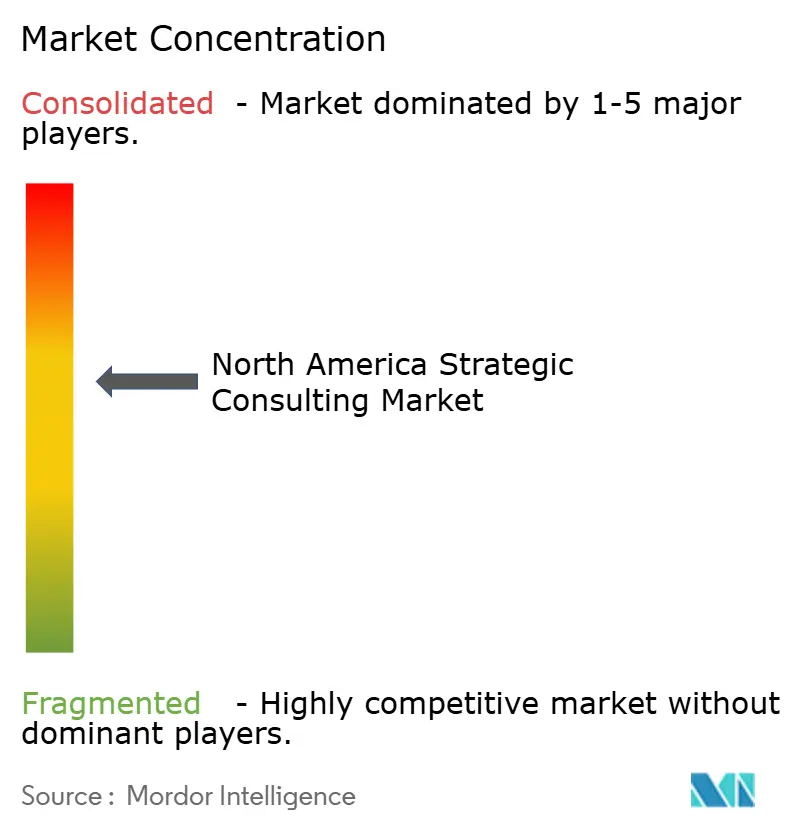
| Market Concentration | Medium |
Major Players *Disclaimer: Major Players sorted in no particular order Image © Mordor Intelligence. Reuse requires attribution under CC BY 4.0. | |
North America Strategic Consulting Market Analysis by Mordor Intelligence
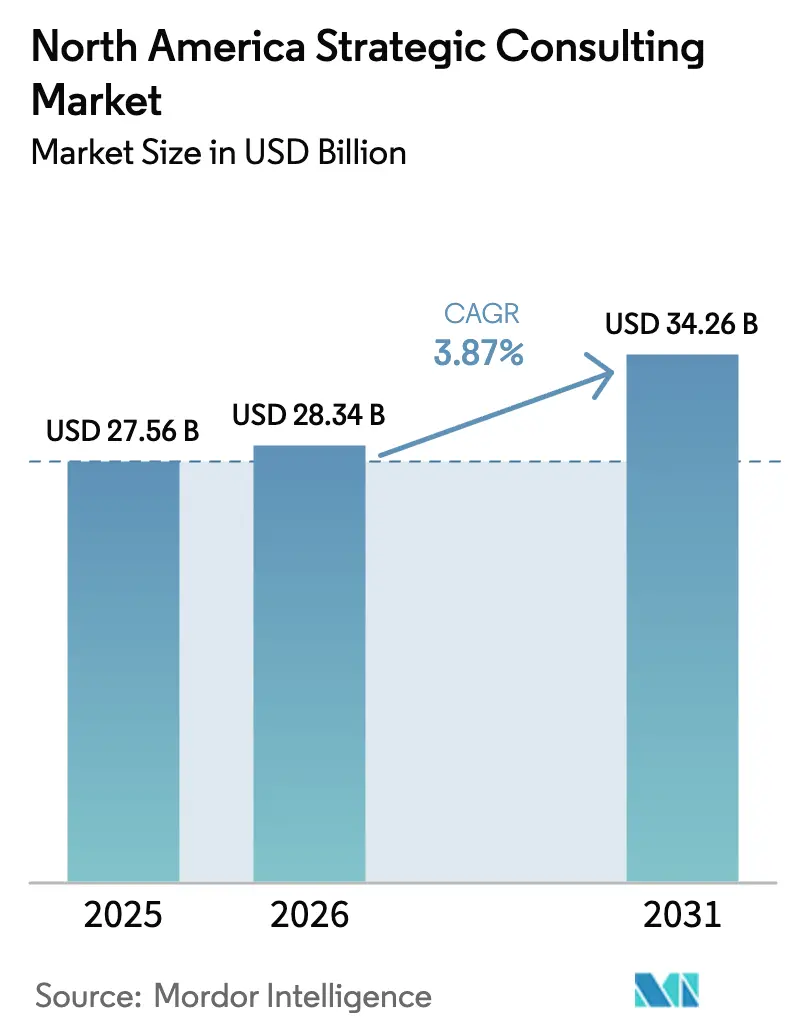
The North America strategic consulting market size is projected to be USD 27.56 billion in 2025, USD 28.34 billion in 2026, and reach USD 34.26 billion by 2031, growing at a CAGR of 3.87% from 2026 to 2031. Solid demand for external counsel persists even as clients develop in-house analytics teams and algorithm-driven decision platforms. Advisory firms are pivoting toward outcome-linked contracts, proprietary artificial intelligence toolkits, and deeper industry specialization to preserve pricing power. The result is a North America strategic consulting market that is growing steadily yet transforming rapidly in both service mix and delivery model. Competitive pressure is intensifying as boutique digital specialists court mid-market clients once served almost exclusively by global integrators.
Key Report Takeaways
- By service type, functional strategy commanded 39.53% revenue share in 2025 while digital strategy and innovation is forecast to accelerate at a 4.65% CAGR through 2031.
- By organization size, large enterprises held 62.89% of the North America strategic consulting market share in 2025 whereas small enterprises are projected to expand at a 4.86% CAGR to 2031.
- By engagement model, project-based advisory delivered 53.43% of 2025 revenue and outcome-based consulting is advancing at a 4.78% CAGR during the outlook period.
- By end-user industry, financial services led with 28.92% share in 2025; life sciences and healthcare is set to grow at a 5.32% CAGR through 2031.
- By country, the United States captured 80.42% of 2025 revenue, while Mexico is poised for a 5.41% CAGR to 2031.
Note: Market size and forecast figures in this report are generated using Mordor Intelligence’s proprietary estimation framework, updated with the latest available data and insights as of January 2026.
Market Trends and Insights
Drivers Impact Analysis of North America Strategic Consulting Market*
| Driver | (~) % Impact on CAGR Forecast | Geographic Relevance | Impact Timeline |
|---|---|---|---|
| Increasing Demand for Digital Strategy Consulting Among Corporates | +1.2% | United States, Canada, with early adoption in technology and financial services sectors | Medium term (2-4 years) |
| Growth of Mergers and Acquisitions Activity | +0.9% | United States dominance, spillover to Canada and Mexico cross-border transactions | Short term (≤ 2 years) |
| Rising Complexity in Regulatory Compliance | +0.7% | United States and Canada, particularly financial services and healthcare sectors | Long term (≥ 4 years) |
| Need for Cost Optimization and Operational Efficiency | +0.6% | North America-wide, with concentration in industrial and manufacturing segments | Medium term (2-4 years) |
| Accelerated Adoption of Advanced Analytics and AI-Powered Strategic Modeling | +0.8% | United States technology hubs, expanding to Canada and Mexico | Medium term (2-4 years) |
| Emergence of Sustainability-Linked Corporate Strategy Mandates | +0.5% | United States and Canada, driven by institutional investor pressure and SEC climate disclosure rules | Long term (≥ 4 years) |
| Source: Mordor Intelligence | |||
Increasing Demand For Digital Strategy Consulting Among Corporates
C-suite budgets earmarked 7.5% of 2024 revenue for digital transformation, yet only 22% of organizations shifted generative AI pilots into production, underscoring an execution gap that external advisors now monetize. Legacy technology stacks, dispersed data estates, and cautious governance impede scale-up, so engagements pivot toward organizational change, technical-debt remediation, and return-on-investment modeling. Financial institutions and healthcare providers lead demand because regulators require independent validation of cybersecurity resilience and data-privacy safeguards. [1] As digital road maps intertwine with compliance workflows, the North America strategic consulting market deepens its role inside enterprise governance structures. Advisory firms differentiate through proprietary accelerators that compress proof-of-concept cycles and quantify business impact within months.
Growth Of Mergers And Acquisitions Activity
North American deal value reached USD 2.04 trillion in 2025, a 63% jump over 2024, producing episodic but high-margin mandates for due diligence, valuation modeling, and synergy capture. Consultants remain embedded up to 24 months post-close to resolve integration bottlenecks around culture, systems, and operating cadence. Life sciences illustrates the pattern as pharmaceutical acquirers seek pipeline rejuvenation and require guidance on regulatory pathway viability and post-market evidence generation. Cross-border activity among the United States, Canada, and Mexico accelerates under the United States-Mexico-Canada Agreement, compelling advisors to interpret divergent tax regimes and labor codes. The North America strategic consulting market thereby links its own fee trajectory to the region’s M&A cycle.
Accelerated Adoption Of Advanced Analytics And AI-Powered Strategic Modeling
Consulting firms have armed their workforces with proprietary large language models that synthesize research, pre-populate scenario libraries, and draft deliverables at unprecedented speed. These internal platforms improve project margins while forming demonstration sandboxes for client AI initiatives. Advisory value now stems from algorithmic sophistication plus change-management rigor rather than generic frameworks that off-the-shelf AI can replicate. Clients demand pilot engagements that tie fees to realized gains, nudging the North America strategic consulting market toward outcome-linked contracts. The frontier emphasis on data-network effects and model governance cements long-term consultant involvement as businesses seek confidence in AI risk controls.
Rising Complexity In Regulatory Compliance
Financial institutions digested over 200 material rule changes during 2025, pushing compliance budgets up 18% year over year. Healthcare systems face parallel pressure as fast-track approval routes for gene therapies multiply documentation requirements.[2] Regulatory fragmentation across federal, state, and provincial lines prevents economies of scale, forcing executives to lean on specialists who translate statutes into operating policy. Advisory projects span risk-taxonomy redesign, reg-tech selection, and supervisory exam rehearsal. The North America strategic consulting market, thus secures an annuity stream tethered to perpetual rule churn.
Restraints Impact Analysis of North America Strategic Consulting Market*
| Restraint | (~) % Impact on CAGR Forecast | Geographic Relevance | Impact Timeline |
|---|---|---|---|
| Expansion of In-House Strategy Teams | -0.8% | United States, particularly among Fortune 500 companies and technology firms | Medium term (2-4 years) |
| Talent Shortages and High Consultant Turnover | -0.5% | North America-wide, with acute pressure in technology and digital strategy practices | Short term (≤ 2 years) |
| Commoditization of Traditional Strategy Frameworks via Generative AI Tools | -0.6% | United States and Canada, affecting mid-tier and boutique consultancies | Medium term (2-4 years) |
| Increasing Client Preference for Outcome-Based Pricing Models Reducing Margins | -0.4% | United States and Canada, driven by procurement sophistication and budget constraints | Long term (≥ 4 ye |
| Source: Mordor Intelligence | |||
Expansion Of In-House Strategy Teams
Fortune 500 enterprises hired former consultants en masse during 2025 to build internal centers of excellence that replicate traditional advisory methods and lower repeat spend.[3] Technology companies lead the shift, redeploying algorithmic talent across product lines without external procurement cycles. Routine planning, market scans, and competitor intelligence now migrate in-house, leaving external firms to fight for complex, high-stakes mandates. Advisory providers counter by embedding staff for multiyear transformation programs that blur boundaries between consulting and managed services, but margin profiles differ markedly from short-cycle project work.
Commoditization Of Traditional Strategy Frameworks Via Generative AI Tools
Freely available language models generate SWOT charts, market-entry matrices, and five-forces analyses within minutes, eroding the perceived value of slide-driven deliverables. Mid-tier and boutique consultancies are most exposed because proprietary data assets and implementation scale often differentiate larger rivals. To defend share, firms bundle analytics platforms, industry benchmarks, and change-management road maps that AI cannot fully automate, yet fee pressure persists. This dynamic restrains the North America strategic consulting market by shaving pricing power even as demand volumes hold steady.
*Our forecasts treat driver/restraint impacts as directional, not additive. The impact forecasts reflect baseline growth, mix effects, and variable interactions.
North America Strategic Consulting Market Segment Analysis
By Service Type:
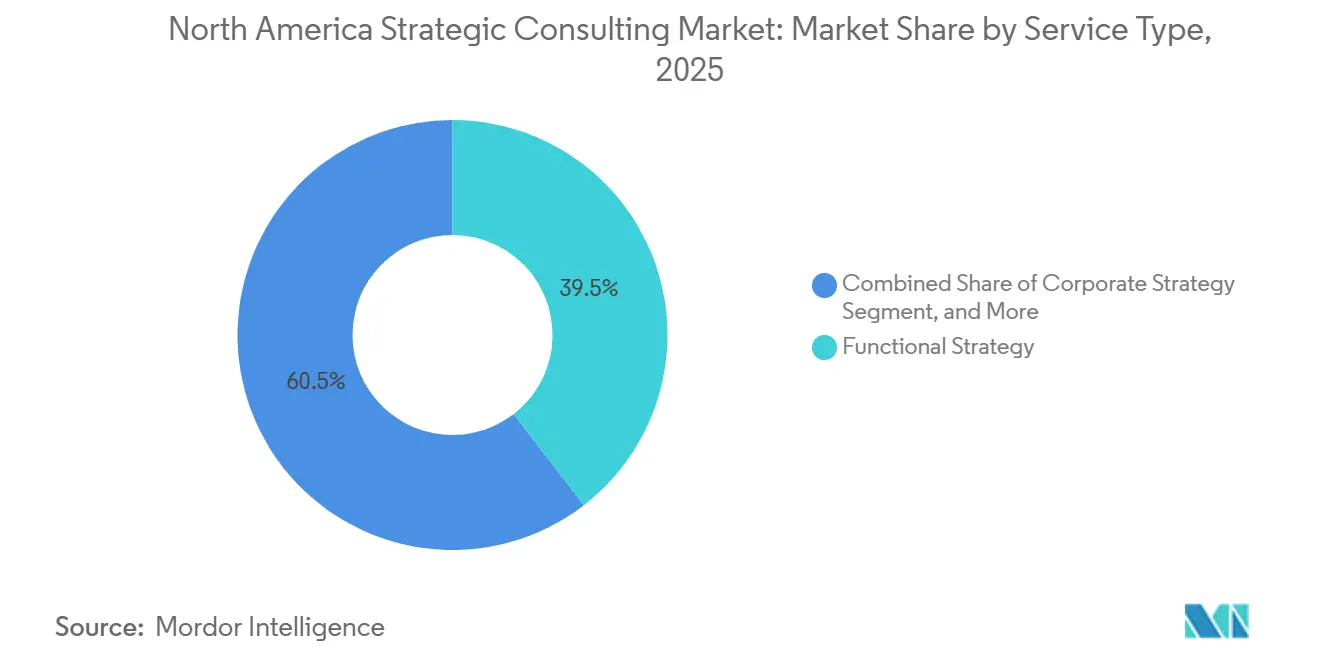
Digital Momentum Outpaces Legacy Functional WorkThe functional strategy accounted for 39.53% of the North America strategic consulting market size in 2025, driven by human-resources redesign and supply-chain resilience mandates. Digital strategy and innovation, however, posts the swiftest 4.65% CAGR thanks to enterprise urgency around artificial intelligence deployment. Clients acknowledge that 65% of firms piloted generative AI yet only 22% scaled it, so advisors who can bridge experimentation and production enjoy pricing latitude. Functional advisory retains scale for cost-takeout programs, but digital teams now influence every redesign because cloud architectures and advanced analytics underpin modern process excellence. Corporate-strategy mandates still appear, but investors increasingly evaluate technology leverage when approving capital plans, blending digital imperatives into boardroom conversations. M&A advisory volumes fluctuate with macro conditions, supplying episodic upside yet exposing firms to rate-cycle volatility. Economic and policy engagements serve governments navigating infrastructure or trade reform, but procurement bureaucracy tempers expansion. In aggregate, digital’s rise signals that algorithmic capability eclipses classical economies-of-scale logic as the chief competitive weapon inside the North America strategic consulting market.
Second-order effects reinforce digital’s pull. Talent migration favors practices offering exposure to AI tool-building and data-science problems, thereby deepening capability gaps between digitally fluent consultancies and slower peers. Clients in life-sciences and financial services request dual-track projects that embed regulatory compliance into digital road maps, anchoring consultants for longer horizons. The North America strategic consulting market share held by functional advisory therefore slides gradually even as its absolute revenue grows, a testament to digital’s disproportionate contribution to incremental spend.

By Organization Size:
Democratizing Access To Executive InsightLarge enterprises represented 62.89% of 2025 revenue, securing multiyear transformation road maps that require board-level sign-off. Governance norms oblige external validation, sustaining engagement flow to global integrators. Yet small enterprises, defined here as firms below USD 50 million in annual revenue, are projected to expand their spend at a 4.86% CAGR, the fastest across size tiers. Cloud collaboration suites and AI-assisted research have slashed minimum project economics, letting boutiques win deals once considered too small. As a result, the North America strategic consulting market penetrates entrepreneurial segments earlier in company life cycles.
Medium enterprises exhibit hybrid patterns, purchasing discrete growth diagnostics while lacking budgets for continuous retainers. Price sensitivity pushes these clients toward outcome-linked contracts, accelerating experimentation across the market. Consultants respond by curating modular service catalogs that scale with client maturity, from market-entry blueprints to implementation playbooks. This staircase approach lengthens customer lifetime value while expanding addressable volume. Margins, however, compress when serving smaller clients because delivery costs do not fall linearly with project size, reinforcing the premium positioning of enterprise programs inside the North America strategic consulting industry.
By Engagement Model:
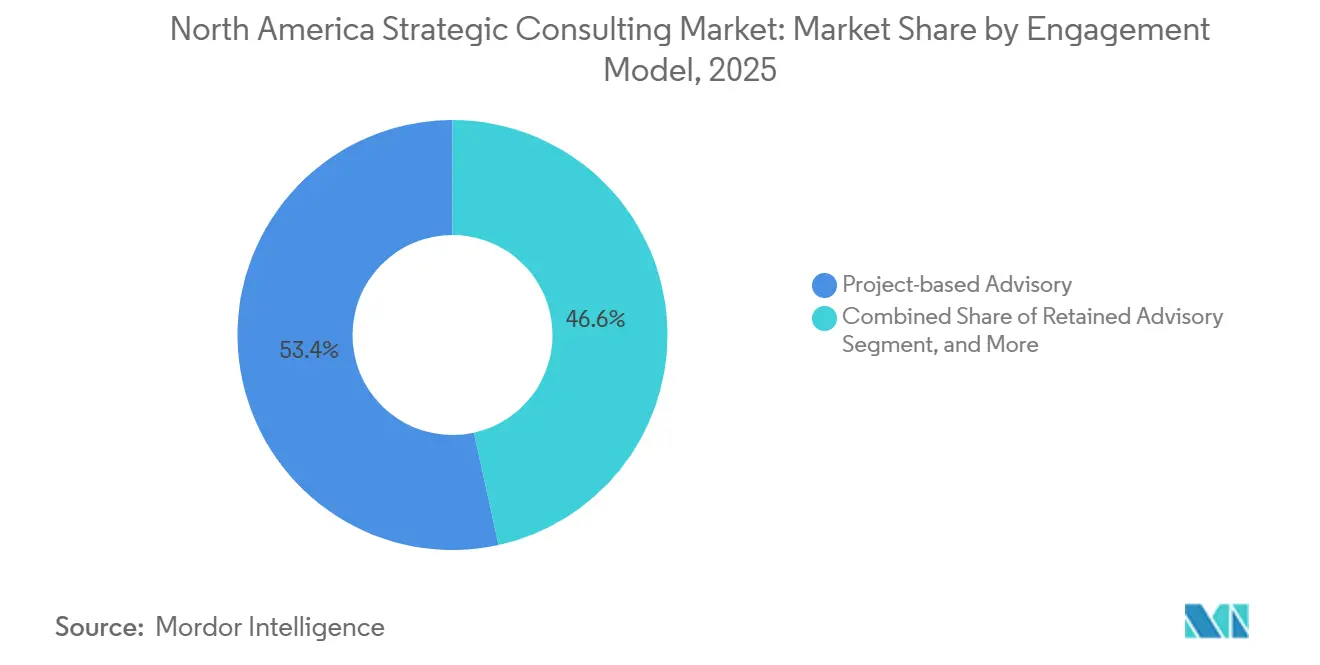
Risk-Sharing Becomes The New NormalProject-based work delivered 53.43% of revenue in 2025, offering clarity on scope, timeline, and cost. Procurement teams value fixed deliverables, yet boards increasingly question fees not tied to observable impact. Consequently, outcome-based consulting is advancing at 4.78% CAGR and threatens to overtake traditional projects in new contract volume by decade-end. The pivot demands stronger data baselines, rigorous value-tracking, and deeper client integration, reshaping consultant operating models.
Retainer arrangements persist, especially in private-equity portfolios that need constant oversight, but growth is muted. Managed-services variants, where consultants run transformation offices for years, gain favor among clients lacking execution bandwidth, although talent retention challenges constrain scale. Platform-enabled advisory reduces cost-to-serve via automated analytics, unlocking mid-market penetration yet sparking skepticism over context depth. Overall, the mix shift forces every provider inside the North America strategic consulting market to balance delivery-risk appetite with profitability.
By End-User Industry:
Life Sciences Becomes The Growth EngineFinancial services maintained a 28.92% revenue share in 2025 as banks, insurers, and asset managers contended with cybersecurity oversight and consolidation. Life sciences and healthcare, however, holds the highest forward CAGR at 5.32% through 2031, reflecting pharmaceutical M&A, gene-therapy regulation, and value-based reimbursement. Each theme demands bespoke insight into regulatory science and post-deal integration, capabilities that few in-house teams possess. Technology, media, and telecom contribute steady demand for platform monetization strategy, though major players increasingly internalize talent, tempering spend growth.
Energy and resources assignments grow around decarbonization road maps, yet project scope often centers on scenario analysis rather than multi-year implementation. Government consulting remains cyclical due to budget ceilings. Industrial and manufacturing engagements jump alongside nearshoring because footprint redesigns dictate supply-chain simulations, site labs, and workforce planning. As life sciences outpaces peers, its share of the North America strategic consulting market size could eclipse 15% by 2031 if the present deal pipeline closes as expected.
Geography Analysis
United States Strategic Consulting Market
The United States generated 80.42% of 2025 revenue, underlining its dominance within the North America strategic consulting market. Fortune 500 density, private-equity capital, and intricate regulatory demands ensure steady advisory volume. Technology clusters in California, Washington, and Texas feed digital-transformation mandates, while financial hubs in New York and North Carolina sustain compliance-oriented consulting. Competitive pressure is high; over 200,000 management consultants operate nationally, but specialization around sustainability strategy, artificial intelligence deployment, and sector-specific regulation allows new entrants to thrive.
Canada Strategic Consulting Market
Canada follows with measured expansion. Financial-services consolidation, resource-sector diversification, and federal infrastructure spending anchor demand. Bilingual delivery requirements and provincial policy fragmentation complicate project staffing, thus domestic firms with French-language teams hold a structural advantage. Canadian boards increasingly link executive incentives to environmental, social, and governance metrics, driving recurring mandates in carbon accounting and transition planning. Although smaller than its southern neighbor, Canada contributes stable, margin-accretive work because clients favor long-term partnerships once cultural fit is proven.
Mexico Strategic Consulting Market
Mexico is the region’s growth leader at a 5.41% CAGR through 2031, propelled by USD 40 billion of nearshoring-related foreign direct investment in 2024. Automotive, electronics, and medical-device makers relocating supply chains require counsel on industrial-park selection, supplier vetting, and trade-corridor optimization. Consulting capacity in Mexico remains nascent; therefore, global firms open local offices and blend on-site teams with offshore analytics hubs to manage cost. Talent scarcity presents a risk, yet first-mover advantage promises durable client relationships. The shift broadens the spatial footprint of the North America strategic consulting market, hedging providers against U.S. macro volatility while embedding them in resilient continental production networks.
Regulatory Landscape
North American strategic consulting demand is shaped by fast-moving telecom, data, and infrastructure rules that increase compliance complexity while supporting network modernization programs. In the United States, the Federal Communications Commission (FCC) adopted a Report and Order on March 26, 2026 (WC Docket Nos. 25-208 and 25-209) to consolidate technology-transitions discontinuance requirements, which lowers procedural friction for operators retiring legacy networks and shifts spend toward strategy, operating-model redesign, and execution governance.
Canada has continued to update technical and spectrum frameworks that affect digital and connectivity strategy programs for enterprises and service providers. Innovation, Science and Economic Development Canada (ISED) revised wireless equipment requirements for the 2300 MHz band on January 16, 2026 (RSS-195 and SRSP-516 updates), and issued a decision on May 14, 2026 to repurpose the lower 26 GHz band (24.25-26.5 GHz) for flexible use. These changes create new planning and investment cycles that often require external advisory support across spectrum strategy, network economics, and risk management.
Competitive Landscape
The North America strategic consulting market has a moderate concentration profile. Talent acquisition sits at the center of rivalry, with firms vying for experts in artificial intelligence, advanced analytics, and specialized regulation. High attrition challenges margins; many practitioners depart for technology vendors, private-equity operators, or corporate strategy roles promising better work-life equilibrium. Consulting firms respond by expanding recruitment beyond MBA pipelines to engineers, data scientists, and industry veterans, yet integrating heterogeneous talent pools strains culture cohesion.
Service innovation has become another battleground. Providers deploy proprietary large language models such as McKinsey Lilli or BCG generative-AI toolkits to speed hypothesis testing and deliverable drafting. Outcome-linked pricing further differentiates offerings but shifts risk onto consultants, compelling greater investment in change-management and implementation capabilities. Boutique specialists punch above their weight where deep domain expertise matters, such as sustainability mandates, policy navigation, or life-science regulation, forcing global integrators either to partner, acquire, or build niche teams organically.
Digital-native platforms also disrupt from below, automating research synthesis and democratizing strategy frameworks for small-enterprise consumers. While margins in that segment are thinner, volume growth attracts venture capital financing and pushes incumbents to develop low-touch productized services. The competitive outlook therefore balances consolidation at the top with fragmentation around niche and tech-enabled challengers, preserving client choice and driving continuous reinvention across the North America strategic consulting industry.
North America Strategic Consulting Industry Leaders
-
Accenture plc
-
A.T. Kearney Inc.
-
The Boston Consulting Group Inc.
-
Bain & Company Inc.
-
Deloitte Touche Tohmatsu Limited
- *Disclaimer: Major Players sorted in no particular order
North America Strategic Consulting Market Companies Covered in this Report
- Accenture plc
- A.T. Kearney Inc.
- McKinsey & Company Inc.
- The Boston Consulting Group Inc.
- Bain & Company Inc.
- Deloitte Touche Tohmatsu Limited
- PricewaterhouseCoopers International Limited
- Marsh & McLennan Companies Inc.
- Roland Berger GmbH
- KPMG International Limited
- Ernst & Young Global Limited
- Booz Allen Hamilton Holding Corporation
- Oliver Wyman Inc.
- L.E.K. Consulting LLC
- AlixPartners LLP
- Strategy&
- ZS Associates
- IBM Corporation (IBM Consulting)
- CGI Inc.
- Capgemini SE
Read Analysis of North America Strategic Consulting Companies
Market Opportunities and Future Outlook
A key opportunity sits at the intersection of AI infrastructure build-outs and enterprise operating-model change. Clients need support translating compute capacity into product, cost, and governance outcomes, particularly as firms move from experimentation to scaled delivery. Meta announced two large 2026 data center moves that reinforce this whitespace: breaking ground on a 1 GW AI-optimized facility in Sturgeon County, Alberta (its first data center in Canada), and expanding its Richland Parish, Louisiana campus to 5 GW with a stated total planned investment of USD 50 billion. These projects typically generate advisory needs around site and ecosystem strategy, utility and power-road-map coordination, vendor and supply-chain risk management, and benefits tracking under outcome-based commercial models.
Cloud consumption and sourcing transformation are also producing near-term work for strategic consultancies. Buyers are rebalancing managed services and XaaS portfolios around AI workloads, with Information Services Group (ISG) reporting that in Q1 2026 combined ACV for managed services and cloud-based XaaS in the Americas surpassed USD 20 billion (up 35% year over year), and that in Q2 2026 the Americas IaaS market ACV reached USD 13.2 billion (up 86%). The mix shift supports demand for vendor strategy, commercial negotiation support, data and model governance, and value-realization measurement, particularly as clients push consultants toward outcome-based or success-fee structures tied to measurable business impact.
Recent Industry Developments in North America Strategic Consulting Market
- June 2026: Bain & Company announced a partnership with Google Cloud to enable accelerated and secure enterprise-scale AI transformations. The tie-up connects Bain's strategy and implementation work with Google Cloud's AI stack, tightening the path from advisory to production deployments and reshaping competitive positioning for digital strategy and innovation engagements.
- April 2026: Deloitte Canada announced the acquisition of Tjene Corp., which specializes in integrated systems for real estate and infrastructure technology. The deal adds capabilities that support large-scale asset and infrastructure transformation programs, strengthening Deloitte's ability to deliver strategy-to-execution work in capital-intensive modernization initiatives.
- July 2024: Accenture completed its acquisition of Fibermind to strengthen fiber and mobile 5G network services. The acquisition expanded Accenture's network services footprint and supports strategic consulting mandates that combine telecom technology modernization with operating-model, cost, and growth strategy work.
North America Strategic Consulting Market Report Scope and Research Methodology
Market Definition and Coverage
For this report, the North America strategic consulting market is defined as revenues earned from advisory work that helps organizations set direction and make high-impact choices, including corporate strategy, transformation programs, and related strategic decision support delivered by consulting firms.
Scope exclusions: We exclude in-house corporate strategy teams and routine staffing or outsourcing work that is billed mainly as labor supply rather than strategic advisory.
Segments Covered in This Report
- By Service Type
- Corporate Strategy
- Business-Model Transformation
- M&A and Corporate Finance Strategy
- Digital Strategy and Innovation
- Functional Strategy (HR, SCM, etc.)
- Economic and Policy Advisory
- By Organization Size
- Large Enterprises
- Medium Enterprises
- Small Enterprises
- By Engagement Model
- Project-based Advisory
- Retained Advisory
- Managed / Implementation Services
- Outcome-based / Success-fee Consulting
- Digital / Platform-enabled Consulting
- By End-user Industry
- Financial Services
- Life Sciences and Healthcare
- Technology, Media and Telecom
- Energy and Resources
- Government and Public Sector
- Consumer and Retail
- Industrial and Manufacturing
- Other End-user Industries
- By Country
- United States
- Canada
- Mexico
Data Sources, Market Sizing, and Validation
Desk Research
Desk research helped us anchor the demand pool and the business environment that drives strategic consulting spend in the United States, Canada, and Mexico. We referenced public sources such as the US Bureau of Labor Statistics (professional services indicators), the US Bureau of Economic Analysis (industry value added), the US Census Bureau (business and services statistics), Statistics Canada (services activity and business counts), and OECD macro indicators to frame the baseline conditions.
We also reviewed company filings, investor presentations, and reputable press coverage to understand service mix shifts, delivery-model changes, and the pricing pressure typically seen in consulting renewals. For cross-checking client-side activity, we used public procurement portals and tender notices where strategy and advisory work is explicitly described, and we complemented this with a paid subscription for company financials and a contracts and tenders database when deeper context was needed. These are illustrative examples, and we used other sources as well to collect data, validate assumptions, and clarify the final analysis.
Primary Interviews and Surveys
Primary interviews and structured surveys were used to confirm what is truly counted as strategic consulting revenue and what is typically packaged under adjacent consulting lines. We spoke with consulting practitioners, independent advisors, and client-side strategy and procurement leaders across key end-user industries, and we tested assumptions on project sizing, utilization patterns, and pricing progression before finalizing the model.
Distribution of primary research fieldwork respondents
| Company type | Respondent position |
|---|---|
| Top tier: 33% | CXOs: 15% |
| Mid tier: 51% | Functional/Unit leaders: 26% |
| Smaller Players: 16% | Managers: 59% |
Market-Sizing & Forecasting
Sizing starts with a top-down build that reconstructs strategic consulting demand from professional services output signals and client spending intensity by industry, which are then allocated to North America and filtered to the strategy-focused scope. To keep totals realistic, we corroborated results with selective bottom-up approximations such as sampled engagement fees by project type, channel checks on retainer versus project mixes, and revenue density checks using public consulting revenue disclosures where available.
A few market fingerprints were treated as key inputs because they change revenue quickly and are typically discussed clearly in client conversations. These include the share of transformation programs within strategy work, the mix of M&A and corporate finance strategy activity, the pace of digital strategy and innovation mandates, average team sizes and utilization norms for senior staff, and the typical contract length and renewal behavior for retained advisory. Where bottom-up checks were thin in Canada or Mexico, gaps were handled using conservative ranges validated by interviews, followed by a country-level sanity check against business counts and services output.
Forecasts were built using scenario analysis tied to macro and corporate activity indicators, then adjusted based on expert feedback on pipeline visibility and budgeting cycles. We kept the forward view aligned with how clients budget, since strategy work is often approved in waves and then reprioritized when growth, cost, or deal conditions change.
Data Validation & Update Cycle
We run several cross-checks so the final number stays tied to observable signals, not just model math. Outputs are compared against independent indicators such as professional services growth, consulting hiring and utilization commentary, and procurement activity patterns, followed by variance checks at the country and service-scope level.
When an outlier shows up, assumptions are revisited and, if needed, interview follow-ups are triggered to confirm whether the change is real or a scope overlap artifact. Before sign-off, the model and write-up go through multi-step analyst reviews to ensure definitions, inputs, and calculations match the stated coverage. Reports are refreshed annually, and interim updates are made when material events occur, after which an analyst performs a fresh pass before delivery so clients receive the latest updated view.
Mordor Intelligence's North America Strategic Consulting Market Size Compared With Other Published Estimates
Published market values for strategic consulting in North America often diverge because different studies draw the line between strategy work and broader management or technology consulting in their own ways. Differences also come from the year used for the base value, the treatment of Canada and Mexico versus a US-only view, and how quickly assumptions are refreshed after changes in deal flow and transformation budgets.
Public procurement award patterns for advisory work and service-mix disclosures seen in consulting financial statements are two checks that help keep Mordor Intelligence's estimate aligned to strategy-led engagements, rather than counting wider implementation-heavy programs that sit outside this scope. Our interviews also indicated that pricing progression is not uniform across corporate strategy, business-model transformation, and economic and policy advisory, so a single blended uplift can move totals up or down depending on what each source includes.
Benchmark comparison
| Source | Market Size | Gaps in Research Methodology |
|---|---|---|
| Mordor Intelligence | USD 27.56 B (2025) | |
| Industry Association A | USD 31.80 B (2025) | Broader definition that tends to blend strategy with general management consulting, and it often captures a larger share of implementation-linked advisory billed under transformation programs. |
| Trade Journal B | USD 24.90 B (2024) | Uses an earlier base year and typically emphasizes mid and large firm revenues, which can undercount boutique strategy specialists and smaller advisory teams in Canada and Mexico. |
The table shows that most of the spread is explained by scope boundaries and the timing of the base year, not by a single modeling trick. By keeping service inclusions explicit, using country-level checks across the region, and validating pricing and mix through interviews, we aim to provide a number that can be traced back to clear assumptions and repeated in future updates.
Key Questions Answered in the Report
How large is the North America strategic consulting market in 2026?
It is valued at USD 28.34 billion and is on track to reach USD 34.26 billion by 2031.
Which service line is growing fastest?
Digital strategy and innovation consulting is forecast to post a 4.65% CAGR through 2031 as companies scale artificial intelligence initiatives.
Why is Mexico the fastest-growing geography for consulting demand?
Nearshoring has attracted USD 40 billion of foreign investment, prompting manufacturers to seek advisory on site selection, supplier networks, and trade-corridor design.
What engagement model is gaining favor with clients?
Outcome-based consulting, where fees align with measurable business results, is advancing at a 4.78% CAGR and reshaping risk-sharing norms.
Which end-user industry offers the highest future growth?
Life sciences and healthcare, supported by record pharmaceutical M&A and complex regulation, is projected to grow at a 5.32% CAGR to 2031.
How concentrated is the competitive landscape?
The top five firms control roughly 35% of revenue, giving the sector a moderate concentration score of 6.