
Market Overview
| Study Period | 2021 - 2031 |
|---|---|
| Forecast Data Period | 2026 - 2031 |
| Base Year Market Size (2025) | USD 70.25 Billion |
| Market Size (2026) | USD 72.81 Billion |
| Market Size (2031) | USD 87.02 Billion |
| Growth Rate (2026 - 2031) | 3.64 % |
| Market Concentration | Medium |
Major Players *Disclaimer: Major Players sorted in no particular order Image © Mordor Intelligence. Reuse requires attribution under CC BY 4.0. | |
North America Snack Food Market Analysis by Mordor Intelligence
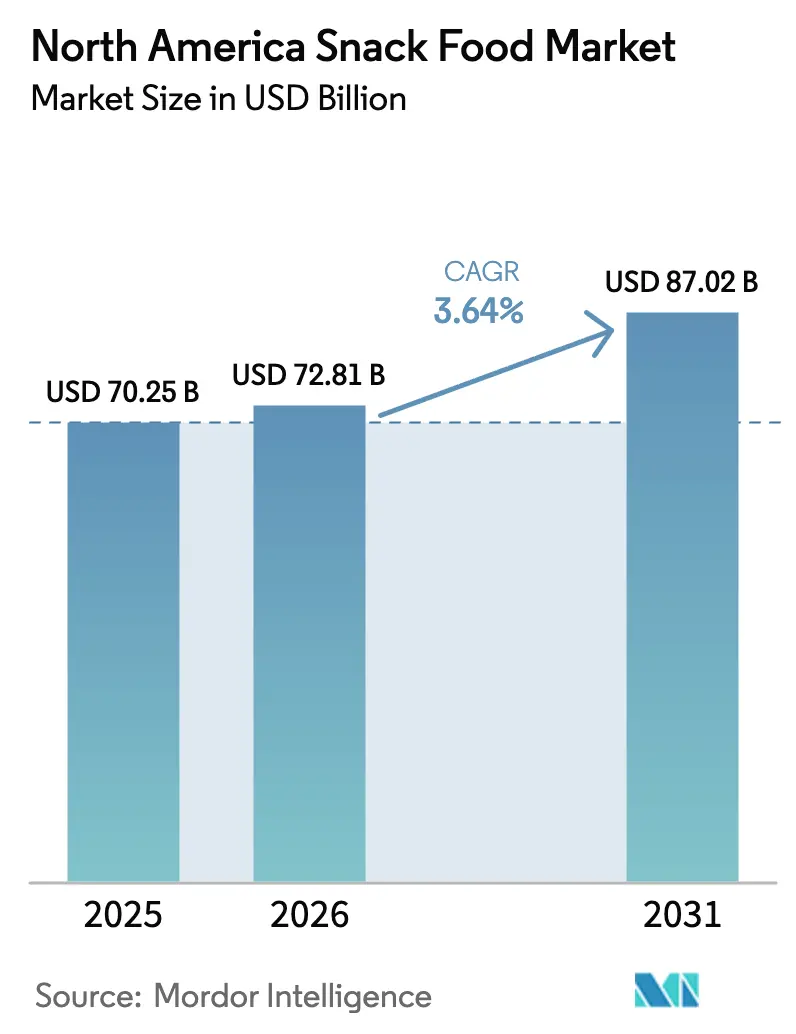
The North America snack food market size is expected to grow from USD 70.25 billion in 2025 to USD 72.81 billion in 2026 and is forecast to reach USD 87.02 billion by 2031 at 3.64% CAGR over 2026-2031. The market continues to expand as consumers increasingly rely on snacks for various purposes, such as quick breakfasts and meal replacements. This shift in consumer behavior is encouraging manufacturers to improve their product offerings and reformulate them to meet the growing demand for healthier options. There is a rising interest in snacks that provide indulgence without guilt, feature premium and unique flavors, and are made with sustainably sourced ingredients, all of which are driving the market's growth. Retailers are dedicating more shelf space to frozen snacks that are compatible with air fryers, reflecting the influence of air fryer popularity on product innovation. Regulatory changes introduced by the United States Food and Drug Administration (FDA), such as stricter guidelines for "healthy" claims and the removal of synthetic dyes, are pushing companies to innovate and adapt their products. While competition in the market remains moderate, recent mergers and acquisitions indicate that major players are expanding their operations to strengthen their distribution networks and maintain their pricing power in an evolving market landscape.
Key Report Takeaways
- By product type, savory snacks captured 32.12% of the North America snack food market share in 2025; frozen snacks are projected to expand at a 5.44% CAGR through 2031.
- By category, conventional products held 87.92% of the North America snack food market size in 2025, whereas organic/clean-label offerings are poised to grow at a 5.03% CAGR between 2026-2031.
- By packaging, bags/pouches commanded 54.78% revenue share of the North America snack food market size in 2025, while cans recorded the highest forecast CAGR at 4.32% to 2031.
- By distribution channel, supermarkets/hypermarkets accounted for 46.62% of the North America snack food market size in 2025, but online retail is expected to post a 6.38% CAGR through 2031.
- By country, the United States dominated with 81.35% of regional market share in 2025; Mexico is the fastest-growing country, advancing at a 5.72% CAGR to 2031.
Note: Market size and forecast figures in this report are generated using Mordor Intelligence’s proprietary estimation framework, updated with the latest available data and insights as of 2026.
Market Trends and Insights
Drivers Impact Analysis of North America Snack Food Market*
| DRIVER | (~) % IMPACT ON CAGR FORECAST | GEOGRAPHIC RELEVANCE | IMPACT TIMELINE |
|---|---|---|---|
| Rising demand for convenient and portable formats | +1.2% | North America-wide, strongest in urban centers | Medium term (2-4 years) |
| Increasing consumer preference for healthy snacking options | +0.8% | United States and Canada leading, Mexico following | Long term (≥ 4 years) |
| Innovation in flavors and gourmet premium products | +0.7% | United States premium markets, expanding to Canada | Short term (≤ 2 years) |
| Growing focus on sustainability and ethical sourcing | +0.6% | United States and Canada regulatory-driven, Mexico emerging | Long term (≥ 4 years) |
| Consumption trends among youth and Gen Z | +0.5% | Cross-regional, social media amplified | Medium term (2-4 years) |
| Preference for emotional and functional snacking | +0.3% | Urban North America, premium segments | Medium term (2-4 years) |
| Source: Mordor Intelligence | |||
Rising demand for convenient and portable formats
Snack foods are becoming increasingly important in North America as consumers look for convenient options to fit their busy and fast-paced lifestyles. With the United States employment rate at 95.8% as of June 2025, as per the Bureau of Labor Statistics, many people face time constraints that influence their eating habits[1]. According to the International Food Information Council (IFIC) Spotlight Survey 2024, 56% of Americans now replace traditional meals with snacks or smaller eating occasions, showing a clear shift in how people consume food[2]. To meet this growing demand, manufacturers are focusing on creating easy-to-carry and ready-to-eat options, such as single-serve pouches, resealable bags, and portion-controlled packs. For instance, Bumble Bee introduced its “Snack On The Run! Tuna Snackers” in early 2024, a protein-packed kit with flavored tuna and crackers that is perfect for eating on the go. These types of products demonstrate how brands are adapting to changing consumer habits by offering solutions, making snacking a more versatile option throughout the day.
Increasing consumer preference for healthy snacking options
Consumers in North America are increasingly choosing healthier snack options, driven by changing regulations and a stronger focus on nutrition. The Food and Drug Administration's updated definition of “healthy,” which will take effect in February 2028, imposes stricter limits on added sugars and sodium while requiring snacks to include key food groups. Manufacturers are modifying their recipes to meet these standards and market their products as healthy. According to the International Food Information Council (IFIC) Food and Health Survey 2024, 66% of Americans are trying to reduce their sugar intake, highlighting a growing awareness of ingredients[3]. Complementing this, a Pew Research Org report from May 2025 revealed that 52% of United States adults prioritize the healthiness of food when making dietary choices[4]. Younger consumers are showing a strong preference for snacks that offer functional benefits, such as fiber-enriched chips and immunity-boosting bites. The growing focus on health is expected to encourage companies to develop snacks that offer added health benefits.
Innovation in flavors and gourmet premium products
In North America, brands are focusing on creating unique flavors and premium products to attract more consumers. Social media trends are driving interest in bold and adventurous tastes, such as Korean barbecue-seasoned nuts, yuzu-pepper kettle chips, and matcha-flavored popcorn. For example, in May 2025, Oreo introduced Chocolate-Covered Pretzel Oreos, combining pretzel-flavored wafers, chocolate creme, and a hint of salt to offer a new twist on a classic snack. This product reflects the growing demand for sweet and savory combinations that feel indulgent yet unique. Innovation in healthier options is also gaining momentum. In August 2025, Fruitist launched Blueberry Snack Cups, which are single-serve packs designed for convenience, making them ideal for lunchboxes or on-the-go lifestyles. These products cater to consumers looking for snacks that balance health, convenience, and premium quality. These examples demonstrate how brands are reshaping the market by focusing on creative flavors and engaging storytelling to meet evolving consumer preferences.
Growing focus on sustainability and ethical sourcing
Snack brands in North America are increasingly focusing on sustainability and ethical sourcing to align with consumer expectations and comply with evolving regulations. In 2023, 68% of United States consumers expressed a willingness to pay more for environmentally friendly products, emphasizing the growing importance of these initiatives. Companies like Kellanova have pledged to make all their packaging reusable, recyclable by 2030 as part of their Better Days Promise. Similarly, PepsiCo’s pep+ initiative aims to ensure that 97% of its packaging is recyclable by 2030. Brands are working to build consumer trust by supporting regenerative farming practices, which help improve soil health and reduce carbon emissions. Efforts to tackle food waste are also gaining momentum, with companies like Spudsy using imperfect sweet potatoes to create snacks. These sustainability measures position companies to better handle future regulations, such as extended producer responsibility fees, which could require businesses to take more accountability for the environmental impact of their products.
Restraints Impact Analysis of North America Snack Food Market*
| RESTRAINT | (~) % IMPACT ON CAGR FORECAST | GEOGRAPHIC RELEVANCE | IMPACT TIMELINE |
|---|---|---|---|
| Concerns regarding the health impact of high salt and sugar levels | -0.4% | United States and Canada regulatory focus, Mexico emerging | Medium term (2-4 years) |
| Fierce price competition among private labels | -0.3% | North America-wide, intensifying during inflation | Short term (≤ 2 years) |
| Strict regulations regarding additives, labeling, and nutritional disclosures | -0.2% | United States Food and Drug Administration-driven, Canada following, Mexico developing | Long term (≥ 4 years) |
| Rising competition from fresh and unprocessed foods | -0.2% | Urban North America, health-conscious segments | Medium term (2-4 years) |
| Source: Mordor Intelligence | |||
Concerns regarding the health impact of high salt and sugar levels
In North America, increasing concerns about sodium and sugar levels are creating challenges for the snack food market. The Food and Drug Administration introduced Phase II voluntary sodium-reduction targets in August 2024, aiming for a 20% reduction in sodium across packaged foods within 3 years. The Food and Drug Administration's (FDA) updated definition of “healthy,” which will take effect in February 2028, imposes strict limits on added sugars, sodium, and saturated fats for products making health claims. Salt and sugar play important roles in texture and shelf life, making it difficult and expensive to find natural alternatives. To address this, companies are gradually reducing sodium and sugar levels while introducing reformulated products. For example, in November 2023, PepsiCo announced a 15% sodium reduction in its Lay’s Classic Potato Chips, lowering sodium to about 140 mg per 28 g serving. These efforts show how manufacturers are trying to meet regulatory requirements and consumer expectations.
Strict regulations regarding additives, labeling, and nutritional disclosures
Rules around additives, labeling, and nutritional information are becoming a growing challenge for snack food manufacturers in North America. In April 2025, the FDA announced plans to phase out six synthetic food dyes, including Red No. 3, by the end of 2026. This change is forcing companies to search for natural alternatives that can maintain the same product appearance, flavor, and stability without losing consumer trust. At the same time, Canada’s upcoming front-of-pack labeling rules, set to take effect in January 2026, will require warnings on products with high levels of sodium, sugar, and saturated fat[5]. These regulations are increasing production and compliance costs for manufacturers while also potentially discouraging health-conscious consumers from buying certain products. To adapt, companies are reformulating their products to meet these new standards while trying to preserve the taste and quality that customers expect. This balancing act is making innovation more complex in the market, as brands work to stay competitive and compliant with evolving regulations.
*Our forecasts treat driver/restraint impacts as directional, not additive. The impact forecasts reflect baseline growth, mix effects, and variable interactions.
North America Snack Food Market Segment Analysis
By Product Type:
Frozen Snacks Drive InnovationSavory snacks were the largest segment in the North America snack food market in 2025, making up 32.12% of the total market share. Their popularity comes from strong consumption habits, especially during sports events, movie nights, and social gatherings, where items like chips, popcorn, and pretzels are widely enjoyed. The variety of flavors, convenient packaging, and loyal customer base further strengthen their position in the market. Companies continue to depend on these products for large-scale sales but are under pressure to introduce new flavors and healthier options to keep consumers interested.
Frozen snacks are expected to grow the fastest, with a projected CAGR of 5.44% through 2031, which is more than double the overall market growth rate. This growth is driven by the demand for easy-to-prepare, ready-to-heat options that fit into busy lifestyles and different meal occasions. Meat snacks are also performing well, benefiting from their high-protein appeal and popularity among health-conscious and busy consumers. These trends are reshaping how manufacturers balance their product portfolios. While savory snacks remain a reliable source of revenue, companies are shifting their focus and investments toward faster-growing categories like frozen and protein-rich snacks.


By Category:
Clean-Label AccelerationIn 2025, conventional snacks led the North America market, holding 87.92% of the total market share. These snacks are popular because they are affordable, easy to find, and cater to the everyday preferences of consumers. They are widely available through supermarkets, convenience stores, and discount retailers, supported by strong distribution networks. Consumers rely on these familiar products, making them a regular part of their shopping habits. Even during periods of rising costs, people often choose these budget-friendly options, ensuring their consistent demand in the market.
On the other hand, clean-label snacks are growing quickly, with an expected 5.03% CAGR through 2031, nearly double the growth rate of conventional snacks. This growth is driven by consumers wanting transparency, simple ingredients, and products without artificial additives or preservatives. Brands that highlight claims like organic, non-genetically modified organism, or minimally processed are becoming more popular, especially among younger buyers who value trust and quality. This trend also aligns with stricter regulations and calls for better labeling. As a result, clean-label snacks are gaining a premium position in the market, pushing manufacturers to focus more on innovation and marketing in this segment.
By Packaging Type:
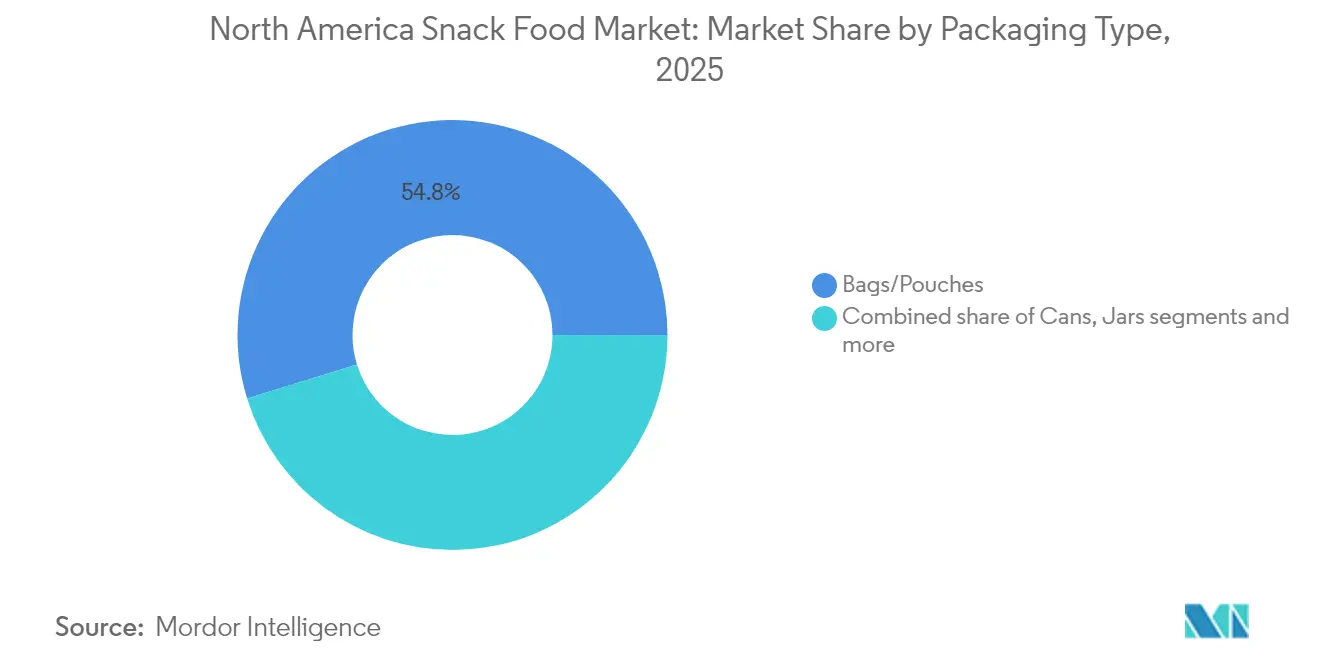
Digital Commerce Drives InnovationBags/pouches were the leading packaging type in the North America snack food market in 2025, accounting for 54.78% of total revenue. Their popularity stems from being cost-effective, lightweight, and easy to carry, making them a practical choice for consumers. Their design allows brands to use attractive graphics, which helps grab attention on store shelves. Features like resealable closures and portion-control sizes add convenience and help reduce food waste, appealing to busy consumers and families. These qualities make bags and pouches a preferred option for both everyday snacks and premium products, ensuring their strong presence across various retail channels.
Meanwhile, cans are expected to grow at the fastest rate, with a projected 4.32% CAGR through 2031. This packaging type is gaining traction, especially in online sales, due to its durability and premium appearance, which appeal to consumers looking for high-quality products. Cans also offer better protection for snacks and extend shelf life, making them ideal for items like seasoned nuts and gourmet popcorn. Their sturdy design reduces the risk of damage during shipping, which is a key advantage in e-commerce. With their combination of practicality and upscale appeal, cans are emerging as a strong alternative to traditional packaging, meeting the evolving preferences of modern consumers.
By Distribution Channel:
E-commerce TransformationSupermarkets/hypermarkets were the leading sales channels in the North America snack food market in 2025, contributing 46.62% of total revenue. These stores attract consumers by offering a wide variety of snacks, ranging from affordable options to premium brands, all in one location. Their strategic placement of snacks at checkout counters and frequent promotional offers encourage impulse buying. The convenience of weekly shopping trips and the trust consumers place in established retail chains make supermarkets and hypermarkets a preferred choice for snack purchases. Their ability to cater to diverse consumer needs ensures their continued dominance in the market.
Online retail is expected to grow at the fastest rate, with a projected 6.38% CAGR from 2026 to 2031. The convenience of home delivery, subscription services, and the ability to explore unique flavors and niche brands online are driving this growth. E-commerce platforms also use personalized recommendations and targeted promotions to engage consumers effectively. This makes online retail particularly appealing for premium and specialty snack brands, as well as direct-to-consumer offerings. While traditional retail remains essential for mass-market reach, the rapid expansion of online channels highlights a significant shift in consumer shopping behavior.
Geography Analysis
United States Snack Food Market
The United States leads the North America snack food market, contributing 81.35% of sales in 2025. High disposable incomes, widespread freezer ownership, and a strong snacking culture drive this dominance. The country also sets regulatory benchmarks, such as synthetic dye removal and front-of-pack nutrition labeling, which often influence neighboring markets. Major companies like PepsiCo utilize their scale and innovation capabilities, using insights from their Texas flavor center to develop cost-effective products across various snack categories. These factors make the United States a key player in shaping the region's snack food trends.
Mexico Snack Food Market
Mexico is the fastest-growing market in the region, with a projected CAGR of 5.72%. Urbanization and the adoption of Western eating habits are fueling this growth. Spicy snack flavors, such as chipotle-lime corn sticks, are particularly popular among younger consumers, blending traditional tastes with modern formats. The United States-Mexico-Canada Agreement (USMCA) trade agreement has simplified cross-border e-commerce, enabling United States brands to enter the Mexican market more easily. However, local companies like Monarca Authentic Snacks remain competitive, benefiting from integrated production facilities and a deep understanding of local preferences. Economic growth is also expanding the middle class, increasing demand for premium and clean-label snacks.
Canada Snack Food Market
Canada's snack food market is more mature, with a focus on premium and eco-friendly products. Retailers are dedicating specific shelf spaces to better-for-you snacks, making it easier for consumers to find healthier options. There is growing interest in sustainable products, such as upcycled snacks made from byproducts like brewery grains. Distribution in Canada relies heavily on brokers who navigate bilingual labeling requirements and provincial regulations. Smaller North American markets serve as testing grounds for new flavors and innovations, contributing incremental growth to the overall regional market.
Regulatory Landscape
Snack food manufacturers in North America face increasingly specific nutrition, labeling, and additive compliance requirements led by the United States Food and Drug Administration (FDA), with parallel rules in Canada. Key policy signals shaping formulation and claims include the FDA's Phase II voluntary sodium-reduction targets announced in August 2024, which frame a multi-year reformulation horizon. The FDA's updated definition of "healthy" for on-pack claims takes effect in February 2028 and tightens limits for added sugar and sodium, while requiring the presence of food-group components.
Additive and labeling changes are also shaping ingredient sourcing and packaging design. In April 2025, the FDA announced plans to phase out six synthetic food dyes by the end of 2026, pushing brands toward natural color systems and associated stability testing. In Canada, mandatory front-of-pack nutrition symbols take effect in January 2026 for products high in sodium, sugars, or saturated fat, which increases compliance complexity for companies selling across both the United States and Canada and drives additional SKU-by-SKU nutrition and pack redesign work.
Competitive Landscape
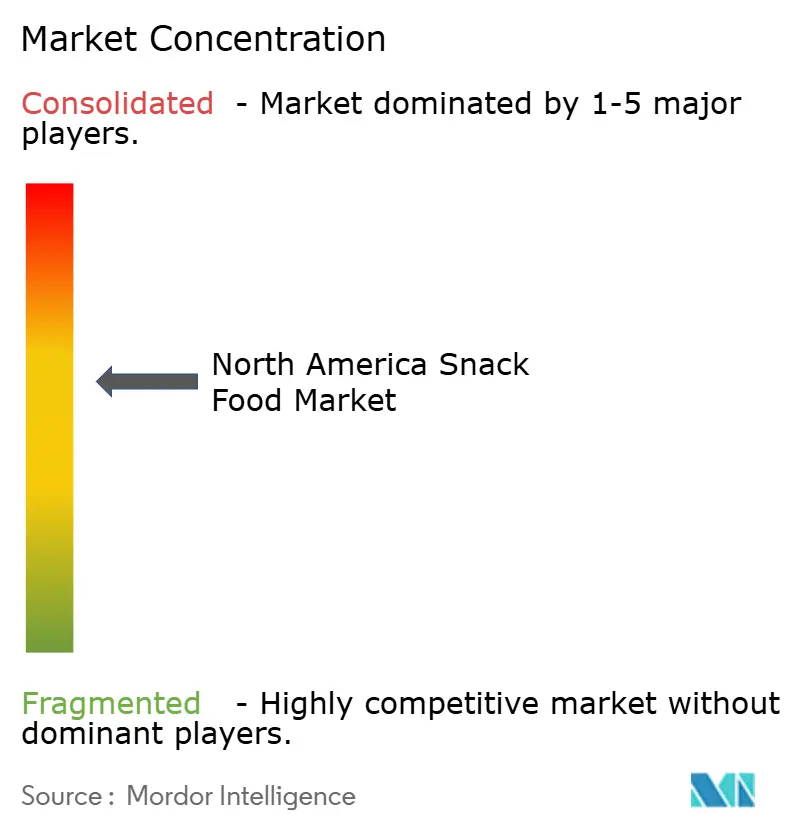
The North America snack food market is moderately consolidated and dominated by a few major players, with Mars, PepsiCo, Mondelez, Conagra Brands, and Hershey collectively accounting for about 60% of total sales in 2024. Mars expanded its portfolio by acquiring Kellanova’s snacking division for USD 35.9 billion, strengthening its presence in granola and plant-based snacks. Similarly, PepsiCo acquired Siete Foods for USD 1.2 billion, adding heritage-inspired tortilla chips to its Frito-Lay lineup to cater to health-conscious Hispanic consumers. These acquisitions highlight a trend where companies prefer to quickly fill gaps in their product offerings through strategic purchases rather than developing new products from scratch.
Smaller, emerging brands are making their mark by focusing on sustainability and health-focused products. For example, LesserEvil’s organic popcorn, made with coconut oil to reduce saturated fat, gained traction and was later acquired by Hershey, which provided the brand with broader distribution while maintaining its core values. Another example is UpSnack Brands, launched in January 2025, which combines heirloom corn-based snacks and sweet potato puffs, using digital marketing to grow its direct-to-consumer subscription model. Private equity investments are also driving growth, as mid-sized companies are being consolidated into larger, vertically integrated operations that share resources like logistics and marketing.
Technology is playing a significant role in shaping the strategies of snack food companies. Artificial intelligence is being used to predict consumer preferences, helping companies develop new flavors more quickly. Blockchain technology is being tested to track the origins of ingredients, such as peanuts, ensuring transparency and addressing concerns about allergies and sustainability. Automated packaging systems are enabling companies to produce limited-edition flavors efficiently, keeping consumers engaged with new offerings. Companies that effectively combine technological innovation with operational efficiency are better positioned to maintain their market share, while smaller players can still find opportunities by focusing on authenticity and unique product stories.
North America Snack Food Industry Leaders
-
PepsiCo Inc.
-
Mondelez International Inc.
-
Conagra Brands Inc.
-
Mars Inc.
-
The Hershey's Company
- *Disclaimer: Major Players sorted in no particular order
North America Snack Food Market Companies Covered in this Report
- PepsiCo Inc.
- Kellanova
- Mondelez International Inc.
- Nestlé SA
- General Mills Inc.
- The Campbell's Company
- Conagra Brands Inc.
- The Hershey's Company
- Utz Brands Holdings, LLC
- J&J Snack Foods Corp.
- Mars Inc.
- Grupo Bimbo SAB de CV
- Tyson Foods Inc.
- The Kraft Heinz Company
- Link Snacks Inc.
- Herr’s Foods Inc.
- McCain Foods Ltd.
- Calbee Inc.
- Our Home
- Nexus Capital Management (CK Snacks)
Market Opportunities and Future Outlook
Regulatory-driven reformulation and claim substantiation create opportunities for snacks that meet tighter nutrition thresholds while keeping convenience features, particularly as consumers use snacks as meal replacements. Companies are already acting on functional renovation and protein-led formats, including PepsiCo's 2026 launches across multiple protein snack platforms (such as Doritos Protein, Quaker Protein Rice Crisps, and PopCorners Protein). This aligns with demand for portion-controlled, protein-forward, better-for-you architectures that fit the FDA's upcoming "healthy" definition and Canada's front-of-pack nutrition symbol requirements.
On operations, investments in cold-chain and supply chain resilience support scaling frozen and refrigerated snack propositions and improving service levels across a channel mix that includes fast-growing online retail. Lineage's 2026 cold-chain insights highlight the role of temperature-controlled networks for refrigerated and frozen foods. Mars, Inc.'s commitment of USD 2 billion into United States manufacturing and supply chain expansion through the end of 2026 also points to continued capacity and logistics investment that can support higher-throughput, more complex product portfolios. Cross-border trade integration under USMCA remains a practical lever for brands expanding assortments in Mexico and Canada, especially where harmonized labeling and standards reduce rollout friction.
Recent Industry Developments in North America Snack Food Market
- May 2026: PepsiCo commences rollout of PopCorners Protein, expanding protein offerings across select retailers. The expansion supports the protein snack category and increases the company's presence across omnichannel channels, including key U.S. retailers.
- April 2026: PepsiCo releases Quaker Protein Rice Crisps with 6g protein and 9g whole grains per serving. The launch introduces a high protein, whole grain option to the core snack lineup and reinforces the company's healthy snack positioning.
- March 2026: PepsiCo launches Good Warrior, a new protein snack brand featuring beef sticks. The introduction diversifies the protein snack portfolio and tests new consumer segments within the protein category.
North America Snack Food Market Report Scope and Research Methodology
Market Definition and Coverage
For this study, the North America snack food market covers packaged snack products sold through retail and foodservice channels across the United States, Canada, Mexico, and the rest of North America, measured in value terms in USD.
Scope exclusions: Fresh, unpackaged snacks sold loose, and full meal replacements are excluded when they are not positioned and sold as snack items.
Segments Covered in This Report
- By Product Type
- Frozen Snacks
- Savory Snacks
- Fruit Snacks
- Confectionery Snacks
- Bakery Snacks
- Meat Snacks
- Other Types
- By Category
- Conventional
- Organic/Clean-Label
- By Packaging Type
- Bags/Pouches
- Jars
- Cans
- Others
- By Distribution Channel
- Supermarkets/Hypermarkets
- Convenience Stores
- Online Retail Stores
- Other Distribution Channels
- By Country
- United States
- Canada
- Mexico
- Rest of North America
Data Sources, Market Sizing, and Validation
Desk Research
Desk work starts by mapping what is sold as snack foods in North America and how it flows through key retail channels, and then matching that mapping to available public data series. We lean on sources such as USDA and Agriculture and Agri-Food Canada publications, US Census Bureau retail trade tables, Statistics Canada consumer price and retail sales tables, and UN Comtrade trade statistics to set guardrails on category direction and price movement.
To turn those guardrails into usable inputs, we also review company filings and investor presentations, association pages, and reputable business press to understand portfolio mix and packaging and distribution shifts. Where it helps close gaps, a paid subscription database is used for company financials and intelligence, another one for news and financials tracking, and an import and export shipment-level database for cross-checking trade-linked snack categories. These sources are illustrative only, and many other public documents and datasets were also consulted for collection, validation, and clarification.
Primary Interviews and Surveys
Primary work is used to sanity-check sizing logic and reduce guesswork in pricing, channel mix, and category boundaries, especially where public datasets group snacks with adjacent packaged foods. We speak with a mix of manufacturers, distributors, retailers, and category specialists across North America so assumptions on volume direction, promo intensity, and premiumization can be aligned with what is seen on the ground.
Distribution of primary research fieldwork respondents
| Company type | Respondent position |
|---|---|
| Top tier: 25% | CXOs: 14% |
| Mid tier: 60% | Functional/Unit leaders: 30% |
| Smaller Players: 15% | Managers: 56% |
Market-Sizing & Forecasting
Sizing is built using a top-down approach once, where household consumption patterns and retail sales direction are reconstructed into a value pool for packaged snacks, and then allocated across countries and major channels. The totals are then corroborated with selective bottom-up approximations, such as sampled price per pack times inferred movement by channel, and supplier and distributor roll-ups for key snack groupings, which helps adjust totals when a category looks overstated or undercounted.
Inputs are kept practical and repeatable, including snack category inflation and price pack architecture shifts, private label penetration trends, convenience store and club channel shares, organic and clean-label mix movement, and packaging format splits (like bags and pouches versus rigid packs). For forecasting, we mainly use scenario analysis supported by a light multivariate regression check, so growth can respond to expected pricing normalization, channel traffic, and consumer downtrading or premiumization signals that were confirmed in interviews. When bottom-up checks cannot cover smaller subcategories evenly, gaps are handled through proxy weighting using channel shares and documented category growth rates, and then re-tested with expert feedback.
Data Validation & Update Cycle
Model outputs are validated through triangulation across independent signals, including retail sales direction, trade flow indicators where relevant, and company-reported category commentary, before figures are finalized. Variance checks are run at the country and channel level, and any sharp jumps are reviewed for driver logic, currency timing, and the balance between price versus volume effects.
Before sign-off, the work goes through multi-step analyst review, and follow-up calls are triggered when an assumption moves the total meaningfully or conflicts with a primary input. Reports are refreshed annually, with interim updates when material events occur, and a final pre-delivery pass is completed so clients receive the most current view available.
Mordor Intelligence's North America Snack Food Market Size Compared With Other Published Estimates
Published market values for North America snack foods often do not match because the category lines are drawn differently, and because price and channel assumptions are refreshed at different times. Differences also come from whether the estimate is built from retail-only tracking versus a wider view that also considers multiple channels and country coverage.
In practice, the biggest gaps usually come from what is counted as snack foods (for example, whether certain bakery snacks, nutrition bars, or frozen snack items are included), how private label is treated, and whether values are reported in current dollars with updated inflation effects or smoothed through older average prices. Some publishers also annualize a short retail window and extend it across the full year, which can miss promotional swings, and that spread is visible when the scope includes the United States, Canada, Mexico, and the rest of North America with consistent currency timing, as modeled by Mordor Intelligence.
Benchmark comparison
| Source | Market Size | Gaps in Research Methodology |
|---|---|---|
| Mordor Intelligence | USD 70.25 B (2025) | |
| Trade Portal A | USD 51.70 B (2023) | Uses a broader snack aisle retail construct that is anchored to a single retail tracking window, and it is not a full North America market total across all snack categories and channels, so it understates the wider packaged snack value pool. |
| Digital Publisher B | USD 90.25 B (2024) | Applies a wider definition that likely folds adjacent packaged foods into snacks and uses a higher base-year value without clear separation of price inflation versus volume, which can push totals upward when premiumization is assumed uniformly. |
The table indicates that the spread is mainly explained by category and channel coverage, and then by how pricing is carried forward from the base year. Our approach keeps the steps traceable to a defined demand pool, checks it with channel and pricing signals, and then adjusts assumptions only when multiple inputs point in the same direction.
Key Questions Answered in the Report
What is the current value of the North America snack food market?
The market is valued at USD 72.81 billion in 2026, with expansion expected through 2031.
Which product category is growing fastest?
Frozen snacks lead growth, forecasting a 5.44% CAGR as air-fryer adoption broadens usage occasions.
How large is online retail within North American snack sales?
Online channels hold a smaller share today but are projected to post a 6.38% CAGR, the quickest among all routes to market.
Which country offers the highest growth potential?
Mexico outpaces its neighbors with a forecast 5.72% CAGR, fueled by rising incomes and Western flavor adoption.