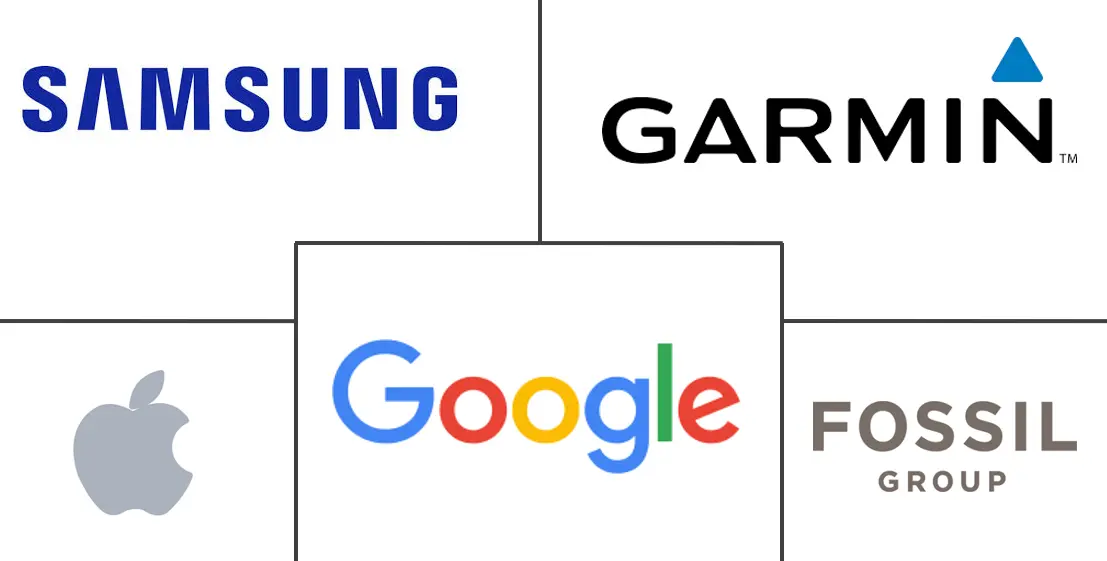
Top 5 North America Smart Watch Companies


Apple Inc.
Google LLC (Fitbit LLC)
Garmin Ltd.
Samsung Electronics Co., Ltd.
Fossil Group, Inc.
Source: Mordor Intelligence
North America Smart Watch Companies Matrix by Mordor Intelligence
Our comprehensive proprietary performance metrics of key North America Smart Watch players beyond traditional revenue and ranking measures
The MI Matrix can diverge from simple size rankings because it weights tangible ability to deliver in North America, not just unit volume. Device availability, carrier and retail reach, sensor validation, and software update cadence can push a brand up or down even when pricing is similar. A second driver is regulation, since FDA related clearances and enforcement actions can expand or shrink feature sets and channels quickly. Buyers often ask which smart watch brands offer regulated health features in the United States, and the answer depends on the exact function and clearance status. Many also ask whether Wear OS or watchOS will deliver better battery life, and the practical outcome usually depends more on hardware and on device AI efficiency than on OS branding alone. This MI Matrix by Mordor Intelligence is more useful for supplier and competitor evaluation than revenue tables because it ties position to execution signals that affect real deployments.
MI Competitive Matrix for North America Smart Watch
The MI Matrix benchmarks top North America Smart Watch Companies on dual axes of Impact and Execution Scale.
Analysis of North America Smart Watch Companies and Quadrants in the MI Competitive Matrix
Comprehensive positioning breakdown
Apple Inc.
Hypertension notifications and redesigned blood oxygen workflows keep health features at the center of the value story in North America. Apple remains a leading player because it pairs device hardware with deep OS level services, and it can respond quickly when US policy or court decisions change product behavior. FDA related clearance timing can still move launch windows, so planning needs slack even for this top brand. If employer reimbursement expands, Apple likely tightens partnerships with care pathways inside its Health app. The biggest operational risk is a repeat of feature interruptions tied to IP disputes or imports, which can disrupt channel confidence.
Google LLC (Fitbit LLC)
Loss of pulse detection FDA clearance signals an intent to compete on safety outcomes, not just steps and sleep scores. Google is a top brand for cross phone compatibility, yet its strategy still depends on consistent software support across Pixel Watch and Fitbit-tied services. If insurers widen reimbursement for remote monitoring, Fitbit style coaching could be packaged into employer programs with lower friction enrollment. The biggest downside is trust risk from account and data migration changes, which can slow upgrades in regulated workplace deployments. Innovation is strong, but it must translate into stable user experience at scale.
Garmin Ltd.
Record results and raised guidance in 2024 and 2025 suggest Garmin can keep funding a steady cadence of endurance focused watch updates. This leading producer in sport wearables differentiates through battery life, mapping, and training depth rather than phone like apps. If corporate wellness buyers shift toward verified performance metrics, Garmin can win more fleet deals with athletes and field staff. Regulatory exposure is lower than medical first brands, but privacy expectations still rise as more health insights are stored in apps. A key operational risk is tariff driven cost volatility, because hardware sourcing and demand cycles can swing quickly.
Samsung Electronics Co., Ltd.
FDA cleared irregular rhythm notifications helped Samsung strengthen credibility for heart sensing in the United States, which supports its premium positioning. Samsung is a major supplier in Android wearables, and it also points to external validation efforts that can reassure enterprise buyers who want repeatable sensor accuracy. If on-device AI features become a must have for battery efficient coaching, Samsung has a realistic path to pull more health workloads onto the watch. Privacy litigation risk remains meaningful because health data is central to differentiation and marketing. Execution can also be pressured when multi year OS support promises outpace hardware refresh cycles.
Withings SA
Predictive health updates for ScanWatch 2 show Withings is still leaning into science led differentiation in North America. Withings acts as a key supplier to hybrid health oriented buyers and can benefit when clinicians want long battery life with passive sensing rather than app heavy devices. If FDA cleared features expand for wrist based screening, Withings could accelerate partnerships with care teams using structured follow ups. The main risk is feature delivery timing and customer expectations when promised metrics arrive later than planned. Brand strength is real in medical adjacent circles, but channel scale remains a constraint.


Frequently Asked Questions
Which smart watch brands have the strongest health feature credibility in the United States?
Look for brands that reference FDA cleared functions for specific cardiac or safety features, not vague wellness claims. Also verify that the feature is active in the United States, not only in other regions.
What is the fastest way to screen a smart watch vendor for enterprise use?
Ask about software update commitments, repair turnaround time, and device management options. Then run a small pilot to measure battery life, sensor stability, and support responsiveness.
How should buyers think about eSIM and cellular capability?
Cellular models help when users leave phones behind, but they increase plan costs and can reduce battery life. Confirm carrier compatibility by country, since support can differ across the United States, Canada, and Mexico.
What privacy checks should HR and health teams require before rolling out watches?
Require clear controls for data sharing, retention, and employee consent in the companion app. Also confirm breach notification processes and audit trails for health data exports.
Are "non invasive" glucose readings from watches reliable today?
Avoid any watch that claims it can measure blood glucose directly without skin penetration. Use watches only to display readings from properly authorized glucose devices, if that workflow is supported.
What device traits matter most for remote monitoring programs?
Prioritize sensor consistency, long battery life, and simple onboarding for older users. Also ensure the vendor can support replacements quickly, since lost uptime breaks care workflows.


Methodology
Research approach and analytical framework
Inputs prioritize company press rooms, investor materials, and regulator or government sources, supported by reputable journalism. Private firms are scored using observable signals such as storefront availability, launch cadence, and update history. When precise segment financials are missing, indicators are triangulated from product and channel activity in North America. Scoring reflects only in scope signals and avoids global substitution when regional evidence is unclear.
Retail and carrier reach in the United States, Canada, and Mexico drives sell through and supportability.
Trust matters for health sensing and for employer or clinician recommended devices.
Relative device volume and ecosystem lock in shape bargaining power with channels and partners.
North America inventory, returns handling, and repair capacity determine real uptime for buyers.
New sensors, FDA related feature expansion, and on device AI since 2023 drive upgrade cycles.
Wearable segment momentum and guidance affect sustained software updates and roadmap delivery.