
Market Overview
| Study Period | 2020 - 2031 |
|---|---|
| Forecast Data Period | 2026 - 2031 |
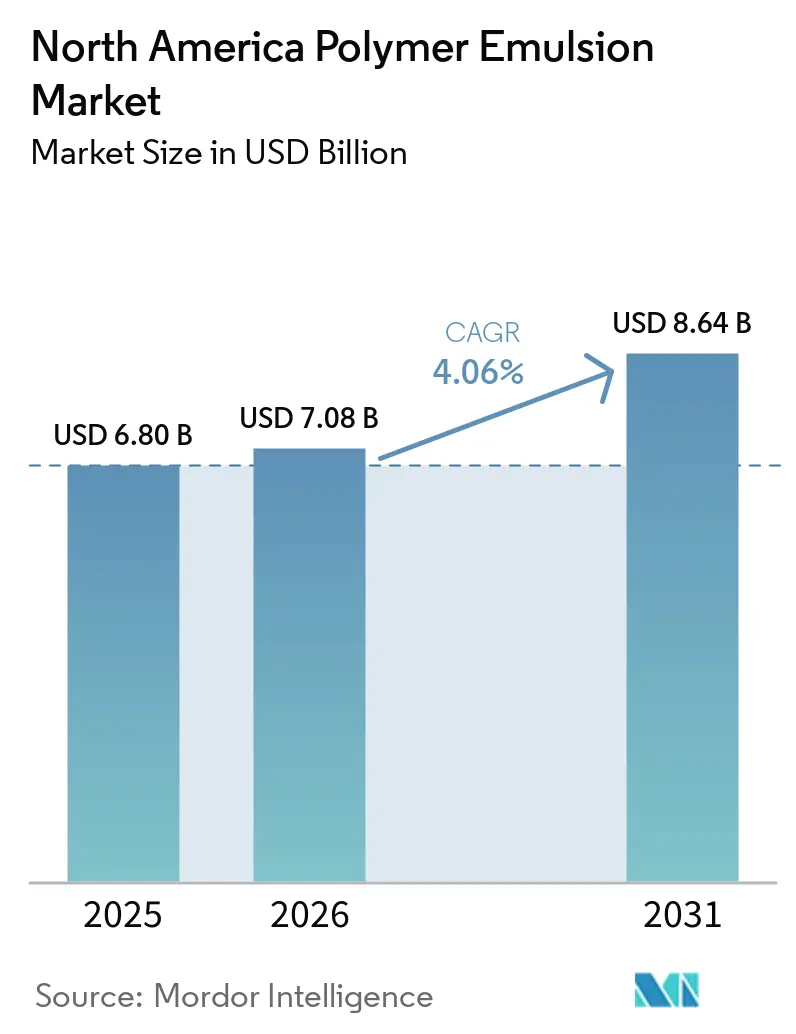
| Base Year Market Size (2025) | USD 6.80 Billion |
| Market Size (2026) | USD 7.08 Billion |
| Market Size (2031) | USD 8.64 Billion |
| Growth Rate (2026 - 2031) | 4.06 % |
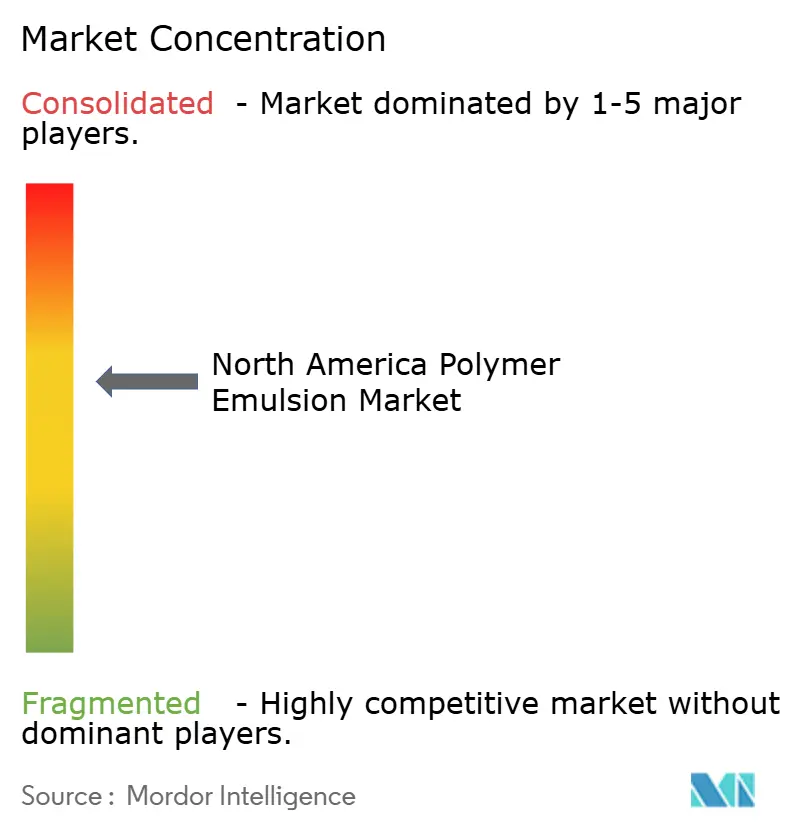
| Market Concentration | Medium |
Major Players *Disclaimer: Major Players sorted in no particular order Image © Mordor Intelligence. Reuse requires attribution under CC BY 4.0. | |
North America Polymer Emulsion Market Analysis by Mordor Intelligence
The North America Polymer Emulsion Market size was valued at USD 6.80 billion in 2025 and estimated to grow from USD 7.08 billion in 2026 to reach USD 8.64 billion by 2031, at a CAGR of 4.06% during the forecast period (2026-2031). Heightened sustainability mandates, infrastructure-related outlays, and steady residential maintenance cycles provide enduring volume support while pushing formulators toward water-borne systems. Tightening VOC thresholds, most notably California’s 50 g/l limit for select architectural coatings, accelerate the shift away from solvent-borne chemistries. Raw-material volatility and PFAS phase-outs create margin pressure but simultaneously trigger rapid innovation in bio-based acrylics and silicone-enabled additives. Against this backdrop, multinational producers scale up specialty dispersions, and mid-tier suppliers pursue capacity debottlenecking to serve premium packaging, automotive interiors, and infrastructure-grade admixture niches.
Key Report Takeaways
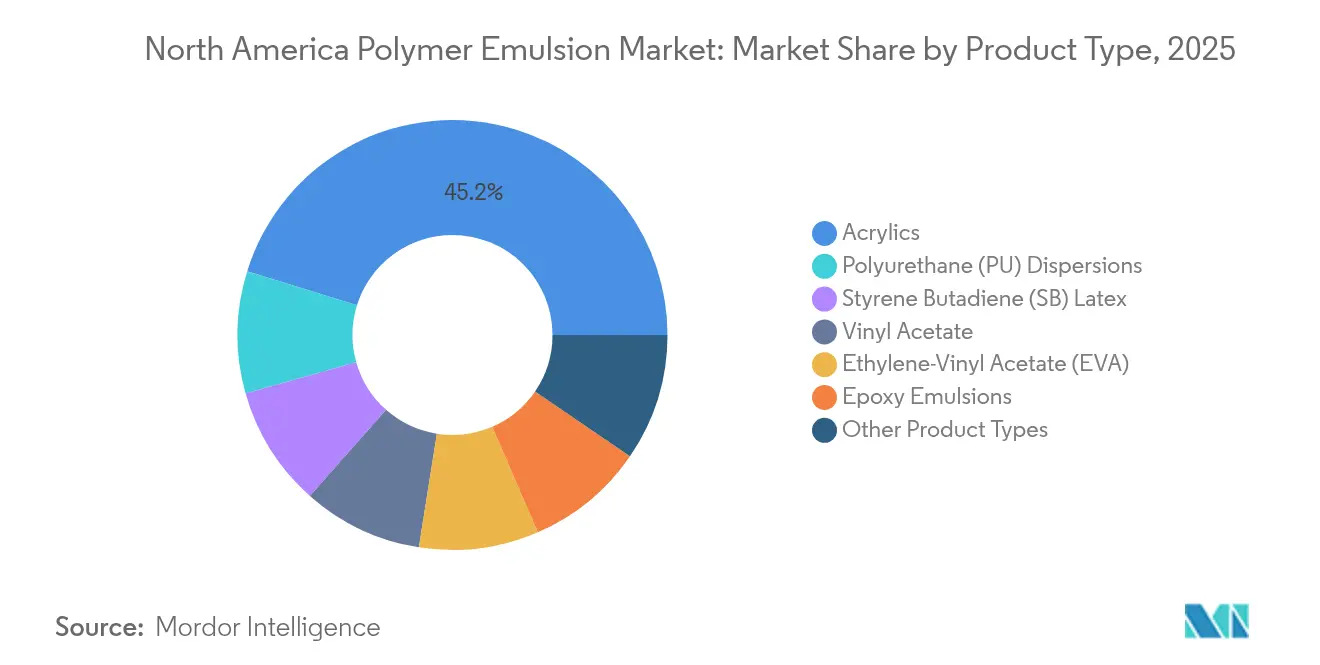
- By product type, acrylics led with 45.20% of the North America polymer emulsion market share in 2025, whereas polyurethane (PU) dispersions are projected to post the fastest 4.65% CAGR through 2031.
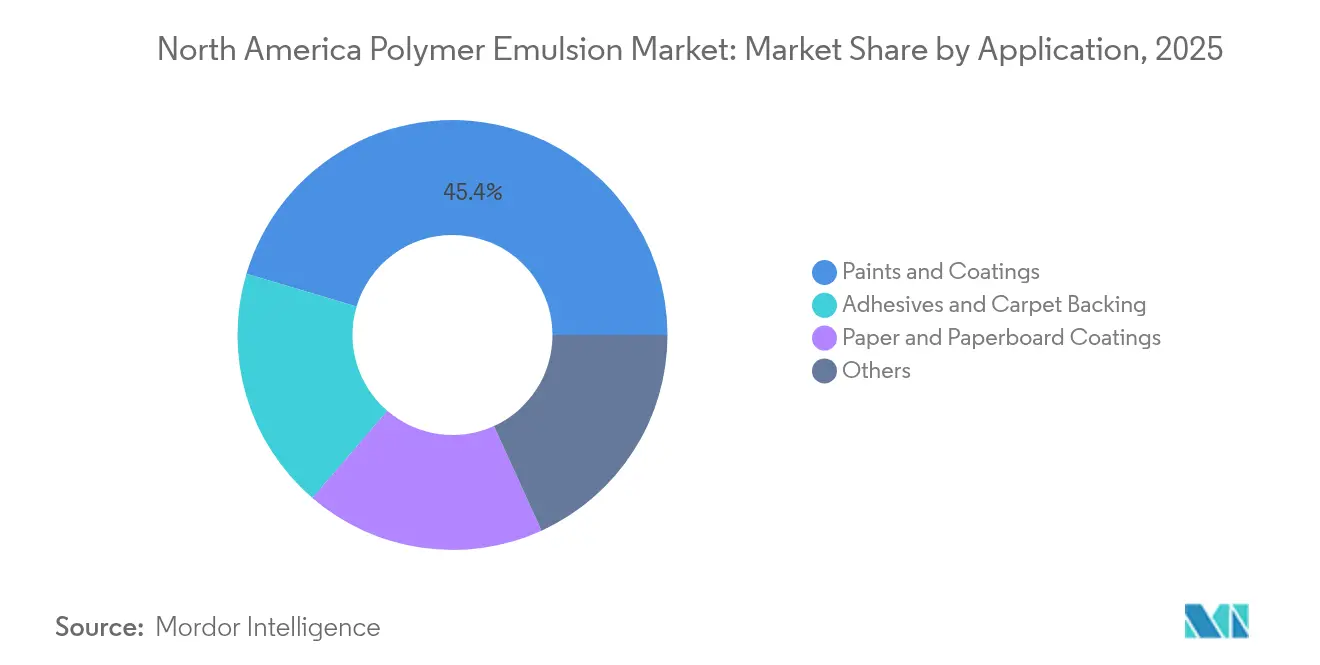
- By application, paints and coatings accounted for 45.40% of demand in 2025, while adhesives and carpet backing are set to expand at a 4.48% CAGR to 2031.
- By geography, the United States held 82.70% revenue stake in 2025 and is poised to grow at a 4.12% CAGR through 2031.
Note: Market size and forecast figures in this report are generated using Mordor Intelligence’s proprietary estimation framework, updated with the latest available data and insights as of 2026.
Market Trends and Insights
Drivers Impact Analysis of North America Polymer Emulsion Market*
| Drivers | (~) % Impact on CAGR Forecast | Geographic Relevance | Impact Timeline |
|---|---|---|---|
| Shift toward low-VOC water-borne systems | +1.2% | California, Northeast U.S. | Medium term (2-4 years) |
| Housing-led repaint demand | +0.8% | U.S. Sunbelt, Canadian urban cores | Short term (≤ 2 years) |
| Infrastructure-grade latex admixtures uptake | +0.7% | United States; spillover to Canada, Mexico | Long term (≥ 4 years) |
| E-commerce packaging adhesives boom | +0.6% | Logistics corridors across North America | Medium term (2-4 years) |
| Bio-based latex in premium architectural work | +0.4% | United States and Canada | Long term (≥ 4 years) |
| Source: Mordor Intelligence | |||
Shift Toward Low-VOC Water-Borne Systems
Stringent emission limits give water-borne dispersions a structural cost-of-compliance advantage over legacy solvent technologies. California’s 50 g/l VOC cap and parallel Canadian rules constrain formulators, pushing demand toward acrylic lattices and next-generation bio-acrylates with 40% certified renewable content that also cut cradle-to-gate carbon footprints by 30%[1]. Industrial coaters cite easier cleanup and safer indoor application as further incentives, ensuring the driver’s impact persists through at least mid-decade.
Housing-Led Repaint Demand in U.S. and Canada
Aging housing stock creates a maintenance cycle unlinked to new-build volatility. Sherwin-Williams raised domestic architectural coating prices by 5% in 2024 and still logged volume gains, underscoring end-market elasticity. North American single-family starts are set to rise another 5% in 2025, but repaint jobs—where higher-performance emulsions command premium pricing—drive the bulk of incremental gallons, especially in cold-climate provinces where freeze-thaw durability is prized.
Infrastructure-Grade Latex Admixtures Uptake
Federal stimulus channeled through the Infrastructure Investment and Jobs Act funded more than 56,000 transportation projects, lifting U.S. highway construction spending to USD 126 billion in 2024. Polymer-modified admixtures enhance asphalt crack resistance and concrete flexural strength, positioning latex suppliers for multi-year volume visibility. Sika’s construction chemicals unit already posted 12.8% sales growth on the back of these specifications.
Bio-Based Latex in Premium Architectural Coatings
Green-building certifications such as LEED reward lower-carbon materials, spurring demand for soy-based or CO₂-utilizing dispersions that emulate alkyd gloss while offering water cleanup. Celanese and partner mortar brands now integrate captured carbon into polymer backbones, creating marketable environmental product declarations and opening margin-rich specification channels in high-profile commercial builds.
Restraints Impact Analysis of North America Polymer Emulsion Market*
| Restraints | (~) % Impact on CAGR Forecast | Geographic Relevance | Impact Timeline |
|---|---|---|---|
| Volatile butadiene feedstock pricing | -0.9% | U.S. Gulf Coast; styrene-butadiene users | Short term (≤ 2 years) |
| Competition from powder and high-solids resins | -0.6% | U.S. Midwest, Canadian Prairies | Medium term (2-4 years) |
| Impending PFAS-linked additive restrictions | -0.4% | California, New York, New England | Long term (≥ 4 years) |
| Source: Mordor Intelligence | |||
Competition from Powder and High-Solids Resins
In appliance and metal-furniture lines, powder coatings offer zero-VOC quick-cure benefits, siphoning share from water-borne enamels. Wacker Chemie’s polymer division logged a 7% sales dip in 2024 despite higher volumes, underscoring price pressure as customers weigh total applied cost savings from powder and high-solids alternatives.
Impending PFAS-Linked Additive Restrictions
California’s finalized rulemaking eliminates key PFAS surfactants by 2026, compelling formulators to re-optimize stability packages. Leading producers have already pledged total PFAS exit by 2025, but smaller toll manufacturers may lack research and development bandwidth, limiting near-term supply flexibility.
*Our forecasts treat driver/restraint impacts as directional, not additive. The impact forecasts reflect baseline growth, mix effects, and variable interactions.
North America Polymer Emulsion Market Segment Analysis
By Product Type:
Acrylic Scale Meets PU AgilityAcrylics captured 45.20% of the North America polymer emulsion market share in 2025, reflecting balanced cost-performance and broad formulation latitude across decorative and light-industrial categories. Although pricing remains sensitive to acrylate monomer swings, scale economies and abundant supplier competition stabilize margins for top-tier producers. The segment’s mid-single-digit growth benefits from VOC compliance tailwinds and continuous tint base innovations that improve hide at lower film thickness.
Polyurethane dispersions represent the fastest-growing slice at a 4.65% CAGR, supported by rising demand for abrasion-resistant automotive interiors and flexible food wraps. High elongation and chemical-resistance profiles enable formulators to displace PVC plastisols in premium seat-cover substrates, while low-temperature heat-seal grades meet e-commerce packaging throughput targets. As capacity additions in North Carolina and the U.S. Midwest come online, the PU segment’s contribution to the North America polymer emulsion market size is forecast to widen steadily.

By Application:
Coatings Anchor, Adhesives AcceleratePaints and coatings consumed 45.40% of total polymer emulsions in 2025, securing a resilient demand floor for bulk acrylic and vinyl acetate grades. Repaint cycles, weather-resistant topcoats for infrastructure, and OEM refinish channels render coatings a dependable cash-flow engine, allowing suppliers to fund specialty dispersion research and development. Architectural brands emphasize washability and early-rain resistance, elevating opportunity for higher-solids binder platforms that preserve open time without cosolvent addition.
Adhesives and carpet backing form the fastest-moving application cohort, expanding at a projected 4.48% CAGR through 2031. Corrugators prefer water-borne lattices over starch to meet moisture-resistance test protocols of digitally printed boxes destined for grocery and meal-kit fulfilment. Carpet mills upgrade to low-odor SBR-acrylic hybrids capable of hot-water extraction stability, a requisite for premium hospitality specifications. Paper and paperboard coatings leverage latex to close porosity gaps, and the starch-to-latex ratio in blade coaters continues to inch upward, underpinning steady binder lifts even in flat publication-paper tonnage environments.
Geography Analysis
United States Polymer Emulsion Market
The United States polymer emulsion market is accounted for 82.70% of the North America polymer emulsion market size in 2025, underpinned by a USD 126 billion highway spend and 5% price hikes that paint manufacturers successfully passed through without demand erosion. Lubrizol’s USD 20 million acrylic expansion in North Carolina and BASF’s Louisiana MDI upgrade attest to the country’s ongoing reinvestment cycle in downstream water-borne technologies.
Canada Polymer Emulsion Market
Canada presents a smaller yet stable market, benefiting from regulations mirroring U.S. VOC limits and consistent renovation activity in Ontario and British Columbia. Federal retrofit incentives stimulate uptake of weather-capable exterior latexes, supporting mid-single-digit dispersion growth. While Dow postponed its Path2Zero ethylene project, local paint makers rely on cross-border feedstock flows, highlighting the integrative nature of the regional supply chain.
Mexico Polymer Emulsion Market
Mexico contributes incremental momentum as industrial coating, appliance, and automotive plants seek locally sourced coil-coating resins. AkzoNobel’s 35% capacity uplift in García underscores the near-shoring trend that positions Mexico as a manufacturing bridge between U.S. consumers and Latin American growth corridors.
Value Chain Analysis
The regional value chain starts upstream with petrochemical- and bio-derived feedstocks (acrylate monomers such as butyl acrylate and 2-ethylhexyl acrylate, vinyl acetate, butadiene and styrene), along with initiators, surfactants, defoamers, and rheology modifiers. These inputs are processed in emulsion polymerization assets, typically stainless-steel reactors with controlled dosing and temperature management, operated by integrated majors (for example, Dow, BASF, Arkema, Celanese, and Wacker Chemie) as well as specialists such as Mallard Creek Polymers, StanChem, Essential Polymers, and Wyn Polymers. Vertical integration into monomers and additives can reduce exposure to spot-market swings, while independent producers tend to manage risk through supplier diversification and contract sourcing.
Midstream, producers supply commodity and specialty dispersions across CASE value chains (coatings, adhesives, sealants, and elastomers), with finishing steps that typically include filtration, stabilization, and packaging into bulk, totes, and drums for shipment. Downstream, distribution runs through direct supply to large formulators and via chemical distributors to regional and niche formulators, with logistics and storage, including freeze-thaw stability and temperature-controlled warehousing where needed, shaping service levels. Demand and margins are influenced by bottlenecks tied to volatility in oil-linked monomers, notably butadiene for SBR latex, and by reformulation cycles tied to tightening additive constraints, including PFAS-related changes, which can shift customers toward higher-value, differentiated dispersions and additive packages that help maintain low-VOC performance targets.
Competitive Landscape
The North America polymer emulsion market is moderately fragmented. BASF, Dow, and Arkema exploit backward integration into monomers, enabling rapid formulation pivots when raw-material spreads widen. Scale allows these leaders to absorb compliance costs tied to PFAS exit and renewable feedstock adoption, then cascade learnings across global sites. Raw-material volatility and sustainability premiums spur deal activity. Arkema divested non-core solvent assets to bankroll bio-acrylate scale-up, while propylene tightness may accelerate alliances between monomer suppliers and downstream dispersers.
North America Polymer Emulsion Industry Leaders
-
Arkema
-
BASF
-
Celanese Corporation
-
Wacker Chemie AG
-
Dow
- *Disclaimer: Major Players sorted in no particular order
North America Polymer Emulsion Market Companies Covered in this Report
- 3M
- Akzo Nobel N.V.
- Allnex
- Arkema
- BASF
- Celanese Corporation
- Covestro AG
- DIC Corporation
- Dow
- H.B. Fuller Company
- Lubrizol
- Nouryon
- Syensqo
- SYNTHOMER PLC
- TRINSEO
- Wacker Chemie AG
Market Opportunities and Future Outlook
Water-borne substitution remains the clearest whitespace where regulation and customer specifications intersect, especially in architectural coatings and packaging adhesives that must meet low-odor and low-VOC targets without giving up scrub resistance, early rain resistance, or heat-seal performance. Recent product and capacity actions reinforce this direction for regional suppliers: Lubrizol announced a USD 20 million investment for acrylic emulsion capacity upgrades at its Gastonia, North Carolina facility (April 2024), and Wyn Polymers reported a new reactor startup that expands water-based polymer output by about 30% for the North American market (April 2026). This sits against a demand base anchored by paints and coatings (45.40% of 2025 demand), while adhesives and carpet backing represent the fastest-growing application cohort within the study scope.
A second opportunity area centers on compliance-driven reformulation toolsets, where additive and binder innovation reduces both the cost and the time needed to move customers to next-generation systems. Nouryon launched Alcosperse OTA-100 (April 2026) to support higher-performing low-odor, low-VOC architectural paints, and BASF introduced renewable-electricity-attributed acrylates from its Freeport, Texas site (March 2026), creating more lower-footprint options for downstream dispersions and binders. For suppliers, this raises the value of application labs and co-development with paint and adhesive formulators, along with commercialization of PFAS-free stability packages for states and provinces tightening VOC and additive constraints.
Recent Industry Developments in North America Polymer Emulsion Market
- July 2026: BASF expanded its certified biomass-balanced additives portfolio for architectural coatings. The launch improves access to lower-footprint formulation components used alongside polymer emulsions in water-borne paint systems, supporting customers working under tighter VOC and sustainability specifications.
- September 2025: Arkema and BASF partnered with AkzoNobel to supply lower carbon footprint, bio-attributed raw materials for superdurable architectural powder coatings. Although powder competes with some liquid coatings, the collaboration supports adoption of bio-attributed acrylic building blocks and changes procurement expectations for lower-carbon inputs across coatings value chains.
- April 2024: Lubrizol announced a USD 20 million investment to expand acrylic emulsion manufacturing capacity at its Gastonia, North Carolina facility, including upgrades to processing, storage, and packaging. The project increases regional supply availability for water-borne coatings binders and supports customers seeking domestic sourcing and shorter lead times.
North America Polymer Emulsion Market Report Scope and Research Methodology
Market Definition and Coverage
This market covers the value of polymer emulsions sold in North America for use in water-based formulations, mainly across paints and coatings, adhesives, paper coatings, and similar industrial and building uses.
Scope exclusions: This sizing excludes solvent-based resins and non-emulsion polymer formats, and it excludes downstream finished goods values beyond the polymer emulsion component.
Segments Covered in This Report
- By Product Type
- Acrylics
- Polyurethane (PU) Dispersions
- Styrene Butadiene (SB) Latex
- Vinyl Acetate
- Ethylene-Vinyl Acetate (EVA)
- Epoxy Emulsions
- Other Product Types
- By Application
- Adhesives and Carpet Backing
- Paper and Paperboard Coatings
- Paints and Coatings
- Others
- By Geography
- United States
- Canada
- Mexico
- Rest of North America
Data Sources, Market Sizing, and Validation
Desk Research
Desk work started by fixing the boundary of polymer emulsion chemistries and where they typically get consumed in North America, then mapping which demand indicators can be tracked consistently year to year. For this, we relied on public sources such as the US Census Bureau manufacturing and construction series, the US Geological Survey for materials context, Statistics Canada for industrial output signals, and the US International Trade Commission trade data, where import and export patterns helped sense-check supply availability.
To keep assumptions grounded, we also used sources such as EPA publications on coatings and chemical usage rules, and peer-reviewed journals that explain typical formulation shifts (for example, water-based adoption and VOC-driven changes). We reviewed company filings, investor presentations, association websites, and reputed trade press to confirm capacity additions, plant utilization commentary, and end-use mix. A paid subscription for company financials and intelligence, and a paid patent database, were used selectively to validate manufacturer footprints and innovation direction. This list is not exhaustive, because many other references were used for cross-checking and clarification.
Primary Interviews and Surveys
Primary interviews and short surveys were used to stress-test the split by polymer type and the demand pull from paints and coatings, adhesives, and paper coatings across the United States, Canada, Mexico, and the rest of the region. We spoke with a mix of producers, distributors, and downstream formulators, so pricing ranges, substitution behavior, and demand seasonality could be understood in operating terms. When desk signals looked inconsistent, we adjusted the assumptions accordingly.
Distribution of primary research fieldwork respondents
| Company type | Respondent position |
|---|---|
| Top tier: 33% | CXOs: 16% |
| Mid tier: 49% | Functional/Unit leaders: 33% |
| Smaller Players: 18% | Managers: 51% |
Market-Sizing & Forecasting
Sizing was built using top-down and bottom-up logic in one model. The top-down view reconstructs a North America demand pool from end-use activity and adoption of water-based binders, then cross-checks totals with selective supplier and channel approximations. In practice, we linked demand to indicators such as construction spending trends, architectural and industrial coatings output, adhesives consumption proxies in packaging and flooring, paper and paperboard coating activity, and typical price movement for key emulsion grades.
For the bottom-up checks, sampled pricing ranges were combined with volume patterns implied by end-use throughput, then we incorporated distributor feedback on mix shifts between acrylics, styrene-butadiene latex, vinyl acetate, polyurethane dispersions, and other emulsions. When a company or sub-region had limited public visibility, we filled the gap using peer-group ratios and validated those ratios through interviews, so the total stayed aligned with regional consumption signals. Forecasting leaned on scenario analysis, supported by a simple multivariate regression on the most stable drivers (construction and coatings activity, and relative price levels), with expert inputs used to keep adoption and substitution paths realistic.
Data Validation & Update Cycle
Outputs were triangulated across multiple checks, so no single data series drove the full answer. We reviewed large year-over-year jumps against known context, including capacity changes, feedstock swings, and demand shocks. Variance checks were run across polymer types and applications, then the logic was reviewed in steps by another analyst before sign-off, which helped catch unit issues and potential double counting.
Reports are refreshed annually, and interim updates are triggered when material events occur, such as major plant start-ups, shutdowns, or sharp pricing resets that change buying behavior. Before delivery, a final review pass is completed so clients receive the most current view based on the latest releases and re-contacts.
Mordor Intelligence's North America Polymer Emulsions Market Market Estimate Compared With Other Published Estimates
Published market sizes for North America polymer emulsions can look different even when the topic sounds the same, since each publisher makes its own calls on what chemistries to include, what year is treated as the base, and how pricing is averaged across grades and contracts. Differences also show up when a forecast relies on more aggressive construction and coatings assumptions versus a steadier mid-case view.
The table shows a spread versus the USD 6.80 B (2025) value, and in Mordor Intelligence's model the scope is kept to polymer emulsions sold into defined applications like paints and coatings, adhesives, and paper coatings across North America, rather than folding in adjacent non-emulsion polymer formats or broader downstream formulated product values.
Benchmark comparison
| Source | Market Size | Gaps in Research Methodology |
|---|---|---|
| Mordor Intelligence | USD 6.80 B (2025) | |
| Industry Research Publisher A | USD 7.46 B (2025) | Uses a wider definition that can blend emulsion polymers with adjacent categories, and it can apply a faster price and demand ramp into the forecast window, which lifts the starting value when back-calculated. |
| Market Data Publisher B | USD 10.66 B (2022) | Uses an earlier base year and may include a broader emulsion polymers basket with more downstream value capture, which makes the number less comparable to a pure polymer emulsion sales view for North America. |
Looking across the three figures, most of the gap comes from scope breadth, base-year alignment, and how average pricing is treated across grades and applications. By keeping the model tied to observable end-use activity and by re-checking assumptions through interviews, the estimate remains traceable to clear demand signals and repeatable steps.
Key Questions Answered in the Report
How large is the North America polymer emulsion market in 2026?
It stands at USD 7.08 billion, with a forecast to reach USD 8.64 billion by 2031.
Which product category holds the biggest slice of regional demand?
Acrylic emulsions lead, capturing 45.20% of 2025 sales thanks to broad architectural and industrial use.
What is the main growth driver through 2031?
Stricter VOC regulations, especially in California, accelerate migration toward low-emission water-borne systems.
Which application is expanding fastest?
Adhesives and carpet backing are projected to rise at a 4.48% CAGR as e-commerce packaging volumes surge.
Why is the United States so dominant?
It holds 82.70% share due to large-scale infrastructure spending, stringent environmental rules, and sizable housing stock.
How will PFAS restrictions influence suppliers?
Firms that commercialize PFAS-free surfactant packages and silicone-based alternatives are positioned to win share as bans tighten from 2026 onward.