
Market Overview
| Study Period | 2020 - 2031 |
|---|---|
| Forecast Data Period | 2026 - 2031 |
| Base Year Market Size (2025) | USD 11.67 Billion |
| Market Size (2026) | USD 12.07 Billion |
| Market Size (2031) | USD 14.29 Billion |
| Growth Rate (2026 - 2031) | 3.43 % |
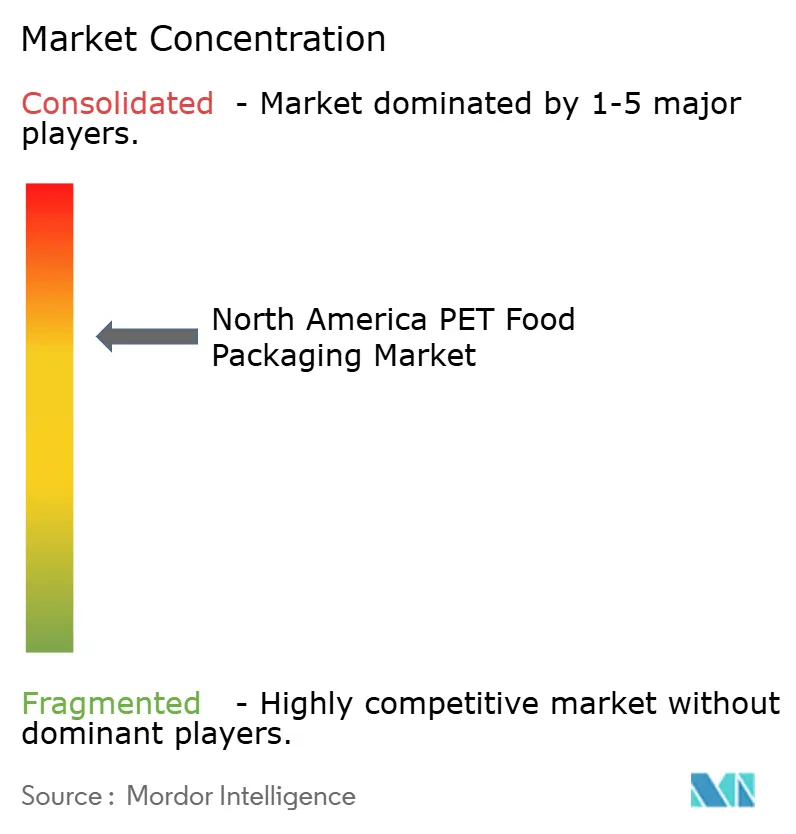
| Market Concentration | Medium |
Major Players *Disclaimer: Major Players sorted in no particular order Image © Mordor Intelligence. Reuse requires attribution under CC BY 4.0. | |
North America PET Food Packaging Market Analysis by Mordor Intelligence
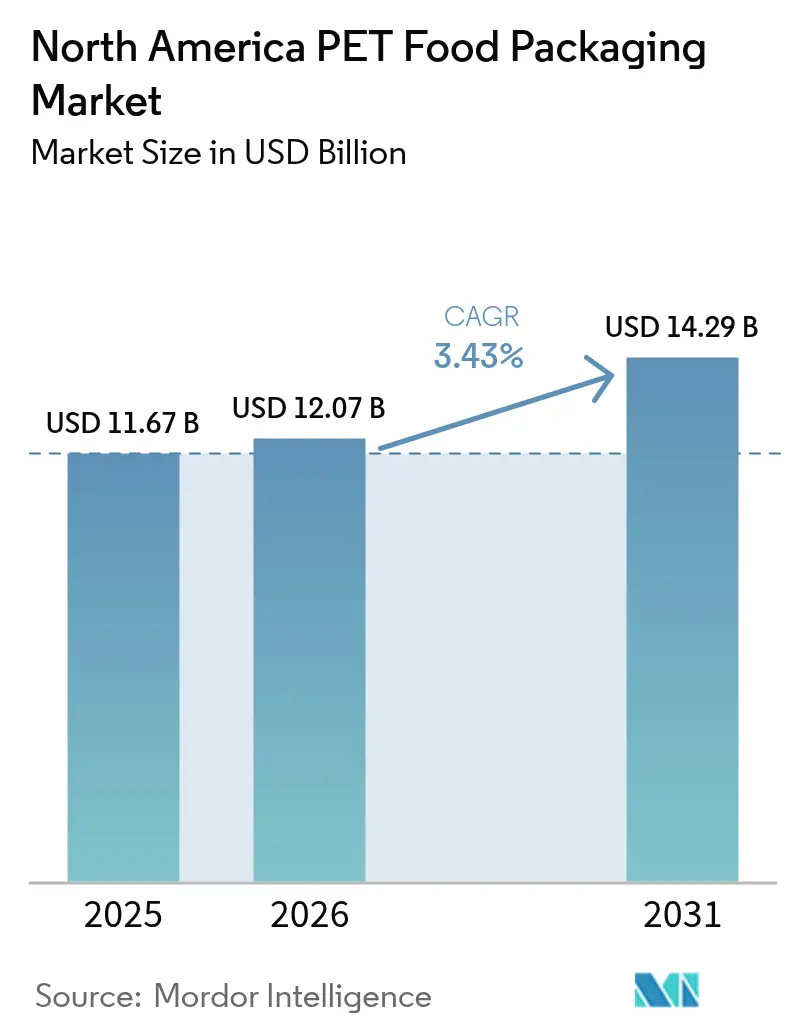
The North America pet food packaging market size in 2026 is estimated at USD 12.07 billion, growing from 2025 value of USD 11.67 billion with 2031 projections showing USD 14.29 billion, growing at 3.43% CAGR over 2026-2031. An upswing in pet ownership, premium dietary preferences, and regulatory nudges toward recyclability are shifting demand from commodity containers to high-value formats that balance barrier performance with sustainability. Millennial consumers favor resealable closures, clear windows, and lightweight constructions that fit e-commerce parcel dimensions, prompting brand owners to redesign primary and secondary packs for omnichannel distribution.[1] While plastic retains scale advantages, rapid material substitution toward paper, paperboard, and mono-material films reflects intensifying anti-plastics activism and emerging 30% recycled-content mandates. Concurrently, automation and smart sensors are raising throughput and traceability standards, enabling converters to offset labor constraints and meet retailer guidelines for in-line quality assurance.
Key Report Takeaways
- By material, plastic captured 55.62% of the North America pet food packaging market share in 2025.
- By product type, the North America pet food packaging market size for the pouches segment is projected to grow at a 5.59% CAGR between 2026-2031.
- By food type, dry food captured 53.55% of the North America pet food packaging market share in 2025.
- By pet animal type, the North America pet food packaging market size for the feline segment is projected to grow at a 3.9% CAGR between 2026-2031.
- By geography, the United States captured 59.70% of the North America pet food packaging market share in 2025.
Note: Market size and forecast figures in this report are generated using Mordor Intelligence’s proprietary estimation framework, updated with the latest available data and insights as of 2026.
North America PET Food Packaging Market Trends and Insights
Drivers Impact Analysis*
| Driver | (~) % Impact on CAGR Forecast | Geographic Relevance | Impact Timeline |
|---|---|---|---|
| Premiumisation of Grain-Free and High-Protein Formulae | +0.8% | United States and Canada metropolitan areas | Medium term (2-4 years) |
| Surge in E-Commerce Led Direct-to-Consumer Packaging Fulfilment | +0.9% | Core North America, spill-over to Mexico cities | Short term (≤ 2 years) |
| Lightweight Barrier Films Replacing Multilayer Metal Cans | +0.6% | United States and Canada premium segments | Long term (≥ 4 years) |
| Rising Disposable Incomes among Millennial Pet Parents | +0.7% | North American metropolitan areas | Medium term (2-4 years) |
| Deployment of Smart RFID-Enabled Freshness Sensors | +0.3% | United States and Canada premium channels | Long term (≥ 4 years) |
| Local Legislative Mandates on Post-Consumer Recycled Resin Content | +0.5% | United States state programs, Canadian provinces, emerging Mexico standards | Medium term (2-4 years) |
| Source: Mordor Intelligence | |||
Premiumisation of Grain-Free and High-Protein Formulae
Manufacturers marketing grain-free and protein-dense diets require ultra-low oxygen transmission rates to curb lipid oxidation, pushing demand for metallized polyethylene terephthalate and aluminum-oxide coated films that cost up to 20% more than standard laminations. Ingredient transparency surveys show 73% of pet parents under 35 read labels before purchase, encouraging clear windows, matte varnishes, and tactile elements that reinforce premium narratives. Resealable sliders and portion-control cups reduce feeding errors, supporting veterinary recommendations and minimizing waste. These enhancements lift average pack price but also elevate brand loyalty in a market where 42% of consumers switched labels after noticing packaging damage. The premiumisation driver therefore ties material science to lifestyle storytelling, boosting the North America pet food packaging market even in mature categories.
Surge in E-Commerce Led Direct-to-Consumer Packaging Fulfilment
Online penetration hit 23% of regional pet food sales in 2024, and parcel carriers now dictate drop-test and dimensional-weight thresholds that converge on sturdy, space-efficient designs.[2] Brands qualifying for Amazon’s Frustration-Free program remove outer cartons and shave 15-25% of total material, creating immediate cost-of-goods savings while slashing freight surcharges. Optimal cases of 12 x 9 x 6 inches for dry diets boost pallet fill to 88%, cutting transportation emissions and supporting corporate ESG targets. Subscription bundles embed tamper-evident pull tabs and scannable batch codes so automated inventory platforms can predict reorder cycles. These logistics-centric tweaks are central to the North America pet food packaging market, especially as last-mile economics shape pack geometry more than shelf presence.
Lightweight Barrier Films Replacing Multilayer Metal Cans
Retort-ready pouches employing aluminum-oxide coatings deliver water-vapor transmission rates under 0.1 g/m²/day, matching the shelf stability of cans while trimming pack weight by up to 60%. Flexible structures also cut warehouse footprint and reduce energy during sterilization because thinner walls accelerate heat penetration. Capital costs for retort lines, however, span USD 2-5 million, driving partnerships between brands and co-packers to de-risk investment. Early adopters positioned retort pouches as portion-friendly “spoon-free” meals, commanding 10-15% price premiums that consumers pay for convenience. As curbside recycling expands to accommodate mono-material high-barrier films, regulatory momentum will further tilt share away from metal, reshaping the North America pet food packaging market over the long term.
Rising Disposable Incomes among Millennial Pet Parents
Millennial households now account for 35% of regional pet ownership and spent USD 1,247 each on pet food in 2024, 40% above the Generation X average. This cohort values pack aesthetics, with 62% ranking resealability as a top attribute and 54% willing to pay more for recycled content. AAFCO’s Pet Food Label Modernization mandates larger nutrition panels, boosting primary pack real estate and indirectly favoring stand-up pouches over small cans because of the printable face area. High discretionary income supports rapid trial of novel formats such as freeze-dried toppers in rigid PET jars, each equipped with QR codes linking to farm-of-origin stories. These trends amplify premium pack-value capture and push converters to diversify machinery, sustaining the North America pet food packaging market growth during economic cycles.
Restraints Impact Analysis*
| Restraint | (~) % Impact on CAGR Forecast | Geographic Relevance | Impact Timeline |
|---|---|---|---|
| Volatility in Virgin Resin Prices | -0.4% | Global, acute in North America converters | Short term (≤ 2 years) |
| High Capital Outlay for Retort-Ready Pouch Lines | -0.3% | United States and Canada production hubs | Medium term (2-4 years) |
| Limited Curb-Side Recycling Infrastructure for Multi-Material Pouches | -0.2% | North America suburban and rural zones | Long term (≥ 4 years) |
| Growing Anti-Plastics Activism Targeting Pet Food Brands | -0.3% | United States and Canada consumer markets | Medium term (2-4 years) |
| Source: Mordor Intelligence | |||
Volatility in Virgin Resin Prices
Polyethylene and polypropylene quotes swung 25-40% during 2023-2024, compressing converter margins locked into fixed brand contracts.[3] To hedge, large suppliers carry 60-90 days of inventory, tying up working capital and crowding out R&D budgets. Food-grade recycled pellets trade at 15-20% above virgin when supply is tight, limiting substitution that could cushion volatility. Small and mid-sized plants without multi-year resin agreements face spot-price exposure that erodes competitiveness, nudging them toward consolidation. The resulting supply-base shake-up tempers the otherwise steady expansion of the North America pet food packaging market.
High Capital Outlay for Retort-Ready Pouch Lines
Achieving commercial sterility in flexible retort packs requires specialized sealing heads, overpressure vessels, and in-line vision systems, pushing initial investment beyond USD 2 million per line. Validation tests dictated by FDA Low-Acid Canned Food rules can add USD 500,000 before first sale, extending payback horizons to five years for mid-tier brands. Operator training demands augment payroll expenses, while downtime during installation disrupts supply contracts. As a result, only converters with deep pockets or high-volume commitments can participate, slowing format migration despite consumer appeal. This restraint caps wet-food pouch penetration and slightly drags on the North America pet food packaging market CAGR.
*Our forecasts treat driver/restraint impacts as directional, not additive. The impact forecasts reflect baseline growth, mix effects, and variable interactions.
Segment Analysis
By Material: Sustainability Pressures Recast the Plastic Core
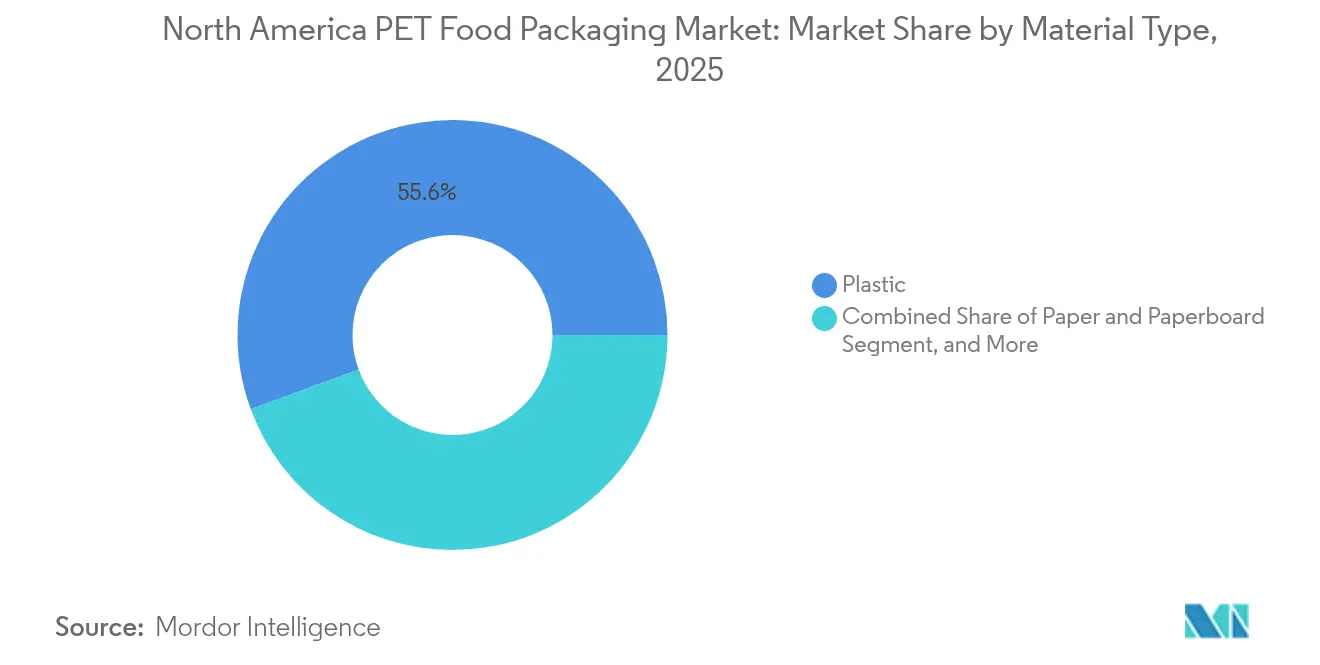
Plastic accounted for 55.62% of North America pet food packaging market share in 2025, but its dominance is edging down as paper and paperboard climb at a 4.44% CAGR to 2031. The transition is driven by state-level recycled-content bills and producer-responsibility fees that penalize multi-material laminates. Despite cost advantages, conventional polyethylene structures struggle to reach the 30% post-consumer resin threshold without compromising seal integrity, pushing converters toward engineered mono-material films. EPR schemes in California, Oregon, and New Jersey already levy variable tariffs based on recyclability, steering brand owners to substrate redesign.
Developers of water-based dispersion coatings are piloting paper packs that withstand 50 drop cycles and sustain moisture barrier ratings suited for dry kibble. For wet formulas, bio-based coatings blended with polyvinyl alcohol extend shelf life up to 12 months, creating credible alternatives to metallized film. The continuous ebb and flow between barrier performance and recyclability will redefine material value pools, yet plastic remains indispensable for retort closures and high-stiffness zipper profiles. As a result, hybrid solutions such as “recycle-ready” PE-PE laminates will anchor near-term volume, while fiber innovations chip away at longer-term share in the North America pet food packaging market.

By Product Type: Pouches Leapfrog Legacy Bags
Bags held 33.78% North America pet food packaging market share in 2025 thanks to cost-efficient rollstock and high-speed form-fill-seal lines. However, stand-up pouches are accelerating at a 5.59% CAGR, reflecting their ship-ready geometry, billboard branding area, and portion-friendly reclosability. Barrier enhancements have raised oxygen protection to rival that of thick-wall bags, enabling smaller SKU sizes without sacrificing shelf life. For wet entrées, spouted retort pouches support “tear-pour-serve” rituals that resonate with busy pet parents and cut aluminum inputs by half.
Rigid bottles cater to niche liquid treats and probiotic toppers, leveraging HDPE’s compatibility with high-viscosity fills. Folding cartons primarily aggregate single-serve packs for club-store channels, adding gift-worthy cues. Though cans remain synonymous with traditional wet food, 76% of surveyed millennials indicated a preference for lighter packs that they can reseal after partial feeding. In this context, pouches are poised to surpass bags in perceived value, cementing their position as the innovation epicenter of the North America pet food packaging market.
By Food Type: Wet Formulas Gain Hydration-Driven Momentum
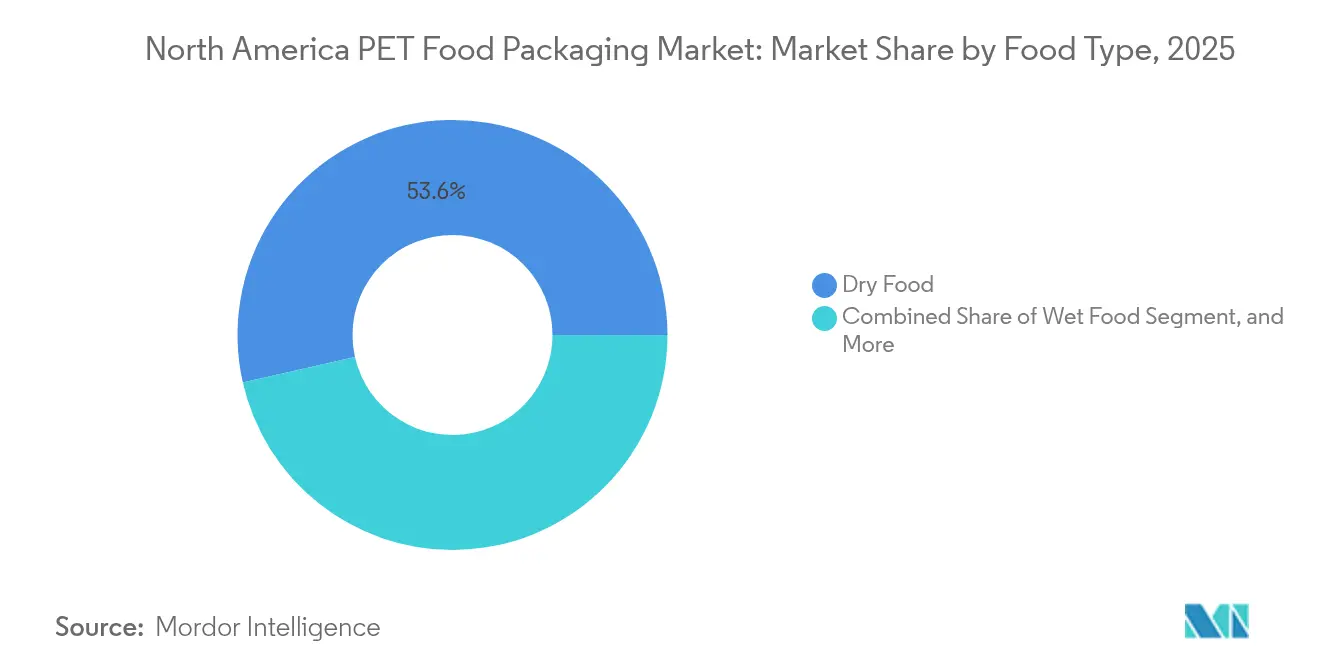
Dry diets continued to command 53.55% of the North America pet food packaging market size in 2025, yet wet recipes are advancing at a 3.96% CAGR as veterinarians highlight hydration and palatability benefits. Premium claim stacking human-grade meat, bone broth, and functional botanicals necessitate sterilization regimes that preserve nutrient integrity without retort-induced off-flavors. Thus, high-barrier pouches and aluminum trays are displacing steel cans, especially in urban markets where waste collection favors lightweight packs.
Hybrid freeze-dried and raw nuggets, though still below 5% share, call for nitrogen-flushed stand-up pouches with moisture scavengers that extend shelf life above 18 months. These cutting-edge formats capture double-digit price premiums while navigating complex cold-chain or ambient-shelf transitions. In parallel, dry kibble pack optimization targets higher fat diets, using EVOH layers to arrest rancidity. Collectively, format diversity tied to nutrition trends unlocks incremental value for converters across the North America pet food packaging market.
By Pet Animal Type: Cats Climb on Portion-Perfect Packs
Canine products delivered a 50.75% North America pet food packaging market share in 2025 because of larger feeding volumes. However, feline lines are rising at a 3.9% CAGR, propelled by smaller households adopting cats that demand high-protein single-serve portions. Cat owners gravitate to 70-gram pouches with tear-notch openings and easy-scrape interiors that curtail leftovers. Slim cans with foil-peel lids also cater to cats’ “fresh can every meal” rituals, but flexible packs now offer equivalent aroma retention with less metal.
Dog-food packaging innovations focus on reclosable sliders for 20-pound bags and measuring windows that guide portion control, supporting weight-management claims. Meanwhile, exotic species reptiles, birds, and small mammals drive micro-batch packaging with gas-barrier PET jars and child-safe caps. Each sub-segment challenges converters to balance run-length efficiency with SKU proliferation, sustaining overall momentum in the North America pet food packaging market.
Geography Analysis
The United States, representing 59.70% of North America pet food packaging market share in 2025, benefits from sophisticated e-commerce fulfillment, retailer recyclable-content scorecards, and per-capita spending that exceeds USD 250 annually. Federal Food Safety Modernization updates have introduced new current good manufacturing practice clauses that emphasize package integrity, nudging plants toward automated optical inspection. State-level recycled-content legislation adds cost but simultaneously rewards early adopters with shelf-tag recognition programs that attract eco-conscious buyers.
Canada’s adoption of extended producer responsibility widened in 2025, obligating brands to finance collection and sortation infrastructure. Provincial eco-fees vary by recyclability index; hence mono-material PE-PE laminates enjoy a 12% fee discount compared with foil-laminate stand-up pouches. Bilingual labeling statutes occupy up to 35% of printable area, favoring wider gusset or wrap-around formats. These dynamics encourage converters to maintain dedicated Canadian artwork teams and shorter press runs, slightly raising unit economics yet deepening strategic alignment with retailer packaging scorecards.
Mexico is the regional growth frontier, advancing at a 4.08% CAGR through 2031. Urbanization and disposable-income gains in Guadalajara and Monterrey spur premium pet food adoption, prompting local pack makers to install multi-lane pouch fillers that handle small grammage wet foods. ADM’s USD 33 million Guadalajara expansion triples output and integrates water-reuse systems that cut process effluent by 40%. Government moves to align with MERCOSUR food-contact protocols promote export agility, while pending recycled-content rules could accelerate film substitution, unlocking further upside for the North America pet food packaging market.
Regulatory Landscape
In the United States, pet food packaging is shaped by federal food safety and labeling requirements that affect package design and process validation. This includes FDA requirements for animal food labeling and the Low-Acid Canned Food framework (21 CFR 113), which drives process control, seal integrity, and documentation for thermally processed products. In parallel, sustainability compliance is increasingly handled through state-by-state Extended Producer Responsibility (EPR) and recycled-content rules, which adds compliance fragmentation for converters and brand owners across multiple states.
In Canada, packaging suitability and contamination prevention requirements for animal feed were refreshed through the Feeds Regulations, 2024 (SOR/DORS-132), while broader packaging safety expectations apply under the Safe Food for Canadians Regulations for prepackaged food containers. On sustainability timelines, 2026 EPR milestones provide more immediate compliance anchors, including Maryland’s Department of the Environment making its initial packaging EPR implementing regulations effective May 25, 2026, with a July 1, 2026 producer registration deadline. Washington’s Recycling Reform Act (SB 5284) similarly requires producers to join a producer responsibility organization or register individually by July 1, 2026, increasing the need for packaging-material data tracking and recyclability-aligned format choices.
Value Chain Analysis
The value chain starts with petrochemical and recycled resin suppliers, including food-grade post-consumer recycled streams, and specialty material providers such as coating and adhesive suppliers for high-barrier structures. Packaging converters then transform these inputs into bags, pouches, rigid plastic containers, cans, and folding cartons using extrusion, lamination, printing, and converting, with flexible-pack specialists such as ProAmpac and regional players including American Packaging Corporation, ePac Flexibles, Emmerson Packaging, Accredo Packaging, Lucid Corp, and Royal Interpack supplying recyclable and high-barrier formats for dry and wet pet foods.
Brand owners and co-packers set performance targets around barrier properties, retort compatibility, resealability, and e-commerce durability, and packaging is run on high-speed filling lines before distribution through retail, club, and direct-to-consumer channels. Parcel testing and retailer scorecards influence pack geometry and material selection. A cross-cutting layer is EPR compliance operations and data reporting, often coordinated through producer responsibility organizations such as Circular Action Alliance in applicable states, which links packaging selection directly to fee exposure via eco-modulated schedules and pushes SKU-level material reporting, redesign toward mono-material structures, and closer coordination between procurement, converters, and logistics partners.
Competitive Landscape
Amcor, Berry Global, Crown Holdings, and Silgan Holdings anchor a moderately concentrated field where the five largest suppliers account for about 68% of regional sales. Their investment cadence centers on high-throughput machinery, in-line vision tech, and closed-loop scrap recovery that cushions resin price swings. Berry Global, for instance, fitted its Iowa plant with smart conveyors that boost line speed 18% and cut unscheduled downtime by 9%, driving cost leadership in co-extruded films.
Mid-tier converters pursue niche value bio-based coatings, digital printing for short runs, or subscription-specific pack assortments to evade direct commodity confrontation. Hill’s Pet Nutrition’s USD 450 million Kansas plant exemplifies integrated scale; the site processes more than 1,000 cans per minute under AI-enhanced defect detection, reinforcing vertical alignment between brand owner and converter. Meanwhile, Hillenbrand’s buyout of Schenck Process Food and Performance Materials adds weigh-belt feeders and bulk-handling systems to its pet-food portfolio, broadening equipment ecosystems that surround primary packaging.
Emerging entrants emphasize sustainability storytelling with compostable films or post-consumer resin rates above 50%. Yet anti-plastics activism risks customer backlash if end-of-life claims prove unverifiable, compelling alliances with recycling start-ups to guarantee traceability. Overall, competitive differentiation hinges on balancing regulatory foresight, material innovation, and operational excellence each essential for capturing share in the evolving North America pet food packaging market.
North America PET Food Packaging Industry Leaders
-
Amcor PLC
-
American Packaging Corporation
-
ProAmpac Intermediate Inc.
-
Coveris Holdings SA
-
Crown Holdings Inc.
- *Disclaimer: Major Players sorted in no particular order
Market Opportunities and Future Outlook
State packaging EPR programs and recycled-content mandates are creating a more actionable opportunity for pet food packaging redesign aimed at reducing eco-modulated fees and simplifying end-of-life pathways. The clearest fit is around recycle-ready flexible formats that can replace complex multi-material laminates, while still meeting required barrier performance. Companies are responding with commercial offerings and certified material claims to support brand owners’ compliance reporting, including American Packaging Corporation expanding availability of ISCC PLUS certified circular-content resins and films for pet food applications across its Centers of Excellence (June 2026), which supports use of verified inputs across multiple pack formats.
Capacity additions and upstream investments in pet food manufacturing also support packaging pull-through, particularly where new lines favor high-speed flexible packaging and automated quality systems. Nestle Purina’s announcement for the August 2026 grand opening of its new USD 550 million pet food factory in Batavia, Ohio (May 2026), and The J.M. Smucker Co.’s USD 20.5 million investment in its Topeka, Kansas pet food operations (February 2026) point to active modernization where packaging specifications, line speeds, and sustainability targets are being reset. On the converter side, expansions directed at pouches and recycle-ready structures, such as American Packaging Corporation’s pouching-capacity expansion in Story City, Iowa (announced July 2025, completion targeted by September 2026), reinforce a near-term window for suppliers that can deliver mono-material, high-barrier, e-commerce-robust packs with documented recycled or certified-circular content.
Recent Industry Developments
- June 2026: American Packaging Corporation announced the availability of Certified-Circular Content resins and films for pet food applications across all six of its Centers of Excellence under ISCC PLUS certification. This expands procurement options for brands seeking verified circular inputs and standardizes material claims across multiple package formats and plants.
- April 2026: ProAmpac completed its USD 1.51 billion acquisition of TC Transcontinental Packaging, adding a large multi-site manufacturing footprint and workforce. The deal increases scale and capacity depth for flexible packaging programs, supporting larger pet food customers that want supply continuity and faster adoption of recyclable structures.
- April 2024: American Packaging Corporation introduced its RE Design for Recycle flexible packaging technology for pet food products, spanning treat pouches through large kibble bags. The launch gave brand owners a pathway to shift toward recycle-ready constructions without abandoning key shelf-life and durability requirements.
Research Methodology Framework and Report Scope
Market Definition and Coverage
This market covers the value of packaging used for commercially sold pet food in North America, counted at the packaging level across common pack formats and materials used to ship and sell finished pet food.
Scope exclusions: Packaging used for homemade feeding, non-food pet products (like litter), and packaging sold for general-purpose household storage are excluded.
Segmentation Overview
- By Material
- Plastic
- Paper and Paperboard
- Metal
- By Product Type
- Bags
- Pouches
- Plastic Bottles and Containers
- Metal Cans
- Folding Cartons
- Other Product Types
- By Food Type
- Dry Food
- Wet Food
- Other Food Type
- By Pet Animal Type
- Canine (Dog)
- Feline (Cat)
- Other Pet Animal Types
- By Geography
- United States
- Canada
- Mexico
Data Sources, Market Sizing, and Validation
Desk Research
Desk work starts with building the demand context for pet food packaging, then linking it to packaging consumption by format and material. We relied on public sources such as USDA economic and trade statistics, USITC trade data, U.S. Census Bureau manufacturing and business data, and EPA materials and recycling indicators, which helped confirm the direction of pack mix changes.
To keep assumptions grounded, we also reviewed supporting evidence from sources such as SEC filings and investor presentations from packaging and pet food value chain participants, packaging association publications, and reputable business press that tracks sustainability commitments and regulations. Where needed, we used paid subscriptions for company financials and intelligence, patent databases, and an import and export shipment-level database to sanity check activity levels and packaging-related exposure. The sources listed here are illustrative and not exhaustive, and many other references were used for data collection, validation, and clarification.
Primary Interviews and Surveys
Primary work focused on confirming what is really being shipped and how pack formats are changing, especially for dry food bags, wet food cans, and the growing use of pouches. We spoke with packaging converters, material suppliers, brand and co-manufacturing teams, and channel participants, and we kept discussions balanced across the United States, Canada, and Mexico to validate pricing logic, material substitution, and the timing of sustainability-driven changes.
Distribution of primary research fieldwork respondents
| Company type | Respondent position |
|---|---|
| Top tier: 32% | CXOs: 12% |
| Mid tier: 54% | Functional/Unit leaders: 28% |
| Smaller Players: 14% | Managers: 60% |
Market-Sizing & Forecasting
Sizing begins with a top-down reconstruction, where pet food output and consumption signals are translated into packaging demand pools, and then filtered by the pack formats typically used across dry, wet, and other food types. After building that total demand picture, we corroborated it with selective bottom-up checks, such as sampling format-level volumes and applying observed average selling price ranges, followed by supplier and channel checks to adjust any clear over or under counts.
The model uses practical inputs that are traceable and can be refreshed, including pet food category mix (dry versus wet), pack format penetration (bags, pouches, cans, cartons, bottles and containers), material intensity and down-gauging trends, recycled-content and recycle-ready shifts that affect material choice, and regional demand differences across the United States, Canada, and Mexico. When a variable could not be observed directly, we used interview-backed ranges and cross-checked against adjacent indicators, then tightened the assumption during analyst review.
For forecasting, scenario analysis was used to reflect how quickly format substitution and sustainability requirements move, and then the scenarios were anchored to consensus expectations from industry experts. Growth drivers were translated into year-by-year changes in pack mix, pricing, and material shifts, which then roll up into the final market value series.
Data Validation & Update Cycle
Validation is handled through multiple passes, where outputs are compared against independent signals such as pet food shipment trends, packaging material demand direction, and format adoption cues reported by industry sources. If an anomaly appears, such as an unusual price jump or an unrealistic format share change, we revisited the inputs and triggered follow-up conversations to confirm what changed and when.
Before sign-off, a separate analyst review is performed to check arithmetic integrity, unit consistency, and whether assumptions match what was heard in the primary discussions. Reports are refreshed annually, and interim updates are made when material events can shift pricing, regulation-driven material choices, or packaging format adoption. Before delivery, the full model and narrative are re-checked so the output reflects the latest updated view.
Mordor Intelligence's North America Pet Food Packaging Market Size Versus Other Published Estimates
It is normal to see different market values for pet food packaging because publishers do not always count the same pack formats, pricing layers, or geography detail. Differences also come from how quickly price changes are reflected and whether the model is tied to pet food consumption indicators or to packaging supply-side proxies.
The main gap comes from format and end-use inclusions. Mordor Intelligence counts packaging only when it is used for finished pet food sold in North America, and it does not add packaging for pet treats, supplements, or general food applications that can look similar in trade and materials data.
Benchmark comparison
| Source | Market Size | Gaps in Research Methodology |
|---|---|---|
| Mordor Intelligence | USD 11.67 B (2025) | |
| Industry Association A | USD 10.90 B (2025) | Often reflects a narrower set of counted pack formats, and the totals can lean toward packaging category shipments that undercount imported packaged pet food and some premium pouch penetration. |
| Trade Journal B | USD 13.10 B (2025) | May expand scope by blending pet food packaging with nearby flexible packaging lines, and it can apply a faster average price progression without tightening it against material mix shifts and down-gauging. |
The spread in published figures is mainly explained by what is included in the market boundary and how quickly resin, paper, and metal price movement is carried into average selling prices. By tying the total to clear demand signals, then pressure-testing it with format and material checks, the final number stays transparent and repeatable when new inputs are introduced.
Key Questions Answered in the Report
How large is the North America pet food packaging market in 2026?
The market is valued at USD 12.07 billion in 2026 and is projected to reach USD 14.29 billion by 2031, growing at a 3.43% CAGR.
Which package format is growing fastest in North America?
Stand-up pouches are the fastest, expanding at a 5.59% CAGR as brands pursue lightweight, resealable alternatives for both dry and wet foods.
Why is Mexico considered a high-growth region for pet food packaging?
Rising disposable incomes, urbanization, and investments like ADM’s new Guadalajara line support a 4.08% CAGR for Mexican demand.
What regulatory trends influence material choice in pet food packaging?
State recycled-content mandates, extended producer responsibility fees, and a pending 30% recycled-content federal bill are steering brands toward mono-material and PCR-rich substrates.
How are converters coping with volatile resin prices?
Large suppliers hedge via long-term contracts and scrap-recycling loops, while smaller firms explore post-consumer resin blends and joint purchasing cooperatives to cushion price swings.
What role does automation play in the competitive landscape?
High-speed vision systems, robotic palletizers, and RFID tracking like those in Hill’s Kansas plant elevate throughput and traceability, delivering cost and compliance advantages.