
North America Patient Care Monitoring Device Market Size and Share
Market Overview
| Study Period | 2020 - 2031 |
|---|---|
| Forecast Data Period | 2026 - 2031 |
| Base Year Market Size (2025) | USD 20.60 Billion |
| Market Size (2026) | USD 22.06 Billion |
| Market Size (2031) | USD 31.02 Billion |
| Growth Rate (2026 - 2031) | 7.07 % |
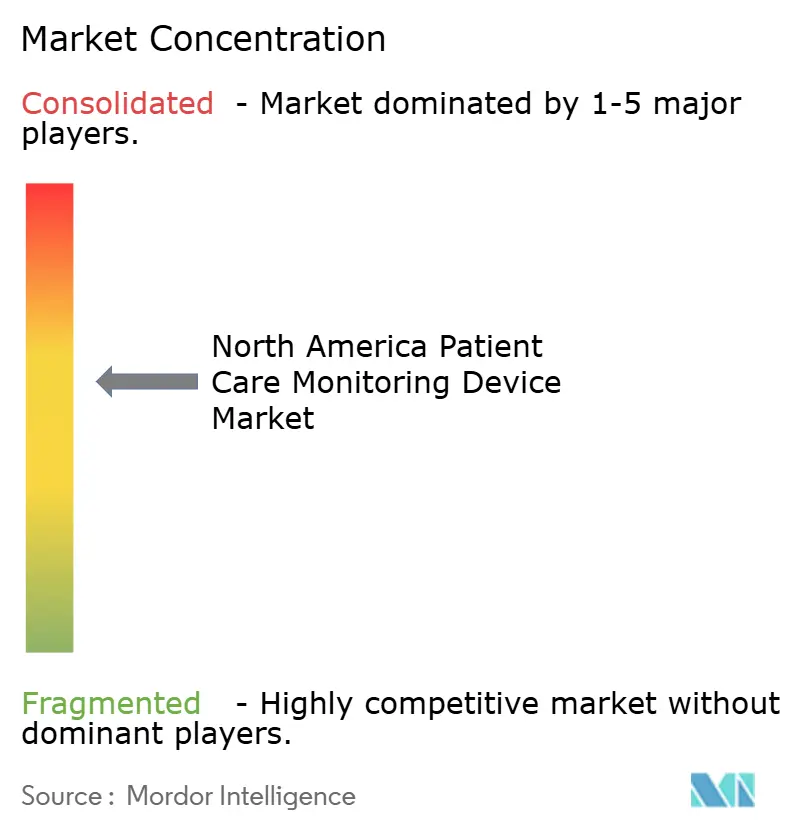
| Market Concentration | Medium |
Major Players *Disclaimer: Major Players sorted in no particular order Image © Mordor Intelligence. Reuse requires attribution under CC BY 4.0. | |
North America Patient Care Monitoring Device Market Analysis by Mordor Intelligence
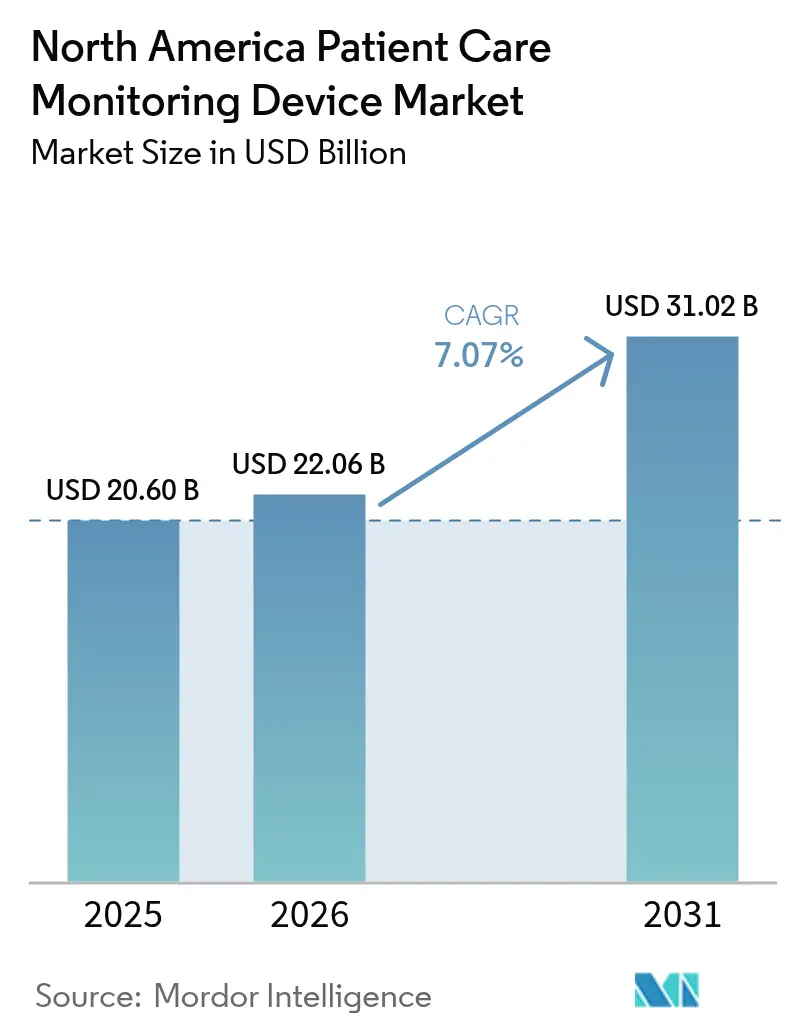
North America Patient Care Monitoring Device Market size in 2026 is estimated at USD 22.06 billion, growing from 2025 value of USD 20.60 billion with 2031 projections showing USD 31.02 billion, growing at 7.07% CAGR over 2026-2031.
The major contributing factors are the growing burden of chronic diseases and growing preference for home care setting.
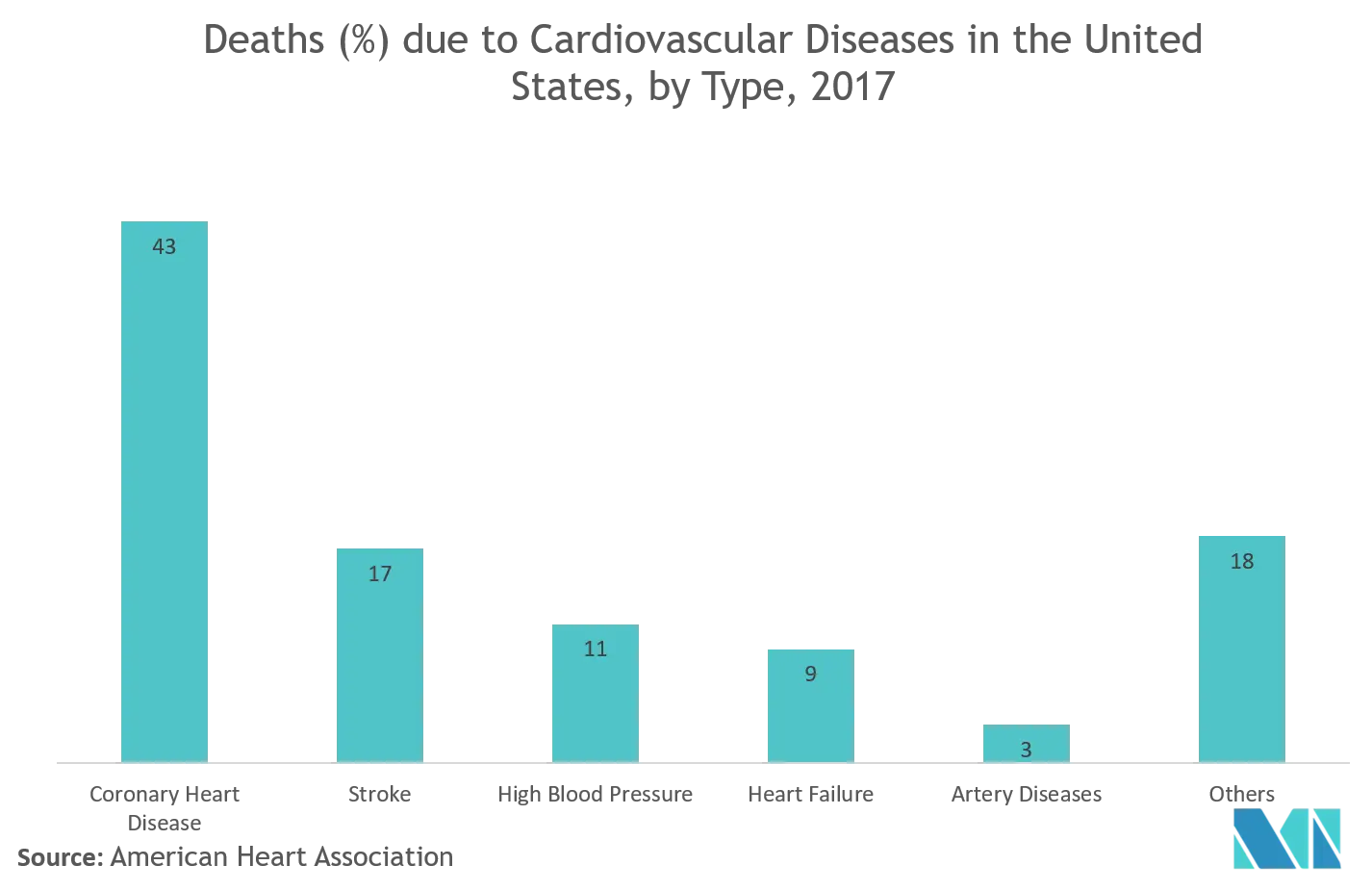
According to the Centres for Disease Control and Prevention, heart disease is one of the leading causes of death in the United States. According to the American Heart Association, the annual incidence for heart attack in the United States was reported to be around 720,000 and 335,000 recurrent attacks. The adaptation of sedentary lifestyle such as poor diet, high sugar diet which poses a high threat of heart disease. Therefore, the aforementioned factors are expected to fuel the market growth.
Note: Market size and forecast figures in this report are generated using Mordor Intelligence’s proprietary estimation framework, updated with the latest available data and insights as of 2026.
North America Patient Care Monitoring Device Market Trends and Insights
Weight Management & Fitness Monitoring is expected to Show a Significant Growth During the Forecast Period
The adoption of a sedentary lifestyle in people, such as physical inactivity, poor diet, high consumption of sugar, etc. has led to many of the chronic conditions such as diabetes, obesity, cardiovascular diseases and others. According to the data of the Centre for Disease Control and Prevention, 2017-2018, approximately 42.4% of the people are obese or overweight in America. Furthermore, according to the American Diabetes Association, in 2018, approximately 34.2 million people in the United States were suffering from diabetes. Furthermore, according to the Government of Canada, almost one out of three people in Canada are suffering from diabetes. Thus, weight management and fitness monitoring have a pivotal role in the prevention of these diseases. Therefore, it is expected to propel the market growth in this segment.
Competitive Landscape
The key players in the North America Patient Care Monitoring Device market are Abbott Laboratories , Baxter International Inc., Boston Scientific Corporation, Becton, Dickinson and Company, GE Healthcare, Johnson & Johnson, Masimo Corporation, Medtronic and Omron Corporation.
North America Patient Care Monitoring Device Industry Leaders
-
Abbott Laboratories
-
Boston Scientific Corporation
-
Beckton, Dickinson and Company
-
GE Healthcare
-
Johnson & Johnson
- *Disclaimer: Major Players sorted in no particular order
Market Opportunities and Future Outlook
The market has room for software-led and contactless monitoring that lowers friction in home healthcare and hospitals, which aligns with the report's emphasis on remote monitoring and multi-parameter use cases. In July 2026, FDA 510(k) clearance for Presage Technologies SmartSpectra (software-based contactless vital-sign measurement) and Vadzo Imaging's launch of an AI patient-monitoring camera for contactless vital signs point to a shift from traditional bedside hardware toward camera- and algorithm-enabled monitoring.
There are also opportunities at the boundary of monitoring devices, care delivery, and reimbursement pathways. Withings launched Withings Medical in July 2026 to serve Medicare-eligible patients under CMS's new ACCESS Model (launched July 5, 2026), supporting models that bundle devices with remote monitoring workflows and clinical services rather than relying on device-only sales. On the regulatory side, the FDA's TEMPO pilot (statements of interest collected beginning January 2026) and the July 2026 FDA De Novo authorization for Autonomous Healthcare's Syncron-E (a new category for ventilator waveform analysis software) reinforce momentum for digital monitoring technologies backed by outcomes-focused evidence, creating space for incumbents and new entrants to expand remote patient monitoring device portfolios and connected software offerings across the United States and Canada.
Recent Industry Developments
- July 2026: Autonomous Healthcare received FDA De Novo marketing authorization for Syncron-E, described as the first device in a new FDA category of ventilator waveform analysis software. The authorization expands the addressable scope of patient monitoring into software-defined analytics that can be deployed alongside existing respiratory monitoring workflows in acute care settings.
- June 2026: MiniMed expanded its agreement with Abbott to collaborate on commercializing integrated dual glucose-ketone sensors for use with MiniMed smart dosing systems. The partnership supports more comprehensive metabolic monitoring and tighter integration of sensor data into automated therapy ecosystems used in home and outpatient care.
- May 2026: Boston Scientific received FDA approval for a software upgrade to its LATITUDE patient management system. The approval underscores the role of software updates in strengthening installed-base remote monitoring platforms, enabling new functionality and compliance improvements without full hardware replacement.
Research Methodology Framework and Report Scope
Market Definition and Coverage
For this study, the market covers revenues from patient care monitoring devices used to measure and track patient physiologic parameters during care, including monitoring in hospital and non-hospital settings across North America.
Scope exclusions: We exclude standalone consumer wellness trackers and non-device clinical services such as installation, training, and maintenance.
Segmentation Overview
- By Type of Devices
- Hemodynamic Monitoring Devices
- Neuro-Monitoring Devices
- Cardiac-Monitoring Devices
- Multi-parameters Monitors
- Respiratory Monitoring Devices
- Remote Patient Monitoring Devices
- Other Devices
- By Application
- Cardiology
- Neurology
- Respiratory
- Fetal & Neonatal
- Remote Monitoring
- Weight Management & Fitness Monitoring
- By End User
- Home Healthcare
- Hospitals & Clinics
- Other End Users
- By Geography
- North America
- United States
- Canada
- Mexico
- North America
Data Sources, Market Sizing, and Validation
Desk Research
Desk work was used to set the market perimeter and to build clean input series that can be audited later. We relied on public and official sources, including the FDA device databases and safety communications, the US Centers for Disease Control and Prevention for health burden signals, the US Census Bureau for demographic baselines, and OECD health statistics for cross-country comparability.
To ensure inputs matched how devices are bought and deployed, we also reviewed sources such as hospital and health system procurement disclosures, company annual filings and investor decks, medical association publications, and reputable coverage of approvals and product launches. In a few places, we used paid subscriptions for company financials and patent databases to confirm product activity and sanity check growth patterns. These examples are not exhaustive, and we reviewed many other public sources for data collection, validation, and clarification.
Primary Interviews and Surveys
Primary work focused on validating device scope and how pricing logic maps to actual purchase decisions, and then pressure testing demand signals such as monitoring intensity in acute care and adoption in home and post-acute settings. We spoke with a mix of device makers, distributors, clinical users, and procurement roles across the United States, Canada, and Mexico. This input helped close gaps left by public datasets and supported assumption checks before finalizing the model.
Distribution of primary research fieldwork respondents
| Company type | Respondent position |
|---|---|
| Top tier: 32% | CXOs: 19% |
| Mid tier: 49% | Functional/Unit leaders: 38% |
| Smaller Players: 19% | Managers: 43% |
Market-Sizing & Forecasting
Sizing started with a top-down rebuild of addressable demand, where healthcare delivery activity and patient monitoring intensity were translated into device demand by care setting and monitoring category, then converted into revenue using typical ASP ranges. Once that structure was in place, we corroborated totals with selective bottom-up checks, including sampled product revenue rollups from public financials, channel feedback on unit movement, and spot checks of ASP movement in tenders and procurement notes.
The model was anchored on a practical set of inputs that can be traced and updated, including hospital admissions and procedure volumes that drive monitoring needs, chronic disease and aging population trends that lift longer term monitoring usage, care shifting toward home and post-acute settings, replacement cycles for monitoring equipment, and price mix changes as multi-parameter monitoring expands. For the forecast, scenario analysis was applied around adoption speed and pricing mix, and then reviewed with expert views so the final curve reflects observed buying behavior rather than a single aggressive case. Where bottom-up signals were incomplete for smaller categories, we filled gaps using penetration and replacement assumptions validated through interviews, and then rechecked against the total demand pool.
Data Validation & Update Cycle
Outputs were triangulated against independent signals such as procurement activity, public revenue disclosures, and major regulatory and product-launch timing, followed by variance checks to catch outliers by country and care setting. If a number moved too far from the supporting indicators, we rechecked inputs, revisited pricing assumptions, and, in some cases, re-contacted sources to confirm whether the change was real or driven by model structure.
Before sign-off, the work is reviewed in multiple steps so that assumptions, units, and conversions remain consistent across the time series. Reports are refreshed annually, and interim updates are made when material events can shift demand or pricing, including reimbursement changes or major device recalls. Immediately before delivery, a final pass is completed so clients receive the latest updated view.
Mordor Intelligence's North America Patient Care Monitoring Device Market Estimate Compared With Other Published Estimates
Published market sizes for patient care monitoring devices can differ even when the topic sounds identical, because teams do not always count the same device scope, geography, or revenue types. Differences also show up in how pricing is carried forward, which demand signals are used to project adoption, and how recently the assumptions were refreshed.
A common gap is that some estimates expand the market into monitoring services or broader digital health system revenues, and that can lift totals quickly. In Mordor Intelligence modeling, only device revenues tied to patient care monitoring are counted, while consumer wellness wearables and service line items are kept out, which keeps the value closer to an auditable device demand pool.
Benchmark comparison
| Source | Market Size | Gaps in Research Methodology |
|---|---|---|
| Mordor Intelligence | USD 20.60 B (2025) | |
| Industry Data Publisher A | USD 48.72 B (2024) | This figure is presented for a broader patient monitoring systems scope, and the higher total is consistent with including wider system and solution revenues beyond device-only monitoring equipment. |
| Research Publisher B | USD 19.01 B (2025) | The estimate appears closer to a narrower device basket and may reflect different category inclusion and pricing mix assumptions, which can pull the total down even in the same region and year. |
Taken together, the spread is mainly explained by what is counted as market revenue and how pricing and adoption are carried across settings like acute care and home care. By keeping inputs tied to observable care activity, replacement behavior, and realistic ASP bands, the sizing steps stay repeatable and easier to validate during updates.
Key Questions Answered in the Report
How big is the North America Patient Care Monitoring Device Market?
The North America Patient Care Monitoring Device Market size is expected to reach USD 22.06 billion in 2026 and grow at a CAGR of 7.07% to reach USD 31.02 billion by 2031.
What is the current North America Patient Care Monitoring Device Market size?
In 2026, the North America Patient Care Monitoring Device Market size is expected to reach USD 22.06 billion.
Who are the key players in North America Patient Care Monitoring Device Market?
Abbott Laboratories, Boston Scientific Corporation, Beckton, Dickinson and Company, GE Healthcare and Johnson & Johnson are the major companies operating in the North America Patient Care Monitoring Device Market.
What years does this North America Patient Care Monitoring Device Market cover, and what was the market size in 2025?
In 2025, the North America Patient Care Monitoring Device Market size was estimated at USD 22.06 billion. The report covers the North America Patient Care Monitoring Device Market historical market size for years: 2019, 2020, 2021, 2022, 2023 and 2024. The report also forecasts the North America Patient Care Monitoring Device Market size for years: 2026, 2027, 2028, 2029, 2030 and 2031.