
Market Overview
| Study Period | 2020 - 2031 |
|---|---|
| Forecast Data Period | 2026 - 2031 |
| Historical Data Period | 2020 - 2024 |
| Base Year Market Size (2025) | USD 3.91 Billion |
| Market Size (2026) | USD 4.05 Billion |
| Market Size (2031) | USD 4.83 Billion |
| Growth Rate (2026 - 2031) | 3.58 % |
Major Players *Disclaimer: Major Players sorted in no particular order Image © Mordor Intelligence. Reuse requires attribution under CC BY 4.0. | |
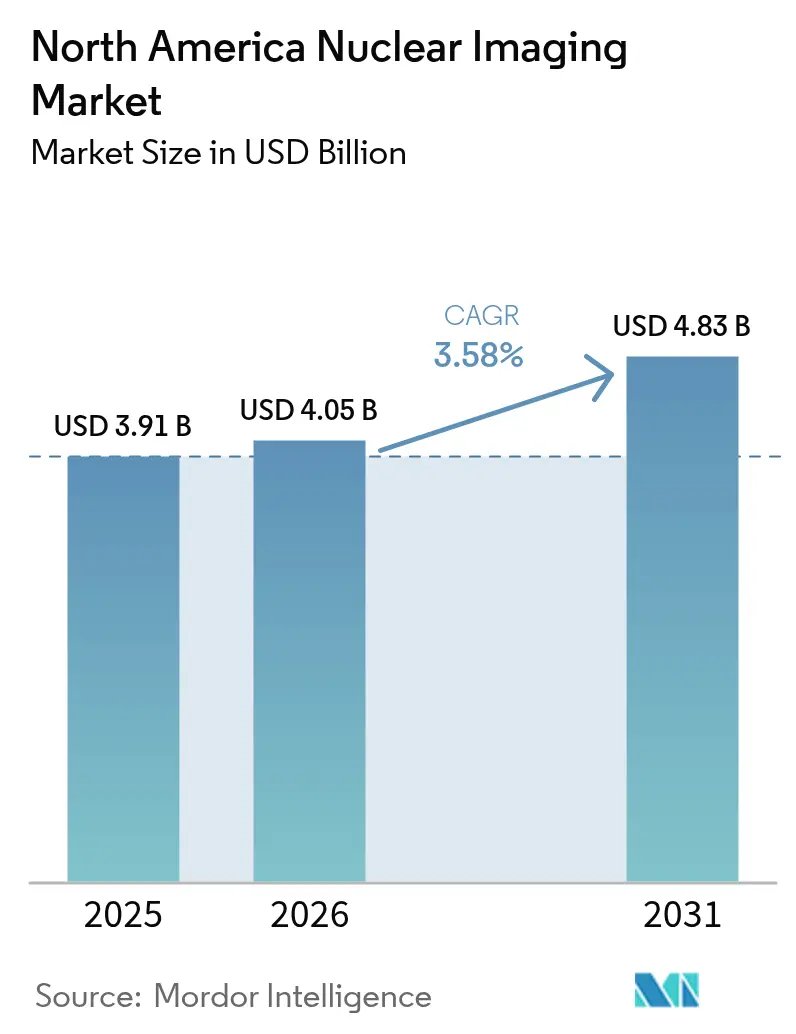
North America Nuclear Imaging Market Analysis by Mordor Intelligence
The North America Nuclear Imaging market size is expected to grow from USD 3.91 billion in 2025 to USD 4.05 billion in 2026 and is forecast to reach USD 4.83 billion by 2031 at 3.58% CAGR over 2026-2031.
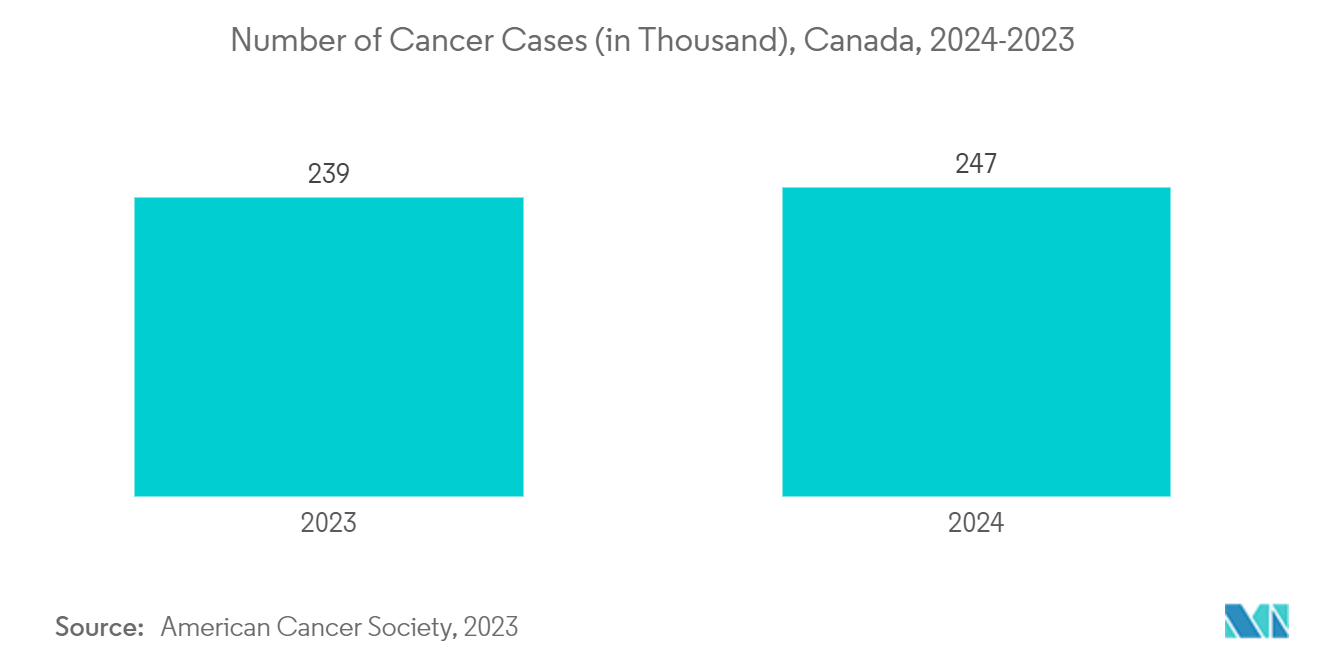
- The market is expected to grow with technological advancements, increasing diagnostic applications in various diseases, such as cancer and cardiovascular diseases, and increasing government support. The prevalence of chronic diseases is on the rise in the North American region, which is expected to create more demand for nuclear imaging. For instance, according to data published by the Canadian Cancer Society in May 2022, it was estimated that over 30,000 individuals in Canada would be diagnosed with lung and bronchus cancer. This represented an increase of 13% in the cases of lung and bronchus cancer from 2021 to 2022. It was also estimated that over 20,700 lives would be claimed by the disease in 2022.
- The high prevalence of such chronic diseases has created a huge demand for nuclear imaging diagnosis for the management of diseases in the region. For instance, data published in the Canadian Medical Imaging Inventory Service Report in January 2022 mentioned that demand for PET-CT services has been rising in Canada. The report stated that there is a need for more PET systems. It was mentioned that in Canada, there were 1.5 PET units per million population. The country ranked 16th out of 25 in the list of the volume of PET-CT exams, with over 3.3 scans per 1,000 population. Thus, the vast patient base and the increasing demand for nuclear imaging are expected to create more growth opportunities in the North American region.
- The strategic activities by the market players such as introduction of advanced equipment in market is expected boost the market growth over the forecast period. For instance, in November 2023, Positron Corporation has secured a significant new customer in Pennsylvania's cardiovascular sector. The client will be leveraging Positron's cutting-edge Attrius PET System and accompanying services. The installation of the Attrius system is scheduled to align with the facility's radiopharmaceutical timeline.
- Additionally, in October 2022, GE Healthcare launched its Omni Legend, which is a first-of-its-kind all-digital PET-CT system. The system is equipped with cutting-edge system features such as digital BGO (dBGO) detector material, and it offers high efficiency and improved diagnostics for precision medicines. Similarly, in November 2023, IONETIX, a Cardiac PET services and isotope manufacturing company expanded its partnership with the Center for Imaging and Research of America (CIRA) in Sarasota, United States. Under the partnership, IONETIX launched the new PET/CT imaging facility, which utilizes N-13 Ammonia, which is manufactured by IONETIX itself.
- Therefore, owing to the aforementioned factors, the studied market is anticipated to witness growth over the analysis period. However, the regulatory issues and lack of reimbursement are likely to impede market growth.
Note: Market size and forecast figures in this report are generated using Mordor Intelligence’s proprietary estimation framework, updated with the latest available data and insights as of 2026.
North America Nuclear Imaging Market Trends and Insights
The Oncology Segment of the PET Applications is Expected to Witness Significant Growth Over the Forecast Period
- Positron emission tomography (PET) scanning is carried out for the diagnosis and study of cancer by revealing the biochemical or metabolic functions of the tissue under study. The abnormal biochemical or metabolic activities in the tissue enable the identification or location of the tumor or cancer site/tissue. The wide applications of PET scans in cancer studies, increasing cases of cancer, and advancing research are expected to create more demand for PET scans for cancer. Several research studies have highlighted the wide applications and advantages of PET scans alone and in combination with other techniques for the management of the treatment and diagnosis of cancer.
- A study published in the Journal of Cancer in March 2022 mentioned that PET and computer tomography (CT) scans enabled the assessment of the treatment of head and neck squamous cell carcinoma using chemoradiation. The study further mentioned that the repetitive PET/CT scans offered the clarity of the diagnosis in the patients who had an incomplete post-treatment scan, and it decreased the need for biopsies and neck dissections, which are often not necessary. Further, another study published in the Journal of Cancer in June 2022 underlined that PET/CT has diverse oncologic applications with its advanced imaging modality. PET/CT enables the staging, restaging, longitudinal surveillance, and therapeutic assessment of cancer therapy.
- Therefore, the oncology segment of PET applications is expected to witness significant growth over the forecast period due to the abovementioned factors, including the wide applications of PET in the management of a wide variety of cancer and diagnostic benefits offered by PET.
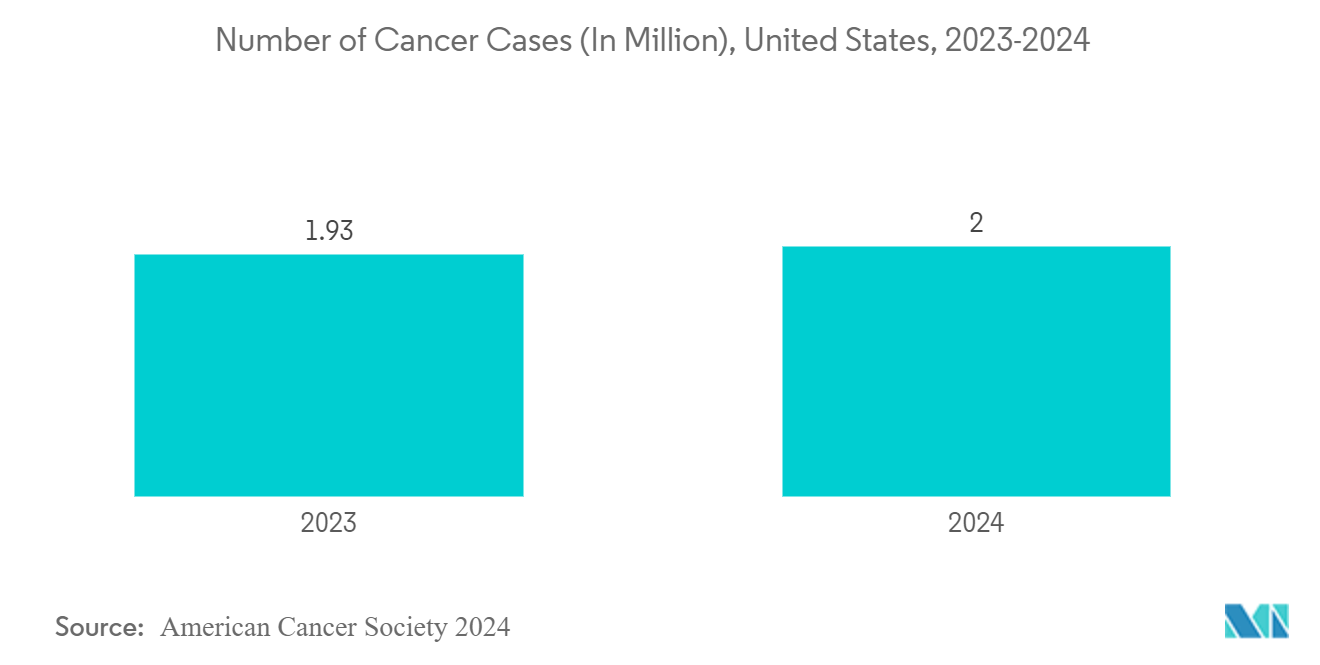
The United States is Expected to Dominate the North America Nuclear Imaging Market
- The United States is expected to dominate the market owing to factors such as the high prevalence of chronic diseases, high healthcare expenditure, advanced medical infrastructure and research, and the presence of leading players in the country. The country has a high prevalence of chronic diseases, which necessitates the use of nuclear imaging for the diagnosis and management of the disease.
- For instance, as per the data published by the National Brain Tumor Society in 2023, over 700,000 were estimated to have primary brain tumors, and over 88,970 more patients were estimated to be diagnosed in the United States in 2022. According to data published by the World Nuclear Association in April 2022, over 20 million procedures of nuclear medicine are performed every year in the United States.
- Furthermore, the presence of the leading players in the country and their key developments are boosting the growth of the market. For instance, in November 2023, Siemens Healthineers has received FDA clearance for its Biograph Vision.X, a PET/CT scanner boasting an industry-leading time of flight (TOF) of 178 picoseconds (ps). This marks the fastest TOF in the market. The Biograph Vision.X is the latest addition to Siemens Healthineers' renowned Biograph Vision scanner family, enhancing on its already established performance.
- Further, in June 2024, the QEII Health Sciences Centre, part of Nova Scotia Health, has made history by becoming the inaugural Canadian health facility to adopt GE HealthCare's StarGuide SPECT/CT scanner. This cutting-edge nuclear medicine scanner employs advanced 3-D imaging, empowering physicians to diagnose and treat diseases such as cancer and heart conditions with unprecedented precision. These continuous developments in the region are anticipated to drive the growth of the market in the country.
- Therefore, owing to the aforesaid factors, the growth of the studied market is anticipated in the North American region.
Regulatory Landscape
In the United States, nuclear imaging equipment and related radiology devices fall under FDA oversight, with radiology devices addressed within 21 CFR Part 892. Recent federal actions inside this framework include the FDA final rule (June 2025) classifying Radiological Acquisition and/or Optimization Guidance Systems as class II (special controls), and a March 2026 Federal Register action that established new compliance timelines for blood irradiator devices under 21 CFR Part 892 requiring PMA submissions. In parallel, FDA updated its device regulation overview in February 2026 to reflect the transition from QSIT to a new inspection approach for medical device manufacturing facilities, which changes how quality-system compliance is assessed during inspections.
In Canada, radiopharmaceuticals are regulated by Health Canada under Schedule C of the Food and Drugs Act, while nuclear imaging equipment must comply with the Medical Devices Regulations (SOR/98-282). For devices that use radiation or are treated as Class II prescribed equipment, certification and licensing requirements also run through the Canadian Nuclear Safety Commission (CNSC), including conformity with CNSC guidance such as REGDOC-1.5.1 and related certification expectations for radiation devices. Trade policy has also emerged as a practical compliance and procurement variable, with a Section 232 national security investigation initiated in September 2025 covering medical devices (including certain electromedical apparatus), which has prompted industry and provider attention to potential tariff outcomes and supply-chain implications.
Competitive Landscape
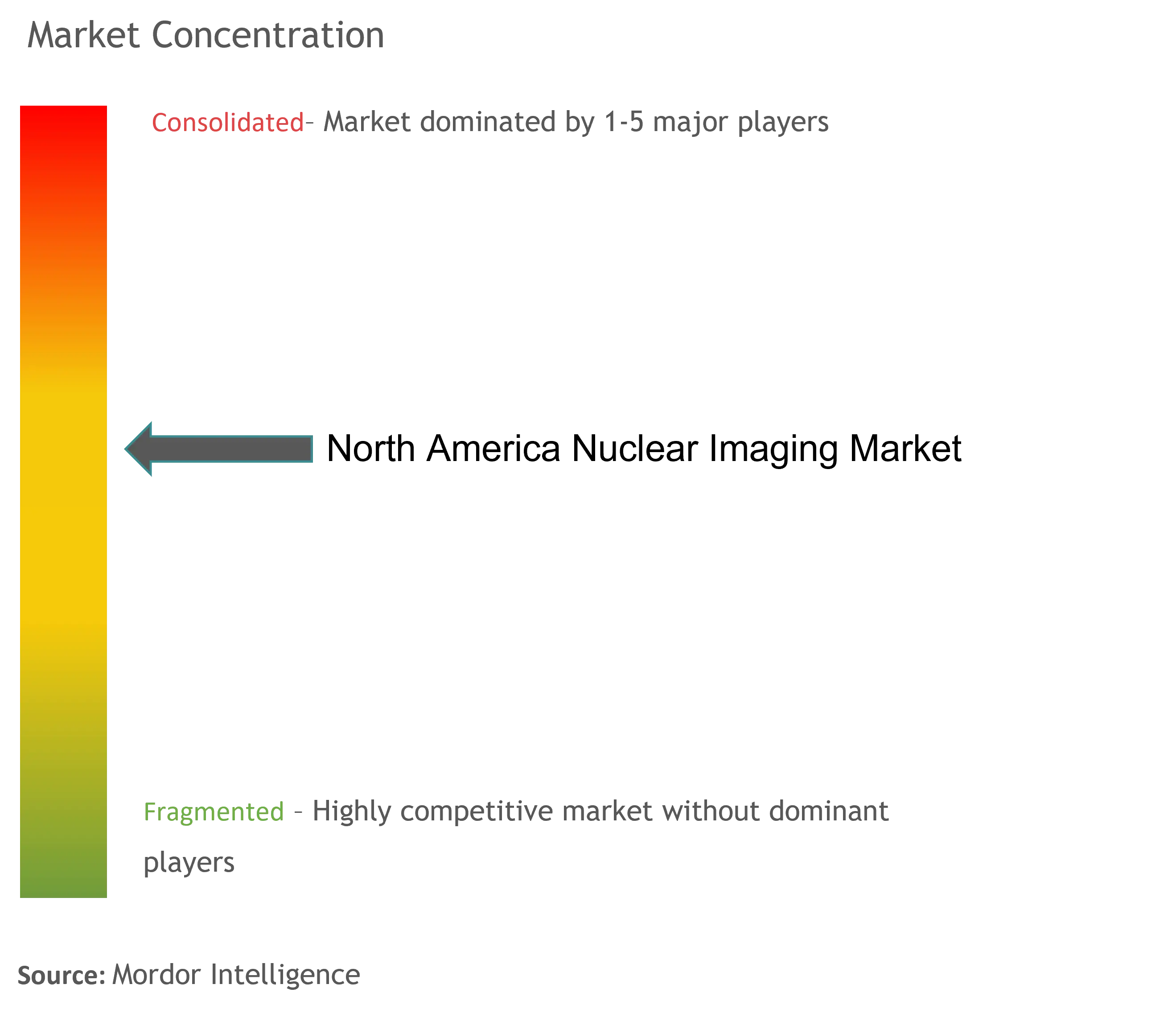
The North American nuclear imaging market is moderately competitive due to the presence of several companies operating in the region. The market players adopt several strategies such as product launches, mergers, and acquisitions to stay competitive. The key players operating in the market include Bracco Imaging SpA, Cardinal Health Inc., GE Healthcare, Koninklijke Philips NV, and Siemens Healthineers.
North America Nuclear Imaging Industry Leaders
-
Bracco Imaging SpA
-
Cardinal Health Inc.
-
GE Healthcare
-
Koninklijke Philips NV
-
Siemens Healthineers
- *Disclaimer: Major Players sorted in no particular order
Market Opportunities and Future Outlook
Capacity additions for medical isotopes and radiopharmaceutical manufacturing are sharpening supply security considerations and site-of-care availability for nuclear imaging and theranostics workflows. In April 2026, Cardinal Health expanded Actinium-225 production capabilities at its Center for Theranostics Advancement in Indianapolis, adding a high-capacity production line intended to support radiopharmaceutical scaling. In April 2026, SHINE received a USD 263 million conditional US Department of Energy loan to complete its medical isotope production facility in Janesville, Wisconsin, reinforcing ongoing public-private focus on domestic isotope supply chains.
At the same time, commercialization pathways for widely used PET agents and newer isotope networks are opening for integrated service models that connect isotope production, radiopharmacy distribution, and imaging system utilization. In May 2026, Ionetix received FDA approval for its ANDA for Gallium Ga-68 gozetotide (PSMA-11), and in June 2026, RadioMedix announced FDA approval for a generic Ga-68 PSMA-11 radiodiagnostic, adding competitive supply options for prostate cancer PET imaging. Equipment clearances are also expanding adoption routes: in February 2026, United Imaging Healthcare received FDA clearance for the uMI Panvivo PET/CT system, including the uMI Panvivo LS model, and dedicated brain PET platforms are broadening use cases beyond traditional large-footprint installations, particularly for centers focused on organ-specific protocols and throughput-driven nuclear medicine programs.
Recent Industry Developments
- June 2026: RadioMedix announced FDA approval of its generic Ga-68 PSMA-11 radiodiagnostic for prostate cancer and referenced completion of an inspection at The SPICA Center in Houston, Texas. The approval adds another commercial supply route for a high-volume PET agent, supporting broader provider access and competitive sourcing for PSMA PET imaging workflows.
- May 2026: Ionetix Corporation received FDA approval for its Abbreviated New Drug Application (ANDA) for Gallium Ga-68 gozetotide (PSMA-11), positioning it as the first commercial drug manufacturer to receive an ANDA approval for this agent. The milestone strengthens domestic manufacturing and distribution options for PSMA PET imaging and can reduce operational dependence on limited-site supply models.
- June 2024: QEII Health Sciences Centre (Nova Scotia Health) became the first Canadian facility to adopt GE HealthCare's StarGuide SPECT/CT scanner. The installation highlights hospital-led modernization of nuclear medicine infrastructure in Canada, expanding the deployed base for advanced SPECT/CT workflows in oncology and cardiology.
Research Methodology Framework and Report Scope
Market Definition and Coverage
For this study, the North America nuclear imaging market covers nuclear medicine imaging used to diagnose and monitor disease, including imaging equipment and the radioisotopes used to generate clinical images across routine care and diagnostic pathways.
Scope exclusions: This sizing excludes non-nuclear imaging modalities (such as ultrasound and MRI), radiation therapy, and purely laboratory research activity that does not translate into clinical imaging demand.
Segmentation Overview
- By Product
- By Equipment
- By Radioisotope
- SPECT Radioisotopes
- Technetium-99m (TC-99m)
- Thallium-201 (TI-201)
- Gallium (Ga-67)
- Iodine (I-123)
- Other SPECT Radioisotopes
- PET Radioisotopes
- Fluorine-18 (F-18)
- Rubidium-82 (RB-82)
- Other PET Radioisotopes
- SPECT Radioisotopes
- By Application
- SPECT Applications
- Cardiology
- Neurology
- Thyroid
- Other SPECT Applications
- PET Applications
- Oncology
- Cardiology
- Neurology
- Other PET Applications
- SPECT Applications
- Geography
- United States
- Canada
- Mexico
Data Sources, Market Sizing, and Validation
Desk Research
Desk work starts by aligning the market boundary, geography, and definitions with public healthcare and trade indicators that can be checked year over year. We mainly refer to sources such as the US Food and Drug Administration (radiopharmaceutical approvals and safety updates), the US Nuclear Regulatory Commission and national radiation safety bodies, and the Centers for Medicare and Medicaid Services for procedure and reimbursement context.
To make the model practical, we also pull foundational inputs from sources such as the International Atomic Energy Agency for nuclear medicine context, government health statistics agencies in the US, Canada, and Mexico for utilization signals, and peer reviewed clinical journals for modality level adoption direction. Company annual reports, investor presentations, reputable press coverage, and a paid subscription for company financials and intelligence are also used to cross-check revenue exposure where disclosures allow it. This list is not exhaustive, and additional sources are reviewed to collect data points, validate assumptions, and clarify gaps.
Primary Interviews and Surveys
Primary work is used to confirm what is being purchased and used in practice, and how demand is shifting across PET and SPECT workflows in North America. We speak with a mix of hospital imaging heads, nuclear medicine physicians, radiopharmacy and isotope supply stakeholders, and service teams, then re-check assumptions across the US, Canada, and Mexico so one country does not overly drive the final totals.
Distribution of primary research fieldwork respondents
| Company type | Respondent position |
|---|---|
| Top tier: 27% | CXOs: 20% |
| Mid tier: 51% | Functional/Unit leaders: 36% |
| Smaller Players: 22% | Managers: 44% |
Market-Sizing & Forecasting
Sizing is built using a top-down demand reconstruction, where imaging procedure volumes and installed base signals are translated into spending for equipment and radioisotopes, then normalized at the country level across the US, Canada, and Mexico. The total is corroborated using selective bottom-up approximations, such as sampled ASP x volume checks for key camera types, channel feedback on replacement cycles, and supplier side revenue splits when they are disclosed.
Key model inputs include PET and SPECT procedure mix, scanner installed base and replacement timing, radiotracer availability constraints, reimbursement and payment coverage direction, and hospital capital budget trends that influence large equipment purchases. When a public series is not available for a country or year, gaps are handled with nearby proxy indicators (such as utilization per million population), then re-validated through interviews before being accepted.
Forecasting uses scenario analysis supported by a light multivariate regression, since demand is influenced by more than one driver, and then assumptions are stress-tested with expert feedback on tracer supply, modality preference, and expected purchasing cycles. The final forecast stays traceable to a small set of variables that can be updated when new procedure, policy, or supply signals appear.
Data Validation & Update Cycle
Model outputs are checked against independent signals, including country level healthcare spend direction, public procedure and reimbursement updates, and visible changes in isotope supply and site operations. If any segment grows faster than the underlying demand signals can support, we re-open the input assumptions, check currency and timing alignment, and contact select interviewees again to understand what changed.
A multi-step internal review is completed before sign-off, with cross-checks on year-over-year movement, segment shares, and country totals. Reports are refreshed annually, and interim updates are made when material events occur, such as policy shifts, major supply disruptions, or technology changes that can alter utilization or pricing. Before delivery, a final analyst pass is completed to ensure the latest public updates are reflected.
Mordor Intelligence's North America Nuclear Imaging Market Market Size Versus Other Published Estimates
Published numbers for nuclear imaging in North America can look different because the boundary is not always set the same way, and because the split between equipment and isotopes is treated differently across models. Timing also matters, since procedure trends, tracer availability, and reimbursement changes can move quarterly, which then affects how each publisher reports a given year value.
By tracking procedure mix shifts and isotope supply signals, Mordor Intelligence keeps the model aligned to equipment plus radioisotope spend in the US, Canada, and Mexico, instead of folding in adjacent nuclear medicine therapy revenues or global equipment totals that are later allocated down.
Benchmark comparison
| Source | Market Size | Gaps in Research Methodology |
|---|---|---|
| Mordor Intelligence | USD 3.91 B (2025) | |
| Regional Research Publisher A | USD 3.78 B (2025) | Uses a slightly different product boundary and country grouping, and the smaller 2025 value can come from tighter inclusion of isotope and service revenue, plus different currency timing assumptions. |
| Global Consultancy B | USD 2.82 B (2024) | This value is derived from a global nuclear imaging equipment total and a North America share, which can undercount radioisotopes and can also shift depending on the chosen regional share year and device-only scope. |
Overall, the spread is explained by what gets counted (equipment only versus equipment plus isotopes), which geography is included under North America, and whether the number is built from local demand signals or allocated from a global total. Using clear inclusions and repeatable checks helps keep the estimate consistent when procedure, pricing, and supply inputs are refreshed.
Key Questions Answered in the Report
How big is the North America Nuclear Imaging Market?
The North America Nuclear Imaging Market size is expected to reach USD 4.05 billion in 2026 and grow at a CAGR of 3.58% to reach USD 4.83 billion by 2031.
What is the current North America Nuclear Imaging Market size?
In 2026, the North America Nuclear Imaging Market size is expected to reach USD 4.05 billion.
Who are the key players in North America Nuclear Imaging Market?
Bracco Imaging SpA, Cardinal Health Inc., GE Healthcare, Koninklijke Philips NV and Siemens Healthineers are the major companies operating in the North America Nuclear Imaging Market.
What years does this North America Nuclear Imaging Market cover, and what was the market size in 2025?
In 2025, the North America Nuclear Imaging Market size was estimated at USD 4.05 billion. The report covers the North America Nuclear Imaging Market historical market size for years: 2019, 2020, 2021, 2022, 2023 and 2024. The report also forecasts the North America Nuclear Imaging Market size for years: 2026, 2027, 2028, 2029, 2030 and 2031.