
Market Overview
| Study Period | 2020 - 2031 |
|---|---|
| Forecast Data Period | 2026 - 2031 |
| Base Year Market Size (2025) | USD 73.57 Billion |
| Market Size (2026) | USD 80.89 Billion |
| Market Size (2031) | USD 130.06 Billion |
| Growth Rate (2026 - 2031) | 9.96 % |
| Market Concentration | Medium |
Major Players *Disclaimer: Major Players sorted in no particular order Image © Mordor Intelligence. Reuse requires attribution under CC BY 4.0. | |
North America Managed Services Market Analysis by Mordor Intelligence
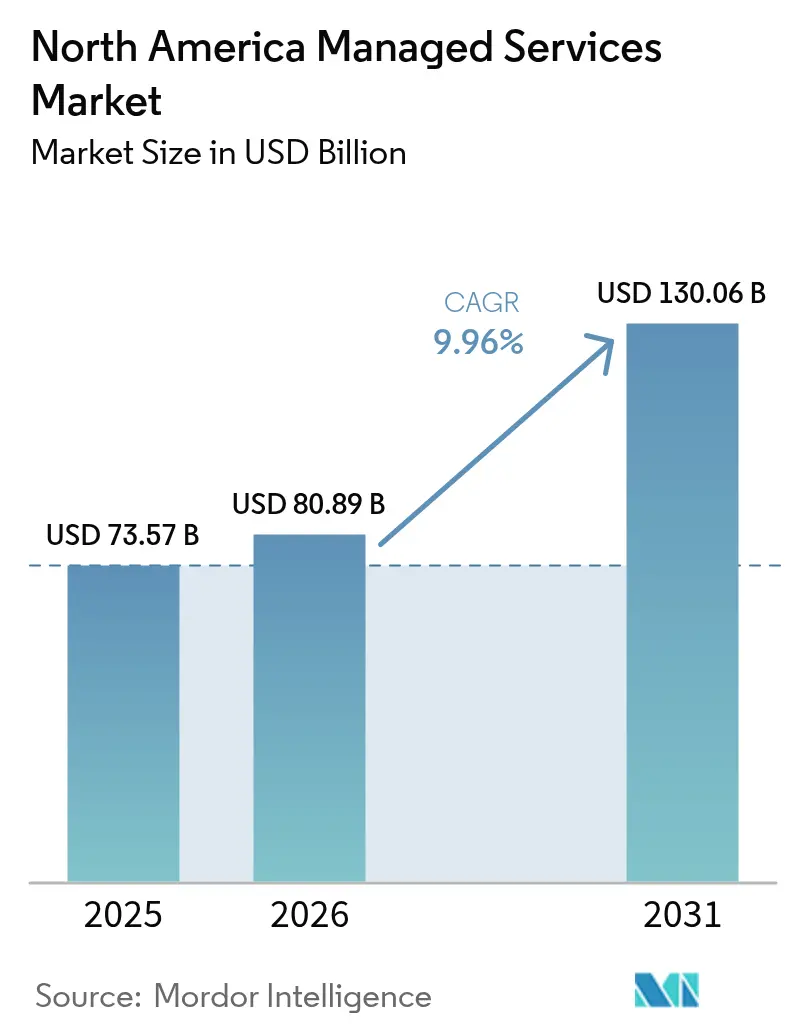
The North America managed services market size is expected to grow from USD 73.57 billion in 2025 to USD 80.89 billion in 2026 and is forecast to reach USD 130.06 billion by 2031 at 9.96% CAGR over 2026-2031. Ongoing spending on cloud modernization, surging cyber-insurance premiums, and the proliferation of state privacy rules continue to push enterprises toward managed services partnerships that reduce compliance risk and deliver specialized expertise. Nearly three of every four regional enterprises now operate some mix of public and private clouds, making cross-platform management a top operational priority. Severe talent shortages in security, cloud architecture, and artificial intelligence amplify the need for external providers that can supply hard-to-hire skills at scale. Large deals increasingly link cost optimization commitments to service-level metrics, which strengthens the business case for AI-enabled automation inside service delivery platforms. Competitive intensity is rising as private-equity-backed consolidators buy regional specialists, broadening geographic reach and service breadth while maintaining the customer intimacy that mid-market buyers expect.
Key Report Takeaways
- By deployment, cloud-hosted solutions commanded 58.22% of North America managed services market share in 2025, while hybrid deployments are projected to expand at 11.03% CAGR through 2031.
- By service type, managed security services led with a 24.05% revenue share in 2025 in the North America managed services market; managed cloud and application services hold the fastest projected CAGR at 10.61% through 2031.
- By enterprise size, large enterprises accounted for 49.15% of the North America managed services market size in 2025, whereas small and medium enterprises are projected to record an 10.95% CAGR to 2031.
- By end user, the BFSI segment generated 24.21% of 2025 revenue in the North America managed services market, while healthcare and life sciences is on track for a 10.49% CAGR through 2031.
- By country, the United States represented 72.10% of regional spending in 2025 in the North America managed services market and is forecast to expand at an 11.26% CAGR over the next five years.
Note: Market size and forecast figures in this report are generated using Mordor Intelligence’s proprietary estimation framework, updated with the latest available data and insights as of 2026.
North America Managed Services Market Trends and Insights
Drivers Impact Analysis*
| Driver | (~) % Impact on CAGR Forecast | Geographic Relevance | Impact Timeline |
|---|---|---|---|
| Enterprises shifting to hybrid and multi-cloud architectures | +2.8% | Global, with early gains in US West Coast, Northeast corridors | Medium term (2-4 years) |
| Rising cyber-threat landscape driving managed security adoption | +2.1% | North America and EU, spill-over to APAC | Short term (≤ 2 years) |
| IT skill shortages and need for cost optimisation | +1.9% | Global | Long term (≥ 4 years) |
| Accelerated digital transformation in SMEs | +1.7% | APAC core, spill-over to North America | Medium term (2-4 years) |
| State-level privacy laws spurring compliance-led outsourcing | +1.4% | National, with early gains in California, Texas, Florida | Short term (≤ 2 years) |
| Edge-compute managed services for 5G private networks and Industry 4.0 | +1.2% | North America and EU | Long term (≥ 4 years) |
| Source: Mordor Intelligence | |||
Enterprises Shifting to Hybrid and Multi-Cloud Architectures
Roughly 75% of regional organizations now distribute workloads across multiple public clouds and on-premises infrastructure, which intensifies demand for managed orchestration and governance services. Vendor pricing actions that raise licensing costs are accelerating repatriation assessments and hybrid adoption strategies. Enterprises are standardizing on container platforms to limit lock-in and simplify portability, yet they still require outside expertise for policy enforcement, FinOps optimization, and workload migration. Managed service providers are capitalizing by bundling discovery, migration, and ongoing cost-control services into outcome-based contracts that tie fees to savings delivered. These factors collectively sustain the North America managed services market as a critical channel for multicloud operational excellence.
Rising Cyber-Threat Landscape Driving Managed Security Adoption
Threat actors now deploy artificial intelligence to automate reconnaissance and build polymorphic malware, which overwhelms internal security operations centers. New U.S. Securities and Exchange Commission incident-reporting rules obligate public companies to disclose material breaches within four business days, pushing boards to demand 24 × 7 detection and response coverage. Managed detection and response services fill the gap because enterprises often lack staff trained in threat hunting, forensics, and cloud-native security controls. Providers are investing in AI correlation engines that shrink dwell time and meet the stringent reporting windows. As cyber insurance underwriters impose higher premiums for organizations without third-party monitoring, managed security becomes both a technical requirement and a financial hedge.
IT Talent Shortages and Need for Cost Optimization
Nine in ten enterprises report difficulty hiring experts in cloud architecture, data science, and secure DevOps. Wage inflation adds further strain, raising the fully-loaded cost of experienced engineers and prompting financial officers to shift spending toward opex-based managed services contracts. Providers respond with talent-as-a-service models that embed specialized squads for cloud migrations, AI model operations, and zero-trust implementations. Continuous certification programs help MSPs retain scarce practitioners and pass skill depth on to clients. Because investors increasingly evaluate digital transformation projects on six-month return windows, the ability to deploy ready-made teams has become a critical advantage that sustains growth across the North America managed services market.
Accelerated Digital Transformation in SMEs
Small and medium enterprises once lagged digital pioneers, yet three in four now expect bigger technology budgets in 2025, and one in five plans to invest at least USD 10 million per initiative.[1] Many adopt platform-based managed services because they lack internal integration skills and cannot justify enterprise software licenses. Providers tailor packaged cloud migration, data analytics, and cybersecurity bundles that offer predictable monthly fees tied to usage. Pay-as-you-grow pricing helps SMEs scale without large capital outlays while gaining enterprise-grade resiliency and compliance. As a result, SME adoption adds a fresh layer of momentum to the North America managed services market by broadening the addressable base beyond Fortune 500 buyers.
Restraints Impact Analysis*
| Restraints | (~) % Impact on CAGR Forecast | Geographic Relevance | Impact Timeline |
|---|---|---|---|
| Data-sovereignty and legacy-integration complexity | -1.8% | Global, with regulatory influence from GDPR, state privacy laws | Medium term (2-4 years) |
| Vendor lock-in and perceived loss of control | -1.2% | North America and EU | Long term (≥ 4 years) |
| Inflation-driven wage pressure eroding MSP margins | -0.9% | Global | Short term (≤ 2 years) |
| Sustainability-reporting costs for service providers | -0.6% | North America and EU, with early gains in California, New York | Medium term (2-4 years) |
| Source: Mordor Intelligence | |||
Data-Sovereignty and Legacy-Integration Complexity
Fourteen U.S. states now enforce comprehensive privacy statutes with varied residency and processing obligations, which complicates cross-border data architectures and lengthens implementation cycles. Many large enterprises retain decades-old proprietary systems that cannot move to public clouds without costly refactoring, forcing providers to blend on-premises support with cloud-native tooling. Compliance frameworks such as NIST SP 800-171 and sector-specific mandates in healthcare or finance require granular audit trails, adding overhead for managed service providers. These factors slow project kickoffs and in certain cases limit the revenue capture potential that otherwise fuels the North America managed services market.
Vendor Lock-in and Perceived Loss of Control
High-profile supplier consolidation and surprise price increases amplify customer fears of dependency. CIOs now draft exit clauses, data portability terms, and multi-provider structures into managed services contracts, which extends negotiation timelines. Technology leaders also worry that outsourcing strategic functions can diminish internal relevance, leading to organizational pushback. To address these concerns, providers increasingly propose hybrid engagement models that allow companies to retain governance over key workloads while outsourcing discrete tasks. Although such models support adoption, they narrow deal scope and temper revenue growth within the North America managed services industry.
*Our forecasts treat driver/restraint impacts as directional, not additive. The impact forecasts reflect baseline growth, mix effects, and variable interactions.
Segment Analysis
By Deployment: Cloud Dominance Accelerates Hybrid Innovation
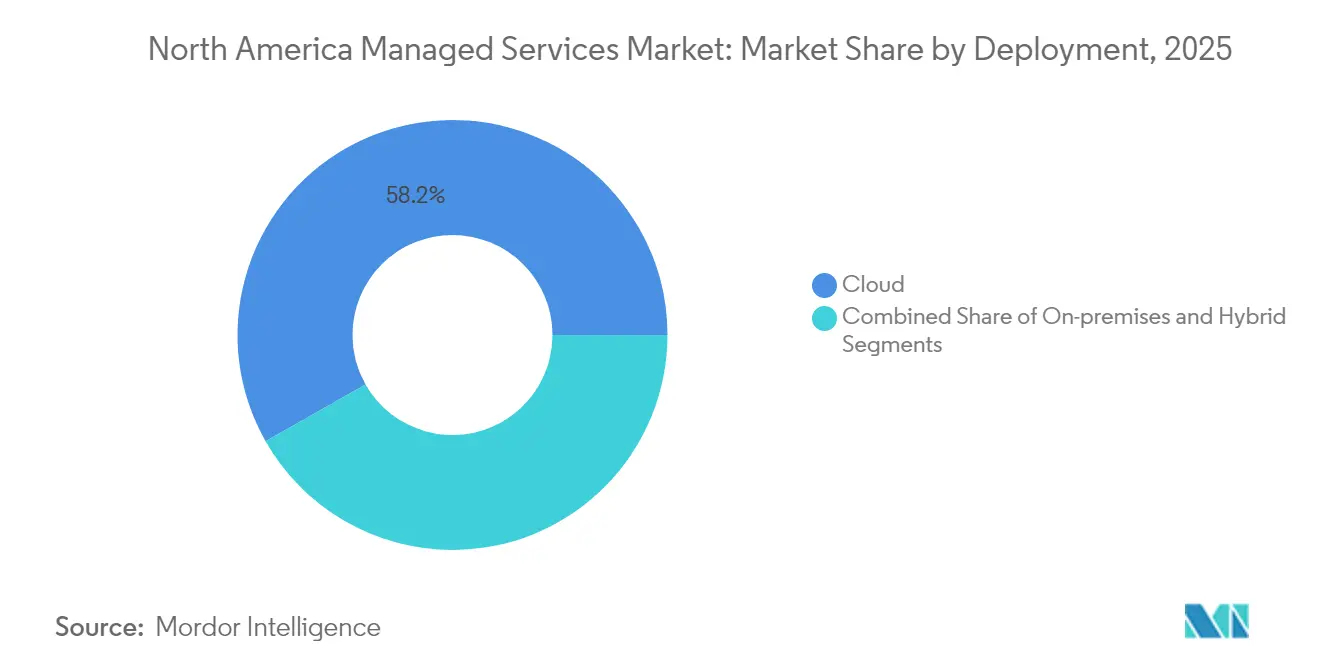
Cloud-hosted deployments generated 58.22% of North America managed services market revenue in 2025, while hybrid environments are forecast for an 11.03% CAGR through 2031. The surge reflects hyperscaler resilience, generous partner rebates, and marketplace procurement that simplify subscription terms. Hybrid adoption gains momentum as strict data-residency rules and edge-compute latency targets push certain workloads closer to users. Industrial firms use private 5G networks to link factories, then anchor data analytics in regional clouds managed by MSPs. As a result, providers rebound from purely lift-and-shift work to ongoing optimization engagements that balance cost, performance, and compliance across diverse infrastructures. The North America managed services market frequently embeds container management add-ons that deliver automated patching and policy enforcement for distributed clusters. Service catalogs now include FinOps dashboards that visualize chargeback and governance metrics, further cementing MSP involvement in cost stewardship.

By Service Type: Security Leadership Meets Cloud Acceleration
Managed security accounted for 24.05% of 2025 revenue, underscoring board-level urgency to harden defenses against AI-driven attacks. Managed cloud and application services claim the fastest forecast CAGR at 10.61%, propelled by enterprises that shift custom development into serverless and container environments yet still require external oversight. Legacy data-center services remain relevant for regulated workloads that must stay on-premises, but providers increasingly wrap them in automation and remote-management layers to improve margin profile. Unified communications, SD-WAN, and managed networks support hybrid work patterns that persist in 2025. Across categories, AI-based orchestration engines reduce manual effort, freeing engineers to move into consulting roles that drive higher bill rates. This pivot helps sustain profitability even as price competition intensifies across the North America managed services market.
By Enterprise Size: SME Momentum Challenges Large-Enterprise Dominance
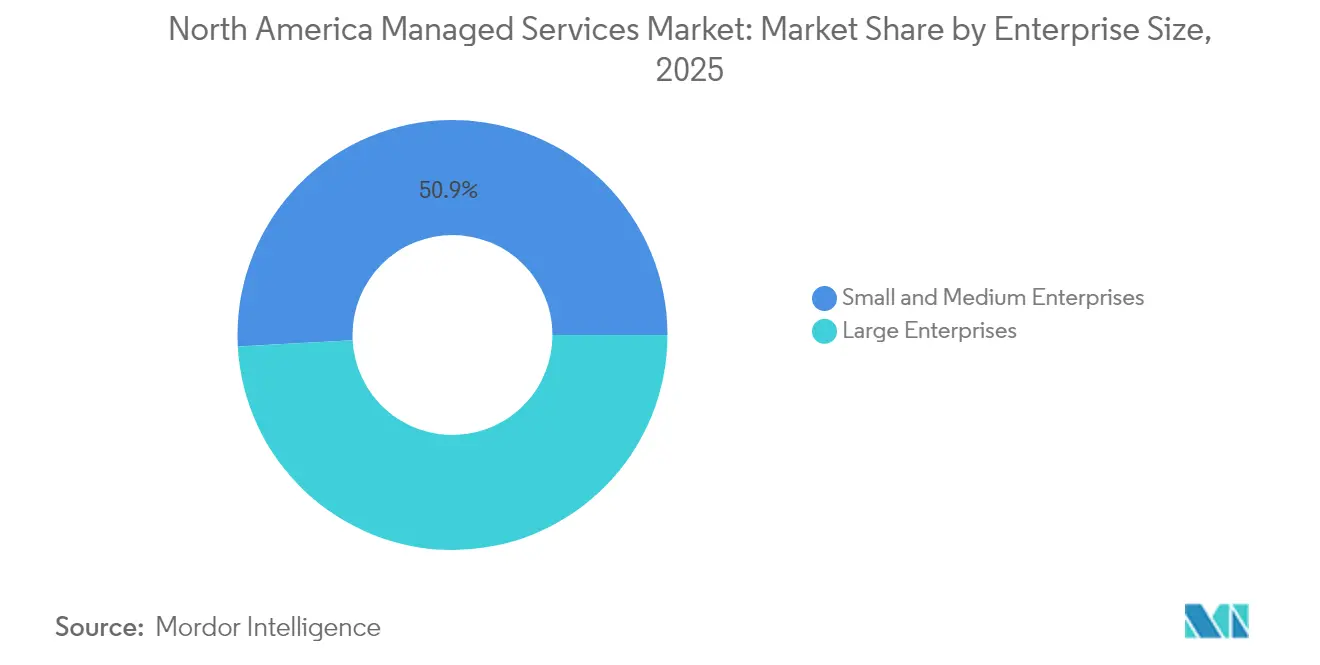
Large enterprises represented 49.15% of North America managed services market share in 2025, leveraging multiyear budgets to negotiate broad outcome-based contracts covering infrastructure, applications, and cybersecurity. In contrast, SMEs demonstrate an 10.95% CAGR through 2031 as cloud-first strategies lower entry barriers. Providers package modular service blocks that align with SME cash-flow needs and regulatory thresholds. Many SMEs view MSPs as fractional CIOs who orchestrate vendor ecosystems and maintain compliance artifacts. The North America managed services industry therefore benefits from an expanding funnel of customers willing to consume standardized offerings, creating scale advantages for providers that specialize in specific verticals like dental practices, regional banks, or SaaS start-ups.
By End-user Vertical: BFSI Leadership Meets Healthcare Innovation
BFSI generated 24.21% of 2025 revenue, reinforced by interchange fee pressures that push banks to outsource non-core IT functions and focus spend on digital engagement. Robust regulatory frameworks such as FedLine compliance elevate the need for external audit support and real-time monitoring. Healthcare and life sciences exhibit the fastest 10.49% CAGR amid telehealth adoption, electronic health record modernization, and genomics workloads that demand high-performance compute with strict data privacy. Industrial settings use managed services to converge operational technology and IT under zero-trust frameworks, while retailers invest in omnichannel optimization that blends inventory analytics with customer-facing applications. The sector mix diversifies top-line growth across the North America managed services market, reducing dependence on any single vertical.
Geography Analysis
North American spending remains heavily concentrated in large metropolitan corridors, yet secondary cities in the Mountain West and Midwest post above-average growth as manufacturers deploy Industry 4.0 programs. The region is expected to grow, supported by deep cloud adoption and a patchwork of state privacy laws that incentivize outsourcing to compliance-ready providers. United States federal modernization initiatives drive multi-billion-dollar contract vehicles that often stipulate small-business participation, creating teaming opportunities for regional MSPs. In Canada, fintech regulation and public-sector cloud mandates sustain consistent contract flow despite softer macroeconomic indicators.
Mexico benefits from supply-chain realignment that encourages near-shore software development centers relying on managed cloud security to satisfy U.S. client compliance. State privacy rules in California, Texas, Florida, and Colorado add regional complexity that favors providers with embedded legal and audit experts. Cross-border data-flow negotiations under the new Canada-U.S. Data Bridge Agreement encourage harmonized controls that MSPs can standardize across multi-tenant platforms. The North America managed services market, therefore, grows not just in volume but in geographic nuance, demanding provider footprints that combine local delivery with centralized innovation hubs.
Regulatory Landscape
Regulation across North America continues to support managed services adoption through cybersecurity disclosure mandates, privacy compliance obligations, and government procurement vehicles. In the United States, the U.S. Securities and Exchange Commission breach-disclosure requirement (material incidents reported within four business days) raises expectations for continuous monitoring and incident response, which increases demand for managed detection and response and for compliance-ready logging and audit support.
In 2026, telecom-facing managed services are also shaped by Federal Communications Commission actions tied to network modernization and consumer protection. The FCC adopted FCC 26-25 in April 2026 to streamline discontinuance rules for technology transitions from legacy networks to IP-based infrastructure. It also advanced a proposed rulemaking that targets the use of foreign call centers by telecom, cable, and interconnected VoIP providers to protect customer information. On the public-sector demand side, U.S. federal agencies continue to procure managed IT through large GWACs such as GSA Alliant 2 (conformed contract released March 2026), while Canada has tightened professional-services procurement controls through PSPC measures effective July 1, 2025 and updates to Treasury Board procurement direction during 2025. These changes raise compliance and reporting requirements and tend to favor providers with mature governance and subcontractor oversight.
Competitive Landscape
The top 10 providers control roughly 49% of revenue, yet more than 5,000 regional and vertical specialists operate profitably within the long tail. Accenture closed 27 acquisitions in fiscal 2024 to deepen industry-specific capabilities, while IBM and Kyndryl expanded hyperscaler alliances to shift revenue toward higher-margin cloud services.[3] Private equity funding exceeded USD 8 billion in completed transactions during 2024, fueling roll-ups that merge local MSPs into national platforms and accelerate the adoption of standardized AI-driven delivery tooling. Competitive differentiation now hinges on the ability to embed automation that compresses resolution time and surfaces predictive insights. Providers experiment with usage-based pricing that aligns incentives and mitigates perceived vendor lock-in. Partnerships with Amazon Web Services, Microsoft Azure, and Google Cloud unlock co-selling benefits that improve lead-generation economics across the North America managed services market. Vertical compliance accelerators, such as pre-mapped HIPAA controls, shorten sales cycles and shore up win rates against global integrators.
North America Managed Services Industry Leaders
-
AT&T Inc.
-
Fujitsu Limited
-
Cisco Systems, Inc.
-
Hewlett Packard Enterprise Company
-
International Business Machines Corporation
- *Disclaimer: Major Players sorted in no particular order

Market Opportunities and Future Outlook
White space is building as buyers re-bundle managed services around AI operations, automation, and cloud-native modernization, rather than labor-heavy infrastructure management. Deal activity in 2026 reflects this shift: ISG reported that the Americas combined tech services market (managed services plus cloud-based XaaS) exceeded USD 20 billion in ACV in Q1 2026, and it also reported a record USD 21.8 billion in Q2 2026 while noting year-over-year managed services ACV pressure. The results point to active deal flow alongside contract redesign toward XaaS and AI-enabled delivery models.
Network modernization and carrier platform programs also expand adjacent opportunities for managed communications, edge operations, and service assurance. AT&T announced a more than USD 250 billion, five-year commitment to expand US fiber, 5G, and satellite infrastructure, which increases the installed base that enterprises and public-sector buyers need to operate securely. Provider investment and consolidation are adding momentum for platform build-out, including Bridgepointe Technologies’ growth investment led by Charlesbank Capital Partners (valuing the business at over USD 1 billion) to accelerate technology and data capabilities and acquisitions. In April 2026, Albion partnered with Tecnotree to deliver a next-generation VAS platform for TELUS in North America that includes end-to-end platform operations and service assurance. In Canada, strengthened procurement requirements for professional services and updated procurement management direction increase the value of MSPs that can demonstrate compliant delivery, subcontractor controls, and standardized security baselines for government and regulated buyers.
Recent Industry Developments
- July 2026: Fujitsu launched an AI-driven modernization service aimed at accelerating legacy system transformation and migration programs. The offering targets enterprises modernizing complex estates while tightening delivery around automation and repeatable methods, aligning managed services with modernization outcomes rather than staff augmentation.
- June 2026: AT&T received federal authorization to discontinue traditional copper-wire landline service across more than 184,000 locations in California. The update reinforces the transition from legacy access networks to IP-based connectivity and affects the baseline for managed network services, service assurance, and customer migration projects tied to modernization.
- December 2024: OMERS Private Equity acquired a majority stake in Integris, establishing a platform position in the regional MSP space. The transaction underscores ongoing sponsor-led consolidation and the scaling of standardized service delivery, which influences pricing, geographic coverage, and cross-sell capabilities across mid-market managed services.
Research Methodology Framework and Report Scope
Market Definition and Coverage
For this report, the market covers third-party managed services revenues earned from running, monitoring, and improving customer IT operations under a contract in North America, where delivery is continuous and service levels are agreed upfront.
Scope exclusions: We exclude one-time IT consulting, systems integration projects, pure product resale, and standalone telecom connectivity that is not bundled as a managed service.
Segmentation Overview
- By Deployment
- On-premises
- Cloud-hosted
- Hybrid
- By Service Type
- Managed Data Centre
- Managed Security
- Managed Communications (UCaaS)
- Managed Network (LAN/WAN, SD-WAN)
- Managed Infrastructure and Platform
- Managed Mobility and Workplace
- Managed Application and DevOps
- By Enterprise Size
- Small and Medium Enterprises
- Large Enterprises
- By End-user Vertical
- BFSI
- IT and Telecom
- Healthcare and Life Sciences
- Media and Entertainment
- Retail and E-commerce
- Manufacturing and Industrial
- Government and Public Sector
- Energy and Utilities
- Other End-user Verticals
- By Country
- United States
- Canada
- Mexico
Data Sources, Market Sizing, and Validation
Desk Research
Desk work started by mapping what buyers typically outsource and how these contracts are priced, then anchoring the model with public indicators that track managed services spend. We used official and open sources such as the US Bureau of Labor Statistics for IT wage and employment trends, US Census Bureau and BEA series for business investment signals, and the Federal Communications Commission for network and broadband context that affects managed network demand.
To keep the scope practical, we also reviewed sources such as SEC filings and investor decks of listed service providers, press releases on contract wins and renewals, and documentation from standards and security bodies such as NIST that shapes managed security requirements. In a few cases, paid database subscriptions were used for company financials and news screening, plus patent databases to spot where tooling and automation are changing delivery costs and service bundles. These desk sources are illustrative, and we also used other public references to collect data, validate assumptions, and clarify open questions.
Primary Interviews and Surveys
Primary conversations were used to test how MSP bundles are defined in practice, how prices move over a contract life, and what share of spend sits in security, network, cloud, and workplace operations for different customer sizes. We spoke with a mix of service providers, channel partners, enterprise IT buyers, and subject experts across the US, Canada, and Mexico so assumptions could be checked against real renewal cycles and service-level commitments.
Distribution of primary research fieldwork respondents
| Company type | Respondent position |
|---|---|
| Top tier: 36% | CXOs: 14% |
| Mid tier: 47% | Functional/Unit leaders: 35% |
| Smaller Players: 17% | Managers: 51% |
Market-Sizing & Forecasting
Sizing was built using a top-down and bottom-up combination, where North America IT services demand signals are reconstructed first and then narrowed to the managed services share using service mix and outsourcing intensity checks. In practice, the top-down side used regional spend context and adoption proxies, followed by country splits that reflect buyer maturity and contract penetration.
We then corroborated totals with selective bottom-up approximations, such as sampling provider revenue disclosures, testing typical contract values by customer size, and using channel checks to confirm the likely volume of managed security, managed network, and managed workplace deals. Key inputs that were repeatedly tested include the share of workloads on hybrid and multi-cloud setups, security operations adoption and compliance pressure, SD-WAN and network modernization activity, enterprise IT headcount constraints, and the direction of managed service pricing (including how much automation is offsetting labor inflation). Forecasts were produced using scenario analysis with a base case tied to these drivers, and the final curve was adjusted only when multiple interviews confirmed a different renewal pace or price reset pattern. Where a bottom-up view was thin for a niche bundle, the gap was handled by applying conservative mix shares and then rechecking against regional contract activity signals.
Data Validation & Update Cycle
Model outputs were checked against independent demand signals, including IT services spend direction, contract and renewal commentary, and hiring and wage pressure that impacts delivery cost and pricing. When variances appeared, the assumptions were revisited, and in a few cases follow-up questions were sent back to participants to confirm whether the issue was scope, timing, or a country mix effect.
Before sign-off, the work goes through multiple analyst reviews that focus on outliers, sudden step changes, and country-level consistency. Reports are refreshed annually, and interim updates are done when material events occur that can shift pricing or demand (such as regulation changes or sharp shifts in cloud or security buying). Right before delivery, we perform a final update pass so the client receives the most current view available.
Mordor Intelligence's North America Managed Services Market Sizing Compared With Other Published Estimates
Published market sizes for managed services in North America often do not match because authors draw the boundary differently and they also pick different ways to time currency, renewals, and pricing resets. When these choices vary, the final number can move even if everyone agrees that demand is rising.
A common gap is whether adjacent IT outsourcing work (like one-time transformation programs) gets counted as managed services, and whether UCaaS and managed connectivity are included only when they are run under a managed SLA. Another driver is refresh cadence, since contract renewals and security incidents can change deal volumes quickly, and outdated price curves can overstate or understate the market. By updating assumed ASP movements with recent contract renewal checks and locking currency timing to the same reference year, the figure stays consistent in the way it is applied by Mordor Intelligence.
Benchmark comparison
| Source | Market Size | Gaps in Research Methodology |
|---|---|---|
| Mordor Intelligence | USD 73.57 B (2025) | |
| Trade Journal A | USD 23.40 B (2024) | Uses managed services annual contract value (ACV) for outsourcing deals, which is not the same as recognized managed services revenue and also follows a broader Americas deal universe with contract timing effects. |
| Industry Publisher B | USD 161.40 B (2026) | Appears to use a wider service boundary and a longer forecast window, and can blend managed services with related IT outsourcing or cloud-run services, which lifts totals when pricing is projected aggressively. |
The spread in the table is mostly explained by what is being measured and when it is measured, where ACV-based deal tracking and broad service bundling naturally create different totals than revenue-based sizing. Our approach keeps the scope tied to ongoing managed delivery under contract and then tests pricing and renewal timing with interviews, so users can trace the number back to clear variables and repeatable steps.
Key Questions Answered in the Report
How large is the North America managed services market in 2026?
The market reached USD 80.89 billion in 2026 and is projected to hit USD 130.06 billion by 2031.
Which service category generates the greatest revenue?
Managed security services lead with 24.05% of 2025 revenue, propelled by rising threat complexity.
Why are hybrid deployments growing faster than fully cloud or on-premises models?
Hybrid designs help enterprises meet data-residency rules and control costs while leveraging public-cloud scalability, resulting in an 11.03% CAGR through 2031.
Which end-user vertical shows the fastest spending growth?
Healthcare and life sciences is expected to grow at a 10.49% CAGR as digital health adoption accelerates.
What is driving private equity interest in managed service providers?
Recurring revenue, scalable automation platforms, and cross-sell opportunities have pushed PE investments above USD 8 billion in recent transactions.