
Market Overview
| Study Period | 2020 - 2031 |
|---|---|
| Forecast Data Period | 2026 - 2031 |
| Base Year Market Size (2025) | USD 52.33 Billion |
| Market Size (2026) | USD 57.19 Billion |
| Market Size (2031) | USD 89.18 Billion |
| Growth Rate (2026 - 2031) | 9.29 % |
| Market Concentration | Medium |
Major Players *Disclaimer: Major Players sorted in no particular order Image © Mordor Intelligence. Reuse requires attribution under CC BY 4.0. | |
North America Luxury Car Market Analysis by Mordor Intelligence
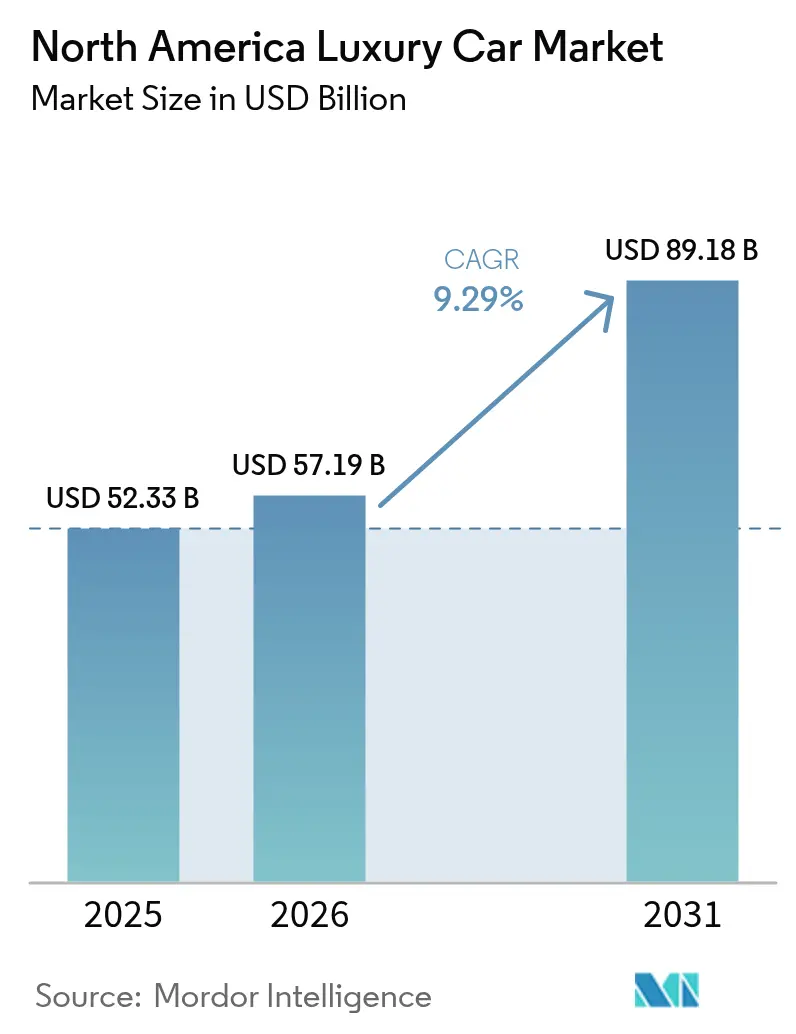
The North America luxury car market size was valued at USD 52.33 billion in 2025 and estimated to grow from USD 57.19 billion in 2026 to reach USD 89.18 billion by 2031, at a CAGR of 9.29% during the forecast period (2026-2031). The expansion rests on a generational shift as wealth moves to millennials and Gen-Z, who place a higher weight on digital integration, electrification, and responsible sourcing. Luxury nameplates are launching SUV-heavy portfolios, enlarging average selling prices, and protecting margins even as financing costs rise. The pivot toward battery-electric nameplates, spurred by Canadian purchase incentives and stricter fleet-emission rules, further elevates demand for premium EVs. Supply-side investments in localized battery packs, coupled with over-the-air upgrade revenues, allow automakers to absorb raw-material volatility while keeping profit pools attractive. Meanwhile, digital retail channels build relevance among affluent digital natives, accelerating a wider move away from exclusive reliance on franchised dealers.
Key Report Takeaways
- By vehicle type, SUVs and crossovers led with 55.18% of the North America luxury car market share in 2025 while recording a forecast of 10.52% CAGR through 2031.
- By drive type, battery-electric vehicles will post the fastest growth at an 10.76% CAGR, whereas internal-combustion engines retained 64.70% share of the North America luxury car market size in 2025.
- By price band, the premium tier (USD 50,000-100,000) accounted for 41.62% of the North America luxury car market size in 2025; the upper-premium tier (USD 100,000-200,000) is projected to expand at 11.88% CAGR to 2031.
- By sales channel, franchised dealers held 60.92% revenue share in 2025, but online marketplaces are advancing at an 11.21% CAGR through 2031.
- By geography, the United States commanded an 82.10% share in 2025, whereas Canada is set to grow at a 10.55% CAGR to 2031.
Note: Market size and forecast figures in this report are generated using Mordor Intelligence’s proprietary estimation framework, updated with the latest available data and insights as of 2026.
North America Luxury Car Market Trends and Insights
Drivers Impact Analysis*
| Driver | (~) % Impact on CAGR Forecast | Geographic Relevance | Impact Timeline |
|---|---|---|---|
| Gen-Y / HNWI Premiumization | +2.1% | North America Metros | Medium term (2-4 years) |
| ≥50% Luxury EV Target | +1.8% | Global, faster in Canada | Long term (≥ 4 years) |
| SUV-Heavy Mix Lifts ASPs | +1.4% | US suburbs | Short term (≤ 2 years) |
| OTA Feature Revenues | +0.9% | Tech-forward regions | Medium term (2-4 years) |
| Luxury Ride-Hailing & Subs | +0.6% | Key US & CA cities | Long term (≥ 4 years) |
| Blockchain CPO Programs | +0.4% | Major North America metros | Long term (≥ 4 years) |
| Source: Mordor Intelligence | |||
Premiumization Momentum Among Gen-Y/HNWIs
Wealth reallocation toward millennials and Gen-Z means that 40% of high-net-worth buyers choosing premium vehicles now come from these cohorts [1]. Their purchase logic favors embedded software, green footprints, and personalized experiences, pushing brands to craft omnichannel storefronts, connected-service bundles, and subscription-based access models. The emphasis on technology platforms rather than static status symbols raises the strategic value of over-the-air update capability and service-based upselling.
Automaker Push Toward ≥50% Luxury EV Mix by 2030
BMW Group ties senior bonuses to electrified-vehicle penetration and has aligned North American launches accordingly [2]. Canadian rebates magnify the effect, prompting faster model cadence in that market. While capital flows favor battery supply localization, firms must juggle near-term ICE profitability with heavy EV capex, making portfolio balancing a critical executive KPI.
SUV-Centered Product-Mix Realignment Raises ASPs
Affluent households prefer luxury SUVs for their commanding stance and lifestyle flexibility, enabling 15-20% higher transaction prices versus sedans. Carmakers leverage the roomier platforms to integrate flagship infotainment, sustainable interiors, and performance-oriented battery packs, reinforcing SUVs as the segment’s prestige backbone.
OTA-Driven Feature-on-Demand Revenue Streams
BMW reports early success monetizing driver-assist packages and enhanced infotainment through post-sale activations. Continuous software releases keep vehicles current and extend life-cycle value, creating a flywheel of higher gross margins while delivering personalized add-ons that resonate with tech-savvy owners.
Restraints Impact Analysis*
| Restraint | (~) % Impact on CAGR Forecast | Geographic Relevance | Impact Timeline |
|---|---|---|---|
| APR Spikes | -1.6% | Across North America | Short term (≤ 2 years) |
| BEV Resale Doubts | -1.2% | Global, premium EV segments | Medium term (2-4 years) |
| Battery Origin Rules | -0.8% | United States, EV supply chains | Medium term (2-4 years) |
| ADAS Litigation Risk | -0.5% | North America, regulatory focus | Short term (≤ 2 years) |
| Source: Mordor Intelligence | |||
Inflation-Induced APR Spikes Squeeze Leasing Uptake
Lease payments have risen 25-30% versus pre-inflation benchmarks, disproportionately affecting younger aspirational buyers and eroding the entry-luxury funnel. Automakers are countering with longer-tenor leases, subscription pilots, and interest-rate buydowns to protect volume.
BEV Resale-Value Uncertainty Dents Buyer Confidence
Rapid battery innovation and ambiguous second-life economics drive depreciation anxiety, amplifying hesitation in purchasing high-ticket EVs. In the ultra-luxury sphere, anticipated three-year maintenance bills can exceed USD 450,000, as seen with the Aston Martin Valkyrie. Manufacturers respond with buy-back guarantees and long-horizon battery warranties to safeguard brand equity.
*Our forecasts treat driver/restraint impacts as directional, not additive. The impact forecasts reflect baseline growth, mix effects, and variable interactions.
Segment Analysis
By Vehicle Type: SUVs Extend Market Leadership
The North America luxury car market size attributed to SUVs reached 55.18% in 2025, supported by a 10.52% forecast CAGR. Positioning SUVs as technology flagships unlocks superior margins, letting manufacturers offset electrification costs. Continuous EV SUV introductions by BMW, Mercedes-Benz, and newcomers sustain momentum. Sedans continue to resonate in densely populated metros yet yield ground to SUVs among younger families. Coupes, convertibles, and hatchbacks serve enthusiast niches, collectively under 5% of volume.
A longer wheelbase allows SUVs to house larger battery packs without cabin compromise. Consequently, battery-electric SUVs bridge performance expectations and environmental commitments, making them strategic launchpads for next-gen driver-assist suites. The emotional appeal of heightened seating and versatile cargo room cements the SUV as a luxury staple.


By Drive Type: ICE Holds Majority as EV Surges
Internal-combustion engines still represented 64.70% of the North America luxury car market share in 2025, but battery-electric vehicles will log an 10.76% CAGR through 2031. Hybrids provide a transitional hedge for buyers with occasional long-distance needs, while plug-in hybrids give daily electric range without charging network dependency. Lexus’ fuel-cell pilot remains limited by hydrogen infrastructure.
The regulatory blueprint in Canada and state-level zero-emission mandates in the United States compress timelines, motivating OEMs to accelerate dedicated EV platforms. Tesla’s entrenched mindshare forces incumbents to match over-the-air proficiency and charging ecosystems, intensifying capital deployment toward electrification.
By Price Band: Upper-Premium Accelerates Trading-Up Trend
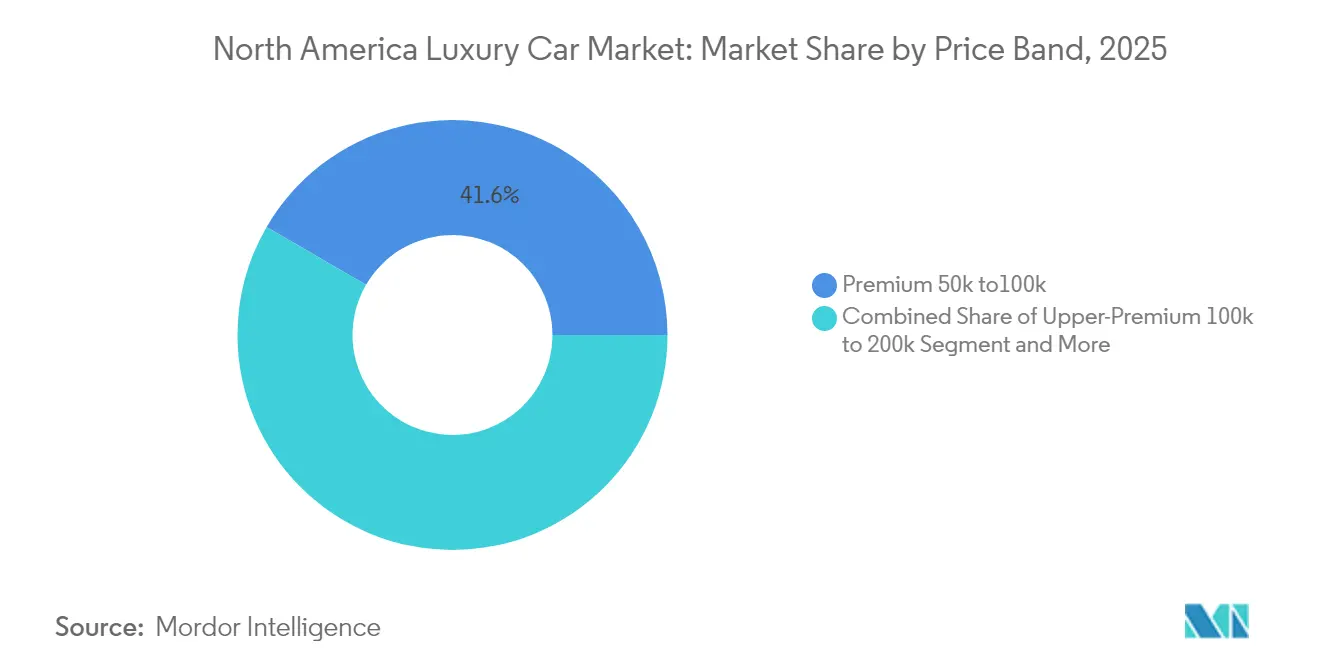
The premium bracket (USD 50,000-100,000) remained the volume anchor at 41.62% of the North America luxury car market size in 2025. Yet the upper-premium tier grows the fastest at 11.88% CAGR as affluent buyers prioritize full-suite ADAS, bespoke interiors, and brand cachet over price sensitivity. Ultra-luxury vehicles priced above USD 200,000 entail extreme ownership costs, where maintenance alone can outstrip the original purchase price of many entry luxury cars.
Pared inventory strategies further propel trading-up behavior when consumers accept higher trims in exchange for shorter waiting times. Digital configuration tools showcasing premium materials and limited-edition specs reinforce upsell momentum.
By Sales Channel: Omnichannel Redefines Retail
Franchised outlets held a 60.92% share in 2025, yet online journeys now influence more than 80% of North America luxury car market purchase decisions. Tesla’s factory-direct model proved compelling, nudging incumbents to roll out reservation portals, remote paperwork, and at-home delivery. A younger demographic welcomes transparent pricing and time-efficient transactions, boosting online marketplaces at an 11.21% CAGR.
Subscription fleets introduce flexibility, bundling insurance, maintenance, and roadside assistance. For manufacturers, direct data capture from digital sales feeds analytics loops that guide personalized service offerings and service-based revenue streams, aligning with over-the-air monetization ambitions.
Geography Analysis
The North America luxury car market is geographically led by the United States, which controlled 82.10% share in 2025. High concentrations of millionaires, established dealer infrastructure, and long-standing brand hierarchies sustain luxury consumption. Yet, climbing student debt and rising mortgage costs place pressure on entry-level luxury adoption. American buyers particularly favor full-sized SUVs and pickup-derived luxury trucks, nudging OEMs to prioritize these body styles.
Canada, although smaller in absolute volume, is forecast to post a 10.55% CAGR as federal incentives of up to CAD 5,000 for zero-emission vehicles tilt the demand mix toward premium EVs. Urban hubs such as Toronto, Vancouver, and Montreal account for the lion’s share of orders, and buyers exhibit higher openness to European makes and electrified drivetrains. BMW Group already ranks among the best-selling premium brands in the country.
Mexico and the rest of North America remain nascent but strategically important. Rising disposable incomes in Mexico City, Monterrey, and Guadalajara encourage aspirational premium purchases, though currency swings and import tariffs introduce volatility. Over time, localized final-assembly initiatives could mitigate cost barriers and unlock mid-single-digit regional growth.
Regulatory Landscape
The North America luxury car market operates under tightening safety and emissions oversight led by NHTSA and the U.S. EPA, while Canada continues to align vehicle compliance through Transport Canada frameworks. In June 2026, NHTSA published a final rule amending FMVSS No. 214, 305a, and 307, setting mandatory applicability for FMVSS 305a beginning September 1, 2027, which raises compliance requirements for electrified-vehicle crash safety and battery integrity in premium lineups.\n\nTrade and cross-border rules influence product planning and sourcing. The United States implemented 25% Section 232 tariffs on imported automobiles in April 2025, and in April 2026 manufacturers became eligible to apply for import adjustment offset amounts tied to the aggregate MSRP of U.S.-assembled vehicles, reinforcing incentives for localized assembly and higher regional content. On emissions, the EPA issued a proposal in May 2026 to delay Tier 4 criteria pollutant standards for light and medium-duty vehicles by two years to model year 2029, changing near-term compliance timing and calibrations for luxury ICE and hybrid portfolios.
Value Chain Analysis
Luxury vehicle value creation in North America centers on platform engineering and brand-led product definition, followed by high-value component sourcing (power electronics, batteries, semiconductors, advanced sensors, and premium interior materials), vehicle assembly, and software integration that enables connected services and over-the-air feature activation. Distribution remains dominated by franchised dealers for delivery and service, but OEM digital commerce and online marketplaces increasingly shape configuration, financing, and transaction flows, with aftersales, certified-pre-owned programs, and software-enabled upgrades acting as recurring profit pools.\n\nOn the supply side, semiconductor availability and cross-border logistics are pivotal constraints for feature-rich luxury vehicles, especially where mature-node automotive chips and memory are required for infotainment and ADAS controllers. Localization efforts are expanding to reduce transoceanic exposure and trade friction within the USMCA bloc, with added emphasis on domestic supply for EV-critical components; for example, Robert Bosch GmbH confirmed the start of sample production at its U.S. semiconductor plant in Roseville, California in July 2026, supported by a USD 225 million CHIPS Act subsidy. At the same time, tighter enforcement affecting U.S.-Mexico transport (including B-1 visa and cabotage compliance) has reduced available logistics capacity for some lanes, increasing lead-time and cost sensitivity for just-in-time vehicle and component flows.
Competitive Landscape
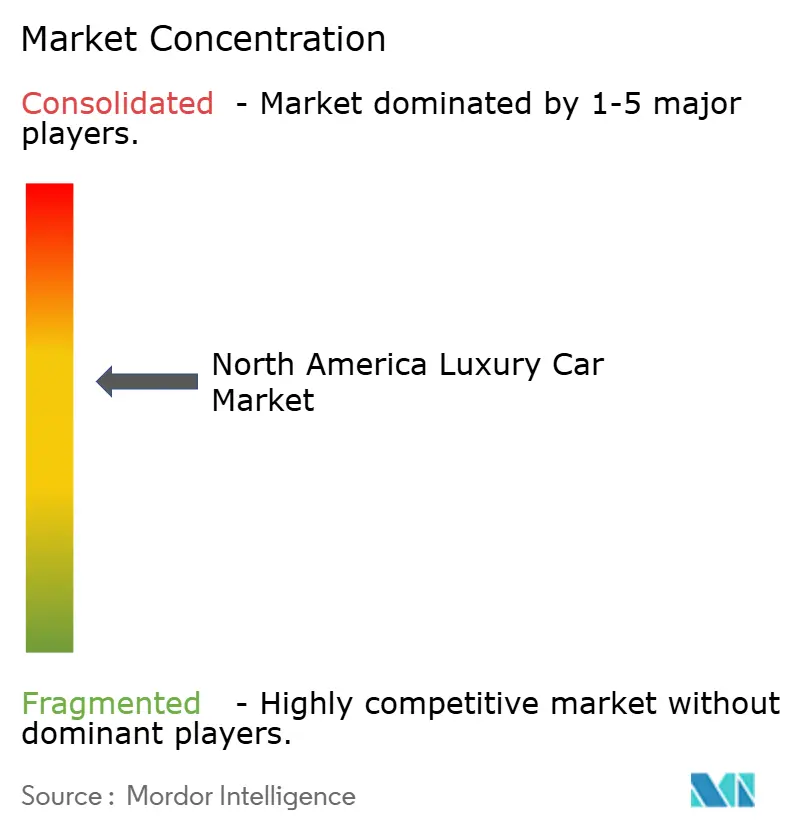
The North America luxury car market features a crowded field of German stalwarts—BMW, Mercedes-Benz, and Audi—alongside American badges such as Cadillac and Lincoln, and pure-play electric specialists led by Tesla. Each marque guards long-standing brand equity while pursuing fresh digital storefronts that echo Tesla’s factory-direct experience. Newcomers Lucid and Rivian sharpen the contest by offering performance-first EVs paired with concierge-level after-sales touchpoints.
Incumbent automakers hedge their profitable ICE portfolios while assigning multibillion-dollar budgets to dedicated EV architectures, battery plants, and software-defined vehicle platforms. BMW Group directs a sizable North American capital program toward cell production and regionalized assembly to satisfy rules-of-origin provisions. Cadillac accelerates the Celestiq and Escalade IQ pipelines to reclaim premium-EV mindshare, whereas Mercedes-Benz scales its MB.OS operating system to unlock over-the-air monetization.
Regulation intensifies both opportunity and risk. NHTSA’s proposed automatic-emergency-braking mandate promises sizeable safety benefits but raises compliance thresholds that favor brands with mature ADAS stacks [3]. Battery end-of-life rules are nudging firms to launch certified second-life programs that bolster sustainability narratives and reassure affluent buyers. In parallel, subscription-centric revenue models and performance-unlock downloads underscore a broader pivot toward software as a primary battleground for differentiation.
North America Luxury Car Industry Leaders
-
Tesla Inc.
-
BMW AG
-
Mercedes-Benz Group AG
-
Volkswagen AG
-
Toyota Motor Corporation (Lexus)
- *Disclaimer: Major Players sorted in no particular order
Market Opportunities and Future Outlook
A clear opportunity is expanding North American premium SUV and EV capacity on flexible manufacturing footprints that can build multiple powertrains, helping OEMs respond to tariff and rules-of-origin pressure while keeping high-margin nameplates close to demand centers. Mercedes-Benz announced a USD 4 billion investment in March 2026 to upgrade its Tuscaloosa, Alabama plant to support SUV models and EV variants through 2030, and it also formally established Atlanta, Georgia as its North American headquarters in April 2026 with an R&D hub, reinforcing local engineering and faster product/software iteration for the region.\n\nManufacturing and supply localization also opens whitespace for premium brands to deepen U.S.-based sourcing and reduce exposure to shifting trade conditions under USMCA review. Toyota announced a USD 3.6 billion expansion of its San Antonio, Texas manufacturing campus to add a second vehicle assembly line by 2030, creating 2,000 jobs by 2030, and Hyundai accelerated scaling of Hyundai Motor Group Metaplant America in Georgia in May 2026 (initial 300,000-unit capacity with modular scalability). These investments reinforce a regional path for luxury and near-luxury models to pair software-defined features with locally assembled vehicles, while supplier-side moves such as Bosch starting U.S. semiconductor sample production support higher ADAS and infotainment content without relying entirely on overseas allocation.
Recent Industry Developments
- March 2026: Mercedes-Benz announced a USD 4 billion investment to upgrade its Tuscaloosa, Alabama plant to support SUV models and EV variants through 2030. The move reinforces local production capacity and accelerates regional engineering work for next-generation vehicles.
- July 2026: Robert Bosch GmbH started U.S. semiconductor sample production at its Roseville, California plant, supported by a USD 225 million CHIPS Act subsidy. This expands domestic supply for ADAS and infotainment content and reduces dependence on foreign chip allocations.
- July 2026: Toyota announced a USD 3.6 billion expansion of its San Antonio, Texas manufacturing campus to add a second vehicle assembly line by 2030, creating 2,000 jobs by 2030. The expansion strengthens North American capacity for premium and mass-market models and supports local supply chain resilience.
Research Methodology Framework and Report Scope
Market Definition and Coverage
This market is defined as the value of factory-new luxury passenger cars sold in North America, captured at the point of vehicle sale through franchised or brand-owned outlets. The focus stays on vehicles positioned as luxury based on pricing and buyer expectations for premium features and performance.
Scope exclusions: Used and gray-market imports, commercial vans, rental fleet purchases, and aftermarket accessories are excluded from the market value.
Segmentation Overview
- By Vehicle Type
- Sedan
- SUV/Crossover
- Hatchback
- Coupe
- Convertible
- By Drive Type
- Internal Combustion Engine (ICE)
- Mild/Full Hybrid
- Plug-in Hybrid Vehicle (PHEV)
- Battery-Electric Vehicle (BEV)
- Fuel-Cell Electric Vehicle (FCEV)
- By Price Band
- Premium 50k USD to 100k USD
- Upper-Premium 100k USD to 200k USD
- Ultra-Luxury Above 200k USD
- By Sales Channel
- Franchised Dealer
- Direct-to-Consumer
- Online Marketplace
- Subscription/Lease Fleet
- By Country
- United States
- Canada
- Rest of North America
Data Sources, Market Sizing, and Validation
Desk Research
Desk research was used to set the factual base for demand, pricing, and policy signals that influence luxury vehicle sales in North America. We used public sources such as U.S. BEA and BLS releases for income and inflation context, U.S. EPA fuel economy and emissions datasets, NHTSA safety and recall information, and customs and trade statistics from the U.S. ITC and Statistics Canada.
We also reviewed automaker annual reports, investor presentations, and official press updates to track model cycles and technology launches that can shift mix. Paid subscriptions for company financials and news intelligence were used selectively to cross-check revenue disclosures and major capacity or distribution announcements. This list is not exhaustive, and other public documents and datasets were also referenced as needed for data collection and cross-checking.
Primary Interviews and Surveys
Primary inputs came from interviews and structured surveys with OEM-facing executives, dealer and distributor leaders, financing and leasing stakeholders, and aftermarket-adjacent observers who track buyer preferences (even though accessories are not counted). For North America, we covered viewpoints across the United States and Canada, and we used these discussions to confirm luxury price thresholds, model mix shifts toward SUVs, and realistic pricing progression assumptions.
Distribution of primary research fieldwork respondents
| Company type | Respondent position |
|---|---|
| Top tier: 39% | CXOs: 17% |
| Mid tier: 42% | Functional/Unit leaders: 36% |
| Smaller Players: 19% | Managers: 47% |
Market-Sizing & Forecasting
Market size was built using a top-down demand reconstruction that starts from North America new passenger vehicle sales and then filters to the luxury-eligible pool using price thresholds, body-type mix, and registration level signals. Once that demand pool is set, average transaction price ranges were applied by major body types to translate unit demand into USD value.
To keep the totals realistic, we ran selective bottom-up approximations, such as sampling model-level volumes visible in public sales releases and validating implied pricing through dealer feedback and financing and leasing mix. When a data point was missing for a smaller country or a niche body type, we used proxy ratios based on nearby markets, and then we tested the impact in the model before finalizing.
Forecasting relied mainly on scenario analysis supported by a light multivariate regression view, where luxury demand was linked to real disposable income trends, interest rate direction, premium SUV share, electrified luxury adoption, and expected model refresh cadence. Assumptions were adjusted after expert feedback so the forecast reflects practical constraints like supply availability and shifting incentive intensity.
Data Validation & Update Cycle
Outputs were validated through triangulation across independent signals, including new vehicle sales direction, price inflation patterns, and observed shifts in luxury mix by body type and propulsion. Any large variance triggered a second pass on inputs, followed by peer review, and then targeted re-contact with a few interviewees to confirm the specific assumption driving the gap.
The report is refreshed on an annual cycle, and interim updates are made when material events occur, such as major policy moves, sharp interest rate changes, or supply disruptions that affect luxury deliveries. Before publication, we do a final review pass so the delivered numbers reflect the latest available public data and confirmed market feedback.
Mordor Intelligence's North America Luxury Car Market Size Measured Against Other Published Estimates
Published market values for luxury cars in North America can look far apart, even when they seem to talk about the same vehicles. The gaps usually come from different choices on what counts as luxury, whether used and fleet channels are included, and how pricing is converted into a single USD value.
Some sources broaden the scope by blending in pre-owned luxury sales and related revenue streams around the vehicle transaction. Mordor Intelligence limits the market to factory-new luxury passenger vehicles sold through franchised or brand-owned outlets, and it also excludes rental fleets and aftermarket accessories, which reduces double counting and keeps the model tied to new-vehicle demand signals.
Benchmark comparison
| Source | Market Size | Gaps in Research Methodology |
|---|---|---|
| Mordor Intelligence | USD 52.33 B (2025) | |
| Trade Journal A | USD 82.05 B (2030) | Year is a later endpoint, and the scope narrative suggests a broader luxury definition that may blend premium tiers and channel effects, so the number is not directly comparable to a new-vehicle-only value for 2025. |
| Regional Consultancy B | USD 89.18 B (2031) | Uses a different end year and may apply a growth-led projection path without clearly stating the luxury price cutoffs or whether fleet and used-market activity is excluded, which can shift the total upward. |
Across the table, the spread is mainly explained by time horizon and what each publisher counts as part of the luxury car transaction. By keeping the scope anchored to new-vehicle sales value and then validating key inputs like price progression and mix changes through interviews, our estimate stays traceable to clear demand drivers and repeatable steps.
Key Questions Answered in the Report
What is the current value of the North America luxury car market?
The market stands at USD 57.19 billion in 2026 and is forecast to reach USD 89.18 billion by 2031, marking a 9.29% CAGR.
Which vehicle type dominates sales?
SUVs lead with 55.18% share in 2025 and are projected to grow at a 10.52% CAGR through 2031.
How fast is the luxury EV segment expanding?
Battery-electric vehicles are set to grow at an 10.76% CAGR, the quickest among drivetrains, reflecting policy support and model proliferation.
What geographic market is growing the quickest?
Canada is the fastest-expanding geography, expected to post a 10.55% CAGR through 2031 due to generous EV incentives.