
Market Overview
| Study Period | 2021 - 2031 |
|---|---|
| Forecast Data Period | 2026 - 2031 |
| Base Year Market Size (2025) | USD 14.58 Billion |
| Market Size (2026) | USD 15.21 Billion |
| Market Size (2031) | USD 18.75 Billion |
| Growth Rate (2026 - 2031) | 4.28 % |
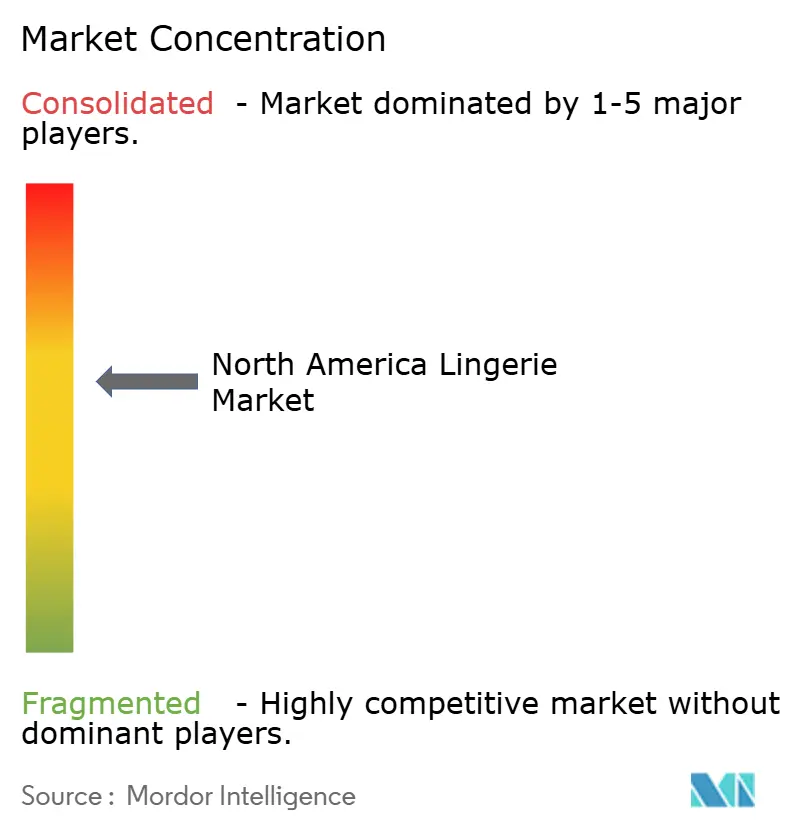
| Market Concentration | Medium |
Major Players *Disclaimer: Major Players sorted in no particular order Image © Mordor Intelligence. Reuse requires attribution under CC BY 4.0. | |
North America Lingerie Market Analysis by Mordor Intelligence
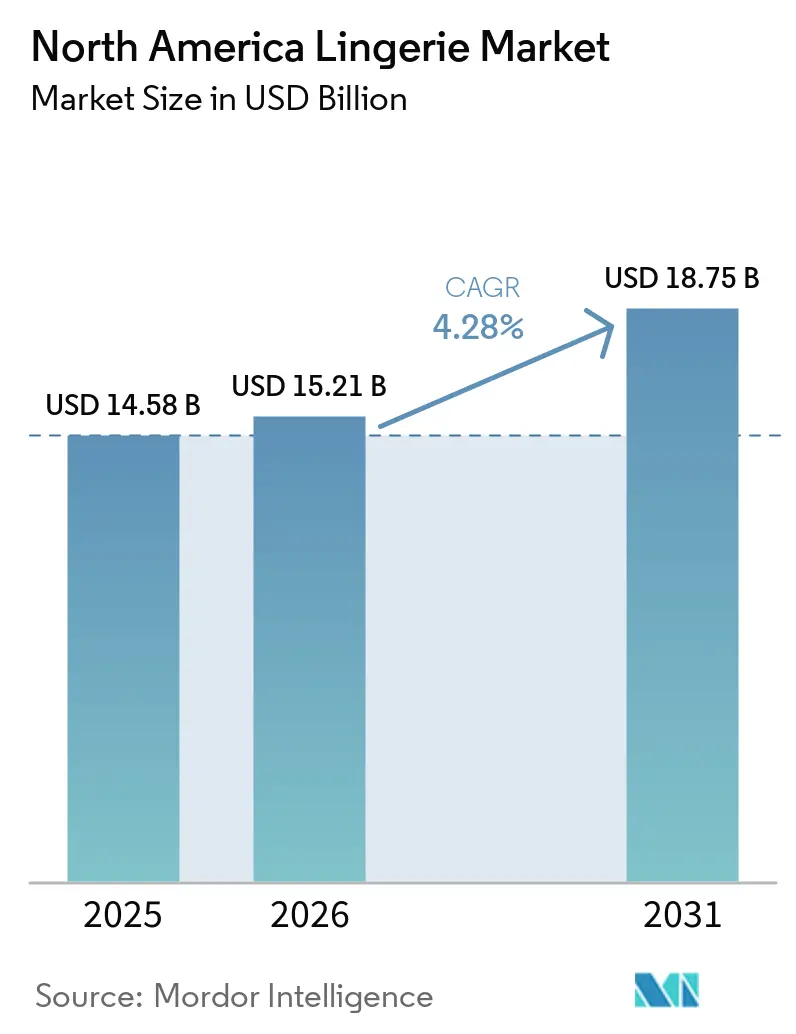
The North America Lingerie Market size in 2026 is estimated at USD 15.21 billion, growing from 2025 value of USD 14.58 billion with 2031 projections showing USD 18.75 billion, growing at 4.28% CAGR over 2026-2031. This growth trajectory reflects a market undergoing fundamental transformation, driven by evolving consumer expectations around body positivity, technological innovation in fabrics, and the accelerating shift toward direct-to-consumer channels. The market's moderate but steady expansion masks significant underlying disruptions, particularly the decline of traditional wholesale models and the rise of digitally native brands that prioritize inclusive sizing and personalized fit solutions. Digitally native labels are eroding the primacy of wholesale distribution as personalized fit algorithms, virtual try-ons, and narrative-rich social media campaigns lift conversion and loyalty. Meanwhile, sustainability imperatives are accelerating fiber substitution, and the pace of mergers, acquisitions, and retail partnerships underscores a market that rewards agility. Competitive intensity is moderated yet meaningful; a market concentration score of 6 indicates ample room for incumbents and disruptors alike to gain share through differentiated positioning.
Key Report Takeaways
- By product category, brassieres held 52.05% of North American lingerie market share in 2025, while briefs are projected to grow at a 4.96% CAGR through 2031.
- By price range, the mass segment commanded 70.18% of the North American lingerie market size in 2025; premium products are advancing at a 6.05% CAGR to 2031.
- By material, cotton accounted for 54.86% share of the North American lingerie market size in 2025, whereas recycled and bio-based fibers are expanding at a 5.58% CAGR.
- By distribution channel, specialty stores led with 40.27% revenue share in 2025, yet online retail stores are forecast to post a 6.53% CAGR through 2031.
- By geography, the United States captured 83.62% of North American lingerie market share in 2025, while Canada is expected to register a 6.42% CAGR from 2026-2031.
Note: Market size and forecast figures in this report are generated using Mordor Intelligence’s proprietary estimation framework, updated with the latest available data and insights as of 2026.
Market Trends and Insights
Drivers Impact Analysis of North America Lingerie Market*
| Driver | (~) % Impact on CAGR Forecast | Geographic Relevance | Impact Timeline |
|---|---|---|---|
| Demand for Comfortable and Stylish Lingerie | +1.2% | North America, with strongest adoption in urban centers | Medium term (2-4 years) |
| Growth of Body Positivity and Size Inclusivity | +0.8% | United States and Canada, expanding to Mexico | Long term (≥ 4 years) |
| Impact of Social Media and Influencer Marketing | +0.6% | North America, particularly among Gen Z and Millennial demographics | Short term (≤ 2 years) |
| Rising Focus on Sustainability and Eco-friendly Materials | +0.5% | United States and Canada, with regulatory influence from GOTS and OEKO-TEX standards | Long term (≥ 4 years) |
| Innovations in Fabric and Design Technology | +0.4% | North America, with technology adoption led by premium brands | Medium term (2-4 years) |
| Expansion of E-Commerce and Online Sales | +0.9% | North America, accelerated by post-pandemic digital adoption | Short term (≤ 2 years) |
| Source: Mordor Intelligence | |||
Demand for Comfortable and Stylish Lingerie
The convergence of comfort and style represents a fundamental shift in consumer priorities, moving beyond traditional aesthetic-focused purchasing decisions toward functionality-driven choices. This trend gained significant momentum during the pandemic as remote work normalized comfort-first apparel, with consumers increasingly refusing to compromise between appearance and wearability. The LYCRA Company's ADAPTIV fiber technology exemplifies this evolution, delivering dynamic compression that adapts to movement while maintaining shaping properties, addressing the core tension between support and comfort. American Eagle's Aerie brand capitalized on this shift, achieving record quarterly revenue of USD 539.7 million in Q4 2024 through collections emphasizing soft fabrics and wireless designs that prioritize comfort without sacrificing style. This driver particularly impacts the premium segment, where consumers demonstrate willingness to pay higher prices for innovative materials and construction techniques that deliver superior comfort. The trend extends beyond product features to encompass brand messaging, with successful companies positioning comfort as a form of self-care rather than compromise.
Growth of Body Positivity and Size Inclusivity
The body positivity movement has evolved from social activism into a core business imperative, fundamentally reshaping product development, marketing strategies, and brand positioning across the industry. This transformation extends beyond expanded size ranges to encompass inclusive design principles, diverse representation in marketing campaigns, and the rejection of traditional beauty standards that historically dominated lingerie advertising. American Eagle's Aerie brand demonstrates the commercial viability of this approach, achieving 21 consecutive quarters of double-digit comparable sales growth through 2024 by embracing unretouched photography and size inclusivity. The movement's impact transcends marketing aesthetics, driving substantive changes in product development processes, with brands investing in fit studies across diverse body types and expanding size ranges to accommodate previously underserved segments. Research indicates that over one-third of women fall between standard cup sizes, creating significant market opportunities for brands offering half-cup sizing and personalized fit solutions. This driver particularly benefits direct-to-consumer brands that can rapidly iterate product offerings based on customer feedback and data analytics.
Impact of Social Media and Influencer Marketing
Social media platforms have transformed lingerie marketing from traditional advertising to community-driven brand building, enabling direct consumer engagement and authentic product endorsement through influencer partnerships. This shift proves particularly powerful in intimate apparel, where traditional advertising often felt disconnected from real consumer experiences and body diversity. Platforms like Instagram and TikTok allow brands to showcase products on diverse body types, demonstrate fit and comfort through user-generated content, and build communities around shared values rather than aspirational imagery alone. The effectiveness of this approach is evidenced by digitally native brands achieving significant market penetration despite limited traditional advertising budgets, leveraging organic social content and micro-influencer partnerships to drive awareness and conversion. Victoria's Secret's strategic pivot illustrates the urgency of this transformation, launching campaigns featuring diverse talent and authentic storytelling to reconnect with consumers who had migrated to more inclusive brands. The channel's impact extends beyond marketing to product development, with social media feedback directly informing design decisions and size range expansions.
Innovations in Fabric and Design Technology
Technological advancement in textile engineering has unlocked new performance capabilities that address longstanding consumer pain points while enabling entirely new product categories and market segments. Smart textiles incorporating phase-change materials, moisture-wicking properties, and temperature regulation represent the convergence of fashion and function, creating competitive advantages for brands that successfully integrate these innovations. Outlast Technologies' temperature regulation technology, utilizing microencapsulated phase-change wax, demonstrates how advanced materials can deliver measurable comfort benefits, claiming up to 48% reduction in sweat production. These innovations particularly impact the sports bra and activewear segments, where performance requirements drive premium pricing and brand differentiation. Nike's development of wearable pump-compatible sports bras for mothers illustrates how technology can address specific consumer needs while creating new market categories. The driver's medium-term impact reflects the time required for technology adoption and consumer education, but early movers gain significant competitive advantages through patent protection and brand association with innovation.
Restraints Impact Analysis of North America Lingerie Market*
| Restraint | (~) % Impact on CAGR Forecast | Geographic Relevance | Impact Timeline |
|---|---|---|---|
| Competition from Fast Fashion and Private Labels | -0.7% | North America, with particular pressure in Mexico from Chinese platforms | Short term (≤ 2 years) |
| Proliferation of Counterfeit and Low-Quality Products | -0.4% | United States and Canada, with enforcement challenges in cross-border e-commerce | Medium term (2-4 years) |
| Fit-related Concerns in Online Purchases | -0.5% | North America, affecting all demographics but particularly older consumers | Medium term (2-4 years) |
| Rapidly Changing Fashion Trends | -0.3% | North America, with fastest impact on younger consumer segments | Short term (≤ 2 years) |
| Source: Mordor Intelligence | |||
Proliferation of Counterfeit and Low-Quality Products
Counterfeit intimate apparel poses multifaceted challenges encompassing consumer safety, brand integrity, and market share erosion, with enforcement complexity amplified by cross-border e-commerce and sophisticated distribution networks. U.S. Customs and Border Protection seized counterfeit goods worth nearly USD 1.3 billion in fiscal 2020, with wearing apparel and accessories representing 26.2% of seizure lines by count, indicating the scale of illicit trade affecting legitimate market participants [1]. The largest-ever counterfeit goods seizure in U.S. history occurred in 2023, involving approximately 219,000 items with an estimated manufacturer's suggested retail price of about USD 1.03 billion, demonstrating the sophisticated operations undermining authentic brands [2]. E-commerce platforms facilitate counterfeit distribution, with over 90% of intellectual property rights seizures occurring in international mail and express shipments, complicating enforcement efforts and consumer protection. The restraint particularly impacts premium brands whose higher price points create attractive targets for counterfeiters, while consumer safety concerns arise from substandard materials that may not meet flammability standards required under the Consumer Product Safety Commission's Flammable Fabrics Act [3].
Rapidly Changing Fashion Trends
Accelerated trend cycles driven by social media and fast fashion have compressed product development timelines while increasing inventory risk, forcing brands to balance trend responsiveness with sustainable business practices and quality standards. This dynamic particularly challenges intimate apparel brands that traditionally operated on seasonal collections and longer product lifecycles, now facing pressure to introduce new styles and colorways at unprecedented frequency. The tension between trend-driven demand and the intimate nature of lingerie purchases creates complex consumer behavior patterns, where some segments prioritize fashion-forward designs while others seek timeless, high-quality pieces that transcend seasonal trends. Social media platforms amplify trend velocity by enabling rapid style dissemination and creating viral moments that can drive sudden demand spikes for specific products or aesthetics, requiring sophisticated demand forecasting and agile supply chain capabilities. Brands must navigate this environment while maintaining brand identity and quality standards, as the intimate nature of the category means that poor-quality trend pieces can damage long-term customer relationships more severely than in other fashion categories. The restraint's short-term impact reflects the immediate pressure on inventory management and product development cycles, while the long-term implications include potential brand dilution and increased operational complexity.
*Our forecasts treat driver/restraint impacts as directional, not additive. The impact forecasts reflect baseline growth, mix effects, and variable interactions.
North America Lingerie Market Segment Analysis
By Product Type:
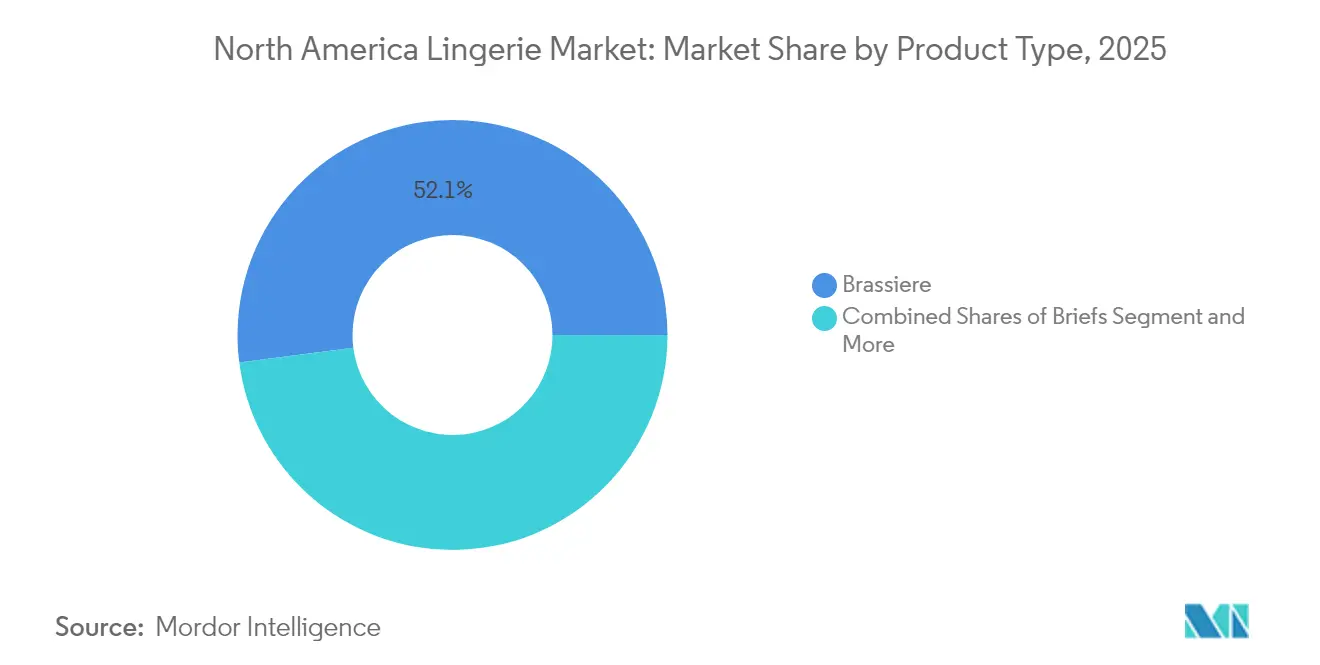
Brassieres Dominate Despite Brief InnovationBrassieres command 52.05% market share in 2025, reflecting their fundamental role in women's wardrobes and the category's continued innovation in comfort, support, and style integration. However, briefs emerge as the fastest-growing segment with 4.96% CAGR through 2031, driven by technological advances in moisture-wicking fabrics, seamless construction, and body-positive sizing approaches that address previously underserved market segments. The brassiere segment's dominance stems from higher average selling prices and frequent replacement cycles, with consumers increasingly willing to invest in premium options that deliver superior fit and comfort. Victoria's Secret's Dream Collection launch in 2024, featuring ForeverStretch Lace and Marshmallow Memory Foam padding across sizes 32-40 bands and A-G cups, illustrates how established players are innovating within traditional categories to maintain market leadership.
Other product types, including shapewear, loungewear, and specialty items, represent emerging opportunities as consumer preferences expand beyond traditional intimate apparel categories. The convergence of activewear and intimate apparel has created hybrid products that serve multiple functions, appealing to consumers seeking versatility and value in their purchases. Nike's development of pump-compatible sports bras demonstrates how major brands are expanding into specialized segments that address specific consumer needs while commanding premium pricing. Regulatory compliance factors, particularly Consumer Product Safety Commission flammability standards under 16 CFR Part 1610, influence product development across all segments of the underwear market, requiring manufacturers to ensure materials meet safety requirements while maintaining aesthetic and functional properties

By Price Range:
Premium Growth Outpaces Mass MarketThe mass market segment maintains 70.18% share in 2025, reflecting the broad consumer base seeking accessible pricing for essential intimate apparel, yet premium offerings surge ahead with 6.05% CAGR, indicating significant opportunities for brands that successfully differentiate through quality, innovation, and brand positioning. This divergence reflects a bifurcating market where value-conscious consumers gravitate toward functional, affordable options while a growing segment prioritizes premium features, sustainable materials, and personalized experiences worth higher price points. American Eagle's Aerie brand exemplifies successful premium positioning within accessible luxury, achieving record revenues through inclusive sizing, body-positive messaging, and quality construction that justifies price premiums over fast fashion alternatives.
Victoria's Secret's collaboration with designer Joseph Altuzarra, launching limited-edition pieces priced between USD 95-500, demonstrates how established brands are exploring ultra-premium segments to capture consumers willing to pay luxury prices for exclusive designs and superior craftsmanship. The premium segment's growth trajectory benefits from technological innovations like LYCRA ADAPTIV fiber, which enables brands to deliver measurable performance improvements that justify higher pricing through enhanced comfort and durability. Direct-to-consumer brands particularly benefit from this trend, as they can capture the full margin structure while investing in premium materials, innovative construction techniques, and personalized customer experiences that traditional wholesale models cannot economically support.
By Material:
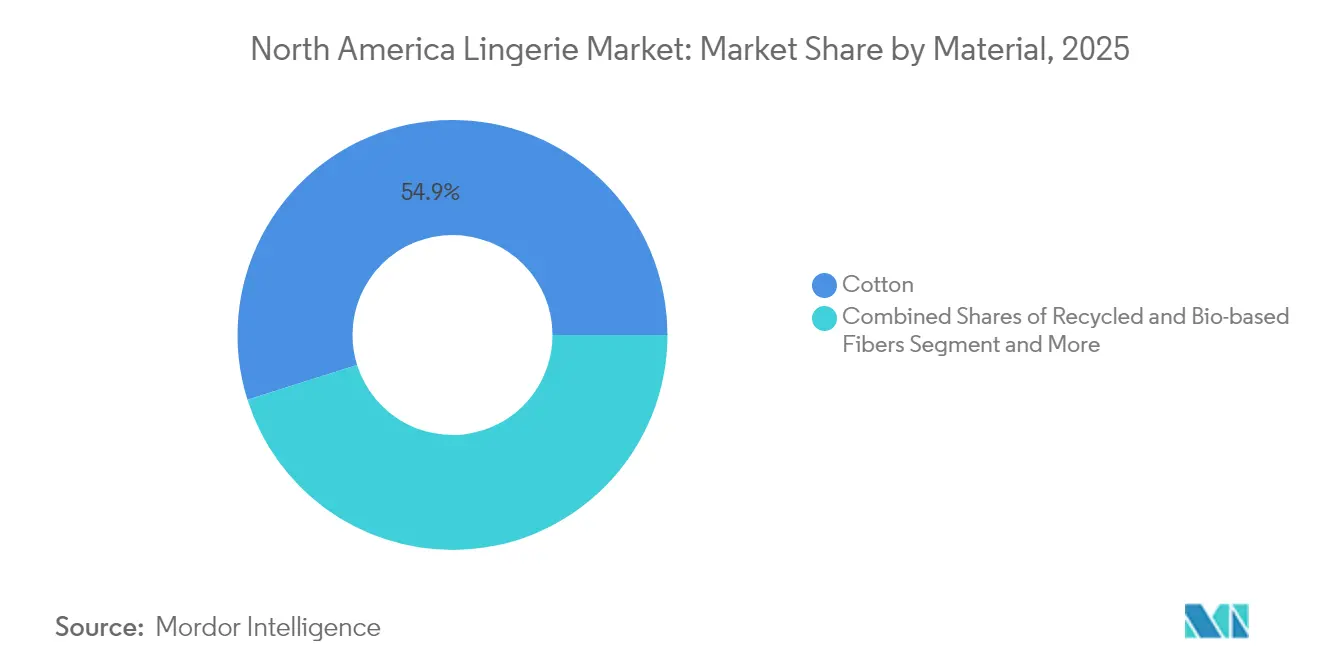
Cotton Leads While Sustainable Fibers Gain MomentumCotton maintains 54.86% market share in 2025 due to its natural breathability, comfort properties, and consumer familiarity, yet recycled and bio-based fibers represent the fastest-growing segment at 5.58% CAGR, reflecting accelerating sustainability demands and regulatory pressures for circular economy adoption. This growth trajectory indicates a fundamental shift in consumer values, particularly among younger demographics who prioritize environmental responsibility and are willing to pay premium prices for verified sustainable materials. OEKO-TEX and Global Organic Textile Standard (GOTS) certifications have become critical differentiators, providing third-party verification of environmental and social responsibility claims that increasingly influence purchasing decisions.
Silk and satin segments serve niche luxury markets where aesthetic appeal and premium positioning justify higher price points, while synthetic materials continue evolving through technological advancement in moisture management, durability, and comfort properties. The synthetic segment benefits from innovations like Outlast Technologies' temperature regulation fibers, which deliver measurable performance improvements that natural materials cannot match. Between the Sheets' use of FSC-certified modal fibers and domestic manufacturing illustrates how premium brands are building entire value propositions around sustainable material sourcing and transparent supply chains. Regulatory compliance factors, including OEKO-TEX Standard 100 testing for harmful substances, increasingly influence material selection as brands seek to minimize consumer safety risks while meeting environmental standards that appeal to conscious consumers.
By Distribution Channel:
Digital Transformation AcceleratesSpecialty stores command 40.27% market share in 2025, leveraging personalized fitting services, expert consultation, and curated product selections that address the intimate nature of lingerie purchasing, yet online retail stores project 6.53% CAGR growth, representing the fastest-expanding channel as digital natives mature and virtual fitting technologies improve. This channel evolution reflects broader retail transformation accelerated by pandemic-driven behavioral changes, with consumers who initially embraced online purchasing out of necessity now permanently integrating digital channels into their shopping behaviors. ThirdLove's expansion from pure direct-to-consumer into wholesale partnerships with Neiman Marcus and Amazon marketplace presence illustrates how digitally native brands are adopting omnichannel strategies to capture broader market opportunities.
Supermarkets and hypermarkets serve the convenience and value segments, offering basic intimate apparel alongside other household essentials, while other distribution channels include department stores, outlet centers, and emerging subscription services that provide personalized curation and automatic replenishment. The online channel's growth trajectory benefits from technological solutions addressing traditional fit concerns, with virtual sizing tools and comprehensive return policies reducing purchase barriers that historically limited digital adoption. Fit Analytics' size recommendation engine, powered by machine learning and billions of purchase records, demonstrates how technology can address the fundamental challenge of online intimate apparel shopping. The channel transformation particularly impacts inventory management and customer acquisition costs, as brands must balance the efficiency of digital fulfillment with the higher marketing investments required to drive online discovery and conversion.
Geography Analysis
United States Lingerie Market
The United States anchors the North American lingerie market with 83.62% share in 2025, driven by a mature consumer base, sophisticated retail infrastructure, and cultural leadership in intimate apparel trends that influence global market directions. American consumers demonstrate increasing sophistication in their purchasing decisions, prioritizing fit, comfort, and brand values over traditional price-focused considerations, creating opportunities for premium positioning and innovative product development. Victoria's Secret's strategic repositioning through designer collaborations and inclusive sizing, combined with Aerie's continued market share gains through body-positive messaging, illustrates the competitive dynamics reshaping the U.S. market. The market benefits from strong e-commerce infrastructure and consumer comfort with online intimate apparel purchasing, supported by comprehensive return policies and emerging virtual fitting technologies that address traditional sizing concerns.
Canada Lingerie Market
Canada emerges as the fastest-growing geography with 6.42% CAGR through 2031, reflecting expanding disposable income, increasing awareness of premium intimate apparel options, and growing adoption of direct-to-consumer brands that offer expanded sizing and inclusive messaging. Canadian consumers demonstrate particular interest in sustainable and ethically produced intimate apparel, creating opportunities for brands that can credibly communicate environmental and social responsibility throughout their supply chains. Statistics Canada's classification systems for women's lingerie, sleepwear, and underwear provide structured frameworks for market analysis, while retail sales data indicates resilient demand despite economic volatility Statistics. ThirdLove's expansion into Canadian shipping with localized pricing and customer service demonstrates how successful brands are adapting their direct-to-consumer models for cross-border growth.
Mexico Lingerie Market
Mexico represents an emerging opportunity within the North American market, though growth faces headwinds from economic challenges, currency fluctuations, and intense competition from low-cost imports that pressure both domestic manufacturing and retail pricing structures. The Mexican textile industry has lost approximately 80,000 jobs from peak employment levels as Chinese fast fashion platforms like Shein and Temu capture market share through ultra-low pricing enabled by favorable import regulations. Government responses include a 35% tariff on textile imports from countries without free trade agreements and enhanced traceability requirements for e-commerce orders, but enforcement challenges persist in digital channels. Mexican consumer spending data shows modest growth, with private consumption increasing 0.2% month-over-month in August 2024, indicating cautious but positive demand trends that could support premium intimate apparel positioning. The market's long-term potential depends on economic stability, middle-class expansion, and successful differentiation from low-cost alternatives through quality, fit, and brand positioning strategies.
Regulatory Landscape
In North America, lingerie sold through retail and e-commerce channels is governed by a mix of federal product-safety requirements, import compliance, and state-level chemical restrictions. In the United States, the Consumer Product Safety Commission (CPSC) administers the Flammable Fabrics Act and related testing and certification expectations applicable to apparel textiles, which can affect material selection and labeling for intimate apparel. A key compliance shift is the CPSC eFiling requirement under 16 CFR Part 1110, effective July 8, 2026, which requires importers of regulated products to transmit General Certificate of Conformity (GCC) and, where applicable, Children's Product Certificate (CPC) data to U.S. Customs and Border Protection (CBP) via the Automated Commercial Environment (ACE), increasing documentation rigor for cross-border supply chains.
Sustainability and chemical-management rules continue to tighten via state action and industry standards used in sourcing decisions. PFAS restrictions in apparel, including California AB 1817 and New York state measures, took effect on January 1, 2025 and influence fabric finishes and supplier declarations for brands and private labels. Alongside legal requirements, large apparel owners such as PVH Corp and Nike maintain internal supply-chain compliance frameworks (codes of conduct, factory assessments, remediation expectations), while trade bodies such as the American Apparel & Footwear Association (AAFA) and the United States Fashion Industry Association (USFIA) provide guidance on evolving labeling, safety testing, and trade compliance topics relevant to intimate apparel.
Competitive Landscape
The North American lingerie market exhibits moderate concentration, indicating significant opportunities for both consolidation by established players and market entry by innovative newcomers who can differentiate through technology, sustainability, or inclusive positioning. Legacy incumbents like Victoria's Secret are executing strategic repositioning initiatives, including designer collaborations and expanded size ranges, while simultaneously facing market share erosion to digitally native brands that better align with evolving consumer values around body positivity and authentic brand messaging.
American Eagle's Aerie brand exemplifies successful disruption within established retail frameworks, achieving 21 consecutive quarters of double-digit growth by embracing unretouched photography, inclusive sizing, and comfort-focused product development that resonates with younger demographics. The competitive landscape increasingly rewards brands that can successfully integrate omnichannel distribution strategies, with pure-play e-commerce companies like ThirdLove expanding into wholesale partnerships while traditional retailers enhance their digital capabilities and direct-to-consumer offerings. Regulatory compliance factors, particularly Consumer Product Safety Commission flammability standards and OEKO-TEX certifications, create barriers to entry that favor established players with sophisticated supply chain management capabilities while simultaneously providing differentiation opportunities for brands that exceed minimum requirements.
Technology adoption has become a critical competitive differentiator, with successful brands leveraging virtual fitting solutions, AI-powered size recommendations, and advanced fabric innovations to address longstanding consumer pain points around fit and comfort. PVH Corp's divestiture of its Heritage Brands women's intimate’s business in November 2023 illustrates how major apparel conglomerates are focusing resources on core brands like Calvin Klein while exiting lower-margin intimate apparel operations. Opportunities exist in sustainable luxury positioning, adaptive intimate apparel for specific consumer needs, and technology-enabled personalization that goes beyond traditional sizing to encompass individual preferences for support, coverage, and aesthetic appeal.
North America Lingerie Industry Leaders
-
PVH Corp.
-
Nike Inc.
-
Victoria's Secret & Co.
-
HANESBRANDS INC.
-
AEO Management Co.
- *Disclaimer: Major Players sorted in no particular order
North America Lingerie Market Companies Covered in this Report
- PVH Corp.
- Nike Inc.
- Victoria's Secret & Co.
- HANESBRANDS INC.
- AEO Management Co.
- Jockey International Inc.
- The Gap Inc.
- ThirdLove LLC
- Savage X Fenty (Kendo Holdings)
- Natori Company Incorporated
- La Perla Group
- Calvin Klein
- Triumph International Ltd.
- Hunkemoller
- Bare Necessities
- Agent Provocateur
- Clovia
- MAS Holdings
- Amante
- The Lingerie Company
Market Opportunities and Future Outlook
Online-led growth continues to hinge on fit-solutions, since fit concerns remain a persistent barrier in digital lingerie purchasing, while specialty-store fitting still supports a large share of sales. This leaves room for brands to expand size-recommendation tools, virtual fit assistance, and inclusive size architectures, reinforcing the momentum behind direct-to-consumer and omnichannel approaches already visible in the market. Victoria's Secret used 2026 campaigns and assortment updates to emphasize bra technology and comfort, and PVH highlighted underwear as a direct-to-consumer hero category for Calvin Klein, pointing to continued investment focus on core intimate categories with higher repeat potential.
Compliance-driven sourcing and substantiated sustainability claims also offer a practical opportunity. State-level chemical rules, including PFAS restrictions effective January 1, 2025, and broader scrutiny of environmental and social assertions raise expectations for supplier documentation and testing. Brands that can operationalize traceability, consistent product testing, and clearer labeling can reduce friction in cross-border e-commerce and import flows, particularly as U.S. requirements such as CPSC eFiling (effective July 8, 2026) formalize certificate data transmission into CBP systems. Separately, tariff and trade-policy uncertainty, including potential shifts tied to U.S. trade tools such as Section 301 and Section 232, continues to prompt sourcing and logistics reassessments, creating space for nearshore and dual-sourcing strategies in intimate apparel supply chains.
Recent Industry Developments in North America Lingerie Market
- July 2026: Victoria's Secret PINK launches Marshmallow Bra Collection with four wireless silhouettes. The launch expands Victoria's Secret PINKs product lineup with wireless silhouettes designed for everyday comfort. It supports DTC-led brand positioning in PINK, with a continued emphasis on day-to-day comfort.
- June 2026: Calvin Klein grew full hero categories in Direct-to-Consumer channels, specifically underwear. The expansion into DTC channels reinforces direct retail momentum for the brand. This supports PVH+ strategic push and potential margin uplift through DTC channel expansion.
- April 2026: Victoria's Secret Season of Strapless campaign and collection launched, featuring Invisible by Victoria Strapless Collection. The seasonal push broadens strapless bra technology and styling options for consumers. It reinforces product innovation and omni-channel outreach to drive category growth.
North America Lingerie Market Report Scope and Research Methodology
Market Definition and Coverage
For this study, the market is defined as revenue earned from lingerie products sold to consumers across North America through offline and online channels, counted at the brand or manufacturer level and reported in USD.
Scope exclusions: Items that are treated as adjacent apparel, such as shapewear-only products and general loungewear that is not positioned as lingerie, are not counted in this market.
Segments Covered in This Report
- By Product Type
- Brassiere
- Briefs
- Other Product Types
- By Price Range
- Mass
- Premium
- By Material
- Cotton
- Silk and Satin
- Synthetic
- Recycled and Bio-based Fibers
- By Distribution Channel
- Supermarkets/Hypermarkets
- Specialty Stores
- Online Retail Stores
- Other Distribution Channels
- By Geography
- United States
- Canada
- Mexico
- Rest of North America
Data Sources, Market Sizing, and Validation
Desk Research
We start by building a clean fact base on demand, trade flows, and retail signals for lingerie and closely related apparel categories, then map it to North America and its main countries. Public statistics and reference sources, such as the US Census Bureau, Statistics Canada, INEGI (Mexico), and UN Comtrade, help us understand category-level imports, household spend direction, and cross-border supply patterns.
To keep the modeling anchored, we also review channel and consumer context from sources such as the Bureau of Labor Statistics (CPI and consumer expenditure series), government trade releases, and relevant apparel and textile association publications. Company annual reports, earnings notes, investor decks, and reputable business press are used to check pricing moves, promotional intensity, and distribution shifts. In a few places, we supplement with paid subscriptions that provide company financial intelligence, shipment-level trade detail, and broad news and financial screening, and then we cross-check the findings before using them. The desk research sources named here are illustrative only, and we used many other public and paid references for collection, validation, and clarification.
Primary Interviews and Surveys
Next, we validate the desk view through expert interviews and structured surveys with brand owners, distributors, sourcing specialists, retailers, and category managers who see real sell-in and sell-through signals. We also speak with material and manufacturing participants to sanity-check cost and availability trends, and we spread coverage across the United States, Canada, Mexico, and cross-border trade corridors so regional differences are not averaged away.
Distribution of primary research fieldwork respondents
| Company type | Respondent position |
|---|---|
| Top tier: 38% | CXOs: 15% |
| Mid tier: 47% | Functional/Unit leaders: 40% |
| Smaller Players: 15% | Managers: 45% |
Market-Sizing & Forecasting
Sizing starts with a top-down build where apparel consumption and trade series are used to reconstruct the lingerie demand pool by country, followed by adjustments for channel mix and category allocation that come from retailer and expert checks. Once the regional total is formed, we corroborate it using selective bottom-up approximations, such as sampled brand revenue disclosures, distribution checks, and an ASP-by-volume view for key product groupings to see if the totals look realistic.
A few inputs that matter in this market include lingerie price inflation and discount cadence, shifts between mass and premium positioning, online share movement versus store-based sales, import reliance and sourcing changes, and demographic or lifestyle signals that affect replenishment buying. Where direct volume signals are weak, gaps are handled by using proxy indicators like trade unit values, category share splits from interviews, and consistency checks against apparel spending direction.
Forecasting is run using scenario analysis supported by trend smoothing, where the base case is anchored to expected pricing, channel share, and product mix changes that respondents see for the next few years. Growth is then stress-tested using alternative paths for promotions and consumer confidence so the range stays practical and explainable.
Data Validation & Update Cycle
Outputs are validated by comparing model totals against independent signals, including trade movements, inflation indices, and reported category performance cues from public company commentary, and then investigating any variances. If a country total looks out of line, we revisit the assumptions behind price mix, channel splits, and import dependence, and then a re-contact is triggered when interview feedback conflicts with desk indicators.
Before sign-off, the model goes through multi-step analyst reviews where arithmetic checks, year-over-year movements, and unit economics consistency are verified. Reports are refreshed annually, with interim updates when material events can shift pricing, sourcing, or channel access, and a final pre-delivery pass is completed so clients receive the latest updated view.
Mordor Intelligence's North America Lingerie Market Estimate Compared With Other Published Estimates
Published market sizes for lingerie in North America can look far apart because different studies count different product baskets, use different price points, and sometimes mix consumer spend with brand revenue. Even when the geography sounds the same, the included items and the year basis can shift the final number by a lot.
Shapewear-only revenue is a common add-on in broader intimates studies, and it sits outside Mordor Intelligence's scope for this lingerie market, which is why some published totals land higher. Other gaps usually come from whether discounting is normalized or not, whether online-only brands are fully captured, and how currency timing is handled for Canada and Mexico when annual averages are converted to USD.
Benchmark comparison
| Source | Market Size | Gaps in Research Methodology |
|---|---|---|
| Mordor Intelligence | USD 14.58 B (2025) | |
| Trade Journal A | USD 34.00 B (2024) | This figure appears to treat the market as broader "intimates" spend, which can roll in shapewear and adjacent apparel and may also reflect a different value chain point (consumer spend versus brand revenue). The earlier base year and different price treatment can also inflate the total versus a lingerie-only definition. |
| Regional Consultancy B | USD 5.93 B (2025) | This estimate likely narrows the scope to a subset of lingerie (for example, intimate lingerie only, or a tighter channel coverage), which can exclude parts of mass-market and non-specialty retail. Differences in how online sales and cross-border shipments are captured can further pull the number down. |
Taken together, the spread mainly points to scope and value-chain alignment rather than simple math differences. By keeping product inclusions explicit, checking pricing and channel splits with interviews, and reconciling the totals with trade and inflation signals, the resulting market size stays traceable to clear inputs and repeatable steps.
Key Questions Answered in the Report
What is the current value of the North American lingerie market?
The market was valued at USD 15.21 billion in 2026 and is projected to reach USD 18.75 billion by 2031.
Which product category leads sales?
Brassieres hold the largest share at 52.05% of 2025 revenue.
Which channel is growing fastest for lingerie sales in North America?
Online retail stores are forecast to expand at a 6.53% CAGR through 2031.
Which geography shows the highest growth outlook through 2031?
Canada is expected to post a 6.42% CAGR, outpacing the regional average.