
Market Overview
| Study Period | 2021 - 2031 |
|---|---|
| Forecast Data Period | 2026 - 2031 |
| Historical Data Period | 2021 - 2024 |
| Growth Rate | 6.13 % |
| Market Concentration | Medium |
Major Players *Disclaimer: Major Players sorted in no particular order Image © Mordor Intelligence. Reuse requires attribution under CC BY 4.0. | |
North America Liner Hanger Market Analysis by Mordor Intelligence
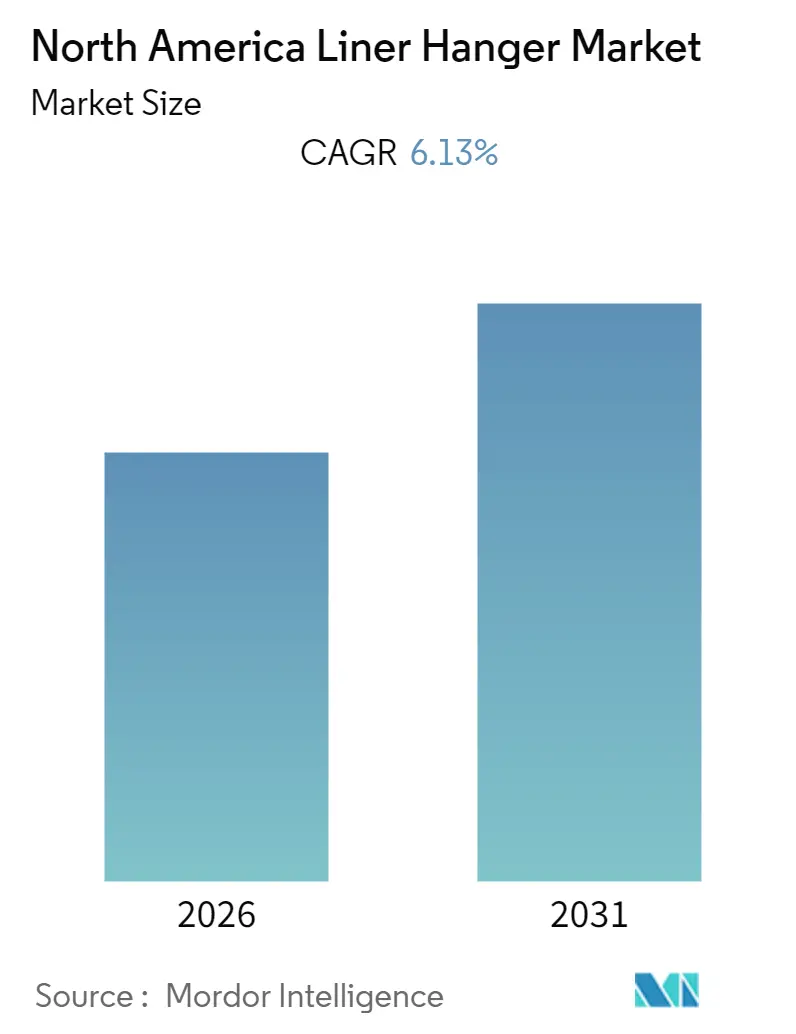
The North America Liner Hanger Market size is expected to register a CAGR of greater than 6.13% during the forecast period.
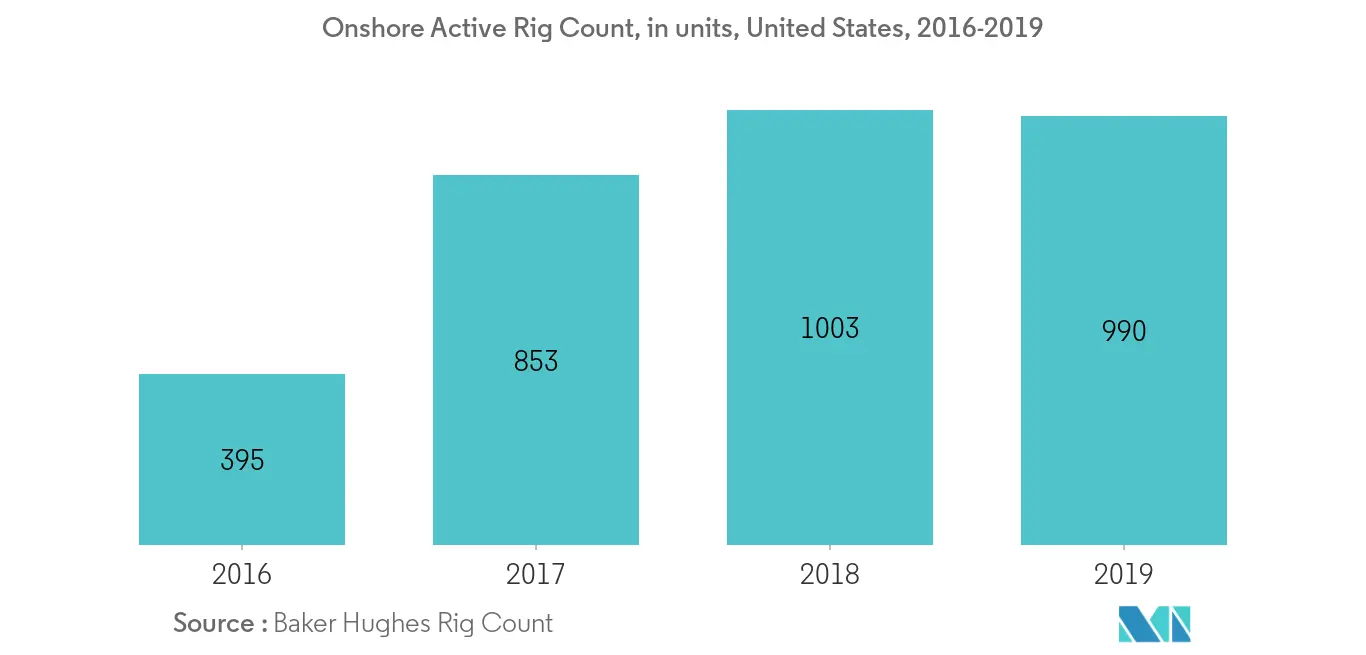
- With 990 active onshore rigs in the United States and increasing production from the Permian basin, the onshore sector is expected to dominate the liner hanger system market.
- The United States has one of the largest technically recoverable shale gas reserves and the second-largest tight oil reserves in the world. Moreover, the technological development in hydraulic fracturing is expected to create ample opportunities for the liner hanger system providers.
- With oil production of 17 million barrels per day in 2019, the United States is leading the market of the liner hanger system market. It is expected to continue its dominance in the forecast period.
Note: Market size and forecast figures in this report are generated using Mordor Intelligence’s proprietary estimation framework, updated with the latest available data and insights as of 2026.
North America Liner Hanger Market Trends and Insights
Onshore Sector to Dominate the Market
- A liner hanger system consists of a liner hanger assembly, releasing tool, cementing head, packer, etc. The liner hanger system is a part of good completion and can be mechanical or hydraulic, premium or standard, rotating or non-rotating, conventional or expandable, and pocket slip.
- Canada is estimated to have 1,100 trillion cubic feet of natural gas potential. Hydraulic fracturing, in combination with horizontal drilling techniques, allows better access to the natural gas in such formations. This, in turn, is expected to drive the demand for hydraulic liner hanger systems, over the forecast period
- In Canada, there is a major focus on unconventional resources, such as oil sands, which require greater drilling lengths or 'laterals,' which will increase the demand of liner hangers in the forecast period.
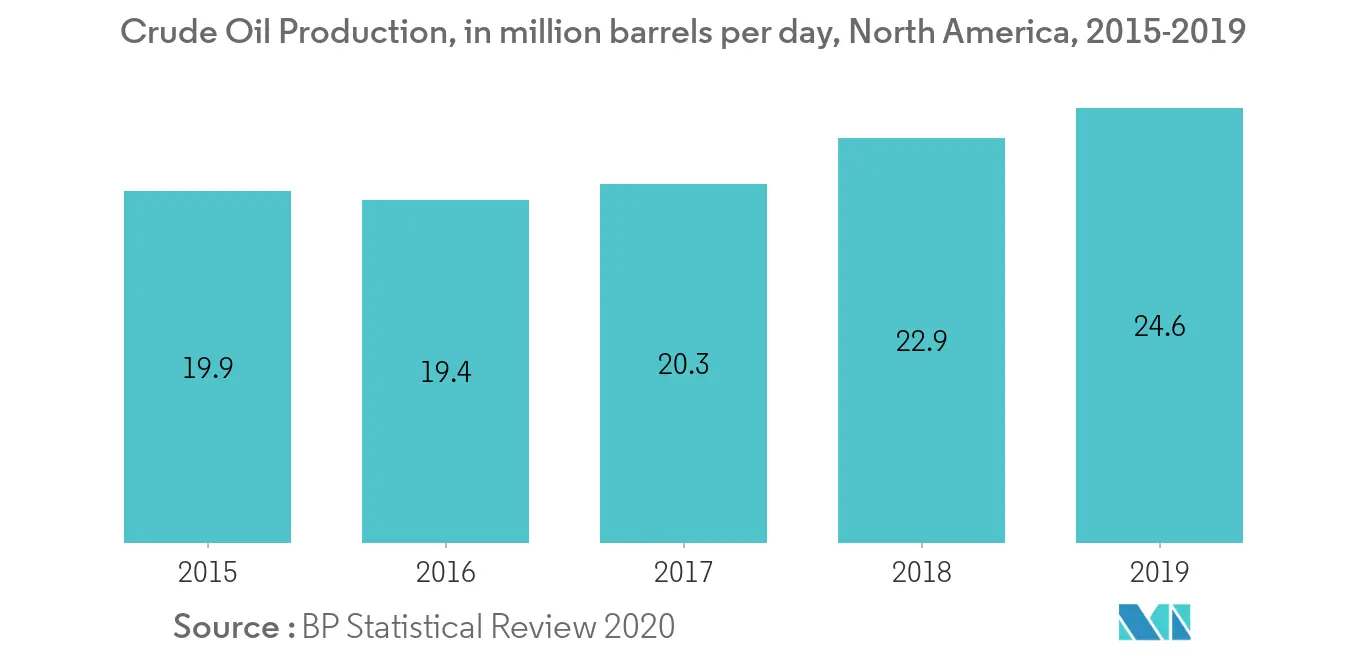
- With total crude oil production of 24.6 million barrels per day, the market of oil and gas is growing and simultaneously driving the need for liner hanger systems.
- Due to the COVID-19 pandemic in 2020, delay in upstream projects is anticipated. Later in the forecast period, with the initiation of new projects and completion of drilled wells, the market of the liner hangers is expected to grow considerably.


The United States to Dominate the Market
- The United States was one of the largest producers of crude oil and natural gas, accounting for around 18% and 23% of the global production, respectively, in 2019. The production surged in 2019, mainly due to robust drilling in its shale reserves, led by the Permian Basin.
- As of April 2019, 8390 drilled wells are incomplete in the country, with the Permian Basin having the largest share. These wells are expected to be completed in the coming years, creating ample opportunity for the liner hanger system suppliers.
- At the beginning of 2018, the government announced the opening of 98% of the coastal water for oil and gas exploration and production. The announcement is expected to drive the demand for liner hanger systems in the offshore sector in the long run.
- Despite the decrease in the number of active rig count to 990 in 2019, the production of both crude oil and natural gas is increasing, driving the market of the liner hanger system significantly.
- Factors, such as increasing share of horizontal and directional drilling, significant oil and gas discoveries in both onshore and offshore segments, along with the shift toward unconventional fields, are expected to boost the demand for oil fields services, including liner hanger systems.
Regulatory Landscape
In the United States, offshore well completion and workover activities in federal waters are governed by Bureau of Safety and Environmental Enforcement (BSEE) regulations under 30 CFR Part 250. For production liners, pressure testing requirements, including testing to at least 500 psi above formation fracture pressure (30 CFR 250.721), affect liner hanger selection, qualification, and field procedures, while BSEE technical work has highlighted seal-assembly reliability as a focal integrity topic.
Air emissions regulation also affects completion operations where liner hangers are run, cemented, and tested. The US Environmental Protection Agency (EPA) finalized technical changes in April 2026 to specific aspects of the 2024 New Source Performance Standards and Emissions Guidelines for oil and natural gas operations (Subparts OOOOb and OOOOc), reinforcing an active compliance environment around wellsite equipment and operating practices. In Canada, provincial regulators such as the Alberta Energy Regulator (AER) set mechanical integrity expectations for liners and associated equipment, including design requirements aligned with production casing design (AER Directive 010) and additional materials and fit-for-service considerations for critical sour wells referencing NACE MR0175 (AER Directive 036).
Value Chain Analysis
The liner hanger value chain in North America starts with raw materials (specialty steel and corrosion-resistant alloys) and elastomer systems used in seal and packoff elements. It then moves through machining, forging, heat treatment, and assembly of mechanical and hydraulic hanger systems, packers, running tools, and cementing accessories. Industry standards and qualification frameworks shape product design and validation, with API SPEC 19LH:2019 (and the 2021 addendum) commonly referenced for conventional and expandable liner system requirements, and BSEE technical recommendations emphasizing robust verification of seal assemblies used in offshore service.
Midstream participants include integrated oilfield service providers and specialized completion-tool manufacturers that design, qualify, and package liner hanger systems within broader well construction offerings. Equipment is staged and distributed through regional service bases and warehouses near key basins. During deployment, completion teams integrate the hanger with drilling and cementing workflows, supported by field service, inspection, and testing capabilities. Performance feedback from complex wells, including extended-reach, HPHT, and unconventional laterals, feeds back into engineering, materials selection, and qualification testing, raising the value of documented validation and single-source solutions as operators and regulators prioritize well integrity.
Competitive Landscape
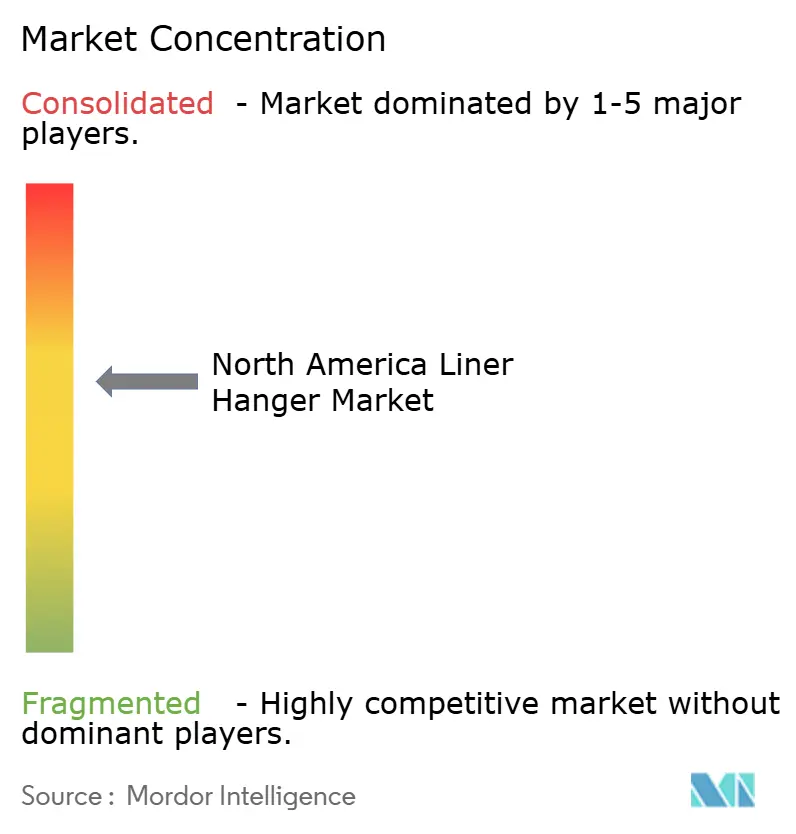
The North America liner hanger market is moderately consolidated. Some of the major companies include National-Oilwell Varco, Inc., Halliburton Company, Weatherford International plc, Baker Hughes, Schlumberger Limited Ltd.
North America Liner Hanger Industry Leaders
Halliburton Company
Weatherford International plc
Schlumberger Limited
Baker Hughes Ltd
National-Oilwell Varco, Inc
- *Disclaimer: Major Players sorted in no particular order

Market Opportunities and Future Outlook
Opportunities are concentrating around premium and expandable liner hanger systems that address integrity and efficiency requirements in more demanding well architectures, including long laterals and HPHT environments. Field evidence includes SLB case-study deployments of its Xcelis high-performance liner hanger system in Mexico onshore HPHT wells in June 2026, where the company described single-trip installation under unstable formation and high equivalent circulating density conditions. This supports demand for systems engineered to reduce trips and manage narrow operating windows.
Compliance and operating-practice needs also shape adoption. Evolving US requirements affecting wellsite operations, including the EPA actions tied to the 2024 NSPS and Emissions Guidelines with technical changes finalized in April 2026, keep attention on disciplined completion execution and verification steps. That focus supports adoption of higher-specification hardware and documented qualification. At the same time, BSEE well integrity expectations for offshore operations and identified sealability concerns in liner hanger seal assemblies create room for suppliers that can demonstrate repeatable validation, improved seal designs (including metal-to-metal sealing concepts), and integrated workflows that reduce non-productive time during running, cementing, and pressure testing.
Recent Industry Developments
- May 2026: Halliburton deployed a 13.5 x 16 inch VersaFlex expandable liner hanger system at the West Azeri C44 well in the bp-operated Azeri-Chirag-Gunashli project in the Caspian Sea. The company reported the installation cut well construction time by about two days versus a conventional liner hanger approach, reinforcing the operational case for expandable systems where multi-liner programs drive high rig-time exposure.
- October 2025: Aker BP and Halliburton executed the first umbilical-less tubing hanger installation and also established a longer-term framework agreement covering such installations. While centered on tubing hangers, the move signals continued engineering focus on reducing subsea installation complexity and offshore well construction time, adjacent drivers that influence specification and procurement of completion hardware across hanger-related product families.
- August 2025: Enventure Global Technology reported a deployment of its SET Expandable Liner Hanger for an operator in the Williston Basin on a long lateral well. The activity underscores ongoing North American interest in expandable liner hanger solutions for unconventional wells where long laterals and completion intensity increase the value of robust anchoring and sealing performance.


Research Methodology Framework and Report Scope
Market Definition and Coverage
For this study, the market covers revenue generated from liner hanger systems used to suspend and seal liners during oil and gas well completion and workover activity across North America, including demand from onshore basins and offshore developments.
Scope exclusions: Excludes casing and tubing strings that are not installed as liners, and it also excludes general completion tools unless they are part of the liner hanger system sale.
Segmentation Overview
- Type
- Conventional
- Expandable
- Location of Deployment
- Offshore
- Onshore
- Geography
- The United States
- Canada
- Rest of North America
Data Sources, Market Sizing, and Validation
Desk Research
Desk research was used to build the factual base for drilling and completion activity, and then to cross-check the direction of demand for liner hangers. We mainly looked for public time series that explain where wells are being drilled and completed, and how activity is shifting between onshore basins and offshore fields.
Sources used include public datasets and publications such as EIA drilling and production statistics, BSEE offshore activity and safety updates, USGS energy related publications, and Statistics Canada energy and drilling indicators. We also reviewed company annual reports, investor presentations, and credible press coverage to understand completion intensity and product adoption, and we supported this with paid subscriptions for company financials and news, plus a patent database to track technology signals. The sources listed here are illustrative only, and many other public and subscription sources were also referred to for data collection, validation, and clarification.
Primary Interviews and Surveys
Primary work focused on confirming what is actually being purchased per completion program, and how specifications change by well design. We spoke with a mix of manufacturers, distributors, and oilfield service participants, and then checked the logic with E&P and completion engineering viewpoints across the United States, Canada, and the rest of North America so the assumptions stayed practical.
Distribution of primary research fieldwork respondents
| Company type | Respondent position |
|---|---|
| Top tier: 34% | CXOs: 13% |
| Mid tier: 46% | Functional/Unit leaders: 41% |
| Smaller Players: 20% | Managers: 46% |
Market-Sizing & Forecasting
Sizing started with a top-down build that reconstructs the demand pool from North America drilling and completion activity, then translated it into liner hanger system demand using adoption rates by well type. Once that total was formed, we corroborated it with selective bottom-up approximations, such as sampled pricing checks and a roll-up of supplier revenue exposure to liner hanger systems, and adjusted the gaps using interview-backed ranges.
Inputs used in the model include active rig and well counts, completion activity trends (including horizontal versus vertical mix), offshore versus onshore share, typical completion intensity where it changes liner design needs, and observed price movement driven by steel, logistics, and premium feature adoption (for example, expandable versus conventional). Forecasting relied on scenario analysis built around oil and gas capex direction, planned offshore projects, and basin level activity expectations that were repeatedly validated during calls. Where a bottom-up view was incomplete due to private participants, we applied conservative penetration and price bands and then re-checked them against the top-down demand picture.
Data Validation & Update Cycle
Outputs were checked against independent signals, including drilling activity direction, completion intensity discussions reflected in public filings, and the implied spend per well for completion hardware. Any sharp year-to-year jumps were reviewed for input errors first, and then for real drivers such as offshore project timing or unusual price spikes.
Before sign-off, the model goes through multiple analyst reviews, and respondents are re-contacted when an assumption moves outside the expected range. The report is refreshed annually, and interim updates are done when material events change drilling plans, pricing, or supply availability. Right before delivery, a final pass is completed so clients receive the most up-to-date view.
Mordor Intelligence's North America Liner Hanger Market Size Compared Against Other Published Estimates
Published market sizes for liner hanger systems can look far apart because firms do not always count the same products, years, or pricing basis, and then apply different activity outlooks for drilling and completions. Currency timing and how offshore project ramps are treated also create visible spreads in the final number.
Some published figures appear to bundle a wider basket of completion hardware or related services into the same total. Those broader totals can move materially, and for Mordor Intelligence the counted value is limited to liner hanger systems tied to well completion demand in North America, with adjacent completion tools excluded unless they are part of the liner hanger system sale.
Benchmark comparison
| Source | Market Size | Gaps in Research Methodology |
|---|---|---|
| Mordor Intelligence | USD 0.78 B (2024) | |
| Trade Publisher A | USD 13.78 B (2024) | Uses a wider definition that appears to combine liner hanger systems with other completion equipment and services, which expands the revenue pool beyond liner hangers. The estimate also does not clearly show checks against well counts, offshore activity timing, and typical system pricing ranges. |
| Industry Publisher B | USD 0.69 B (2026) | Uses a different start year and pricing cycle by anchoring the series in 2026, which makes the size not directly comparable to a 2024 view. It also explicitly includes Mexico in North America coverage and applies a longer horizon growth path that can smooth near term drilling swings. |
The table shows that the biggest gaps come from scope expansion into adjacent completion items and from using different base years and pricing refresh timings. When the demand pool is tied back to observed drilling and completion activity, and then cross-checked through interviews on adoption and pricing bands, the resulting size stays transparent and easier to reproduce.


Key Questions Answered in the Report
What is the current North America Liner Hanger System Market size?
The North America Liner Hanger System Market is projected to register a CAGR of 6.13% during the forecast period (2026-2031)
Who are the key players in North America Liner Hanger System Market?
Halliburton Company, Weatherford International plc, Schlumberger Limited, Baker Hughes Ltd and National-Oilwell Varco, Inc are the major companies operating in the North America Liner Hanger System Market.
What years does this North America Liner Hanger System Market cover?
The report covers the North America Liner Hanger System Market historical market size for years: 2020, 2021, 2022, 2023 and 2024. The report also forecasts the North America Liner Hanger System Market size for years: 2026, 2027, 2028, 2029, 2030 and 2031.
Page last updated on:


 Your data is secure and never sold or shared.


