
Market Overview
| Study Period | 2019 - 2031 |
|---|---|
| Forecast Data Period | 2026 - 2031 |
| Base Year Market Size (2025) | USD 1.39 Billion |
| Market Size (2026) | USD 1.5 Billion |
| Market Size (2031) | USD 2.23 Billion |
| Growth Rate (2026 - 2031) | 8.25 % |
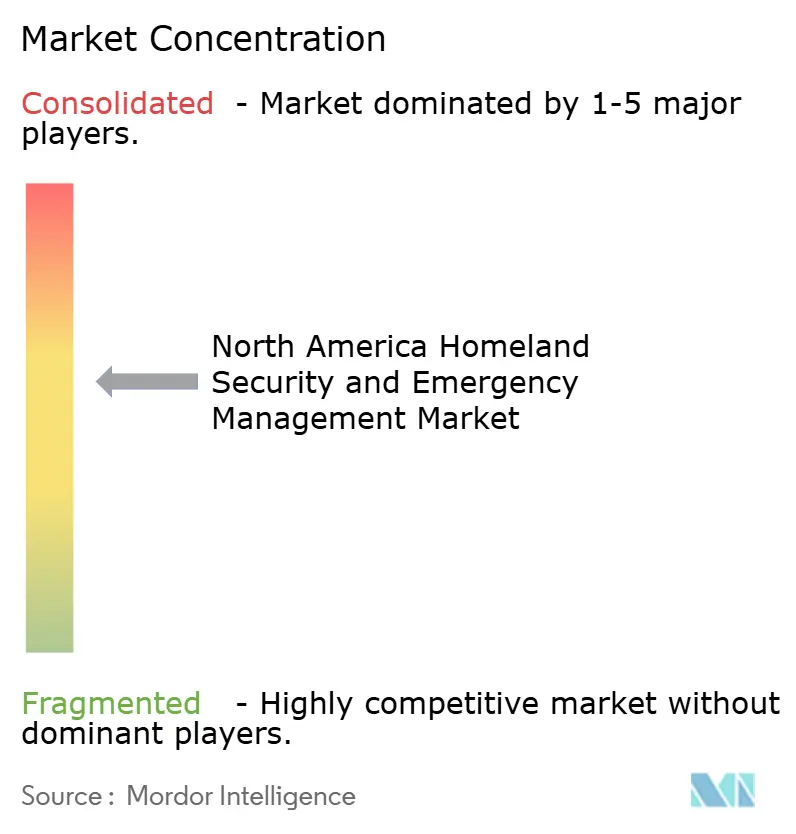
| Market Concentration | Medium |
Major Players *Disclaimer: Major Players sorted in no particular order Image © Mordor Intelligence. Reuse requires attribution under CC BY 4.0. | |
North America Homeland Security and Emergency Management Market Analysis by Mordor Intelligence
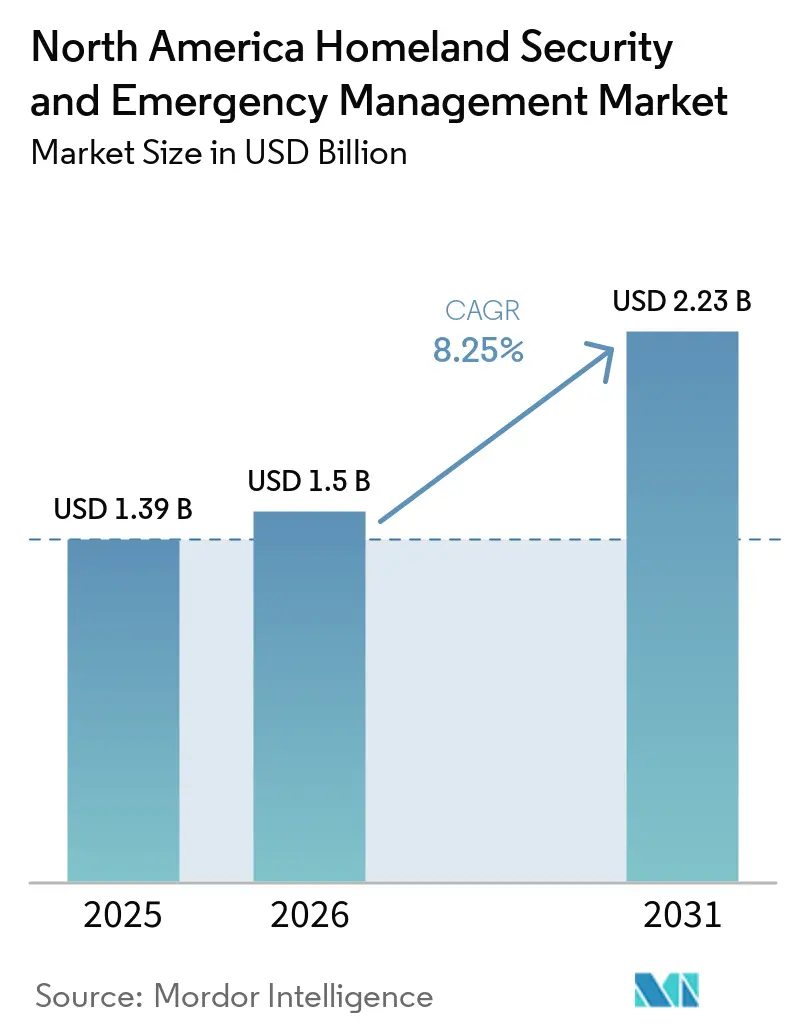
The North America homeland security and emergency management market size was valued at USD 1.39 billion in 2025, and is forecast to grow from USD 1.50 billion in 2026 to USD 2.23 billion by 2031, registering a 8.27% CAGR during the forecast period (2026-2031). Federal grants and appropriations are directing spending toward compliant cybersecurity, communications, and resilience systems. FEMA allocated USD 1.01 billion through the FY2025 Homeland Security Grant Program, with cybersecurity among the required national priority areas. Weather losses are also sustaining demand for risk analytics, continuity tools, and resilient communications, as NOAA recorded USD 27 billion in weather and climate disasters in 2024, with USD 182.70 billion in losses. Large contractors retain positions in classified and capital-intensive programs, while software providers compete for analytics, cloud, and cybersecurity work. Procurement rules, aging installed systems, and shortages in cybersecurity and emergency communications personnel can delay deployments across the North America homeland security and emergency management market.
Key Report Takeaways
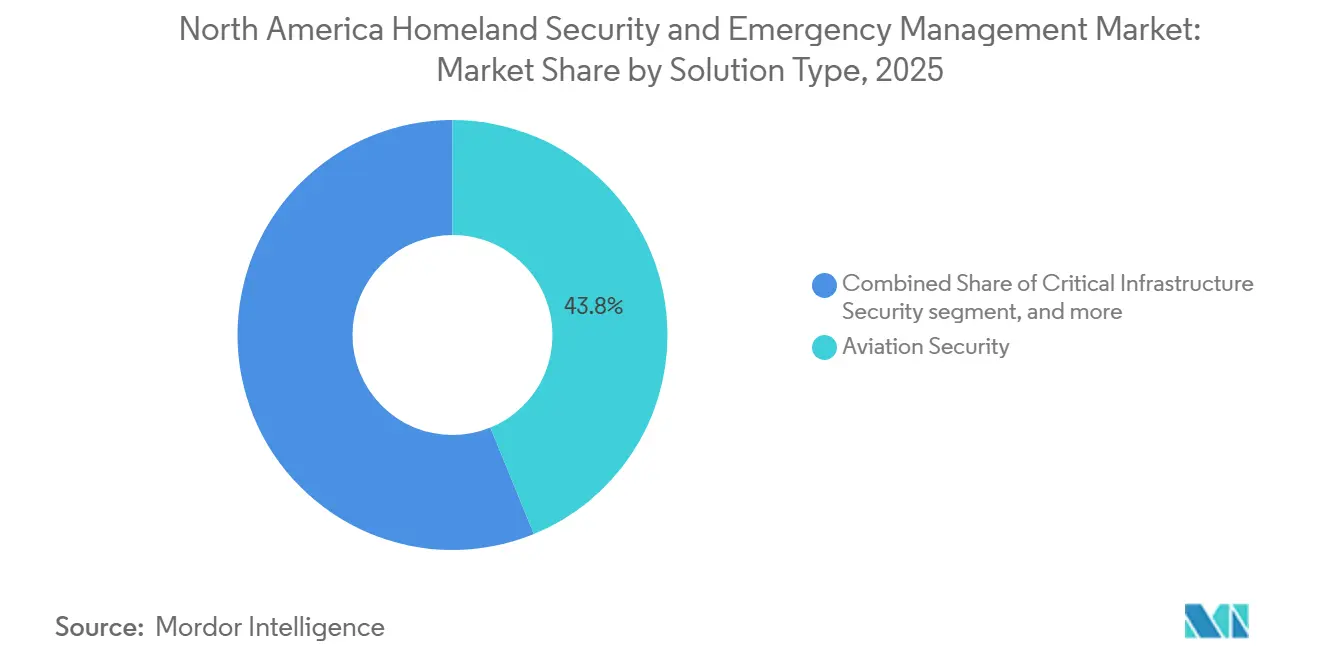
- By solution type, aviation security accounted for 43.82% of the North America homeland security and emergency management market share in 2025, while cybersecurity is forecast to grow at a 10.48% CAGR through 2031.
- By technology, AI and machine learning held 31.93% of the North America homeland security and emergency management market share in 2025, while cloud security platforms are forecast to grow at an 11.91% CAGR through 2031.
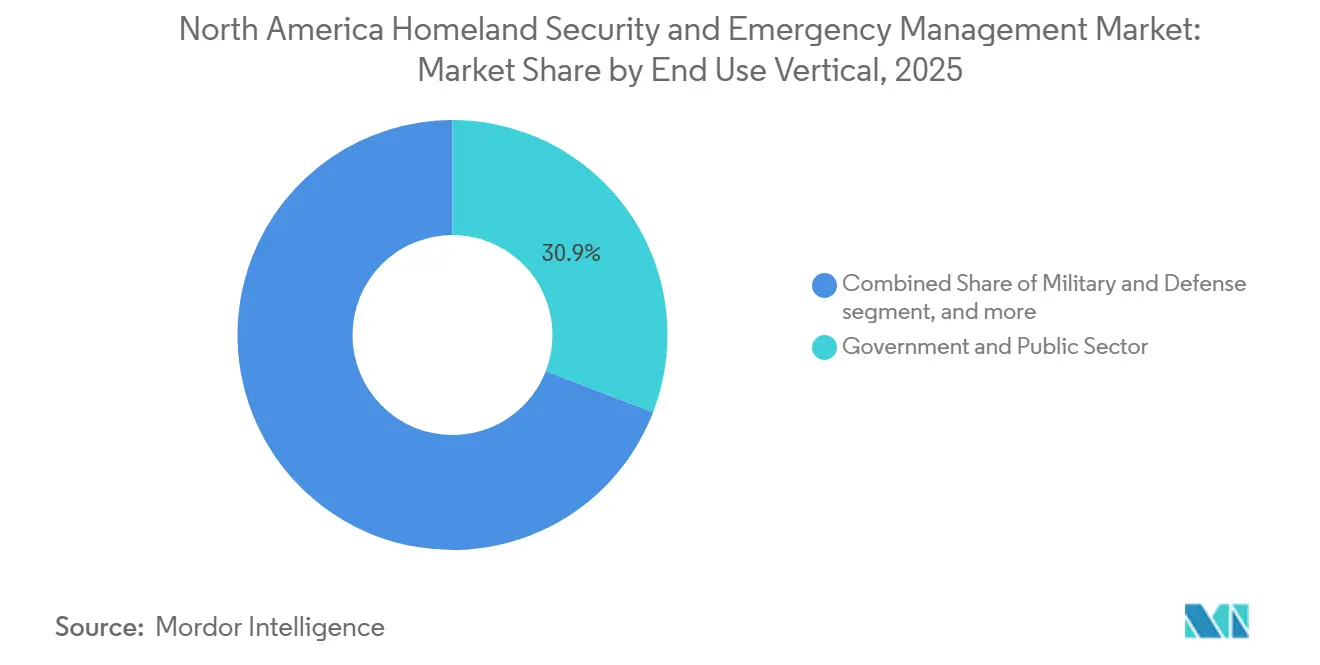
- By end-use vertical, the government and public sector accounted for 30.85% of spending in 2025, while the military and defense sector is forecast to grow at a 9.95% CAGR through 2031.
- By geography, the United States held 39.67% of regional spending in 2025, while Canada is forecast to grow at a 10.29% CAGR through 2031.
Note: Market size and forecast figures in this report are generated using Mordor Intelligence’s proprietary estimation framework, updated with the latest available data and insights as of January 2026.
North America Homeland Security and Emergency Management Market Trends and Insights
Drivers Impact Analysis*
| Driver | (~) % Impact on CAGR Forecast | Geographic Relevance | Impact Timeline |
|---|---|---|---|
| Federal preparedness and Homeland Security Grant funding | +2.10% | United States, with secondary spillovers to Canada and Mexico | Medium term (2-4 years) |
| Zero-trust and critical infrastructure cybersecurity modernization | +1.80% | United States, with Canadian alignment | Medium term (2-4 years) |
| Rising frequency and cost of extreme weather disasters | +1.60% | United States and Canada, with rising exposure in Mexico | Short term (≤ 2 years) |
| Modernization of legacy emergency communications and public safety systems | +1.10% | United States and Canada | Long term (≥ 4 years) |
| Grant eligibility digitization and compliance-driven software procurement | +0.80% | United States, with similar Canadian digital compliance efforts | Medium term (2-4 years) |
| Cross-jurisdiction data interoperability for tribal, rural, and border communities | +0.50% | United States and Canada border and tribal communities | Long term (≥ 4 years) |
| Source: Mordor Intelligence | |||
Federal Preparedness and Homeland Security Grant Funding
Federal grants have shifted from a pass-through funding approach toward technology procurement tied to compliance requirements. FEMA distributed USD 1.01 billion through its FY2025 Homeland Security Grant Program. The State Homeland Security Program received USD 373.50 million, the Urban Area Security Initiative received USD 553.50 million, and Operation Stonegarden received USD 81 million.[1] Recipients must direct at least 30% of awards across five national priority areas, including cybersecurity and border crisis response. This requirement supports demand for vendors whose products meet grant and authorization requirements. The DHS FY2026 discretionary budget of USD 66.40 billion was USD 1.30 billion above the FY2025 enacted level, supporting multiyear programs for integrators and analytics providers.
Rising Frequency and Cost of Extreme-Weather Disasters
The US averaged USD 23 billion in weather events annually between 2020 and 2024, with an average annual cost of USD 149.30 billion.[2] These events keep risk analytics and operational continuity systems relevant to preparedness planning. The January 2025 Los Angeles wildfires increased attention to predictive wildfire management, evacuation analytics, and AI-supported incident coordination. FEMA preparedness requirements also require after-action reporting that identifies capability gaps. Those documented gaps can shape the specifications used in future grant-funded purchases. The result is sustained demand for situation awareness systems, resilient communications, and next-generation 911 capabilities in the North America homeland security and emergency management market.
Zero-Trust and Critical-Infrastructure Cybersecurity Modernization
CISA issued Microsegmentation in Zero Trust, Part One, in July 2025 to set out planning guidance for Federal Civilian Executive Branch agencies. The guidance gives agencies a clearer path for microsegmentation projects and related procurement. CISA Binding Operational Directive BOD 26-02 also requires agencies to inventory and replace end-of-support edge devices. The Federal Energy Regulatory Commission approved CIP-015-1 in July 2025, extending internal network monitoring requirements to high-impact bulk electric system assets. These requirements cover both information technology and operational technology settings. CISA also issued joint guidance on secure AI integration in operational technology during December 2025, supporting demand for security operations platforms.[3]
Modernization of Legacy Emergency Communications and Public Safety Systems
FirstNet had more than 7 million public safety connections and more than 31,000 public safety agencies and organizations as of Q4 2025. AT&T delivered 1,000 new Band 14 sites in 2025, with more than two-thirds located in rural and tribal areas. The network expansion places added pressure on agencies still using narrowband systems to replace older equipment. This replacement cycle reaches public safety answering points and emergency dispatch centers through 2031. Canada allocated CAD 55.40 million (USD 40 million) over 4 years in Budget 2025 to renew the National Public Alerting System. The North America homeland security and emergency management market, therefore, has separate US and Canadian procurement paths for public safety communications.
Restraints Impact Analysis*
| Restraint | (~) % Impact on CAGR Forecast | Geographic Relevance | Impact Timeline |
|---|---|---|---|
| Fragmented federal, state, local, tribal, and territorial procurement | -1.10% | United States, with federal-provincial tension in Canada | Medium term (2-4 years) |
| Budget pressure from legacy system operations and maintenance | -0.90% | North America | Medium term (2-4 years) |
| Uneven access to preparedness funding for rural and tribal communities | -0.60% | Rural western United States, tribal lands, and remote northern Canada | Long term (≥ 4 years) |
| Workforce scarcity for cybersecurity, emergency communications, and incident management | -0.80% | United States, with secondary effects in Canada | Short term (≤ 2 years) |
| Source: Mordor Intelligence | |||
Fragmented Federal, State, Local, Tribal, and Territorial Procurement
Procurement is split among many federal, state, local, tribal, and territorial authorities, each with different rules and timelines. DHS programs for states, urban areas, regions, nonprofits, and tribal governments have separate eligibility and reporting structures. Vendors may need to repeat FedRAMP assessments, state privacy reviews, and tribal consultations for different opportunities. This raises entry costs and can concentrate competition around firms with established government authorizations. Smaller jurisdictions can also purchase grant-eligible point solutions instead of long-term interoperable platforms. These factors can slow coordinated deployments in the North America homeland security and emergency management market.
Budget Pressure from Legacy-System Operations and Maintenance
Operations and maintenance expenses for installed systems can limit the funds available for new capabilities. The Transportation Security Administration (TSA) received USD 215 million in FY2026 to modernize the Checkpoint Property Screening System, but its current plan projects completion by FY2049. The timeline shows how annual budget limits can slow major upgrade programs. Agencies moving from analog 911 to Next Generation 911 must replace equipment, redesign networks, and train staff. Heavy maintenance commitments can delay AI and analytics purchases until compliance rules require action. The effect is strongest where older biometric and surveillance systems still carry maintenance contracts.
*Our forecasts treat driver/restraint impacts as directional, not additive. The impact forecasts reflect baseline growth, mix effects, and variable interactions.
Segment Analysis
By Solution Type: Aviation Security Dominates, Cybersecurity Gains Ground Fast
Aviation security accounted for 43.82% of the North America homeland security and emergency management market size by solution type in 2025. TSA allocated USD 215 million for CT scanner procurement and deployment and USD 20 million for biometrics research and development in FY2026. CT scanner deployment began in 2025 at Atlanta, Denver, Orlando, and Boston airports. Deployment expands in 2026 to Los Angeles, Dallas-Fort Worth, Seattle, and more than 20 mid-sized airports. Critical infrastructure security, perimeter security, border security, maritime security, and risk services reflect other federal responsibilities.
Cybersecurity is projected to expand at a 10.48% CAGR from 2026 to 2031, the highest rate within the solution mix. Connected operational technology has widened the security needs of public agencies and critical infrastructure operators. Federal requirements include FISMA, CMMC 2.0, FedRAMP, and BOD 26-02 for end-of-support edge devices. CISA’s 2026 AI material addresses security issues associated with AI use. Teledyne FLIR Defense launched CheMSense Protect in June 2026, a continuous air monitor that detects chemical warfare agent threats in under 20 seconds.

By Technology: AI and Machine Learning Commands Share as Cloud Emerges
AI and machine learning accounted for 31.93% of technology spending in 2025. The technology supports intelligent sensing, anomaly detection, and decision support in aviation, border, and cybersecurity operations. CISA uses unsupervised machine learning through CyberSentry to monitor critical infrastructure networks for anomalies. IoT and smart sensors add more data from ports, checkpoints, and utilities. FirstNet Authority directed the deployment of more than 135 purpose-built cell sites to extend 5G broadband coverage for public safety.
Cloud security platforms are forecast to expand at an 11.91% CAGR from 2026 to 2031. Their demand is linked to federal workloads moving into FedRAMP-authorized cloud environments. BOD 26-02 supports software-defined perimeter architectures that depend on cloud-connected security controls. NIST SP 800-53 Rev. 5 and the CISA Zero Trust Maturity Model v2.0 reinforce cloud-native security in new government deployments. Biometric identification grows as TSA deploys CAT-2 systems and Customs and Border Protection (CBP) expands biometric verification at ports of entry.
By End-Use Vertical: Government Anchors Demand While Defense Accelerates
Government and public sector users held 30.85% of spending by end-use vertical in 2025. Federal grants, statutory requirements, and long-duration contract vehicles underpin this position. Palantir received a USD 1 billion DHS blanket purchase agreement in February 2026 for department-wide software licenses and analytical services. Critical infrastructure, commercial facilities, healthcare, and emergency medical services also require security and response technology. Connected ambulance fleets, hospital resilience programs, and Next Generation 911-linked dispatch systems support demand.
Military and defense are forecast to grow at a 9.95% CAGR from 2026 to 2031. Homeland defense and warfighting requirements increasingly use interoperable command-and-control systems. This allows software developed for mission planning to be adapted for domestic civil defense uses. Transportation receives incremental spending from aviation modernization, port security grants, and border surveillance expansion. The North America homeland security and emergency management industry links defense technology procurement with civil preparedness needs.
Geography Analysis
The United States held 39.67% of regional spending in 2025. The DHS FY2026 appropriations bill provides USD 99.1 billion in total discretionary funding, including USD 66.4 billion within the bill, USD 26.5 billion for major disaster response, and USD 6.3 billion for fee-offset programs. Elbit Systems of America began deploying AI-enabled Integrated Surveillance Towers in the Del Rio Area of Responsibility during July 2025 under a USD 1.8 billion IDIQ contract with US CBP. Fragmented procurement across more than 50 state administrative agencies and thousands of local jurisdictions can slow delivery. Suppliers with federal and sub-federal contract paths are better placed to navigate this structure.
Canada is projected to be the fastest-growing geography, with a 10.29% CAGR from 2026 to 2031. Budget 2025 committed CAD 257.60 million (USD 187 million) for waterbomber aircraft and CAD 55.40 million (USD 40 million) to renew the National Public Alerting System. Public Safety Canada planned CAD 744.60 million (USD 535 million) in emergency management spending for fiscal year 2025-26. The modernized Disaster Financial Assistance Arrangements, launched in April 2025, use five cost-share streams with revised federal-provincial ratios. Canada is shifting more attention toward prevention and mitigation, although it uses transfer agreements rather than the US grant structure.
Mexico is an emerging opportunity within the North America homeland security and emergency management market. The September 2024 transfer of the National Guard from the Secretaría de Seguridad y Protección Ciudadana to the Secretariat of National Defense consolidated federal oversight of security technology within a civil-military model. Zacatecas inaugurated the first phase of its C5i Command Center in September 2025 with an investment of MXN 1 billion (USD 50 million) in technology and infrastructure. The project includes P25 communications, surveillance systems, and biometric access controls.
Competitive Landscape
The North America homeland security and emergency management market has a semi-consolidated competitive structure. Northrop Grumman Corporation, RTX Corporation, BAE Systems plc, Honeywell Aerospace Inc., and General Dynamics IT are established in capital-intensive programs that need deep systems integration, long program cycles, and classified facilities. These companies commonly compete through IDIQ vehicles and long-duration cost-plus contracts. CIP-015-1 has opened an adjacent opportunity in internal network monitoring for high-impact bulk electric systems. Palantir’s USD 1 billion DHS blanket purchase agreement shows that contracting officers are using platform continuity and integration depth in major purchasing decisions.
Competition within the North America homeland security and emergency management market centers on cross-jurisdiction interoperability, AI-native threat detection outside aviation, and cloud-managed services for mid-sized state and local governments. Technology-focused analytics and cloud cybersecurity providers can convert regulatory obligations into recurring compliance services. Vendors that combine FedRAMP-authorized cloud environments with CMMC-compliant managed services can reduce the number of vendor relationships agencies must manage. GDIT’s Relocatable Autonomous Surveillance Tower concept and Anduril’s autonomous systems activities add competitive pressure in border and perimeter surveillance. Elbit Systems of America received multiple awards from the US CBP in July 2026, totaling more than USD 370 million for surveillance and sensing systems.
Large primes increasingly work with technology specialists rather than developing all AI and cloud capabilities internally. This approach allows primes to retain systems integration roles while specialists provide software and cybersecurity components. Palantir received a USD 45.85 million ICE task order in June 2026 for homeland security investigations modernization and operational analytics. Teledyne FLIR Defense introduced CheMSense Protect in June 2026, extending commercial chemical detection technology into defense and civilian applications.
North America Homeland Security and Emergency Management Industry Leaders
-
Northrop Grumman Corporation
-
RTX Corporation
-
Thales Group
-
Honeywell Aerospace Inc.
-
General Dynamics Information Technology, Inc. (General Dynamics Corporation)
- *Disclaimer: Major Players sorted in no particular order
Recent Industry Developments
- July 2026: Elbit Systems of America received multiple US CBP contracts totaling more than USD 370 million to enhance US national security. The contracts are scheduled to be executed through May 2029, supporting real-time situational awareness and border security capabilities.
- February 2026: The US DHS established a USD 1 billion blanket purchase agreement with Palantir covering commercial software licenses, maintenance, and implementation services across the department. The agreement streamlines procurement for DHS agencies such as CBP and ICE, enabling purchases of up to USD 1 billion in Palantir products and services without requiring separate competitive bidding for each purchase.
- November 2025: The Government of Canada announced measures to strengthen federal emergency management, including a new Government Operations Center designed to coordinate multiple emergencies simultaneously and improve federal-provincial-territorial response. The initiative also includes national public and stakeholder engagement, as well as Budget 2025 investments, to enhance Canada's capacity to respond to increasingly frequent and severe natural disasters.
North America Homeland Security and Emergency Management Market Report Scope
The North America homeland security and emergency management market encompasses the development, integration, deployment, and provision of security, emergency preparedness, incident response, risk management, and resilience solutions for federal, state, local, tribal, and territorial authorities, critical infrastructure operators, transportation organizations, commercial facilities, and other end users across the region. The market evaluates physical and digital security systems, emergency management capabilities, communications infrastructure, detection and protection technologies, cybersecurity platforms, analytics, and related services addressing threats such as terrorism, cyberattacks, border and immigration risks, extreme weather events, public safety incidents, and other emergencies. The market also considers government preparedness programs, federal grant funding, modernization of legacy systems, interoperability, cybersecurity requirements, and the increasing adoption of AI, IoT, cloud, secure communications, biometrics, and data analytics.
The North America homeland security and emergency management market is segmented by solution type, technology, end-use vertical, and geography. By solution type, the market is segmented into critical infrastructure security, CBRNE detection and protection, perimeter and physical security, cybersecurity, border security and immigration control, maritime and port security, aviation security, and risk and emergency services. By technology, the market is segmented into AI and machine learning, IoT and smart sensors, big-data analytics, 5G and secure communications, cloud security platforms, and biometric identification. By end-use vertical, the market is segmented into government and public sector, critical infrastructure, military and defense, transportation, commercial and industrial facilities, and healthcare and emergency medical services. The report also covers the market sizes and forecasts for the North America homeland security and emergency management market in three countries across the region. For each segment, the market size is provided in terms of value (USD).
By Solution Type
| Critical Infrastructure Security |
| CBRNE Detection and Protection |
| Perimeter and Physical Security |
| Cybersecurity |
| Border Security and Immigration Control |
| Maritime and Port Security |
| Aviation Security |
| Risk and Emergency Services |
By Technology
| AI and Machine Learning |
| IoT and Smart Sensors |
| Big-Data Analytics |
| 5G and Secure Communications |
| Cloud Security Platforms |
| Biometric Identification |
By End-Use Vertical
| Government and Public Sector |
| Critical Infrastructure (Energy and Utilities) |
| Military and Defense |
| Transportation (Aviation, Maritime, and Rail) |
| Commercial and Industrial Facilities |
| Healthcare and Emergency Medical Services |
By Geography
| United States |
| Canada |
| Mexico |
| By Solution Type | Critical Infrastructure Security |
| CBRNE Detection and Protection | |
| Perimeter and Physical Security | |
| Cybersecurity | |
| Border Security and Immigration Control | |
| Maritime and Port Security | |
| Aviation Security | |
| Risk and Emergency Services | |
| By Technology | AI and Machine Learning |
| IoT and Smart Sensors | |
| Big-Data Analytics | |
| 5G and Secure Communications | |
| Cloud Security Platforms | |
| Biometric Identification | |
| By End-Use Vertical | Government and Public Sector |
| Critical Infrastructure (Energy and Utilities) | |
| Military and Defense | |
| Transportation (Aviation, Maritime, and Rail) | |
| Commercial and Industrial Facilities | |
| Healthcare and Emergency Medical Services | |
| By Geography | United States |
| Canada | |
| Mexico |
Key Questions Answered in the Report
What is the 2026 size of the North America homeland security and emergency management market?
The North America homeland security and emergency management market size is USD 1.50 billion in 2026 and is projected to reach USD 2.23 billion by 2031 at an 8.25% CAGR.
Which solution leads spending in North America homeland security and emergency management?
Aviation security led solution spending with a 43.82% share in 2025, supported by TSA scanner and biometric investment.
What is the fastest-growing solution area through 2031?
Cybersecurity is projected to grow at a 10.48% CAGR as zero-trust requirements and critical-infrastructure protections expand.
Which technology is growing fastest in homeland security and emergency management?
Cloud security platforms are forecast to grow at an 11.91% CAGR through 2031, supported by authorized cloud adoption and zero-trust requirements.
Which country is growing fastest in the regional forecast?
Canada is projected to record a 10.29% CAGR from 2026 to 2031, supported by alerting, aerial firefighting, and emergency management programs.
What factors can slow deployment of homeland security systems?
Fragmented purchasing rules, legacy-system maintenance costs, uneven local funding, and skilled workforce shortages can delay adoption.