
Market Overview
| Study Period | 2022 - 2031 |
|---|---|
| Forecast Data Period | 2026 - 2031 |
| Historical Data Period | 2022 - 2024 |
| Growth Rate | 17.52 % |
| Market Concentration | Low |
Major Players_Transmission_Systems_Market.webp) *Disclaimer: Major Players sorted in no particular order Image © Mordor Intelligence. Reuse requires attribution under CC BY 4.0. | |
North America High-Voltage Direct Current (HVDC) Transmission Systems Market Analysis by Mordor Intelligence
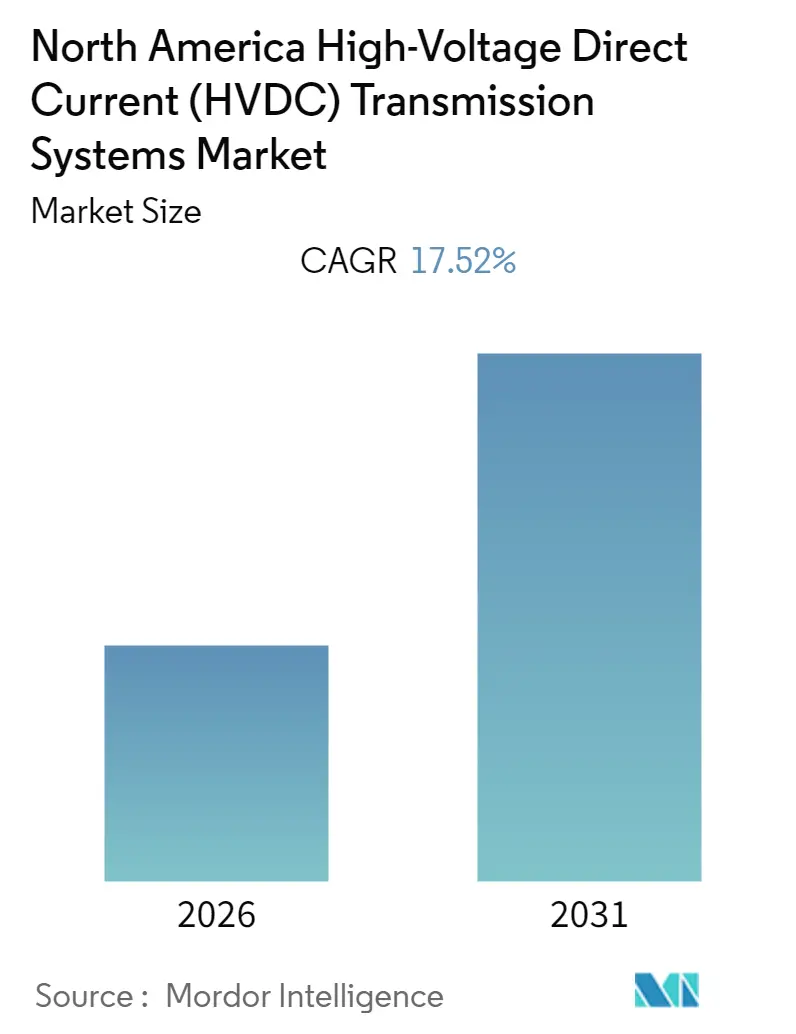
The North America High-Voltage Direct Current (HVDC) Transmission Systems Market size is expected to register a CAGR of 17.52% during the forecast period (2026-2031).
The market was severely impacted by the Covid-19 pandemic, as global energy demand plummeted. However, the market has since rebounded strongly and is expected to grow steadily during the forecast period.
- Over the long term, growing investments in renewable energy transmission systems, primarily offshore wind, is expected to drive the market during the forecast period.
- On the other hand, high installation costs and losses for smaller transmission distances are likely to hinder the market growth.
- The growth of offshore wind power technology and the offshore oil and gas sector will likely create immense opportunities for the market studied.
Note: Market size and forecast figures in this report are generated using Mordor Intelligence’s proprietary estimation framework, updated with the latest available data and insights as of 2026.
North America High-Voltage Direct Current (HVDC) Transmission Systems Market Trends and Insights
Submarine HVDC Transmission Systems to be the fastest-growing segment
- Submarine electricity transmission is gaining importance because of the increasing focus on power trading between countries. The HVDC submarine power transmission system is crucial for developing future power transmission networks.
- It is the only solution for transferring high power across long subsea distances. For these reasons, HVDC lines are preferred for interconnecting offshore wind plants worldwide. In the HVDC transmission system, the submarine power cables can be less costly, especially on a long link where the cable's capacitance requires too much additional charging current. Due to this, submarine HVDC systems are especially preferred for transmitting power from utility-scale offshore wind projects.
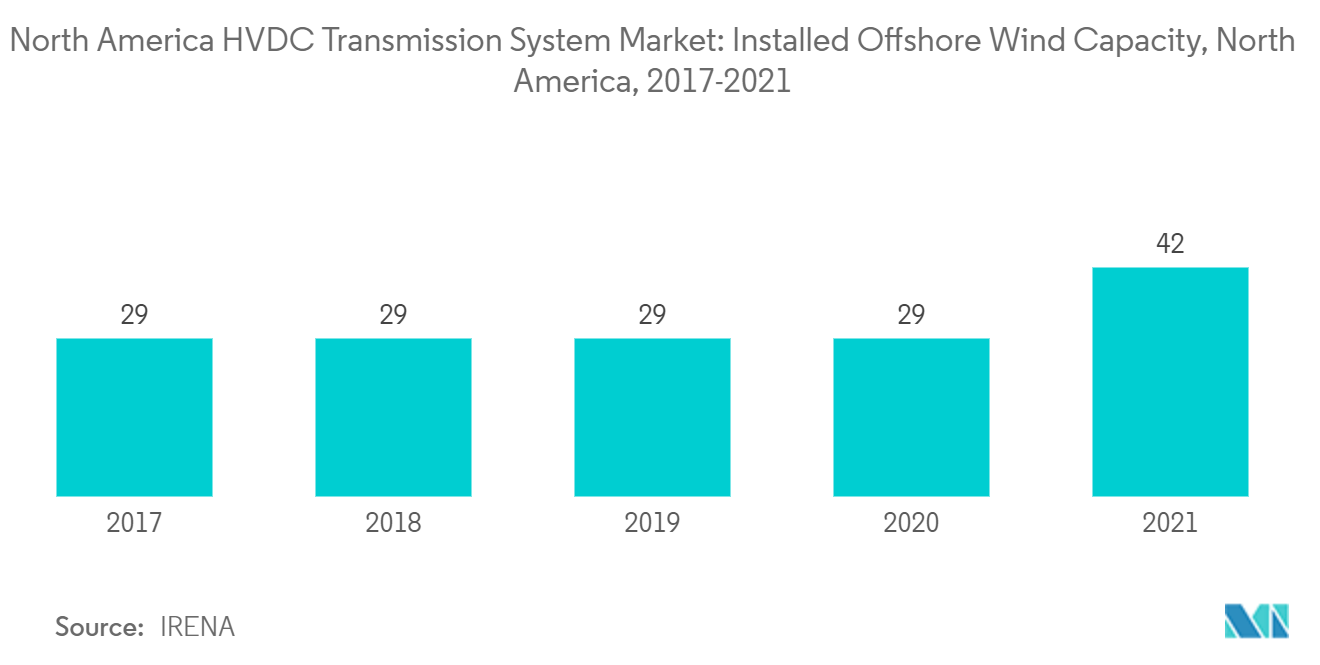
- The Offshore wind sector is beginning to take off in North America, and the segment is expected to grow massively during the forecast period. Several large-scale wind farms are under development in the region, which is expected to significantly boost the demand for submarine HVDC services during the forecast period.
- According to the United States Department of Energy, By May 2022, the U.S. offshore wind energy project development and operational pipeline grew to a potential generating capacity of 40,083 megawatts (MW). The 40,083 MW in the U.S. offshore wind energy pipeline has witnessed a 13.5% growth since 2021.
- The U.S. offshore wind energy market continues to be driven by state-level offshore wind energy procurement activities and policies. Collectively, offshore wind energy policies in eight states call for deploying at least 39,322 MW of offshore wind energy capacity by 2040.
- Hence, the increasing offshore activities are expected to drive the submarine HVDC transmission systems market during the forecast period.
The United States to Dominate the Market
- The market for HVDC in the United States is likely to grow at a significant rate during the forecast period. The transmission and distribution (T&D) loss in the United States was estimated to be around 5% (averaged over the period 2017-2021, lower than global T&D loss, and is among the lowest in the world.
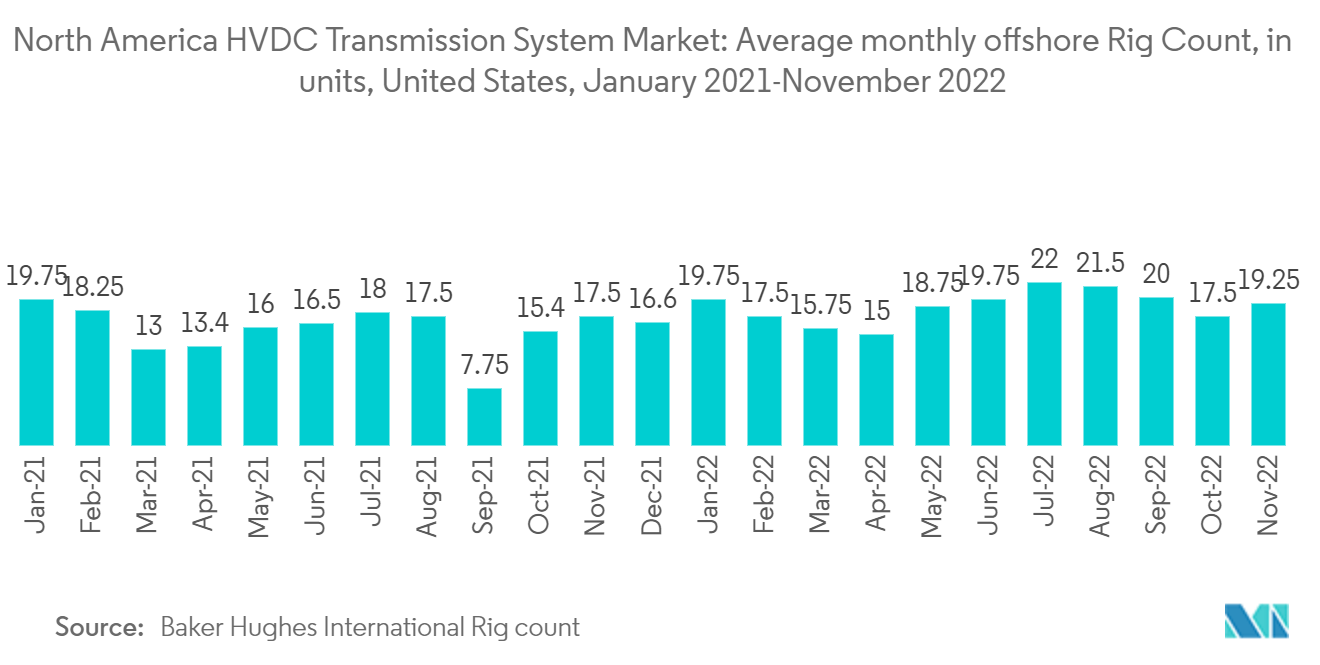
- In 2021, offshore oil and natural gas production in the Federal Gulf of Mexico accounted for about 15% of total U.S. crude oil production and about 2% of total U.S. dry natural gas production.
- In order to maintain offshore production, the exploration and development activity is moving toward deeper waters, where oil and gas reserves have not been exploited. As deep-sea oil exploration and production requires the construction of temporary or permanent offshore installations, which need massive electricity supply to operate, which is usually done through HVDC connections for long distance transmission, typical in the case of deep-sea exploration. This trend is expected to drive the demand for HVDC transmission services in the country to power offshore installations.
- Additionally, the growth of the offshore wind sector is another factor driving the market during the forecast period. The United States government has been promoting the deployment of the HVDC lines to transfer large amounts of power over long distances. They are now being proposed to move electricity generated from wind in high-quality wind resource regions to other parts of the country.
- As of May 31, 2022, 24 power purchase agreements for offshore wind energy procurement were signed in the United States, adding up to 17,597 MW in offshore wind energy contracts.
- Therefore, the rising offshore oil and gas development and an increasing number of offshore wind farms in the country is expected to require additional HVDC transmission lines to facilitate large GW-scale electricity transmission lines to transmit power from massive offshore wind farms, which is expected to drive the demand for HVDC transmission systems in the country.
- Therefore, with the development of renewable, and especially the offshore wind in the United States, the market is likely to witness growth over the forecast period.
Regulatory Landscape
In the United States, interstate electric transmission siting and permitting is shaped by the U.S. Department of Energy (DOE) and the Federal Energy Regulatory Commission (FERC) under Section 216 of the Federal Power Act, as amended by the Infrastructure Investment and Jobs Act (IIJA). In May 2024, FERC issued Order No. 1977 to finalize regulations governing applications for permits to site interstate electric transmission facilities, which creates a more structured federal pathway for multi-state HVDC lines dealing with cross-jurisdiction constraints.
Federal planning and grid access policy is also widening beyond generation interconnection to accommodate large-load growth. In January 2026, FERC opened Docket No. RM26-4 to seek comments tied to DOE principles for interconnecting large loads to the interstate grid, and in July 2026 DOE Office of Electricity released the draft 2026 National Transmission Needs Study for a 60-day public comment window ending September 7, 2026, highlighting congestion and reliability needs that raise the value of high-capacity transmission such as HVDC. In Canada, the Canada Energy Regulator (CER) regulates international power lines, while provincial and territorial authorities oversee most domestic transmission and distribution, so cross-border HVDC projects typically require approvals across both federal and subnational levels.
Value Chain Analysis
The North America HVDC transmission systems value chain runs from project origination and permitting (developers, utilities, ISOs) to front-end engineering and system design (OEMs and engineering firms). It then extends to long-lead manufacturing for converter stations, transformers, valves and controls, and cable systems, followed by EPC and civil works for station builds and line or cable installation. The chain ends with commissioning and lifecycle services such as grid compliance, spares, monitoring, and maintenance.
Execution is increasingly shaped by long-lead equipment and specialized manufacturing constraints. Evidence in the market points to dependence on imported HVDC converter transformers into the United States and tight availability for subsea and underground HVDC cable capacity, supported by the limited availability of specialized production assets such as very tall vertical continuous vulcanization towers. Recent initiatives also show upstream localization and risk mitigation efforts, including LS Cable starting construction of an HVDC subsea cable manufacturing facility in Chesapeake, Virginia (April 2025), and Mitsubishi Electric and GE Vernova signing an MOU to secure supply of IGBT power semiconductors for VSC HVDC systems (June 2025), both of which affect converter and cable delivery schedules for North American projects.
Competitive Landscape
The market for high voltage direct current (HVDC) transmission systems in North America is fragmented, with the presence of numerous players, including ABB Ltd., Siemens AG, Toshiba Corporation, General Electric Company, and Alstom SA,among others
North America High-Voltage Direct Current (HVDC) Transmission Systems Industry Leaders
-
ABB Ltd.
-
Siemens AG
-
General Electric Company
-
Toshiba Corporation
-
Alstom SA
- *Disclaimer: Major Players sorted in no particular order

Market Opportunities and Future Outlook
Large interregional and cross-border projects moving from approval into operation are creating room for additional HVDC corridors that connect remote resources to dense load centers and relieve constrained interfaces. A clear reference point is the Champlain Hudson Power Express (CHPE), a 1,250 MW HVDC link delivering hydropower from Quebec to New York City, which reached commercial operation on May 13, 2026 and received FERC approval of market rules on April 14, 2026 to enable integration with the New York ISO. Taken together, the operational milestone and the market-integration precedent on merchant transmission rules provide a working template for other large HVDC developments that need both physical delivery and schedules and congestion frameworks that fit market operations.
Federal financing and grid modernization programs are also opening near-term entry points for HVDC terminals, upgrades, and new builds that expand capacity on existing rights-of-way and improve interties. Examples include the U.S. DOE Loan Programs Office conditional commitment of up to USD 4.9 billion (November 2024) to support Grain Belt Express Phase 1, a 2,500 MW HVDC project between Kansas and Missouri, and a USD 50 million DOE grant awarded to Minnesota Power (ALLETE) for its HVDC Terminal Expansion Capability Project to modernize its 465-mile line between North Dakota and Minnesota. At the same time, developer-OEM engineering programs are advancing interconnection concepts that bridge asynchronous systems, including Hitachi Energy and Grid United progressing the 3 GW North Plains Connector (±525 kV) through an engineering services agreement (October 2025), which expands the pipeline for multi-GW HVDC converter stations and high-voltage cable or overhead line packages across the region.
Recent Industry Developments
- June 2026: Hitachi Energy announced commercial operations for the 1,250 MW Champlain Hudson Power Express (CHPE) HVDC project connecting Quebec hydropower to New York City. The milestone moves a marquee cross-border HVDC corridor into an operating reference project, strengthening bankability and execution confidence for similar buried and submarine-heavy transmission builds in North America.
- June 2026: Minnesota Power broke ground on the Square Butte HVDC modernization program, a roughly USD 900 million project spanning Minnesota and North Dakota, with converter technology supplied by Siemens Energy. The start of major construction work signals an active replacement and uprating cycle for legacy HVDC assets, supporting demand for converter station engineering, controls modernization, and long-lead power equipment.
- October 2025: Hitachi Energy and Grid United executed an engineering services agreement to advance the North Plains Connector HVDC project, a 3,000 MW interregional line intended to link Montana and North Dakota and bridge the Eastern and Western U.S. grids. Advancing design and procurement planning at this stage pulls forward supplier engagement on converters, transformers, and transmission media, while positioning intertie-style HVDC as a pathway for large-scale power transfers across asynchronous systems.
Research Methodology Framework and Report Scope
Market Definition and Coverage
For this study, the market is defined as the value of HVDC transmission systems supplied and installed across North America, covering converter stations and the transmission medium (HVDC cables and related line items) used to move bulk power over long distances.
Scope exclusions: Routine maintenance-only services, general AC grid equipment, and generation assets are excluded unless they are directly bundled into an HVDC transmission system contract.
Segmentation Overview
- Transmission Type
- Submarine HVDC Transmission System
- HVDC Overhead Transmission System
- HVDC Underground Transmission System
- Component
- Converter Stations
- Transmission Medium (Cables)
- Geography
- United States
- Canada
- Mexico
Data Sources, Market Sizing, and Validation
Desk Research
We start by building a North America view of where HVDC projects are planned, approved, and moving into procurement, and then use that as the backbone for yearly sizing. Public and official references used for this include sources such as the US Energy Information Administration, the Federal Energy Regulatory Commission, the North American Electric Reliability Corporation, the US Bureau of Ocean Energy Management (for offshore transmission context), and Natural Resources Canada for national energy data.
To convert activity into market value, additional desk inputs are taken from ISO and RTO planning documents, utility integrated resource plans and rate filings, interconnection queues, environmental and permitting records, and cross-border trade and customs statistics where relevant for cable movements. Company annual reports, investor presentations, and reputable press releases are also reviewed to confirm project timing, equipment types, and order visibility. Paid subscriptions that aggregate company financials and project news are used as a cross-check. The desk sources listed here are illustrative only, and many other public documents and datasets were used for data collection, validation, and clarification.
Primary Interviews and Surveys
To tighten assumptions that are not cleanly visible in public data, we validate with expert interviews and surveys across utilities, EPCs, OEM-facing channel partners, developers, and grid consultants active in North America. We focus questions on project timing shifts, typical converter station configurations, cable mix by route type, and pricing movement for major bill-of-material elements. We then reconcile these inputs back to the desk-built project pipeline.
Distribution of primary research fieldwork respondents
| Company type | Respondent position |
|---|---|
| Top tier: 39% | CXOs: 14% |
| Mid tier: 42% | Functional/Unit leaders: 30% |
| Smaller Players: 19% | Managers: 56% |
Market-Sizing & Forecasting
The sizing logic is built from the top down by reconstructing the addressable HVDC spend using announced and planned transmission builds, route types, and typical system configurations, followed by translating them into yearly value using timing and procurement patterns. We corroborate the totals with selective bottom-up checks, such as sampled project cost per kilometer by overhead, underground, and submarine routes, plus converter station cost ranges aligned to power rating, and then adjust for gaps where project disclosures are incomplete.
Inputs that matter in this market include the active and proposed HVDC project pipeline, route length by transmission medium, converter technology mix (LCC versus VSC), typical terminal count and configuration, and observed pricing direction for cables and major power-electronics equipment. For forecasting, scenario analysis is used to reflect permitting and interconnection delays, grid reliability needs, and renewable build-out pace. We then review scenario weights with primary respondents so the final path stays realistic for North America.
Data Validation & Update Cycle
We run triangulation by comparing the model output against independent signals, including project award announcements, grid plan updates, and shifts in converter and cable ordering timelines. Outliers are flagged when implied cost per kilometer, converter station share of total cost, or year-to-year deployment jumps look inconsistent, and those items are rechecked against source documents and follow-up calls.
Before sign-off, the work goes through multi-step analyst review so assumptions, formulas, and unit conversions are consistent across countries and years. The report is refreshed annually, and interim updates are made when a material event occurs, such as a major approval, cancellation, or procurement delay. We then complete a final pre-delivery pass to ensure clients receive the latest view.
Mordor Intelligence's North America High Voltage Direct Current Hvdc Transmission Systems Market Market Size Compared Against Other Published Estimates
Published market sizes for North America HVDC often do not match because the counted scope is not the same, and timing is treated differently across sources. In this space, the biggest swings usually come from whether figures include full project EPC value versus only system equipment, how overhead and underground route costs are normalized, and which year is used for currency and pricing.
Some external estimates roll up broader HVDC-related spend, including parts of civil construction and grid works that sit next to HVDC builds. For Mordor Intelligence, the total is restricted to converter stations and HVDC transmission medium that are specified within HVDC transmission projects in North America, and general AC T&D equipment is excluded even if it is installed in parallel.
Benchmark comparison
| Source | Market Size | Gaps in Research Methodology |
|---|---|---|
| Mordor Intelligence | USD 0.00 B (2024) | |
| Global Consultancy A | USD 4.50 B (2024) | This figure is presented as HVDC transmission market revenue and can include a wider set of project value elements beyond converter stations and HVDC cables, which lifts the total for the same year. |
| Regional Consultancy B | USD 4.61 B (2024) | The estimate is built on a different segmentation and value capture logic, and mixed application buckets and timing assumptions can shift when revenue is recognized across the forecast window. |
Across the three figures, the spread is mainly explained by what is being counted inside the market total and how project value is translated into annual revenue. By keeping the inputs tied to route type, converter configuration, and realistic project timing checks, the final number remains traceable to repeatable steps instead of broad spend pooling.
Key Questions Answered in the Report
What is the current North America High-Voltage Direct Current (HVDC) Transmission Systems Market size?
The North America High-Voltage Direct Current (HVDC) Transmission Systems Market is projected to register a CAGR of 17.52% during the forecast period (2026-2031)
Who are the key players in North America High-Voltage Direct Current (HVDC) Transmission Systems Market?
ABB Ltd., Siemens AG, General Electric Company, Toshiba Corporation and Alstom SA are the major companies operating in the North America High-Voltage Direct Current (HVDC) Transmission Systems Market.
What years does this North America High-Voltage Direct Current (HVDC) Transmission Systems Market cover?
The report covers the North America High-Voltage Direct Current (HVDC) Transmission Systems Market historical market size for years: 2022, 2023, 2024 and 2025. The report also forecasts the North America High-Voltage Direct Current (HVDC) Transmission Systems Market size for years: 2026, 2027, 2028, 2029, 2030 and 2031.