
Market Overview
| Study Period | 2021 - 2031 |
|---|---|
| Forecast Data Period | 2026 - 2031 |
| Base Year Market Size (2025) | USD 75.18 Billion |
| Market Size (2026) | USD 80.67 Billion |
| Market Size (2031) | USD 114.68 Billion |
| Growth Rate (2026 - 2031) | 7.31 % |
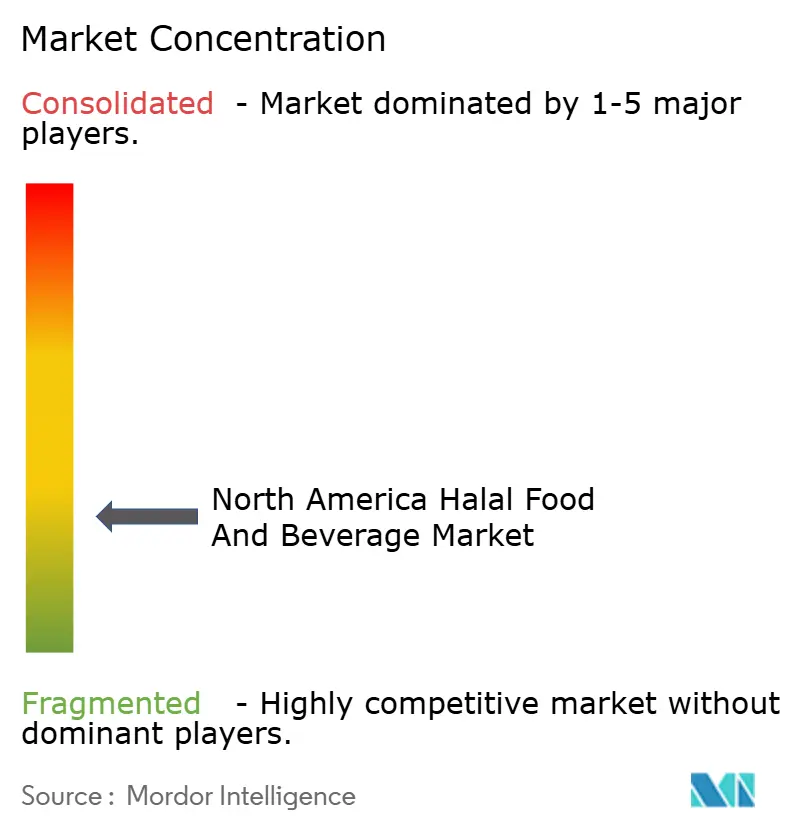
| Market Concentration | Low |
Major Players *Disclaimer: Major Players sorted in no particular order Image © Mordor Intelligence. Reuse requires attribution under CC BY 4.0. | |
North America Halal Food And Beverage Market Analysis by Mordor Intelligence
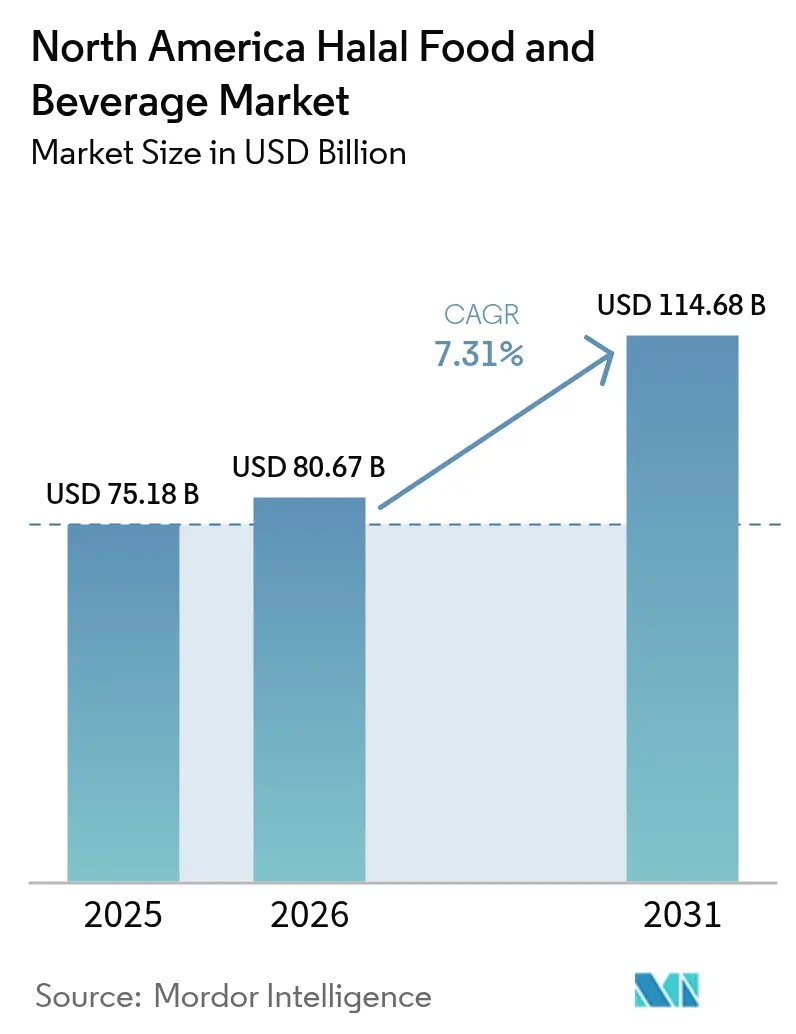
The North America halal food and beverage market size was valued at USD 75.18 billion in 2025 and estimated to grow from USD 80.67 billion in 2026 to reach USD 114.68 billion by 2031, at a CAGR of 7.31% during the forecast period (2026-2031). Robust population growth in Muslim communities, a widening appeal among health-minded non-Muslim consumers, and retailer push into clean-label offerings keep demand on an upward slope. Mainstream supermarkets now place halal meat in prime refrigerated cases, while beverage players shift to halal-compliant enzymes, shortening reformulation cycles and accelerating product launches. At the policy level, the Canadian Food Inspection Agency’s labeling framework and the United States Department of Agriculture’s 2024 accreditation of several certifiers create a permissive if fragmented regulatory environment that manufacturers navigate for speed-to-market advantage. Online grocery platforms further expand reach into rural zip codes, effectively enlarging the North America halal food and beverage market beyond its traditional urban core.
Key Report Takeaways
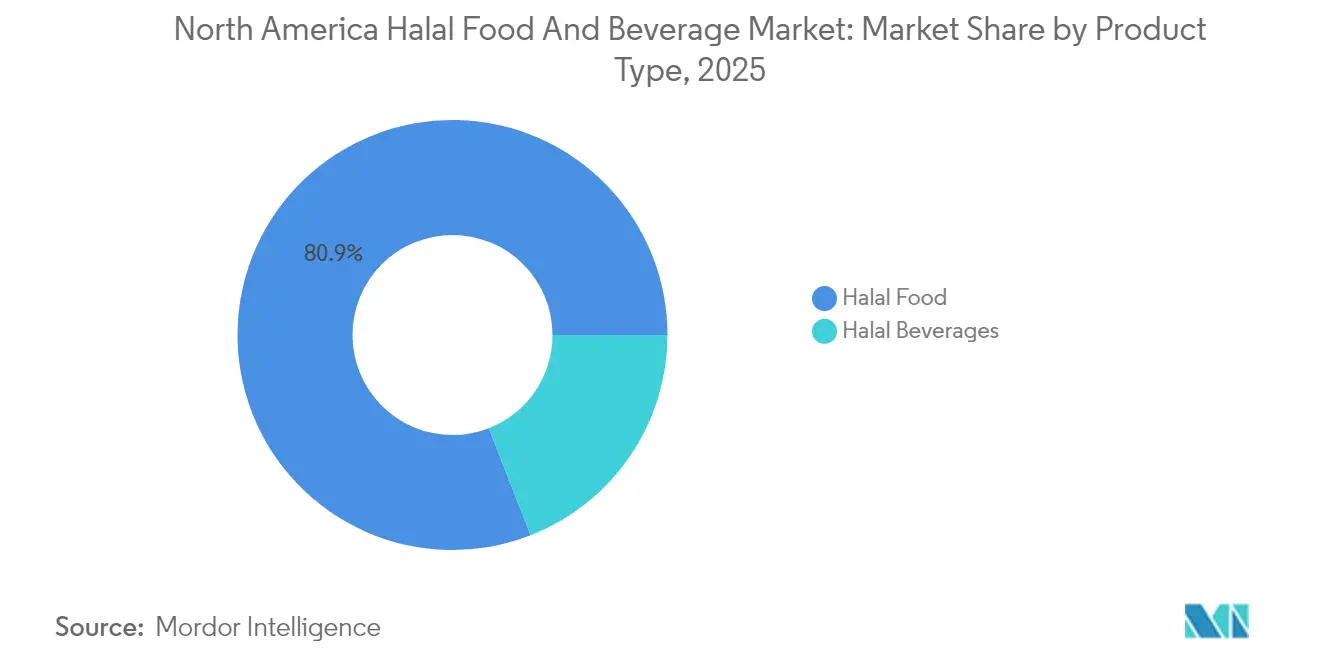
- By product type, halal food commanded 80.92% of the North America halal food and beverage market share in 2025, while halal beverages are forecast to post the fastest growth at an 8.02% CAGR through 2031.
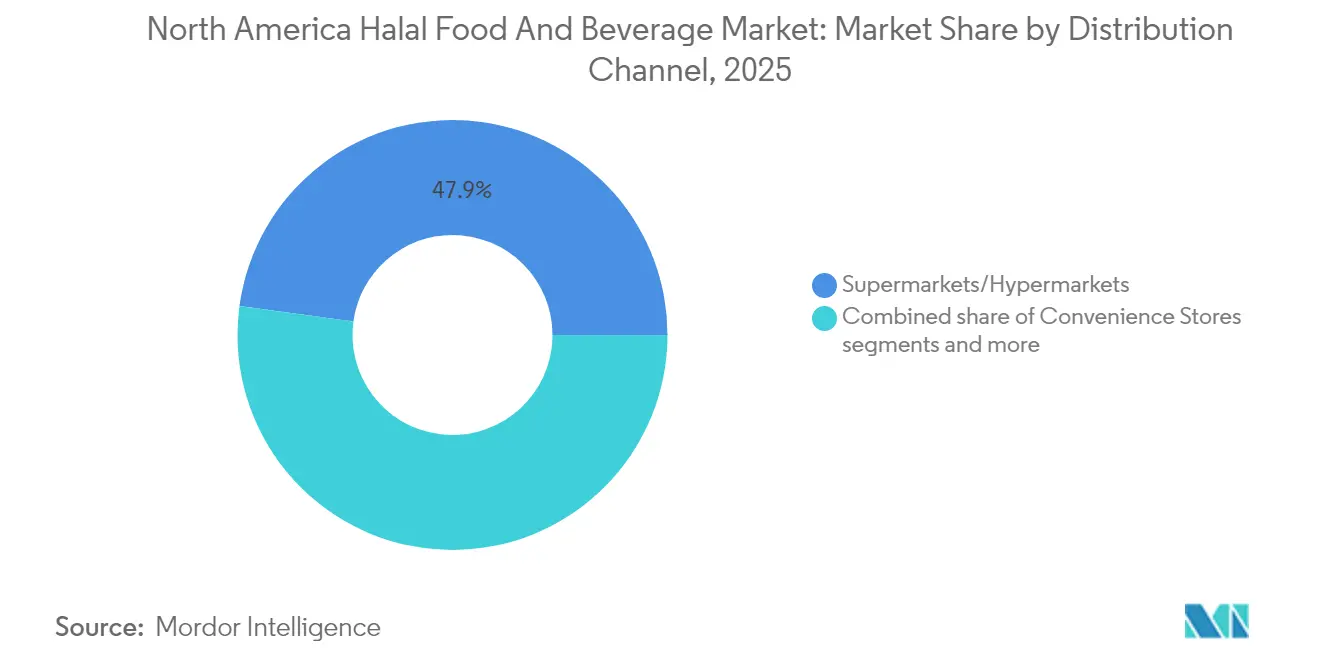
- By distribution channel, supermarkets and hypermarkets led with 47.85% revenue share in 2025; online retail stores are poised for the quickest expansion at an 8.55% CAGR to 2031.
- By geography, the United States held 74.88% of the North America halal food and beverage market size in 2025, whereas Mexico is set to record the highest CAGR at 7.88% between 2026 and 2031.
Note: Market size and forecast figures in this report are generated using Mordor Intelligence’s proprietary estimation framework, updated with the latest available data and insights as of 2026.
North America Halal Food And Beverage Market Trends and Insights
Drivers Impact Analysis*
| Driver | (~) % Impact on CAGR Forecast | Geographic Relevance | Impact Timeline |
|---|---|---|---|
| Surge in tourism and expatriate communities demanding halal food | +1.8% | United States (major gateway cities), Canada (Toronto, Vancouver), Mexico (resort corridors) | Medium term (2-4 years) |
| Increasing number of halal food certifications and regulatory bodies | +1.2% | United States, Canada | Long term (≥ 4 years) |
| Growing awareness and demand for halal-certified products | +1.5% | North America-wide, with urban concentration | Medium term (2-4 years) |
| Rising health-conscious consumers preferring clean, ethically sourced foods | +0.9% | United States, Canada | Short term (≤ 2 years) |
| Rising demand for convenient, ready-to-eat halal meals | +1.1% | United States (major metros), Canada | Short term (≤ 2 years) |
| Expanding availability of halal products in mainstream grocery stores | +0.8% | United States, Canada, Mexico (urban centers) | Medium term (2-4 years) |
| Source: Mordor Intelligence | |||
Surge in tourism and expatriate communities demanding Halal food
Surging tourism flows and the expansion of expatriate communities in major North American cities are significantly boosting demand for halal food and beverages, as travelers and migrants seek products aligned with Islamic dietary requirements across retail, foodservice, and hospitality channels. International Trade Administration data indicate that the United States welcomed 6,456,562 international visitors in December 2024, a 9.5% increase over the previous year[1], highlighting the strengthening tourism base that underpins this demand. Growing inflows from Muslim-majority countries, combined with established expatriate clusters in hubs such as New York, Toronto, Houston, and Los Angeles, are encouraging airports, hotels, and quick-service restaurants to integrate halal-certified options into their menus. This expanding and increasingly affluent customer pool is prompting retailers and manufacturers to broaden halal assortments beyond meat into snacks, ready meals, dairy, and beverages, thereby accelerating the mainstreaming and growth of the halal food and beverage segment in North America.
Increasing number of Halal food certifications and regulatory bodies
Increasing number of halal food certifications and specialized regulatory bodies is a key driver of the North America halal food and beverage market. Independent halal certifiers, Islamic councils, and audit organizations are expanding their presence, standardizing requirements, and improving oversight. The proliferation of bodies such as the Islamic Food and Nutrition Council of America (IFANCA) in the U.S. and the Halal Monitoring Authority in Canada creates wider certification access and clearer signals of compliance for brands [2]. This enhances consumer trust by reducing uncertainty around ingredient sources, slaughter methods, and processing standards. In turn, retailers and foodservice operators gain confidence to scale halal assortments and private-label offerings. At the same time, differing standards and logos can create some friction and complexity for multinational manufacturers navigating multiple schemes.
Growing awareness and demand for Halal-certified products
Growing awareness and demand for halal-certified products is a critical driver of the North America halal food and beverage market. Muslim consumers are increasingly seeking clear halal labeling to ensure products comply with religious dietary requirements, while non-Muslim shoppers perceive halal as a proxy for cleanliness, humane treatment, and stringent quality control. Retailers and foodservice operators are responding by expanding halal ranges across meat, packaged foods, snacks, and beverages, moving halal from ethnic aisles into mainstream shelves. Digital media, community organizations, and influencers are playing a key role in educating consumers about halal standards and available brands. This heightened visibility is encouraging national brands and private labels to pursue certification as a route to market differentiation. As awareness rises, halal demand is shifting from niche to mass, supporting premiumization, broader distribution, and sustained category growth across North America.
Rising health-conscious consumers preferring clean, ethically sourced foods
Rising health-conscious consumers preferring clean, ethically sourced foods are increasingly supporting growth in the North America halal food and beverage market. Many shoppers view halal standards such as controlled sourcing, specific slaughter practices, and restrictions on certain additives as aligned with broader concerns around animal welfare, product integrity, and traceability. This perception positions halal as overlapping with “better-for-you” and “ethical” food segments rather than only a religious requirement. As a result, halal-certified products are attracting interest from flexitarians and non-Muslim health-conscious consumers seeking minimally processed and transparently sourced options. Brands are responding by highlighting halal certification alongside claims such as organic, natural, and antibiotic-free on packaging and marketing. This convergence of health, ethics, and faith-driven preferences is expanding the consumer base for halal offerings and encouraging retailers to integrate them into mainstream assortments.
Restraints Impact Analysis*
| Restraint | (~) % Impact on CAGR Forecast | Geographic Relevance | Impact Timeline |
|---|---|---|---|
| Limited consumer awareness in non-urban and emerging markets | -0.5% | Rural areas in South Asia, Sub-Saharan Africa, interior South America | Long term (≥ 4 years) |
| Perception of inferior taste or mouthfeel versus regular butter | -0.4% | Global, particularly among traditional dairy consumers in Europe and North America | Medium term (2-4 years) |
| Shorter shelf life due to processing sensitivities | -0.3% | Global, with acute impact in regions lacking cold-chain infrastructure (Africa, Southeast Asia) | Medium term (2-4 years) |
| Stringent food safety and labeling compliance burdens | -0.4% | Global, disproportionately affecting small and medium producers in emerging markets | Long term (≥ 4 years) |
| Source: Mordor Intelligence | |||
High cost of Halal certification for manufacturers
High cost of halal certification for manufacturers is a notable restraint in the North America halal food and beverage market. Certification involves recurring fees for audits, plant inspections, documentation reviews, and logo usage, which can be particularly burdensome for small and mid-sized processors. Additional operational expenses arise from segregated production lines, dedicated storage, and traceability systems needed to comply with halal standards. These costs can erode margins or force higher retail prices, limiting competitiveness against conventional products. Manufacturers with broad portfolios may also face complexity and expense in certifying multiple SKUs and facilities. In some cases, varying requirements across certifying bodies add further duplication of effort and cost. Consequently, certain companies delay or avoid entering the halal segment, constraining product availability and slowing overall market expansion.
Competition from conventional food and beverage products
Competition from conventional food and beverage products acts as a key restraint on the North America halal food and beverage market. Mainstream products typically benefit from wider brand recognition, entrenched shelf space, and aggressive pricing supported by economies of scale. Many retailers still prioritize fast-moving conventional SKUs, limiting visibility and assortment depth for halal alternatives. Price-sensitive consumers, including some Muslim shoppers, may opt for cheaper non-halal options when certified products carry a premium. In categories where halal benefits are not clearly communicated, non-halal brands can dominate through stronger marketing and promotions. This intense competition makes it harder for halal manufacturers to secure national listings and scale volumes. As a result, overall halal market penetration and growth are slower than the underlying demand potential.
*Our forecasts treat driver/restraint impacts as directional, not additive. The impact forecasts reflect baseline growth, mix effects, and variable interactions.
Segment Analysis
By Product Type: Protein Dominates, Beverages Accelerate
Halal food accounted for the dominant share of 80.92% in North America’s halal food and beverage market in 2025, establishing the segment as the clear market leader. The category’s strength is primarily anchored by meat, poultry, and seafood products, which continue to represent the core of halal consumption across the region. This dominance is driven by strong consumer confidence in halal certification standards that emphasize hygiene, humane animal treatment, and perceived product freshness. The broad acceptance of halal meat products among both Muslim and non-Muslim consumers has further expanded the category’s reach across mainstream retail and foodservice channels. Additionally, increasing availability of ready-to-cook and frozen halal meat-based meals supports convenience-driven demand.
Halal beverages, meanwhile, represent the fastest-growing segment and are projected to record a compound annual growth rate (CAGR) of 8.02% between 2026 and 2031, surpassing the overall market pace. Growth in this category is largely fueled by the ease with which soft drinks, energy drinks, and functional beverages can be reformulated using halal-compliant ingredients such as enzymes, emulsifiers, and natural flavorings. Beverage manufacturers are increasingly aligning their product portfolios with halal certification standards to tap into a widening consumer base seeking transparency and ethical sourcing. The shift toward halal-certified functional drinks resonates strongly with health-conscious younger consumers, particularly within urban markets. Growing investments from global beverage companies in halal product innovation and certification programs are further accelerating the segment’s expansion.

By Distribution Channel: E-Commerce Disrupts Traditional Retail
Supermarkets and hypermarkets dominated the North America halal food and beverage distribution landscape in 2025, capturing 47.85% of the total market share. Their leadership stems from the convenience of one-stop shopping, extensive product assortments, and strong price competitiveness compared with smaller ethnic or specialty grocers. These large-format retailers have increasingly expanded their halal-certified product ranges to cater to both Muslim and non-Muslim consumers seeking quality and authenticity. Strategic partnerships with halal-certified suppliers have enabled consistent product availability and enhanced consumer trust in labeling and sourcing. Additionally, attractive promotional campaigns, store branding, and in-store education initiatives have further driven traffic within this channel.
Online retail stores, by contrast, are emerging as the fastest-growing distribution channel, projected to register a CAGR of 8.55% from 2026 to 2031. This rapid expansion is propelled by increasing digital adoption, the rise of e-grocery platforms such as Amazon Fresh, and the growth of specialized halal e-tailers catering to niche consumer groups. Online channels eliminate the geographic limitations of brick-and-mortar outlets, allowing consumers to access a broader range of halal-certified products irrespective of location. The convenience of home delivery, flexible payment options, and improved product verification systems further enhance consumer confidence in online purchases. Moreover, digital marketing initiatives and subscription-based delivery models are helping e-retailers build sustained engagement within younger, tech-savvy demographics.
Geography Analysis
The United States held the dominant position in North America’s halal food and beverage market in 2025, accounting for 74.88% of the total regional share. This leadership is supported by a sizable Muslim population exceeding 3.5 million , primarily concentrated in key metropolitan hubs such as New York, Los Angeles, Chicago, and Houston. The strong presence of halal-certified restaurants, food manufacturers, and retail outlets in these cities has further reinforced the country’s market position. Growing awareness of halal standards among mainstream consumers, coupled with a rising interest in ethical and clean-label products, has widened the appeal of halal offerings beyond the Muslim community. Moreover, major U.S. retailers and quick-service restaurant chains have increasingly incorporated halal-certified product lines and menus, reflecting expanding consumer diversity.
Mexico, meanwhile, is projected to register the fastest growth in the region, with a compound annual growth rate (CAGR) of 7.88% from 2026 to 2031. The country’s growth trajectory is fueled by rising tourism from Muslim-majority nations and a small but expanding Muslim expatriate population in Mexico City and high-traffic resort destinations such as Cancún and Los Cabos. Growing hospitality industry awareness of halal preferences has led to the gradual introduction of halal-certified food options in hotels and restaurants catering to international visitors. Additionally, import partnerships with Middle Eastern and Southeast Asian suppliers are facilitating the availability of compliant ingredients and processed foods. Government initiatives aimed at diversifying tourism and promoting inclusive dining experiences further support market development.
Canada represents another significant market within the region, characterized by a mature halal ecosystem and steady demand across major urban centers such as Toronto, Vancouver, and Montreal. The country’s multicultural demographic composition and supportive regulatory environment have encouraged widespread acceptance and availability of halal food and beverages. Local producers and importers benefit from clear certification standards, enabling consistent product labeling and consumer trust. Retail chains and foodservice operators are expanding halal offerings, catering to both domestic demand and export opportunities across North America.
Regulatory Landscape
Halal governance in North America is mostly claim and labeling enforcement layered on top of general food safety rules, with halal conformity typically verified by third-party certifiers rather than a single federal halal standard. In Canada, Food and Drug Regulations (B.01.050) require that any product labeled as halal identify the certifying body on-pack, and the Canadian Food Inspection Agency (CFIA) administers broader labeling frameworks without setting halal standards or accrediting certifiers. In the United States, USDA-FSIS oversight becomes central for meat and poultry labeling, where establishments using halal claims must retain current supporting documentation from a certifying organization in labeling records.
Recent U.S. guidance tightened practical expectations for label approval workflows. In December 2025, USDA-FSIS issued FSIS-GD-2025-0006, clarifying that "Certified Halal" labels without current supporting documentation do not qualify for generic label approval, increasing the importance of document control for national retail programs. Mexico adds a standards-based reference point through NMX-F-595-SCFI-2015 as a national recommended code of practice for halal, with certification overseen by entities accredited by Entidad Mexicana de Acreditacion (EMA). The region also includes state-level consumer protection provisions in the U.S., such as the Illinois Halal Food Disclosure Act, reinforcing disclosure and recordkeeping obligations for sellers and processors marketing halal products.
Value Chain Analysis
The North American halal food and beverage value chain begins with livestock and ingredient suppliers that can support segregation and traceability, then moves through slaughter and primary processing, secondary processing (prepared foods, deli, frozen, snacks, dairy, and beverages), and packaging, with halal compliance treated as a parallel control system alongside HACCP and other food safety programs. Third-party certification bodies such as IFANCA and other U.S. halal auditors act as a gatekeeper between manufacturing and market access, since retailers and foodservice operators typically require recognized certification logos and audit documentation to list products. For beverages and processed foods, upstream inputs such as enzymes, emulsifiers, flavors, and processing aids become key control points, driving supplier qualification and reformulation work when portfolios shift to halal-compliant alternatives.
Downstream, mainstream supermarkets and hypermarkets and expanding e-commerce platforms aggregate demand, but logistics execution remains a friction point because multi-use cold storage and distribution centers must prevent co-mingling of halal and non-halal inventory. This has increased emphasis on chain-of-custody practices (dedicated storage zones, validated cleaning, lot-level documentation) and has accelerated adoption of digital traceability tools across supply-chain participants to reduce fraud risk and shorten verification cycles. Cross-border flows also elevate the role of importer documentation and label substantiation, particularly for meat and poultry subject to USDA-FSIS label controls and for products sold into Canada where halal claims require certifier identification on-pack.
Competitive Landscape
The North America halal food and beverage market is highly fragmented, characterized by the presence of numerous regional players, ethnic brands, and emerging startups competing alongside global food manufacturers. The competitive environment is shaped by diverse product portfolios, varying certification standards, and differences in supply chain integration. Large multinational companies such as Nestlé, Unilever, and PepsiCo have expanded their halal-certified offerings to leverage cross-regional demand, particularly in beverages, dairy, and packaged foods. Meanwhile, regional producers and specialty brands continue to dominate niche segments including halal meat, ready-to-eat meals, and bakery products. The coexistence of mainstream international corporations and community-focused enterprises contributes to a dynamic, competitive marketplace where brand credibility and certification authenticity are key differentiating factors.
Local and mid-sized companies play a critical role in shaping competition by offering culturally tailored products designed for diverse Muslim and non-Muslim consumer groups. These companies often emphasize traditional recipes, ethical sourcing, and traceability to strengthen brand loyalty within local markets. Strategic partnerships with halal certification bodies enhance transparency and help smaller brands gain consumer trust. Many operators are also adopting omnichannel retail models, including e-commerce distribution and direct-to-consumer sales, to reach geographically dispersed audiences. The ability to maintain price competitiveness while ensuring compliance with halal standards remains essential for sustaining market position.
The competitive landscape is further evolving as investment in product innovation and certification infrastructure intensifies across the region. Companies are focusing on reformulating existing product lines to meet halal certification requirements, while also developing new items in high-growth categories such as functional beverages, frozen meals, and confectionery. Mergers, acquisitions, and collaborations with certified suppliers are becoming more common as firms seek to streamline supply chains and expand portfolio reach. Additionally, the rise of private-label halal products in major retail chains adds another layer of complexity, increasing competition based on both pricing and branding.
North America Halal Food And Beverage Industry Leaders
-
American Foods Group, LLC
-
JBS S.A.
-
BRF S.A.
-
Crescent Foods, Inc.
-
Nestlé S.A.
- *Disclaimer: Major Players sorted in no particular order
Market Opportunities and Future Outlook
A near-term opportunity sits in compliance-enabled scaling into mainstream and digital retail, where brands that standardize documentation and labeling workflows can move faster across large banners and club formats while reducing the risk of claim challenges. The December 2025 USDA-FSIS FSIS-GD-2025-0006 clarification on "Certified Halal" label approval increases the value of robust certifier documentation management for meat and poultry suppliers targeting national distribution, especially when listings span multiple states with additional consumer protection statutes such as Illinois. In Canada, the Food and Drug Regulations requirement to name the certifying body on halal-labeled foods reinforces an identifiable trust cue that manufacturers can operationalize across portfolios to support broader shelf placement beyond ethnic aisles.
Product and channel whitespace is also apparent in categories where halal compliance depends primarily on ingredient sourcing rather than dedicated facilities, such as functional and packaged beverages and many processed foods. Retail activity continues to provide evidence of where assortment expansion is moving. Crescent Foods broadened distribution of halal proteins into Sams Club locations in Texas, signaling a pathway for other certified suppliers to reach non-specialty shoppers through club and mass retail while keeping halal credentials and clean-label claims prominent. On the supply side, large-scale protein processing investments that increase regional throughput and improve consistency of raw material supply, such as American Foods Groups new Americas Heartland Packing facility in Missouri, can support greater availability of certified proteins and prepared halal items when paired with certifier-audited segregation and recordkeeping practices.
Recent Industry Developments
- January 2026: Crescent Foods expanded distribution of halal-certified chicken items, including breaded chicken breast nuggets and individually frozen boneless skinless chicken breasts, into Sams Club locations across Texas. The move pushes halal proteins deeper into club retail, improving visibility and volume potential outside specialty grocers. It also raises execution demands around consistent certification documentation and cold-chain handling at scale.
- December 2025: USDA-FSIS issued updated guidance (FSIS-GD-2025-0006) indicating that labels with "Certified Halal" claims without current supporting documentation from the certifying organization do not qualify for generic label approval. This change increases the operational importance of maintaining up-to-date certifier records for faster label clearances and uninterrupted retail supply. It also strengthens the role of recognized third-party certifiers in day-to-day market access for meat and poultry products.
- April 2025: American Foods Group opened the Americas Heartland Packing beef processing facility in Wright City, Missouri, an investment reported at USD 800 million. The plant is designed to process up to 2,400 cattle per day when fully operational, adding major throughput capacity in the regional protein supply chain. For halal programs, such large-scale infrastructure can support broader availability when paired with certifier-audited processes for segregation, documentation, and compliant handling.
Research Methodology Framework and Report Scope
Market Definition and Coverage
This market covers the value of halal-compliant food and beverage products sold across North America, where halal certification and handling practices are followed through the supply chain and the product is offered to consumers through retail and foodservice routes.
Scope exclusions: We exclude non-food halal categories (such as cosmetics), informal home production, and products marketed as halal without recognizable certification or documented halal handling.
Segmentation Overview
- By Product Type
- Halal Food
- Dairy and Dairy Alternatives
- Confectionery
- Bakery Products
- Savory Snacks
- Baby Food
- Meat, Poultry and Seafood
- Ready Meals and Sauces
- Other Product Types
- Halal Beverages
- Halal Food
- By Distribution Channel
- Supermarkets/Hypermarkets
- Convenience Stores
- Online Retail Stores
- Other Distribution Channels
- By Country
- United States
- Canada
- Mexico
- Rest of North America
Data Sources, Market Sizing, and Validation
Desk Research
Desk research was used to set the fact base for population, consumption, and labeling context, and then to narrow what should count as halal in everyday retail and foodservice. Public sources such as USDA Economic Research Service (food spending and categories), USDA Foreign Agricultural Service trade statistics (imports of meat and processed foods), Statistics Canada and the Canadian Food Inspection Agency (labeling and inspection references), and US Census Bureau retail and population series were used to build realistic demand pools.
We also reviewed company filings, investor presentations, certifier and association websites, and trusted press coverage to understand product availability, channel expansion (including online), and pricing direction for key categories. In parallel, paid subscriptions for company financials and a shipment-level import/export database were used selectively to sanity-check supplier scale and category movements when public granularity was limited. These examples are illustrative only, and many other sources were referred to for data collection, validation, and research clarification.
Primary Interviews and Surveys
Primary work focused on validating what is truly sold as halal in mainstream shelves and foodservice menus, and on separating certified products from adjacent ethnic or specialty items. We spoke with certifiers, processors, brand and channel managers, distributors, and foodservice operators across the United States, Canada, and Mexico so the assumptions on category mix, price points, and channel splits could be corrected before finalization.
Distribution of primary research fieldwork respondents
| Company type | Respondent position |
|---|---|
| Top tier: 38% | CXOs: 17% |
| Mid tier: 42% | Functional/Unit leaders: 31% |
| Smaller Players: 20% | Managers: 52% |
Market-Sizing & Forecasting
Sizing starts with a top-down demand reconstruction, where regional food and beverage expenditure is filtered through the halal addressable base and then adjusted by category and channel realities. Inputs we used include the Muslim and broader halal-seeking consumer base, per capita food spending levels, penetration of halal-labeled items in modern retail and foodservice, typical price premiums versus conventional items, and the shift toward online retail for packaged halal products.
Those totals are then cross-checked with selective bottom-up approximations, such as rolling up a sample set of supplier and retailer indicators, applying observed average selling prices to category volumes, and validating channel shares through distributor and store checks. Where direct volume signals were missing for smaller categories, we applied conservative proxy ratios anchored to comparable food groups, and then re-tested the result in interviews.
For forecasting, we relied on scenario analysis supported by a simple multivariate regression on drivers that can be tracked annually, such as population growth, retail assortment expansion, import availability for halal meats and ingredients, and consumer price inflation. Assumptions were kept transparent so small changes in penetration or price could be traced through the model quickly.
Data Validation & Update Cycle
Outputs are validated through multiple passes, where the market totals are compared against independent signals like category growth in food retail, trade flows for relevant product groups, and directional pricing movements. When a country or channel shows a swing that does not match these checks, the inputs are reopened and the most sensitive assumptions are reworked before sign-off.
We also run variance checks across product groups so the implied category shares stay realistic, and then the model is reviewed by another analyst for logic, math, and consistency of scope. Reports are refreshed annually, and interim updates are triggered when material events occur, such as certification policy changes or abrupt trade disruptions. Before delivery, a fresh review pass is completed so clients receive the latest updated view.
Mordor Intelligence's North America Halal Food and Beverages Market Size Versus Other Published Estimates
Published market sizes for halal food and beverages in North America can differ, even when they appear to be covering the same theme. The differences usually come from what is counted as halal in practice, which countries are included, and whether the number is built from consumer demand signals or from broad revenue allocations.
The main gap comes from scope mixing, where Mordor Intelligence counts only halal food and halal beverages sold in North America (United States, Canada, Mexico, and the rest of the region) and keeps adjacent ethical or ethnic foods out unless they are tied to halal certification and handling, which can pull some other estimates upward or downward depending on what they bundle together.
Benchmark comparison
| Source | Market Size | Gaps in Research Methodology |
|---|---|---|
| Mordor Intelligence | USD 75.18 B (2025) | |
| Press Release Publisher A | USD 100.11 B (2024) | This estimate is presented for halal food only with a 2024 base year, and the definition in press summaries can blend food with broader halal positioning, which makes year alignment and product coverage less comparable to a food plus beverages view. |
| Regional Research House B | USD 35.79 B (2023) | This figure uses an earlier base year and appears to apply narrower category capture and channel coverage assumptions, which can undercount mainstream retail penetration that expanded later in the study period. |
The spread across the three values mostly reflects differences in what is included, which year is used as the anchor, and how quickly pricing and channel shifts are refreshed. By keeping assumptions tied to observable demand indicators and then stress-testing them in interviews, our estimate stays easier to reproduce and to update when new certification rules or retail assortment changes occur.
Key Questions Answered in the Report
What is the current value of the North America halal food and beverage market?
The market is valued at USD 80.67 billion in 2026 and is projected to grow to USD 114.68 billion by 2031.
Which product category is growing fastest?
Halal beverages are forecast to expand at an 8.02% CAGR between 2026 and 2031, outpacing all other segments.
Why are mainstream retailers increasing halal offerings?
Clean-label positioning and rising non-Muslim interest make halal SKUs profitable additions to primary meat and dairy cases.
Which country will record the fastest growth through 2031?
Mexico is expected to grow at an 7.88% CAGR, driven by tourism and a nascent local production base.
What challenges do small processors face in halal certification?
Certification fees, segregated production lines, and ongoing audit costs can exceed USD 500,000 for mid-sized facilities.