
Market Overview
| Study Period | 2021 - 2031 |
|---|---|
| Forecast Data Period | 2026 - 2031 |
| Base Year Market Size (2025) | USD 3.89 Billion |
| Market Size (2026) | USD 4.04 Billion |
| Market Size (2031) | USD 4.91 Billion |
| Growth Rate (2026 - 2031) | 3.96 % |
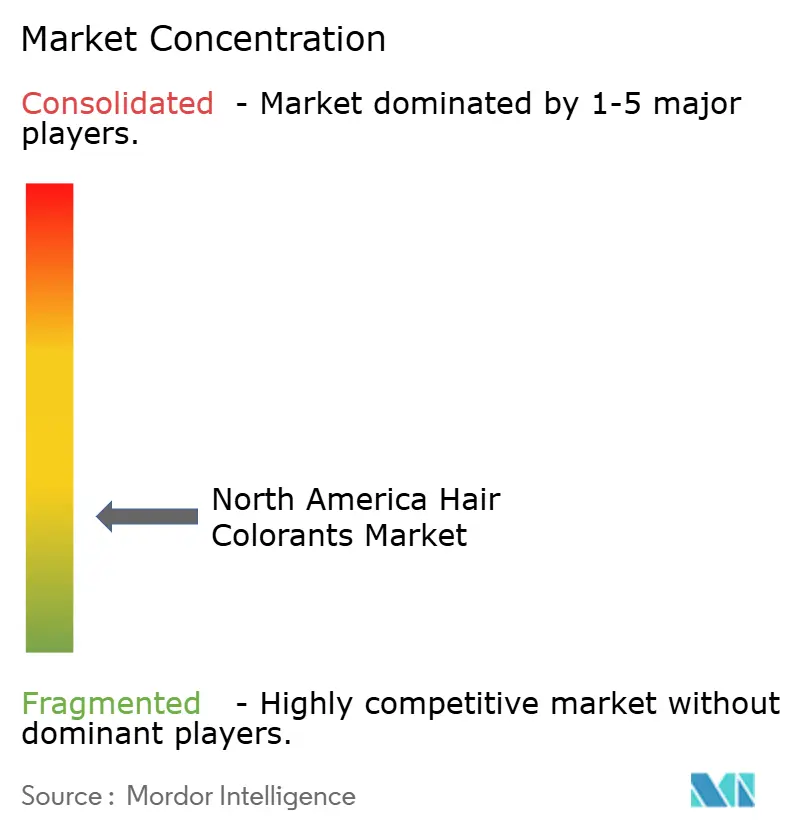
| Market Concentration | Low |
Major Players *Disclaimer: Major Players sorted in no particular order Image © Mordor Intelligence. Reuse requires attribution under CC BY 4.0. | |
North America Hair Colorants Market Analysis by Mordor Intelligence
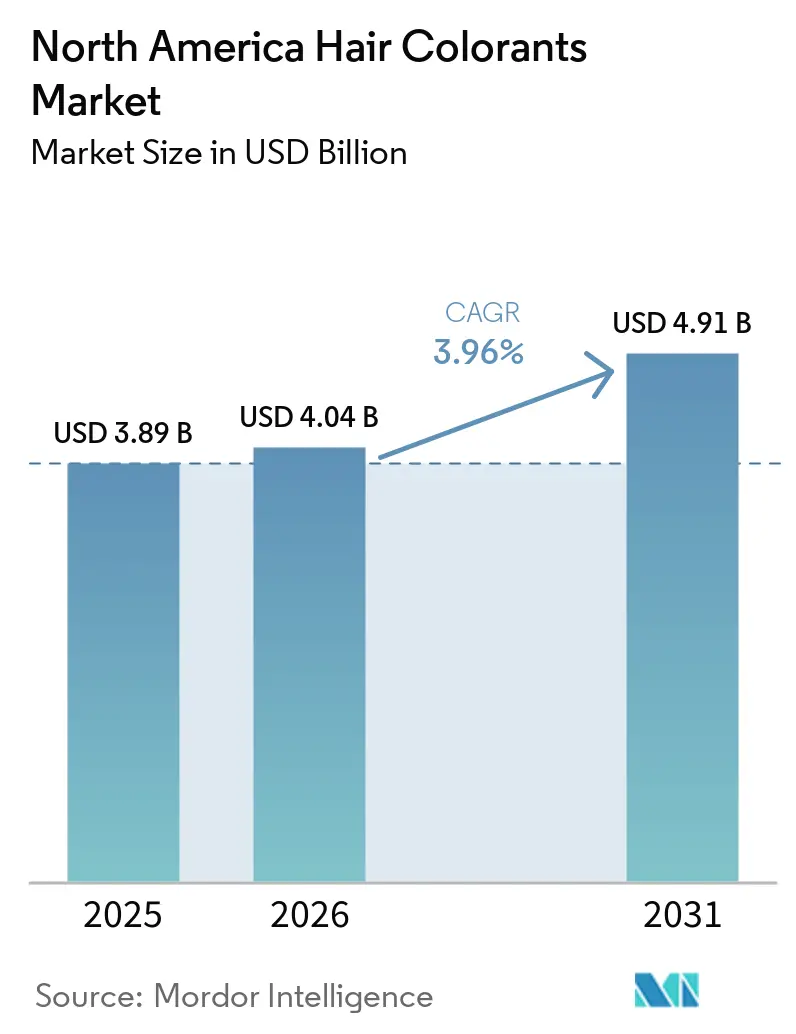
The North America Hair Colorants Market was valued at USD 3.89 billion in 2025 and is estimated to grow from USD 4.04 billion in 2026 to reach USD 4.91 billion by 2031, at a CAGR of 3.96% during the forecast period (2026–2031). Market growth is driven by increasing emphasis on personal grooming, changing beauty preferences, and the growing role of hair coloring in individual style expression. Continuous innovation in dye formulations, pigment technologies, and conditioning ingredients is improving color retention, shade consistency, and the overall coloring experience, encouraging consumers to explore newer products. Rising interest in personalized hair aesthetics, including multidimensional colors and customized shades, is also expanding the range of coloring products sought by consumers.
Key Report Takeaways
- By product type, permanent colorants held 49.55% of the North America hair colorants market share in 2025, while highlighters are forecast to grow at a 4.85% CAGR through 2031.
- By category, conventional hair colorants accounted for 84.23% of the North America hair colorants market size in 2025, while organic colorants are projected to advance at a 5.96% CAGR through 2031.
- By price tier, the mass tier captured 79.09% of the North America hair colorants market share in 2025, while premium colorants are expected to grow at a 5.87% CAGR through 2031.
- By distribution channel, supermarkets and hypermarkets held 40.67% of the North America hair colorants market in 2025, while online retail stores are forecast to expand at a 6.09% CAGR through 2031.
- By geography, the United States represented 78.34% of the North America hair colorants market in 2025, while Canada is projected to grow at a 5.61% CAGR through 2031.
Note: Market size and forecast figures in this report are generated using Mordor Intelligence’s proprietary estimation framework, updated with the latest available data and insights as of January 2026.
North America Hair Colorants Market Trends and Insights
Drivers Impact Analysis*
| Driver | (~) % Impact on CAGR Forecast | Geographic Relevance | Impact Timeline |
|---|---|---|---|
| Rising demand for at-home hair coloring products | +0.8% | United States (core), Canada (spill-over) | Short term (≤ 2 years) |
| Aging population and recurring gray-coverage demand | +0.7% | United States, Canada, Rest of North America | Long term (≥ 4 years) |
| Growing influence of social media and beauty trends | +0.6% | United States (dominant), Canada (secondary) | Short term (≤ 2 years) |
| Product innovation in long-lasting color performance | +0.5% | Global, with North America as primary test market | Medium term (2–4 years) |
| Growing demand for personalized hair color solutions | +0.4% | United States (primary), with early gains in urban Canada | Medium term (2–4 years) |
| Increasing adoption of men's hair coloring products | +0.3% | United States, Canada | Long term (≥ 4 years) |
| Source: Mordor Intelligence | |||
Rising Demand for At-Home Hair Coloring Products
The growing preference for at-home hair coloring is driving the North America Hair Colorants Market. Ready-to-use coloring kits, pre-measured formulations, applicator bottles, and step-by-step instructions simplify the coloring process for routine use, offering consumers greater flexibility in managing their hair color without depending on salon appointments. Consumers can refresh faded shades, cover visible roots, and experiment with different colors according to their preferences and schedules. The availability of permanent, semi-permanent, and temporary formulations allows consumers to select products based on their desired color longevity and maintenance requirements. Improvements in application convenience, shade selection, and conditioning properties further support the appeal of at-home hair colorants.
Aging Population and Recurring Gray-Coverage Demand
The aging population across North America supports sustained demand for hair colorants, particularly products designed to cover gray hair, blend silver strands, and maintain consistent hair color between applications. As natural melanin production declines with age, visible gray hair creates recurring coloring needs among consumers who prefer to retain their natural-looking hair shades. This drives repeat purchases of permanent hair dyes, root touch-up kits, and gray-blending formulations, as newly emerging gray roots require periodic maintenance to preserve uniform color. According to the United States Census Bureau, approximately 18.7% of the American population was aged 65 and older in 2025, highlighting the growing importance of older consumers in the beauty and personal care market[1]. This demographic trend presents opportunities for manufacturers to develop hair colorants with reliable gray coverage and natural-looking shade options.
Growing Influence of Social Media and Beauty Trends
The growing influence of social media and digital beauty trends is driving the North America Hair Colorants Market by exposing consumers to trending hair shades, celebrity-inspired looks, and innovative coloring techniques. Visual content, including before-and-after transformations and hairstyling tutorials, encourages consumers to experiment with balayage, vivid colors, face-framing highlights, and multidimensional shades, increasing interest in products that help recreate these looks. For instance, according to the Pew Research Center's 2025 survey of United States adults, 50% used Instagram, and 37% used TikTok[2]. The widespread use of these platforms creates substantial opportunities for beauty influencers and hairstylists to showcase trending hair colors, demonstrate coloring techniques, and introduce consumers to new shades, encouraging experimentation and supporting demand for trend-driven hair colorants.
Product Innovation in Long-Lasting Color Performance
Continuous product innovation in color retention, hair-fiber protection, and conditioning performance is driving the North America Hair Colorants Market by addressing consumer concerns about fading, dryness, and damage associated with repeated coloring. Manufacturers are incorporating bond-supporting technologies, conditioning ingredients, and alternative formulations to improve the coloring experience while maintaining effective shade coverage. These developments help differentiate products by combining color performance with hair-care benefits, encouraging consumers to adopt newer formulations. For instance, in January 2025, Clairol launched its first Bonding Hair Color line, featuring alpha hydroxy acid (AHA)-inspired technology in a three-step system designed to strengthen and revitalize hair, alongside a zero-ammonia formulation. This launch illustrates how innovation that combines hair coloring with conditioning and fiber-care benefits can expand consumer interest in advanced hair colorants.
Restraints Impact Analysis*
| Restraint | (~) % Impact on CAGR Forecast | Geographic Relevance | Impact Timeline |
|---|---|---|---|
| Concerns about scalp irritation and allergic reactions | -0.5% | United States, Canada | Short term (≤ 2 years) |
| Stringent regulatory requirements | -0.4% | United States (FDA), Canada (Health Canada) | Medium term (2–4 years) |
| Increasing scrutiny of chemical ingredients | -0.3% | North America-wide | Medium term (2–4 years) |
| Risk of hair damage from repeated coloring | -0.2% | United States, Canada | Long term (≥ 4 years) |
| Source: Mordor Intelligence | |||
Concerns About Scalp Irritation and Allergic Reactions
Concerns about scalp irritation and allergic reactions restrain the North America Hair Colorants Market by increasing consumer caution toward formulations containing sensitizing ingredients. Paraphenylenediamine (PPD), widely used in permanent oxidative hair dyes, is a recognized cause of allergic contact dermatitis and can trigger itching, redness, swelling, and skin irritation in sensitized individuals. These reactions may discourage repeat use of conventional hair dyes and push consumers toward PPD-free alternatives or formulations with different coloring technologies. This risk also reinforces the importance of ingredient transparency, precautionary allergy testing, and clear product labeling, placing additional pressure on manufacturers to improve formulation safety while maintaining effective color performance.
Stringent Regulatory Requirements
Stringent regulatory requirements across North America can restrain the hair colorants market by increasing compliance costs, extending product development timelines, and complicating the introduction of new formulations. In the United States, the Food and Drug Administration (FDA) regulates coal-tar hair dyes under the Federal Food, Drug, and Cosmetic Act, with specific requirements governing permitted uses, precautionary statements, and product labeling. Manufacturers must ensure their formulations comply with applicable ingredient restrictions and safety-related labeling provisions before bringing products to market. In Canada, cosmetic manufacturers must also comply with ingredient prohibitions and restrictions under the Food and Drugs Act and the Cosmetic Regulations. These requirements can increase the complexity of reformulating products, validating ingredient safety, and maintaining compliant packaging across markets, potentially delaying product launches and creating additional challenges for smaller manufacturers entering the North American hair colorants market.
*Our forecasts treat driver/restraint impacts as directional, not additive. The impact forecasts reflect baseline growth, mix effects, and variable interactions.
Segment Analysis
By Product Type: Permanent Formulations Drive Volumes; Highlighters Gaining Ground
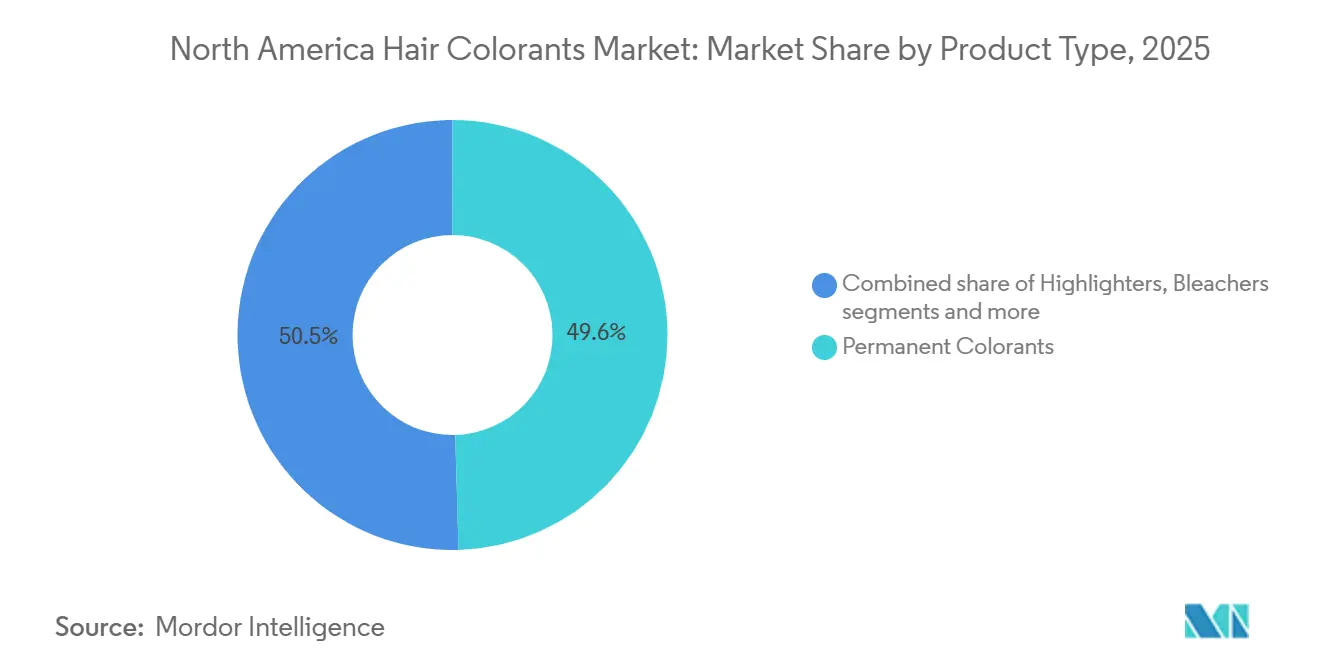
Permanent colorants accounted for 49.55% of the market in 2025, supported by their ability to deliver substantial shade transformations through oxidative coloring technology. These formulations combine dye precursors with an oxidizing agent to alter natural hair pigmentation and develop color molecules within the hair shaft, enabling both lightening and color deposition. This technical capability gives permanent colorants an advantage when consumers seek significant changes to their existing hair shade, rather than simply depositing surface-level pigments. Their broad shade-development potential, from natural-looking tones to more pronounced color changes, further strengthens their market position.
Highlighters are projected to be the fastest-growing segment of the North America Hair Colorants Market, advancing at a CAGR of 4.85% during 2026–2031. Growth is supported by increasing interest in multidimensional hair coloring techniques that create contrast, depth, and visual texture without requiring uniform color application across the entire head. Highlighting products enable consumers to introduce lighter strands, face-framing accents, and blended color transitions while retaining their natural base shade, appealing to those seeking customized and less uniform styling results. Demand is further supported by techniques such as balayage-inspired coloring, baby lights, and foil highlighting, which offer different levels of color intensity and placement precision.

By Category: Conventional Holds Ground; Organic Disrupts at the Margin
Conventional hair colorants accounted for 84.23% of the North America Hair Colorants Market in 2025, driven by their established performance, extensive shade portfolios, and versatility across different coloring needs. These formulations offer reliable gray coverage, significant color transformations, and lasting results through established dye technologies, making them suitable for consumers seeking consistent outcomes and predictable shade development. Their availability in permanent, semi-permanent, and other synthetic formulations allows consumers to select products based on desired color intensity, longevity, and maintenance requirements. Broad familiarity with conventional coloring systems, wide retail availability, and continued use in both home-based coloring and professional salon treatments further reinforce the category's dominant market position.
The organic category is projected to be the fastest-growing segment, registering a CAGR of 5.96% during 2026–2031. Growth is supported by increasing consumer interest in ingredient transparency, plant-derived ingredients, and personal care formulations aligned with natural beauty preferences. According to NSF, a public health and product safety standards organization, 72% of Canadian consumers considered organic ingredients important in personal care products in research conducted in 2024[3]. This preference supports opportunities for hair colorants formulated with organic ingredients, as consumers increasingly scrutinize product composition when selecting beauty products. The development of plant-based coloring alternatives and formulations emphasizing organic ingredients may further strengthen the segment's appeal, although product performance, shade availability, and the ability to achieve lasting color remain important considerations.
By Price Tier: Mass Dominates Volume; Premium Erodes Share Gap
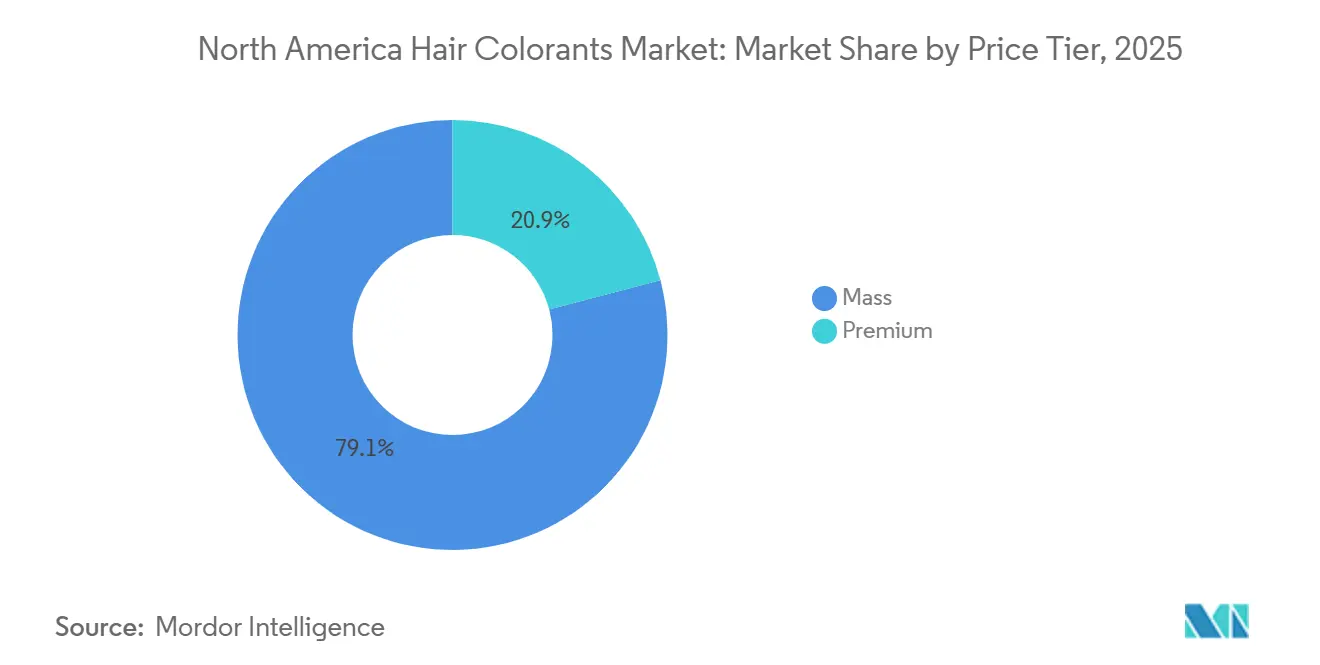
The mass tier accounted for 79.09% of the North America Hair Colorants Market in 2025, supported by the widespread availability of affordable coloring products across supermarkets, drugstores, mass merchandisers, and online retail channels. Mass-market formulations address routine coloring needs through accessible pricing, familiar shade options, and convenient at-home application kits that include essential coloring components and instructions. Products for gray coverage, root touch-ups, and overall color renewal enable consumers to maintain their preferred appearance without relying exclusively on professional salon treatments. Broad distribution and established purchasing habits further strengthen the segment's dominance by making hair colorants readily accessible for regular use.
The premium tier is projected to be the fastest-growing segment, registering a CAGR of 5.87% during 2026–2031. Growth is driven by increasing consumer interest in advanced coloring experiences that emphasize sophisticated shade development, improved hair conditioning, and specialized formulations. Premium products differentiate themselves through features such as bond-building technologies, color-protecting ingredients, ammonia-free options, and customized shade systems designed to support more controlled coloring outcomes. Demand is also supported by consumers seeking salon-inspired results, multidimensional colors, and formulations tailored to specific hair conditions or coloring goals. The focus on product performance, specialized ingredients, and enhanced post-color care creates opportunities for premium offerings to expand beyond traditional coloring products.
By Distribution Channel: Supermarkets Anchor Volume; Online Accelerates
Supermarkets and hypermarkets accounted for 40.67% of the North America Hair Colorants Market in 2025, supported by their extensive product assortments, physical accessibility, and ability to facilitate immediate purchases. Dedicated haircare and personal care aisles allow consumers to compare shades, formulation types, pack sizes, and product features across multiple brands in one location. The availability of permanent dyes, root touch-up kits, bleaching products, and color-maintenance solutions enables shoppers to select products according to their coloring requirements during routine shopping trips. Physical packaging displays, product instructions, promotional offers, and established retail purchasing habits further strengthen this channel by simplifying product selection and encouraging repeat purchases.
Online retail stores are projected to be the fastest-growing distribution channel, registering a CAGR of 6.09% during 2026–2031. Growth is driven by the convenience of home delivery, access to a wider range of shades and specialized formulations, and the ability to compare product ingredients, prices, and consumer reviews before purchasing. Online platforms also help consumers discover niche products, including ammonia-free colorants, specialty shades, and targeted root touch-up solutions that may have limited availability in physical stores. Virtual shade-matching tools, personalized product recommendations, instructional videos, and brand-operated websites reduce uncertainty when selecting hair colorants without professional assistance.
Geography Analysis
The United States accounted for 78.34% of the North America Hair Colorants Market in 2025, supported by an established beauty and personal care industry, widespread use of at-home hair coloring products, and strong demand for gray coverage and fashion-oriented shades. The availability of extensive product portfolios across supermarkets, drugstores, specialty beauty retailers, and e-commerce platforms enables consumers to access diverse formulations and shade options. Demand is further reinforced by established salon services, frequent product launches, and growing interest in specialized coloring solutions, including root touch-up products, ammonia-free formulations, and color-protecting treatments. The combination of established coloring habits, broad retail distribution, and continuous product innovation sustains the country's dominant position in the regional market.
Canada is projected to be the fastest-growing geography in the North America Hair Colorants Market, registering a CAGR of 5.61% during 2026–2031. Growth is supported by increasing interest in personalized hair styling, convenient at-home coloring solutions, and formulations that align with ingredient-conscious beauty preferences. Demand for products offering gray coverage, multidimensional shades, and lower-maintenance coloring results creates opportunities for manufacturers to expand their portfolios. The growth of online beauty retail and improved access to specialized products also enables consumers to explore a broader range of hair colorants beyond conventional retail assortments. In addition, interest in organic ingredients and alternative formulations may support product differentiation as consumers pay greater attention to ingredient lists and coloring experiences.
Mexico is gaining importance in the regional hair colorants market, driven by established beauty routines and interest in hair appearance and personal grooming. Demand for products that provide gray coverage, natural-looking shades, and convenient application supports the continued relevance of conventional hair colorants, while fashion-driven coloring creates opportunities for highlights, lighter shades, and other style-focused products. The Rest of North America region presents opportunities for market expansion through wider distribution of hair colorants, greater availability of diverse shade ranges, and increased access to convenient coloring formats.
Competitive Landscape
The North America Hair Colorants Market is moderately concentrated, with competition shaped by established multinational beauty companies, strong brand recognition, broad product portfolios, and extensive distribution networks. Key players include Henkel AG & Co. KGaA, L'Oréal S.A., Wella Company, Coty Inc., and Revlon, Inc. Competition is influenced by product performance, shade diversity, formulation innovation, brand positioning, and the ability to serve both at-home and professional hair coloring needs. Market participants seek to differentiate their offerings through improvements in color durability, gray coverage, hair conditioning, and application convenience, while maintaining strong retail and e-commerce availability across the region.
Product innovation is a major competitive strategy, particularly as consumers seek effective coloring results alongside improved hair-care benefits. Manufacturers are developing ammonia-free formulations, products designed without paraphenylenediamine (PPD), and vegan hair colorants to address specific ingredient preferences and differentiate their portfolios. Companies are also incorporating conditioning ingredients, bond-supporting technologies, and color-protection features to improve the coloring experience and support hair-fiber care. These developments enable brands to target consumers with different formulation preferences while competing on shade performance, product quality, and specialized coloring benefits.
Digital capabilities and distribution reach further influence competitive positioning in the North America Hair Colorants Market. Brands are increasingly using artificial intelligence (AI)-powered virtual try-on tools and digital shade-matching technologies to help consumers visualize potential results before purchasing, improving product discovery and supporting shade selection. Manufacturers also compete through availability across supermarkets, drugstores, specialty beauty retailers, professional salon distributors, brand websites, and online marketplaces. The combination of digital personalization, omnichannel distribution, product innovation, and brand engagement enables established players to strengthen consumer relationships and respond to evolving beauty trends.
North America Hair Colorants Industry Leaders
-
Henkel AG & Co. KGaA
-
L’Oréal S.A.
-
Coty Inc.
-
Revlon, Inc.
-
Wella Company
- *Disclaimer: Major Players sorted in no particular order
Recent Industry Developments
- September 2026: Wella Professionals launched Pure Perfection, a 30-shade ammonia-free permanent hair color clinically proven to improve shine by 55% and smoothness by 45%. The product is formulated without ammonia, fragrance, mineral oil, silicones, and PPD/PTD.
- March 2026: Henkel launched KERATÎME Care & Styling by Schwarzkopf exclusively at Walmart. The retail-exclusive rollout made Schwarzkopf's keratin-infused hair care products available to Walmart shoppers nationwide, representing a deliberate mass-market shelf expansion strategy.
- January 2026: Clairol launched two major innovations designed for modern women, such as Nice'n Easy 10 and Color Pro. Building on Clairol's heritage of making professional-level results accessible, Nice'n Easy 10 delivers 100% gray coverage and salon-quality shine up to 3x faster than the original Nice'n Easy.
North America Hair Colorants Market Report Scope
Hair colorants are cosmetic preparations such as dyes, tints, or rinses, applied to human hair to alter its natural color, enhance tone, or conceal gray strands. The North America Hair Colorants Market is segmented by product type, category, price tier, distribution channel, and geography. Based on product type, the market is segmented into bleachers, highlighters, permanent colorants, semi-permanent colorants, and temporary colorants. Based on category, the market is segmented into conventional and organic. Based on price tier, the market is segmented into mass and premium. Based on distribution channel, the market is segmented into supermarkets/hypermarkets, health and beauty stores, online retail stores, and other distribution channels. Based on geography, the market is segmented into the United States, Canada, Mexico, and the Rest of North America. For each segment, the market sizing and forecast have been done based on the value (in USD).
By Product Type
| Bleachers |
| Highlighters |
| Permanent Colorants |
| Semi-Permanent Colorants |
| Temporary Colorants |
By Category
| Conventional |
| Organic |
By Price Tier
| Mass |
| Premium |
By Distribution Channel
| Supermarkets/Hypermarkets |
| Health and Beauty Stores |
| Online Retail Stores |
| Other Distribution Channels |
By Geography
| United States |
| Canada |
| Mexico |
| Rest of North America |
| By Product Type | Bleachers |
| Highlighters | |
| Permanent Colorants | |
| Semi-Permanent Colorants | |
| Temporary Colorants | |
| By Category | Conventional |
| Organic | |
| By Price Tier | Mass |
| Premium | |
| By Distribution Channel | Supermarkets/Hypermarkets |
| Health and Beauty Stores | |
| Online Retail Stores | |
| Other Distribution Channels | |
| By Geography | United States |
| Canada | |
| Mexico | |
| Rest of North America |
Key Questions Answered in the Report
What is the projected growth rate for hair colorants in North America?
The North America hair colorants market is projected to grow at a 3.96% CAGR from 2026 to 2031, reaching USD 4.91 billion by 2031.
Which product type holds the largest share in North America?
Permanent colorants lead with a 49.55% share in 2025, supported by regular demand for gray coverage among repeat users.
Which hair colorant category is growing the fastest?
Organic hair colorants are the fastest-growing category, with a projected CAGR of 5.96% through 2031, as consumers seek formulations with fewer concerning ingredients.
Which distribution channel is expanding fastest for hair colorants?
Online retail stores are forecast to grow at a 6.09% CAGR through 2031, supported by subscriptions, faster delivery options, and virtual shade try-on tools.