
Market Overview
| Study Period | 2021 - 2031 |
|---|---|
| Forecast Data Period | 2026 - 2031 |
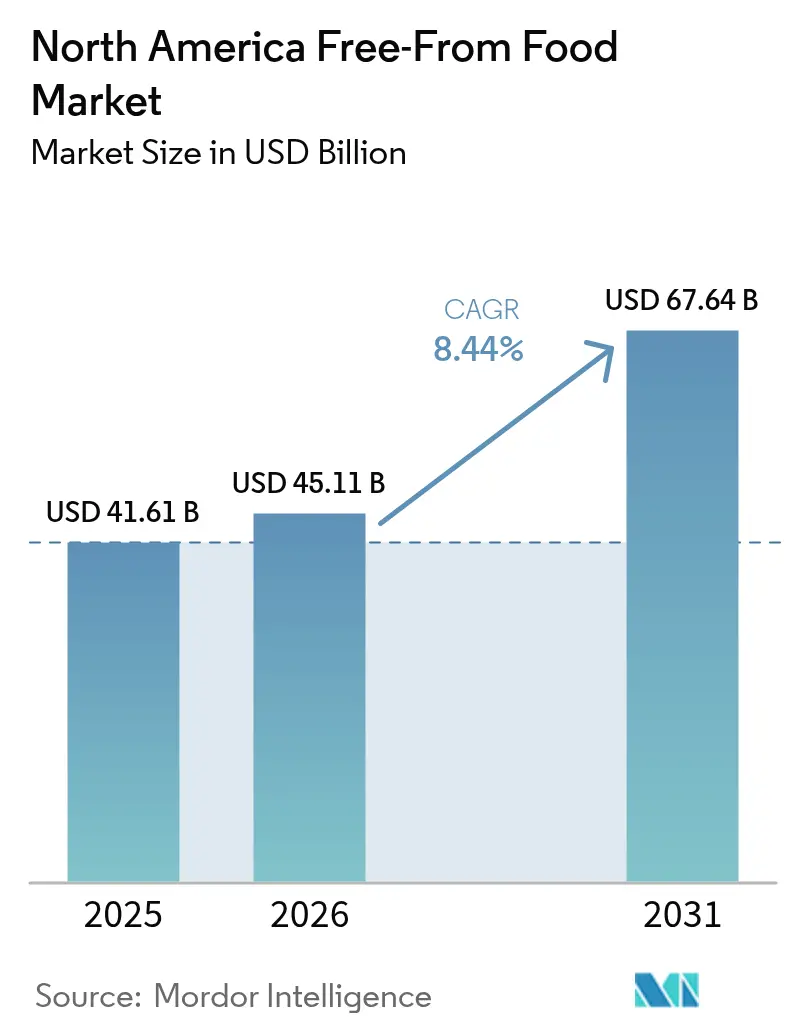
| Base Year Market Size (2025) | USD 41.61 Billion |
| Market Size (2026) | USD 45.11 Billion |
| Market Size (2031) | USD 67.64 Billion |
| Growth Rate (2026 - 2031) | 8.44 % |
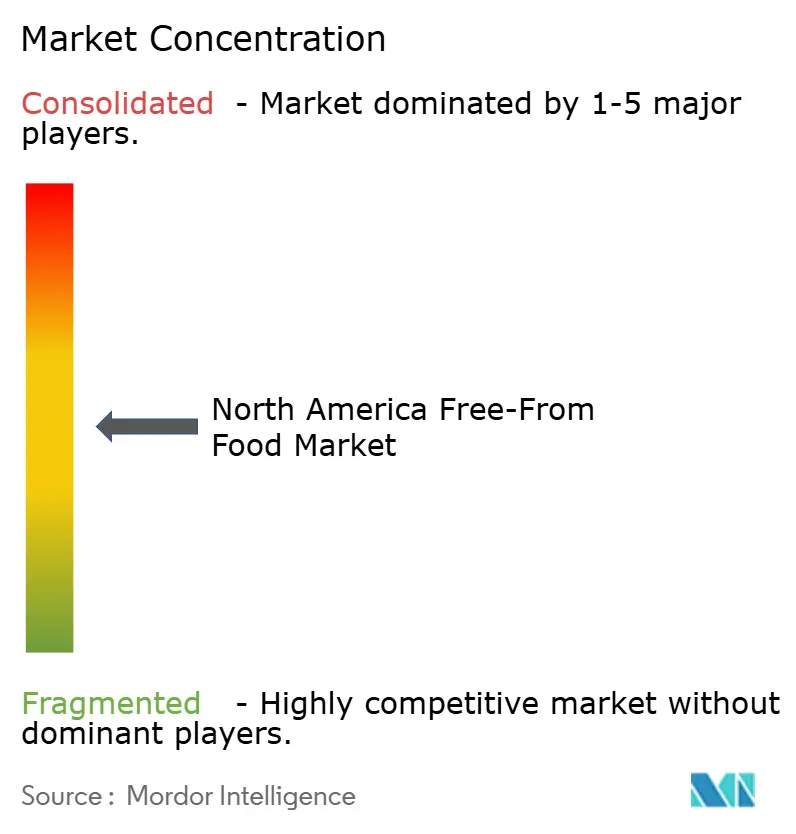
| Market Concentration | Medium |
Major Players *Disclaimer: Major Players sorted in no particular order Image © Mordor Intelligence. Reuse requires attribution under CC BY 4.0. | |
North America Free-From Food Market Analysis by Mordor Intelligence
The North American free-from food market size is expected to increase from USD 41.61 billion in 2025 to USD 45.11 billion in 2026 and reach USD 67.64 billion by 2031, growing at a CAGR of 8.44% over 2026-2031. Consumer awareness of food allergies, rising household incomes, and stricter labeling laws are moving free-from products from specialty aisles to mainstream shelves, supporting steady value growth even when discretionary categories slow. Gluten-free bakery items are benefiting from enzyme-based dough conditioners that extend shelf life to 7-10 days, while dairy alternatives such as oat and almond milk have reached cost parity in many large retail chains. Certification costs that add 15-25% to production expenses are encouraging scale advantages for multinationals, yet mid-sized brands still gain shelf presence by emphasizing clean-label claims and first-party data from direct-to-consumer channels. Raw-material price spikes for almond flour and pea protein isolates continue to pressure margins, but manufacturers are partially offsetting these costs through hybrid formulation strategies and private-label collaborations.
Key Report Takeaways
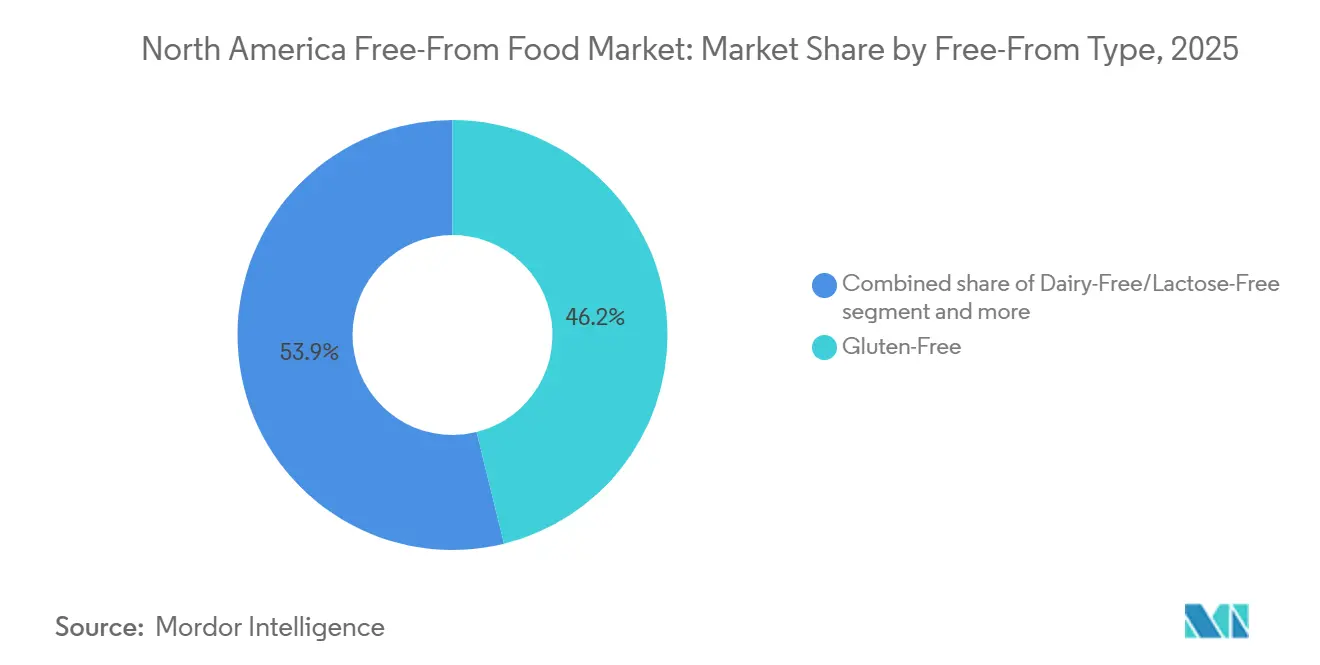
- By free-from type, gluten-free products captured 46.15% of the gluten-free market share in 2025 and meat-free plant-based alternatives are projected to record the fastest 9.26% CAGR through 2031.
- By end product, bakery and confectionery led with 29.77% revenue share in 2025, while dairy alternatives are forecast to expand at an 8.99% CAGR to 2031.
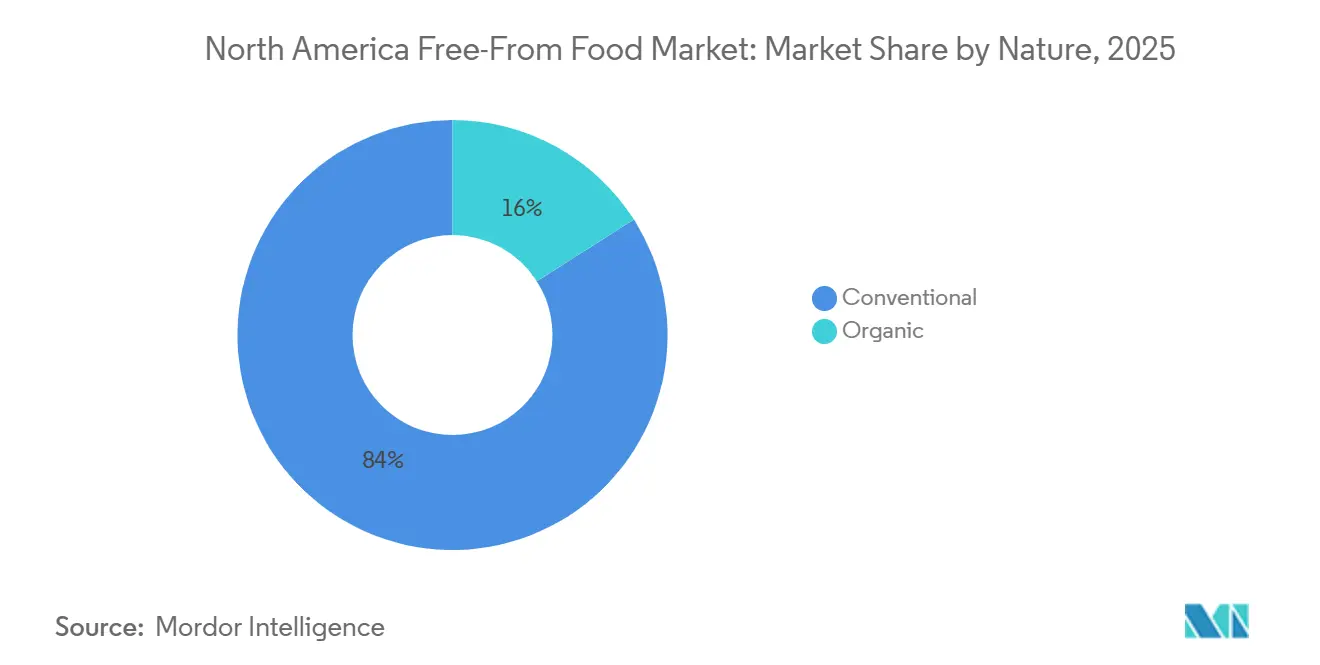
- By nature, conventional lines held 84.02% of the gluten-free market size in 2025 and organic variants are advancing at a 10.05% CAGR between 2026-2031.
- By distribution channel, off-trade outlets controlled 71.91% of sales in 2025, yet on-trade foodservice is accelerating at a 9.63% CAGR through 2031.
- By geography, the United States generated 79.89% of 2025 revenue, whereas Mexico is forecast to post the highest 9.84% CAGR to 2031.
Note: Market size and forecast figures in this report are generated using Mordor Intelligence’s proprietary estimation framework, updated with the latest available data and insights as of 2026.
Market Trends and Insights
Drivers Impact Analysis of North America Free-From Food Market*
| Driver | (~) % Impact on CAGR Forecast | Geographic Relevance | Impact Timeline |
|---|---|---|---|
| Rising prevalence of food allergies and intolerance | +1.5% | Regional, with highest intensity in United States and Canada | Medium term (2-4 years) |
| Increasing demand for gluten-free and dairy-free products | +1.8% | North America, with spillover to Mexico urban centers | Short term (≤ 2 years) |
| Growing health and wellness awareness among consumers | +1.2% | United States, Canada, Mexico metropolitan areas | Long term (≥ 4 years) |
| Rising adoption of plant-based and allergen-free diets | +1.6% | United States and Canada, emerging in Mexico | Medium term (2-4 years) |
| Expansion of free-from products in mainstream retail channels | +1.0% | United States, Canada, with gradual Mexico penetration | Short term (≤ 2 years) |
| Growing demand for clean-label and minimally processed foods | +0.9% | United States and Canada, early adoption in Mexico | Long term (≥ 4 years) |
| Source: Mordor Intelligence | |||
Rising prevalence of food allergies and intolerance
The rising prevalence of food allergies and intolerances is a major driver of the North America free-from food market. Increasing awareness of dietary restrictions and health concerns is encouraging consumers to seek products that are safe, allergen-free, and suitable for specific dietary needs. In 2024, 6.7% of U.S. adults were diagnosed with a food allergy, according to the Centers for Disease Control and Prevention (CDC), highlighting the growing portion of the population that requires allergen-conscious food options[1]. This trend is further supported by parents seeking safe, nutritious foods for children with allergies, as well as individuals managing lactose intolerance, gluten sensitivity, or other dietary restrictions. The demand for free-from products spans multiple categories, including bakery, dairy alternatives, snacks, and beverages, driving product innovation and diversification. With increasing health consciousness and stricter labeling regulations, the market for free-from foods is expected to continue expanding steadily across North America.
Increasing demand for gluten-free and dairy-free products
Increasing demand for gluten-free and dairy-free products is a key driver of the North America free-from food market. Consumers are becoming more health-conscious and actively seeking alternatives that align with dietary preferences, intolerances, or lifestyle choices. According to the 2024 IFIC Food & Health Survey, 66% of consumers reported limiting sugar consumption, up from 61% in 2023, reflecting a broader shift toward healthier eating habits[2]. This growing focus on nutrition and wellness is creating opportunities for gluten-free and dairy-free products to compete effectively with conventional foods in mainstream retail channels. Products such as plant-based milk, yogurt alternatives, and gluten-free bakery items are gaining traction as consumers look for options that are both safe and aligned with their health goals. The trend is further reinforced by increasing availability, product innovation, and clean-label claims that appeal to urban and millennial consumers.
Growing health and wellness awareness among consumers
Growing health and wellness awareness among consumers is a significant driver of the North America free-from food market. Increasing knowledge about diet-related health issues, such as obesity, diabetes, and food intolerances, has encouraged individuals to make more conscious food choices. In 2024, 56.2 million adults aged 20-79 in North America were reported to have diabetes, as per the International Diabetes Federation[3]. Consumers are actively seeking products that are low in sugar, free from allergens, and minimally processed, aligning with broader wellness and clean-eating trends. This heightened focus on nutrition and preventive health has boosted demand for gluten-free, dairy-free, plant-based, and organic alternatives across multiple food categories. Retailers and foodservice providers are responding by expanding their free-from offerings, highlighting health benefits and clean-label claims to attract health-conscious buyers. Millennials and urban populations, in particular, are driving the adoption of functional foods, protein-rich snacks, and allergen-free products.
Rising adoption of plant-based and allergen-free diets
The rising adoption of plant-based and allergen-free diets is a key driver of the North America free-from food market. Growing awareness of health, environmental sustainability, and ethical eating is encouraging more consumers to embrace plant-based and allergen-conscious lifestyles. According to the Good Food Institute, 59% of U.S. households purchased plant-based foods in 2024, highlighting the expanding mainstream acceptance of alternative proteins and dairy-free options[4]. This shift is driving demand across multiple product categories, including meat substitutes, plant-based dairy alternatives, and allergen-free snacks. Consumers are increasingly seeking foods that are not only nutritious and safe but also align with their personal values and lifestyle choices. The rise of clean-label, minimally processed products further reinforces this trend, appealing to health-conscious and ethically minded buyers.
Restraints Impact Analysis of North America Free-From Food Market*
| Restraint | (~) % Impact on CAGR Forecast | Geographic Relevance | Impact Timeline |
|---|---|---|---|
| High production costs due to strict certification requirements | -0.8% | United States and Canada, with emerging impact in Mexico | Short term (≤ 2 years) |
| Higher product prices compared to conventional foods | -1.0% | Regional, most acute in price-sensitive Mexico market | Medium term (2-4 years) |
| Complex formulation challenges affecting taste and texture | -0.6% | United States and Canada, where sensory expectations are highest | Long term (≥ 4 years) |
| Regulatory compliance and labeling requirements | -0.5% | United States, Canada, Mexico as regulations harmonize | Medium term (2-4 years) |
| Source: Mordor Intelligence | |||
High production costs due to strict certification requirements
High production costs due to strict certification requirements act as a significant restraint on the North America free-from food market. Free-from products, including gluten-free, dairy-free, and allergen-free items, must comply with rigorous regulatory standards and labeling guidelines to ensure consumer safety and transparency. Obtaining certifications such as gluten-free verification, non-GMO, organic, or allergen-free can be expensive and time-consuming, requiring specialized testing, quality control measures, and compliance audits. These additional operational expenses often increase the final product cost, making free-from foods less affordable for price-sensitive consumers. Small and medium-sized manufacturers, in particular, may face challenges in scaling production while meeting certification standards. Furthermore, maintaining strict segregation of ingredients to avoid cross-contamination adds complexity and cost to manufacturing processes.
Higher product prices compared to conventional foods
Higher product prices compared to conventional foods represent a key restraint for the North America free-from food market. Free-from products, such as gluten-free, dairy-free, and allergen-free options, often require specialized ingredients, advanced processing techniques, and strict quality control measures, all of which increase production costs. These added expenses are reflected in retail prices, making free-from foods more expensive than standard alternatives and limiting their affordability for price-sensitive consumers. As a result, some households may opt for conventional products despite health or dietary concerns. The higher pricing also affects market penetration in value-conscious segments and can slow adoption among first-time buyers. Additionally, premium positioning of clean-label and certified allergen-free products contributes to the perception of free-from foods as niche or specialty items.
*Our forecasts treat driver/restraint impacts as directional, not additive. The impact forecasts reflect baseline growth, mix effects, and variable interactions.
North America Free-From Food Market Segment Analysis
By Free-From Type:
Plant-Based Surge Reshapes Category MixGluten-free products accounted for the largest share of the North America free-from food market in 2025, capturing 46.15% of total market revenue. The segment’s dominance is largely driven by increasing consumer awareness of gluten intolerance, celiac disease, and digestive health concerns, which has expanded demand beyond medically required diets to lifestyle-driven consumption. A growing number of consumers perceive gluten-free products as healthier alternatives, contributing to their widespread adoption across bakery, snacks, and packaged food categories. Major food manufacturers have significantly expanded their gluten-free product portfolios, improving product quality, taste, and availability across retail channels. In addition, strong distribution through supermarkets, specialty health stores, and online platforms has enhanced accessibility for consumers across the region.
Meat-free plant-based alternatives are projected to be the fastest-growing segment within the North America free-from food market, expected to register a CAGR of 9.26% through 2031. This growth is primarily driven by rising consumer interest in sustainable, ethical, and health-conscious food choices, alongside increasing awareness of environmental impacts associated with conventional meat production. The expansion of flexitarian and vegan dietary patterns has significantly boosted demand for plant-based meat substitutes across both retail and foodservice sectors. Food manufacturers are investing heavily in research and development to improve taste, texture, and nutritional profiles, making plant-based alternatives more appealing to mainstream consumers.

By End Product:
Dairy Alternatives Accelerate as Bakery MaturesBakery and confectionery products accounted for the largest share of the North America free-from food market in 2025, representing 29.77% of total revenue. The strong performance of this segment is primarily supported by high consumer demand for free-from alternatives in everyday food categories such as bread, cakes, cookies, and chocolate products. Increasing awareness of dietary sensitivities, including gluten and allergen intolerance, has encouraged manufacturers to expand free-from bakery offerings without compromising taste and texture. Continuous product innovation, including the use of alternative flours and natural sweeteners, has improved product acceptance among mainstream consumers. The segment also benefits from impulse purchasing behavior and frequent consumption patterns, sustaining its dominant position within the regional market.
Dairy alternatives are projected to be the fastest-growing segment in the North America free-from food market, expected to register a CAGR of 8.99% through 2031. Growth in this segment is largely driven by rising lactose intolerance awareness, increasing vegan and flexitarian lifestyles, and growing consumer preference for plant-based nutrition. Products such as plant-based milk, yogurt, cheese, and creamers are gaining popularity due to perceived health and environmental benefits. Manufacturers are actively introducing new formulations using ingredients such as almond, oat, soy, and coconut to enhance taste and nutritional value. Expansion of foodservice adoption, particularly in coffee chains and quick-service restaurants, has further accelerated consumption of dairy alternatives.
By Nature:
Organic Premiumization Drives Margin ExpansionConventional product lines accounted for the largest share of the North America free-from food market in 2025, representing 84.02% of the gluten-free market size. Their dominance is primarily attributed to broad affordability, extensive retail distribution, and strong brand recognition among mainstream consumers. Conventional free-from products are widely available across supermarkets, hypermarkets, and mass retail chains, ensuring higher visibility and accessibility compared to niche premium offerings. Large-scale production capabilities also enable manufacturers to maintain competitive pricing while meeting growing demand. In addition, continuous product reformulation and quality improvements have enhanced taste, texture, and nutritional value, reducing the perception gap between conventional and specialty products.
Organic variants, however, are emerging as the fastest-growing segment in the North America free-from food market, projected to expand at a CAGR of 10.05% between 2026 and 2031. Growth in this segment is driven by rising consumer preference for clean-label, non-GMO, and sustainably sourced ingredients. Health-conscious consumers increasingly associate organic certification with higher product quality, safety, and environmental responsibility. Expanding availability of organic free-from products across specialty health stores and premium retail chains has further supported market penetration. Manufacturers are responding by investing in certified organic supply chains and transparent sourcing practices to strengthen consumer trust.
By Distribution Channel:
Foodservice Rebounds as On-Trade AcceleratesOff-trade outlets accounted for the largest share of the North America free-from food market in 2025, controlling 71.91% of total sales. The dominance of this segment is largely driven by strong consumer preference for purchasing free-from products through supermarkets, hypermarkets, convenience stores, and online retail platforms. These channels provide extensive product variety, competitive pricing, and easy accessibility, enabling consumers to compare brands and dietary options conveniently. The growing availability of private-label free-from products has further strengthened off-trade sales by offering affordable alternatives to premium brands. In addition, increasing at-home consumption trends and rising demand for packaged and ready-to-consume free-from foods have supported consistent retail growth.
On-trade foodservice is emerging as the fastest-growing distribution channel in the North America free-from food market, projected to expand at a CAGR of 9.63% through 2031. Growth in this segment is primarily supported by increasing consumer demand for allergen-friendly and dietary-specific menu options in restaurants, cafés, and quick-service outlets. Foodservice operators are increasingly incorporating gluten-free, dairy-free, and plant-based offerings to cater to evolving consumer preferences and dietary restrictions. Rising dining-out frequency and the expansion of health-focused restaurant concepts have further accelerated adoption of free-from ingredients in foodservice menus. Partnerships between food manufacturers and restaurant chains are also contributing to wider availability and visibility of free-from products.
Geography Analysis
United States Free-From Food Market
The United States accounted for the largest share of the North America free-from food market in 2025, generating 79.89% of total regional revenue. The country’s dominance is supported by high consumer awareness regarding food allergies, dietary intolerances, and health-focused eating habits. A well-established retail infrastructure, combined with strong presence of leading food manufacturers and private-label brands, has enabled widespread availability of free-from products across multiple categories. Continuous product innovation, particularly in gluten-free, dairy-free, and plant-based segments, has further strengthened market expansion. In addition, rising demand for clean-label and functional food products among health-conscious consumers continues to support steady growth.
Mexico Free-From Food Market
Mexico is projected to be the fastest-growing market in the North America free-from food sector, expected to register a CAGR of 9.84% through 2031. Growth in the country is driven by increasing urbanization, rising disposable incomes, and growing consumer awareness of healthier dietary alternatives. Expanding retail networks and the increasing presence of international food brands have improved access to free-from products across major cities. Changing lifestyle patterns and a gradual shift toward preventive healthcare are encouraging consumers to adopt gluten-free, lactose-free, and plant-based food options. Food manufacturers are also increasing investments in localized product offerings to cater to regional taste preferences.
Canada Free-From Food Market
Canada represents a steadily growing market within the North America free-from food landscape, supported by strong demand for premium, organic, and clean-label food products. High awareness of dietary sensitivities and increasing adoption of plant-based diets have encouraged consistent consumption of free-from alternatives across retail and foodservice channels. The country benefits from stringent food labeling regulations, which enhance consumer confidence and transparency in product selection. Growing interest in sustainability and ethically sourced ingredients has further supported demand for organic and allergen-free food options.
Regulatory Landscape
Across North America, free-from foods are shaped by strict labeling and substantiation expectations, with enforcement anchored by the US Food and Drug Administration (FDA) in the United States and Health Canada and the Canadian Food Inspection Agency (CFIA) in Canada. In January 2025, the FDA published Edition 5 of its Guidance for Industry on food allergen labeling, reinforcing that allergen-related claims must be truthful and not misleading and clarifying practical expectations around allergen disclosure and unintended cross-contact. For manufacturers using allergen-free positioning, the guidance increases scrutiny of ingredient controls, sanitation, and documentation, since trace residues from cross-contact can undermine a free-from claim.
In Canada, label compliance has tightened through the rollout of mandatory front-of-package (FOP) nutrition symbol labeling, with the transition period ending in January 2026 and requiring applicable products to be compliant at retail. Separately, formulation changes remain subject to federal review pathways for additives and ingredients, illustrated by the FDA color additive process: a February 2026 final order on expanded safe use for spirulina extract was subsequently delayed on March 20, 2026 pending evaluation of objections. Taken together, these regulatory and administrative updates raise the compliance bar for both claims (gluten-free, dairy-free, allergen-free) and the supporting formulation choices used by free-from product developers across the region.
Competitive Landscape
The North American free-from food market exhibits a moderately fragmented competitive landscape, characterized by the presence of large multinational food companies, specialized health-focused brands, and emerging niche players. While established manufacturers hold strong brand recognition and distribution networks, smaller companies continue to gain traction by targeting specific dietary needs such as gluten-free, dairy-free, allergen-free, and plant-based formulations. The diversity of product categories within the free-from segment allows multiple players to coexist without a single company dominating the overall market. Regional preferences, evolving consumer dietary trends, and rapid product innovation further contribute to market fragmentation. Retail private labels have also strengthened their presence by offering competitively priced free-from alternatives, intensifying competition across mainstream channels.
Competition in the market is largely driven by innovation, product quality, pricing strategies, and brand trust. Leading players invest heavily in research and development to improve taste, texture, and nutritional value, addressing earlier challenges associated with free-from products. Clean-label formulations, organic certifications, and non-GMO claims have become key differentiators as consumers increasingly prioritize health and sustainability. Companies are also expanding their distribution through e-commerce platforms and direct-to-consumer channels to strengthen market reach. Strategic partnerships with retailers and foodservice operators are becoming more common, allowing brands to enhance visibility and accessibility.
At the same time, smaller and innovative firms continue to introduce specialized products that cater to evolving consumer preferences, maintaining competitive diversity. Investments in advanced manufacturing technologies and sustainable sourcing practices are becoming increasingly important for long-term competitiveness. Companies are also focusing on supply chain optimization to manage ingredient sourcing challenges and cost pressures. The growing influence of health-conscious consumers and regulatory emphasis on clear labeling further encourages product innovation and compliance.
North America Free-From Food Industry Leaders
-
Conagra Brands Inc.
-
The Hain Celestial Group
-
General Mills Inc.
-
Danone S.A.
-
The Kraft Heinz Company
- *Disclaimer: Major Players sorted in no particular order
North America Free-From Food Market Companies Covered in this Report
- General Mills Inc.
- Conagra Brands Inc.
- The Kraft Heinz Company
- Danone S.A.
- The Hain Celestial Group Inc.
- Kellanova
- Dr. Schär AG
- Barilla G. e R. Fratelli S.p.A.
- Mars Incorporated
- Nestlé S.A.
- Amy's Kitchen Inc.
- Enjoy Life Foods
- Bob's Red Mill Natural Foods
- Udi's Healthy Foods
- Tofutti Brands Inc.
- Dr. Praeger's Sensible Foods
- Gardein (Conagra Brands)
- Siete Foods
- Seitz Glutenfree
- Ecotone
Market Opportunities and Future Outlook
Near-term whitespace is forming around localized, higher-throughput manufacturing for plant-based dairy and protein staples, where producers are investing to reduce supply risk and improve unit economics for mainstream channels. March 2026 Nasoya expanded its Ayer, Massachusetts facility by 65,000 square feet to scale tofu output, and May 2026 Fenton Food and Beverage received support from the Michigan Strategic Fund for a USD 56.2 million investment in a new plant-based milk facility in Michigan using proprietary nut-extraction technology. These moves indicate ongoing capacity buildout for everyday free-from staples (dairy alternatives and plant-based proteins), supporting broader off-trade availability and private-label collaborations in settings where retailers emphasize consistent supply and price parity.
A second opportunity is product and ingredient innovation that addresses formulation and sensory barriers while aligning with more rigorous labeling expectations, particularly for egg- and dairy-replacement use cases in bakery, ready meals, and snacks. In July 2026, The Every Company and ADM partnered to manufacture animal-free egg white protein (OvoPro) at ADM’s facility in Clinton, Iowa using precision fermentation, adding a scalable supply option for egg-free and allergen-managed formulations. In Canada, ingredient processing investments also reinforce this direction, including Alinova Canada’s December 2025 announcement of a CAD 24 million non-GMO soymilk powder processing facility in Morrisburg, Ontario, supported by the Ontario Regional Development Program, which expands regional inputs for shelf-stable and foodservice-adapted dairy-alternative formats.
Recent Industry Developments in North America Free-From Food Market
- July 2026: The Every Company and ADM partnered to manufacture animal-free egg white protein (OvoPro) at ADM’s Clinton, Iowa facility using precision fermentation, creating a scalable supply option for egg-free and allergen-managed formulations. The collaboration strengthens North America’s plant-based protein supply chain for bakery and ready-to-dreat applications.
- June 2026: SunOpta invested over USD 25 million to expand its Omak, Washington facility with a new production line, raising fruit snack production capacity by 25%. The expansion supports higher-volume output for packaged snack formats that frequently carry free-from positioning and improves responsiveness to retail replenishment cycles.
- May 2024: The Kraft Heinz Company and TheNotCompany, Inc. introduced KD NotMacandCheese as the first plant-based offering under the KD brand, positioned as plant-based and gluten-free. Bringing a major legacy brand into plant-based and gluten-free mac and cheese increased category visibility in mass retail and raised the bar for taste and pricing expectations among incumbent and emerging free-from competitors.
North America Free-From Food Market Report Scope and Research Methodology
Market Definition and Coverage
We define the North America free-from food market as packaged foods and beverages formulated without specific ingredients that consumers avoid due to allergies, intolerances, medical needs, or preference, and that are sold through retail and foodservice channels.
Scope exclusions: The sizing excludes non-food supplements, cosmetics, and medical nutrition that is purchased as a prescribed clinical product.
Segments Covered in This Report
- By Free-From Type
- Gluten-Free
- Dairy-Free/Lactose-Free
- Meat-Free (Plant-based)
- Sugar-Free/Low-GI
- Other Types
- By End Product
- Bakery and Confectionery Products
- Meat Substitutes and Analogues
- Dairy Alternatives
- Snacks
- Ready Meals and Meal Kits
- Other Products (Baby and Infant Foods, Sauces, Condiments)
- By Nature
- Conventional
- Organic
- By Distribution Channel
- On-Trade
- Off-Trade
- Supermarkets/Hypermarkets
- Specialty Stores
- Convenience Stores
- Online Retail Stores
- Other Distribution Channels
- By Geography
- United States
- Canada
- Mexico
- Rest of North America
Data Sources, Market Sizing, and Validation
Desk Research
Desk work starts by clarifying how "free-from" claims map to the food categories actually sold in North America, and then pinning down the biggest demand pools. Public sources such as the USDA Economic Research Service, the US Food and Drug Administration allergen and labeling guidance, Statistics Canada, and the US International Trade Commission trade statistics help us anchor food category baselines and cross-check import exposure.
We also review information from industry bodies and open research, such as Food Allergy Research and Education updates, peer-reviewed nutrition and allergy journals, and company filings, investor presentations, and retailer announcements that signal pricing moves and product launches. For targeted checks, we sometimes use paid subscriptions focused on company financials and intelligence, news and financials, patent databases, and shipment-level import and export data to validate directional shifts. The sources listed here are illustrative, and other references are used for data collection, validation, and clarification during the study.
Primary Interviews and Surveys
Primary work is used to pressure-test what is counted as a free-from sale at shelf and in foodservice, and to understand how claims and reformulations are changing mix over time. We speak with brand and category managers, ingredient and co-manufacturing participants, distributors, and retail channel experts across the United States, Canada, and Mexico so assumptions on volumes, average selling prices, and promotion intensity can be adjusted when needed.
Distribution of primary research fieldwork respondents
| Company type | Respondent position |
|---|---|
| Top tier: 31% | CXOs: 21% |
| Mid tier: 47% | Functional/Unit leaders: 28% |
| Smaller Players: 22% | Managers: 51% |
Market-Sizing & Forecasting
The core model starts with a top-down reconstruction of demand by linking North America packaged food and beverage consumption to the share influenced by free-from claims, then refining it by country and channel. To keep the totals realistic, we corroborate outputs using selective bottom-up approximations such as sampled category volumes multiplied by observed price bands, supplier and distributor checks, and channel-mix rollups where data gaps exist.
Inputs used in the model include the incidence of food allergies and intolerances, the pace of allergen labeling and claim adoption, household spending on packaged foods, the mix shift toward dairy alternatives and meat substitutes, and price premiums for labeled free-from SKUs versus conventional products. When the main clause is reached, these variables are used to adjust penetration assumptions and average selling prices by year so the value trend remains traceable. Forecasts are built using scenario analysis, where baseline growth is anchored to category demand and then stress-tested using primary feedback on pricing, reformulation cadence, and promotional intensity.
Data Validation & Update Cycle
Validation is done in layers, where our estimates are compared against independent signals such as category growth in key retail channels, trade flow direction for major ingredients, and visible price changes in high-velocity products. If outliers appear, they are reviewed for unit mismatches, currency timing issues, or unrealistic penetration jumps, and then assumptions are revisited. When needed, respondents are re-contacted for clarification.
Before sign-off, the model and written logic go through analyst review checks so the steps can be repeated and explained. Reports are refreshed annually, and interim updates are made when material events can shift demand or pricing. Right before delivery, a fresh pass is completed so clients receive the most current view available.
Mordor Intelligence's North America Free From Food Market Size Versus Other Published Estimates
Published market values can differ even when the topic sounds the same, mainly because the included product set and counting rules are not identical. Differences also come from how pricing is treated, whether foodservice is included, and how quickly the model is refreshed when labeling and reformulation trends shift.
The main gap comes from whether adjacent "better-for-you" and clean label items are counted as free-from. In this approach, Mordor Intelligence counts sales only when a defined ingredient exclusion claim is present and ties the result back to measurable retail and foodservice demand by country. Other gaps usually show up in how average selling prices are projected through the forecast period, and whether currency timing and channel mix are handled consistently across the United States, Canada, and Mexico.
Benchmark comparison
| Source | Market Size | Gaps in Research Methodology |
|---|---|---|
| Mordor Intelligence | USD 41.61 B (2025) | |
| Trade Journal A | USD 30.41 B (2025) | Often presented as a US-only total and may emphasize a narrower set of claims, which can reduce the counted value versus a full North America rollup. |
| Industry Report B | USD 53.90 B (2025) | Can include a wider "free-from plus clean label" basket and use faster price premium expansion, which inflates value if claim-based counting is not enforced. |
The spread in the table is largely explained by what gets classified as free-from and how price premiums are carried forward year to year. By keeping inclusion rules linked to claim-based products and by cross-checking with channel and country-level signals, the final number stays balanced and easier to reconcile with real-world demand movement.
Key Questions Answered in the Report
What is the current market size of the market?
The market is valued at USD 45.11 billion in 2026 and projected to reach USD 67.64 billion in 2031.
Which sales channel currently moves the most free-from products?
Off-trade retail outlets, led by supermarkets and hypermarkets, captured 71.91% of 2025 revenue thanks to dedicated aisles and end-cap displays.
Where is the strongest geographic upside over the next five years?
Mexico is projected to post a 9.84% CAGR through 2031, outstripping the United States and Canada as middle-class spending and aligned labeling rules accelerate adoption.
How concentrated is supplier power in the category today?
The top five companies hold 55% of 2025 revenue, indicating moderate concentration that still leaves room for agile regional and direct-to-consumer brands.