
Market Overview
| Study Period | 2020 - 2031 |
|---|---|
| Forecast Data Period | 2026 - 2031 |
| Base Year Market Size (2025) | USD 12.55 Billion |
| Market Size (2026) | USD 15.02 Billion |
| Market Size (2031) | USD 36.76 Billion |
| Growth Rate (2026 - 2031) | 19.61 % |
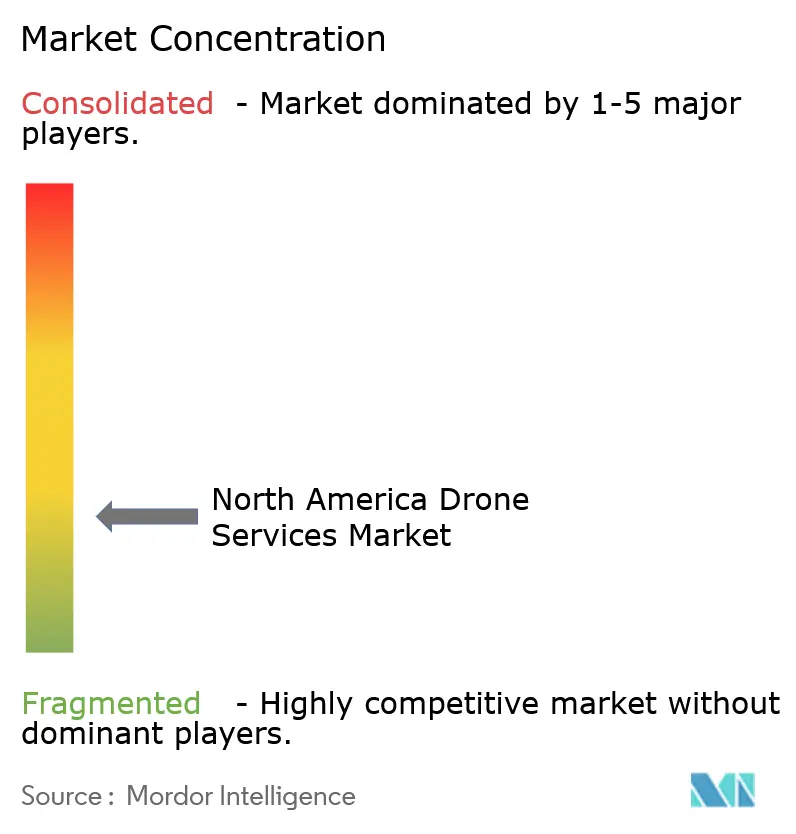
| Market Concentration | Low |
Major Players *Disclaimer: Major Players sorted in no particular order Image © Mordor Intelligence. Reuse requires attribution under CC BY 4.0. | |
North America Drone Services Market Analysis by Mordor Intelligence
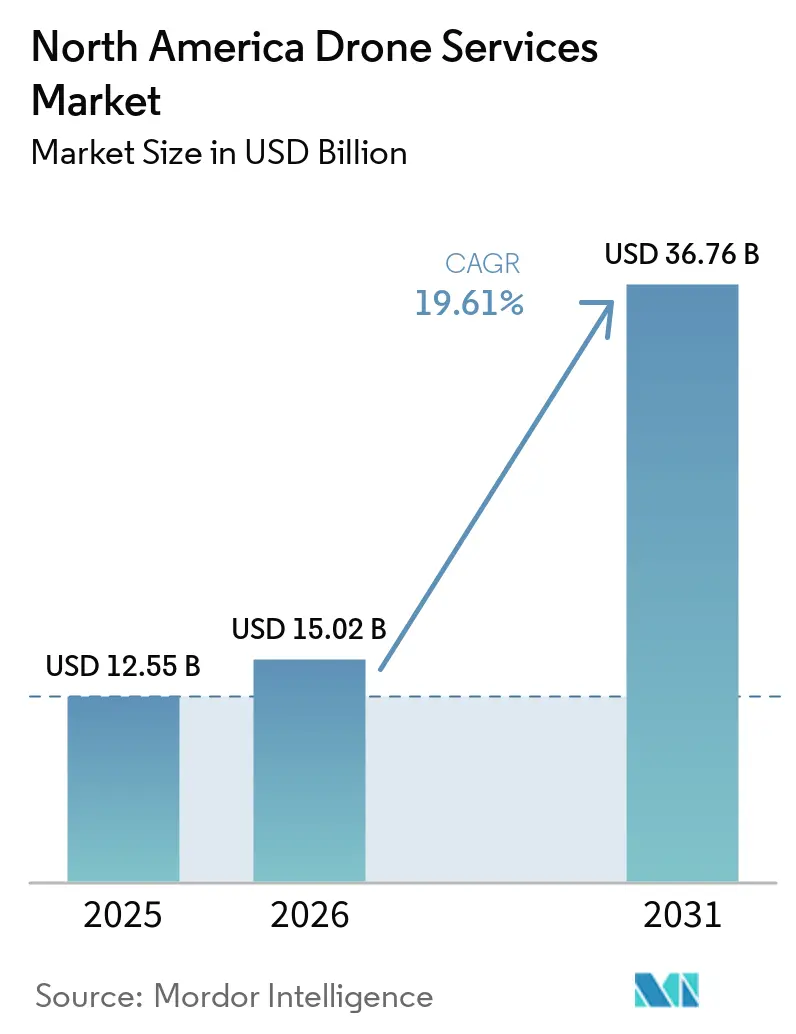
The North America drone services market size is expected to grow from USD 12.55 billion in 2025 to USD 15.02 billion in 2026 and is forecast to reach USD 36.76 billion by 2031 at 19.61% CAGR over 2026-2031. The growth trajectory is underpinned by fast-moving Federal Aviation Administration (FAA) rulemaking on beyond-visual-line-of-sight (BVLOS) operations, expanding 5G connectivity, and rising enterprise demand for low-carbon data capture. A shift from hardware sales toward service-centric business models is encouraging specialized operators in analytics, training, and maintenance. Rapid consolidation, highlighted by Axon’s 2024 acquisition of Dedrone and John Deere’s 2025 purchase of Sentera, signals a pivot to vertically integrated platforms that combine flight operations with data insights. At the same time, Transport Canada’s streamlined BVLOS rules and Mexico’s regulatory alignment with ICAO standards are opening new addressable segments across the region.[1]
Key Report Takeaways
- By service type, drone platform services led with a 56.65% revenue share in 2025, while training and simulation grew fastest at a 24.10% CAGR.
- By end-user industry, construction and infrastructure led with 31.62% revenue share in 2025; the medical and parcel delivery segment is poised to expand at a 25.10% CAGR to 2031.
- By drone type, rotary-wing models accounted for 70.58% of the North American commercial drone services market size in 2025, while hybrid VTOL models are set to grow at a 27.95% CAGR.
- By operating range, visual line-of-sight (VLOS) flights accounted for 67.96% of 2025 revenue, but BVLOS services are projected to grow at a 22.98% CAGR through 2031.
- By geography, the United States captured an 86.02% market share in 2025, although Mexico is forecasted to become the fastest-growing country, with a 21.98% CAGR.
Note: Market size and forecast figures in this report are generated using Mordor Intelligence’s proprietary estimation framework, updated with the latest available data and insights as of 2026.
North America Drone Services Market Trends and Insights
Drivers Impact Analysis*
| Driver | (~)% Impact on CAGR Forecast | Geographic Relevance | Impact Timeline |
|---|---|---|---|
| FAA Part 135 and BVLOS waiver expansion | +4.2% | United States with spillover to Canada and Mexico | Medium term (2-4 years) |
| Cost-saving construction and infrastructure inspection | +3.8% | North America, concentrated in US and Canada | Short term (≤ 2 years) |
| Precision-agriculture adoption in row-crop farming | +3.1% | US Midwest, Canadian Prairies, Northern Mexico | Medium term (2-4 years) |
| Scaling medical and retail drone-delivery pilots | +2.9% | US urban centers, expanding to suburban markets | Long term (≥ 4 years) |
| Corporate ESG-driven shift to low-carbon aerial data | +2.4% | Global, early adoption in North America | Medium term (2-4 years) |
| Edge-AI and 5G enabling real-time analytics as-a-service | +2.8% | US and Canada tech corridors, Mexico emerging markets | Long term (≥ 4 years) |
| Source: Mordor Intelligence | |||
FAA Part 135 and BVLOS Waiver Expansion
Congressional direction required the FAA to finalize a Part 108 BVLOS framework within 20 months, transitioning from individual waivers to corporate oversight. The structure is expected to condense approval cycles from months to weeks and ultimately unlock scalable BVLOS services across the North American commercial drone services market.
Cost-Saving Construction and Infrastructure Inspection
Bridge and power-line inspections performed by drones resulted in up to 40% cost reductions and 75% faster cycle times, encouraging state transport agencies and utilities to replace crewed lifts. Georgia Power’s in-house fleet of 200 drones cut inspection spending by 60% while tripling anomaly detection, reinforcing adoption in the North American commercial drone services market.[2]
Precision-Agriculture Adoption in Row-Crop Farming
Spray drones treated 10.3 million acres in 2024, generating USD 215 million in service revenue. FAA approvals for swarm operations, which allow one pilot to supervise three heavy spray drones, have lowered labor intensity and pushed demand across the North American commercial drone services market.
Scaling Medical and Retail Drone-Delivery Pilots
Zipline surpassed 1 million commercial deliveries and partnered with Walmart to cover a large portion of the Dallas–Fort Worth area. The P2 Zip drone’s 8-pound payload and 10-mile radius address last-mile logistics inefficiencies and extend serviceable zones within the North American commercial drone services market.
Restraints Impact Analysis*
| Restraint | (~)% Impact on CAGR Forecast | Geographic Relevance | Impact Timeline |
|---|---|---|---|
| Patchwork state and municipal air-rights legislation | -2.1% | United States urban jurisdictions | Short term (≤ 2 years) |
| Limited skilled remote-pilot labour pool despite FAA Part 107 growth | -1.8% | North America, acute in rural areas | Medium term (2-4 years) |
| Cyber-security vulnerabilities in C2 links deterring critical-infrastructure clients | -1.5% | United States and Canada energy sectors | Medium term (2-4 years) |
| Fragmented BVLOS regulation and waiver burden | -1.3% | United States, spillover cross-border | Short term (≤ 2 years) |
| Source: Mordor Intelligence | |||
Patchwork State and Municipal Air-Rights Legislation
Local ordinances on air rights and privacy created a multilayered compliance burden that slowed multi-state roll-outs, particularly in densely populated corridors. Operators must map varying altitude limits and flight-over-people restrictions, which adds cost and dampens near-term growth in the North American commercial drone services market.
Limited Skilled Remote-Pilot Labor Pool
Although FAA Part 107 license holders increased, specialized sectors such as film, energy, and precision agriculture continued to face pilot shortages, with salaries exceeding USD 100,000. Demand for advanced certifications supported a 24.41% CAGR in training services, but constrained operational capacity across the North American commercial drone services market.
*Our forecasts treat driver/restraint impacts as directional, not additive. The impact forecasts reflect baseline growth, mix effects, and variable interactions.
Segment Analysis
By Service Type: Training Momentum Meets Platform Scale
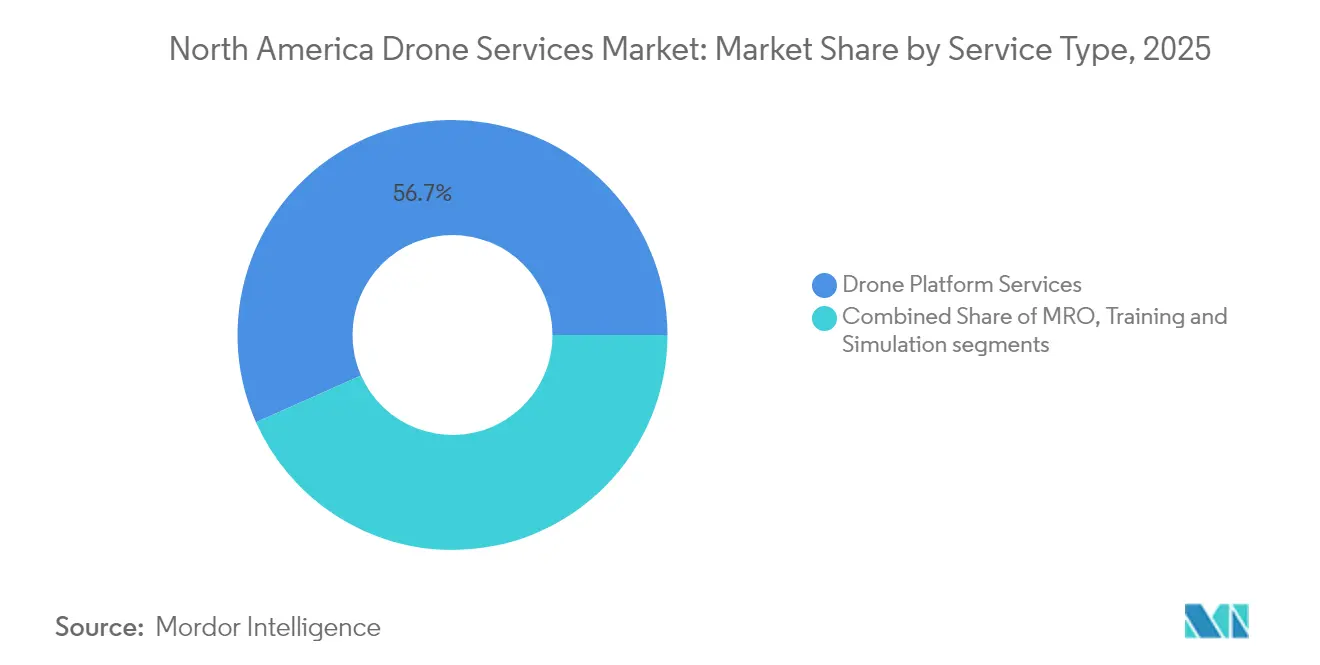
The North American drone services market, for platform services, led with a 56.65% revenue share in 2025, reflecting the central role of piloting, data capture, and processing packages. Globally, mapping and surveying produced 38.21% of 2025 revenue, demonstrating that the drone data services market remains rooted in core geospatial deliverables. Enterprises relied on turnkey flight teams and cloud analytics to streamline adoption, sustaining fee-based recurring revenue across energy, construction, and agriculture verticals. Hardware commoditization led providers to focus on value-added insights, and bundled service contracts contributed to expanding average deal sizes in 2025.
Training and simulation grew fastest at a 24.10% CAGR as labor shortfalls increased demand for scenario-based modules covering BVLOS procedures, swarm oversight, and advanced payload operation. Providers adopted mixed-reality simulators aligned with FAA Practical Test Standards, compressing time-to-currency and meeting insurers’ proficiency requirements. As BVLOS rules mature, certification refresh programs are expected to accelerate, further lifting the North American commercial drone services market.

By End-User Industry: Delivery Accelerates, Infrastructure Anchors
Construction and infrastructure held 31.62% of 2025 revenue, benefiting from measurable savings in bridge, transmission line, and pipeline inspections that reinforced steady renewal projects funded under the US Infrastructure Investment and Jobs Act. Tight labor markets and stringent safety mandates incentivized contractors to outsource aerial progress tracking, consolidating demand within the North American commercial drone services market.
Medical and parcel delivery registered the highest 25.10% CAGR. Distance-agnostic drones shortened fulfillment windows and reduced vehicle emissions, aligning with corporate ESG targets. Surgical supply networks, pharmacy chains, and mass-merchandise retailers expanded pilot programs into multi-state coverage zones after receiving route-based BVLOS authorizations, unlocking new addressable revenue streams for the North American commercial drone services industry.
By Drone Type: Hybrid VTOL Surges
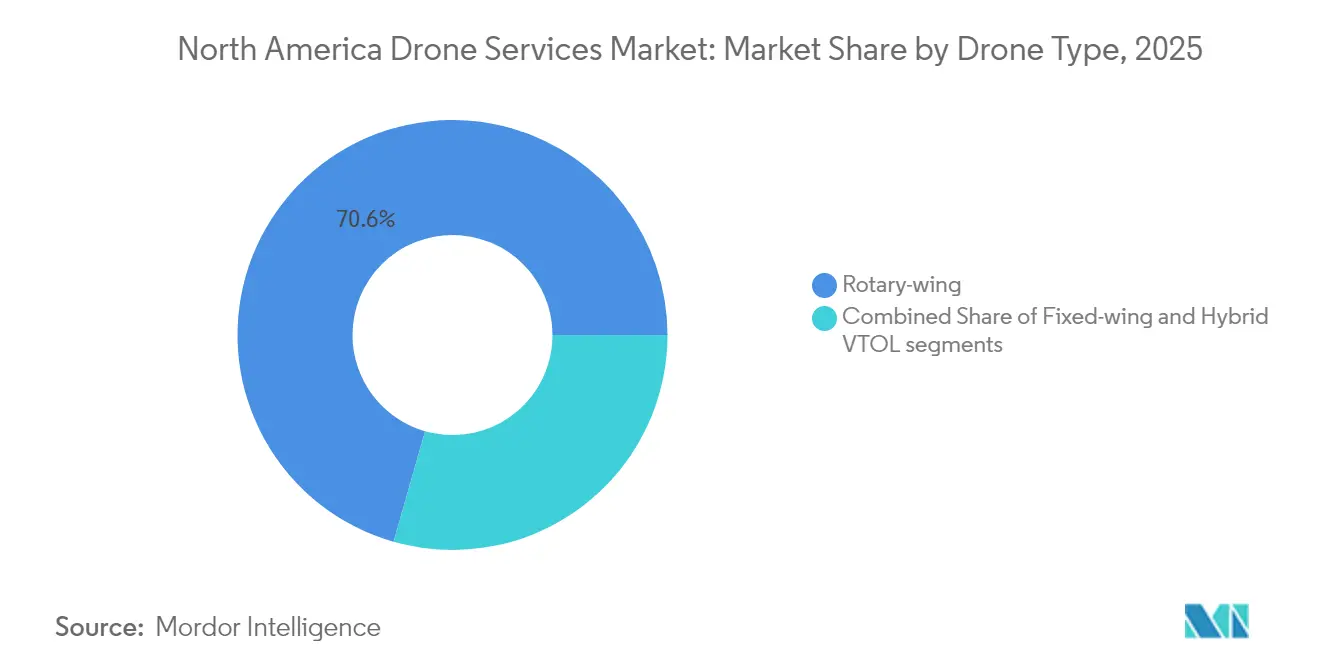
Rotary-wing platforms retained 70.58% of the North American commercial drone services market share in 2025, driven by user familiarity, their hovering capability, and low maintenance requirements. They excelled in close-range visual inspections and tactical public safety deployments. Improved obstacle-avoidance sensors and IP-rated airframes extended their service life and minimized downtime.
Hybrid VTOL systems posted a 27.95% CAGR due to the FAA's powered-lift certification rules effective January 2025. Combining vertical takeoff with fixed-wing cruise, these aircraft delivered payloads over 50 km without the need for ground-based launchers, opening up underserved suburban logistics routes within the North American commercial drone services market.
By Operating Range: BVLOS Regulatory Breakthrough Drives Growth
VLOS flights contributed 67.96% of 2025 revenue. They remained the default for inspection and public-safety tasks requiring immediate pilot intervention. Risk-based regulatory compliance and lower insurance premiums sustained volume within the North American commercial drone services market.
BVLOS services, growing at 22.98% CAGR, benefited from Part 108 rulemaking, expanded FAA BEYOND test sites, and mature detect-and-avoid sensors. Zipline’s 2023 FAA approval set safety precedents that encouraged insurers to revise underwriting guidelines, while Transport Canada’s new certificate-free framework for routine BVLOS reduced administrative overhead for cross-border operators. Investors, therefore, funneled capital into fleet expansions designed for regional logistics networks across the North American commercial drone services market.
Geography Analysis
The United States dominates the North American commercial drone services market in 2025, accounting for 86.02% of the market size, supported by the FAA’s structured waiver process, extensive venture funding, and a dense enterprise client base. Federal test sites in Oklahoma, New York, and North Dakota facilitated technology validation, while defense grants under the DIU Blue UAS program accelerated the domestic scale-up of manufacturing. Congressional oversight of Part 108 BVLOS rulemaking further strengthened investor confidence.
Canada accounted for most of the remaining revenue and is forecast to increase as Transport Canada’s November 2025 rules simplify BVLOS approvals for drones weighing 25-150 kg. Routine line-of-sight flights will no longer require Special Flight Operations Certificates in low-risk airspace, reducing administrative costs and promoting adoption in the resource extraction, utilities, and forestry sectors.
Mexico represented the fastest-growing geography, with a 21.98% CAGR, as the civil aviation agency updated regulations in line with ICAO’s Model UAS framework. Large-scale irrigation modernization projects in Sonora and renewable-energy expansion along the Gulf Coast presented use cases for long-range surveys. Although infrastructure gaps persist, venture partnerships with US-based operators accelerated knowledge transfer, integrating skilled crews and command-and-control technologies into the North American commercial drone services market.
Regulatory Landscape
In the United States, the Federal Aviation Administration (FAA) continues to shape commercial drone services scalability through BVLOS rulemaking and stricter compliance enforcement. The FAA Reauthorization Act of 2024 (Public Law 118-63) added authorities that affect service operators, including Section 927 to enable waivers as an alternative to exemption processes, and Section 929 directing restrictions on UAS operations near certain fixed-site facilities such as state prisons. In parallel, FAA enforcement mechanisms were reinforced in 2026 with initiatives such as the DETER program for prompt settlements for first-time UAS violators.
Canada and Mexico present different levels of operational friction for service providers. Transport Canada expanded the pathway for lower-risk BVLOS and clarified requirements for medium RPAS through changes that came into force in November 2025, reducing reliance on Special Flight Operations Certificates for routine operations. Additional 2026 activity focused on airspace access management and burden reduction. In Mexico, the Agencia Federal de Aviacion Civil (AFAC) maintains the NOM-107-SCT3-2019 framework as a central regulatory reference after a 2024 systematic review, which keeps compliance requirements and permitting processes as a key planning variable for cross-border service rollouts.
Value Chain Analysis
The drone services value chain in North America starts with airframes and critical subsystems (batteries, propulsion, navigation, payloads), feeding into integration and software layers (flight control, autonomy, geospatial and inspection analytics). These capabilities then support service delivery (mission planning, piloting, data capture, processing, and reporting), followed by post-delivery support such as training, safety management, and MRO. Service operators increasingly bundle platform operations with recurring analytics outputs for construction, energy, agriculture, and public safety buyers, while training and simulation providers target the remote-pilot labor gap for advanced operations like BVLOS and multi-aircraft oversight.
Government procurement and security-driven supply chain controls influence both upstream sourcing and downstream contracting for enterprise and public-sector use cases. The Federal Acquisition Regulation clause 52.240-1, tied to American Security Drone Act covered foreign entity restrictions (effective November 2024, with additional restrictions linked to federal funds effective December 22, 2025), pushes vendors and service providers toward compliant component sourcing and verified catalogs such as the DIU Blue UAS framework and related government-verified lists. This compliance overlay increases the importance of secure command-and-control, data-handling practices, and vetted supplier networks for operators competing for critical infrastructure and government-adjacent work.
Competitive Landscape
The competitive field remained fragmented in 2025. Axon’s USD 170 million purchase of Dedrone brought counter-UAS, first-responder drones, and evidence-management software under one umbrella, creating an end-to-end air-domain awareness stack. John Deere’s Sentera acquisition integrated multispectral optics and crop-scouting analytics into its See and Spray platform, enhancing precision agriculture services.
Skydio raised USD 170 million to scale Remote Flight Deck, enabling browser-based drone control over 5G and positioning the company as a leading provider of autonomy for infrastructure clients. Drone Delivery Canada merged with Volatus Aerospace, combining manufacturing with logistics service delivery to pursue medical supply corridors and border surveillance contracts.
Emerging specialists target niche verticals. Energy-focused VOLT Inspections offered thermographic analytics for transmission lines, while Rantizo scaled spray-drone maintenance subscriptions for co-ops. Edge-AI module providers supplied real-time defect detection to enhance value capture, intensifying differentiation through software within the North American commercial drone services market.
North America Drone Services Industry Leaders
-
DroneDeploy, Inc.
-
Zipline International Inc.
-
Cyberhawk Innovations Limited
-
AgEagle Aerial Systems Inc.
-
Skydio, Inc.
- *Disclaimer: Major Players sorted in no particular order
Market Opportunities and Future Outlook
Scaling BVLOS operations is the clearest whitespace for North American drone services, since rulemaking and interim approval pathways are widening what can be delivered as a repeatable service rather than a one-off waiver project. The FAA published an NPRM on normalizing BVLOS operations on August 7, 2025, and the comment period reopened and concluded in February 2026. The agency also continues to use processes such as the Near-Term Approval Process (NTAP) to evaluate safety cases that incorporate third-party UAS Traffic Management (UTM) services. Together, the regulatory approach and UTM supplier framework create room for service providers to package compliant detect-and-avoid, remote operations, and auditable workflows for enterprise customers operating across multiple jurisdictions.
Commercial expansion is also becoming more visible where buyers standardize reality capture and delivery operations at scale, which supports longer-duration contracts and higher utilization rates. In construction and infrastructure, large-fleet, multi-project standardization is being pursued through enterprise platform deployments, for example, DroneDeploy and PCL Construction expanding standardized reality capture across 1,000+ active projects. This approach sustains demand for data processing, analytics, and training services tied to measurable operational outcomes. In medical, retail, and on-demand logistics, Zipline has demonstrated scale milestones and geographic expansion in the United States, reinforcing demand for operators that can combine route-based permissions with consistent service levels and integration into customer fulfillment workflows.
Recent Industry Developments
- July 2026: DroneDeploy partnered with Shepherd to introduce data-backed insurance premium savings for contractors using DroneDeploy reality capture workflows. The program framed drone-derived documentation and jobsite risk visibility as an insurable control, reinforcing the business case for standardized, recurring construction deployments.
- May 2026: DroneDeploy and PCL Construction expanded their partnership to standardize reality capture across more than 1,000 active projects. The scale of deployment increased demand for consistent field operations, data processing, and enterprise governance that favor platform-centric service models over ad-hoc flight work.
- May 2025: John Deere acquired Sentera to add remote imagery and analytics capabilities to its precision-agriculture stack. The deal tightened integration between agronomic insights and field workflows, encouraging service providers to align drone data capture with downstream decision tools used by growers and co-ops.
Research Methodology Framework and Report Scope
Market Definition and Coverage
This market captures revenue earned from paid drone service work across North America, where a service provider uses drones to perform tasks such as inspection, mapping, monitoring, and data capture, and then delivers outputs to customers.
Scope exclusions: We exclude drone hardware sales, stand-alone software licensing not tied to service delivery, and purely military missions.
Segmentation Overview
- By Service Type
- Drone Platform Services
- Piloting and Operations
- Data Analytics
- Data Processing
- Maintenance, Repair and Overhaul (MRO)
- Training and Simulation
- Drone Platform Services
- By End User Industry
- Construction and Infrastructure
- Agriculture and Forestry
- Energy and Utilities
- Law Enforcement and Public Safety
- Medical and Parcel Delivery
- Others (Mining, Real-estate, Media)
- By Drone Type
- Rotary-wing
- Fixed-wing
- Hybrid VTOL
- By Operating Range
- Visual Line-of-Sight (VLOS)
- Beyond Visual Line-of-Sight (BVLOS)
- By Geography
- United States
- Canada
- Mexico
Data Sources, Market Sizing, and Validation
Desk Research
Desk research was used to set the market boundary, understand how services are priced, and create realistic demand drivers by country (United States, Canada, and Mexico). We relied on non-paywalled sources such as FAA rule updates and waiver programs, Transport Canada drone regulation publications, and government statistics series from agencies including the US Bureau of Labor Statistics and the US Census Bureau that signal activity in construction, utilities, and agriculture where service demand tends to rise.
We also reviewed USGS and Natural Resources Canada publications that inform mapping and surveying activity, and public procurement portals and tender bulletins that show inspection and monitoring spend patterns. In addition, we used sources such as SEC filings and investor presentations from listed operators, reputable press coverage on BVLOS approvals and program rollouts, and association websites that discuss operating practices and safety guidance. Where needed, we referenced paid database subscriptions for company financials and intelligence, patent databases for capability direction, and news and financials tools to time major commercial events. This list is not exhaustive, and many other sources were also used for data collection, validation, and clarification.
Primary Interviews and Surveys
Primary work focused on checking what is actually sold as a service, how pricing moves with flight complexity, and which end users are expanding budgets. We spoke with service providers, enterprise users, and channel partners across the United States, Canada, and Mexico so gaps from desk research could be closed and assumptions could be stress-tested.
Distribution of primary research fieldwork respondents
| Company type | Respondent position |
|---|---|
| Top tier: 38% | CXOs: 14% |
| Mid tier: 47% | Functional/Unit leaders: 41% |
| Smaller Players: 15% | Managers: 45% |
Market-Sizing & Forecasting
Our model starts with a top-down build that ties service demand to real activity pools in North America, then converts that demand into revenue using service-mix and pricing assumptions. For drone services, this is done by mapping end-use activity to serviceable jobs (for example, infrastructure inspections, surveying and mapping work, and recurring monitoring needs) and then applying realistic penetration and repeat-cycle behavior.
To keep the totals grounded, we corroborated outputs with selective bottom-up checks such as sampled price-per-mission and price-per-project ranges, capacity and utilization logic for service teams, and channel checks on typical contract sizes. Key inputs used in the model include the pace of BVLOS-enabling regulation and approvals, utilization levels (flight hours and project turnaround), application mix shifts between mapping, inspection, and monitoring, average selling price progression by complexity, and the share of projects that bundle analytics with field work. Forecasting relied on scenario analysis supported by expert views, where adoption and pricing were flexed under different regulatory speed and end-user budget paths, and then reconciled back to the most probable case. Where bottom-up data was thin for smaller local operators, gaps were handled by using conservative capacity assumptions and then cross-checking against observed pricing bands and customer procurement behavior.
Data Validation & Update Cycle
Model outputs are checked against independent signals such as regulation-driven operating permissions, visible commercial activity in major end-use industries, and the implied revenue per active service team, which helps flag unrealistic jumps. When a variance is found, assumptions are revisited, and targeted follow-ups are done with interviewees to confirm whether the change reflects real conditions or an artifact of timing, currency, or scope.
Before sign-off, the numbers go through multi-step analyst review so formulas, unit economics, and country splits are consistent. Reports are refreshed annually, and interim updates are made when material events occur, such as major rule changes, large contract awards, or demand shocks. Right before delivery, a final pass is completed so clients receive the latest updated view.
Mordor Intelligence's North America Drone Services Market Sizing Compared With Other Published Estimates
Published market sizes can look far apart for drone services because studies do not always count the same revenue streams, and they often use different time horizons and growth assumptions. In our experience, the biggest differences come from how "services" are interpreted, what geography is included, and how pricing and utilization are treated over the forecast window.
FAA waiver activity and Transport Canada operating permissions, together with service-pricing bands validated through interviews, are the evidence that anchors Mordor Intelligence to fee-for-service flight operations in the United States, Canada, and Mexico, while keeping drone hardware sales and stand-alone software licensing outside scope. In addition, some publications quote a US-only value and then generalize it to North America, or they assume aggressive BVLOS-driven uptake without checking whether service teams can scale flight capacity and delivery timelines at the same speed.
Benchmark comparison
| Source | Market Size | Gaps in Research Methodology |
|---|---|---|
| Mordor Intelligence | USD 15.02 B (2026) | |
| Financial Media Brief A | USD 8.84 B (2024) | Uses a different base year and appears to follow a global split-down logic, which can shift what is counted as services and how North America is derived from the global total. |
| Presswire Summary B | USD 6.47 B (2024) | Covers the United States only, and it may also treat analytics or platform-related items as service revenue even when flight delivery is not clearly bundled. |
The comparison shows that year choice and geography are two quick drivers of variance, and service-scope treatment widens the spread further. By tying revenue to observable operating permissions, realistic utilization, and verified pricing ranges, the final number stays traceable to repeatable inputs that can be rechecked as the market evolves.
Key Questions Answered in the Report
What is the current value of the North American commercial drone services market?
The North American commercial drone services market size was USD 15.02 billion in 2026.
How fast is the market expected to grow?
The market is projected to expand at a 19.61% CAGR, reaching USD 36.76 billion by 2031.
Which end-user industry is growing the fastest?
Medical and parcel delivery is forecasted to grow at 25.10% CAGR through 2031.
What regulatory change will have the biggest impact?
The FAA’s forthcoming Part 108 BVLOS rulemaking is expected to reduce waiver timelines from months to weeks, enabling scalable beyond-visual-line-of-sight operations.
Why are hybrid VTOL drones gaining traction?
FAA powered-lift certification rules effective in 2025 cleared a pathway for aircraft that combine vertical take-off with fixed-wing efficiency, supporting longer-range delivery and inspection missions.