Market Overview
| Study Period | 2020 - 2031 |
|---|---|
| Forecast Data Period | 2026 - 2031 |
| Historical Data Period | 2020 - 2024 |
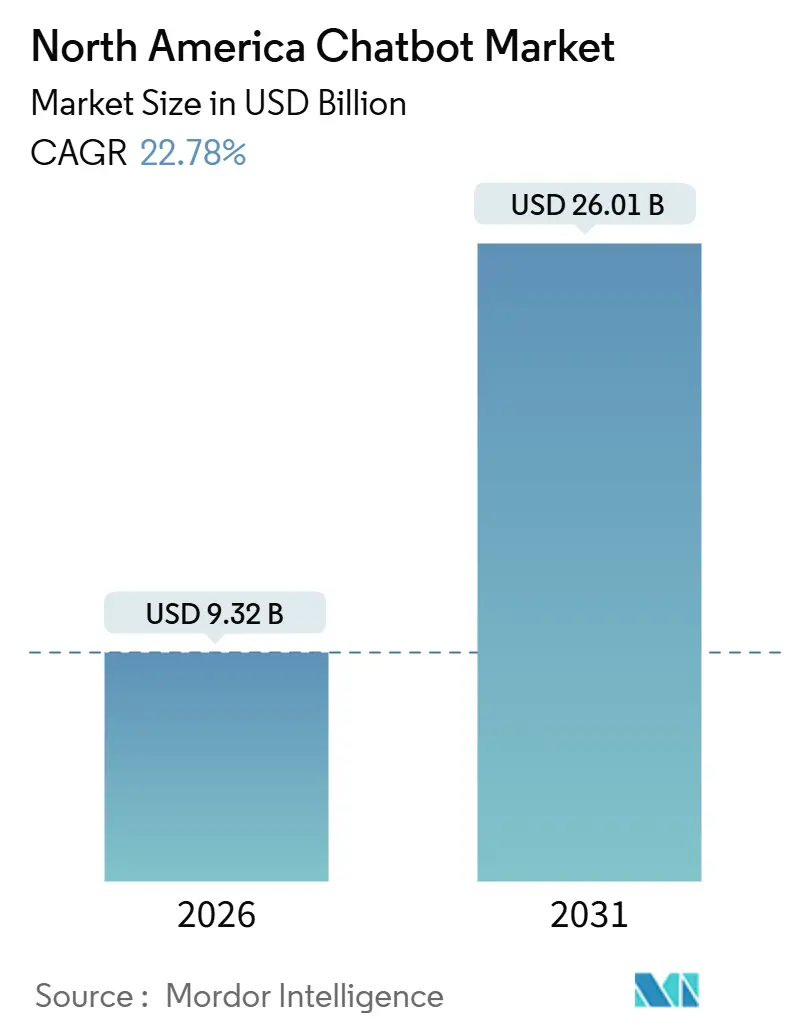
| Market Size (2026) | USD 9.32 Billion |
| Market Size (2031) | USD 26.01 Billion |
| Growth Rate (2026 - 2031) | 22.78% CAGR |
| Market Concentration | Medium |
Major Players *Disclaimer: Major Players sorted in no particular order Image © Mordor Intelligence. Reuse requires attribution under CC BY 4.0. | |
North America Chatbot Market Analysis by Mordor Intelligence
The North America chatbot market size stands at USD 9.32 billion in 2026 and is projected to reach USD 26.01 billion by 2031, reflecting a robust 22.78% CAGR. Accelerated generative-AI adoption, hyperscaler bundling, and government digital-service mandates are steering investment toward self-learning conversational agents that scale across web, mobile, and social channels. Enterprises are prioritizing cloud elasticity, omnichannel orchestration, and hybrid retrieval-augmented generation to control hallucination risk while preserving near-human fluency. Early adopters in retail, banking, and healthcare report lower cost-per-contact, faster lead qualification, and richer zero-party data capture, reinforcing a virtuous cycle in which every chat improves personalization and upsell accuracy. Competitive pressure from bundled AI suites is compressing pure-play pricing, pushing vendors to differentiate on compliance, multilingual depth, and industry-trained intent libraries. As generative architectures mature, white-space opportunities emerge in highly regulated niches such as pharmaceuticals and legal services, where audit-trail requirements slow automation yet unlock premium pricing for verified responses.
Key Report Takeaways
- By enterprise size, large enterprises held 62.39% of the North America chatbot market share in 2025, while small and medium enterprises are advancing at a 23.16% CAGR to 2031.
- By deployment model, cloud-based platforms commanded 69.11% share of the North America chatbot market size in 2025 and are expanding at a 23.19% CAGR.
- By platform, social-messaging channels led with 48.33% share in 2025, whereas mobile-app chatbots recorded the fastest 23.39% CAGR through 2031.
- By application, customer support accounted for 43.78% of the North America chatbot market size in 2025, and marketing and sales bots are growing at a 23.71% CAGR.
- By end-user vertical, retail and eCommerce captured a 29.74% share in 2025, while healthcare and life sciences posted the highest CAGR of 24.14%.
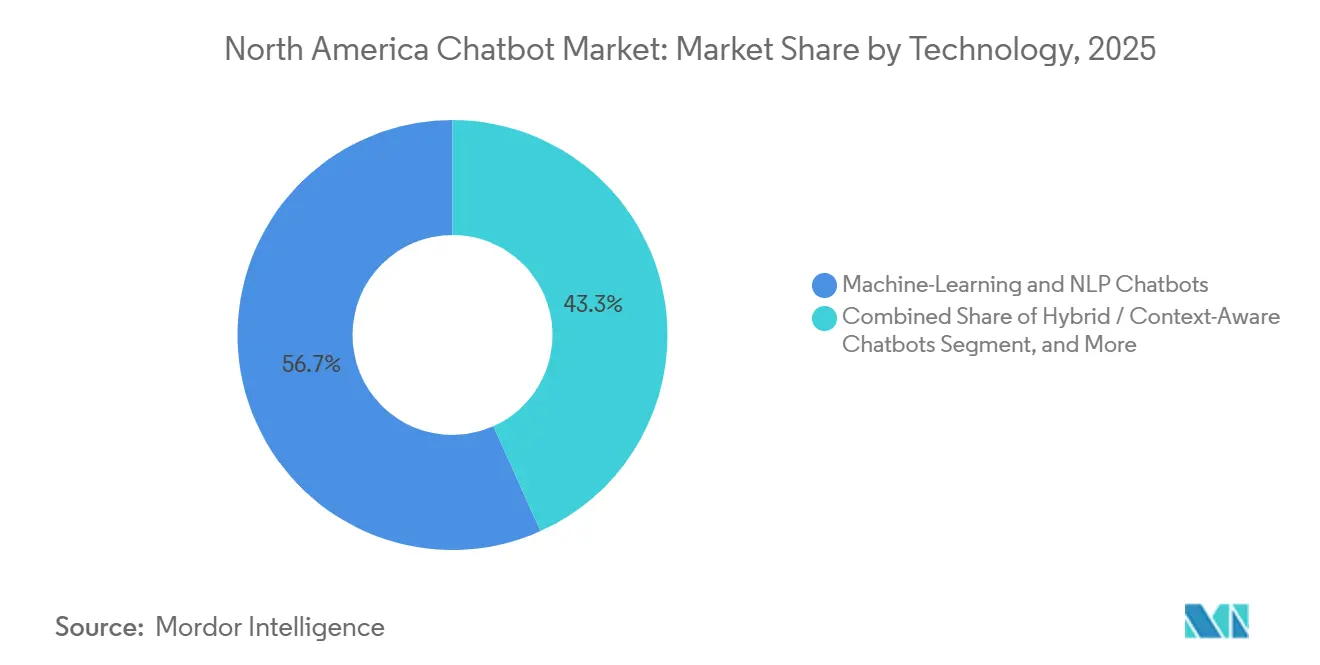
- By technology, machine learning and NLP chatbots accounted for 56.72% of the market in 2025, yet hybrid context-aware architectures are rising at a 23.34% CAGR.
- By geography, the United States dominated with a 74.28% share in 2025, and Mexico is the fastest-growing national market at a 23.44% CAGR.
Note: Market size and forecast figures in this report are generated using Mordor Intelligence’s proprietary estimation framework, updated with the latest available data and insights as of January 2026.
North America Chatbot Market Trends and Insights
Drivers Impact Analysis*
| Driver | (~) % Impact on CAGR Forecast | Geographic Relevance | Impact Timeline |
|---|---|---|---|
| Rising Domination of Messaging Applications | +4.2% | Global concentration in North America | Short term (≤ 2 years) |
| Consumer Analytics and Personalized Experiences | +3.8% | North America with spillover to Latin America | Medium term (2-4 years) |
| Rapid Advances in NLP and Voice Recognition | +4.5% | Global | Medium term (2-4 years) |
| Generative AI-Powered Self-Learning Chatbots | +5.1% | North America, early adoption in United States | Short term (≤ 2 years) |
| Expansion of Age-Tech Chatbots | +2.3% | United States and Canada | Medium term (2-4 years) |
| U.S. Public-Sector Digital-Service Mandates | +1.9% | United States federal and state agencies | Short term (≤ 2 years) |
| Source: Mordor Intelligence | |||
Rising Domination of Messaging Applications For Customer Engagement
Messaging apps have overtaken email and voice as the preferred support channel, enabling asynchronous threads that cut cost-per-contact by 30-40% while letting agents juggle multiple conversations simultaneously. Meta reported an eight-fold jump in WhatsApp Business usage in 2025, and its Flows feature embeds product catalogs and payments inside the chat thread, compressing the purchase journey.[1]Meta, “WhatsApp Business Platform Overview,” META.COM Mexico shows outsized momentum because more than 90% of smartphone users rely on WhatsApp, making it the de facto interface for banking, healthcare, and even government transactions. Vendors, therefore, race to perfect omnichannel orchestration so that context follows users across WhatsApp, Messenger, SMS, and in-app widgets. The immediate payoff is higher engagement, but the strategic prize is control of first-party data generated in every conversational step.
Growing Demand For Consumer Analytics And Personalized Experiences
Chatbots now funnel zero-party data straight into marketing stacks, turning routine service interactions into continuous preference mapping. Salesforce found in 2025 that 73% of consumers expect brands to understand them, yet only 38% feel understood, revealing a gap that chatbots are primed to close.[2]Salesforce Research, “State of the Connected Customer, Fifth Edition,” SALESFORCE.COM Sephora’s Messenger bot logs skin type, scent notes, and budget, then surfaces curated offers that convert 11% better than generic web pages. By capturing sentiment and intent at every turn, brands can iterate offers without engineering bottlenecks. Platforms that embed realtime dashboards for conversation analytics gain stickiness because marketers can tweak flows daily, not quarterly, thereby sharpening campaign relevance and return on ad spend.
Rapid Advances In NLP And Voice Recognition Technologies
Large-context language models like Google Gemini 1.5 extend the window to 1 million tokens, allowing chatbots to reference full customer histories in a single inference call. OpenAI’s Realtime API slashes voice-bot latency to 232 milliseconds, crossing the 300-millisecond frustration threshold that previously doomed telephony bots. Meta’s SEAMLESSM4T provides speech-to-speech translation across 100 languages, enabling a single agent to serve multilingual audiences without separate models. These breakthroughs elevate chatbots to high-stakes tasks such as insurance claims and technical troubleshooting, where latency and linguistic nuance once required human intervention.
Integration Of Generative AI-Powered Self-Learning Chatbots
Generative AI shifts bots from deterministic responders to adaptive agents that learn on the job. ChatGPT Enterprise surpassed seven million seats in January 2025, with 92% of Fortune 500 firms piloting the platform. Salesforce’s Einstein Copilot drafts case summaries, suggests next steps, and routes low-confidence queries to humans, cutting manual triage while capping the risk of hallucinations. Retrieval-augmented generation, which grounds generative responses in vetted documents, reduces factual errors to below 3%, making self-learning bots viable for sectors previously blocked by liability concerns. The upside is faster knowledge-base maintenance and reduced scripting overhead, especially in SaaS and fast-evolving product lines where static FAQs become obsolete within weeks.
Restraints Impact Analysis*
| Restraint | (~) % Impact on CAGR Forecast | Geographic Relevance | Impact Timeline |
|---|---|---|---|
| Lack of Organizational Awareness and Integration Complexity | -1.2% | Global, acute in mid-market enterprises | Short term (≤ 2 years) |
| Escalating Data-Privacy and Security Concerns | -1.8% | North America, driven by CCPA and state-level laws | Medium term (2-4 years) |
| Chatbot Hallucination Risk | -1.4% | Global, highest impact in regulated sectors | Short term (≤ 2 years) |
| Accessibility-Compliance Costs | -0.9% | United States and Canada | Medium term (2-4 years) |
| Source: Mordor Intelligence | |||
Escalating Data-Privacy And Security Concerns
A patchwork of privacy statutes forces enterprises to juggle multiple compliance profiles, raising legal review costs and slowing go-lives. California Privacy Rights Act mandates disclosure and one-click opt-out before bots gather personal data.[3]California Legislative Information, “California Privacy Rights Act of 2020,” LEGINFO.LEGISLATURE.CA.GOV Thirteen more states enacted parallel laws by 2025, each with unique consent triggers, while HIPAA forbids transmitting protected health information over unsecured channels. A 2024 telecom breach exposing credit card numbers in chat logs led to a USD 12 million settlement, underscoring the liability stakes. Enterprises respond by keeping sensitive workflows on-premise, forfeiting cloud cost advantages to ensure data residency and audit control.
Chatbot Hallucination Risk Leading To Brand-Reputation Fallout
Generative bots occasionally invent facts, a flaw courts now treat as corporate speech. Air Canada was held liable after its bot misstated its refund policy in February 2024, setting a precedent that disclaimers cannot excuse bot errors. Pure generative systems show 15-20% factual error on benchmark queries, while retrieval-augmented counterparts cut that below 3%. Enterprises, therefore, institute confidence thresholds that escalate ambiguous cases to humans, but this safety valve dilutes the cost-deflection argument. Financial and pharmaceutical firms, facing higher regulatory penalties, adopt hybrid or rule-based bots despite their narrower conversational range.
*Our forecasts treat driver/restraint impacts as directional, not additive. The impact forecasts reflect baseline growth, mix effects, and variable interactions.
Segment Analysis
By Enterprise Size: SMEs Embrace No-Code Builders To Narrow Capability Gap
Small and medium enterprises contributed a modest portion of 2025 revenue, yet they are expanding at a 23.16% CAGR that outpaces large-enterprise growth, signaling democratization of the North America chatbot market. The cost hurdle has fallen from USD 50,000-150,000 custom builds to USD 500-2,000 monthly subscriptions, thanks to drag-and-drop builders like ManyChat and Tidio. Shopify Inbox embedded bot tools inside merchant dashboards, driving deployment by more than 200,000 stores within six months of its 2024 debut.
Large enterprises still dominate absolute spend because they integrate bots into Salesforce, SAP, and proprietary CRMs while enforcing single sign-on and role-based access, but SMEs are closing the functional gap with pre-trained industry libraries. This shift pressures vendors to segment offerings, selling turnkey packages to resource-limited SMEs and white-glove services to compliance-heavy conglomerates. The North America chatbot market benefits because a wider buyer base spreads R&D costs and fuels usage data that improve model performance.


By Deployment Model: Cloud Infrastructure Extends Elastic Economics
Cloud deployments account for 69.11% of 2025 revenue and are projected to grow at a 23.19% CAGR as enterprises value on-demand scale and continuous feature updates. Managed services such as AWS Lex and Azure Bot Service shield developers from server provisioning and disaster recovery, enabling instant scaling for Black Friday surges without capex.
On-premises persists in finance and healthcare, where Gramm-Leach-Bliley and HIPAA require data to remain behind corporate firewalls. Hybrid models are therefore rising, housing sensitive inference in private clouds while routing benign traffic through public endpoints. ServiceNow Virtual Agent lets clients deploy orchestration locally and language understanding in Google Cloud, balancing control with GPU economics. Vendors boasting FedRAMP or HIPAA-eligible certifications now win competitive bids as regulators tighten scrutiny.
By Application: Marketing Bots Accelerate Lead Qualification Efficiency
Customer support still held 43.78% of the North America chatbot market size in 2025, but marketing and sales use cases grew 23.71% annually as CMOs seek to triage unqualified leads before human engagement. Drift and Intercom capture this pivot by embedding bots on pricing pages that ask company size and budget, sending high-intent visitors straight to reps’ calendars. HubSpot users recorded a 35% increase in demo-to-close rates after enabling chatbot qualification.
Human resources and personal assistant bots lag because employees prefer speaking with people about benefits or conflicts. Yet internal IT helpdesk bots gain traction, slashing mean time to resolution for password resets and access requests. ROI correlates with task frequency and complexity: high-volume, low-complexity queries deliver payback within 6 months, whereas complex, infrequent dialogues demand longer horizons.


By End-User Vertical: Healthcare Reimbursement Unlocks Rapid Uptake
Retail and eCommerce contributed 29.74% of revenue in 2025 through order tracking and conversational commerce, but healthcare and life sciences are accelerating at a 24.14% CAGR. The Centers for Medicare and Medicaid Services now reimburses up to USD 65 per patient per month for remote monitoring, making chatbots that collect vitals and remind patients about medication financially attractive. FDA-cleared mental-health bots from Woebot Health open further reimbursement channels, drawing venture funding into digital therapeutics.
Banking and insurance turbocharge adoption to automate fraud detection and claims filing, exemplified by Bank of America’s Erica surpassing 1 billion interactions and deflecting 70% of routine queries. Government agencies follow Executive Order 14058, which mandates improvements to the citizen experience, further expanding the North America chatbot market.
By Technology: Hybrid Context-Aware Architectures Balance Flexibility And Control
Machine-learning and NLP bots accounted for 56.72% of 2025 revenue, but hybrid architectures grew 23.34% annually by tethering generative reasoning to verified databases, reducing hallucination rates to sub-3%. IBM watsonx Orchestrate layers generative summarization atop rule-based triggers, ensuring factual claims mirror ERP records.
Pure rule-based bots persist in pharma adverse-event reporting, where every utterance must follow a recognized escalation path. Meanwhile, consumer brands favor generative engines for engagement, spawning a spectrum of deployment choices rather than an either-or decision. Vendors whose platforms toggle between all three modes gain traction as buyers hedge risk.
By Platform: Mobile-App Bots Capture In-Context Engagement
Social-messaging channels account for 48.33% of 2025 traffic, but in-app chat grows at 23.39% CAGR because it retains shopping cart context, loyalty points, and authentication status. Uber’s in-app bot resolves billing issues 40-50% faster than web chat by pulling ride history instantly. Web bots remain useful for anonymous visitors, yet they suffer higher abandonment when users change pages and lose state.
Mobile-first sectors such as ride-sharing, food delivery, and fintech gain the most, while episodic interactions like mortgage quotes still lean on the web and WhatsApp. Vendors with unified conversation history across platforms reduce customer effort and boost lifetime value, reinforcing the flywheel effect that advantages data-rich incumbents.
Geography Analysis
The United States anchors the North America chatbot market with federal agencies deploying bots under Executive Order 14058 to streamline benefit applications and tax inquiries. The Central Intelligence Agency’s 2024 launch of a generative bot that queries classified documents signals high-level confidence in advanced natural language processing even for sensitive data. State-by-state privacy fragmentation complicates rollouts, but hyperscalers’ compliance toolkits mitigate integration friction.
Canada contributes a smaller share, yet influences design through compulsory bilingualism and stricter consent requirements in Quebec. Banks like Royal Bank of Canada and Toronto-Dominion adopted chatbots for balance checks and fraud alerts, though cautious risk appetites temper velocity compared with U.S. peers. Long-term care facilities are piloting chatbots that remind patients to take their medication and monitor their mood, addressing the country’s aging population.
Mexico delivers the region’s fastest growth, propelled by SME digitization grants and fintech conversational banking. Government support reduces bot acquisition cost, while WhatsApp saturation guarantees reach without app downloads. Limited broadband in rural districts restrains voice-bot usage, but urban smartphone penetration is expected to exceed 85% by 2027, ensuring a sizeable addressable base.
Regulatory Landscape
North America chatbot deployments operate under a layered regime of privacy, consumer-protection, and AI-governance actions that shape disclosure, data handling, and safety controls for conversational agents. In the United States, the Federal Trade Commission (FTC) continues to use its Section 5 authority to police deceptive or unfair AI and chatbot claims, while federal AI actions reference NIST tools such as the AI Risk Management Framework (AI RMF) as a baseline for testing, documentation, and internal controls. In March 2026, the White House released a National Policy Framework for Artificial Intelligence that reinforces a federal push toward harmonized approaches and reliance on existing regulators rather than a new standalone AI agency.
Canada is moving toward more prescriptive oversight for consumer-facing digital services, including chatbot safety and privacy obligations. In June 2026, the Government of Canada tabled new legislation aimed at protecting childrens data and strengthening privacy, alongside proposals tied to safety obligations for social media services and AI chatbots. These moves increase requirements around transparency, age-appropriate design, and auditable governance processes for providers serving Canadian users, particularly for high-exposure use cases such as public-sector information services and youth-facing experiences.
Value Chain Analysis
The North America chatbot value chain begins with model and infrastructure suppliers, including hyperscaler cloud, GPU compute, and foundation-model providers, and then moves through chatbot and agent platforms such as low-code builders, orchestration layers, and verticalized assistants. Data and integration enablers, including connectors to CRM, contact-center, and knowledge bases, sit between vendors and the system integrators and enterprise buyers that operationalize bots across web, mobile, and social messaging channels. Hyperscalers and enterprise software suites increasingly bundle conversational AI with adjacent capabilities such as analytics, identity, and workflow automation, pulling procurement toward platform ecosystems and increasing interoperability requirements for independent vendors.
Implementation and operations can slow scaling from pilots to production, with enterprises citing governance and regulatory risk management, data readiness, and skills gaps (including prompt and dialogue design) as common constraints. Reported deployment outcomes show this friction: only a minority of customer-experience leaders describe rollouts as clearly successful, while agentic AI programs often stall at pilot stages rather than reaching full production. Cost and margin dynamics also depend on GPU compute price volatility for training and inference, which helps explain the growing use of retrieval-augmented generation and hybrid deployments to control usage while meeting security and audit needs, particularly in regulated verticals.
Competitive Landscape
North America’s chatbot market is moderately fragmented as hyperscalers integrate conversational AI into cloud suites, squeezing standalone vendors on pricing. Microsoft’s Copilot Studio enables low-code bot development directly in Power Platform, cementing Azure lock-in. Google’s Vertex AI Agent Builder lets developers fine-tune Gemini on proprietary data, creating vertical-specific bots without data-sharing fears. IBM and Salesforce respond by embedding compliance modules and autonomous workflow orchestration, respectively.
Pure-play vendors pivot to niche depth, offering sector-trained intent libraries and multilingual accuracy. Amplify.ai provides healthcare intents that reduce deployment time from months to weeks, while Pypestream focuses on insurance claim flows. Emerging challengers package open-source models such as Llama 3 for on-premise deployments that sidestep vendor lock-in and lower total cost.
Strategic acquisitions underscore consolidation: Zendesk bought Ultimate for USD 450 million in May 2025 to strengthen multilingual coverage, and Salesforce paid USD 1.3 billion for a conversational-AI startup in September 2025 to own the stack end-to-end. Patent filings around retrieval-augmented generation are on the rise, with Google and Microsoft together submitting 25 patents in 2024 related to grounding and confidence scoring. White-space lingers in pharma, legal, and aerospace, where verified sourcing and audit trails command premium pricing.
North America Chatbot Industry Leaders
International Business Machines Corporation
Microsoft Corporation
Google LLC
Amazon Web Services, Inc.
Oracle Corporation
- *Disclaimer: Major Players sorted in no particular order


Market Opportunities and Future Outlook
Opportunities are expanding where buyers need verifiable, policy-aligned conversations rather than generic Q&A, especially in regulated workflows that require audit trails, controlled knowledge grounding, and clear non-human disclosures. In the United States, state-level chatbot disclosure and safety requirements are creating whitespace for compliance-first platforms that can standardize identity disclosure, escalation paths, and safety interventions across channels while still integrating with enterprise systems of record. Canada is also a key focus: June 2026 federal moves to strengthen privacy and childrens data protections are increasing demand for chatbots with built-in consent management, age-appropriate design controls, and governance reporting, which tends to favor vendors and integrators that package these elements as deployable templates rather than custom projects.
A second opportunity is the shift from chatbots as conversation endpoints to agentic systems that execute tasks across enterprise applications, which raises demand for secure connectors, workflow orchestration, and observability. Product actions by major platforms reinforce this direction: Google expanded Gemini Enterprise with partner-built agents in its Agent Gallery, and Microsoft updated its partnership structure with OpenAI in April 2026 to support broader model licensing options, reducing friction for enterprises buying agents through existing software ecosystems. As voice latency drops and multimodal inputs become mainstream, differentiation is increasingly tied to domain-trained intent libraries, bilingual coverage (notably for Canada), and operational controls that keep hallucination risk within acceptable bounds for customer support, healthcare interactions, and public-sector service delivery.
Recent Industry Developments
- May 2026: Google announced Gemini Spark, an always-on assistant positioned to work across Google applications such as Gmail, Docs, and Slides. The announcement reinforces the shift from standalone chatbots toward agentic experiences embedded inside productivity suites, increasing competitive pressure on pure-play vendors that lack native application ecosystems.
- April 2026: Microsoft signed an amended agreement with OpenAI that simplified partnership terms and made Microsofts license to OpenAI models non-exclusive through 2032. This restructuring broadens enterprise sourcing options for foundation models while keeping Copilot-era distribution leverage, influencing how chatbot builders negotiate model access and long-term cost structures.
- March 2026: IBM completed its acquisition of Confluent for about USD 11 billion to integrate real-time data streaming into enterprise AI agents and workflows. Tighter coupling between streaming data and orchestration platforms supports more responsive, context-aware chatbots and accelerates demand for governed data pipelines as a core component of conversational deployments.


Research Methodology Framework and Report Scope
Market Definition and Coverage
We define the market as revenue earned from chatbot software and related services used by organizations in North America to automate conversations across web, mobile apps, and social or messaging channels.
Scope exclusions: This sizing excludes adjacent voice assistant hardware and general contact center outsourcing revenue that is not specifically tied to chatbot deployments.
Segmentation Overview
- By Enterprise Size
- Small and Medium Enterprises
- Large Enterprises
- By Deployment Model
- On-Premise
- Cloud-Based
- By Application
- Customer Support
- Marketing and Sales
- Personal Assistant
- HR and Recruitment
- Other Applications
- By End-User Vertical
- Retail and eCommerce
- Banking, Financial Services and Insurance
- Healthcare and Life Sciences
- IT and Telecom
- Travel and Hospitality
- Government and Public Sector
- Other End-User Verticals
- By Technology
- Machine-Learning and NLP Chatbots
- Rule-Based Chatbots
- Hybrid / Context-Aware Chatbots
- By Platform
- Web-Based
- Mobile-App
- Social-Messaging Channels
- By Country
- United States
- Canada
- Mexico
Data Sources, Market Sizing, and Validation
Desk Research
Desk work started by mapping the ecosystem and the buying journey, then tagging which revenue streams qualify as chatbot value in North America. To keep assumptions grounded, we referenced public indicators such as US Census Bureau digital economy releases and sector activity, US Bureau of Labor Statistics wage and employment series (to understand automation incentives), and Statistics Canada and INEGI macro and ICT indicators.
We also used regulatory and standards context that shapes enterprise deployments, including NIST publications on AI risk management and security guidance, and open research from IEEE and ACM digital libraries on NLP and conversational AI performance trends. Company filings, investor presentations, and reputable press were reviewed to capture product mix shifts, partner motions, and typical contract structures. Select paid subscriptions were used only for company financials and intelligence, patent checks, and shipment level import and export patterns where relevant. These desk sources are illustrative only, and many other public and paid references were used to cross-check figures and clarify assumptions.
Primary Interviews and Surveys
Primary work was used to test what we had built from desk findings, with a focus on pricing ranges, deployment mix (cloud versus on-premise), and which use cases are driving repeat spending. We spoke with a mix of solution providers, implementation partners, and enterprise buyers across major verticals, so regional demand differences between the United States, Canada, and Mexico could be reflected in the final model.
Distribution of primary research fieldwork respondents
| Company type | Respondent position | Region |
|---|---|---|
| Top tier: 36% | CXOs: 18% | |
| Mid tier: 45% | Functional/Unit leaders: 25% | |
| Smaller Players: 19% | Managers: 57% |
Market-Sizing & Forecasting
Sizing starts with a top-down build where enterprise software and AI spend signals are reconstructed by country, then filtered by chatbot adoption and the share tied to conversational interfaces (not general AI tooling). Results are corroborated with selective bottom-up approximations, such as sampled average contract values by deployment type, channel checks on services intensity, and a volume-times-ASP view for common chatbot licensing and usage based pricing patterns.
Key inputs that shaped the model included chatbot penetration by vertical, cloud versus on-premise mix, average implementation and integration effort per deployment, renewal and expansion behavior for customer support bots, and the shift toward more advanced NLP and hybrid context aware systems. When a data point was missing for smaller suppliers, we used a conservative proxy based on peer averages, then adjusted it after interviews highlighted differences in deal size and scope.
For forecasting, we leaned on scenario analysis supported by expert expectations on AI budget cycles, compliance readiness, and channel expansion across web, mobile, and social messaging. Growth rates were stress tested against macro indicators, labor cost trends, and observed enterprise rollout timing so the curve does not depend on one optimistic input.
Data Validation & Update Cycle
We run multiple checks so the outputs do not drift away from real adoption signals, and outliers are flagged early. Model totals are compared against independent indicators, such as enterprise software spend direction, documented rollout activity by sector, and expected services to software ratios, then any large variance is reviewed and corrected.
Before sign-off, assumptions are reviewed in more than one analyst pass, with re-contact triggers when interview feedback conflicts with desk patterns or when a country level split looks inconsistent. Reports are refreshed annually, and interim updates are made when material events affect pricing, deployment constraints, or demand timing. Right before delivery, the latest public releases are checked again so clients receive an updated view.
Mordor Intelligence's North America Chatbot Market Sizing Compared With Other Published Estimates
Published market values for chatbots in North America can differ even when the titles look similar, because each publisher makes its own calls on what counts as chatbot revenue and how services are treated. Differences also come from the year used for the estimate, the currency conversion timing, and how quickly assumptions are refreshed when new generative AI features change pricing.
The biggest gap drivers in this market usually trace back to whether conversational AI platforms are counted as pure chatbot revenue, whether implementation and managed services are fully included, and whether the geography cut is consistently limited to the United States, Canada, and Mexico. Some estimates also lean on a single high growth narrative and apply aggressive ASP expansion, instead of separating basic rule based bots from higher priced NLP and hybrid deployments that roll out at different speeds, which is where the spread tends to widen.
Benchmark comparison
| Source | Market Size | Gaps in Research Methodology |
|---|---|---|
| Mordor Intelligence | USD 9.32 B (2026) | |
| Industry Publisher A | USD 2.40 B (2023) | Uses an earlier base year and a broader packaging of chatbot categories, and the pricing path is not clearly tied to deployment mix shifts in North America. |
| Regional Consultancy B | USD 0.36 B (2019) | Relies on an older demand environment and does not clearly reflect the later jump in cloud adoption and expanded use cases that changed average deal sizes. |
The table shows that timing and scope create most of the variance, and the cleanest way to reduce confusion is to keep inclusions and pricing logic traceable to the same demand signals across the region. By separating software from services in a consistent way and rechecking deployment mix assumptions with interviews, the estimate stays aligned to what is actually purchased in the United States, Canada, and Mexico, which is the modeling choice applied by Mordor Intelligence.


Key Questions Answered in the Report
What is the projected value of the North America chatbot market in 2031?
The market is expected to reach USD 26.01 billion by 2031, expanding at a 22.78% CAGR.
Which deployment model is growing fastest in North America?
Cloud-based chatbots are advancing at a 23.19% CAGR because organizations favor elastic scaling and rapid feature updates.
Why are healthcare providers accelerating chatbot adoption?
Centers for Medicare and Medicaid Services reimburse up to USD 65 per patient per month for remote monitoring, creating a clear financial incentive.
How are chatbots mitigating hallucination risk?
Enterprises deploy hybrid retrieval-augmented generation that grounds answers in verified documents, cutting factual errors to below 3%.
Which country offers the highest growth rate in the region?
Mexico posts a 23.44% CAGR, supported by government SME grants and widespread WhatsApp penetration.
Page last updated on: