
Market Overview
| Study Period | 2021 - 2031 |
|---|---|
| Forecast Data Period | 2026 - 2031 |
| Base Year Market Size (2025) | USD 6.90 Billion |
| Market Size (2026) | USD 7.28 Billion |
| Market Size (2031) | USD 9.51 Billion |
| Growth Rate (2026 - 2031) | 5.50 % |
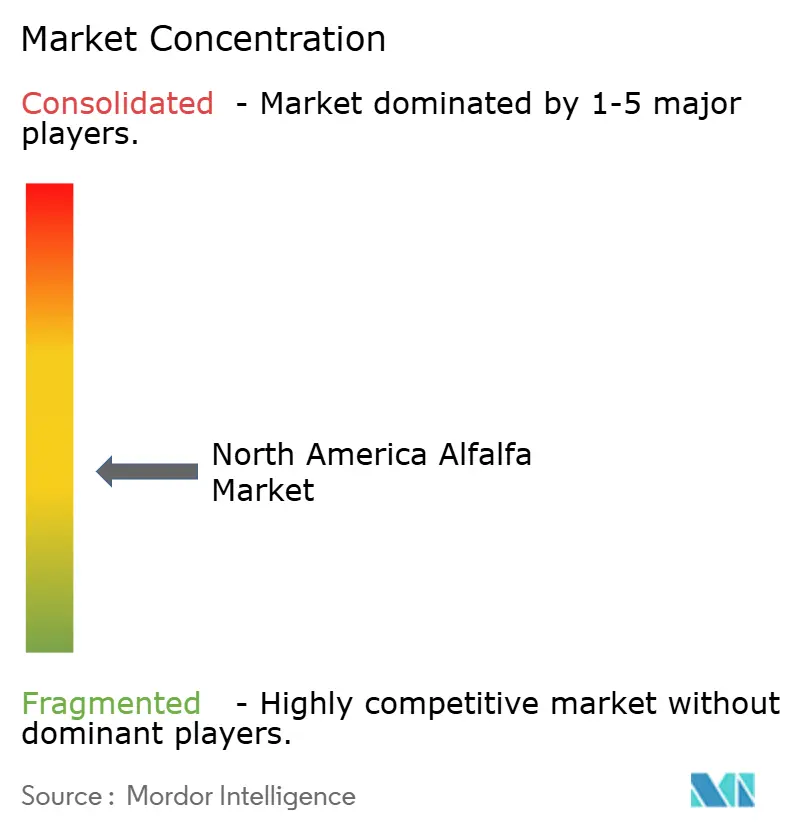
| Market Concentration | Medium |
Major Players *Disclaimer: Major Players sorted in no particular order Image © Mordor Intelligence. Reuse requires attribution under CC BY 4.0. | |
North America Alfalfa Market Analysis by Mordor Intelligence
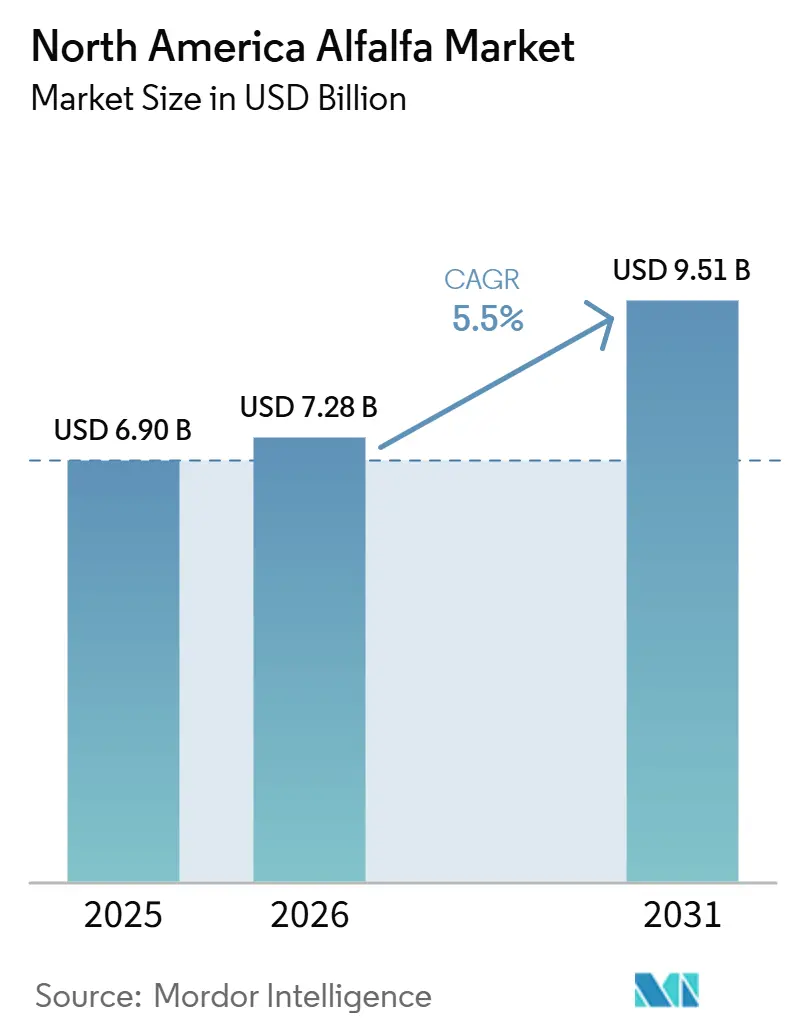
The North America alfalfa market size is projected to grow from USD 6.90 billion in 2025 and USD 7.28 billion in 2026 to USD 9.51 billion by 2031, registering a CAGR of 5.50% between 2026 and 2031. Production in the North America alfalfa market is gradually shifting toward Idaho and the broader Pacific Northwest, as water compliance costs continue to limit California's historically established acreage base. Export demand remains relevant to the market, but the mix of destination markets and required product specifications is changing faster than shipment trends alone indicate. Large exporters capable of shifting supply routes across regions have responded more effectively to trade disruptions, increasing the value of logistics reach, documentation systems, and multi-origin sourcing in premium trade channels. Margin pressure in 2025 demonstrated that operators with limited scale or weak quality differentiation faced tighter economics, while premium-grade product remained more defensible in contract and export channels. The North America alfalfa market continues to present investment opportunities in traceable premium hay, export-ready compressed formats, and advanced seed platforms that improve harvest flexibility and forage quality.
Key Report Takeaways
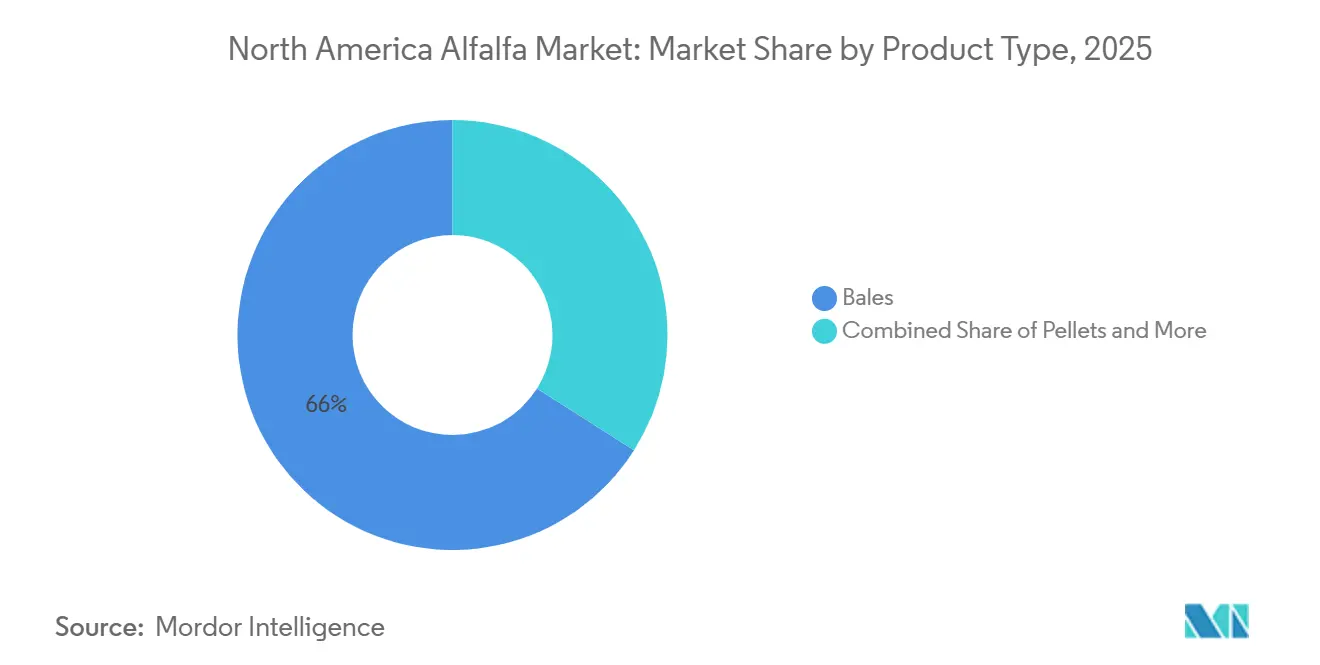
- By product type, bales were the largest segment and accounted for 66% of the North America alfalfa market share in 2025, while pellets are the fastest-growing segment and are anticipated to expand at a CAGR of 8.5% during 2026–2031.
- By application, dairy cattle feed was the largest segment and accounted for 39% of the North America alfalfa market size in 2025, while poultry feed is projected to register the highest CAGR of 9.2% during 2026–2031.
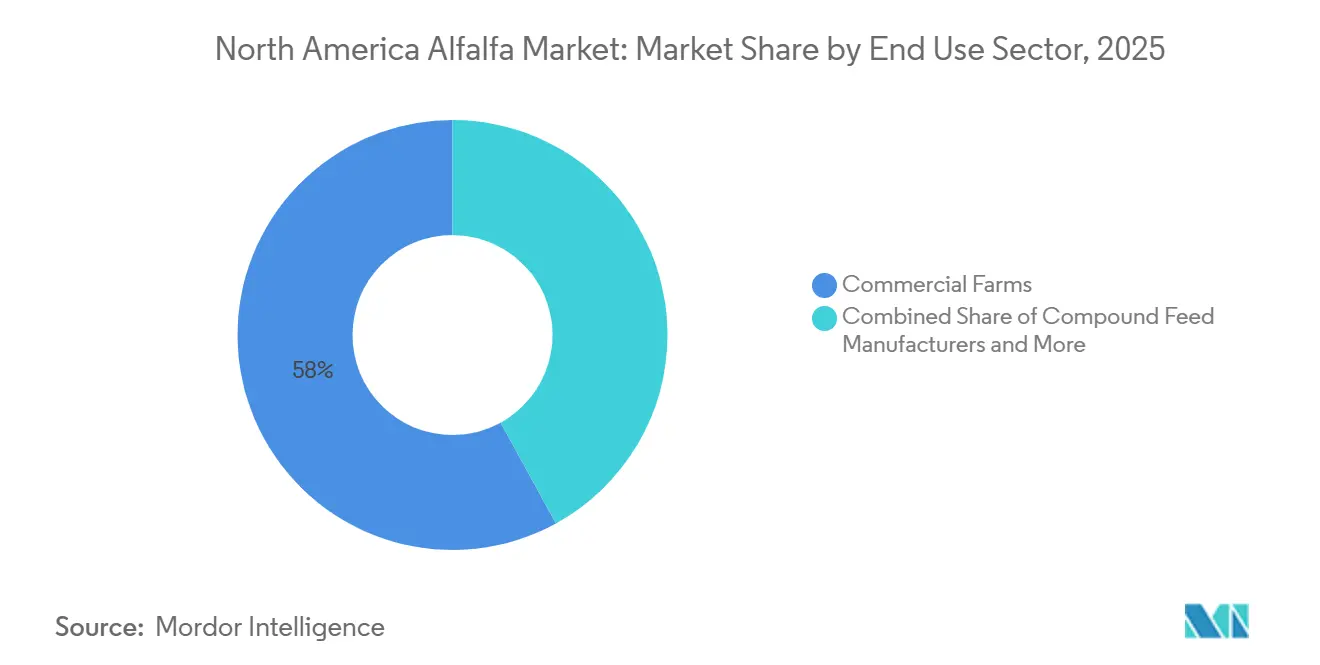
- By end-use sector, commercial farms held 58% share of the market in 2025, while pet food and specialty nutrition are anticipated to expand at the fastest CAGR of 8.2% during 2026–2031.
- By geography, the United States accounted for 85% share of the market in 2025, while Canada is projected to record the highest CAGR of 6.3% during 2026–2031.
Note: Market size and forecast figures in this report are generated using Mordor Intelligence’s proprietary estimation framework, updated with the latest available data and insights as of 2026.
Market Trends and Insights
Drivers Impact Analysis of North America Alfalfa Market*
| Driver | (~) % Impact on CAGR Forecast | Geographic Relevance | Impact Timeline |
|---|---|---|---|
| Pacific export demand for premium hay | +1.1% | United States, especially Washington, Oregon, and California, and Canada, especially British Columbia | Short term (≤ 2 years) |
| Dairy ration demand in core production belts | +1.2% | United States, especially Wisconsin, Idaho, and California, and Canada, especially Ontario | Medium term (2-4 years) |
| Adoption of drought-tolerant alfalfa varieties | +0.8% | United States, especially the Southwest and Great Plains, and Mexico, especially Chihuahua and Sonora | Long term (≥ 4 years) |
| Mechanized baling and moisture control | +0.5% | United States, especially western states, and Canada, especially the Prairie provinces | Medium term (2-4 years) |
| Soil-health and rotation incentives | +0.4% | United States, especially the Upper Midwest and Great Plains, and Canada | Long term (≥ 4 years) |
| Organic and non-GMO feed premiums | +0.7% | United States, especially the Pacific Northwest and Upper Midwest, along with Canada and Mexico | Long term (≥ 4 years) |
| Source: Mordor Intelligence | |||
Pacific Export Demand for Premium Hay
Pacific buyer behavior has become a key pricing variable in the North America alfalfa market. Buyers are placing greater weight on consistency, documentation, and compressed export formats than on volume alone. The tariff disruption between the United States and China in early 2025 interrupted normal shipment flows and demonstrated how quickly export channels can stall when policy changes affect a concentrated trade lane. Al Dahra responded by rerouting United States cargo to Japan, South Korea, and the Middle East, while redirecting Chinese customer demand to other supply origins within its network. This response highlighted why diversified supply chains now matter as much as field production in premium export trade, particularly when freight and trade policy conditions can change with little warning. The North America alfalfa market is therefore rewarding exporters that can manage quality traceability, lot-level documentation, and multi-market fulfillment simultaneously.
Dairy Ration Demand in Core Production Belts
Dairy demand in major production regions continues to set quality benchmarks for the North America alfalfa market, as large commercial herds purchase repeatedly and enforce measurable feed standards. Wisconsin recorded an alfalfa dry matter yield of 5.2 metric tons per acre in 2025, the highest in 19 years of tracking, demonstrating the productivity potential of well-managed stands serving contract dairy channels. Large dairies increasingly purchase against relative feed value and other measurable quality standards, supporting longer-term contracts and more stable procurement patterns across the North America alfalfa market. In this context, Idaho benefits from a combination of agronomic strength, irrigation access, and export proximity that serves both domestic dairies and overseas buyers.
Adoption of Drought-Tolerant Alfalfa Varieties
Improved seed genetics are changing how the North American alfalfa market manages water stress, harvest timing, and quality risk associated with narrow cutting windows. HarvXtra alfalfa reduces lignin by 20%, improves relative forage quality by 15-20%, and extends the harvest window by 7 to 10 days without a quality penalty, giving growers more operational flexibility under stressed production conditions. DLF completed the integration of Corteva's alfalfa breeding assets by the 2024 season and published the unified Forage First 5 Series in January 2026, widening the commercial path for advanced germplasm across the United States and Canada. This consolidation broadened the reach of advanced trait technology through a single distribution platform, giving growers clearer access to previously separated genetics. As improved varieties raise baseline forage quality, the North American alfalfa market is likely to become less tolerant of lower-performing conventional stands in contracted dairy and export channels.
Organic and Non-GMO Feed Premiums
Verified and differentiated forage is becoming more important in the North America alfalfa market as branded feed and specialty nutrition buyers ask for cleaner ingredient positioning and steadier product quality. Equine and specialty feed buyers remain at the front of this shift because they purchase more processed formats and place greater value on packaging, consistency, and product claims than commodity bulk buyers do. Triple Crown Nutrition and Standlee announced the Diamond Smart forage line in May 2025, combining Standlee forage with Triple Crown EquiMix for equine digestibility and showing how branded nutrition companies are locking in differentiated alfalfa inputs. Similar demand is also appearing in pet food and specialty channels where traceability, packaging quality, and ingredient disclosure carry more weight than spot-market price. The North America alfalfa market is therefore seeing certification and branding become part of margin protection, especially in smaller but faster-growing premium channels.
Restraints Impact Analysis of North America Alfalfa Market*
| Restraint | (~) % Impact on CAGR Forecast | Geographic Relevance | Impact Timeline |
|---|---|---|---|
| Groundwater restrictions in the southwest | -0.8% | United States, especially California and Arizona, and Mexico, especially Chihuahua and Sonora | Long term (≥ 4 years) |
| Export freight and container volatility | -0.6% | United States, Canada, and Mexico across Pacific export lanes | Short term (≤ 2 years) |
| Substitution by corn silage and roughage | -0.5% | United States and Canada | Medium term (2-4 years) |
| Contamination and moisture-related quality loss | -0.3% | United States, especially the South-Central and Southeast, along with Canada and Mexico | Short term (≤ 2 years) |
| Source: Mordor Intelligence | |||
Groundwater Restrictions in the Southwest
Groundwater restrictions in the Southwest remain a structural constraint on the North America alfalfa market, as premium irrigated acreage cannot expand freely under tighter water governance. The Public Policy Institute of California (PPIC) projected in June 2026 that more than 500,000 acres of San Joaquin Valley cropland will ultimately need to exit irrigated production as sustainability deadlines approach, increasing long-run pressure on forage cropping decisions[1]. Feed crops such as alfalfa, corn silage, and pasture currently cover up to 700,000 acres of irrigated valley land, leaving a large share of forage area exposed to future fallowing pressure. This limits long-run expansion of premium irrigated alfalfa in California and shifts more future growth toward Idaho, Washington, and the Prairie provinces, where regulatory pressure is lower. Similar water stress in northern Mexico reinforces that supply risk in the North America alfalfa market is regional rather than confined to a single state.
Substitution by Corn Silage and Roughage
Substitution by corn silage and other roughages creates a recurring demand ceiling for the North America alfalfa market, particularly in lower-grade supply segments where nutritionists have greater formulation flexibility. A 2025 Animal Science Journal study found that replacing alfalfa silage with corn silage in amino acid-balanced diets did not significantly affect early lactation performance in crossbred ewes. This evidence supports the use of least-cost formulation tools when alfalfa prices rise faster than competing roughages, meaning some demand can shift within a single ration planning cycle. Average dairy alfalfa prices stood at USD 171 per metric ton in 2025, which reduced substitution pressure at that point in the cycle, though the ability to reformulate diets remained. Premium suppliers with strong quality specifications are less exposed to this risk, while commodity operators remain more vulnerable when ration economics shift.
*Our forecasts treat driver/restraint impacts as directional, not additive. The impact forecasts reflect baseline growth, mix effects, and variable interactions.
North America Alfalfa Market Segment Analysis
By Product Type:
Bales Hold the Largest Share, Pellets Grow the FastestBales held 66% share of the North America alfalfa market size in 2025, which kept them as the clear anchor across large dairy and beef operations with bulk storage and steady feed turnover. Their position reflects simple storage, easier movement at farm scale, and a strong fit with commercial procurement routines that still favor field-friendly formats over more processed forms. Export chains also support this dominance because compressed bale formats travel more efficiently through West Coast container routes and can better meet destination specifications in premium channels.
Pellets are projected to grow at an 8.5% CAGR from 2026 to 2031, supported by precision feeding needs in equine, poultry, and pet food applications where product uniformity matters more. Cubes serve a smaller but steady part of the North America alfalfa market for buyers who want easier handling, cleaner packaging, and controlled portions without fully moving to pellet-based feeding systems. Compressed bales are also gaining ground where shipping density and specification consistency matter more than simple field handling, especially in export-linked channels. New Holland has promoted hay baler automation with fill and moisture sensors, which supports more consistent bale quality and lower storage loss in commercial forage operations. That equipment trend helps larger operators narrow quality variation, reduce rejected lots, and defend premium positions in export and contract channels across the North America alfalfa industry.

By Application:
Dairy Cattle Feed Holds the Largest Share, While Poultry Feed Grows the FastestDairy cattle feed accounted for 39% of the North America alfalfa market value in 2025, making it the largest application segment. Demand remained firm as large commercial dairies continue to use multi-year supply contracts that specify relative feed value standards and support consistent forage quality[2]. This keeps alfalfa well established in high-producing Holstein rations, where it remains a key protein and fiber ingredient. Beef cattle feed remained an important application, with feedlot and cow-calf operations incorporating alfalfa to provide energy and protein during the backgrounding and finishing stages.
Poultry feed is projected to grow at a 9.2% CAGR from 2026 to 2031, as alfalfa pellets and meal gain wider acceptance in commercial layer diets[3]. The North America alfalfa market is also benefiting from broader buyer diversification, as poultry adds a faster-growing outlet beyond traditional dairy use. Equine feed continues to support premium pricing through cubes and pellets, particularly where nutrition quality, handling convenience, and product verification influence purchase decisions more than price alone. Small ruminant and camelid uses remain lower-volume segments of the North America alfalfa industry, but they often carry stronger unit economics in specialty formats and certified channels. This broader demand base supports gradual expansion into species categories that have historically remained outside the core dairy and beef pool in the North America alfalfa market.
By End-Use Sector:
Commercial Farms Hold the Largest Share, Specialty Nutrition Expands the FastestCommercial farms accounted for 58% of the North America alfalfa market in 2025, reflecting the bulk buying power of large dairy, beef, and mixed livestock operations that purchase in repeat cycles and rely on consistent supply. Their procurement behavior sets the baseline, as they move multi-ton orders through direct grower contracts or regional aggregators, and their demand is essential to seasonal inventory planning. The pet food and specialty nutrition segment is projected to grow at an 8.2% CAGR from 2026 to 2031, making it the fastest-growing end-use segment in the North America alfalfa market. Compound feed manufacturers also represent a significant portion of demand, as they convert alfalfa pellets and meal into standardized inputs for multiple livestock categories, creating a link between field supply and finished feed demand.
Household and hobby animal owners represent a smaller share of the North America alfalfa market but support higher unit margins through branded packaged products sold through retail and e-commerce channels. This creates a clear divide between commodity bulk sales and premium certified retail offerings, which has become one of the most distinct margin differentials in the market. Triple Crown Nutrition and Standlee's 2025 collaboration around the Diamond Smart line demonstrated how branded suppliers are expanding into value-added forage formats rather than focusing solely on bulk feed. Across the North America alfalfa market, recent investment is shifting more clearly toward processing, packaging, and brand-led specialty demand rather than undifferentiated bulk volume.
Geography Analysis
United States Alfalfa Market
The United States held a major share of 85% of the North America alfalfa market share in 2025, maintaining its position as the primary center of regional production, consumption, and export activity. Wisconsin posted an alfalfa dry matter yield of 5.2 metric tons per acre in 2025, while Idaho continues to benefit from strong agronomic conditions and access to export routes that support both domestic and overseas channels. These factors keep the United States as the pricing reference point for the North America alfalfa market, even as internal production geography gradually shifts west and north.
Canada and Mexico Alfalfa Market
Canada is the fastest-growing geography in the North America alfalfa market, with its market size projected to expand at a 6.3% CAGR from 2026 to 2031. Growth is supported by expanding forage acreage in Alberta and Saskatchewan and by a stronger Pacific export orientation through western logistics corridors that improve outbound market access. Domestic dairy and beef demand in Ontario and Quebec also supports a more balanced demand base than export-only models, providing the country with both internal and external demand support. Mexico is growing, with northern dairy and livestock belts keeping alfalfa central to feed systems that depend on irrigated forage. Chihuahua led national output in 2024, with an alfalfa production value of MXN 8,372.7 million (USD 487 million), confirming the scale of northern Mexico in commercial forage production.
North America Alfalfa Market
Demand in North America is concentrated in pellets and cubes for equine and specialty livestock uses, where importers prioritize consistent specifications, convenient packaging, and product assurance over bulk price. The area relies more on supply from the United States and Canada than on large-scale local production, making import relationships important for supply continuity. Despite its modest share, this geography provides premium processors with a steady outlet that is less exposed to commodity bulk price fluctuations.
Competitive Landscape
The North America alfalfa market was moderately fragmented in 2025. This level of concentration allows regional traders, grower-direct operators, pellet processors, cube makers, and seed companies to remain active across different crop belts and buyer channels. Although scale provides competitive advantages, the market remains only moderately concentrated because supply is distributed across multiple regions, logistics networks, and product formats. Al Dahra ACX Global, Inc. demonstrated one approach to competitive resilience by redirecting United States shipments away from China and serving Chinese customers from alternative origins during the 2025 tariff disruption. The same company also used its 2026 sustainability reporting to strengthen its position with buyers that increasingly evaluate suppliers on farming practices and emissions disclosure.
Standlee Premium Western Forage, LLC has built its position in the North America alfalfa market through branded retail distribution, processing depth, and product development that extends beyond raw forage merchandising. Its collaboration with Triple Crown Nutrition in 2025 demonstrated how premium forage can be packaged into branded performance products rather than sold solely as bulk feed. DLF Seeds A/S restructured the seed side of the North America alfalfa market by consolidating the former Pioneer, Dairyland Seed, and Alforex genetics into a single commercial platform by January 2026. This created a broader single-channel route to germplasm that had previously been distributed across separate brands and distribution systems. Forage Genetics International remains influential because the HarvXtra trait provides growers with a documented quality and harvest-flexibility advantage in premium programs.
Another competitive opportunity in the North America alfalfa market lies in lot-level traceability, bale-level documentation, and audit-ready export systems that can meet the requirements of premium overseas buyers. Smaller regional operators can still compete locally, but face greater difficulty absorbing freight shocks or sustaining multi-market export service over time. This keeps the North America alfalfa market open to specialization, while favoring better-capitalized firms in premium export and branded feed segments.
North America Alfalfa Industry Leaders
-
Anderson Hay and Grain Company, Inc.
-
Al Dahra ACX Global, Inc.
-
Standlee Premium Western Forage, LLC
-
Green Prairie International Inc.
-
Border Valley Trading, LLC
- *Disclaimer: Major Players sorted in no particular order
North America Alfalfa Market Companies Covered in this Report
- Anderson Hay and Grain Company, Inc.
- Al Dahra ACX Global, Inc.
- Standlee Premium Western Forage, LLC
- Green Prairie International Inc.
- Border Valley Trading, LLC
- Bailey Farms International
- Cubeit Hay Company
- Hay USA Inc.
- Western Alfalfa Milling Co.
- Oxbow Animal Health, LLC
- SL Follen Company
- M and C Hay LLC
- Ward Rugh Inc.
- Douliere Hay France SAS
- California Alfalfa Products Inc.
- McCracken Hay Company
- Haykingdom Inc.
- DLF Seeds A/S
Recent Industry Developments in North America Alfalfa Market
- December 2025: DLF North America launched the "We Love Alfalfa" campaign to communicate full commercial availability of genetics formerly offered under Pioneer, Dairyland Seed, and Alforex Seeds brands through its integrated United States and Canadian distribution network, La Crosse Seed and DLF Canada respectively.
- August 2025: Forage Genetics International published updated HarvXtra alfalfa performance documentation in Hoard’s Dairyman, confirming that growers who extended cutting windows by up to 10 days achieved superior forage quality outcomes compared with conventional varieties cut on a standard schedule, reinforcing the value proposition of the reduced-lignin trait platform
- January 2025: Barnes Hay and Feed Co Inc. acquired Dehy Alfalfa Mills Inc. on January 29, expanding its alfalfa milling network from 2 to 4 mills across Gayville, South Dakota, and Uehling, Lyons, and Arlington, Nebraska. The combined platform operating under the Dehy Mills brand for the acquired locations consolidates alfalfa dehydration and processing capacity across a key Midwest production corridor.
North America Alfalfa Market Report Scope
Alfalfa (Medicago sativa) is a perennial leguminous forage crop grown worldwide for livestock feed. It is characterized by its high protein content, digestibility, and nitrogen-fixing ability, making it one of the most important forage crops for dairy, beef, and other ruminant livestock.
The North America alfalfa market is segmented by product type across bales, pellets, cubes, and compressed bales, by application across dairy cattle feed, beef cattle feed, poultry feed, equine feed, small ruminant feed, camelids, and other livestock feed, by end-use sector across commercial farms, compound feed manufacturers, household and hobby animal owners, and pet food and specialty nutrition, and by geography across the United States, Canada, Mexico, and the Rest of North America. The market size and forecasts are provided in terms of value (USD) and volume (metric tons).
Segmentation Overview
By Product Type
| Bales |
| Pellets |
| Cubes |
| Compressed Bales |
By Application
| Dairy Cattle Feed |
| Beef Cattle Feed |
| Poultry Feed |
| Equine Feed |
| Small Ruminant Feed |
| Camelids and Other Livestock Feed |
By End Use Sector
| Commercial Farms |
| Compound Feed Manufacturers |
| Household and Hobby Animal Owners |
| Pet Food and Specialty Nutrition |
By Geography
| United States |
| Canada |
| Mexico |
| Rest of North America |
| By Product Type | Bales |
| Pellets | |
| Cubes | |
| Compressed Bales | |
| By Application | Dairy Cattle Feed |
| Beef Cattle Feed | |
| Poultry Feed | |
| Equine Feed | |
| Small Ruminant Feed | |
| Camelids and Other Livestock Feed | |
| By End Use Sector | Commercial Farms |
| Compound Feed Manufacturers | |
| Household and Hobby Animal Owners | |
| Pet Food and Specialty Nutrition | |
| By Geography | United States |
| Canada | |
| Mexico | |
| Rest of North America |
Key Questions Answered in the Report
What is the 2031 outlook for North America alfalfa?
The North America alfalfa market is projected to reach USD 9.51 billion by 2031 from USD 7.28 billion in 2026, with a CAGR of 5.5% from 2026 to 2031.
Which product form leads North America alfalfa revenue?
Bales led the North America alfalfa market in 2025 with a 66% share because large dairy and beef operations still prefer bulk-friendly formats.
Which application is growing the fastest in alfalfa demand?
Poultry feed is the fastest-growing application, with a projected 9.2 % CAGR between 2026 and 2031 as pellets and meal fit better into managed feed programs.
What is the biggest supply-side risk for alfalfa producers in North America?
Groundwater restrictions, especially in California and parts of northern Mexico, are the most persistent supply-side risk because they limit irrigated acreage expansion.