
Market Overview
| Study Period | 2019 - 2031 |
|---|---|
| Forecast Data Period | 2026 - 2031 |
| Base Year Market Size (2025) | USD 0.55 Billion |
| Market Size (2026) | USD 0.59 Billion |
| Market Size (2031) | USD 0.89 Billion |
| Growth Rate (2026 - 2031) | 8.57 % |
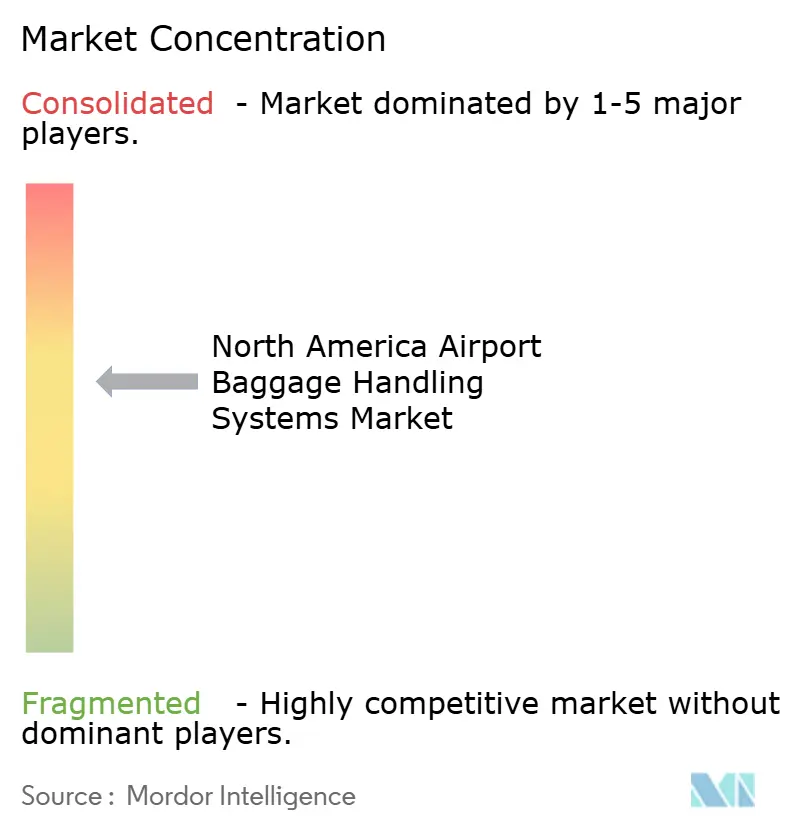
| Market Concentration | Medium |
Major Players *Disclaimer: Major Players sorted in no particular order Image © Mordor Intelligence. Reuse requires attribution under CC BY 4.0. | |
North America Airport Baggage Handling Systems Market Analysis by Mordor Intelligence
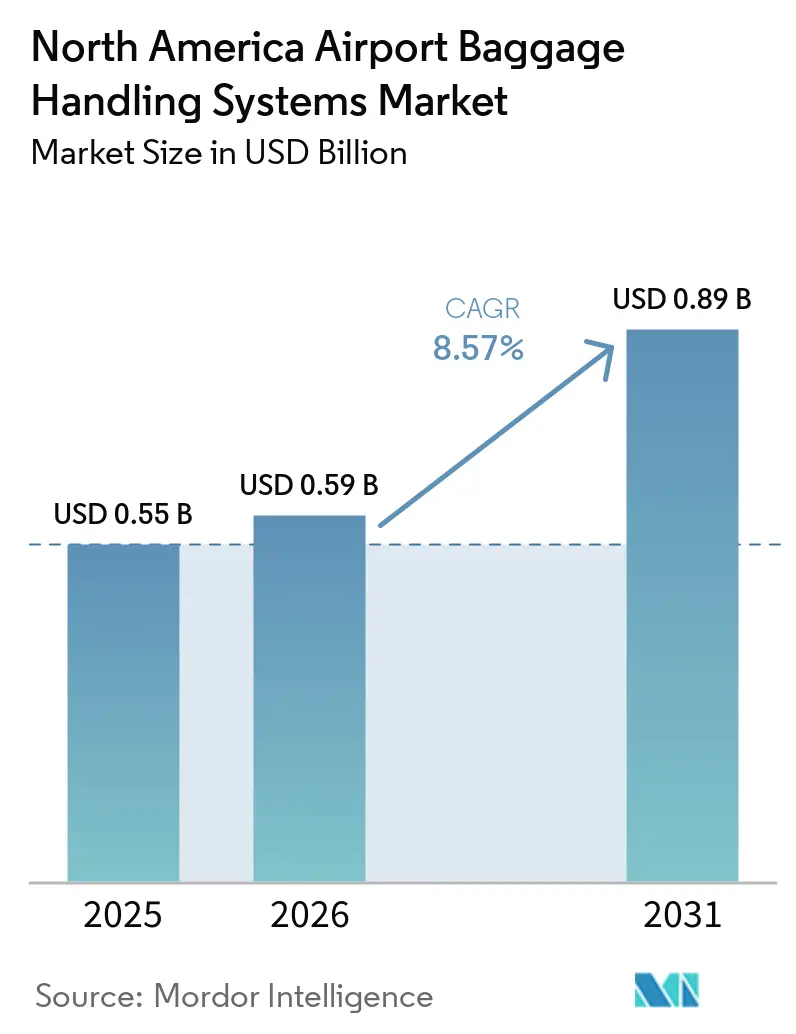
The North America airport baggage handling systems market size was valued at USD 0.55 billion in 2025 and is estimated to grow from USD 0.59 billion in 2026 to USD 0.89 billion by 2031, at an 8.57% CAGR during the forecast period. Airport modernization, security screening rules, and baggage tracking requirements support investment across the region. Federal airport grants in the US and large capital programs in Canada provide operators with a means to fund terminal and baggage upgrades. These programs also favor suppliers that can link sorting equipment, screening equipment, controls, and service support. The North America airport baggage handling systems market is less dependent on short-term passenger volumes because many projects are driven by security and tracking requirements. High retrofit costs and cybersecurity concerns still delay decisions at smaller airports.
Key Report Takeaways
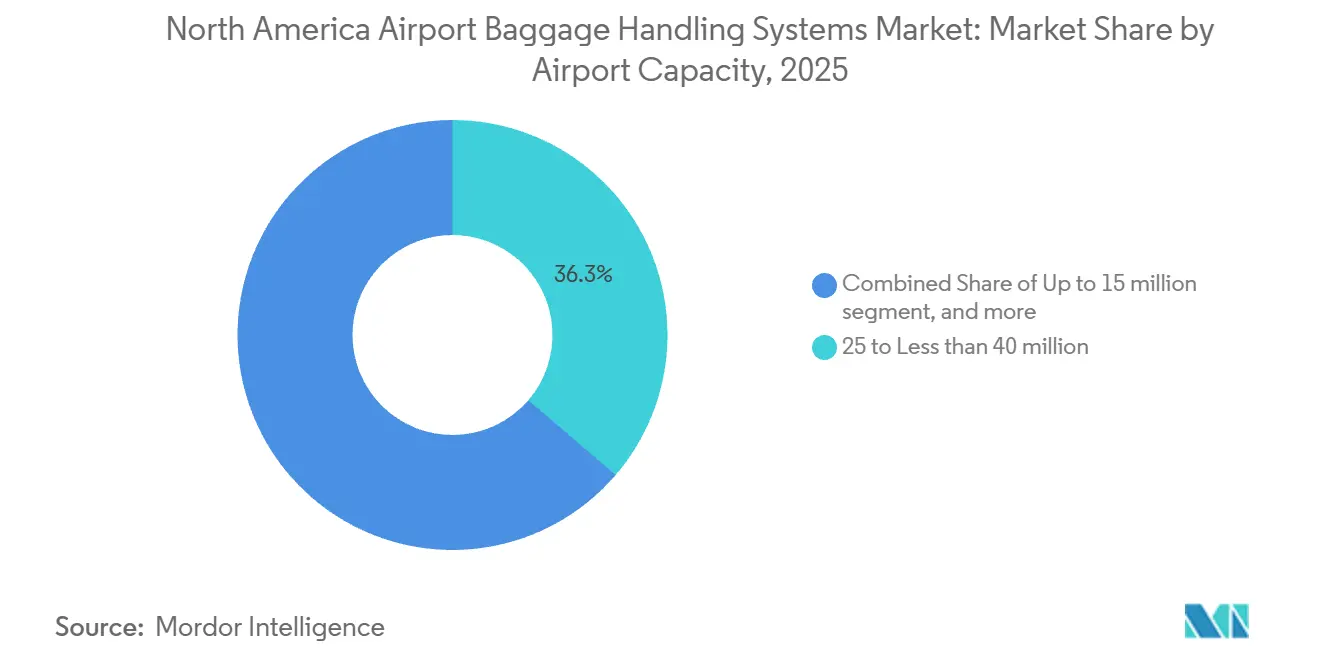
- By airport capacity, the 25 to less than 40 million-passenger tier accounted for 35.65% of market share in 2025 and is projected to grow at an 11.49% CAGR through 2031.
- By solution, conveying and sorting systems accounted for 38.91% of the market share in 2025, while tracking and tracing is projected to grow at a 12.72% CAGR through 2031.
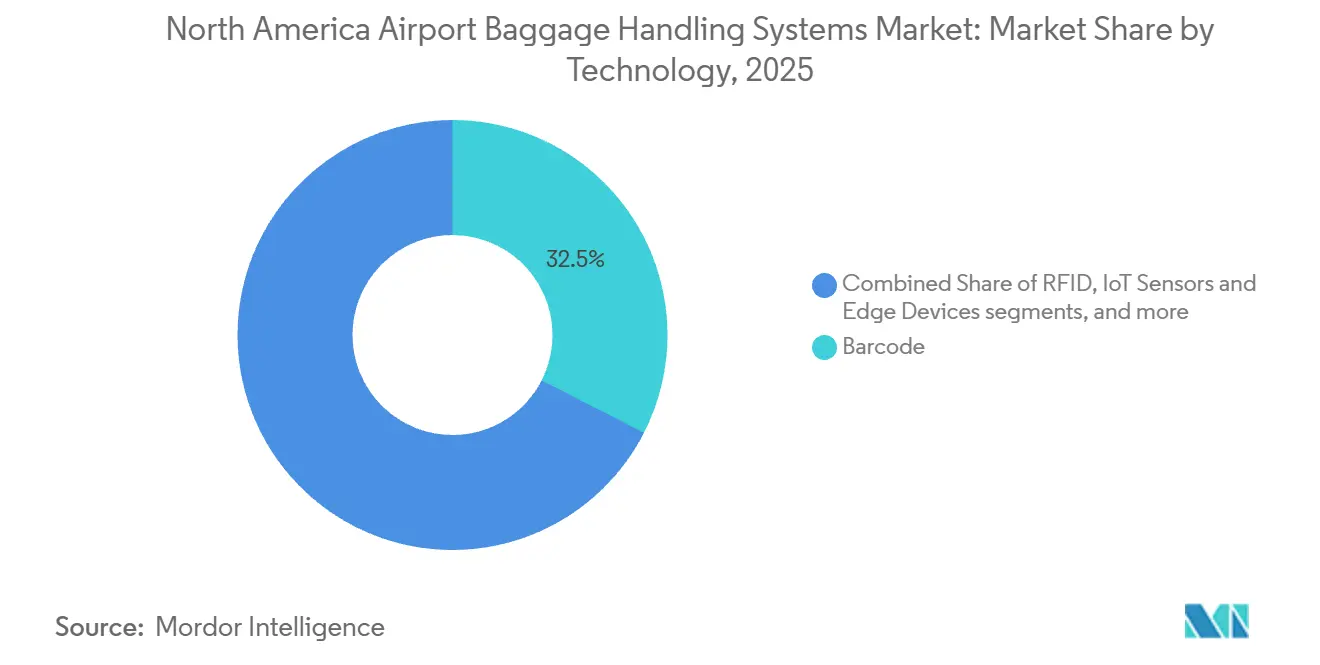
- By technology, barcode scanning accounted for 32.51% of the North America airport baggage handling systems market size in 2025, while AI/ML software is forecast to grow at a 13.49% CAGR through 2031.
- By system type, conveyor belt systems held 48.18% revenue share in 2025, while tote-based and individual carrier systems (ICS) are projected to grow at an 11.11% CAGR through 2031.
- By geography, the United States held 79.29% of revenue in 2025, while Canada is forecast to grow at an 11.22% CAGR through 2031.
Note: Market size and forecast figures in this report are generated using Mordor Intelligence’s proprietary estimation framework, updated with the latest available data and insights as of January 2026.
Market Trends and Insights
Drivers Impact Analysis of North America Airport Baggage Handling Systems Market*
| Driver | (~) % Impact on CAGR Forecast | Geographic Relevance | Impact Timeline |
|---|---|---|---|
| Acceleration of airport modernization and capacity expansion programs | +2.50% | US primary airports, Canadian major hubs, and Mexico City gateways | Long term (≥ 4 years) |
| Regulatory compliance with IATA Resolution driving RFID-based tracking adoption | +1.80% | Major Americas airports handling more than 25 million passengers | Short term (≤ 2 years) |
| Recovery in air passenger traffic driving higher baggage throughput demand | +1.40% | North America, strongest at US international and Canadian major hubs | Medium term (2-4 years) |
| Increasing use of automation and AI to reduce mishandled baggage rates | +1.30% | Major US and Canadian hubs with data infrastructure | Medium term (2-4 years) |
| TSA mandates for CT-EDS integration driving baggage system upgrades | +1.20% | US airports with in-line CBIS configurations | Short term (≤ 2 years) |
| Rising emphasis on climate-resilient baggage handling system design | +0.30% | US Southwest, northern Canadian terminals, and Mexico City | Long term (≥ 4 years) |
| Source: Mordor Intelligence | |||
Acceleration of Airport Modernization and Capacity Expansion Programs
The North America airport baggage handling systems market benefits from major terminal programs that combine capacity additions with the replacement of aging baggage equipment. The FAA states that Airport Infrastructure Grant funding under the Infrastructure Investment and Jobs Act totals USD 14.5 billion from FY2022 through FY2026, including a final USD 2.9 billion installment in FY2026.[1] The Airport Terminal Program provided USD 5 billion for terminal development during the same period. ACI-NA estimated that US airports required USD 173.9 billion in infrastructure investment over 5 years, which highlights the funding gap facing many operators. Large projects can support multi-year procurement plans for conveyance, sortation, screening interfaces, controls, and maintenance services. The uneven availability of grants also separates better-funded primary airports from smaller facilities that must sequence their projects. Procurement at larger airports can combine baggage work with terminal, gate, and security changes. This gives integrators scope to coordinate interfaces across several operating areas. Smaller operators are more likely to separate upgrades into limited phases. The North America airport baggage handling systems market consequently includes both large replacement programs and smaller modernization packages. Each type requires planning that protects daily airport operations.
Regulatory Compliance with IATA Resolution 753 Driving RFID-Based Tracking Adoption
IATA Resolution 753 requires baggage monitoring at a minimum of 4 custody-transfer points, placing tracking performance at the center of airport and airline requirements. IATA reported that 60% of airlines in the region had implemented the resolution in 2024, while 75% of airports worldwide had the required capability.[2] These results make a case for retrofits where airports need better custody data but cannot replace an entire sorting system. The North America airport baggage handling systems market, therefore, includes a growing software and sensor layer alongside physical equipment. Compliance targets through 2027 give airports a defined period for implementation and testing. Airlines also need dependable data at handoff points, so airport equipment must work with carrier processes. This makes system compatibility relevant when selecting a vendor. A tracking deployment can include readers, software, message links, and procedures for exception handling. The market benefits from this layered investment model. It permits upgrades at airports that do not have immediate plans to change core conveyors.
TSA Mandates for CT-EDS Integration Driving Baggage System Upgrades
TSA requirements make baggage screening upgrades a direct driver of changes to in-line baggage infrastructure at US airports. Airports using in-line checked baggage inspection systems must meet TSA planning and design standards when integrating screening equipment into the baggage system. A screening equipment refresh can consequently require changes to conveyor layouts, sorting connections, control systems, and baggage routing. FAA guidance also allows IIJA funds to be used for EDS acquisition and installation when TSA cannot provide near-term funding. This connection between security cycles and baggage equipment spending supports demand even when an airport does not plan a full terminal expansion. It also means baggage engineers must coordinate closely with screening planners early in the project. Airports cannot treat screening and conveyance as unrelated capital items in an in-line configuration. The North America airport baggage handling systems market benefits from this required coordination. Suppliers with established TSA design experience can reduce the risk of late changes. Regional airports may use eligible grant funding to begin work that they would otherwise defer.
Increasing Use of Automation and AI to Reduce Mishandled Baggage Rates
Automation investment responds to measurable costs from bags that do not arrive as planned. SITA reported that mishandled baggage fell 23% in 2025, but 24 million bags were still mishandled, and the annual cost reached USD 6.3 billion. IATA launched its Global Baggage Roadmap in 2025, which covers electronic bag tags, GPS tracking, robotics, and API-based messaging. A 2025 Scientific Reports study found that a YOLOv8-based system could detect baggage anomalies on conveyor systems in real time without reducing throughput. These tools help operators identify routing issues and develop more responsive handling rules. Predictive routing is particularly relevant because transfer failures represented 39% of mishandling incidents in 2025. Software can draw on flight status and baggage location information before making a transfer decision. This can improve the timing of sortation and staging. The North America airport baggage handling systems market can therefore add operational value through upgrades that do not require new terminals. Airlines also have a clear reason to support tools that reduce the cost of exceptions. These applications link equipment performance with passenger service outcomes.
Restraints Impact Analysis of North America Airport Baggage Handling Systems Market*
| Restraint | (~) % Impact on CAGR Forecast | Geographic Relevance | Impact Timeline |
|---|---|---|---|
| High capital investment requirements for large-scale baggage system retrofits | -1.20% | US regional and smaller Canadian airports without direct grant access | Medium term (2-4 years) |
| Integration complexity with legacy baggage handling infrastructure | -0.90% | Older US facilities, Canadian hub brownfields, and Mexico City | Short term (≤ 2 years) |
| Component cost volatility linked to tariffs and import dependencies | -0.80% | Regional supply chains, especially fixed-price US contracts | Medium term (2-4 years) |
| Cybersecurity risks associated with connected and IoT-enabled baggage systems | -0.70% | Major US international hubs and Canadian primary airports | Long term (≥ 4 years) |
| Source: Mordor Intelligence | |||
High Capital Investment Requirements for Large-Scale Baggage System Retrofits
Brownfield baggage projects require work around live flight operations, phased cutovers, structural changes, and interfaces with security systems. These conditions increase both project duration and project cost when compared with a greenfield installation. ACI-NA reported that the Airport Terminal Program was oversubscribed by a factor of 10 and ended in FY2026. Smaller airports may therefore face TSA and IATA compliance obligations without a comparable grant source. The North America airport baggage handling systems market has responded through modular systems that can be installed in stages. This approach can defer a full replacement, but it can also lengthen the period between early planning and a final system contract. Legacy layouts add another constraint because new equipment must operate with existing conveyors, controls, and terminal space. A live airport cannot simply stop baggage processing while a replacement is installed. Operators must arrange testing, cutovers, and fallback procedures around airline schedules. This raises the importance of detailed engineering and experienced installation teams. The North America airport baggage handling systems market continues to require retrofit-specific services as well as new equipment. Phased projects can manage risk, but they can require several procurement decisions over time.
Cybersecurity Risks Associated with Connected and IoT-Enabled Baggage Systems
Connected baggage equipment expands the operational benefits of tracking, remote monitoring, and predictive maintenance, but it also creates more security exposure. A 2026 Journal of Transportation Security study documented ransomware attacks affecting check-in, baggage, and airport operational systems during 2024 and 2025. The study identified the Seattle-Tacoma Airport incident as an example where disruption affected baggage operations and caused material delays. A related 2025 study found that IoT devices in baggage halls can create paths from poorly monitored endpoints into operational technology networks. Airports are consequently placing greater weight on controls that separate operating systems and manage access. This requirement can slow deployment, but it also creates a clearer role for suppliers that can address cybersecurity in their designs. Baggage control equipment was built for reliable operation, so security changes need careful treatment. Airports must protect access without creating unplanned interruptions to essential systems. This affects the design review for connected sensors, software, and remote support tools. The North America airport baggage handling systems market has a growing need for designs that incorporate operational technology security from the start. It also favors clear responsibility between airport teams and equipment providers.
*Our forecasts treat driver/restraint impacts as directional, not additive. The impact forecasts reflect baseline growth, mix effects, and variable interactions.
North America Airport Baggage Handling Systems Market Segment Analysis
By Airport Capacity:
Mid-Tier Hubs Anchor the Modernization CycleThe 25 to less than 40 million-passenger tier accounted for 35.65% of the North American airport baggage handling systems market in 2025. These airports are large enough to justify in-line screening and automated sortation, yet they often face the limits of existing terminal footprints. TSA-checked baggage inspection system requirements and IATA tracking rules shape their investment decisions. Toronto Pearson and Montréal-Trudeau fall within or near this capacity range and have active programs that include baggage infrastructure. The above-40-million-passenger tier produces the highest single-contract values because major hubs require large, complex system designs. These facilities have many airline connections and a large number of transfer bags. Their equipment must support simultaneous throughput, screening, storage, and operational continuity. Many of these airports have already upgraded core equipment over the past decade and now add layers of technology to their established equipment.
The up to 15 million and 15 to less than 25 million passenger tiers offer distinct routes to growth for the North America airport baggage handling systems market. Smaller airports are reviewing modular, individual-carrier systems as an alternative to conventional conveyor systems. This supports phased investment when a full terminal reconstruction is not affordable. The input draft identified Grand Rapids Gerald R. Ford International Airport as an early adopter that integrated individual carrier totes with self-bag drop using common-use kiosk infrastructure. Smaller Canadian airports also installed equipment in 2025, including new baggage systems at Charlottetown and Saint John. These examples show that modernization extends beyond the largest hubs, although the project scale is lower and funding decisions are more constrained. The market includes work that improves reliability and passenger processing at these airports. Projects may focus on a single baggage belt, a small sorting area, or a self-service connection. The commercial value is lower than at a major hub, but the number of facilities broadens the addressable base.

By Solution:
Tracking and Tracing Pulls Spend Above the Conveyance LayerTracking and tracing is the fastest-growing solution category, with a projected 12.72% CAGR through 2031. Resolution 753, carrier pressure to reduce mishandling costs, and the wider availability of RFID and analytics platforms support this demand. Tracking is increasingly purchased as a data layer that can work with an existing conveyor or sorter. This lets an airport improve compliance without replacing the underlying system. It also supports a more measured investment decision when space or funding is limited. Airports can prioritize visibility at critical transfer points before considering mechanical changes. The North America airport baggage handling systems market, therefore, serves airports that need compliance improvements as well as airports undertaking complete modernization. IATA's 2025 roadmap treats electronic bag tags, GPS tracking, and API-based messaging as a separate development path from physical sorting technology.
Conveying and sorting systems remain the operational backbone of the North America airport baggage handling systems market, with a 38.91% market share. Their replacement is tied to screening equipment life cycles, terminal capacity additions, and the condition of current equipment. Security screening systems benefit from continued integration of CT-EDS, while early baggage storage becomes increasingly important as self-service bag drop changes the timing of bag arrivals. Reclaim and unloading equipment is also receiving attention for robotic assistance, particularly in labor-intensive and peak-period operations. Check-in and ticketing systems are increasingly linked with self-service and biometric processes. SITA reported that 66% of airlines offered automated bag drop, while 16% planned to do so by 2027.
By Technology:
Barcode Scale Coexists With AI/ML Software MomentumBarcode scanning accounted for 32.51% of technology revenue in 2025, reflecting its broad installed base at domestic-route airports. IATA reported that optical barcode systems were in operation at 73% of airports worldwide in 2024. The cost of replacing existing scanning equipment keeps barcode systems in use at airports without a major funding package. AI/ML software is the fastest-growing technology category at a 13.49% CAGR through 2031. It can be added to existing systems to support predictive sortation, anomaly detection, and bag staging when flight plans change. The North America airport baggage handling systems industry benefits because this software approach does not always require new physical equipment.
RFID adoption continues at major airports, where IATA reported that 54% of global facilities had implemented the technology in 2024. IoT sensors and edge devices are being evaluated with existing control systems to improve equipment visibility. Robotics and autonomous vehicles remain less mature, but airport operators are moving selected applications from pilots to limited deployments. Automated loaders and baggage vehicles are most useful where labor costs and peak-hour volume fluctuations create operational pressure. IATA included robotics as a core part of its 2025 baggage roadmap. The resulting technology mix allows airports to make targeted upgrades rather than adopt one replacement method across all operations. Existing barcode infrastructure can continue to operate while airports add RFID at selected points. Software can then use information from both systems to improve decision-making. This staged approach reflects the differing funding positions of airports across the region. The North America airport baggage handling systems market supports this gradual transition because its equipment and software can be deployed in several combinations.
By System Type:
Conveyor Belt Systems Face Growing Individual Carrier System CompetitionConveyor belt systems led with 48.18% of revenue in 2025, supported by a broad installed base and established service networks at US hubs. Replacing a large conveyor system is often a multiyear program because it is embedded in terminal layouts and operating routines. Tote-based and individual carrier systems are forecast to grow at a 11.11% CAGR through 2031. Canadian capital programs provide reference cases for individual carrier systems at Toronto Pearson, Calgary, Ottawa, and Montréal-Trudeau. Tilt-tray and cross-belt sorters remain relevant for medium-throughput requirements.
Leonardo's 2025 contracts at Houston Hobby and Melbourne Orlando use cross-belt baggage systems, indicating continued demand for this design. Destination-coded vehicle systems continue to serve high-volume hubs and long inter-terminal routes.[3] Hybrid systems are useful when a project must connect a new carrier- or vehicle-based element to an existing conveyor footprint. This range of architectures gives airports a choice between a full transition and phased modernization. Airport managers can assess each option against available space, screening requirements, and future traffic needs. Conventional systems remain practical where existing networks are in good condition. Carrier and vehicle-based systems become more relevant where tracking accuracy and layout efficiency are priority outcomes. The North America airport baggage handling systems market, therefore, has no single replacement path across all airport types.
Geography Analysis
United States Airport Baggage Handling Systems Market
The US accounted for 79.29% of the North America airport baggage handling systems market in 2025. A large network of major hubs supports its position, TSA's 100% baggage-screening requirement, and access to federal airport programs. The FY2026 Airport Infrastructure Grant installment was USD 2.9 billion, supporting another round of airport investment before the program's funding concludes. Austin-Bergstrom awarded BEUMER a contract of up to USD 320 million in July 2025 for an integrated baggage system across its terminal and concourse program. The TSA planning and design framework creates a consistent need for in-line screening integration at primary airports. This creates a stable base of compliance work alongside capacity-led development. US airport operators also have a wide range of facility ages and layouts. That diversity produces demand for both replacement systems and specialized retrofit work. The North America airport baggage handling systems market has its largest revenue base in the US for these reasons.
Canada Airport Baggage Handling Systems Market
Canada is the fastest-growing national segment at an 11.22% CAGR through 2031. Toronto Pearson began the first phase of its Pearson LIFT program in May 2026, with CAD 3 billion (USD 2.17 billion) allocated to airside and baggage systems, 30 kilometers of baggage infrastructure, carousels, and sensor systems. Pearson then announced a CAD 1.5 billion (USD 1.07 billion) terminal revitalization program in July 2026, including improved baggage processing.
Mexico Airport Baggage Handling Systems Market
Mexico has the smallest national share, but airport renovations and future capacity plans sustain a pipeline for baggage equipment. Mexico City International Airport had invested in its renovation program by early 2026. The program includes baggage carousels, security inspection lines, and X-ray equipment. AIFA plans to reach 20 million passengers by 2032 and up to 85 million by 2052, which would require successive additions to baggage capacity. Mexico, therefore, offers lower near-term spending than the US or Canada, but it has a longer time horizon for new infrastructure.
Regulatory Landscape
In the US, the regulatory baseline for baggage handling systems is set by the federal requirement to screen 100% of passenger checked baggage for explosives (49 USC 44901). This requirement drives the integration of the in-line Checked Baggage Inspection System (CBIS) into conveyors, sortation, and controls. The Transportation Security Administration (TSA) operationalizes the approach through its Electronic Baggage Screening Program (EBSP) and the Planning Guidelines and Design Standards (PGDS) v8.0, which cover design submittals, equipment qualification, and acceptance testing. In practice, early TSA coordination becomes a gating item for major retrofits and new terminal programs.
In Canada, Transport Canada regulates civil aviation security, while the Canadian Air Transport Security Authority (CATSA) delivers screening operations at 89 designated airports. Under the Canadian Aviation Security Regulations, 2012 (CASR), aerodrome operators must obtain CATSA agreement for changes to baggage handling systems that affect screening operations. This reinforces controlled change management for brownfield upgrades. Transport Canada also maintains an Aviation Security Oversight Program for FY 2025-2026, with inspector-led reviews and testing, keeping screening-driven design compliance central to baggage system approvals and commissioning.
Value Chain Analysis
The value chain starts with airport operators and authorities defining the project scope, including capacity, reliability, screening integration, and tracking requirements. It then moves through concept and detailed design, aligned with TSA PGDS v8.0 for CBIS in the US and with CATSA and Transport Canada requirements in Canada. Prime systems integrators and OEMs such as Vanderlande, Daifuku, BEUMER, and Leonardo package conveyors and sortation (belt, cross-belt, tilt-tray, DCV, tote/ICS), controls, and baggage management software. Specialist contractors and EPC partners (for example, Industrial Constructors/Managers and other local builders) handle installation, civil works, and phased cutovers designed to avoid terminal shutdowns.
Upstream inputs typically include fabricated steel, motors and drives, sensors, PLCs, networking components, and EDS interface hardware, with sourcing strategies shaped by project delivery constraints and public-sector procurement rules. Downstream, commissioning depends on integrated testing across the baggage flow, screening equipment, and legacy interfaces. Bottlenecks most often emerge at the EDS-to-conveyor handoff, software integration, and acceptance testing. After handover, spares, uptime SLAs, cybersecurity hardening, and analytics upgrades take on a larger share of lifetime value as airports seek higher availability and stronger resilience against operational disruption.
Competitive Landscape
The North America airport baggage handling systems market is moderately consolidated among major system integrators. Vanderlande Industries B.V., Daifuku Co., Ltd., and BEUMER Group GmbH & Co. KG hold leading positions due to their installed systems, long-term maintenance, and control software. Their customers value the ability to link equipment integration with operations and maintenance support. Competition also depends on whether a supplier can meet airport requirements for security interfaces, baggage tracking, and operating continuity. The competitive setting supports vendors with proven designs at large hubs as well as local providers serving smaller domestic airports. Long-term service contracts matter because operators need dependable support after commissioning. Established suppliers can use their installed base to pursue upgrades and extensions. New entrants need strong reference projects and local delivery capability to compete. The North America airport baggage handling systems market is competitive, but airport buyers place a high value on proven operating performance.
BEUMER's individual carrier system positions the company in projects where floor area and bag-level tracking are central requirements. Leonardo strengthened its US references in December 2025 through contracts worth more than USD 120 million for Houston Hobby and Melbourne Orlando. Daifuku was selected as the original equipment manufacturer for an American Airlines baggage system upgrade at Chicago O'Hare, covering sortation, early baggage storage, conveyors, and carousels. These projects show that airport customers are continuing to select experienced equipment suppliers for complex upgrades. They also provide vendors with local operating references that can influence future bids. The North America airport baggage handling systems market uses such references to assess performance in comparable terminals and traffic conditions. Vendors can use a completed project to show that their control systems work with airport security and airline operations. Local maintenance coverage remains a practical factor for airports that cannot carry extended periods of disruption.
North America Airport Baggage Handling Systems Industry Leaders
-
Vanderlande Industries B.V.
-
BEUMER Group GmbH & Co. KG
-
Daifuku Co., Ltd.
-
Smiths Group plc
-
Rapiscan Systems, Inc.
- *Disclaimer: Major Players sorted in no particular order
North America Airport Baggage Handling Systems Market Companies Covered in this Report
- Vanderlande Industries B.V.
- Daifuku Co., Ltd.
- BEUMER Group GmbH & Co. KG
- Alstef Group SAS
- Fives SAS
- G&S Airport Conveyor
- Pteris Global Limited
- Logplan LLC
- Ansir Systems
- SITA N.V.
- Smiths Group plc
- Leonardo S.p.A.
- Rapiscan Systems, Inc.
- ADB SAFEGATE
Read Analysis of North America Airport Baggage Handling Systems Companies
Market Opportunities and Future Outlook
Near-term whitespace is concentrated in multi-year terminal rebuilds and hub optimization programs that incorporate new CBIS layouts, centralized sortation, and higher-redundancy architectures, rather than relying on incremental belt swaps. A recent project signal is the Greater Toronto Airports Authority, which broke ground on the CA$3 billion Pearson LIFT program in May 2026. The scope includes rebuilding more than 30 km of baggage belts across Terminals 1 and 3 to lift peak sorting capacity. In the United States, brownfield upgrades tied to airline and terminal programs continue to open competitive lanes for integrators that can execute phased commissioning while keeping operations in service, including contract activity at Denver International Airport and other large hubs.
Technology-driven opportunities are clustering around tracking and data orchestration layered onto core conveyance, using IATA Resolution 753 processes and high-read-rate RFID to reduce mishandled-bag costs and improve transfer reliability. Delta Air Lines' reported performance data, 99.9% RFID tracking accuracy across 344 airports and a 37% reduction in mishandled cases, provides a benchmark that airports and airlines can reference when building tracking retrofits and software upgrade justifications. Security and resilience requirements also support demand for integrated screening layouts, cybersecurity controls, and faster recovery designs, particularly after operationally disruptive incidents such as the 2024 ransomware event at Seattle-Tacoma that forced manual processing and increased scrutiny of connected baggage networks.
Recent Industry Developments in North America Airport Baggage Handling Systems Market
- May 2026: Daifuku received a contract for Tampa International Airport covering a new Centralized Checked Baggage System (CCBS) and the Airside D Baggage Handling System project. The award strengthens Daifuku's position in large, TSA-integrated programs, where in-line screening, controls, and staged cutovers are critical to maintaining operations during construction.
- February 2026: Vanderlande completed the acquisition of Siemens Logistics in the US, expanding its local baggage and cargo handling capabilities. The acquisition deepens in-region engineering and service capacity and reinforces consolidation among large systems integrators competing for multi-airport, multi-year modernization scopes.
- March 2025: Daifuku, working with Industrial Constructors/Managers, Inc., secured a USD 12 million contract to upgrade and expand American Airlines' baggage handling system in Terminal 3 at Chicago O'Hare International Airport. The project highlights sustained airline-driven retrofit demand in constrained terminals, where new screening interfaces and higher throughput must be delivered without extended downtime.
North America Airport Baggage Handling Systems Market Report Scope and Research Methodology
Market Definition and Coverage
This market covers the value of airport baggage handling systems used to move, screen, sort, track, and reclaim passenger bags from check-in through arrival within North America, including the core equipment and related software that enables automated baggage flow.
Scope exclusions: Manual-only baggage handling tools and cargo or freight handling systems are excluded from this sizing.
Segments Covered in This Report
- By Airport Capacity
- Up to 15 million
- 15 to Less than 25 million
- 25 to Less than 40 million
- Above 40 million
- By Solution
- Check-In and Ticketing Systems
- Security Screening Systems
- Conveying and Sorting Systems
- Early Baggage Storage (EBS)
- Baggage Reclaim/Unloading
- Tracking and Tracing
- By Technology
- Barcode
- RFID
- IoT Sensors and Edge Devices
- Robotics and Autonomous Vehicles (AVs)
- AI/ML Software
- By System Type
- Conveyor Belt Systems
- Tilt-Tray and Cross-Belt Sorters
- Destination-Coded Vehicle (DCV)
- Tote-based/Individual Carrier Systems (ICS)
- Hybrid and Other Emerging Systems
- By Geography
- United States
- Canada
- Mexico
Data Sources, Market Sizing, and Validation
Desk Research
Desk research was used to set the demand context for North American airports and to build sanity checks around volumes and investment cycles. We referred to public aviation statistics and planning guidance such as FAA airport programs, TSA screening and security updates, Transport Canada aviation publications, and materials from airport councils such as ACI North America. To keep the model grounded, baggage volume indicators were also cross-checked using airport-level traffic releases, annual reports, and disclosures from airport authorities.
On the supply side, system-level cues were collected from public company filings, investor presentations, and procurement announcements, and then matched with trade and customs reporting where relevant for major equipment categories. In parallel, patent databases were reviewed to understand which baggage tracking and automation technologies are moving from trials into deployments, which helped set realistic adoption curves. The sources listed above are illustrative and not exhaustive, and many other public references were also used for data collection, validation, and clarification during the study.
Primary Interviews and Surveys
Primary interviews and surveys focused on confirming what airports are actually buying and upgrading, and how project phasing translates into annual spending in the United States, Canada, and Mexico. We spoke with a mix of airport operations teams, engineering and maintenance leaders, system integrators, and component suppliers, which helped refine retrofit timing, pricing ranges, and the split between equipment and software.
Distribution of primary research fieldwork respondents
| Company type | Respondent position |
|---|---|
| Top tier: 28% | CXOs: 12% |
| Mid tier: 53% | Functional/Unit leaders: 33% |
| Smaller Players: 19% | Managers: 55% |
Market-Sizing & Forecasting
Sizing starts with a top-down approach where airport passenger throughput and checked-bag intensity are translated into baggage flow requirements, which then inform the timing and value of system upgrades and new installations across North America. Once that demand pool is formed, results are corroborated with selective bottom-up approximations, such as sampled project values by airport size, typical system spend per baggage line or sorter, and channel checks on replacement and modernization cycles.
Key inputs used in the model include passenger traffic growth, share of connecting passengers (which changes transfer-bag volumes), baggage screening capacity needs tied to security norms, terminal expansion and gate capacity additions, and the refresh cycle of conveyors, sorters, and controls. When these signals align, the spending curve becomes clearer, and the forecast becomes less dependent on one assumption. Forecasting is built using scenario analysis, where the base case is supported by interview consensus on airport capex timing and then adjusted for delays, funding variability, and construction phasing. Where supplier roll-ups are incomplete, gaps are handled by applying airport-capacity based spend ratios and then rechecking totals against known project pipelines and traffic trends.
Data Validation & Update Cycle
Validation is done by comparing outputs against independent signals, including airport capital plans, traffic trends, and publicly announced modernization programs, and then checking that implied spend per passenger stays within realistic bounds. Outliers are reviewed at the airport capacity level, and assumptions are revisited when a variance cannot be explained by project phasing or technology mix.
Before sign-off, findings go through multi-step analyst reviews, and experts are re-contacted when major gaps show up in pricing, adoption timing, or the split between new-build and retrofit demand. The report is refreshed annually, and interim updates are triggered when material events occur, such as large hub expansion approvals or changes in security screening requirements. Right before delivery, we run a final pass so the numbers reflect the most recent public updates.
Mordor Intelligence's North America Airport Baggage Handling Systems Market Size Compared With Other Published Estimates
Published market sizes for airport baggage handling systems can look far apart, even when they appear to cover the same airports. The differences usually come from how each source treats equipment versus software and services, which year is used as the base, and how multi-year retrofit projects are spread into annual revenue.
The largest gaps typically show up when a broader airport baggage handling spend gets blended in with system installations, or when an aggressive retrofit cycle is assumed across all major hubs. Currency timing and whether values are reported as shipments, installed value, or contract awards can also shift the headline number.
Benchmark comparison
| Source | Market Size | Gaps in Research Methodology |
|---|---|---|
| Mordor Intelligence | USD 0.79 B (2025) | |
| Regional Consultancy A | USD 0.48 B (2023) | Uses an earlier base year and may focus on a narrower equipment capture that undercounts large modernization waves, especially when software and integration are separated or reported outside the core system value. |
| Industry Publisher B | USD 2.97 B (2023) | Often reflects a wider airport baggage handling spend that can include services and adjacent handling activities beyond passenger baggage system installations, which lifts totals versus equipment-plus-core-software sizing. |
The table points to scope and base-year effects as the main reasons for the spread. In Mordor Intelligence's model, only passenger-baggage handling systems from check-in through reclaim in North America are counted, with manual-only tools and cargo handling kept outside the scope. Once these boundaries are applied, remaining differences are mostly explained by how quickly retrofit cycles are assumed and how project phasing is converted into yearly revenue. This makes the final number easier to trace back to airport traffic, baggage flow needs, and observable upgrade programs.
Key Questions Answered in the Report
What is driving spending on airport baggage handling systems in North America?
Terminal modernization, TSA screening requirements, and IATA baggage tracking rules are supporting investment. The regional value is forecast to reach USD 0.89 billion by 2031.
Which airport capacity segment held the largest share in 2025?
Airports handling 25 to less than 40 million passengers held 35.65% of revenue in 2025.
What is the fastest-growing baggage handling solution?
Tracking and tracing is forecast to grow at a 12.72% CAGR through 2031, supported by Resolution 753 and efforts to reduce mishandled baggage.
Why are individual carrier systems gaining attention?
Individual carrier systems (ICS) offer modular deployment, reduced floor-space needs, and bag-level tracking, which helps airports modernize within constrained terminals.
Which country is growing fastest in North America?
Canada is forecast to grow at an 11.22% CAGR through 2031, supported by large programs at Toronto Pearson and Montréal-Trudeau.
What risks affect airport baggage system modernization?
High costs for brownfield retrofits, legacy-system integration, component costs, and cybersecurity risks can delay projects.