
Market Overview
| Study Period | 2020 - 2031 |
|---|---|
| Forecast Data Period | 2026 - 2031 |
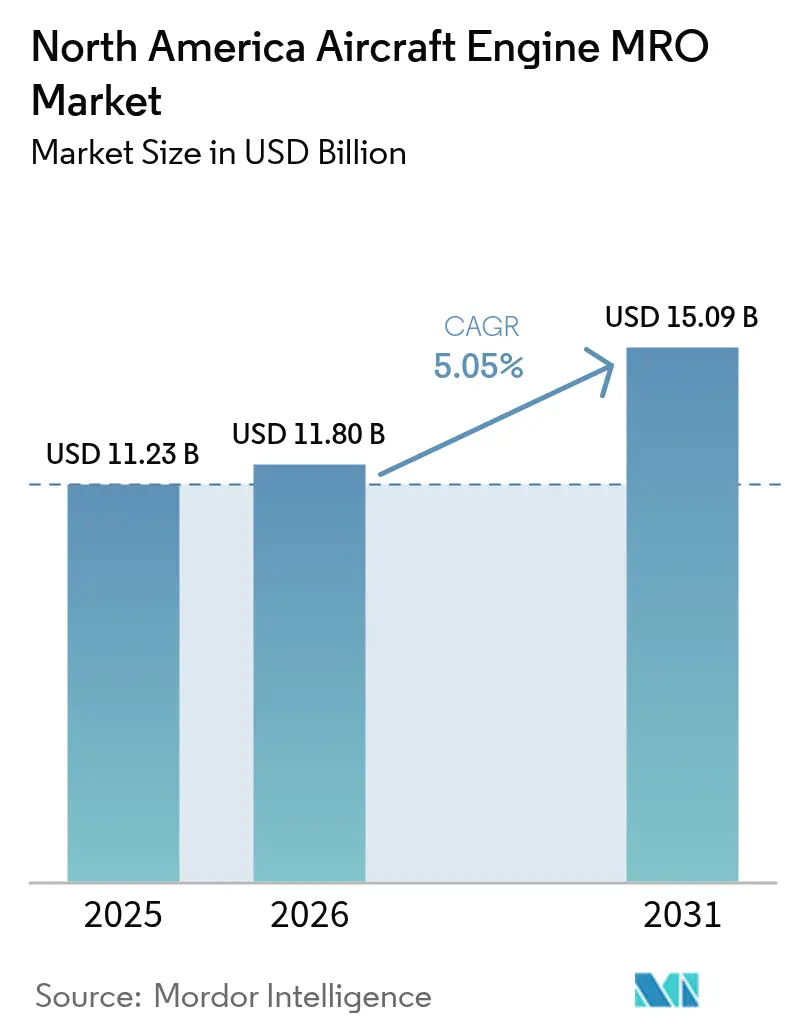
| Base Year Market Size (2025) | USD 11.23 Billion |
| Market Size (2026) | USD 11.8 Billion |
| Market Size (2031) | USD 15.09 Billion |
| Growth Rate (2026 - 2031) | 5.05 % |
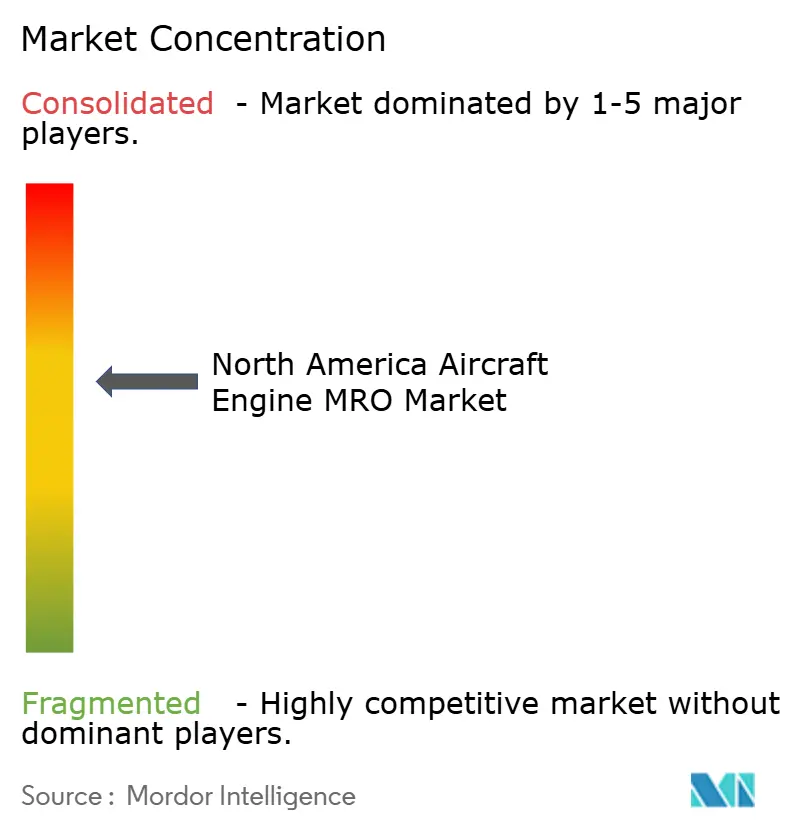
| Market Concentration | Medium |
Major Players *Disclaimer: Major Players sorted in no particular order Image © Mordor Intelligence. Reuse requires attribution under CC BY 4.0. | |
North America Aircraft Engine MRO Market Analysis by Mordor Intelligence
The North America aircraft engine MRO market size was valued at USD 11.23 billion in 2025 and estimated to grow from USD 11.8 billion in 2026 to reach USD 15.09 billion by 2031, at a CAGR of 5.05% during the forecast period (2026-2031). Early-life durability challenges in LEAP and GTF programs, combined with heavy-maintenance cycles for aging CFM56 and V2500 fleets, and tightening FAA and ICAO emissions rules, are contributing to increased shop visit volumes. Supply chain delays for life-limited parts, however, are stretching turnaround times to 90 to 120 days, which limits capacity even as demand climbs. OEM control of proprietary data is tilting competitive power toward affiliated shops, while nearshoring trends are drawing new facilities to Mexico. Technician shortages and weather-related unscheduled inspections further complicate operational planning for airlines and MROs.
Key Report Takeaways
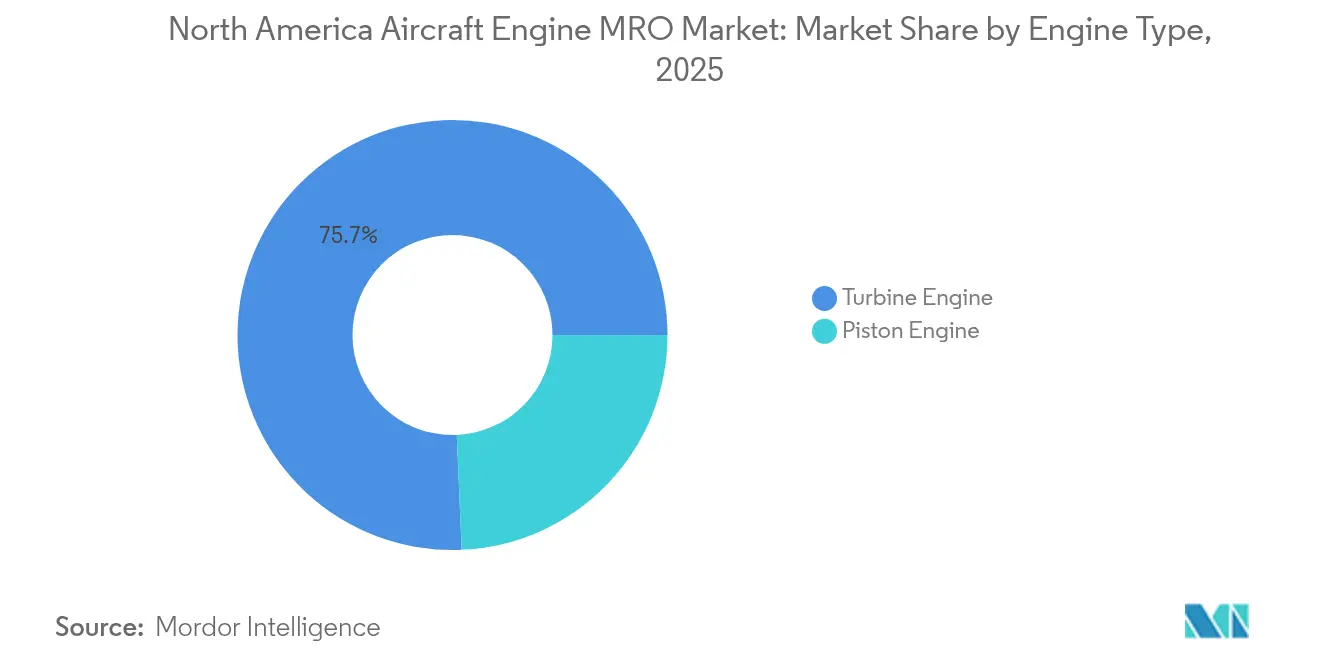
- By engine type, turbine powerplants led with 75.68% of the North America aircraft engine MRO market share in 2025, while piston-engine work remains marginal.
- By aviation segment, commercial aircraft generated 63.25% of 2025 revenue, while UAVs are forecasted to expand at a 7.3% CAGR through 2031.
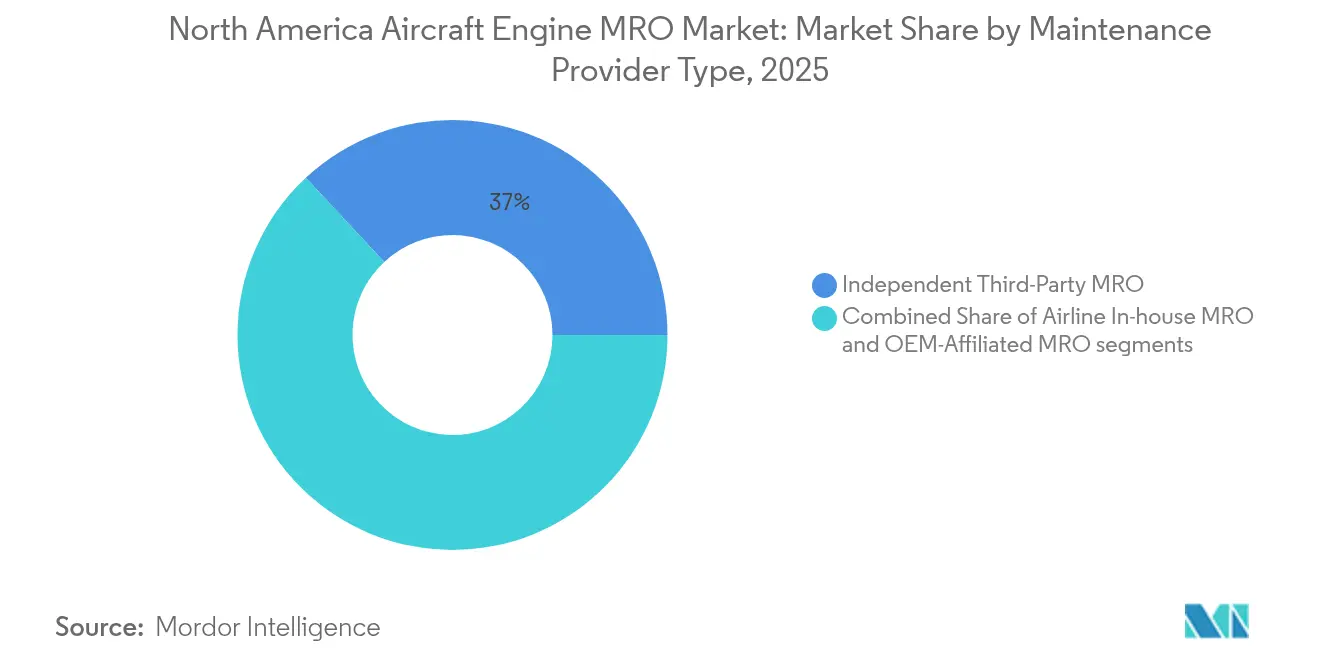
- By maintenance provider, independent third-party shops held 36.95% of 2025 revenue, and OEM-affiliated facilities are projected to grow at a 5.63% CAGR to 2031.
- By geography, the United States accounted for 85.74% of 2025 spending, while Mexico is advancing at a 6.18% CAGR, the fastest rate in the region.
Note: Market size and forecast figures in this report are generated using Mordor Intelligence’s proprietary estimation framework, updated with the latest available data and insights as of 2026.
North America Aircraft Engine MRO Market Trends and Insights
Drivers Impact Analysis*
| Driver | (~) % Impact on CAGR Forecast | Geographic Relevance | Impact Timeline |
|---|---|---|---|
| Peak fleet aging driving increased heavy engine maintenance demand | +1.4% | United States, Canada | Medium term (2-4 years) |
| Expansion of OEM open-service agreements enhancing MRO shop accessibility | +0.9% | United States, Mexico | Short term (≤2 years) |
| Stricter FAA and ICAO emissions and noise regulations driving engine retrofit activity | +0.7% | United States, Canada | Long term (≥4 years) |
| Early-life reliability issues in LEAP and GTF engines increasing maintenance visits | +1.2% | United States, Canada, Mexico | Short term (≤2 years) |
| Limited availability of used serviceable material driving engine and module swap-outs | +0.6% | United States | Medium term (2-4 years) |
| Insurance-mandated post-severe weather inspections increasing unscheduled MRO events | +0.4% | US Gulf Coast, Southeast | Short term (≤2 years) |
| Source: Mordor Intelligence | |||
Peak Fleet Aging Driving Increased Heavy Engine Maintenance Demand
More than 3,200 US narrowbody aircraft delivered between 2010 and 2015 are now 12 to 15 years old, a milestone that triggers the first complete overhauls of their CFM56-7B and V2500-A5 engines. Approximately 6,400 power plants are expected to cycle through shops over the next four years, potentially crowding capacity and increasing lease-pool demand. Airlines are also postponing retirements because of OEM delivery delays, which compresses maintenance windows and lifts the strategic value of power-by-the-hour agreements. Larger, vertically integrated MROs can fund both legacy tooling and LEAP/GTF capability, widening the gap with smaller independents. Elevated shop volumes resulting from peak aging will continue to drive turbine-engine work as the main growth driver through 2028.
Expansion of OEM Open Service Agreements Enhancing MRO Shop Accessibility
Pratt & Whitney’s Certified Maintenance Provider program accepts 12 independent shops for PW1000G module work, while maintaining proprietary data control. GE Aerospace’s EngineWise analytics reduce unscheduled removals by 18 to 22%, but require airlines to share operational data that deepens OEM insight into fleet usage.[1] Safran’s modular LEAP repair option reduces the cost of single visits by up to 30% and drives more frequent, lower-value interventions that anchor long-term revenue. These selective partnerships expand geographic coverage and alleviate near-term capacity bottlenecks, directing more traffic into OEM-approved channels and accelerating vertical integration in the aftermarket.
Stricter FAA and ICAO Emissions and Noise Regulations Driving Engine Retrofit Activity
The FAA’s adoption of CORSIA metrics in 2024 requires older CFM56 and V2500 engines to undergo combustor upgrades, costing between USD 800,000 and USD 1.2 million each, to remain compliant.[2] New Annex 16 Chapter 14 noise rules add 180-220 labor hours per engine for acoustic-liner retrofits, further swelling shop workloads. Capital-rich network carriers are pursuing modifications to extend the life of their assets, while regional operators are accelerating fleet renewal, thereby shrinking the resale window for legacy power plants. Retrofit complexity boosts demand for engineering services with DER authority, a niche where seasoned independents can earn premium margins. Regulations, therefore, convert environmental mandates into sustained revenue in the aftermarket.
Early-Life Reliability Issues in LEAP and GTF Engines Increasing Maintenance Visits
Powder-metal contamination in PW1000G turbine disks grounded 600 to 700 engines in 2024 and shortened inspection intervals to 300 flight hours, a 70% reduction from plan. FAA directives on LEAP-1A/-1B ceramic shroud wear cut inspection cycles in half to 1,500 flights. These premature removals push spare-engine lease rates 40 to 50% higher and overwhelm shop bays, prompting airlines to pay premiums for accelerated turnarounds. Independent MROs that can mobilize rapid-response teams capture urgent business despite OEM data constraints. Moreover, the unplanned surge in visits offsets fuel-burn savings promised by new-generation propulsion.
Restraints Impact Analysis*
| Restraint | (~) % Impact on CAGR Forecast | Geographic Relevance | Impact Timeline |
|---|---|---|---|
| Shortage of certified aircraft maintenance technicians increasing turnaround times | −0.5% | Germany, UK, France | Medium term (2-4 years) |
| Supply chain delays in life-limited parts and forged components constraining MRO capacity | −0.7% | France, UK | Short term (≤ 2 years) |
| Rising weather-related engine and nacelle damage increasing maintenance complexity | −0.3% | EU | Long term (≥ 4 years) |
| OEM controlled data access limiting cost competitiveness for independent MROs | −0.4% | Germany, UK, Italy | Medium term (2-4 years) |
| Source: Mordor Intelligence | |||
Shortage of Certified Aircraft Maintenance Technicians Increasing Turnaround Times
Retirements outpaced new FAA A&P certifications three-to-one in 2024, and the workforce is projected to shrink 6% by 2026.[3] Experienced engine specialists now command salaries of USD 85,000 to USD 110,000 in major hubs, 20 to 25% higher than in 2022, which squeezes margins for independents. Training pipelines require 18 to 30 months, so capacity cannot be ramped up quickly when demand spikes. Automation aids parts cleaning and documentation, yet core disassembly and rebuild tasks remain labor-intensive. Persistent staffing gaps lengthen shop cycles and force operators to defer non-critical work, tempering overall market growth despite robust demand.
Supply Chain Delays in Life-Limited Parts and Forged Components Constraining MRO Capacity
Lead times for titanium compressor disks and single-crystal blades doubled to 12-18 months in 2024 due to geopolitical disruptions in raw materials and foundry bottlenecks. Aging CFM56 fleets consume parts faster than reduced-rate production lines can replenish them, idling engines in “dock-awaiting-parts” status. Shops carry larger inventories, tying up working capital and risking obsolescence when fleets retire. Airlines resort to consignment pools or green-time leasing to secure availability, raising maintenance costs. Until supply chains normalize, component scarcity caps throughput, even where labor and bays are available, limiting the market’s near-term upside.
*Our forecasts treat driver/restraint impacts as directional, not additive. The impact forecasts reflect baseline growth, mix effects, and variable interactions.
Segment Analysis
By Engine Type Turbine Dominance Reflects Commercial Fleet Mix
Turbine engines generated 75.68% of the North America aircraft engine MRO market in 2025 and are forecasted to grow at a 5.99% CAGR to 2031. The North America aircraft engine MRO market size for turbine categories is therefore rising faster than overall expenditure, reflecting the heavy concentration of CFM56, LEAP, V2500, and PW1000G powerplants on narrowbody aircraft. High-thrust designs increase inspection frequency for advanced materials such as ceramic matrix composites, driving specialized repair demand that favors facilities with proprietary tooling and OEM data access.
Additive repair of turbine blades, as disclosed by GE Aerospace in 2024, reduces scrap rates and enables affiliated shops to increase throughput. Turboprop and turboshaft engines support regional airlines, offshore energy operations, and emergency medical services, where reliability takes precedence over cost. Piston powerplants serve flight training and general aviation; their more straightforward upkeep keeps most work at fixed-base operators rather than dedicated overhaul centers. Despite utilization gains in general aviation, piston activity accounts for a small portion of the North America aircraft engine MRO market.

By Aviation UAV Emergence Signals Propulsion Diversification
Commercial carriers commanded 63.25% of the North American aircraft engine MRO market in 2025, primarily driven by high-cycle narrowbodies that average 10 to 12 flight hours daily. Widebody engines, although fewer in number, require higher dollar outlays per visit, which balances value across fleet groups. Regional jet work is declining as airlines phase out 50-seat aircraft that no longer meet scope clause economics, trimming demand for PW1500G and CF34 engines within the forecast horizon.
UAVs are expanding at a 7.3% CAGR and represent the fastest-growing slice of the North America aircraft engine MRO market. Military reconnaissance drones currently drive the majority of the volume, but commercial logistics trials by parcel carriers promise new civil demand. MRO infrastructure remains sparse, giving early movers a competitive edge in field support and parts pooling. Military aviation remains significant due to the F-35 Pratt & Whitney F135's sustainment and Rolls-Royce AE 2100's support for C-130J transports, both of which require security-cleared facilities that OEMs typically dominate.
By Maintenance Provider OEM Affiliates Gain Ground
Independent third-party shops held 36.95% of 2025 revenue, but OEM-affiliated networks are advancing at 5.63% CAGR, overtaking independents in new long-term contracts. Control of digital engine health data enables Pratt & Whitney, GE Aerospace, and Safran to bundle analytics, parts, and labor into power-by-the-hour agreements, guaranteeing turnaround slots. Airlines favor budget certainty, even when fixed hourly rates exceed historic time-and-materials cost averages.
Independent providers defend their share by offering flexible pricing and faster slot allocation on legacy engines where data is less restricted. AAR Corp’s additive fan-blade repair, FAA-approved in 2024, shortens lead times from 90 days to 30 days. StandardAero’s August 2024 acquisition of Signature Aviation’s engine division lifted its turbofan throughput by 30%, improving economies of scale. Airline in-house MROs, such as Delta TechOps, leverage fleet proximity to minimize aircraft-on-ground days and increasingly accept third-party work to monetize capacity.
Geography Analysis
The United States accounted for 85.74% of the 2025 revenue in the North America aircraft engine MRO market. The Dallas, Atlanta, Miami, and Cincinnati anchor clusters of extensive facilities with deep supply networks. Peak fleet aging of CFM56 and V2500 engines drives shop bay utilization, while new PW1000G and LEAP reliability issues force airlines to seek rapid module-swap capability. High labor costs prompt some lower-margin work, such as light maintenance on older turboprops, to be outsourced to out-of-state or cross-border shops.
Mexico is rising fastest with a 6.18% CAGR through 2031 and is capturing turbine-component repairs for LEAP engines. Safran’s 2024 opening in Querétaro, along with GE and Pratt & Whitney satellite sites, benefits from skilled labor priced 40 to 50% below US averages. The USMCA pact eases the flow of cross-border parts, allowing Mexican shops to supply US airlines without incurring punitive duties. Universities and technical institutes, funded jointly with industry, graduate A&P-equivalent mechanics who receive bilingual training aligned with FAA Part 147 standards.
Regulatory Landscape
In the United States, aircraft engine maintenance and overhaul activity is governed primarily by FAA rules under 14 CFR Part 43 (maintenance performance and records) and 14 CFR Part 145 (repair station certification, quality systems, and capability listing). Airworthiness Directives (ADs) remain a key near-term compliance driver for engine shops, shaping inspection content, tooling needs, and documentation requirements. For example, the FAA issued AD 2026-07-06 in July 2026, mandating specific ultrasonic inspections for certain Pratt & Whitney engines, which increases inspection workload and scheduling pressure for affected fleets.
In Canada, Transport Canada oversees MRO through the Canadian Aviation Regulations (CARs) and associated standards, including Standard 571 (maintenance requirements) and the Approved Maintenance Organization (AMO) framework. Engine airworthiness standards in Airworthiness Manual Chapter 533 align closely with US 14 CFR Part 33 to support harmonized certification. Canadian programs for alternative intervals or on-condition maintenance require approval under the applicable CARs standards, keeping OEM instructions and regulator-accepted programs central to planning for engine overhaul content, records, and release-to-service across cross-border operations.
Value Chain Analysis
The value chain starts with operators, including commercial, military, general aviation, and UAV fleets, generating demand for scheduled shop visits, LLP replacements, and unscheduled removals. It then moves through induction planning, teardown, inspection, repair or overhaul, test cell runs, and return-to-service. Inputs are dominated by OEM and licensed repair data, life-limited parts, and specialty materials such as forged titanium and single-crystal components, alongside tooling for next-generation engines such as LEAP and PW1000G. Internal and third-party engineering support, including DER-level expertise for certain modifications, also adds cost and time. Material availability and OEM-controlled access to proprietary repairs continue to influence which providers can execute high-value module work and how quickly engines can be released.
Downstream, engines return to airline and lessor pools supported by logistics providers, parts pooling, and increasingly used serviceable material (USM) channels to mitigate long lead times. Recent contract and authorization terms shape throughput, including CFM International and IATA extending open MRO conduct policies for LEAP engines through February 2033 (announced January 2026). Provider agreements also matter at the capacity-node level, such as StandardAero’s March 2026 general terms with AviLease for LEAP and CFM56-7B services. Capability licensing is a related bottleneck, highlighted when Delta TechOps reported in March 2026 that it had achieved full LEAP-1A and LEAP-1B overhaul capability, expanding the set of North American shops able to process next-generation narrowbody engines at scale.
Competitive Landscape
The North America aircraft engine MRO market is moderately concentrated, wherein the top five entities, GE Aerospace (General Electric Company), Pratt & Whitney (RTX Corporation), Delta TechOps (Delta Air Lines, Inc.), Rolls-Royce Holdings plc, and StandardAero Aviation Holdings, Inc., account for the majority of the revenue. OEMs tighten their grip by bundling analytics, parts pooling, and guaranteed access to slots. Delta TechOps combines airline parentage with third-party contracts, forging a hybrid model that competes with independents and OEM affiliates alike.
Technology is the primary differentiator. GE’s EngineWise platform utilizes machine learning to identify anomaly trends and reduce unscheduled removals by 15-20%, thereby enhancing airline confidence in long-term service agreements. Pratt & Whitney’s Columbus expansion adds automated inspection cells that shave turnaround times by 20%. Rolls-Royce and Lufthansa Technik’s joint venture in Tulsa eliminates trans-Atlantic shipping costs for Trent work, thereby shortening widebody downtime.
Additive manufacturing reduces working-capital exposure. AAR Corp’s FAA-approved process lowers fan-blade repair cost by 40% and demonstrates how independents compete on innovation rather than volume. Digital capacity marketplaces reduce procurement friction, allowing smaller shops to monetize open bays when OEM centers experience overflow. Yet, technician shortages, raw material delays, and OEM data restrictions keep barriers high. The North America aircraft engine MRO market continues to reward providers that align capital with high-cycle fleet segments and invest in predictive analytics.
North America Aircraft Engine MRO Industry Leaders
-
Delta TechOps (Delta Air Lines, Inc.)
-
Pratt & Whitney (RTX Corporation)
-
GE Aerospace (General Electric Company)
-
StandardAero Aviation Holdings, Inc.
-
Rolls-Royce Holdings plc
- *Disclaimer: Major Players sorted in no particular order
Market Opportunities and Future Outlook
Capacity additions tied to next-generation engine backlogs create near-term whitespace for incremental overhaul slots, module work, and supporting component repair capacity in the United States and Mexico. Pratt & Whitney’s announced investment of more than USD 100 million (April 2026) across Irving, West Palm Beach, and Springdale targets expanding GTF MRO throughput and adjacent capabilities such as engine case repair, additive manufacturing, and USM operations. The expansion reinforces pull for material solutions that can shorten turnaround time. MTU Maintenance’s July 2026 opening of a 43,000 square meter facility in Fort Worth with LEAP-1A and LEAP-1B overhaul capability, along with a roadmap to add GEnx services later, also points to the near-term opportunity for shops that can secure test cell access, trained labor, and OEM-aligned processes for advanced narrowbody engines.
A second opportunity is in services that reduce time in “dock-awaiting-parts,” including USM sourcing, consignment inventory programs, and repair development that broadens allowable restorations for high-value hardware. Providers and airlines are also leaning into analytics-enabled maintenance planning and engine health solutions, which increases demand for data integration, documentation automation, and shop-floor digital tooling that improves inspection speed and traceability. Nearshoring into Mexico, supported by cross-border parts flows under USMCA and lower labor costs at facilities such as Safran’s Querétaro footprint, continues to support component repair and subassembly work-share, especially when US shops prioritize high-complexity engine modules and outsource labor-intensive repair steps to protect bay capacity.
Recent Industry Developments
- April 2026: Pratt & Whitney (RTX) announced an investment of more than USD 100 million to expand its U.S. GTF MRO footprint across Irving, Texas; West Palm Beach, Florida; and Springdale, Arkansas. The program adds capacity and capabilities including USM processing and additive-enabled repairs, directly targeting turnaround-time constraints driven by elevated shop-visit volumes for geared turbofan fleets.
- April 2025: Pratt & Whitney signed an agreement for Delta TechOps to expand GTF overhaul capacity at Delta’s Atlanta operation by more than 30%, with a stated goal of reaching 450 engine overhauls annually. The deal strengthens an OEM-to-airline MRO pathway for next-generation engine work and widens the pool of North American capacity available for PW1000G-family shop visits.
- July 2024: GE Aerospace announced a USD 1 billion global investment plan to expand and upgrade its MRO network, including USD 64 million allocated to five U.S. facilities for added test cell and repair capability. The spending supports higher engine shop throughput and reinforces the role of OEM-affiliated networks in securing parts, tooling, and process authority for advanced repairs.
Research Methodology Framework and Report Scope
Market Definition and Coverage
This market covers the value of aircraft engine maintenance, repair, and overhaul services delivered in North America for in-service fleets, including shop visits, module work, and related engine-level labor and materials, as captured as MRO revenue.
Scope exclusions: It excludes military UAV engine MRO outside defense use cases and excludes non-engine airframe, line maintenance, and component-only work not accounted as engine MRO.
Segmentation Overview
- By Engine Type
- Turbine Engine
- Turboprop Engine
- Turbofan Engine
- Turboshaft Engine
- Turbojet Engine
- Piston Engine
- Turbine Engine
- By Aviation
- Commercial Aviation
- Narrowbody
- Widebody
- Regional Jets
- Military Aviation
- Combat
- Transport
- Special Mission
- Helicopters
- General Aviation
- Business Jets
- Commercial Helicopters
- Unmanned Aerial Vehicles (UAVs)
- Commercial Aviation
- By Maintenance Provider Type
- Airline In-house MRO
- Independent Third-Party MRO
- OEM-Affiliated MRO
- By Geography
- United States
- Canada
- Mexico
Data Sources, Market Sizing, and Validation
Desk Research
Desk research was used to set market boundaries and build a fact base from fleet activity, maintenance cycles, and the service capacity that can actually deliver engine shop visits. We relied on public and official references such as FAA airworthiness and registry data, US DOT BTS traffic and utilization series, Transport Canada civil aviation statistics, Mexico aviation authority publications where available, and US International Trade Commission trade data for selected engine parts flows.
We also reviewed annual reports and investor decks from airlines, MRO providers, and engine makers for disclosed aftermarket mix, shop visit commentary, and pricing signals. Paid subscriptions for company financials and intelligence, aircraft and engine fleet databases, patent databases, and contracts and tenders coverage were used to cross-check installed base shifts, program maturity, and major maintenance awards. The sources listed above are illustrative, and other references were also reviewed to collect data, validate assumptions, and close small information gaps.
Primary Interviews and Surveys
Primary work focused on interviews and structured surveys with airline maintenance teams, independent engine MRO managers, parts and leasing specialists, and OEM-aligned aftermarket leaders across the United States, Canada, and Mexico. Where desk sources were unclear, these discussions helped confirm shop visit timing, workscope intensity, turn-around constraints, and the practical split between heavy overhaul and lighter restoration events.
Distribution of primary research fieldwork respondents
| Company type | Respondent position |
|---|---|
| Top tier: 29% | CXOs: 18% |
| Mid tier: 52% | Functional/Unit leaders: 32% |
| Smaller Players: 19% | Managers: 50% |
Market-Sizing & Forecasting
Sizing starts with a top-down reconstruction of engine MRO demand from active fleet and utilization signals, then converted into expected shop visits by engine family using typical time on wing and restoration intervals. The value layer is built by applying a blended spend per event that reflects workscope mix, life-limited parts replacement tendency, and labor rate movement observed in the region.
To keep the model realistic, we corroborate totals with selective bottom-up checks, such as rolling up indicative engine shop capacity, sampling pricing ranges through channel checks, and using disclosed aftermarket revenue splits where available. When gaps appear, such as limited disclosure on Mexico-based work performed for US operators, triangulated assumptions from interviews and trade signals were used so cross-border volumes are not overstated.
For forecasting, scenario analysis was used and then grounded through the near-term fleet delivery outlook, expected retirements, and utilization normalization, before being stress-tested with variables such as narrowbody versus widebody engine mix, average shop visit interval shifts, parts lead times, and labor availability constraints. The final trajectory reflects what operators and service centers expect to be achievable under current constraints.
Data Validation & Update Cycle
Outputs were checked against independent signals like reported airline maintenance expense direction, public fleet utilization trends, and visible capacity expansion or bottlenecks in major engine shop networks. Any sharp changes in modeled shop visits, event values, or country splits were flagged, reviewed by another analyst, and traced back to the exact input that caused the variance.
If an assumption is highly sensitive, such as shop visit pricing progression or life-limited parts intensity, we re-contact relevant experts to confirm whether the change is structural or temporary. Reports are refreshed annually, with interim updates made when material events occur, and a final pre-delivery review is completed so clients receive the most current view available.
Mordor Intelligence's North America Aircraft Engine MRO Market Size Compared Against Other Published Estimates
Published market sizes for engine MRO in North America often vary because the scope line is not drawn the same way across studies, and because shop visit intensity and parts pricing are treated differently year to year. Differences also come from whether the number reflects a single-year run rate or a multi-year demand pool spread across a cycle.
By tracking shop visit counts by engine family and refreshing life-limited parts and labor price curves with field inputs, Mordor Intelligence keeps the value tied to in-region engine maintenance revenue (turbine and piston engines) rather than broader aircraft MRO totals or multi-year spend pools that are not reported as a single-year market.
Benchmark comparison
| Source | Market Size | Gaps in Research Methodology |
|---|---|---|
| Mordor Intelligence | USD 11.23 B (2025) | |
| Trade Journal A | USD 15.90 B (2026) | Uses a multi-year engine maintenance demand pool approach and then annualizes it, which can pull forward heavy-visit spending and inflate a one-year run rate. |
| Industry Association B | USD 8.90 B (2022) | Built from a broader aircraft MRO component split and an older base year, and it may not fully reflect recent parts price escalation and next-generation engine workscope complexity. |
The spread mainly comes from timing and from whether adjacent maintenance spending is blended into an engine-only number, which changes the total even when the same fleets are being discussed. A model that stays traceable to fleet activity, shop visit cadence, and a simple pricing build helps keep the estimate repeatable when inputs move.
Key Questions Answered in the Report
How large is the North America aircraft engine MRO market today?
The market is valued at USD 11.8 billion in 2026 and is projected to reach USD 15.09 billion by 2031, growing at a 5.05% CAGR.
Which engine type drives most maintenance spending?
Turbine powerplants account for 75.68% of 2025 spending and are forecast to expand further as CFM56, LEAP, and PW1000G fleets mature.
Why are OEM-affiliated MROs gaining share?
Control over diagnostic data and integrated parts supply lets OEM networks guarantee turnaround times, attracting power-by-the-hour contracts.
What is the fastest growing geographic market?
Mexico is advancing at a 6.18% CAGR due to nearshoring incentives, skilled labor, and proximity to US supply chains.
How is technician shortage affecting turnaround times?
Retirements and limited training throughput extend shop cycles to 90 to 120 days, prompting higher labor costs and deferred non-critical work.
What role do UAVs play in future MRO demand?
UAVs are the fastest growing aviation segment at a 7.3% CAGR, creating new propulsion support requirements across military and commercial operators.