
North America Agriculture Adjuvants Market Size and Share
Market Overview
| Study Period | 2021 - 2031 |
|---|---|
| Forecast Data Period | 2026 - 2031 |
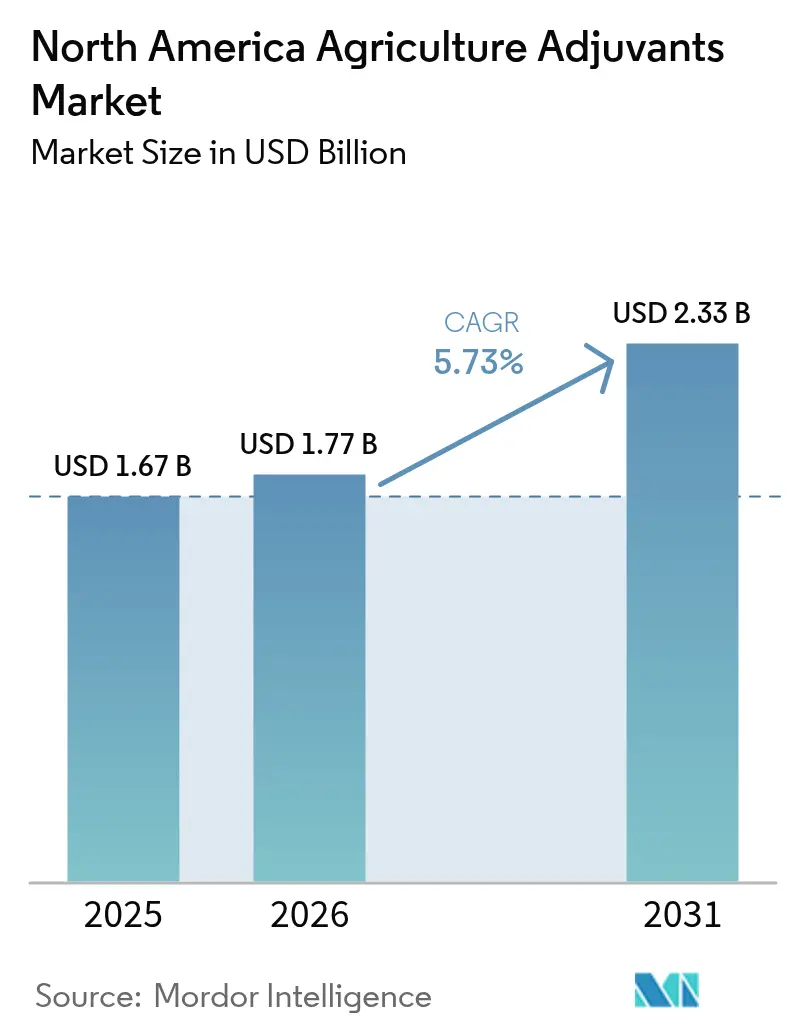
| Base Year Market Size (2025) | USD 1.67 Billion |
| Market Size (2026) | USD 1.77 Billion |
| Market Size (2031) | USD 2.33 Billion |
| Growth Rate (2026 - 2031) | 5.73 % |
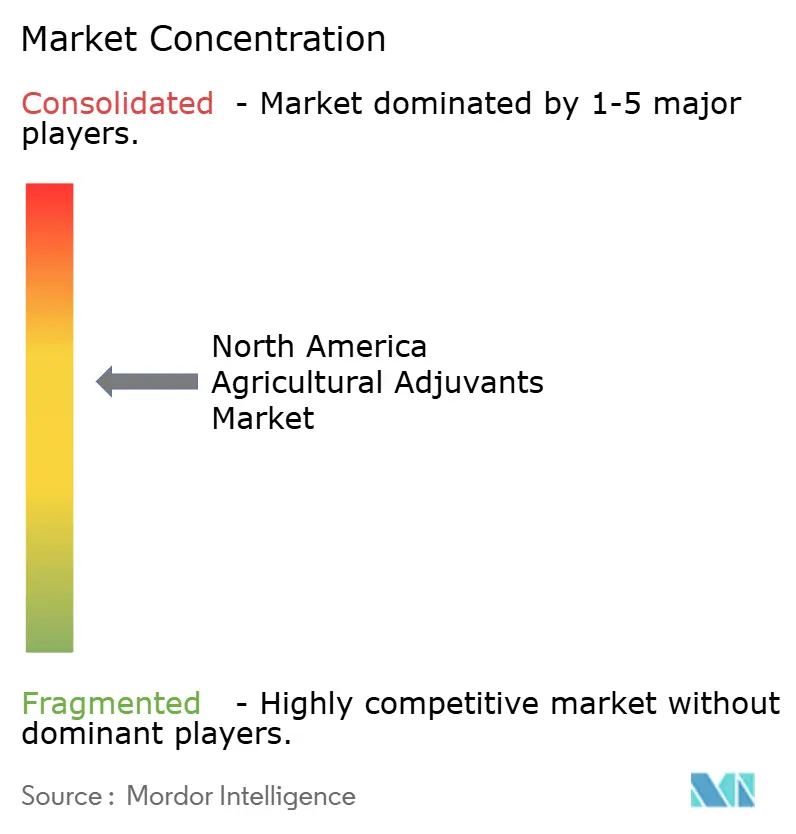
| Market Concentration | Medium |
Major Players *Disclaimer: Major Players sorted in no particular order Image © Mordor Intelligence. Reuse requires attribution under CC BY 4.0. | |
North America Agriculture Adjuvants Market Analysis by Mordor Intelligence
North America agriculture adjuvants market size in 2026 is estimated at USD 1.77 billion, growing from 2025 value of USD 1.67 billion with 2031 projections showing USD 2.33 billion, growing at 5.73% CAGR over 2026-2031. This momentum is driven less by volume gains and more by the economics of modern crop protection as herbicide-resistant weeds now span 120 million acres in the United States, forcing growers to optimize every spray pass. Activator adjuvants remain dominant, but utility adjuvants are accelerating because precision-spraying platforms require drift-control and deposition chemistries that legacy surfactants cannot deliver. Parallel regulatory and sustainability pressures from the Environmental Protection Agency (EPA) drift-mitigation rules, which took effect in 2024, and carbon-credit programs rewarding input efficiency are reshaping procurement priorities toward branded, traceable, and biologically compatible solutions.
Key Report Takeaways
- By type, activator adjuvants accounted for 60.25% of the North America agriculture adjuvants market share in 2025, while utility adjuvants are on track to expand at a 9.41% CAGR through 2031.
- By application, herbicide adjuvants led with 48.10% of the North America agriculture adjuvants market share in 2025, whereas insecticide adjuvants are forecast to post an 8.56% CAGR to 2031.
- By crop type, grains and cereals held 42.55% of the North America agriculture adjuvants market share in 2025, and fruits and vegetables will advance at a 7.26% CAGR to 2031.
- By geography, the United States captured 71.35% of the North America agriculture adjuvants market share in 2025, and Mexico is projected to grow at a 7.42% CAGR to 2031.
Note: Market size and forecast figures in this report are generated using Mordor Intelligence’s proprietary estimation framework, updated with the latest available data and insights as of 2026.
Market Trends and Insights
Drivers Impact Analysis of North America Agriculture Adjuvants Market*
| Driver | (~) % Impact on CAGR Forecast | Geographic Relevance | Impact Timeline |
|---|---|---|---|
| Increasing use of natural and sustainable adjuvants | +0.9% | United States and Canada, with early organic-certified adoption in California, and Ontario | Medium term (2-4 years) |
| Growing demand for crop-protection chemicals | +1.2% | United States (Midwest corn-soy belt) and Mexico (emerging commercial farms) | Short term (≤ 2 years) |
| Higher investment in adjuvant R&D by multinationals | +0.7% | Global, with innovation hubs in United States (Delaware, New Jersey) and Canada (Alberta) | Long term (≥ 4 years) |
| Expansion of precision-spraying technologies | +1.4% | United States (Great Plains, Corn Belt), Canada (Prairie Provinces), and Mexico (Sinaloa, Sonora) | Medium term (2-4 years) |
| Carbon-credit incentives for input-efficiency products | +0.6% | United States (United States Department of Agriculture (USDA) Climate-Smart Commodities states), and Canada (federal carbon pricing zones) | Long term (≥ 4 years) |
| Surfactant blends optimized for biologicals | +1.0% | United States (California, Florida specialty crops), and Canada (Quebec, Ontario vegetable zones) | Medium term (2-4 years) |
| Source: Mordor Intelligence | |||
Increasing Use of Natural and Sustainable Adjuvants
Organic acreage in the United States grew 12% year on year to 5.6 million acres in 2024, opening more shelf space for OMRI-listed adjuvants that comply with National Organic Program rules [1]. Methyl soyate and ethyl lactate are now displacing petroleum-based crop-oil concentrates in many herbicide programs as retailers extend sustainability scorecards to their supply partners. Croda’s rapeseed-derived surfactant line, launched in 2024, illustrates how renewable feedstocks can satisfy both volatile-organic-compound limits and grower preference for lower-risk inputs. California’s stringent Volatile Organic Compound (VOC) rules accelerate this trend because low adjuvants preserve air-quality compliance without compromising efficacy. Carbon-intensity metrics embedded in food-processor supply contracts amplify demand by rewarding input suppliers that can document Scope 3 reductions.
Growing Demand for Crop-Protection Chemicals
Palmer amaranth and waterhemp resistance to glyphosate triggered a 25% surge in herbicide treatments per acre in Midwestern corn and soybean systems since 2020, elevating adjuvant usage to maintain coverage without raising active-ingredient loads. Mexico mirrors this trajectory: federal subsidies now offset up to 50% of herbicide and adjuvant costs for commercial farms in Sinaloa and Sonora under the Fertilizantes para el Bienestar program. Insecticide adjuvants are also climbing as pyrethroid resistance spreads in corn rootworm and soybean aphid populations, spurring interest in chemistries that enhance cuticle penetration and rainfastness. Almond and grape growers deploy premium adjuvants to enhance fungicide canopy coverage, thereby extending spray intervals and reducing labor bottlenecks during peak season as growers stack modes of action, adjuvants that buffer pH, and manage water hardness, becoming indispensable to avoid antagonism in complex tank mixes.
Higher Investment in Adjuvant R&D by Multinationals
Corteva allocated USD 2.1 billion to R&D in 2024, directing a sizable share to proprietary adjuvant systems that enhance the performance ceiling of its flagship herbicides [2]. BASF paired its Revysol fungicide relaunch with co-developed adjuvants that confer faster rainfastness and systemic movement, underscoring a shift toward bundled chemistry solutions. Stepan broke ground on a USD 50 million surfactant plant in Illinois to secure domestic intermediates amid geopolitical uncertainty. Patent filings for adjuvant formulations increased 18% in 2024, with a focus on drift-reduction polymers and biocompatible surfactants, signaling that intellectual property has become a moat in what was once a commodity space. Companies with toxicology datasets that meet the EPA’s revised inert-ingredient guidance are better positioned to list new products faster, thereby raising competitive hurdles for smaller formulators.
Expansion of Precision-Spraying Technologies
John Deere’s See and Spray Ultimate covered 1.2 million acres in 2024, trimming herbicide volumes by up to 76% in Nebraska corn trials but only when paired with adjuvants that stabilize droplets at lower carrier volumes. Drift-control polymers and deposition aids are crucial for maintaining finely atomized sprays within target zones, particularly in regulatory districts that now require coarse droplets to protect endangered species habitats. Mexico’s drip-irrigation subsidy program accelerates the uptake of precision sprayers in water-limited regions, thereby multiplying demand for utility adjuvants that optimize low-volume applications. In Canada, Prairie growers integrate precision spraying with VR nitrogen and seeding, creating complex tank mixes that require high-tolerance compatibility agents.
Restraints Impact Analysis of North America Agriculture Adjuvants Market*
| Restraint | (~) % Impact on CAGR Forecast | Geographic Relevance | Impact Timeline |
|---|---|---|---|
| Stringent Environmental Protection Agency and regulatory guidelines | -0.8% | United States (European Space Agency (ESA) counties, drift-prone zones), Canada (Pest Management Regulatory Agency (PMRA) registration delays) | Short term (≤ 2 years) |
| Low grower awareness in specialty-crop pockets | -0.4% | United States (Southeast vegetables, Pacific Northwest tree fruits), Mexico (smallholder zones) | Medium term (2-4 years) |
| Volatility in tall-oil and methyl-soyate feedstocks | -0.6% | United States and Canada (bio-based adjuvant manufacturers), Mexico (import-dependent formulators) | Short term (≤ 2 years) |
| Increasing scrutiny of wetting agents | -0.5% | United States (Pest Management Regulatory Agency (PMRA)-sensitive watersheds), Canada (Great Lakes basin) | Medium term (2-4 years) |
| Source: Mordor Intelligence | |||
Stringent Environmental Protection Agency and Regulatory Guidelines
The Environmental Protection Agency's (EPA’s) 2024 Herbicide Strategy requires applicators in 1,500 counties designated under the Endangered Species Act to log adjuvant selection and weather parameters, prompting small operators to adopt new record-keeping systems or face compliance penalties. Coarser droplet mandates now cover 40% of the United States cropland, which can reduce efficacy on small-seeded weeds and may lead to repeat treatments if unsuitable adjuvants are used. Canada’s Pest Management Regulatory Agency added aquatic-toxicity data requirements for every surfactant component, extending registration timelines and raising costs for new entrants. Mexico tightened import permits on nonylphenol ethoxylate blends, forcing distributors either to reformulate or exit. As hurdles rise, suppliers with Environmental Protection Agency (EPA) registrations gain a market advantage because growers prefer traceable products that simplify audits.
Low Grower Awareness in Specialty-Crop Pockets
Extension surveys indicate that fewer than 40% of vegetable growers in Pennsylvania and North Carolina adjust adjuvant picks for water hardness or pH, leaving untapped efficacy gains. Retail agronomists often prioritize high-volume row-crop clients, resulting in limited technical advice for tree-fruit and wine-grape producers in the Pacific Northwest. Mexico’s smallholder sector, which cultivates 60% of the farmland, receives minimal adjuvant education because public programs focus mainly on seeds and fertilizers. Price-driven purchasing of generic adjuvants dominates these areas, leading to the potential overapplication of active ingredients. Digital agronomy tools from Farmers Business Network offer field-specific recommendations, but they remain concentrated among larger growers with strong broadband access.
*Our forecasts treat driver/restraint impacts as directional, not additive. The impact forecasts reflect baseline growth, mix effects, and variable interactions.
North America Agriculture Adjuvants Market Segment Analysis
By Type:
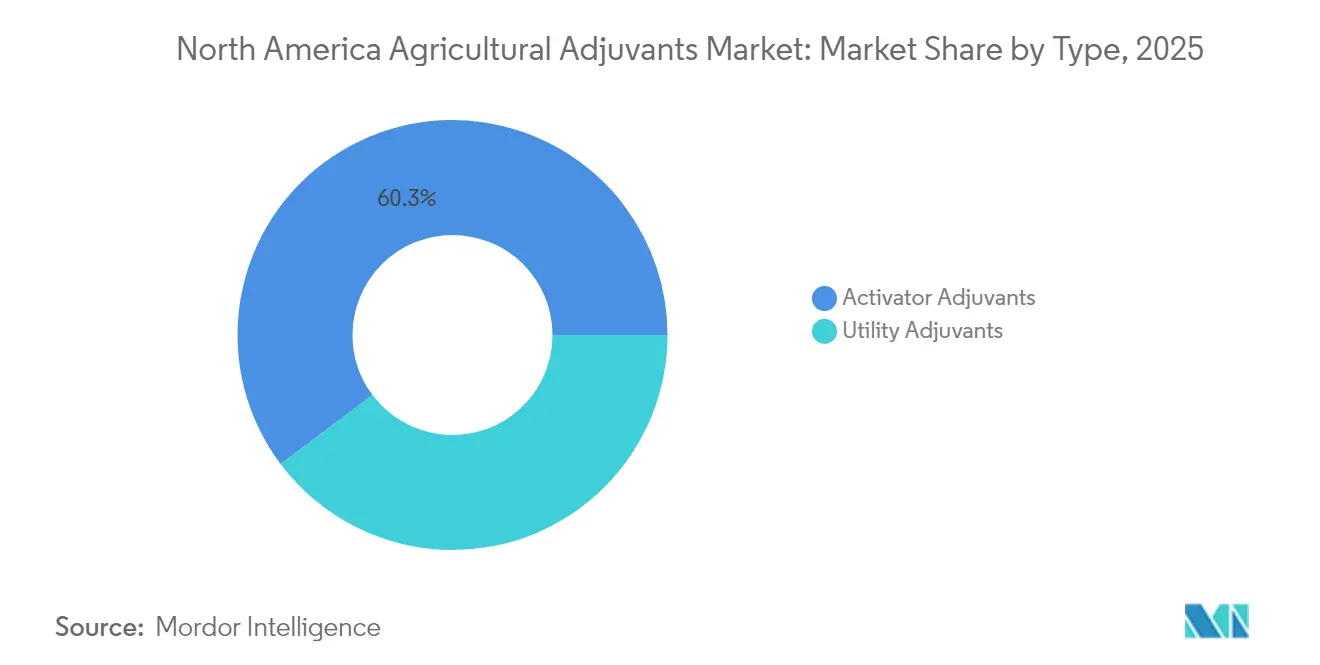
Utility Adjuvants Gain Momentum in Precision SprayingActivator adjuvants accounted for 60.25% of the revenue in 2025, as non-ionic surfactants and crop-oil concentrates remained core to post-emergence herbicide programs in corn and soybeans. Oil-based blends that include methyl soyate offer enhanced penetration and rainfastness, explaining their continued presence even as bio-based alternatives emerge. Utility adjuvants, however, are forecast to rise 9.41% annually to 2031, lifting the North America agriculture adjuvants market size for this category well above USD 980 million by the period end. Drift-control polymers and deposition aids form the backbone of this surge because precision sprayers triple the active-ingredient concentration in the tank, which increases the risk of clogging without specialized additives .
Water conditioners are another high-growth pocket, given evidence that untreated hard-water conditions can slash glyphosate efficacy by as much as 30%. Compatibility agents round out the story as biologicals move mainstream, making it a non-negotiable requirement for growers who want single-pass applications, preventing flocculation when mixing microbes and synthetics. Momentum in these utility segments means the North America agriculture adjuvants market share for activators is expected to slide modestly even as absolute activator revenue rises.

By Application:
Insecticide Adjuvants Accelerate under Resistance PressureHerbicide adjuvants generated 48.10% of the revenue in 2025, reflecting the entrenched reliance on weed management across 320 million acres of United States cropland. Nevertheless, insecticide adjuvants are projected to increase 8.56% annually through 2031, expanding their share of the North America agriculture adjuvants market size as pyrethroid resistance forces growers to seek better cuticle penetration tools. Demand is especially strong in corn rootworm hotspots where improving residual control can trim rescue-treatment costs.
Fungicide adjuvants continue to expand in high-value fruits and vegetables because canopy density makes thorough coverage critical. BASF SE’s drift-reduction additives coupled with Revysol illustrate how integrated offerings reshape buying dynamics. Other applications, namely plant-growth regulators and foliar nutrients, contribute steady but smaller revenue streams, with performance heavily tied to adjuvants that reduce phytotoxicity in stress-sensitive crops.
By Crop Type:
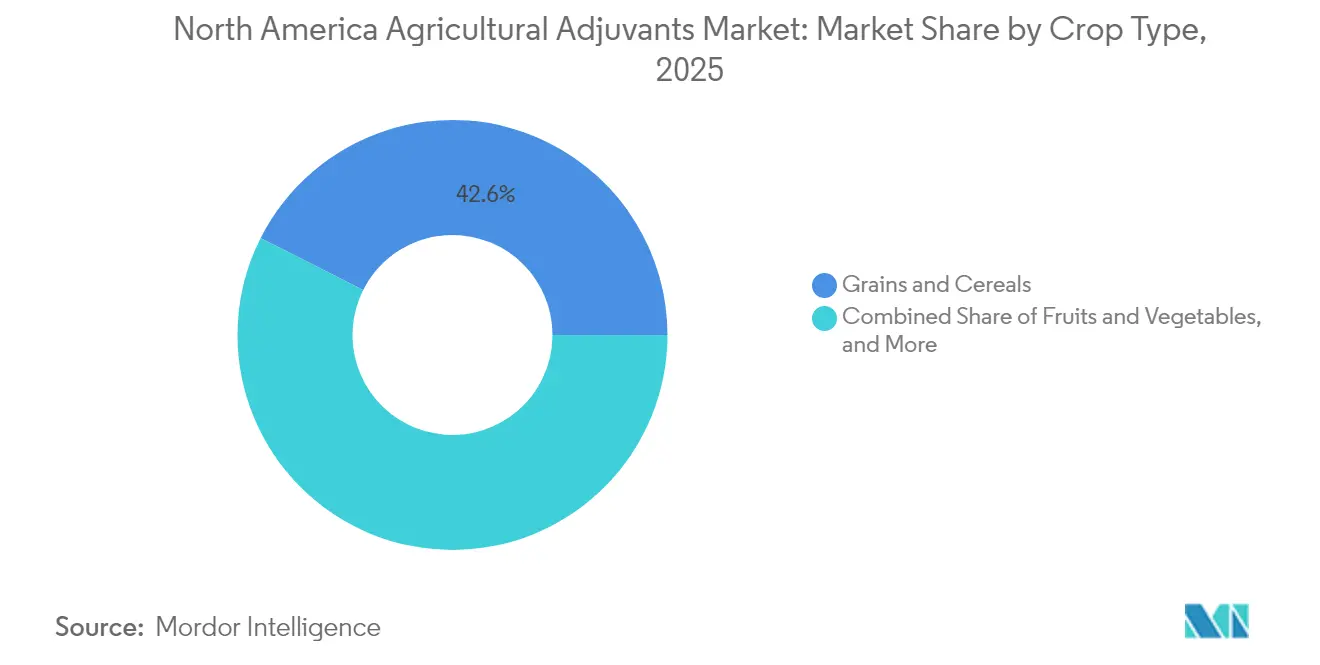
Fruits and Vegetables Justify Premium Price PointsGrains and cereals dominated the market with 42.55% revenue in 2025, as herbicide programs are non-optional across vast corn and soybean acreage. By contrast, fruits and vegetables are forecast to grow at a rate of 7.26% per year to 2031, increasing the North America agriculture adjuvants market share for high-value specialty crops, as premium inputs pay for themselves through reduced disease losses. Almond and wine-grape estates in California alone spend more than USD 200 million annually on adjuvants that help maximize the length of fungicide intervals.
Oilseeds such as canola depend on adjuvants that improve herbicide selectivity, and Canada’s 22 million-acre canola belt ensures a baseline of demand even under flat acreage projections. Turf and ornamental use remains a niche market but carries premium pricing because end users value aesthetics and low-odor formulations, contributing incremental dollar volume despite small tonnage.
Geography Analysis
United States Agriculture Adjuvants Market
The United States generated 71.35% of 2025 revenue, reflecting its expansive cropland, high adjuvant penetration rates, and tight linkage between chemical suppliers and digital agronomy platforms. The North America agriculture adjuvants market size in the United States will still grow, albeit at a slower pace than in Mexico, as saturation effects begin to take hold. Farmer Business Network’s direct-to-grower channel pressures distributor margins and places a premium on technical service rather than simple product availability.
Mexico Agriculture Adjuvants Market
Mexico is projected to grow at a 7.42% CAGR through 2031, driven by government subsidy programs that reimburse the purchase of precision equipment and encourage the use of biologically compatible adjuvants across smallholder cooperatives. Commercial vegetable operations in Sinaloa and Sonora adopt integrated weed management strategies that mirror best practices in the United States, driving increases in herbicide adjuvant usage for crops where per-acre revenue justifies premium additives.
Canada Agriculture Adjuvants Market
Canada remains a steady but slower grower, with Prairie provinces accounting for 80% of national adjuvant demand. Cool, short-season conditions make rainfastness particularly important. Hence, activator adjuvants that accelerate foliar uptake continue to command loyalty. Federal carbon pricing of CAD 80 (USD 59) per metric ton incentivizes input-efficiency gains that bolster utility-adjuvant volumes, especially those that enable lower carrier rates in precision spraying scenarios
Regulatory Landscape
In the United States, tank-mix adjuvants generally sit outside standalone federal pesticide registration under FIFRA when they are sold as spray additives without pesticidal claims. They increasingly affect pesticide-use compliance through label-driven drift and endangered-species mitigations overseen by the US Environmental Protection Agency (EPA). The EPA drift-mitigation framework that took effect in 2024, along with the agency's Endangered Species Act (ESA) Herbicide Strategy documentation and related guidance, has pushed applicators in designated geographies to document application conditions and mitigation choices. As a result, drift reduction adjuvants are functioning as compliance-enabling tools in many programs, not just optional inputs.
In Canada, Health Canada's Pest Management Regulatory Agency (PMRA) applies the Pest Control Products Act and associated policies to adjuvants sold separately to directly improve efficacy or performance. Some utility-type modifiers may fall outside registration if they do not make biological performance claims. PMRA policies on formulants and value assessment also raise data expectations for surfactant-heavy products, which can extend timelines for new offerings. Across North America, these requirements are reinforcing a shift toward registered, traceable, and performance-verified formulations for growers and retailers managing auditability and stewardship obligations.
Competitive Landscape
The North America agriculture adjuvants market remains moderately concentrated, with the five largest suppliers, Corteva Agriscience, Stepan Company, Croda International PLC, Helena Agri-Enterprises, and Land O’Lakes Inc. Each multinational pairs in-house chemistry with distribution scale, allowing them to bundle adjuvants alongside proprietary herbicides and fungicides and lock in grower loyalty. Mid-tier formulators hold the remaining share and compete mostly on price in commodity surfactants, although regulatory expertise and local agronomic support create defensible niches. Patent activity around drift-reduction polymers, biocompatible surfactants, and pH buffers rose 18% in 2024, signaling that intellectual property is becoming a barrier for late entrants.
Strategic investments underscore how leaders seek differentiation. Corteva Agriscience earmarked USD 150 million to expand its Johnston facility and add biologicals-compatible adjuvant capacity that supports its Utrisha foliar line, tightening vertical integration from active ingredient to final spray mix. BASF SE rolled out a new drift-reduction series co-developed with Revysol fungicide, providing specialty-crop growers with a turnkey solution that meets EPA coarse-droplet rules without compromising efficacy. Croda International PLC acquired Solus Biotech for USD 85 million, gaining surfactant know-how that accelerates growth in organic-certified and microbial-safe formulations. Stepan’s USD 50 million Illinois plant secures domestic feedstocks for bio-based surfactants, hedging geopolitical risk tied to import supplies.
Disruptive models are emerging in parallel. Farmers Business Network bypasses traditional retail by bundling adjuvants with data subscriptions that generate field-specific recommendations, compressing distributor margins while sharpening price transparency. Equipment makers such as Deere & Company partner with adjuvant formulators to co-design chemistries that prevent nozzle clogging in precision sprayers, raising the engineering bar for independent blenders. Innovation white space also lies in PFAS-free wetting agents and OMRI-listed blends, areas where smaller specialists can scale fast before multinationals react. As EPA drift and inert-ingredient rules tighten, growers prefer branded, fully registered formulations that simplify audits, a trend likely to extend the advantage of suppliers with deep regulatory portfolios.
North America Agriculture Adjuvants Industry Leaders
-
Corteva Agriscience
-
Land O’Lakes Inc.
-
Stepan Company
-
Croda International PLC
-
Helena Agri-Enterprises
- *Disclaimer: Major Players sorted in no particular order
North America Agriculture Adjuvants Market Companies Covered in this Report
- Corteva Agriscience
- Land O'Lakes Inc.
- Stepan Company
- Croda International plc
- Helena Agri-Enterprises LLC (Marubeni Corporation)
- Huntsman Corporation
- Farmers Business Network Inc.
- BASF SE
- Evonik Industries AG
- Solvay SA
- Nufarm Limited
- Loveland Products Inc. (Nutrien Ltd.)
- Wilbur-Ellis Company LLC
- Clariant AG
- Nouryon Holding B.V.
Read Analysis of North America Agriculture Adjuvants Companies
Market Opportunities and Future Outlook
Compliance-driven drift management is a key whitespace for differentiated utility adjuvants. The EPA's ESA strategies treat drift reduction adjuvants as mitigation options, and that tends to steer applicators toward validated, label-aligned solutions rather than generic surfactant blends. This dynamic supports opportunities in drift-control polymers, deposition aids, and low-volume compatibility systems that help maintain performance under coarse-droplet and lower carrier-volume regimes used by precision sprayers.
Precision spraying is creating another adoption driver. John Deere's See and Spray Ultimate reached 1.2 million acres in 2024, and these platforms place tighter demands on droplet stabilization, nozzle cleanliness, and tank-mix robustness. That is expanding the addressable space for adjuvants engineered for concentrated mixes. Separately, bio-based and biologicals-compatible adjuvants are aligning with measurable demand signals. US organic acreage expanded to 5.6 million acres in 2024, which widens shelf space for OMRI-listed and National Organic Program-aligned adjuvants. Major suppliers have continued to invest in compatibility and renewable feedstock platforms, including Croda's renewable surfactant positioning and Corteva's capacity expansion aimed at biologicals-compatible adjuvants. Industry-led education and stewardship programs, including those supported by the Council of Producers and Distributors of Agrotechnology (CPDA), also reinforce grower pathways for drift-reduction and compliance-oriented adjuvant use by pairing product labels with training, record-keeping support, and retailer-ready technical documentation.
Recent Industry Developments in North America Agriculture Adjuvants Market
- June 2026: Bayer (via Monsanto Company and Ruveon LLC) filed a petition with the US International Trade Commission and US Department of Commerce seeking antidumping and countervailing duties on glyphosate imports from China. While centered on an active ingredient, the action highlights trade and supply-chain scrutiny across crop protection inputs, shaping procurement behavior for formulated systems that include tank-mix components such as adjuvants.
- January 2025: Corteva Agriscience announced a USD 150 million expansion of its formulation facility in Johnston, Iowa, adding capacity for biologicals-compatible adjuvants designed to pair with its Utrisha foliar line. The investment strengthens vertical integration and supports bundled crop-protection offerings where adjuvants are positioned as part of a performance system rather than a commodity add-on.
- December 2024: BASF SE launched a line of drift-reduction adjuvants co-developed with its Revysol fungicide platform, targeting specialty-crop growers operating under tighter drift and stewardship requirements. The release reinforces the shift toward integrated, compliance-aware spray programs that combine active ingredients with performance-verified adjuvant technologies.
North America Agriculture Adjuvants Market Report Scope and Research Methodology
Market Definition and Coverage
For this study, the market covers agricultural adjuvants sold for farm and land management spray programs across North America, where these additives are used to improve the performance, handling, or application quality of crop protection products.
Scope exclusions: We exclude fertilizers, biologicals sold as standalone crop inputs, and the value of the active crop protection products themselves.
Segments Covered in This Report
- By Type
- Activator Adjuvants
- Surfactants
- Oil Adjuvants
- Utility Adjuvants
- Activator Adjuvants
- By Application
- Herbicide Adjuvants
- Insecticide Adjuvants
- Fungicide Adjuvants
- Other Applications
- By Crop Type
- Crops Based
- Grains and Cereals
- Fruits and Vegetables
- Oil Seeds
- Other Applications
- Non-Crops Based
- Turf and Ornamental Grass
- Others
- Crops Based
- By Geography
- United States
- Canada
- Mexico
- Rest of North America
Data Sources, Market Sizing, and Validation
Desk Research
Desk work started with public statistics and rulebooks that shape adjuvant demand and use, since adjuvants are closely tied to spray practices and crop protection. We referenced sources such as USDA (including ERS and NASS), Agriculture and Agri Food Canada, the US Environmental Protection Agency pesticide labeling and drift materials, and USITC trade data for related chemical categories when it helped with direction checks.
To keep the model grounded in real-world pricing and adoption, we also reviewed company annual reports, investor presentations, product technical sheets, and association or extension publications that explain use cases by crop and chemistry. In addition, we used a paid subscription for company financials and news, and a patent database view to spot where formulation and drift-control claims were trending, then we pressure-tested those assumptions in interviews. The desk sources listed here are illustrative only, and many other public and paid references were also used for data collection, validation, and clarification.
Primary Interviews and Surveys
Primary work was done through expert interviews and structured surveys across the United States, Canada, and Mexico to validate how adjuvants are chosen, priced, and used in the field. We spoke with a mix of formulators, distributors, agronomy advisors, and large farm decision makers so gaps from desk research could be filled, and key assumptions could be corrected before totals were finalized.
Distribution of primary research fieldwork respondents
| Company type | Respondent position |
|---|---|
| Top tier: 26% | CXOs: 19% |
| Mid tier: 53% | Functional/Unit leaders: 26% |
| Smaller Players: 21% | Managers: 55% |
Market-Sizing & Forecasting
Sizing was built using top-down and bottom-up logic, but it was led by a top-down demand pool build that ties adjuvant consumption to crop protection spray activity in North America. In practice, cropland and treated area signals are combined with crop mix and spray frequency patterns, and then translated into adjuvant demand using typical use-rate ranges and the share of programs that require activators or utility aids.
To keep the estimate realistic, the outputs were checked using selective bottom-up approximations, including sampled price points across channels, product mix checks, and supplier and distributor feedback on volume movement by season. Inputs that mattered most included planted and harvested acreage for key crops, herbicide and fungicide intensity by crop, drift-management adoption (including nozzle and tank-mix practices), relative pricing of surfactant and oil-based blends, and shifts toward low-dose and low-water-volume application methods. When a bottom-up signal was incomplete for smaller categories, gaps were handled through coverage ratios that were validated in interviews, then tested for reasonableness against the total demand pool.
Forecasting used scenario analysis supported by simple regression-style relationships between adjuvant demand and drivers such as acreage, crop protection intensity, and application practice changes. Assumptions were reviewed and adjusted based on what respondents described as likely adoption and pricing direction. The steps were kept repeatable, so each driver can be updated annually as fresh acreage and crop protection indicators become available.
Data Validation & Update Cycle
Validation was done by cross-checking the modeled totals against independent signals such as crop area trends, observed shifts in spray practices, and directional changes in pricing and product mix reported by the channel. If the model produced an unusual jump by country or by adjuvant function, we revisited the assumptions, rechecked units, and then re-contacted sources when the variance could not be explained by known seasonality or regulation effects.
Before sign-off, the work goes through step-by-step analyst review so calculations, currency handling, and year mapping are consistent across the full time series. The report is refreshed once a year, and it is also revisited when material events occur, such as a major regulatory change affecting spray practices or a sharp input-price swing. Right before delivery, a final pass is completed so clients receive the most current view that can be supported with traceable notes and checks.
Mordor Intelligence's North America Agriculture Adjuvants Market Estimate Compared With Other Published Estimates
Published market sizes for North America agricultural adjuvants often look different because groups do not always count the same products, channels, and end uses, and the base year and currency timing can also vary. Differences also show up when one estimate leans heavily on a single demand proxy, which can be directionally right but still miss how pricing and mix shift across crops and spray programs.
Some published figures appear to bundle broader agrochemical additives and related formulation aids, then apply a general growth path from global assumptions, which can raise or lower the North America number depending on the mix assumed. For Mordor Intelligence, only agricultural adjuvants tied to field application programs across the included North American countries are counted, and the value of the crop protection actives and other farm inputs are excluded, which keeps the total aligned to spray-use drivers like treated acreage and typical use rates.
Benchmark comparison
| Source | Market Size | Gaps in Research Methodology |
|---|---|---|
| Mordor Intelligence | USD 1.67 B (2025) | |
| Global Consultancy A | USD 0.90 B (2025) | This estimate is presented as revenue for North America but appears to rely more on a narrower set of reported sales channels and a tighter product interpretation, which can undercount specialty blends used outside core row-crop programs. |
| Trade Journal B | USD 1.43 B (2025) | This figure uses a broader segmentation lens and a longer-horizon projection, and it can differ based on how technology sub-types are grouped and how price progression is applied across activators versus utility aids. |
Across the three values, the spread is mainly explained by what is treated as an adjuvant versus a wider additive set, and by how strongly pricing and mix are updated for the base year. By tying the total to repeatable demand drivers (acreage, spray intensity, and use-rate ranges) and then checking it with channel feedback, the final number stays transparent and easier to defend during planning discussions.
Key Questions Answered in the Report
How large is the North America agriculture adjuvants market in 2026?
It stands at USD 1.77 billion and is forecast to reach USD 2.33 billion by 2031.
What CAGR is projected for adjuvant sales through 2031?
The market is projected to expand at a 5.73% CAGR over the forecast period 2026-2031.
Which adjuvant type is growing fastest?
Utility adjuvants, including drift-control and deposition aids, are set to climb 9.41% annually as precision spraying scales up.
Why are insecticide adjuvants gaining traction?
Rising pyrethroid resistance increases demand for additives that improve cuticle penetration and residual activity.
How will carbon-credit programs influence adjuvant adoption?
USDA and private-sector carbon markets financially reward growers who pair adjuvants with precision equipment to cut chemical rates, accelerating uptake.
What regulatory changes most affect adjuvant choices?
EPA drift-mitigation rules and PFAS scrutiny push growers toward coarse-droplet, PFAS-free, and EPA-registered formulations.