
Market Overview
| Study Period | 2021 - 2031 |
|---|---|
| Forecast Data Period | 2026 - 2031 |
| Base Year Market Size (2025) | USD 3.25 Billion |
| Market Size (2026) | USD 3.48 Billion |
| Market Size (2031) | USD 4.91 Billion |
| Growth Rate (2026 - 2031) | 7.13 % |
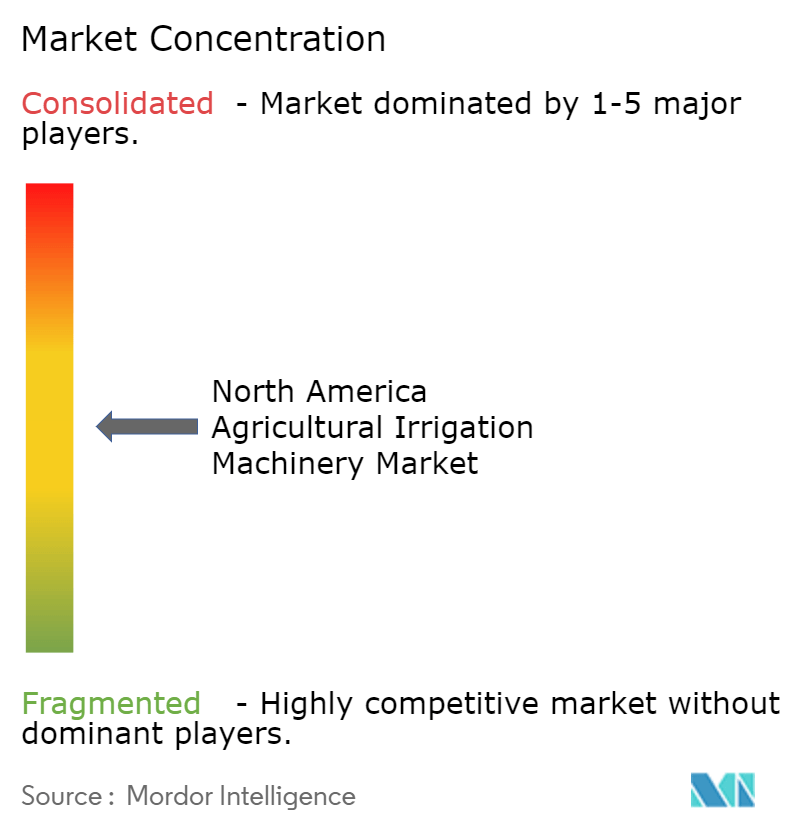
| Market Concentration | Medium |
Major Players *Disclaimer: Major Players sorted in no particular order Image © Mordor Intelligence. Reuse requires attribution under CC BY 4.0. | |
North America Agricultural Irrigation Machinery Market Analysis by Mordor Intelligence
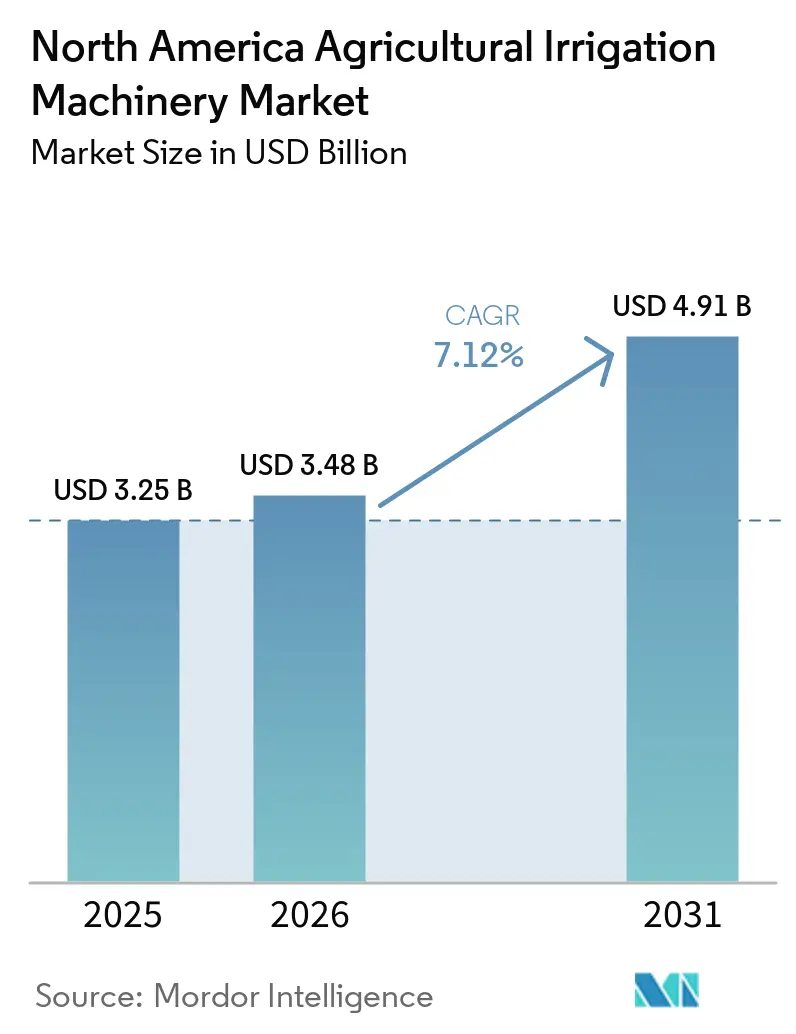
The North American agricultural irrigation machinery market size in 2026 is estimated at USD 3.48 billion, up from a 2025 value of USD 3.25 billion, with 2031 projections of USD 4.91 billion, growing at a 7.13% CAGR over 2026-2031. Robust public-funding streams, rising water scarcity in the High Plains Aquifer, and stricter efficiency mandates in California are underpinning this expansion. Growers are replacing gravity systems with pressurized pivot, sprinkler, and drip technologies that incorporate real-time soil-moisture sensors and variable-rate algorithms, reducing water use in commercial row-crop operations [1]. Government incentives, notably Environmental Quality Incentives Program allocation for fiscal 2025, compress payback periods to fewer than five seasons for many retrofits. Meanwhile, digital-twin design tools shave engineering cycles and reduce installation errors. Competitive pressure is elevating software integration, with edge-Artificial intelligence (AI) predictive-maintenance modules now standard on new pivots and drip controllers, cutting unplanned downtime. Policy momentum in Mexico, to modernize 50,000 hectares, signals a region-wide shift toward mechanized irrigation.
Key Report Takeaways
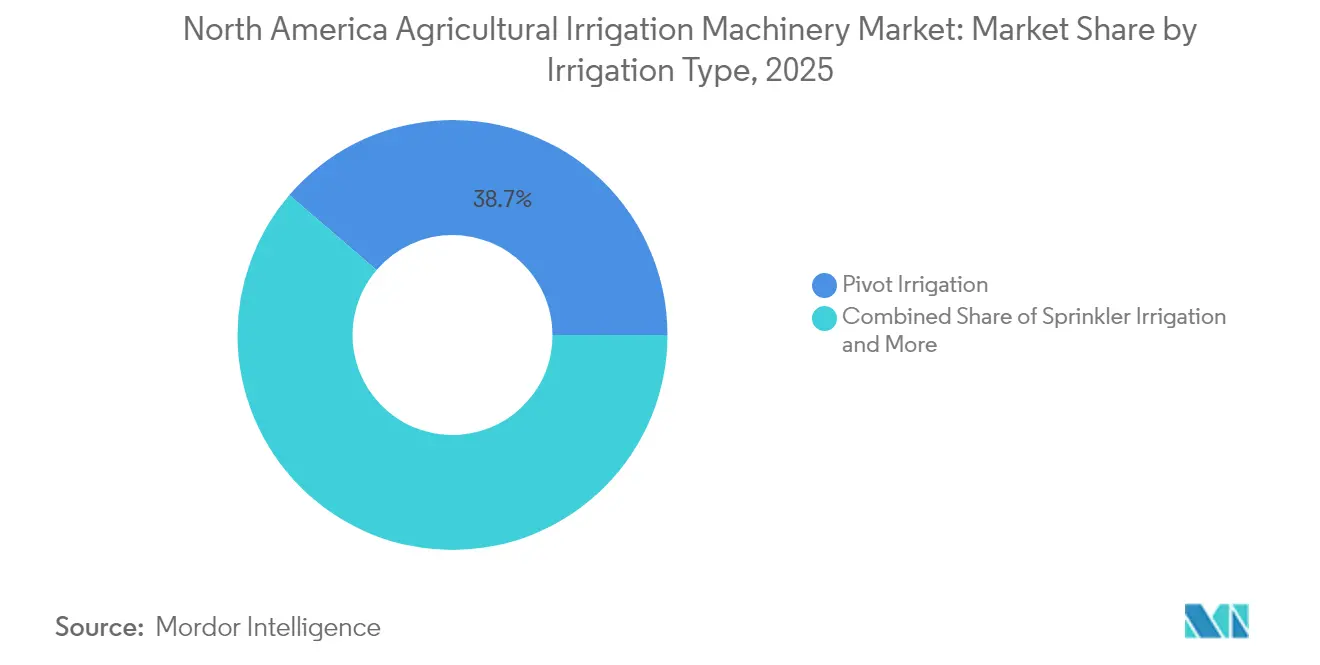
- By irrigation type, pivot systems led with a 38.7% share of the North America agricultural irrigation machinery market in 2025, while drip-sensor solutions are projected to expand at a 12.05% CAGR through 2031.
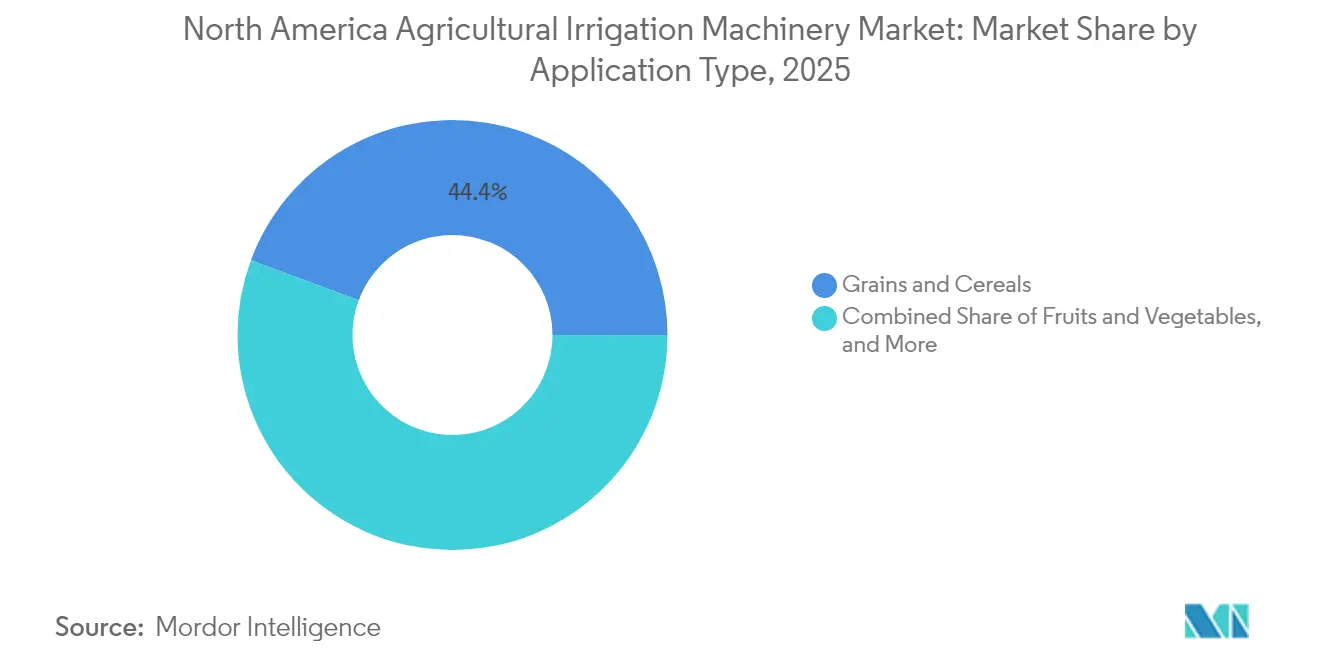
- By application type, grains and cereals accounted for 44.4% of the North America agricultural irrigation machinery market in 2025, while fruits and vegetables are projected to expand at a 10.18% CAGR through 2031.
- By geography, the United States accounted for 67.4% of the North America agricultural irrigation machinery market in 2025, while Mexico is projected to register the fastest CAGR of 8.74% between 2026 and 2031.
Note: Market size and forecast figures in this report are generated using Mordor Intelligence’s proprietary estimation framework, updated with the latest available data and insights as of 2026.
Market Trends and Insights
Drivers Impact Analysis of North America Agricultural Irrigation Machinery Market*
| Driver | (~) % Impact on CAGR Forecast | Geographic Relevance | Impact Timeline |
|---|---|---|---|
| Digital-twin enabled design optimization | +1.2% | United States (High Plains, Corn Belt), Western Canada | Medium term (2-4 years) |
| Increasing area under irrigation | +1.8% | United States (Nebraska, Kansas, Texas), Canadian Prairies, Northern Mexico | Long term (≥ 4 years) |
| Government support to enhance mechanized irrigation | +2.1% | United States, Canada, and Mexico | Short term (≤ 2 years) |
| Climate-resilience funding tied to smart irrigation | +0.9% | United States, and Mexico | Medium term (2-4 years) |
| Adoption of new technological irrigation methods | +1.5% | United States, and Mexico | Medium term (2-4 years) |
| Edge-Artificial Intelligence (AI) based predictive maintenance lowers OPEX | +0.7% | United States, and Canada | Long term (≥ 4 years) |
| Source: Mordor Intelligence | |||
Digital-Twin Enabled Design Optimization
Virtual modeling platforms shorten center-pivot retrofit planning from weeks to days, trimming engineering outlays by up to 18%. The CropTwin project, with heavy funding in 2024, uses soil maps, weather forecasts, and crop coefficients to simulate nozzle packages before hardware is ordered. Growers in Nebraska and Kansas report that the software highlights pressure bottlenecks and span mismatches that are often overlooked during manual sizing, preventing yield loss caused by uneven distribution. Variable-rate retrofits benefit most when zone mapping is accurate, as it is critical for water savings. As manufacturers embed these simulators into customer portals, mid-sized farms with limited technical staff gain affordable access to advanced design capability.
Increasing Area Under Irrigation
The United States Department of Agriculture (USDA) data show a gradual expansion of irrigated acreage in the High Plains and Mississippi Delta, while Canadian programs subsidize up to 50% of new irrigation districts in Alberta and Saskatchewan [2]. Mexico’s northern states are phasing out flood irrigation in favor of pressurized systems eligible for Conagua subsidies, boosting equipment demand despite higher upfront costs. Producers view irrigation infrastructure as insurance against erratic rainfall. Even with elevated interest rates, many operations stretch repayment schedules because stabilized yields support long-term profitability.
Government Support to Enhance Mechanized Irrigation
Federal and provincial incentives compress the return-on-investment period below five years for many upgrades. The Environmental Quality Incentives Program (EQIP) covers 50% to 75% of drip conversions and variable-rate retrofits, while Alberta’s programs lower district infrastructure costs, and Mexico’s subsidies cover up to 70% for ejido cooperatives. These programs de-risk private capital, accelerating the retirement of gravity systems. Dealers bundle financing packages with cost-share paperwork assistance, simplifying adoption for smaller farms.
Climate-Resilience Funding Tied to Smart Irrigation
Carbon-credit protocols reward farms that verify water and energy savings. United States Department of Agriculture (USDA) pilots allow producers to bank credits for diesel and electricity reductions achieved through the Internet of Things (IoT)-enabled irrigation. Private registries such as Verra publish methodologies quantifying avoided groundwater extraction. Manufacturers embed data loggers and telemetry modules into controllers, generating audit trails for credit validation. Demand is strongest in California and the Midwest, where buyers pay premiums for sustainability-certified crops.
Restraints Impact Analysis of North America Agricultural Irrigation Machinery Market*
| Restraint | (~) % Impact on CAGR Forecast | Geographic Relevance | Impact Timeline |
|---|---|---|---|
| High investment and maintenance costs | -1.4% | United States, and Mexico | Short term (≤ 2 years) |
| Complex functioning of high-tech systems | -0.8% | United States, Canada, and Mexico | Medium term (2-4 years) |
| Scarcity of skilled irrigation technologists | -0.6% | Canada, and United States | Long term (≥ 4 years) |
| Cyber-security risks in connected irrigation assets | -0.4% | United States, and Canada | Medium term (2-4 years) |
| Source: Mordor Intelligence | |||
High Investment and Maintenance Costs
Modern drip systems cost USD 1,000 to USD 3,000 per acre, while pivots can range from USD 50,000 to USD 150,000 depending on span length and automation features. Annual upkeep averages 4% of capital value, a heavy burden for farms operating on slim margins. Conagua subsidies reduce acquisition costs for Mexican smallholders but do not offset recurring expenses such as filter cleaning and electricity bills. When grain prices soften, payback timelines lengthen, deterring upgrades.
Scarcity of Skilled Irrigation Technologists
Installer vacancies exceed seven months in rural Canadian provinces and the United States Great Plains. Community-college enrollment in agricultural mechanics programs is falling, and many technicians retire without replacements. Manufacturers respond by dispatching factory crews, adding cost and time. Labor shortages particularly hinder installation peaks in spring.
*Our forecasts treat driver/restraint impacts as directional, not additive. The impact forecasts reflect baseline growth, mix effects, and variable interactions.
North America Agricultural Irrigation Machinery Market Segment Analysis
By Irrigation Type:
Pivot Dominance Meets Drip-Sensor AccelerationPivot irrigation held a 38.7% share of the North America agricultural irrigation machinery market in 2025, reflecting its fit with large-scale row-crop geometry. Variable-rate retrofits, which replace fixed nozzles with zone-controlled heads, are gaining momentum. Drip-sensor solutions remain the fastest-growing subsegment, with a 12.05% CAGR from 2026 to 2031, buoyed by California distribution uniformity mandates and permanent-crop adoption. Tubing, filters, and pressure regulators dominate component sales, while pressure-compensating emitters cut maintenance intervals. Traveling guns and solid-set systems capture the balance of niche demand in sod and nursery operations.
Valmont’s Valley brand saw a revenue decline in the third quarter of 2024, but the firm invested significantly to expand variable-rate pivot production, signaling long-term confidence. Flow meters and telemetry modules are now standard to satisfy water-reporting rules in Ogallala Aquifer counties. Solar-hybrid pumps and variable-frequency drives reduce operating electricity costs, while retrofit kits extend the service life of aging pivots. Edge computing panels record runtime data, enabling growers to claim carbon credits for energy savings.

By Application Type:
Grains Anchor Demand, Fruits and Vegetables Drive GrowthGrains and cereals represented 44.4% of the North America agricultural irrigation machinery market size in 2025, supported by corn, wheat, and soybean acreage across the Corn Belt and Canadian Prairies. This segment advances as producers convert dryland acres to pivots for yield stability. Fruits and vegetables, although smaller, grow the fastest at 10.18% CAGR between 2026 and 2031, propelled by California specialty crops, Florida citrus, and Mexico’s berry and avocado exports that require precise fertigation to meet retailer standards. Pulses and oilseeds offer niche opportunities, especially in rotations aimed at soil health.
California’s Sustainable Groundwater Management Act drives almond and pistachio growers toward subsurface drip monitored for extraction limits. Mexico’s berry exporters install drip to satisfy GlobalGAP audits. Toro’s micro-irrigation division reported revenue gains as specialty farms seek pressure-compensating emitters tailored to crop physiology. Divergent regulatory thresholds between grains and horticulture create contrasting equipment demand patterns.
Geography Analysis
The United States remained the anchor geography, holding 67.4% of the North America agricultural irrigation machinery market share in 2025. United States Department of Agriculture Environmental Quality Incentives Program (USDA EQIP) funding and conservation mandates fuel steady replacement of gravity systems. California’s Model Water Efficient Landscape Ordinance compels new installations to embed flow sensors and pressure-compensating emitters, accelerating drip adoption. Despite softer farm-equipment purchases in 2024 due to higher interest rates, pivot makers Lindsay and Valmont are expanding digital-twin design and remote-monitoring platforms to capture demand for precision irrigation.
In Canada, provincial cost-share schemes under Alberta’s Irrigation Rehabilitation and Expansion Program subsidize half the capital costs for pivots and drip laterals. Producers in Saskatchewan and Alberta view irrigation as a hedge against yield volatility linked to erratic precipitation. Longer equipment lifecycles and remote farm locations raise service expectations, spurring manufacturers to train dealers and deploy mobile fleets.
Mexico shows the fastest 8.74% CAGR during the forecast period 2026-2031, as Conagua’s Programa de Tecnificación de Riego funds modernization of 50,000 hectares, covering 50% to 70% of equipment costs for ejidos and smallholders. Export-oriented berry, avocado, and vegetable sectors seek drip and micro-irrigation to meet GlobalGAP and Rainforest Alliance certifications. Manufacturers with local supply chains, such as Netafim’s Fresno plant, reduce delivery lead times by 30% to serve this expansion.
Regulatory Landscape
In the United States, irrigation upgrades are shaped by conservation program rules and tightening water-related compliance. USDA NRCS cost-share programs (including EQIP in fiscal 2025) continue to anchor adoption economics, while NRCS updates to Conservation Practice Standards in its National Handbook increasingly formalize design, safety, and management requirements for irrigation structures and on-farm efficiency projects. Separately, FDA updates to produce safety requirements in 2024 shifted pre-harvest agricultural water oversight toward a systems-based assessment approach, adding emphasis on monitoring, documentation, and risk-based corrective actions that can favor sensorized irrigation and auditable water-management practices.
At the state and environmental interface, regulatory definitions and reporting obligations shape equipment specifications and digital add-ons. In April 2026, the US EPA issued an interpretive statement clarifying that aquatic herbicide application in irrigation conveyances is treated as a nonpoint source discharge and is exempt from NPDES permit requirements, influencing how conveyance maintenance is managed operationally. In California, AB 2447 (2026) directs updates to the Irrigated Lands Regulatory Program, including a statewide methodology for nitrogen balance reporting due by July 1, 2027, and revised regional orders due by January 1, 2028. These requirements support demand for fertigation-capable drip systems, flow measurement, and record-ready controllers. In Canada, equipment selection and deployment also intersect with compliance on off-road diesel engine emissions for mobile pump sets and relevant CSA Group machinery safety standards for agricultural equipment used in field operations.
Competitive Landscape
The North America agricultural irrigation machinery market remains moderately concentrated, with the top five firms controlling a significant share of 2025 revenue. Lindsay Corporation, Valmont Industries, Inc., Deere & Company, The Toro Company, and Netafim Ltd. command extensive dealer networks and broad portfolios. Competitive parity is shifting toward software integration, with all major players embedding cloud platforms that bundle design, scheduling, and maintenance analytics. White-space niches include variable-rate retrofit kits for legacy pivots, solar-hybrid pumps tied to carbon credits, and turnkey service bundles that offset the shortage of skilled technologists.
Valmont Industries, Inc.’s USD 15 million line expansion focuses on variable-rate pivots that meet state water-reporting mandates, while Netafim Ltd.’s USD 20 million Fresno plant localizes drip-tube extrusion to slash lead times. Lindsay Corporation’s FieldNET Advisor 2.0 integrates predictive maintenance that forecasts pump failures 14 days out, reducing costly downtime. Deere & Company leverages its precision-ag suite to bundle irrigation assets with See and Spray weed-control and ExactApply nozzle technologies, appealing to large enterprises seeking unified data ecosystems.
Smaller entrants combat scale disadvantages by specializing in the Internet of Things (IoT) sensors and decision-support algorithms that retrofit across diverse equipment fleets. Precision-agriculture firms such as CropX Technologies Ltd, Trimble Inc., and Pessl Instruments GmbH are capturing share by offering subscription-based scheduling that integrates with multiple hardware brands, enabling growers to avoid vendor lock-in. Cyber-security is now a differentiator, as manufacturers scramble to harden firmware and add over-the-air updates after a ransomware incident underscored the vulnerability of connected pivots.
North America Agricultural Irrigation Machinery Industry Leaders
-
Valmont Industries.
-
Lindsay Corporation
-
Deere & Company
-
The Toro Company
-
Netafim Ltd.
- *Disclaimer: Major Players sorted in no particular order
North America Agricultural Irrigation Machinery Market Companies Covered in this Report
- Netafim Ltd.
- T-L Irrigation Co.
- Jain Irrigation Systems Ltd.
- Lindsay Corporation
- Nelson Irrigation Corporation
- Deere & Company
- The Toro Company
- Rain Bird Corporation
- Hunter Industries, Inc.
- Valmont Industries, Inc.
- Rivulis Irrigation Ltd.
- Reinke Manufacturing Co., Inc.
- Irritec S.p.A.
- AquaSpy, Inc.
- CropX Technologies Ltd.
- Trimble Inc.
- Pessl Instruments GmbH
- Hosur Plastics
Read Analysis of North America Agricultural Irrigation Machinery Companies
Market Opportunities and Future Outlook
Public funding tied to measurable water and energy outcomes continues to create upgrade pipelines for pressurized and digitally monitored systems. The USDA NRCS EQIP WaterSMART Initiative in fiscal year 2026 allocated USD 5 million for the Lindsay-Strathmore Irrigation District and USD 6 million for the Tulare Irrigation District to improve on-farm water efficiency and conservation through 2030, supporting demand for pivots, pumps, controllers, meters, and telemetry that can document performance and help sustain compliance in drought-stressed basins. Inflation Reduction Act-linked guidance also increases the pull for variable-frequency drives, pump optimization, and controller upgrades that generate auditable energy data by emphasizing energy and greenhouse-gas reductions from improving existing fossil-fueled irrigation systems.
On the technology side, the opportunity expands as irrigation machinery integrates into farm-wide data platforms and automation stacks, rather than operating as stand-alone hardware. In 2026, multiple OEM actions highlighted this direction: AGCO showcased PTx Trimble retrofit autonomy (OutRun) and connectivity-oriented precision upgrades, while John Deere advanced computer-vision based application technology (See and Spray Gen 2) that reinforces the value of unified sensing, prescription, and machine control workflows. This supports whitespace for irrigation OEMs and precision-ag providers to bundle irrigation scheduling, nutrient management reporting (notably in California), and service contracts that mitigate the shortage of skilled irrigation technologists, including dealer-delivered remote diagnostics, predictive maintenance, and retrofit kits for legacy pivot fleets.
Recent Industry Developments in North America Agricultural Irrigation Machinery Market
- February 2026: Valmont Industries acquired the remaining 80% ownership interest in RMDS Innovation, Inc., taking full control of the platform effective January 12, 2026. This consolidation aligns technology and product capabilities to support faster development and integration across Valmont's engineered infrastructure and irrigation-related offerings.
- February 2026: Lindsay Corporation started deliveries for an approximately USD 80 million irrigation and technology project in the MENA region, following its fiscal 2026 second quarter (ended February 28, 2026). The scale of the deployment highlights how Lindsay can execute large irrigation programs and extend its technology-led portfolio beyond cyclical farm-equipment spending.
- January 2025: Lindsay Corporation completed its acquisition of a 49.9% minority interest in Austria-based Pessl Instruments. The investment strengthened access to on-farm sensing and decision-support capabilities that can be embedded into connected irrigation workflows, supporting more data-driven scheduling and service models.
North America Agricultural Irrigation Machinery Market Report Scope and Research Methodology
Market Definition and Coverage
For this study, the market covers farm-use irrigation machinery and equipment sold across North America that helps apply water to crops in a controlled way, including field-installed systems and the main hardware used to run them.
Scope exclusions: We exclude broader farm water infrastructure and civil works (such as canals, reservoirs, and large municipal water projects) that are not purchased as irrigation machinery for farms.
Segments Covered in This Report
- By Irrigation Type
- Sprinkler Irrigation
- Drip Irrigation
- Pivot Irrigation
- Other Irrigation Types
- By Application Type
- Grains and Cereals
- Fruits and Vegetables
- Pulses and Oilseeds
- Other Application Types
- By Geography
- United States
- Canada
- Mexico
- Rest of North America
Data Sources, Market Sizing, and Validation
Desk Research
Desk research was used to build the starting view of demand, usage context, and price signals, and then it was carried through the model as a steady check. Public and official references were reviewed, such as USDA and NASS irrigated acreage and crop data, USGS water-use reporting, Statistics Canada agricultural tables, Agriculture and Agri-Food Canada publications, and FAO datasets that anchor the scale of irrigated farming in the region.
After that, we used company filings, investor presentations, earnings transcripts, and reputable press to understand product mix and pricing direction for irrigation equipment. Select paid subscriptions were also used for company financials and news tracking, and patent databases were checked to confirm when features like automation and efficiency shifted into mainstream product lines that can affect average selling prices. The sources listed here are illustrative only, and other references were also used for data collection, validation, and clarification as the work progressed.
Primary Interviews and Surveys
Primary inputs were used to validate what gets purchased as irrigation machinery at the farm level and to close gaps left by public data. We spoke with manufacturers and distributors, irrigation system designers and installers, and farm operators across the United States, Canada, and Mexico, and the feedback was used to cross-check adoption rates, replacement timing, and realistic pricing bands.
Distribution of primary research fieldwork respondents
| Company type | Respondent position |
|---|---|
| Top tier: 32% | CXOs: 13% |
| Mid tier: 49% | Functional/Unit leaders: 31% |
| Smaller Players: 19% | Managers: 56% |
Market-Sizing & Forecasting
Market sizing was built using a top-down and bottom-up sequence where the demand pool is first reconstructed from irrigated agriculture signals, then totals are checked using selective supplier and channel approximations. The top-down build uses inputs such as irrigated acreage trends, crop mix shifts (grains and cereals versus fruits and vegetables), drought and water restriction indicators, cost-share and incentive activity, and typical replacement cycles for systems like sprinkler, drip, and pivot equipment.
Once country totals were formed, they were corroborated with sampled average selling prices and volumes gathered through channel checks, followed by reasonableness checks against supplier exposure to the region. Where bottom-up views were incomplete, gaps were handled by using conservative penetration ranges tied to irrigated acreage and by ensuring implied unit density stays realistic for farm layouts and typical system spacing.
For forecasting, scenario analysis was applied so year-by-year demand can reflect different water availability and farm income paths that came up repeatedly in interviews. Those scenarios were translated into adoption and price assumptions by irrigation type, and then reviewed to keep the forecast explainable and repeatable during updates.
Data Validation & Update Cycle
Validation is done in steps so large errors are caught early and unusual outputs do not flow into the final numbers. We compare the model against independent signals such as irrigated land direction, policy and funding movement, and implied equipment turnover pace, then anomalies are reviewed and corrected with clear notes.
Before sign-off, another analyst reviews the logic and the calculations, and follow-up outreach is triggered when a key assumption shifts or when new public data changes the demand picture. Reports are refreshed annually, with interim updates when there is a material event that can change market demand or pricing. Right before delivery, a fresh pass is completed so clients receive the latest view available at that time.
Mordor Intelligence's North America Agricultural Irrigation Machinery Market Sizing Compared With Other Published Estimates
Published market sizes for this space often do not match because the counting rules differ even when the report titles sound similar. The biggest drivers are what is treated as irrigation machinery versus broader water infrastructure, which countries are included under North America, and how equipment pricing and replacement demand are timed.
Irrigated acreage trends, crop area splits by major crop groups, and replacement cycle checks for sprinkler, drip, and pivot systems are the evidence that keeps Mordor Intelligence's estimate aligned to farm equipment purchasing activity. Differences also show up when some sources bundle more of the irrigation system stack (including supporting components) or use a different currency timing and base year, which can move the reported value without a real change in underlying demand.
Benchmark comparison
| Source | Market Size | Gaps in Research Methodology |
|---|---|---|
| Mordor Intelligence | USD 3.25 B (2025) | |
| Regional Publisher A | USD 8.90 B (2025) | This figure appears to include a wider set of irrigation system components and may apply a different inclusion rule for what counts as machinery spend at the farm level, which can expand the total even in the same year. |
| Industry Research Desk B | USD 16.56 B (2024) | The higher value likely reflects a broader definition that bundles additional equipment and components across irrigation setups, plus a different base year and price build that can raise the headline number. |
Overall, the spread mainly comes from what gets included in the product stack and how the base year and pricing are handled. When the scope is kept tied to farm irrigation machinery purchases and the key demand signals are checked year by year, the final number becomes easier to trace and update consistently.
Key Questions Answered in the Report
What is the projected value of the North America agricultural irrigation machinery market by 2031?
The market is forecast to reach USD 4.91 billion by 2031 at a 7.13% CAGR.
Which irrigation type is growing the fastest in North America?
Drip-sensor solutions are advancing at a 12.05% CAGR through 2031, driven by specialty-crop adoption and efficiency mandates.
How much public funding supports United States irrigation upgrades in 2025?
United States Department of Agriculture Environmental Quality Incentives (USDA EQIP) Program has allocated USD 7.7 billion for conservation practices in fiscal 2025, with irrigation efficiency a major category.
Why is Mexico the fastest-growing geography for irrigation machinery?
Conagua’s Programa de Tecnificación de Riego covers up to 70% of equipment costs, accelerating adoption among berry, avocado, and vegetable growers.
What technology trend is reducing unplanned irrigation downtime?
Edge-Artificial intelligence (AI) predictive-maintenance modules detect pump and gearbox issues up to 14 days before failure, lowering downtime by 11%.