
Market Overview
| Study Period | 2021 - 2031 |
|---|---|
| Forecast Data Period | 2026 - 2031 |
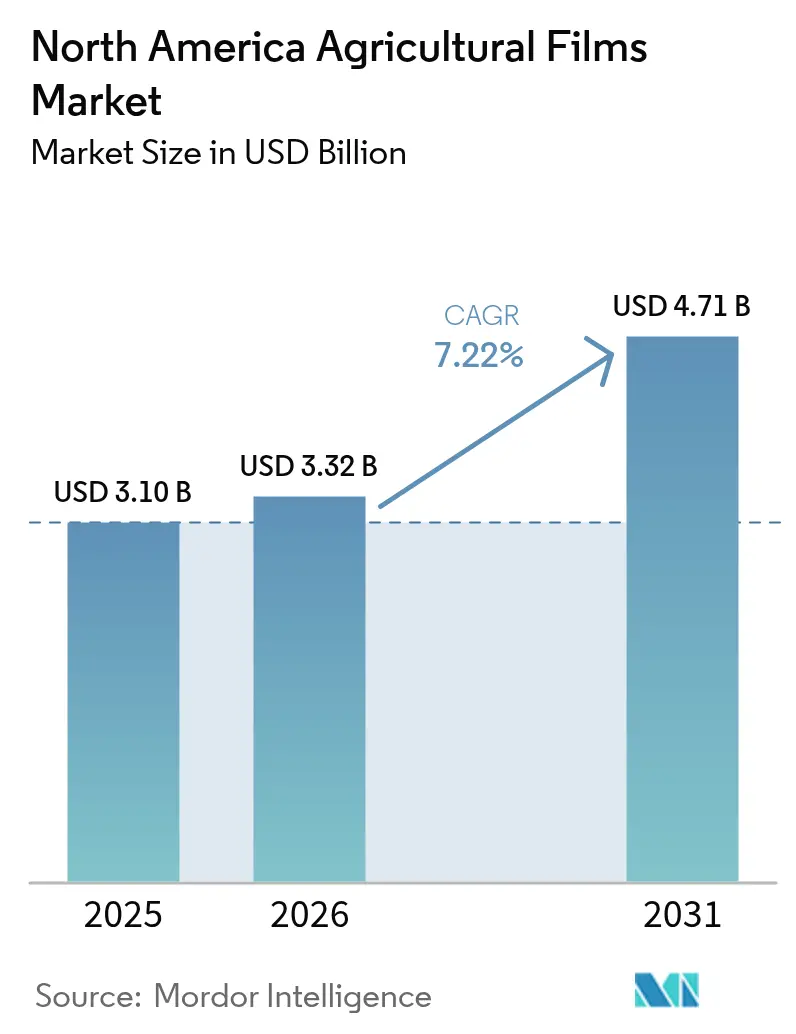
| Base Year Market Size (2025) | USD 3.10 Billion |
| Market Size (2026) | USD 3.32 Billion |
| Market Size (2031) | USD 4.71 Billion |
| Growth Rate (2026 - 2031) | 7.22 % |
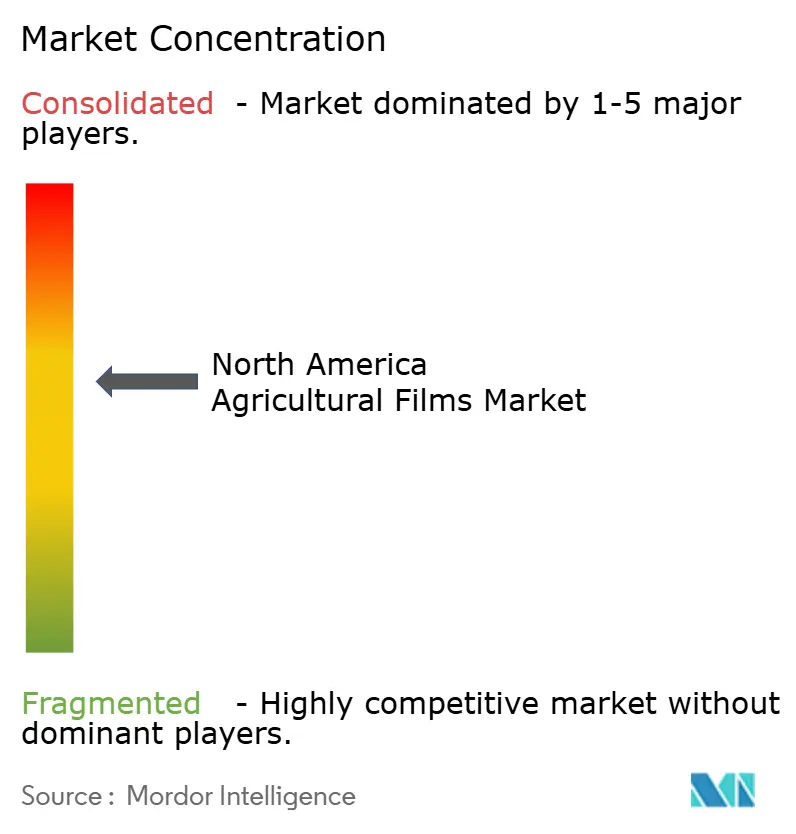
| Market Concentration | Medium |
Major Players *Disclaimer: Major Players sorted in no particular order Image © Mordor Intelligence. Reuse requires attribution under CC BY 4.0. | |
North America Agricultural Films Market Analysis by Mordor Intelligence
The North America agricultural films market size was valued at USD 3.10 billion in 2025 and estimated to grow from USD 3.32 billion in 2026 to reach USD 4.71 billion by 2031, at a CAGR of 7.22% during the forecast period (2026-2031). Accelerated greenhouse construction, larger dairy operations that require silage wrap, and expanding precision agriculture all reinforce steady demand, while corporate net-zero targets create price premiums for recycled-content products. Plastic resin majors are integrating vertically to secure ethylene supply and recycled feedstock, because volatile raw-material costs threaten margins and state rules on plastic waste tighten each year. Mexico’s public farm-modernization budget, Canada’s controlled-environment boom, and shifting weather patterns in the United States combine to keep the growth profile balanced across the region. The market still contends with logistics gaps in agricultural-film recycling and heterogeneous rules on single-use plastics that complicate inventory planning.
Key Report Takeaways
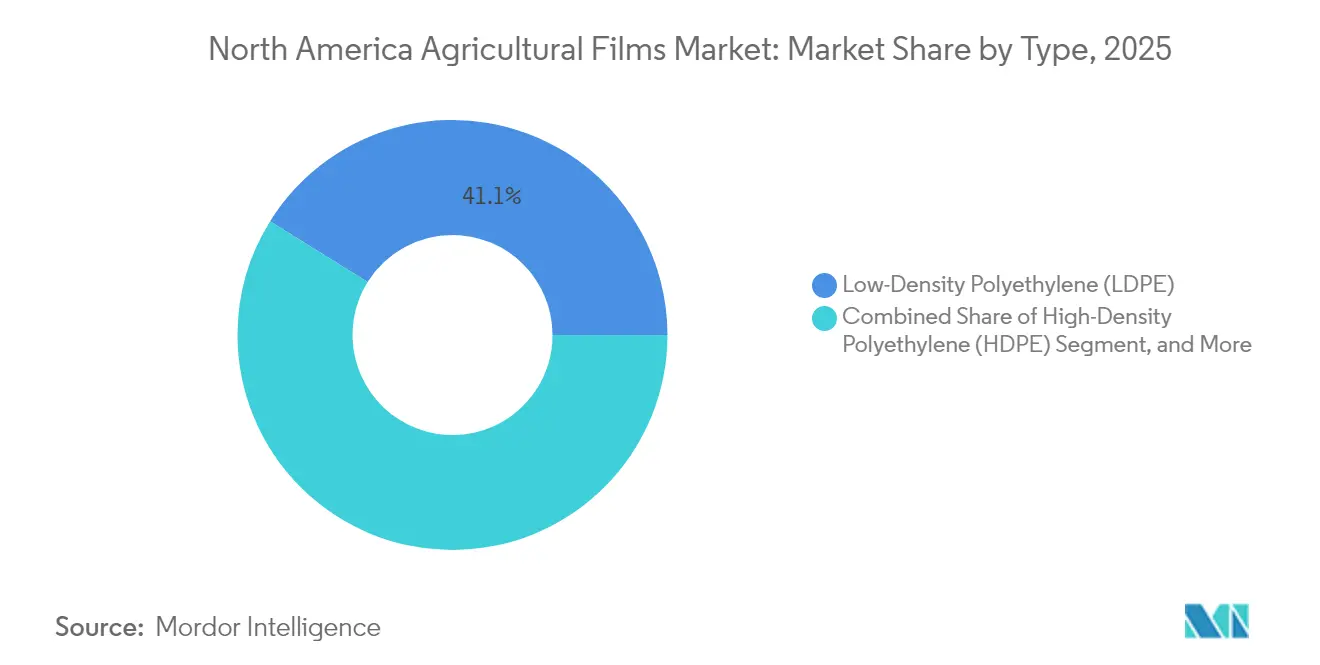
- By type, low-density polyethylene maintained a 41.12% North America agricultural films market share in 2025, but recycled films are forecast to expand at a 10.02% CAGR during the same period.
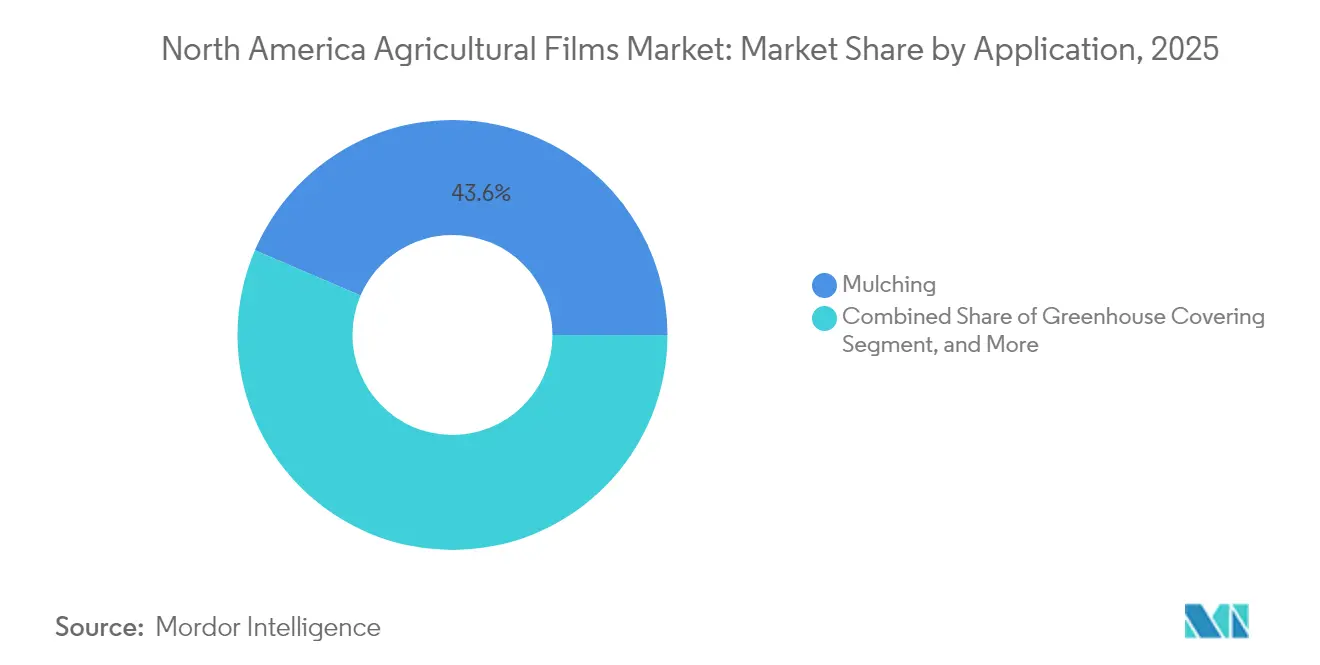
- By application, mulching films accounted for 43.55% of the North America agricultural films market size in 2025, while silage and bale wrap are poised to grow at an 7.98% CAGR to 2031.
- By thickness, films up to 80 microns led with 57.35% revenue share in 2025, whereas films above 150 microns are projected to post the fastest 9.04% CAGR through 2031.
- By geography, the United States held a 66.45% share of the North America agricultural films market in 2025, while Mexico is projected to register the fastest 7.38% CAGR through 2031.
- Key players in the market include Amcor plc, Dow Inc., BASF SE, Exxon Mobil Corporation, and RKW Group that are moderately concentrated.
Note: Market size and forecast figures in this report are generated using Mordor Intelligence’s proprietary estimation framework, updated with the latest available data and insights as of 2026.
North America Agricultural Films Market Trends and Insights
Drivers Impact Analysis*
| Driver | (~) % Impact on CAGR Forecast | Geographic Relevance | Impact Timeline |
|---|---|---|---|
| Growing need to maximize yields on shrinking arable land | +1.2% | Global, with concentration in US Midwest and Canadian Prairies | Medium term (2-4 years) |
| Expansion of controlled-environment agriculture and vertical greenhouses | +0.9% | North America, with early gains in Ontario, California, and Texas | Long term (≥ 4 years) |
| Rising silage demand from large-scale dairy operations | +0.7% | US Dairy Belt, Eastern Canada, and Northern Mexico | Short term (≤ 2 years) |
| Corporate net-zero pledges accelerating demand for recyclable films | +0.8% | North America and EU, spill-over to Mexico | Medium term (2-4 years) |
| Adoption of smart, UV-selective films integrating IoT sensors | +0.5% | US and Canada, limited Mexico penetration | Long term (≥ 4 years) |
| State incentives for compostable mulch film trials | +0.3% | California, Washington, and Oregon primarily | Short term (≤ 2 years) |
| Source: Mordor Intelligence | |||
Growing need to maximize yields on shrinking arable land
Agricultural intensification drives film adoption as farmers confront the dual challenge of feeding growing populations while losing productive acreage to urbanization and climate impacts. Farmland conversion has accelerated since 2020, prompting growers to deploy mulch films that can lift specialty-crop yields 15-25% and cut water use up to 40%.[1] Multi-layer products regulate soil temperature and retain moisture, allowing multiple crop cycles each year despite higher climate volatility. These performance gains are attractive even when feedstock prices rise, because the incremental revenue per acre still offsets film costs.
Corporate net-zero pledges accelerating demand for recyclable films
Corporate sustainability commitments reshape procurement priorities as food companies establish recycled content targets and carbon reduction goals. Brand owners such as Amcor plc pledge 30% recycled content by 2030, cascading recycled-material targets down the supply chain. Chemical-recycling pilots promise contamination tolerance, opening a new outlet for used farm films. Although recycled resin costs exceed virgin prices, food companies pay premiums to validate environmental claims, sustaining double-digit growth in recycled films.
Adoption of smart, UV-selective films integrating IoT sensors
Precision agriculture adoption drives demand for intelligent film systems that integrate environmental monitoring and crop optimization capabilities. Ultraviolet-reflecting films that maximize photosynthetically active radiation generate documented yield gains in greenhouse vegetables.[2] Adding embedded humidity and temperature sensors permits real-time irrigation and ventilation control, but high unit costs restrict uptake to premium crops. Hardware prices are falling, which should broaden adoption from 2027 onward.
State incentives for compostable mulch film trials
California dedicated more than USD 10 million in Healthy Soils Program grants during 2024 for biodegradable mulch demonstrations. Subsidies defray the 50-100% price premium over standard polyethylene. Regulatory compliance with California's SB 54 plastic reduction mandates creates additional incentives for biodegradable film adoption in agricultural applications. The programs' limited geographic scope and budget constraints restrict broader market impact, though successful demonstrations could drive expanded funding and adoption.
Restraints Impact Analysis*
| Restraint | (~) % Impact on CAGR Forecast | Geographic Relevance | Impact Timeline |
|---|---|---|---|
| Stringent state bans on single-use plastics | -0.8% | California, New York, and Washington primarily | Short term (≤ 2 years) |
| Volatile ethylene feedstock prices | -0.6% | North America, with spillover effects globally | Short term (≤ 2 years) |
| Slow farm-level ROI on premium multi-layer films | -0.5% | US and Canada, limited Mexico impact | Medium term (2-4 years) |
| Recycling logistics gaps for contaminated agri-plastics | -0.4% | North America, with concentration in rural areas | Long term (≥ 4 years) |
| Source: Mordor Intelligence | |||
Stringent state bans on single-use plastics
California Senate Bill 54 requires a 25% cut in single-use plastics by 2032, and draft rules leave agricultural films in a gray area. New York and Washington in the United States pursue similar legislative frameworks that could restrict conventional polyethylene film usage in agricultural applications. Compliance costs and administrative burdens associated with producer responsibility organizations add operational complexity for film manufacturers and distributors. The regulatory patchwork across states creates market fragmentation that complicates distribution strategies and inventory management for national suppliers.
Volatile ethylene feedstock prices
Ethylene price volatility directly impacts agricultural film production costs, with feedstock representing 60-70% of total manufacturing expenses. Geopolitical tensions and supply chain disruptions create additional price uncertainty that film manufacturers struggle to pass on to price-sensitive agricultural customers. The industry's limited ability to hedge long-term feedstock costs creates margin pressure during periods of rapid price increases. Alternative feedstock sources, including bio-based ethylene from agricultural residues, offer potential price stability but remain economically uncompetitive at current scales.
*Our forecasts treat driver/restraint impacts as directional, not additive. The impact forecasts reflect baseline growth, mix effects, and variable interactions.
Segment Analysis
By Type: Recycled Content Drives Innovation
Low-density polyethylene is anticipated to maintain a 41.12% share of the North America agricultural films market in 2025, benefiting from established supply chains and processing familiarity among film manufacturers and farming end-users. Recycled films emerge as the fastest-growing segment at 10.02% CAGR through 2031, driven by corporate sustainability mandates and regulatory pressures for circular economy adoption. Linear low-density polyethylene and high-density polyethylene serve specialized applications requiring enhanced puncture resistance and barrier properties, particularly in silage and fumigation applications. Ethylene vinyl acetate and ethylene butyl acrylate copolymers target premium greenhouse covering applications where light transmission and durability command higher pricing.
The compostable films segment, while representing a small current share, demonstrates significant growth potential as regulatory frameworks evolve and cost premiums narrow. BASF SE's ecovio mulch film technology showcases compostable alternatives that eliminate disposal concerns while maintaining agronomic performance. Novamont S.p.A.'s Mater-Bi bioplastic platform gains traction in organic farming applications, where soil compostability provides competitive advantages. The segment's evolution toward higher biobased content and improved mechanical properties addresses historical performance limitations that constrained adoption.

By Application: Silage Wrap Gains Momentum
Mulching applications command 43.55% of the North America agricultural films market size in 2025, reflecting the technology's proven effectiveness in specialty crop production and water conservation strategies. The segment benefits from established agronomic practices and demonstrated return on investment across diverse crop types and growing conditions. Greenhouse covering represents a high-value application requiring specialized properties, including light transmission optimization, condensation control, and extended durability under harsh environmental conditions. Fumigation applications serve niche markets with specific regulatory requirements and seasonal demand patterns.
Silage and bale wrap emerge as the fastest-growing application at 7.98% CAGR, driven by dairy industry consolidation and mechanization trends that favor large-scale operations. The application's technical requirements for anaerobic preservation and weather resistance create barriers to entry that support premium pricing. Advanced silage films incorporate multi-layer constructions that provide superior puncture resistance and UV protection essential for maintaining feed quality. The shift toward round bale silage systems, particularly in regions with unpredictable weather patterns, drives demand for specialized wrapping films that ensure consistent fermentation outcomes.
By Thickness: Demand Shifts Toward Thicker Films for Premium Tasks
Films up to 80 micron controlled 57.35% of the North America agricultural films market share in 2025, reflecting their widespread use in mulching, where material cost per acre dominates purchasing decisions. The 81–150 micron range serves intermediate needs such as greenhouse sidewalls and temporary crop covers that require moderate durability without premium prices. In contrast, films above 150 micron are on track for a 9.04% CAGR through 2031, making them the fastest-growing thickness group and lifting the overall North America agricultural films market size as growers shift toward longer-lasting solutions.
Technical demands are reshaping thickness selection. Greenhouse operators increasingly specify covers over 150 microns to withstand wind, hail, and ultraviolet exposure for several seasons while preserving high light transmission. Dairy producers favor a thicker silage wrap to resist punctures from coarse forage and to lock in the anaerobic conditions vital for fermentation. Multi-layer constructions, which increase total gauge while adding barrier and strength properties, are gaining traction wherever film failure would create costly crop or feed losses. As farms focus on total cost of ownership rather than lowest upfront price, the market continues its gradual move toward thicker, performance-driven films.
Geography Analysis
The United States commanded 66.45% of 2025 sales, anchored by the Central Valley, the Southeast vegetable belt, and the expanding greenhouse footprint in Texas. California’s plastic-reduction targets drive early trials of biodegradable mulch that could scale nationally once cost hurdles fall. Midwest growers adopt mulch film to conserve water as drought cycles intensify, while large dairy operations in the upper Midwest adopt silage wrap that preserves feed quality under variable weather.
Mexico posted a 7.38% CAGR outlook on the back of MXN 80 billion (USD 4.4 billion) in government farm-modernization funding that subsidizes greenhouse construction and drip irrigation. Greenhouse acreage exceeds a significant amount, turning the country into a high-value export supplier and a notable consumer of specialty covers. Sinaloa alone produced a significant amount of agri-food in 2023, illustrating the scale of plastic-film use in protected horticulture.
Canada’s controlled-environment sector concentrates in Ontario’s greenhouse belt, where operators overcome high energy and labor costs with automation investments that include advanced films. Federal quality regulations enforced by the Canadian Food Inspection Agency ensure consistent input standards that favor premium multilayer products. Growth remains steady despite labor shortages because automation offsets headcount and maintains yields year-round.
Regulatory Landscape
Regulation affecting agricultural films in North America is increasingly shaped by state and provincial plastic-waste frameworks that interact with farm-use exemptions and end-of-life responsibilities. In the United States, California Senate Bill 54 sets a 25% reduction target for single-use plastics by 2032, and similar policy directions in states such as New York and Washington add compliance complexity for film suppliers that sell across multiple jurisdictions. This patchwork reinforces demand for recycled-content and compostable alternatives as disposal and producer responsibility requirements tighten.
Environmental and input-use compliance also influence film selection. The US Environmental Protection Agency (EPA) implemented updates to the Worker Protection Standard Application Exclusion Zone (effective December 3, 2024), and the EPA's 2026 Pesticide General Permit under the Clean Water Act establishes permitting conditions for certain pesticide-application discharges (with an effective date in October 2026). In Canada, Health Canada's Pest Management Regulatory Agency advanced a continuous oversight policy for pesticides and opened a February 2026 consultation (PRO2026-01) on permitting pesticide application by remotely piloted aircraft systems (drones) for products currently registered for aerial application, supporting precision application practices that can pair with protected-cropping systems using greenhouse films.
Competitive Landscape
The North America agricultural films market is moderately concentrated. Amcor plc, Dow Inc., BASF SE, Exxon Mobil Corporation, and RKW Group lead in volume or technology. Amcor's all-stock merger with Berry Global in April 2025 created a global packaging company with enhanced material science capabilities. The merger strengthens their agricultural film portfolio of mulch films, silage wraps, and greenhouse covers.[3] Technology differentiation increasingly centers on sustainability credentials, smart film functionalities, and application-specific performance characteristics that command premium pricing in specialized segments.
Dow Inc. partnered with New Energy Blue LLC to secure bio-based ethylene, a move that insulates against fossil-feedstock volatility and supports brand decarbonization pledges. Innovation activity focuses on multilayer structures that blend recycled resin, compostable formulations that meet regional soil standards, and smart films with sensor integration. Smaller specialists such as Novamont S.p.A. and Ginegar Plastic Products Ltd. carve out niches in compostable mulch and greenhouse-specific covers, respectively, leveraging proprietary chemistries and field support services.
Market entry barriers include capital-intensive extrusion assets, customer qualification cycles, and regulatory certifications. Nonetheless, opportunities exist in recycling infrastructure build-outs because post-consumer agricultural film collection is underdeveloped. Partnerships between resin producers, waste haulers, and grower cooperatives are emerging to close the loop and capture resin value.
North America Agricultural Films Industry Leaders
-
Amcor plc
-
BASF SE
-
Dow Inc.
-
Exxon Mobil Corporation
-
RKW Group
- *Disclaimer: Major Players sorted in no particular order
Market Opportunities and Future Outlook
Circular-economy execution remains a primary whitespace across North America agricultural films because collection and reprocessing of contaminated agri-plastics is uneven in rural areas, while corporate net-zero commitments continue to pull recycled-content specifications into procurement. Recycled films are the fastest-growing type segment in the report, and supplier programs that improve mono-material design and recycled-content compatibility support higher-value offerings for mulch, silage, and greenhouse applications where end-of-life handling is scrutinized. State-supported trials for compostable mulch also create targeted opportunities where disposal constraints are most acute. In 2024, California allocated more than USD 10 million in Healthy Soils Program grants for biodegradable mulch demonstrations.
Technology-driven protected agriculture and precision farming create a second opportunity layer by raising performance requirements for durability, light management, and data integration. Smart and UV-selective films that integrate sensing align with on-farm digitalization, and thicker, multi-layer constructions (including gauges above 150 microns) are being specified where failure risk is costly, including multi-season greenhouse covers and puncture-resistant silage wrap. On the crop-protection side, July 2026 US EPA actions around new herbicide chemistries, including Valent U.S.A.'s Rapidicil (epyrifenacil) approval for preplant burndown, underscore continued focus on resistance management and field efficiency, reinforcing demand for film-enabled production systems that conserve water, stabilize yields, and support more precise input programs.
Recent Industry Developments
- April 2026: Amcor announced a multi-million-euro investment in a new printing line at its Hardenberg, Netherlands facility to strengthen industrial film capabilities used in agricultural markets such as fertilizers and peat. The added capability supports higher-performance printed films and helps scale sustainability-oriented formats that require tighter quality control and traceability in packaging and film supply.
- April 2025: Amcor completed its all-stock acquisition of Berry Global, creating a larger packaging company with expanded material science and converting capacity. The combination broadens the platform for agricultural film formats such as mulch films, silage wraps, and greenhouse-related films by integrating complementary assets and innovation pipelines under one supplier.
- July 2024: Dow expanded Pack Studios in Freeport, Texas by adding a Machine Direction Orientation (MDO) unit and a new cast film line to accelerate development and testing of advanced film structures. The upgrade strengthens pilot-scale capability for mono-material and downgauged film designs that translate into recyclable agricultural and industrial film solutions.
Research Methodology Framework and Report Scope
Market Definition and Coverage
This market covers polymer based films used in farming to protect crops, manage moisture, and support yield outcomes across North America. Demand is linked to planted area, protected cultivation footprint, and livestock feed storage needs such as silage covering.
Scope exclusions: We exclude non-agricultural plastic packaging films and industrial stretch or shrink films that are not used for crop or farm production use cases.
Segmentation Overview
- By Type
- Low-Density Polyethylene (LDPE)
- Linear Low-Density Polyethylene (LLDPE)
- High-Density Polyethylene (HDPE)
- Ethylene Vinyl Acetate and Ethylene Butyl Acrylate
- Recycled Films
- Compostable Films
- By Application
- Mulching
- Greenhouse Covering
- Silage and Bale Wrap
- Fumigation
- By Thickness
- Up to 80 Micron
- 81 to 150 Micron
- Above 150 Micron
- By Geography
- United States
- Canada
- Mexico
- Rest of North America
Data Sources, Market Sizing, and Validation
Desk Research
Desk work was used to set the factual base for the model, especially around crop area, protected cultivation, and polymer usage patterns that drive film demand. We referenced public sources such as USDA crop and farm income statistics, Statistics Canada agriculture tables, and FAOSTAT to cross-check harvested area and yield shifts.
To ground pricing and resin availability, we reviewed sources such as USITC trade data for film and resin related flows, and US EPA documents and state level guidance that can affect film collection and disposal practices. Alongside these, we used company annual reports, investor presentations, association publications, and trusted news coverage to capture capacity additions, product launches, and channel shifts. For hard-to-trace private company context, limited paid subscriptions were used for company financials, news screening, patent lookups, and shipment level trade signals. These examples are not exhaustive, and many other public and internal references were reviewed for data collection, validation, and clarification.
Primary Interviews and Surveys
Primary discussions were used to test our assumptions on film consumption per acre, greenhouse cover replacement cycles, and the actual spread between commodity and specialty film pricing. We spoke with a mix of film converters, resin linked suppliers, distributors, and large farm operators across the United States, Canada, and Mexico. Their feedback was used to adjust utilization, loss factors, and adoption curves where desk sources were thin.
Distribution of primary research fieldwork respondents
| Company type | Respondent position |
|---|---|
| Top tier: 28% | CXOs: 12% |
| Mid tier: 55% | Functional/Unit leaders: 40% |
| Smaller Players: 17% | Managers: 48% |
Market-Sizing & Forecasting
Sizing starts with a top-down demand pool build, where cultivated area and protected cultivation footprint are translated into film requirement using practical usage coefficients that vary by application. For North America, that means greenhouse covered area trends, mulch film penetration in high value crops, and silage and bale wrap intensity in dairy and cattle regions that are built into the core demand logic, and then converted to value using typical price bands.
Once that view is built, selective bottom-up checks are used to keep totals realistic, including sampled supplier revenue mapping, channel feedback on volumes, and ASP x estimated tonnage spot checks for the main film families. Key inputs that matter most include film replacement frequency (especially greenhouse covers), share of drip and mulch adoption by crop type, recycled content and multilayer structure impacts on pricing, resin price movement, and import share changes for film and resin feedstocks. Forecasts lean on scenario analysis, because weather, planted area shifts, and policy pressure on single-use plastics can change demand faster than a single trend line, and expert consensus helps set the most likely case.
Where the bottom-up checks have gaps, we do not force a full company roll-up, and instead use conservative proxies like distribution throughput signals and capacity utilization ranges to avoid overstating supply that cannot be sold locally.
Data Validation & Update Cycle
Outputs are checked in layers, starting with consistency tests against independent signals such as greenhouse build activity, resin pricing direction, and import patterns, and then moving to application level sanity checks. When a value swing looks too large for a given year, we re-check assumptions like acreage, replacement rates, and ASP timing, and then re-contact selected experts to confirm what changed.
Before sign-off, the model and narrative go through a multi-step analyst review so calculation logic, units, and currency conversions remain consistent across years. Reports are refreshed annually, and interim updates are made when material events occur, such as major policy changes, large capacity moves, or sudden resin price shocks. Right before delivery, a final pass is run so clients receive the latest updated view.
Mordor Intelligence's North America Agricultural Films Market Size Versus Other Published Estimates
Published estimates for North America agricultural films often do not match because the scope lines are drawn differently and the model inputs are not always built from the same demand indicators. Differences usually show up in which film products are counted, which years are treated as the base, and how pricing is handled when resin costs move quickly.
Stretch film used for industrial pallet wrap sits outside Mordor Intelligence's scope, which is one reason some broader plastic film figures appear higher even when the geography label looks similar. Another common gap comes from mixing volume-led demand builds with supply side revenue roll-ups without reconciling trade. That can double count imports or miss distributor margins. Currency conversion timing and refresh cadence also matter, because fast changes in resin and freight can shift realized prices year to year.
Benchmark comparison
| Source | Market Size | Gaps in Research Methodology |
|---|---|---|
| Mordor Intelligence | USD 3.32 B (2026) | |
| Regional Consultancy A | USD 5.08 B (2026) | Uses a broader product scope that appears to include stretch film and adjacent agricultural plastic items, which increases totals even before pricing assumptions are reconciled. |
| Global Consultancy B | USD 2.60 B (2023) | Uses an older base year and a different segmentation lens (conventional vs biodegradable), and the year mismatch makes direct comparison difficult without re-basing to the same pricing period. |
The table indicates that the spread is mainly explained by scope width and year alignment, followed by pricing timing differences when resin costs move. Our checks against acreage driven demand signals and application replacement cycles help keep the estimate traceable to clear drivers that can be revisited when assumptions change.
Key Questions Answered in the Report
What is the current value of the North America agricultural films market?
The market is valued at USD 3.32 billion in 2026 and is forecast to reach USD 4.71 billion by 2031.
Which application segment is growing the fastest?
Silage and bale wrap is projected to grow at an 7.98% CAGR through 2031 on the back of dairy-sector consolidation.
How large is the United States share of regional sales?
The United States accounted for 66.45% of North America agricultural films market share in 2025.
Why are recycled-content films gaining traction?
Brand-owner net-zero pledges and state plastic-reduction rules support demand, even though recycled films command price premiums.