
Nordics Cybersecurity Market Size and Share
Market Overview
| Study Period | 2021 - 2031 |
|---|---|
| Forecast Data Period | 2026 - 2031 |
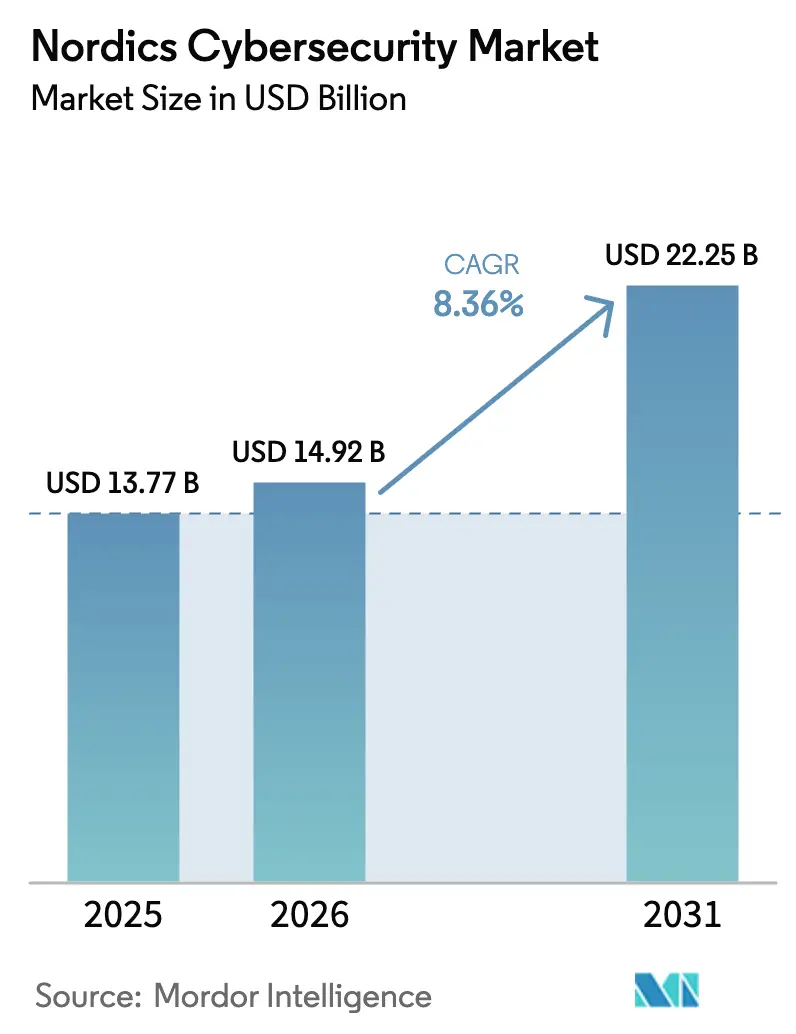
| Base Year Market Size (2025) | USD 13.77 Billion |
| Market Size (2026) | USD 14.92 Billion |
| Market Size (2031) | USD 22.25 Billion |
| Growth Rate (2026 - 2031) | 8.36 % |
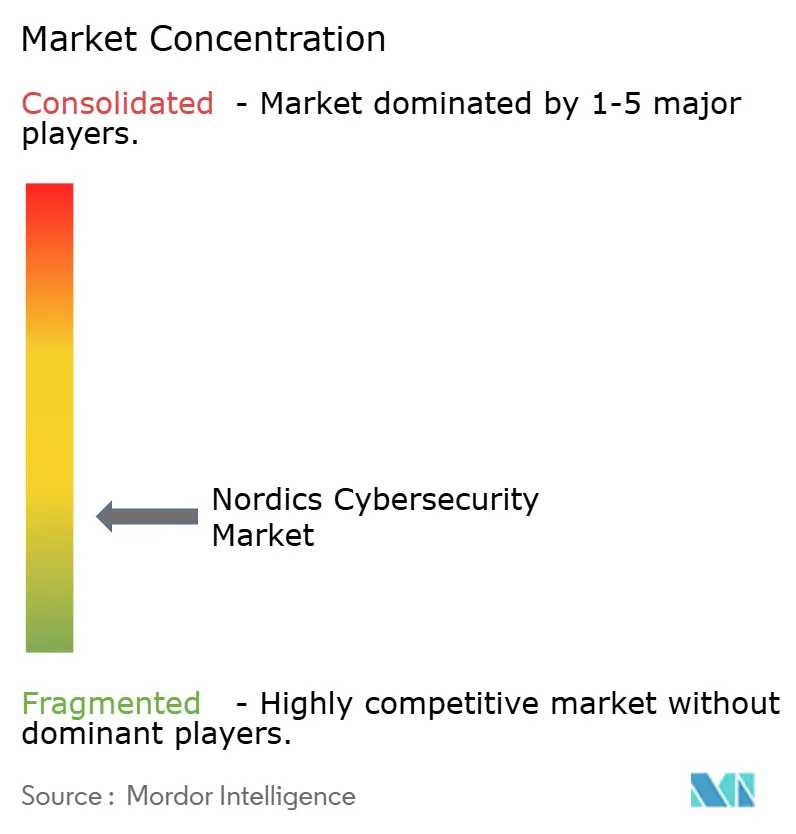
| Market Concentration | Low |
Major Players *Disclaimer: Major Players sorted in no particular order Image © Mordor Intelligence. Reuse requires attribution under CC BY 4.0. | |
Nordics Cybersecurity Market Analysis by Mordor Intelligence
Nordics cybersecurity market size in 2026 is estimated at USD 14.92 billion, growing from 2025 value of USD 13.77 billion with 2031 projections showing USD 22.25 billion, growing at 8.36% CAGR over 2026-2031. Heightened geopolitical pressure, especially after Finland’s 2023 NATO accession and Sweden’s ongoing integration, channels fresh capital toward critical-infrastructure protection, managed XDR platforms, and AI-driven security operations. Government stimulus under the Nordic Defence Cooperation framework spurs joint procurement, while country-level “security-by-design” mandates hasten adoption of integrated risk management tools that automate incident reporting within 24 hours. Demand is also fueled by 5G-enabled Industry 4.0 programs that expand OT attack surfaces, compelling energy, manufacturing, and automotive verticals to converge IT and OT defenses. Vendor consolidation accelerates as end users trim tool sprawl, with platform suppliers promising mean-time-to-detection cuts of 40-60% and sizable operational-cost savings.
Key Report Takeaways
- By offering, cloud security led with 25.62% of Nordics cybersecurity market share in 2025, whereas integrated risk management is projected to grow at a 14.86% CAGR to 2031.
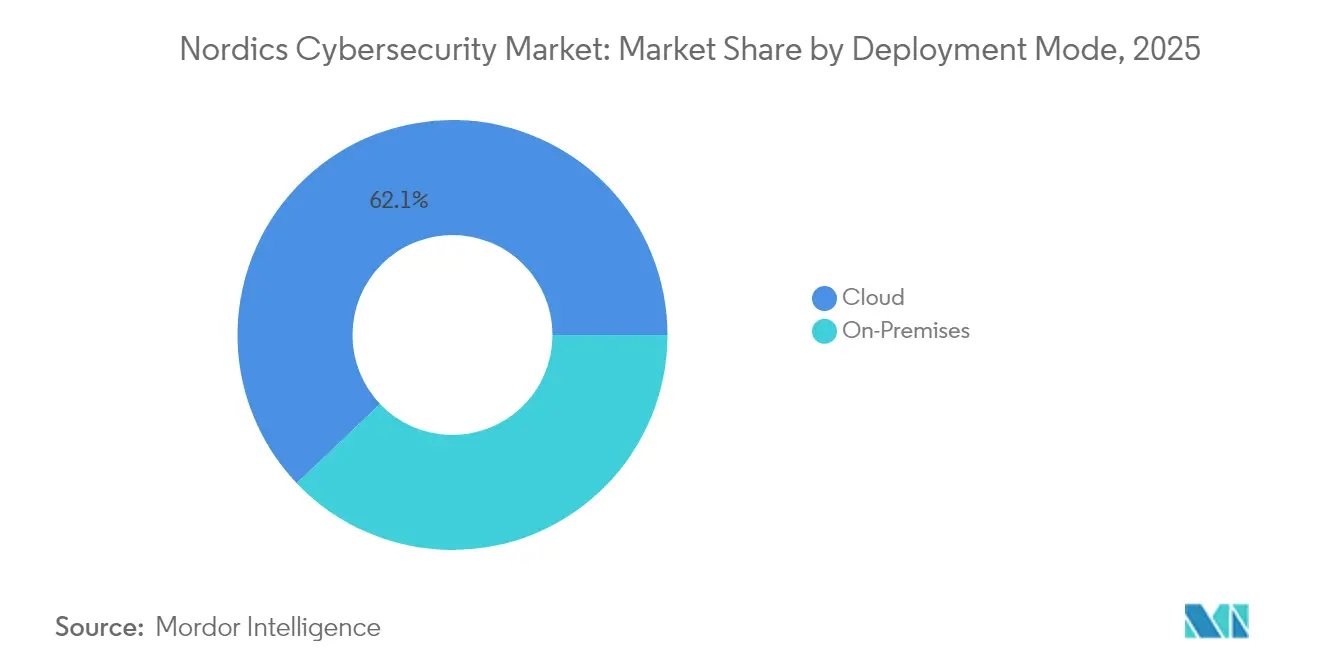
- By deployment mode, cloud deployment accounted for 62.10% share of the Nordics cybersecurity market size in 2025 and is expanding at a 13.02% CAGR through 2031.
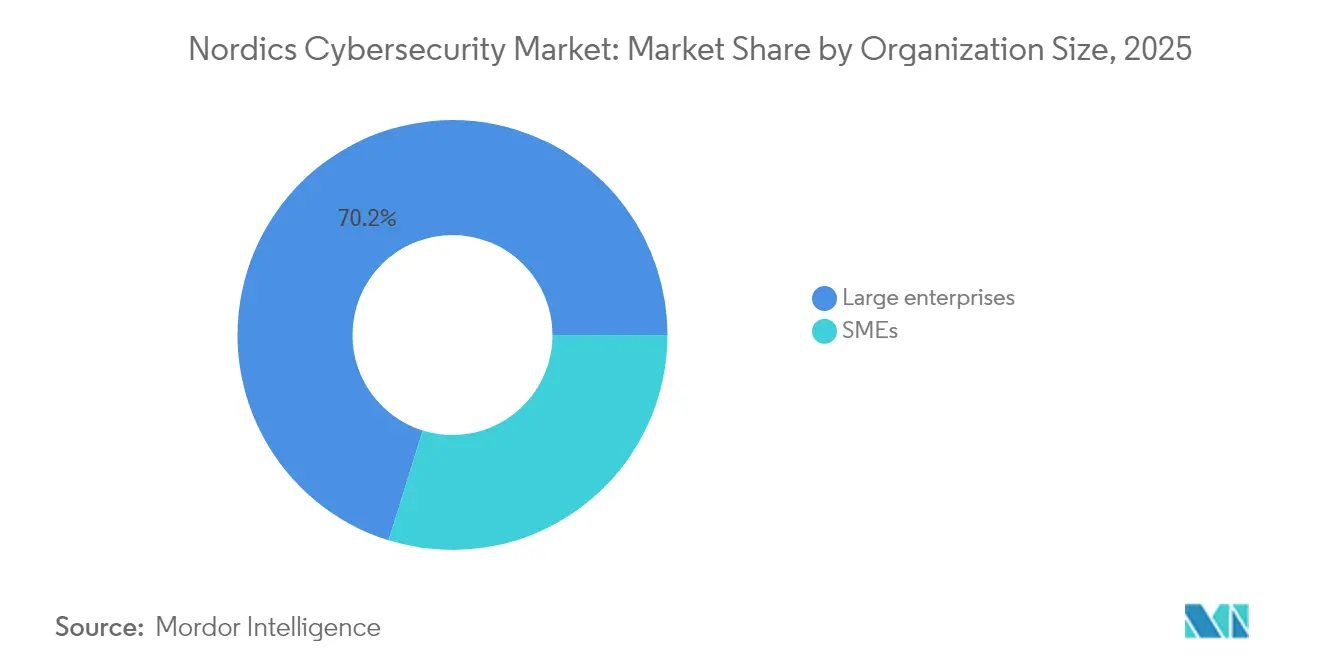
- By organisation size, large enterprises held 70.20% of the Nordics cybersecurity market share in 2025, while SMEs post the quickest 11.21% CAGR to 2031.
- By end-user vertical, BFSI captured 23.10% share of the Nordics cybersecurity market size in 2025; Industrial and Defence is climbing at a 12.31% CAGR.
- By country, Sweden commanded 38.65% market share in 2025, whereas Norway exhibits the fastest 9.82% CAGR to 2031.
Note: Market size and forecast figures in this report are generated using Mordor Intelligence’s proprietary estimation framework, updated with the latest available data and insights as of 2026.
Market Trends and Insights
Drivers Impact Analysis of Nordics Cybersecurity Market*
| Driver | (~) % Impact on CAGR Forecast | Geographic Relevance | Impact Timeline |
|---|---|---|---|
| Accelerating roll-out of 5G-enabled Industry 4.0 production lines | 1.80% | Sweden, Finland core with spillover to Norway, Denmark | Medium term (2-4 years) |
| Public-sector "security-by-design" mandates under NIS2 & DORA | 2.10% | Global Nordic region | Short term (≤ 2 years) |
| Vendor consolidation to managed XDR platforms | 1.40% | Sweden, Norway primary markets | Medium term (2-4 years) |
| AI-driven automated SOC & SecOps tooling | 1.60% | Denmark, Sweden technology hubs | Short term (≤ 2 years) |
| Shift to cloud-native ERP modernisation in BFSI | 0.90% | Sweden, Denmark financial centers | Medium term (2-4 years) |
| NATO accession–linked defence cyber funding surge | 1.20% | Finland, Sweden defense sectors | Long term (≥ 4 years) |
| Source: Mordor Intelligence | |||
Accelerating roll-out of 5G-enabled Industry 4.0 production lines
Real-time connected robotics, machine-vision inspection, and predictive-maintenance workloads running across private 5G networks have multiplied OT entry points that legacy perimeter controls never addressed. Swedish automakers and Finnish electronics assemblers therefore allocate bigger budgets to zero-trust micro-segmentation, 5G-aware intrusion detection, and protocol translation gateways capable of bridging Modbus, OPC-UA, and IP traffic. Integrators report that each brownfield manufacturing site requires six to nine months of phased security retrofits, while co-developed security frameworks between IT and OT teams checkpoint every automation sprint. The resulting demand spike benefits Nordic vendors with deep OT know-how and global platform leaders that bundle 5G policy engines into consolidated firewalls, thereby raising average contract values and locking in multi-year managed-service revenues.
Public-sector “security-by-design” mandates under NIS2 and DORA
NIS2 obliges organisations exceeding 250 employees or EUR 50 million turnover to file breach reports within 24 hours and to pass yearly risk-maturity audits, while DORA layers mandatory threat-led penetration tests for financial entities. Denmark enacted the rules in March 2025 covering nearly 1,500 entities, and Norway’s Digital Security Act applies fines up to 4% of global turnover for non-compliance. Compliance deadlines compress procurement cycles, pushing high-growth orders for policy-automation software, evidence-tracking modules, and managed compliance services. Nordic banks deploy resilience dashboards that map system dependencies against DORA stress-scenarios and auto-populate regulators’ templates, cutting audit preparation by 70%.
Vendor consolidation to managed XDR platforms
CISOs faced with double-digit tool counts and scarce Nordic-language analysts increasingly favour single-stack XDR suites that fuse SIEM, SOAR, EDR, and NDR data under one analytics plane. Consolidation momentum quickened in 2024 when Logpoint added Danish AI specialist Muninn, providing regionally trained language models that lower false positives on Scandinavian log formats. Norwegian power utilities now negotiate multi-year XDR service contracts that include 24/7 SOC outsourcing and threat-hunting retainer hours. Enterprises cite mean-time-to-detect cuts from 14 hours to under 5 hours, freeing staff for red-team simulations and board-level risk reviews.
AI-driven automated SOC and SecOps tooling
The Nordics will need roughly 300,000 additional security professionals by 2029, but local graduate pipelines fall short. AI-enhanced orchestration tackles repetitive triage tasks, correlating asset inventories, CVE feeds, and MITRE ATTandCK heat maps to surface high-certainty alerts. Danish cloud-software firms report 50-70% drops in false alarms after deploying ML-led playbooks that auto-quarantine suspect endpoints and launch no-code forensics jobs. Deepfake voice identification modules now sit on inbound-call systems at Swedish banks to catch fraud that tripled in 2024, while AI-assisted e-discovery tools shorten GDPR data-subject-access responses to hours instead of days.
Restraints Impact Analysis of Nordics Cybersecurity Market*
| Restraint | (~) % Impact on CAGR Forecast | Geographic Relevance | Impact Timeline |
|---|---|---|---|
| Acute shortage of Nordic-language cyber talent | -1.90% | Regional, most severe in Finland, Norway | Long term (≥ 4 years) |
| High electricity prices limiting on-prem crypto workloads | -0.80% | Denmark, Sweden energy-intensive sectors | Medium term (2-4 years) |
| SME under-investment below 5% of IT budget | -1.10% | Regional SME sector | Short term (≤ 2 years) |
| Fragmented legacy operational tech in utilities | -0.70% | Norway, Finland utilities | Long term (≥ 4 years) |
| Source: Mordor Intelligence | |||
Acute shortage of Nordic-language cyber talent
Vacancy ratios top 40% for roles requiring Swedish or Finnish language skills, and salary inflation tops 12% annually for mid-level security architects. Public agencies postpone SOC modernisation projects, while private-sector firms spend on international contractors who lack regional compliance fluency. Training programs sponsored by telecom operators add only 2,000 graduates yearly, leaving a persistent gap. This scarcity propels uptake of autonomous attack-surface monitoring and managed detection services embedded with local-language playbooks, yet long-term talent constraints continue to cap deployment velocity for bespoke security programmes.
High electricity prices limiting on-prem crypto workloads
Nordic electricity futures rose 31% between 2024 and 2025 after hydro output dipped below 20-year averages. Data-centre operators running on-prem HSM clusters face OPEX spikes, prompting moves to cloud-based key-management services that promise 30% lower per-transaction cost yet raise data-sovereignty debates. Danish pharma manufacturers are deferring rollouts of domestic quantum-safe cryptography pilots until wholesale power rates stabilise, slowing certain high-security workload migrations.
*Our forecasts treat driver/restraint impacts as directional, not additive. The impact forecasts reflect baseline growth, mix effects, and variable interactions.
Nordics Cybersecurity Market Segment Analysis
By Deployment Mode:
Cloud Acceleration Reshapes ArchitectureCloud deployment commanded 62.10% share of the Nordics cybersecurity market size in 2025, equating to USD 8.55 billion. Cost-benefit analyses show 30-40% security infrastructure savings when shifting to shared-responsibility models, while threat telemetry coverage broadens through SaaS audit APIs. Nordic ministries migrate citizen-service portals to private-cloud zones, stipulating that workloads remain within Schengen borders, thereby elevating interest in regionally hosted cloud-native security stacks.
On-prem environments persist in energy, defence, and high-assurance manufacturing, where deterministic latency and air-gap policies remain non-negotiable. Statnett’s OT control-room overhaul illustrates hybrid practice: administrative IT logs ship to a public-cloud SIEM, whereas grid-control enclaves retain on-prem collectors protected by host-based firewalls. Over the forecast period, as utilities modernise substations and automate patch-management, cloud-delivered security analytics will gradually absorb visibility, but sovereign-cloud constructs will still anchor final-mile compliance for classified data.

By Organization Size:
SME Growth Challenges Enterprise DominanceLarge enterprises held 70.20% of 2025 revenues as board-level risk appetites justify multi-million-euro security stack renewals and 24/7 SOC staffing. Fortune-500-scale Nordic multinationals funnel budgets into AI-enhanced threat-hunting and red-team labs. Conversely, SMEs add momentum with 11.21% CAGR as digital invoicing mandates, e-ID integration, and NIS2 reporting pull them into regulated territory.
Budget-constrained SMEs favour subscription bundles that wrap endpoint, email, and vulnerability scanning in one console, often procured via telecom resellers who already invoice broadband connectivity. Vendor roadmaps now include “click-to-comply” wizards tailored to local Data Protection Authorities, further easing adoption. While average SME deal size remains modest, volume scales quickly, and low churn underpins predictable recurring revenue that diversifies vendor portfolios beyond enterprise concentration risk.
By End-user Vertical:
Industrial and Defence Surge Challenges BFSI LeadershipBFSI retained 23.10% of 2025 spending as banks invest in anti-fraud analytics, mobile-banking hardening, and DORA-mandated resilience testing. Nordic lenders use model-risk frameworks to ration cybersecurity outlays across open-banking APIs, real-time payments, and cloud-native micro-services that underpin anything-as-a-service retail products.
Industrial and Defence, projected at a 12.31% CAGR, benefits from NATO-aligned cyber ranges, renewable-energy OT visibility, and drone-command network protection. Energy majors allocate double-digit shares of capex to identity segregation, sensor telemetry, and encrypted telemetry backhaul, while defence primes co-develop fortified DevSecOps pipelines for classified systems. Healthcare, telecoms, and public administration each notch mid-single-digit growth as e-health records, 5G rollout schedules, and citizen-ID schemes expand their threat surfaces.
Geography Analysis
Sweden Cybersecurity Market
Sweden’s 38.65% revenue share comes from its digital-government maturity, export-heavy manufacturing, and deep fintech stack. The state’s EUR 5.3 billion IT-transformation program backs electronic-ID expansion and national-cloud investments, ensuring continuous demand for identity governance, SIEM, and zero-trust architecture services. Swedish start-ups like Detectify and Outpost24 supply attack-surface management SaaS consumed globally, cementing the country as an innovation beacon.
Norway Cybersecurity Market
Norway leads growth with 9.82% CAGR. Its NOK 20 million federal cyber-modernisation fund, plus multi-year commitments from Equinor, Statnett, and the USD 1.6 trillion Government Pension Fund, inject steady projects around OT segmentation, sovereign-cloud logs, and AI-aided SOC correlation. Critical-infrastructure directives require event telemetry retention for five years, driving storage and analytics subscription revenue and nudging utilities toward unified OT-IT observability.
Denmark and Finland Cybersecurity Market
Denmark and Finland round out the region. Denmark’s fintech and shipping clusters adopt secure-access-service-edge (SASE) to safeguard distributed workforces and maritime IoT. The relaunch of the National Cyber Security Council and EUR 100 million earmarked for cyber resilience accelerates SME onboarding to managed services. Finland leverages decades of telecom RandD and its NATO gateway role to prototype quantum-resistant encryption, 6G threat-modelling, and classified sovereign-cloud testbeds that will cascade into civil markets. Collective geographic growth remains underpinned by unified Nordic standards bodies that exchange best practice, harmonising buyer requirements and shortening vendor sales cycles.
Regulatory Landscape
Cybersecurity regulation in the Nordics is tightening through national transpositions of EU frameworks and updates to domestic strategies. Sweden brought its Cybersecurity Act (2025:1506) and associated Ordinance (2025:1507) into force on January 15, 2026, aligning Swedish essential and important entities with NIS2 requirements, including strengthened governance and incident handling obligations. Denmark implemented NIS2 via a national act effective July 1, 2025, while Norway enforces a Digital Security Act framework with financial penalties up to 4% of global turnover for non-compliance. These consequences are already compressing procurement timelines for reporting, audit evidence capture, and managed compliance services.
Policy direction is also being reinforced through multi-year national programs and EU-level supply-chain initiatives. Sweden published its National Strategy for Cybersecurity 2025-2029 in February 2026, and Denmark agreed a Strategy for Cyber and Information Security 2026-2029 in January 2026, both stressing improved incident reporting, management accountability, and capability building across essential services. At the EU level, the ICT Supply Chain Security Toolbox provides a common methodology for member states to assess and mitigate ICT supply-chain risk, while Finland's Traficom issued guidance to support NIS supervisory authorities under Finland's Cybersecurity Act (124/2025), raising expectations for risk management measures and supervisory consistency across covered entities.
Value Chain Analysis
The Nordics cybersecurity value chain connects global platform vendors and regional specialists with local service providers, systems integrators, and telecom-led channels that package solutions into managed offerings for enterprises and SMEs. Upstream, hardware, software, and cloud infrastructure suppliers provide security building blocks (network security equipment, endpoint and identity controls, cloud-native security, and analytics). Midstream, platform vendors and Nordic specialists incorporate these controls into consolidated architectures such as managed XDR and compliance automation, while distributors and MSSPs localize deployments, run 24/7 monitoring, and deliver incident response across Sweden, Norway, Denmark, and Finland.
Downstream, procurement and assurance requirements increasingly reflect supply-chain security standards and public guidance, which shapes vendor qualification and contract scope. SS-ISO/IEC 27036-2:2024 codifies expectations for cybersecurity in supplier-acquirer relationships, supporting structured third-party risk management for buyers in manufacturing, software, and cloud services. Practical enablement tools such as Denmark's SUCCESS (Supply Chain Cybersecurity for SMEs) help smaller suppliers document controls and provide evidence for NIS2-aligned requirements, while the EU ICT Supply Chain Security Toolbox reinforces demand for supplier assessment, continuous monitoring, and audit-ready reporting across Nordic supply chains.
Competitive Landscape
The Nordics cybersecurity market hosts a layered vendor mix comprising US platform giants and home-grown specialists. Fortinet, Palo Alto Networks, and CrowdStrike anchor the high-end platform tier; Fortinet posted USD 5.96 billion 2024 revenue and guides to USD 6.65-6.85 billion for 2025. Their single-pane consoles resonate with enterprises seeking to rationalise overlapping point products.
Regional champions WithSecure, Mnemonic, Arctic Security, and Logpoint leverage cultural proximity, Nordic-language threat intel, and privacy-by-design credentials. Logpoint’s 2024 acquisition of Muninn infused AI-driven anomaly detection into its SIEM, boosting upsell potential to existing public-sector accounts. Telecom-linked players like Telenor Cyberdefence widen managed-service footprints by folding in Combitech’s OT expertise, signalling a march toward bundled SASE plus managed SOC offers.
M&A intensity is forecast to stay elevated as investors chase platform plays that weld threat-intelligence feeds, identity analytics, and compliance automation. Vendors differentiating through sovereign-cloud hosting, quantum-safe crypto, or OT-specific protocol mastery will command valuation premiums. Buyers show heightened preference for vendor viability and roadmap clarity, rewarding suppliers with broad partner ecosystems and in-region support desks.
Nordics Cybersecurity Industry Leaders
-
International Business Machines Corporation
-
Cisco Systems, Inc.
-
Fortinet, Inc.
-
WithSecure Corporation
-
Dell Technologies Inc.
- *Disclaimer: Major Players sorted in no particular order
Nordics Cybersecurity Market Companies Covered in this Report
- International Business Machines Corporation
- Cisco Systems, Inc.
- Dell Technologies Inc.
- Fortinet, Inc.
- Clavister Holding AB
- F5, Inc.
- Gen Digital Inc. (NortonLifeLock)
- Acronis International GmbH
- CyberArk Software Ltd.
- Proofpoint, Inc.
- Trend Micro Incorporated
- Trellix LLC
- Palo Alto Networks, Inc.
- CrowdStrike Holdings, Inc.
- WithSecure Corporation (F-Secure)
- Mnemonic AS
- NetClean Technologies AB
- Secunia ApS (Flexera)
- Promon AS
- Arctic Security Oy
- Visma AS
Market Opportunities and Future Outlook
Compliance-driven modernization continues to open whitespace for managed compliance, evidence automation, and supplier-risk programs that make NIS2-aligned requirements workable across complex subcontractor networks. Denmark's Strategy for Cyber and Information Security 2026-2029 includes an allocated 211 million DKK for 2026-2029, with focus areas that cover SMEs and citizens, which provides a clearer funding and programmatic pathway for vendors and service providers offering packaged controls, incident readiness, and training-linked onboarding. The Nordic-Baltic Cybersecurity Consortium (NBCC), supported by 110 million DKK from the EU, also strengthens cross-border capability building and joint procurement, favoring providers that can deliver standardized controls, reporting templates, and multi-country delivery.
Technology opportunities are concentrating around post-quantum readiness, AI-enabled security operations, and OT/IoT protection tied to critical infrastructure digitization and regulator attention on resilience. Cisco's IOS XE 26 release introduced full-stack post-quantum cryptography capabilities, giving enterprises a concrete adoption path for crypto-agility programs alongside broader network modernization. Partnerships that integrate AI-powered detection and response into existing enterprise stacks, such as IBM and Palo Alto Networks collaborating on unified AI-powered security, support platform consolidation objectives and reduce tool sprawl for buyers facing analyst scarcity. In parallel, supplier-relationship standards such as SS-ISO/IEC 27036-2:2024 and practical SME tooling like SUCCESS point to a measurable gap in third-party cyber assurance, sustaining demand for continuous supplier monitoring, contract-aligned control libraries, and audit-ready documentation across Nordic supply chains.
Recent Industry Developments in Nordics Cybersecurity Market
- May 2026: Truesec published the Nordic CISO Report 2026 based on spring 2026 interviews. The time to exploit vulnerabilities dropped to 2.4 days. The release underscores rising pressure on Nordic asset owners to bolster rapid incident response and patch programs.
- April 2026: Advania extended strategic partnership with Nozomi Networks to provide OT and IoT cybersecurity solutions in the Nordics, Germany, Austria and Switzerland. The partnership expands OT and IoT security offerings in the region. This supports potential upsell into critical infrastructure sectors.
- February 2026: Eye World AB launched Nettskjold security package in partnership with Happybytes to address digital fraud for Norwegian mobile customers. The move strengthens mobile carrier integrated cybersecurity for consumers. It broadens the Nordic threat prevention footprint.
Nordics Cybersecurity Market Report Scope and Research Methodology
Market Definition and Coverage
We define the Nordics cybersecurity market as spending on software, services, and related security tools that help prevent, detect, respond to, and recover from cyber incidents across Denmark, Finland, Norway, Sweden, and Iceland.
Scope exclusions: hardware-only sales that are not security specific, general IT outsourcing without a security mandate, and internal labor costs are excluded where they cannot be consistently separated.
Segments Covered in This Report
- By Offering
- Solutions
- Application Security
- Cloud Security
- Data Security
- Identity and Access Management
- Infrastructure Protection
- Integrated Risk Management
- Network Security Equipment
- Endpoint Security
- Other Solutions
- Services
- Professional Services
- Managed Services
- Solutions
- By Deployment Mode
- Cloud
- On-premise
- By Organisation Size
- SMEs
- Large Enterprises
- By End-User Vertical
- BFSI
- Healthcare
- IT and Telecom
- Industrial and Defence
- Retail
- Energy and Utilities
- Manufacturing
- Others
- By Country
- Denmark
- Norway
- Sweden
- Finland
Data Sources, Market Sizing, and Validation
Desk Research
Desk research is used to map the regional demand backdrop and to anchor the model with traceable reference points. We review public updates on cyber strategy and incident reporting notes from Nordic national cyber agencies, alongside EU level policy text and timelines from the European Commission that affect compliance spend.
We also pull adoption and digital intensity signals from Eurostat, national statistics offices across the Nordics, and publications from central bank or telecom regulators that indicate cloud migration and connectivity trends. To validate the supply side narrative, we review company filings and investor presentations, association websites, and reputed press coverage, then cross-check specific company financial line items using a paid company financials and intelligence subscription. These sources are illustrative only, and many other references were used for collection, validation, and clarification during the research process.
Primary Interviews and Surveys
We use interviews and surveys with cybersecurity executives, functional leaders, and managers across Denmark, Finland, Iceland, Norway, and Sweden to test pricing, adoption, outsourcing, cloud migration, and regulatory spending assumptions. Their feedback helps explain secondary-data gaps, refine country allocations, and triangulate the final Nordics model.
Distribution of primary research fieldwork respondents
| Company type | Respondent position |
|---|---|
| Top tier: 27% | CXOs: 15% |
| Mid tier: 48% | Functional/Unit leaders: 30% |
| Smaller Players: 25% | Managers: 55% |
Market-Sizing & Forecasting
The sizing starts with a top-down demand pool build that follows how cybersecurity budgets are typically set in Nordic organizations, then ties it back to macro and sector level digital activity. We break the region into country level demand blocks and build up by applying security spend intensity to addressable IT and digital operations footprints, then refine the outcome using interview led checks.
Inputs used in the model include indicators such as cloud workload migration pace, regulatory compliance timing (for example, NIS2 and DORA readiness activity), managed security service adoption, severity and frequency of reported incidents, and the share of critical infrastructure under stricter security obligations. Pricing and mix are handled through realistic average selling price and renewal patterns, where multi-year contracts are normalized into annualized values to avoid double counting.
For forecasting, we mainly use scenario analysis supported by a light multivariate check on key drivers so the base case stays aligned with what practitioners expect in Nordic budget cycles. Where bottom-up data is incomplete for smaller spend pockets, we fill gaps using conservative penetration ranges, then re-test totals with channel checks and sampled ASP and times-volume approximations.
Data Validation & Update Cycle
Validation is done through stepwise checks so unusual jumps are questioned before any numbers are locked. We compare outputs against independent signals such as public cyber incident trends, cloud and digital adoption indicators, and observed shifts toward managed detection and response. If a variance is not explainable, we re-contact sources to reconcile assumptions.
Each market model goes through multiple analyst review passes, where assumptions, currency conversions, and country splits are challenged and corrected. Reports are refreshed annually, and interim updates are made when material events occur, such as major regulatory deadlines, large public cyber programs, or notable changes in spending behavior. Before delivery, a final pass is completed so clients receive the latest updated view of the market.
Mordor Intelligence's Nordics Cybersecurity Market Size Compared With Other Published Estimates
Published estimates for the Nordics cybersecurity market can look different because the region and the spending definition are not always handled the same way, and because some publishers report different base years. Differences also come from how services are counted, how cloud security subscriptions are annualized, and when currency conversions are applied.
Key gap drivers usually include whether managed security services are fully included, whether adjacent IT risk work is mixed into cybersecurity, and whether the Nordics are treated as four countries or extended to include Iceland and cross-border public sector programs. Some figures also lean on faster tool replacement assumptions, while others keep pricing flat and do not re-check adoption shifts through buyer interviews, which can move the outcome once real renewal behavior is accounted for by Mordor Intelligence.
Benchmark comparison
| Source | Market Size | Gaps in Research Methodology |
|---|---|---|
| Mordor Intelligence | USD 13.77 B (2025) | |
| Trade Release A | USD 11.71 B (2023) | Uses an earlier base year and does not clarify how multi-year subscriptions and managed services are annualized, which can understate the current spend level after recent compliance driven budget resets. |
| Industry Blog B | USD 12.00 B (2024) | Provides a round figure without a defined spend boundary, currency timing, or a stated method for separating cybersecurity from broader IT resilience work, which makes replication difficult. |
The spread across sources is mainly explained by base-year choice and how recurring security subscriptions and services are treated in annual revenue. By keeping country coverage explicit and tying totals back to repeatable demand drivers and interview-tested pricing and renewal behavior, our estimate stays transparent and easier to reconcile across years.
Key Questions Answered in the Report
What is the current value of the Nordics cybersecurity market?
The Nordics cybersecurity market size stands at USD 14.92 billion in 2026 and is set to reach USD 22.25 billion by 2031.
Which regulatory frameworks are having the greatest impact on cybersecurity spending in the Nordics?
Mandatory compliance with the European Union’s NIS2 directive and the Digital Operational Resilience Act (DORA) is accelerating security investments across both public and private sectors, especially in Denmark and Norway where fines for non-compliance reach up to 4% of annual turnover
What is the biggest restraint on market growth?
A severe shortage of Nordic-language cybersecurity talent—Sweden alone needs nearly 300,000 additional professionals by 2029—continues to delay project timelines and keeps labor costs high
Which country shows the fastest market growth through 2031?
Norway leads with a projected 9.82% CAGR, propelled by large-scale energy digitization projects and fresh government funding tied to the Digital Security Act
How is vendor consolidation shaping the competitive landscape?
Regional specialists and global platform vendors are merging or acquiring AI-driven capabilities—such as Logpoint’s purchase of Muninn—to offer unified XDR suites and address talent shortages, while Fortinet continues to expand revenue, guiding up to USD 6.85 billion for 2025