
Non-steroidal Anti-Inflammatory Drugs (NSAIDs) Market Size and Share
Market Overview
| Study Period | 2020 - 2031 |
|---|---|
| Market Size (2026) | USD 25.48 Billion |
| Market Size (2031) | USD 33.57 Billion |
| Growth Rate (2026 - 2031) | 5.67 % |
| Fastest Growing Market | Asia-Pacific |
| Largest Market | North America |
| Market Concentration | Low |
Major Players *Disclaimer: Major Players sorted in no particular order Image © Mordor Intelligence. Reuse requires attribution under CC BY 4.0. | |
Non-steroidal Anti-Inflammatory Drugs (NSAIDs) Market Analysis by Mordor Intelligence
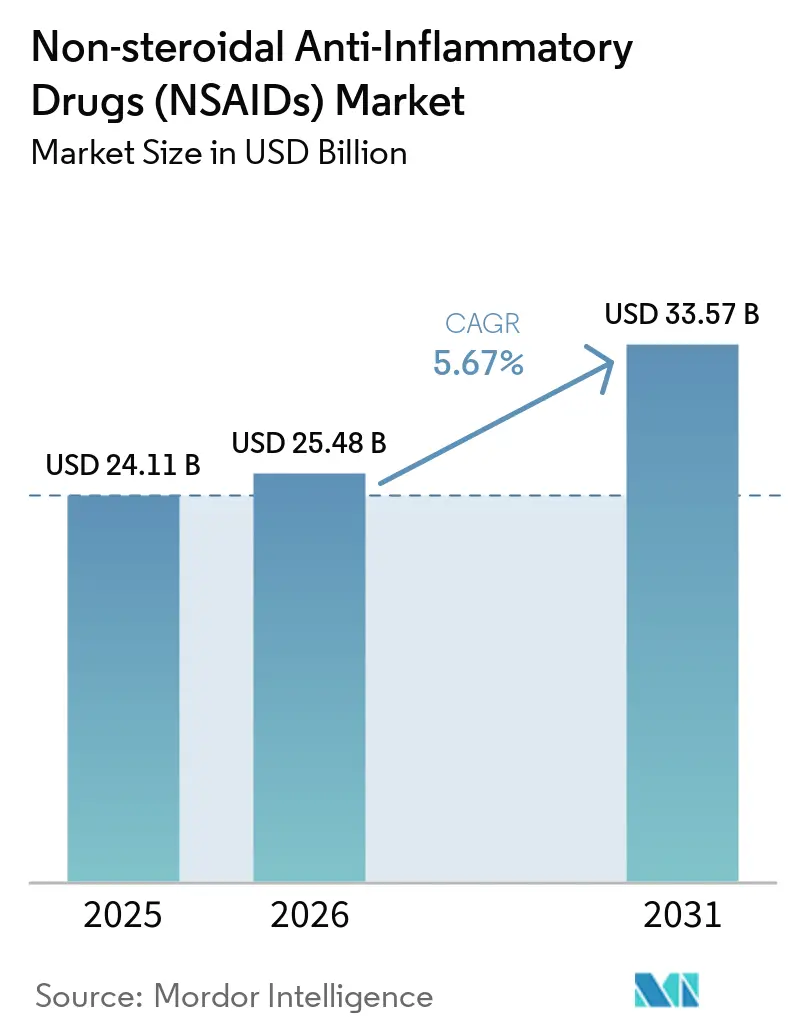
The NSAIDs market size was valued at USD 24.11 billion in 2025 and estimated to grow from USD 25.48 billion in 2026 to reach USD 33.57 billion by 2031, at a CAGR of 5.67% during the forecast period (2026-2031). Demand rises as health systems look for non-opioid pain options, aging populations grow, and over-the-counter (OTC) access expands. Volume gains are tempered by gastrointestinal (GI) and cardiovascular safety warnings, patent expirations, and heightened regulatory scrutiny. North America leads revenue today, yet Asia-Pacific grows fastest as wider insurance coverage and online pharmacies broaden access. Product strategy pivots toward topical gels that mitigate systemic risks, while AI-supported reformulation helps companies extend lifecycles in the NSAIDs market.
Key Report Takeaways
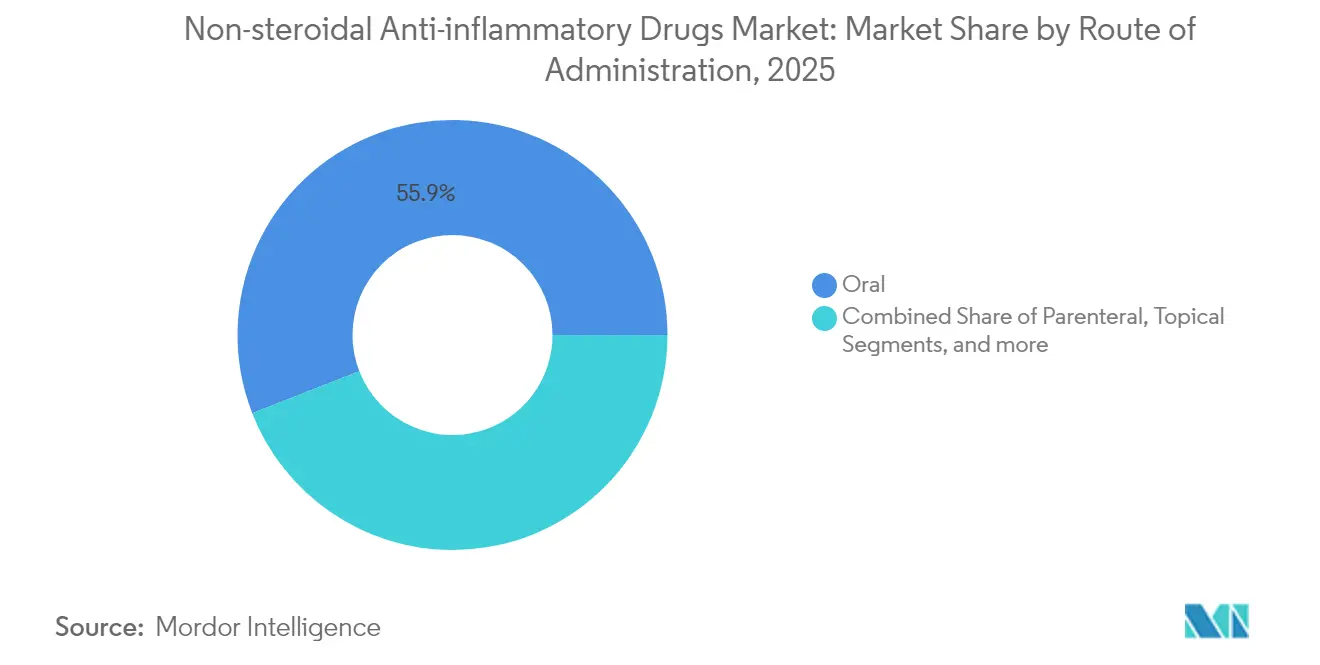
- By route of administration, oral delivery led with 55.92% of NSAIDs market share in 2025, while topical formulations are projected to expand at 6.18% CAGR to 2031.
- By drug class, non-selective COX inhibitors accounted for 61.77% share of the NSAIDs market size in 2025, whereas COX-2 selective drugs are set to grow at 6.32% CAGR through 2031.
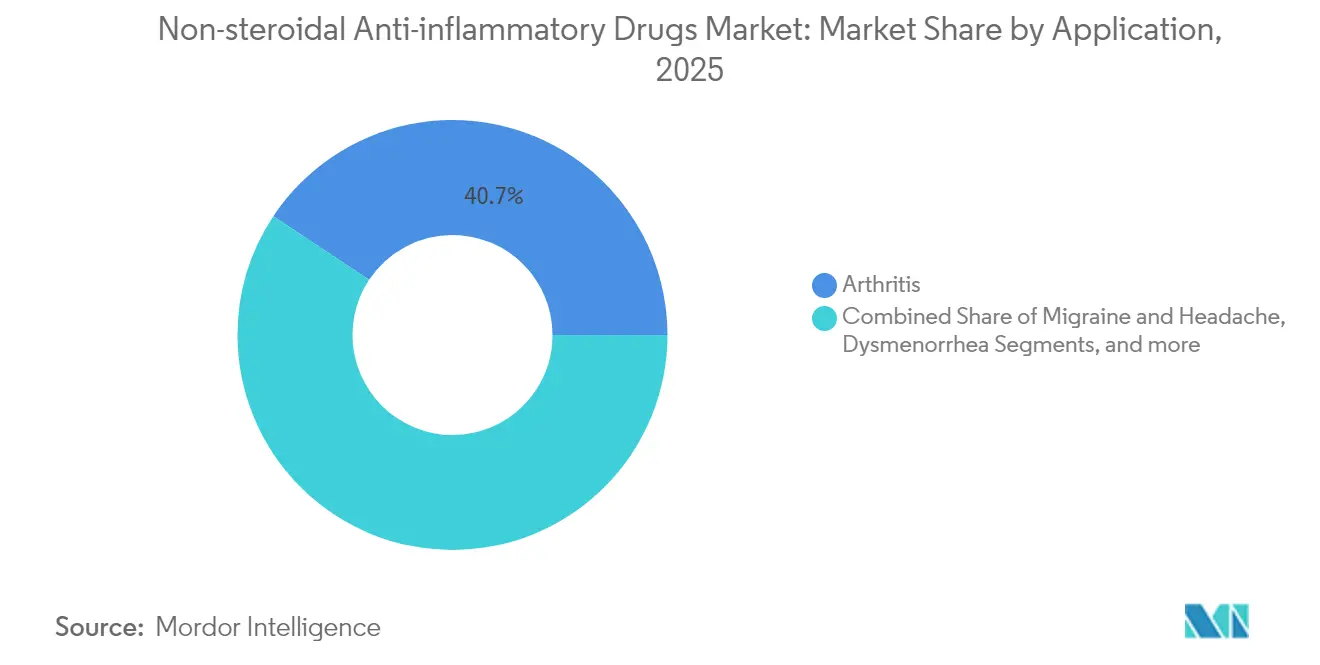
- By application, arthritis treatments captured 40.68% of NSAIDs market share in 2025; migraine therapies are forecast to advance at a 6.12% CAGR to 2031.
- By distribution channel, retail pharmacies controlled 45.98% of the NSAIDs market size in 2025, while e-commerce platforms are expected to rise at 6.41% CAGR.
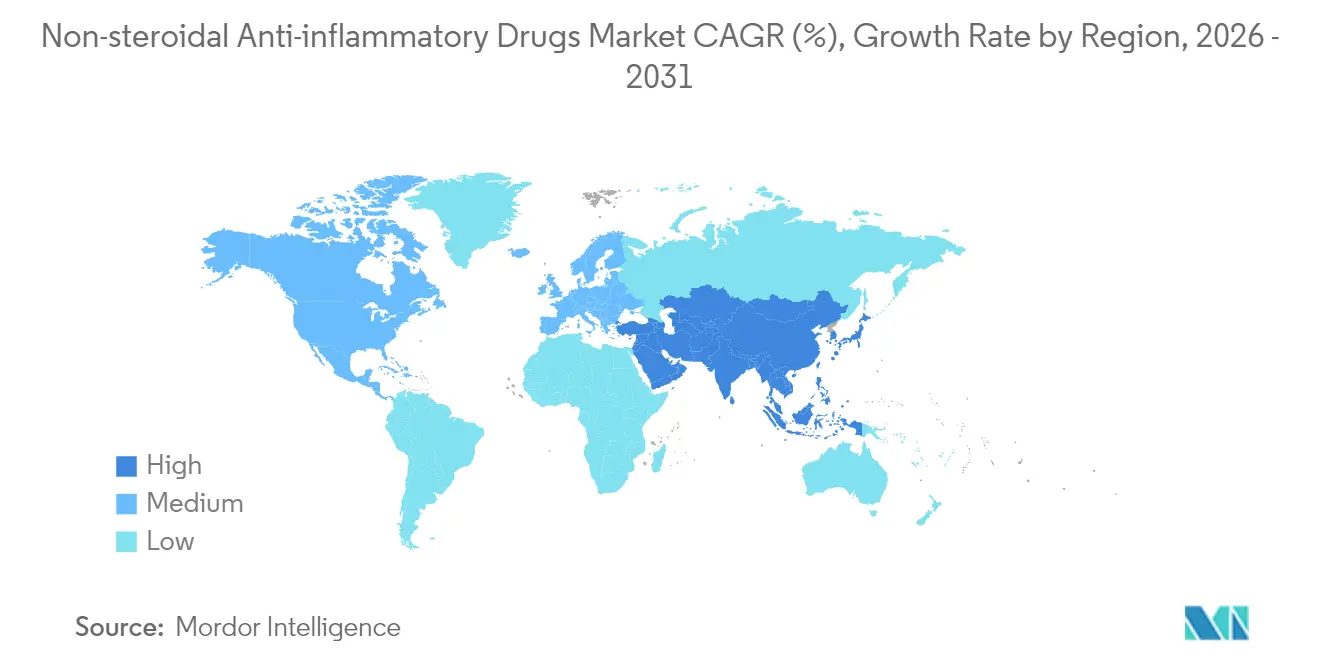
- By geography, North America held 41.35% of NSAIDs market share in 2025; Asia-Pacific is positioned for the highest 6.29% CAGR during 2026-2031.
Note: Market size and forecast figures in this report are generated using Mordor Intelligence’s proprietary estimation framework, updated with the latest available data and insights as of 2026.
Market Trends and Insights
Drivers Impact Analysis of Non-steroidal Anti-Inflammatory Drugs (NSAIDs) Market*
| Driver | % Impact on CAGR Forecast | Geographic Relevance | Impact Timeline |
|---|---|---|---|
| Rising global burden of chronic pain & inflammatory disorders | +1.8% | Global, with highest impact in aging populations of North America & Europe | Long term (≥ 4 years) |
| Preference for NSAIDs over opioids & acetaminophen | +1.2% | North America & Europe, expanding to APAC markets | Medium term (2-4 years) |
| Growing OTC availability & self-medication culture | +0.9% | Global, particularly strong in emerging markets of APAC & Latin America | Short term (≤ 2 years) |
| Emergence of fixed-dose-combination topical gels improving GI safety | +0.7% | North America & Europe initially, with gradual APAC adoption | Medium term (2-4 years) |
| AI-driven drug-repositioning accelerating low-cost reformulations | +0.4% | Global, led by innovation hubs in North America & Europe | Long term (≥ 4 years) |
| Expanding applications in specialized therapeutic areas | +0.3% | North America & Europe primarily, with selective APAC adoption | Medium term (2-4 years) |
| Source: Mordor Intelligence | |||
Rising Global Burden of Chronic Pain & Inflammatory Disorders
Chronic pain affects more than 100 million adults worldwide, and osteoarthritis prevalence is set to climb sharply by 2050, reinforcing a structural need for anti-inflammatory drugs. Broader diagnostic capabilities in emerging economies widen the patient pool, while governments classify chronic pain as its own condition, supporting reimbursement for long-term NSAID therapy. Workforce productivity losses tied to untreated pain further justify coverage expansions. As a result, the NSAIDs market secures a stable demand base that transcends economic cycles.
Preference for NSAIDs Over Opioids & Acetaminophen
Clinical trials show an ibuprofen–acetaminophen regimen can equal hydrocodone’s pain relief with none of the addiction risk. US and EU prescribing guidelines now advise non-opioid first-line therapy, propelling formulary placement of NSAIDs. Because these products also treat inflammation, they out-perform acetaminophen in arthritis and sports injuries. Payers see cost savings versus opioid misuse expenses, reinforcing guideline adoption. This shift repositions the NSAIDs market as the cornerstone of moderate-pain management.
Growing OTC Availability & Self-Medication Culture
The FDA review of OTC Monograph M013 could widen non-prescription NSAID use in the United States[1]. Emerging middle-class consumers in Asia and Latin America rely on pharmacy counters for primary care, boosting volumes. Digital symptom checkers support safe self-medication, while corporate wellness programs stock NSAID options to curb absenteeism. Together these factors funnel discretionary spending into the NSAIDs market.
Fixed-Dose-Combination Topical Gels Improving GI Safety
Topical diclofenac delivers pain relief comparable with oral tablets while reducing systemic exposure. New gels pair penetration enhancers with complementary actives, and real-world data covering 100,000 users show 70.8% buy only a single pack, suggesting rapid benefit and satisfaction (EFSM conference abstract). Payers and clinicians recommend these products for patients with cardiovascular or GI risks. The safety profile draws new users into the NSAIDs market and lengthens therapy duration for existing patients.
Restraints Impact Analysis of Non-steroidal Anti-Inflammatory Drugs (NSAIDs) Market*
| Restraint | % Impact on CAGR Forecast | Geographic Relevance | Impact Timeline |
|---|---|---|---|
| GI & cardiovascular adverse events prompting regulatory warnings | -1.4% | Global, with strictest enforcement in North America & Europe | Short term (≤ 2 years) |
| Patent cliffs & price erosion for blockbuster brands | -0.8% | North America & Europe primarily, with spillover to global markets | Medium term (2-4 years) |
| Increasing healthcare cost pressures and generic competition | -0.6% | Global, with highest impact in cost-sensitive emerging markets | Short term (≤ 2 years) |
| Growing awareness of drug interactions and contraindications | -0.4% | North America & Europe primarily, expanding to APAC markets | Medium term (2-4 years) |
| Source: Mordor Intelligence | |||
GI & Cardiovascular Adverse Events Prompting Regulatory Warnings
The FDA and European Medicines Agency (EMA) now require boxed warnings covering cardiovascular, GI, and rare dermatologic events. High-dose NSAID courses in ankylosing spondylitis raise ischemic heart disease and stroke risk according to longitudinal cohort analyses. Clinicians screen patients more rigorously and limit duration, trimming prescription volumes. Added monitoring inflates treatment costs, weighing on the NSAIDs market despite unflagging underlying demand.
Patent Cliffs & Price Erosion for Blockbuster Brands
Prolensa lost exclusivity in 2024 after generic bromfenac approval, illustrating how niche ophthalmic NSAIDs also face erosion. Broader 2025 losses across the pharmaceutical sector intensify price competition, and payers leverage multiple suppliers to negotiate discounts. Brand owners pivot to novel delivery systems and combination products, yet generic alternatives squeeze revenue per unit in mature segments of the NSAIDs market.
*Our forecasts treat driver/restraint impacts as directional, not additive. The impact forecasts reflect baseline growth, mix effects, and variable interactions.
Non-steroidal Anti-Inflammatory Drugs (NSAIDs) Market Segment Analysis
By Route of Administration:
Topical Formulations Drive Safety RevolutionOral products kept 55.92% of NSAIDs market size in 2025 because of physician familiarity and patient convenience. Topical options, however, climb at 6.18% CAGR as risk-averse prescribers recommend localized therapy for osteoarthritis and soft-tissue injuries. Advanced hydrogels now match oral efficacy without increasing GI or cardiovascular events.
Fixed-dose combination patches embed permeation enhancers that sustain release for up to 12 hours, reducing dosing frequency and boosting adherence. Regulatory guidance encourages topical NSAIDs in older adults with comorbidities. Consequently, manufacturers expand plant capacity for gels and sprays to capture incremental volumes in the NSAIDs market.

By Drug Class:
COX-2 Selectivity Balances Efficacy and SafetyNon-selective inhibitors retained the largest 61.77% slice of NSAIDs market size in 2025 by virtue of cost and broad indication labeling. COX-2 agents escalate at 6.32% CAGR as new evidence refines cardiovascular risk assessments and highlights GI protection. Emerging candidates optimize selectivity ratios and half-lives to widen their therapeutic window.
Pipeline products also aim for dual-target inhibition, modulating prostaglandin and leukotriene pathways simultaneously to tackle inflammation with fewer side effects. If late-stage trials confirm benefit, non-selective dominance could erode, reshaping drug-class revenue mix within the NSAIDs market.
By Application:
Migraine Treatments Accelerate Through InnovationArthritis accounted for 40.68% of NSAIDs market size in 2025 on the back of large, chronic patient pools. Migraine formulations register the quickest 6.12% CAGR thanks to fixed-dose innovations such as meloxicam plus rizatriptan, which achieved 77% sustained pain freedom in phase 3 trials.
Broader neurology adoption follows updated treatment pathways that favor NSAID-triptan combinations for moderate attacks. Ophthalmic, dysmenorrhea, and fever-flu indications broaden the clinical footprint, ensuring diversified revenue streams for companies active in the NSAIDs market.
By Distribution Channel:
E-commerce Transforms Access PatternsRetail pharmacies commanded 45.98% of NSAIDs market share in 2025 through professional counseling and immediate fulfillment. Online pharmacies post the highest 6.41% CAGR as consumers embrace direct-to-door delivery, price transparency, and auto-refill features.
National chains blend digital platforms with local pickup to guard share, while pure-play e-pharmacies ramp marketing in underserved rural areas. Hospital outlets retain relevance for injectable and peri-operative needs, but omnichannel convenience is redefining demand capture strategies in the NSAIDs market.
Geography Analysis
North America Non-steroidal Anti-Inflammatory Drugs (NSAIDs) Market
North America held 41.35% of revenue in 2025, supported by high healthcare outlays and opioid-replacement policies that prioritize NSAID prescriptions. Regulatory frameworks are robust, and insurers push cost-effective generics, creating both stability and price pressure in this zone of the NSAIDs market.
APAC Non-steroidal Anti-Inflammatory Drugs (NSAIDs) Market
Asia-Pacific records the fastest 6.29% CAGR through 2031 as populations age and middle-class consumers seek affordable pain relief. Local manufacturers scale production, and governments integrate essential NSAIDs into reimbursement lists, accelerating access. OTC use is widespread, yet physician visits per capita are rising, bringing more diagnosed arthritis and migraine cases into formal care.
EMEA and South America Non-steroidal Anti-Inflammatory Drugs (NSAIDs) Market
Europe retains sizeable volume anchored by universal health systems, yet strict EMA evaluations slow new launches and emphasize pharmacovigilance. Emerging regions in the Middle East, Africa, and South America gain momentum as infrastructure improves. Multinationals partner with domestic distributors to navigate regulatory nuance and economic swings while unlocking incremental demand in the global NSAIDs market.
Regulatory Landscape
NSAIDs face sustained post-market scrutiny centered on gastrointestinal, cardiovascular, and hypersensitivity risks. In the United States, the FDA advanced label-safety requirements by requiring prescription NSAID labeling updates to include warnings on fixed drug eruptions (FDE) and generalized bullous fixed drug eruption (GBFDE), beginning in late 2024, reinforcing pharmacovigilance expectations across established molecules.
In Europe, regulatory activity is focused on variations and referrals. The European Commission in 2024 refused marketing authorization for Ibuprofen NVT 400 mg soft capsules due to bioequivalence shortcomings, and the EMA CMDh position on systemic diclofenac adopted in 2025 required aligned product information. The EU variations framework became applicable in 2025, and European Commission guidelines applying from January 2026 streamlined processes for marketing authorization changes, affecting label updates and formulation changes. The WHO updated the 24th Model List of Essential Medicines in 2025, influencing procurement and reimbursement decisions for priority analgesics including NSAIDs.
Value Chain Analysis
The NSAIDs value chain runs from petrochemical and fine-chemical inputs, through API synthesis, formulation (oral solids, topical semisolids, injectables, and ophthalmics), quality testing and batch release, and distribution via hospital, retail, and e-commerce channels. API supply remains geographically concentrated, with USP reporting in 2024 that India accounted for 48% of active API DMFs and China for 18%, while the US held about 3% of API manufacturing capacity, leaving many NSAID products exposed to cross-border logistics, compliance, and pricing shocks.
Downstream finished-dose manufacturing competitiveness depends on cost-sensitive, high-volume production and stringent GMP oversight, especially for widely used generics and OTC brands. Integration and resilience examples include BASF maintaining ibuprofen production at its FDA-audited Bishop, Texas facility using a closed-system process, which supports quality and continuity for an important OTC API. Ongoing shortages of low-margin drugs, highlighted in USP shortage reporting, also explain why buyers (payers, wholesalers, and retail chains) pressure pricing while manufacturers prioritize scale, redundant quality systems, and regionalized sourcing. This is especially relevant as safety-related label updates, such as EMA PSUSA outcomes for systemic diclofenac, cascade into artwork, packaging, and regulatory variation work across multiple SKUs.
Competitive Landscape
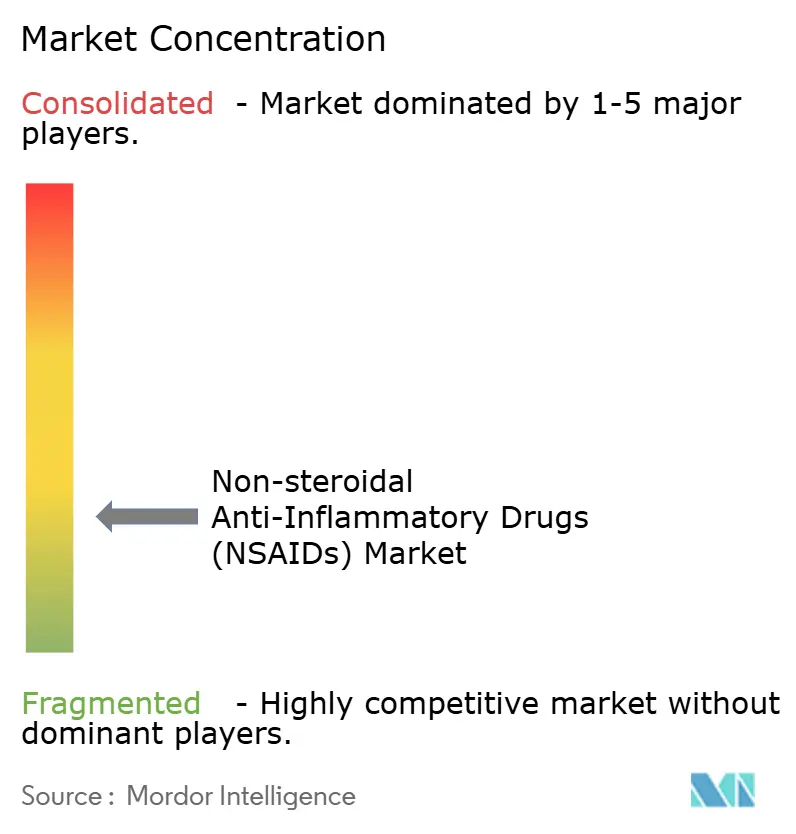
The NSAIDs market is moderately fragmented. Leading firms such as Bayer, Pfizer, and Johnson & Johnson leverage legacy brands, broad portfolios, and global supply chains. Generic specialists like Lupin and Glenmark compete on price and regulatory agility, accelerating erosion after patent expiry for oral and ophthalmic products.
Top contenders invest in AI screening to find new indications or reformulate existing actives, compressing R&D timelines and cost. Novel topical devices, iontophoretic systems, and preservative-free eye drops create premium niches. Partnerships with digital health startups provide patient-support apps that differentiate offerings in a crowded NSAIDs market.
Consolidation prospects rise as mid-tier pipelines thin and scale advantages grow in sourcing active pharmaceutical ingredients (APIs) under tightened quality standards. Sustainability goals add another layer of competition, with firms marketing greener synthesis routes to hospital buyers seeking lower environmental footprints.
Non-steroidal Anti-Inflammatory Drugs (NSAIDs) Industry Leaders
-
Pfizer Inc.
-
Johnson & Johnson
-
Bayer AG
-
Sanofi S.A.
-
Haleon plc
- *Disclaimer: Major Players sorted in no particular order
Non-steroidal Anti-Inflammatory Drugs (NSAIDs) Market Companies Covered in this Report
- Pfizer
- Bayer
- Johnson & Johnson (McNeil)
- Haleon plc
- Reckitt Benckiser Group
- Sanofi
- Horizon Therapeutics
- Sun Pharmaceuticals Industries
- Assertio
- Perrigo Company
- Iroko Pharmaceuticals
- Viatris
- Novartis
- Dr. Reddy’s Laboratories Ltd
- Teva Pharmaceutical Industries
- Boehringer Ingelheim
- Abbvie
- Endo International
- Hikma Pharmaceuticals
- Orion
Read Analysis of Non-steroidal Anti-Inflammatory Drugs (NSAIDs) Companies
Market Opportunities and Future Outlook
Opportunities center on differentiated delivery formats and faster cycle times for lifecycle updates under tightening safety oversight. Topical NSAIDs and other localized formats benefit from the market shift toward non-opioid pain management, while addressing systemic risk concerns that drive monitoring and label changes; this product mix also aligns with the growth of self-care and OTC access across retail and e-commerce channels. Regulatory activity itself creates whitespace for suppliers that can execute rapid label and formulation change programs, supported by recurring EMA PRAC signal recommendations in March 2026 and June 2026 and earlier fixed drug eruption-related labeling actions that trigger portfolio-wide updates.
Manufacturing modernization and supply resilience also create capacity for expansion, particularly in regions prioritizing domestic capability and advanced process controls. In April 2026, Novartis finalized plans for a US API facility in Morrisville, North Carolina, for solid dosage tablets and capsules within a broader US investment program, and AbbVie announced a USD 1.4 billion manufacturing campus in Durham, North Carolina, featuring AI and advanced manufacturing technologies. While these investments are not NSAID-specific, they reflect ongoing buildout of US small-molecule and solid-dose capability that can support high-volume analgesics and improve responsiveness to demand swings tied to OTC seasonality, e-commerce replenishment patterns, and faster post-approval change execution under evolving variations frameworks.
Recent Industry Developments in Non-steroidal Anti-Inflammatory Drugs (NSAIDs) Market
- June 2026: Bayer completed its acquisition of Perfuse Therapeutics for USD 300 million, bringing the PER-001 sustained-release intravitreal implant program into its ophthalmology pipeline. The deal strengthens Bayer's eye-care franchise and complements strategies to offset price erosion in mature small-molecule categories, potentially expanding cross-category capabilities for ocular NSAIDs.
- April 2026: Novartis finalized plans for a US API facility in Morrisville, North Carolina, as part of a broader US investment program for solid dose tablets and capsules. The project reinforces US manufacturing resilience and near-term supply continuity for key solid-dose APIs.
- January 2025: Axsome Therapeutics received FDA approval for Symbravo, a meloxicam-rizatriptan tablet for acute migraine in adults. The approval highlights continued innovation around NSAID-based fixed-dose combinations to improve convenience and outcomes, expanding differentiation beyond commodity oral tablets.
Non-steroidal Anti-Inflammatory Drugs (NSAIDs) Market Report Scope and Research Methodology
Market Definition and Coverage
For this methodology, the market covers the worldwide sales value of prescription and OTC non-steroidal anti-inflammatory drugs (NSAIDs) whose main action is reversible inhibition of COX-1 and or COX-2, across oral, topical, parenteral, and transdermal forms.
Scope exclusions: We exclude combination analgesics where the NSAID is not the primary active ingredient, and veterinary-only products.
Segments Covered in This Report
- By Route of Administration
- Oral
- Parenteral
- Topical
- Others
- By Drug Class
- Non-selective COX Inhibitors
- COX-2 Selective Inhibitors
- By Application
- Arthritis
- Migraine & Headache
- Ophthalmic Conditions
- Fever & Flu
- Dysmenorrhea
- Others
- By Distribution Channel
- Hospital Pharmacies
- Retail Pharmacies
- E-commerce
- Geography
- North America
- United States
- Canada
- Mexico
- Europe
- Germany
- United Kingdom
- France
- Italy
- Spain
- Rest of Europe
- Asia-Pacific
- China
- Japan
- India
- South Korea
- Australia & New Zealand
- Rest of Asia-Pacific
- Middle East and Africa
- GCC
- South Africa
- Rest of Middle East and Africa
- South America
- Brazil
- Argentina
- Rest of South America
- North America
Data Sources, Market Sizing, and Validation
Desk Research
Desk work starts with building the disease and treatment context that makes NSAID demand measurable, and then aligning it with observable drug supply signals. We referenced public sources such as the US FDA for drug labels and safety updates, the CDC for burden signals that tie back to pain and inflammation, and the WHO for global health and country comparisons that help explain regional differences.
To ground volumes and pricing logic, we also reviewed sources such as OECD health statistics, national medicine agencies for OTC and prescription policy notes, and peer-reviewed clinical literature for how utilization shifts by indication (for example, arthritis versus acute pain). Company annual reports and investor materials were used to understand portfolio focus and broad revenue exposure, and an approved paid subscription for company financials and news was used selectively to validate timelines and major product changes. These examples are not exhaustive, and many other public and paid sources were also referenced for data collection, validation, and clarification.
Primary Interviews and Surveys
Primary discussions were used to stress-test what desk sources cannot confirm cleanly, especially the split between prescription and OTC use, typical therapy duration, and the impact of safety guidance on switching across NSAID types and routes. We spoke with a mix of manufacturers, distributors, hospital and retail channel stakeholders, and clinicians who see prescribing behavior and patient adherence firsthand, and coverage was balanced across APAC, EMEA, and the Americas so regional reimbursement and OTC availability effects could be reflected. Inputs from these conversations were used to fill gaps, agree realistic price progression assumptions, and then triangulate the final totals before sign-off.
Distribution of primary research fieldwork respondents
| Company type | Respondent position | Region |
|---|---|---|
| Top tier: 28% | CXOs: 14% | APAC: 46% |
| Mid tier: 51% | Functional/Unit leaders: 27% | EMEA: 30% |
| Smaller Players: 21% | Managers: 59% | Americas: 24% |
Market-Sizing & Forecasting
Sizing begins with a top-down build where treated demand is reconstructed from pain and inflammation case pools, typical NSAID utilization patterns, and channel access differences by country. We then corroborate the totals with selective bottom-up approximations, using sampled volume by key molecules and dosage forms multiplied by observed average selling prices, followed by checks against supplier revenue exposure and channel feedback.
A few practical inputs that shape the model include prescription versus OTC mix, share of oral versus topical NSAIDs, safety-driven switching between non-selective and COX-2 selective products, average pack sizes and therapy duration, and regional price corridors influenced by reimbursement and generic penetration. Where direct volume is not visible, gaps are handled through peer-country analogs and physician validated utilization ranges, and the assumptions are tightened until they align with channel realities.
Forecasting is built using scenario analysis so short-term safety advisories, formulary shifts, and macro health spending changes can be expressed as separate cases before a central case is finalized. The final forecast path is then aligned to expert consensus on how utilization and pricing are likely to move by region over the next few years.
Data Validation & Update Cycle
Outputs are validated through stepwise cross-checks so the final number is not dependent on any single source. We compare results against independent signals such as broad pain-management medicine growth, OTC availability changes, and large portfolio disclosures, and then investigate outliers where regional shares or price levels drift from what interviews indicate.
Before publishing, the model and assumptions go through more than one analyst review, and follow-up calls are triggered when a key variable moves outside an agreed range. Reports are refreshed annually, with interim updates when material events occur, and a final pre-delivery review is completed so clients receive the latest updated view.
Mordor Intelligence's Non Steroidal Anti Inflammatory Drugs Market Estimate Compared With Other Published Estimates
Published NSAIDs market values often differ even when the topic name looks identical, because studies may not match on what they count as an NSAID sale, which forms and channels are included, and which year is treated as the current sizing anchor. Differences also show up when price progression is assumed instead of checked, or when older base-year inputs are carried forward without re-validation.
Key gaps usually come from whether combination products are counted in full, how prescription versus OTC boundaries are treated, and how regional currency conversion timing is handled when sales are reported across many countries. The benchmark table below shows a spread that largely traces back to scope and base-year choices, and in Mordor Intelligence's model combination analgesics are excluded unless the NSAID is the primary active ingredient, which can reduce counted revenue versus approaches that include bundled pain products.
Benchmark comparison
| Source | Market Size | Gaps in Research Methodology |
|---|---|---|
| Mordor Intelligence | USD 24.11 B (2025) | |
| Press Release Tracker A | USD 21.56 B (2024) | Uses a different base year and summary-level assumptions, and the scope description is broad on inclusions, which can shift what is counted and how currency timing is applied. |
| Syndicated Publisher B | USD 25.84 B (2025) | Employs a wider segmentation frame that can vary on what is treated as NSAID revenue by indication and channel, and its CAGR path implies different price and mix assumptions versus channel-checked ranges. |
Overall, the spread is explainable once the year anchor, inclusion rules, and pricing logic are lined up. By keeping the build tied to observable utilization signals and interview-tested mix and price ranges, we can deliver a market value that is easier to trace back to clear steps and repeat over time.
Key Questions Answered in the Report
What is the current value of the NSAIDs market and its growth outlook?
The market is valued at USD 25.48 billion in 2026 and is projected to hit USD 33.57 billion by 2031 at a 5.67% CAGR.
Which region is growing fastest in the NSAIDs market?
Asia-Pacific is forecast to expand at 6.29% CAGR through 2031 due to wider insurance coverage, local manufacturing scale-ups, and strong OTC demand.
Why are topical NSAIDs gaining popularity?
Topical gels and patches offer comparable pain relief with fewer GI and cardiovascular side effects, making them the preferred option for high-risk patients.
How are patent expirations influencing NSAID prices?
Expired exclusivities invite generic competition, which presses down price points and shifts brand focus toward new delivery platforms or fixed-dose combinations.
What role does e-commerce play in NSAID distribution?
Online pharmacies are growing at 6.41% CAGR as consumers prioritize convenience, transparent pricing, and home delivery, prompting retailers to adopt omnichannel models.
Are NSAIDs replacing opioids in moderate pain management?
Yes, recent guidelines recommend NSAIDs as first-line therapy for many moderate pain conditions because they provide effective relief without addiction risk.