
Nitrile Medical Gloves Market Size and Share
Market Overview
| Study Period | 2020 - 2031 |
|---|---|
| Market Size (2026) | USD 6.91 Billion |
| Market Size (2031) | USD 9.74 Billion |
| Growth Rate (2026 - 2031) | 7.12 % |
| Fastest Growing Market | Asia Pacific |
| Largest Market | North America |
| Market Concentration | Low |
Major Players *Disclaimer: Major Players sorted in no particular order Image © Mordor Intelligence. Reuse requires attribution under CC BY 4.0. | |
Nitrile Medical Gloves Market Analysis by Mordor Intelligence
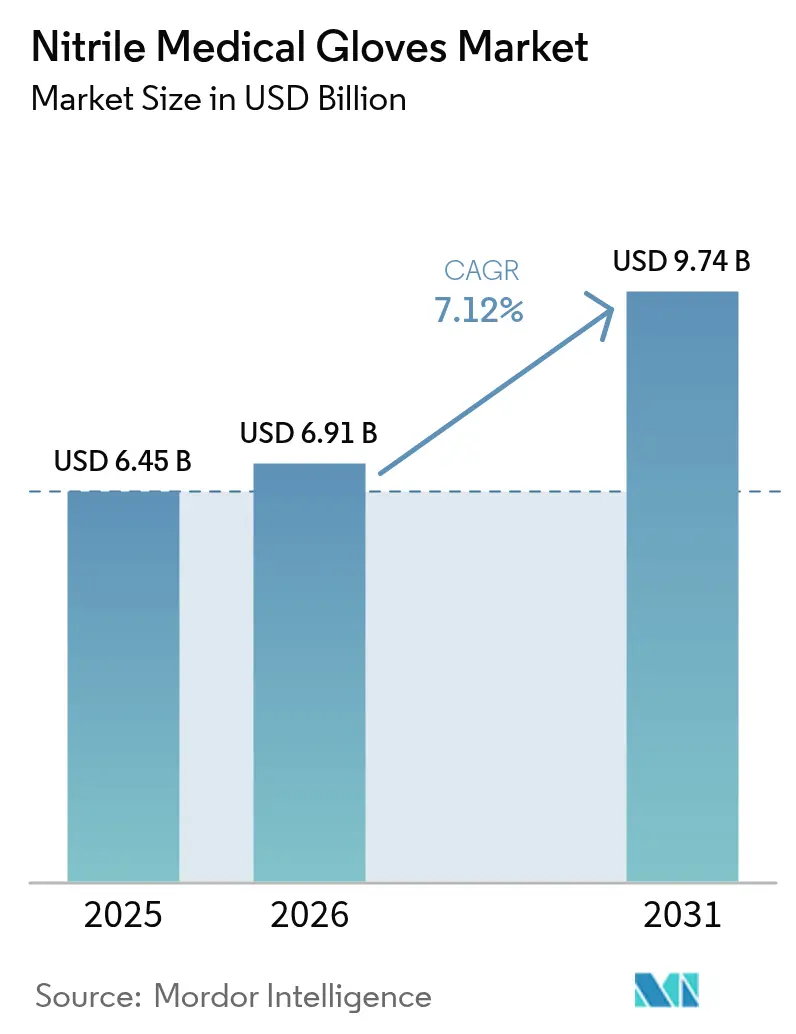
The nitrile medical gloves market size in 2026 is estimated at USD 6.91 billion, growing from 2025 value of USD 6.45 billion with 2031 projections showing USD 9.74 billion, growing at 7.12% CAGR over 2026-2031. Growth flows from stricter infection-control mandates, accelerating migration away from latex, and the elevated role of disposable barrier protection within OSHA’s bloodborne pathogen framework [1]. Price pressure eased as procurement teams prioritize verified performance, supply-chain traceability, and waste-reduction credentials. At the same time, US tariff escalation on Chinese gloves is realigning trade lanes, steering volume toward Malaysian and Thai producers. Automation, vertical NBR integration, and early moves into biodegradable offerings create the most visible competitive differentiators across the nitrile medical gloves market.
Key Report Takeaways
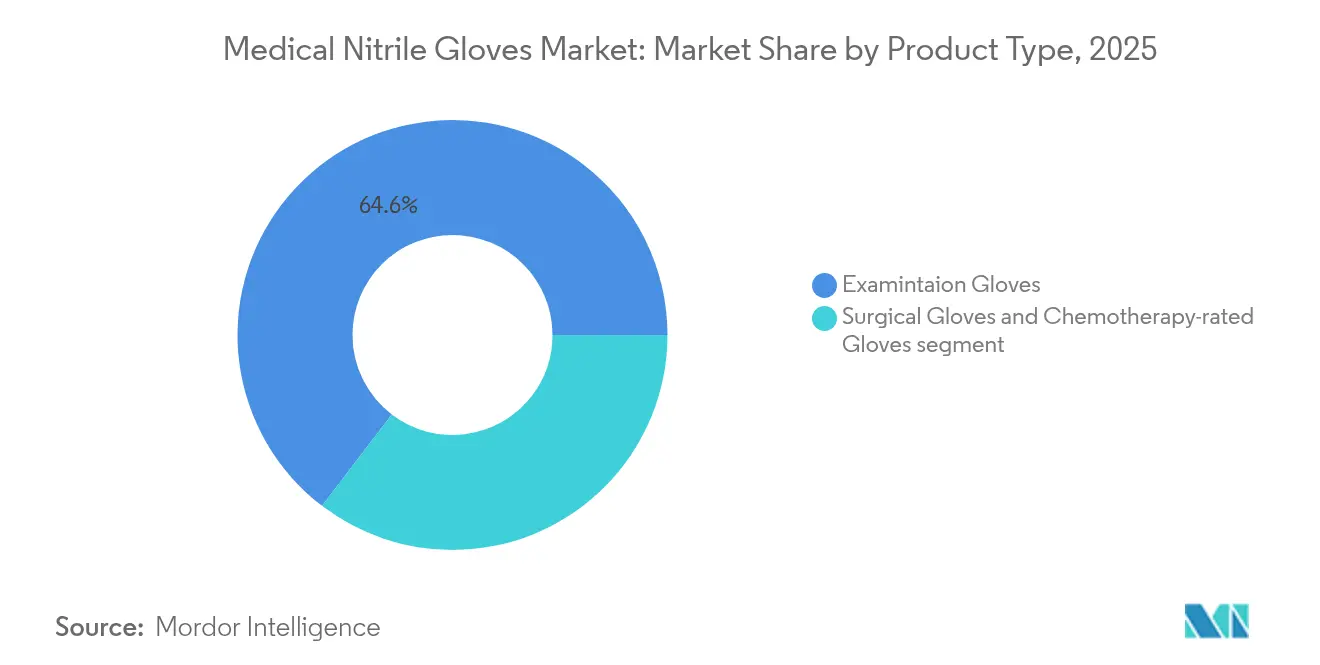
- By product type, examination gloves held 64.62% of nitrile medical gloves market share in 2025 while surgical gloves are projected to expand at a 6.31% CAGR through 2031.
- By form, powder-free variants commanded 87.05% of the nitrile medical gloves market size in 2025 and continue growing at 6.88% CAGR.
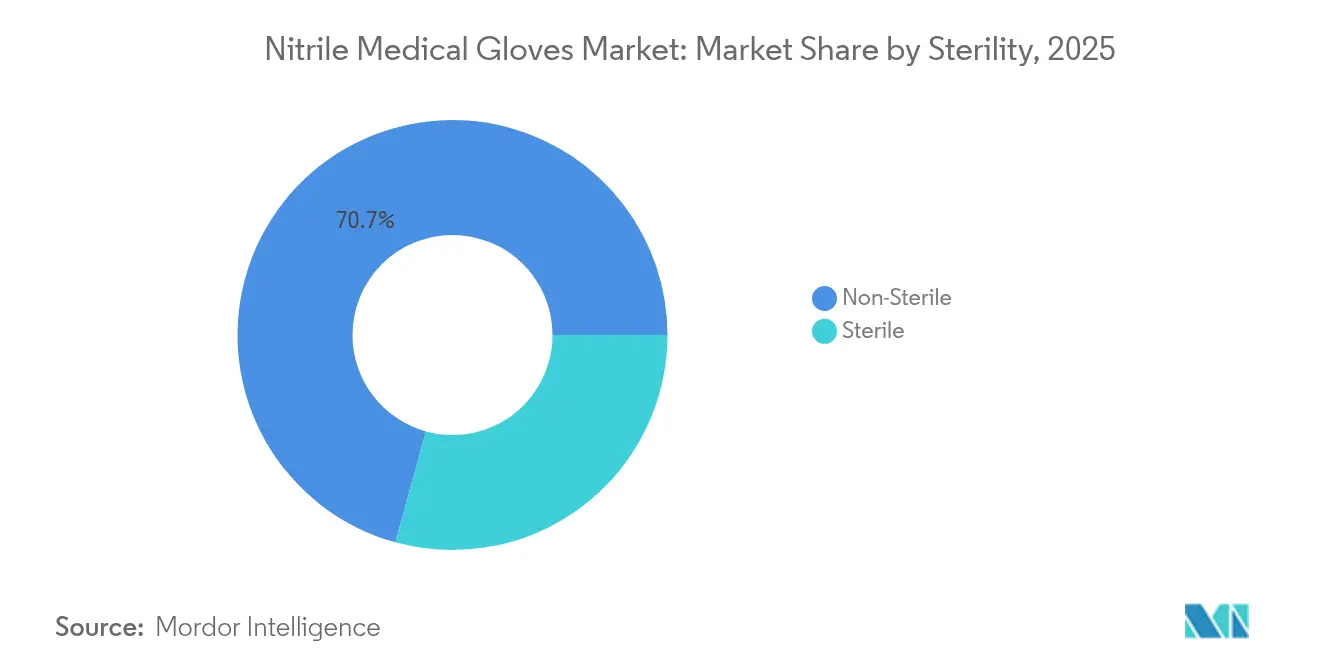
- By sterility, non-sterile gloves captured 70.72% of nitrile medical gloves market size in 2025; sterile demand is rising at 6.9% CAGR.
- By end user, hospitals and clinics contributed 57.10% revenue in 2025, whereas home-healthcare segment is advancing at a 6.11% CAGR.
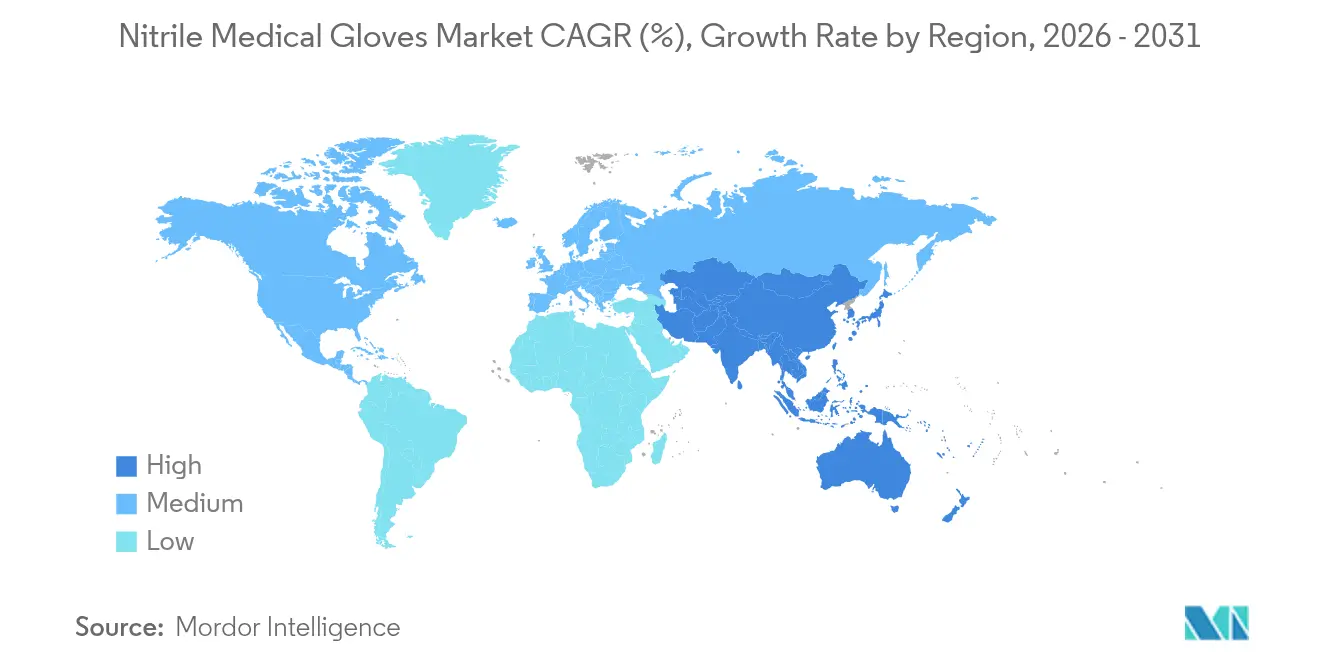
- By geography, North America led with 37.20% revenue share in 2025, while Asia-Pacific delivers the fastest 7.16% CAGR to 2031
Note: Market size and forecast figures in this report are generated using Mordor Intelligence’s proprietary estimation framework, updated with the latest available data and insights as of 2026.
Global Nitrile Medical Gloves Market Trends and Insights
Drivers Impact Analysis*
| Driver | % Impact on CAGR Forecast | Geographic Relevance | Impact Timeline |
|---|---|---|---|
| Rising surgical procedure volumes worldwide | +1.20% | Global, led by North America & Europe | Medium term (2-4 years) |
| Stringent infection-control regulations & OSHA compliance | +0.80% | North America & EU, expanding to APAC | Short term (≤ 2 years) |
| Shift from latex to nitrile due to allergy concerns | +0.60% | Global, led by developed markets | Long term (≥ 4 years) |
| Capacity investments in NBR latex plants in ASEAN | +0.40% | ASEAN core, global spill-over | Medium term (2-4 years) |
| AI-enabled glove defect-detection lines | +0.30% | Global, early adoption in Malaysia & Thailand | Long term (≥ 4 years) |
| Surge in tele-health home-testing kits requiring disposable exam gloves | +0.25% | North America and Europe | Short term (≤ 2 years) |
| Source: Mordor Intelligence | |||
Rising Surgical Procedure Volumes Worldwide
Outpatient centers now perform a larger share of minimally invasive surgeries, each consuming 15-20 glove pairs across peri-operative phases. Aging demographics and chronic illness prevalence keep procedure counts on an upward trend, directly scaling glove demand. Powder-free nitrile products are preferred for surgical tasks because they combine puncture resistance with low allergenic risk. As cardiovascular, orthopedic, and cancer interventions climb, the nitrile medical gloves market absorbs steady incremental volume.
Stringent Infection-Control Regulations & OSHA Compliance
OSHA’s 2024 update expanded inspection scope and documentation requirements, repositioning gloves as strategic safety assets rather than commodities. Hospitals weigh documented pin-hole rates, tensile strength data, and traceability records before awarding contracts. Similar requirements under the EU Medical Device Regulation harmonize performance baselines, raising the entry bar for low-cost producers. As compliance costs of healthcare-associated infections reach USD 28-45 billion per year in the United States, buyers increasingly select premium nitrile options to reduce liability.
Shift from Latex to Nitrile Due to Allergy Concerns
Workplace latex allergies affect 8-12% of healthcare professionals, exposing providers to litigation risk. System-wide latex-free policies have become standard across many hospital groups, locking-in multiyear nitrile purchase commitments. With superior chemical resistance, nitrile also covers chemotherapy preparation and extended procedures, reinforcing adoption across allied departments.
AI-Enabled Glove Defect-Detection Lines Improving Yield
Machine-vision systems now catch 99.5% of defects, versus 95% under manual inspection, shrinking rejection rates by up to 40% and lifting effective capacity [2]. Hartalega’s 85% automation shows how data-driven efficiency supports premium pricing and regulatory documentation.
Restraints Impact Analysis*
| Restraint | % Impact on CAGR Forecast | Geographic Relevance | Impact Timeline |
|---|---|---|---|
| Volatile NBR raw-material prices linked to butadiene supply | -0.90% | Global, acute in ASEAN | Short term (≤ 2 years) |
| Rising environmental scrutiny over non-biodegradable nitrile waste | -0.70% | EU & North America, expanding globally | Long term (≥ 4 years) |
| Over-capacity risk as pandemic-driven demand normalizes | -0.65% | Asia (e.g., Malaysia, Thailand, China) and North America | Short term (≤ 2 years) |
| Trade protectionism & anti-dumping duties on Asian glove exports | -0.85% | North America, Europe, and Asian Countries | Medium term (2-4 years) |
| Source: Mordor Intelligence | |||
Volatile NBR Raw-Material Prices Linked to Butadiene Supply
Butadiene shortages stemming from refinery outages and a looming natural-rubber gap place immediate margin pressure on manufacturers that spend 40-50% of cost on latex inputs. With limited medical-grade substitutes, glove plants hedge feedstock futures and diversify suppliers to manage swings.
Rising Environmental Scrutiny Over Non-Biodegradable Nitrile Waste
Traditional nitrile takes decades to break down, prompting EU discussions on extended-producer responsibility. Ansell confirms the polymer’s inert structure resists microbial attack. Early biodegradable launches, such as Top Glove’s BioGreen line, indicate future standards, but scale and cost parity have yet to materialize.
*Our forecasts treat driver/restraint impacts as directional, not additive. The impact forecasts reflect baseline growth, mix effects, and variable interactions.
Segment Analysis
By Product Type: Examination Dominance Drives Volume Growth
Examination gloves held 64.62% of nitrile medical gloves market share in 2025, underpinned by routine patient contact across all healthcare settings. OSHA’s broad definition of exposure risk keeps examination demand resilient as every blood draw, transport, or specimen handling task requires disposable protection. As a result, the nitrile medical gloves market size allocated to examination lines surpasses USD 4.17 billion, giving manufacturers predictable high-throughput volumes.
Surgical gloves are gaining at a 6.31% CAGR through 2031 as procedure counts rise and surgeons demand tighter pin-hole specifications. Although accounting for a smaller piece of nitrile medical gloves market size today, the segment secures premium pricing because of sterility validation, exact sizing, and extended cuff lengths. Chemotherapy-rated gloves form a niche but high-margin pocket as oncology units require thicker materials for cytotoxic resistance, demonstrating how value migrates toward application-specific performance rather than price alone.

By Form: Powder-Free Preference Reflects Safety Evolution
Powder-free variants represented 87.05% of nitrile medical gloves market size in 2025, fueled by the US FDA ban on surgical glove powder and cornstarch contamination concerns. Polymer-coated interiors replicate easy donning, enabling swift hospital conversion with minimal workflow disruption.
Powdered gloves now cater mainly to lower-risk industrial or low-income healthcare settings, holding a thin residual share. As modern high-speed formers and polymer coatings narrow cost gaps to under 5%, even cost-sensitive buyers adopt powder-free lines, raising the baseline quality level across the nitrile medical gloves market.
By Sterility: Non-Sterile Applications Drive Market Volume
Non-sterile products covered 70.72% of nitrile medical gloves market size in 2025 because outpatient clinics, emergency rooms, and home-care programs consume gloves for each patient encounter. Bulk pack formats and streamlined sizing simplify logistics and keep per-pair pricing competitive.
Sterile gloves, expanding at 6.9% CAGR, respond to higher surgical throughput and sterile pharmacy compounding rules. Hospitals deploy risk-based purchasing protocols that limit sterile use to procedures demanding validated asepsis, balancing cost and safety while sustaining predictable growth for premium grades.
By End User: Hospital Consolidation Drives Procurement Efficiency
Hospitals and clinics contributed 57.10% of 2025 revenue, leveraging group-purchasing contracts that stipulate ASTM performance and lot-traceability clauses. Consolidated health systems favor multiyear supply deals with audited plants, shutting smaller unverified suppliers out of large bids.
Home-healthcare shows the fastest 6.11% CAGR as aging demographics push care into houses, drawing sustained glove demand for wound care and chronic-disease management. Ambulatory surgery centers and labs seek premium specialty lines such as extra-thin tactile gloves or chemo-resistant variants, reinforcing the nitrile medical gloves market’s shift to differentiated SKUs.
Geography Analysis
North America commanded 37.20% of 2025 revenue, reflecting OSHA enforcement intensity, high per-capita surgical rates, and the preference for supply chains viewed as geopolitically secure. With US tariffs on Chinese gloves slated for 25% by 2026, buyers redirect orders to Mexico and Canada, reinforcing near-shoring trajectories. The nitrile medical gloves market sees new North American lines financed to capture that regional premium.
Asia-Pacific records the fastest 7.16% CAGR to 2031 as public-hospital construction, health-insurance expansion, and greater infection-control awareness accelerate glove penetration. Malaysian and Thai producers capitalize on regional NBR proximity and automation investment to supply export markets, gaining share as tariffs constrain Chinese competitors. Domestic demand in Indonesia, Vietnam, and the Philippines climbs as universal healthcare schemes widen access.
Europe is a compliance-driven market where extended-producer responsibility for medical waste is shaping procurement toward lifecycle data. Hospitals pilot biodegradable nitrile options and require environmental product declarations, nudging suppliers to disclose carbon footprints. Meanwhile, Middle East, Africa, and South America represent smaller but double-digit growth adjacencies, where rising surgical volumes intersect with price sensitivity, encouraging mid-tier nitrile offerings.
Regulatory Landscape
In the United States, nitrile medical examination gloves are regulated by the FDA as medical devices (product code LZA under 21 CFR 880.6250). They are treated as Class I reserved devices that require 510(k) premarket notification clearance. Performance and quality expectations are commonly anchored to recognized consensus standards such as ASTM D6319-19 (2023), while workplace use in healthcare is reinforced by OSHA bloodborne pathogen compliance programs that drive documentation around barrier protection and traceability.
In Europe, market access is governed by the EU Medical Device Regulation (MDR) 2017/745. It requires CE marking supported by technical documentation and a compliant quality management system, with notified-body oversight shaping supplier eligibility. Trade policy also influences regulatory friction for cross-border supply: medical gloves fall under specific U.S. tariff schedules (HTS 4015.12.10), and Chinese-origin imports face additional Section 301 duties. As a result, buyers and manufacturers tend to prioritize origin transparency alongside product compliance.
Value Chain Analysis
The value chain starts with petrochemical feedstocks, where acrylonitrile and butadiene are polymerized into nitrile butadiene rubber (NBR) latex, followed by compounding with additives (such as accelerators, zinc oxide, and pigments). Glove manufacturing then proceeds through dipping onto ceramic formers, leaching, and oven curing typically around 100-130 C, before inspection, packing, and sterilization for sterile SKUs. Upstream volatility in crude-oil-linked monomers and planned maintenance at chemical plants can tighten availability and raise input costs, especially for medical-grade NBR latex.
Downstream, production remains concentrated in Asia, notably Malaysia and Thailand, with additional capacity in China. Distribution flows through medical distributors, group purchasing organizations, and hospital procurement channels that increasingly demand lot-level traceability and ASTM-aligned performance data. The chain is also shifting toward lower-carbon inputs: Synthomer, Neste, and PCS established an ISCC PLUS certified value chain in Malaysia to manufacture bio-based nitrile latexes (with at least 20% bio-based feedstock). This frames material provenance and certification as part of supplier qualification, alongside price and capacity.
Competitive Landscape
The nitrile medical gloves market centers on Malaysia, where Top Glove, Hartalega, and Kossan own a significant percentage of installed capacity. Scale, automation, and NBR integration allow these firms to sustain margins despite post-pandemic price normalization. Top Glove’s January 2025 results showed 80% revenue growth and a 325% profit rebound as US customers shifted orders away from China.
Technology investment remains the key differentiator. Hartalega targets 2.7 billion-piece output on 85% automated lines by FY2025, expecting lower unit cost and consistent defect levels. Chinese firms such as INTCO Medical respond by planning offshore plants to bypass tariffs, but capital intensity and regulatory documentation hurdles slow execution.
Sustainability is the next battleground. Top Glove’s BioGreen nitrile and Unigloves’ BioTouch line underscore an industry pivot toward waste mitigation. Early adopters win pilots with EU hospitals seeking circular procurement. Nonetheless, cost parity and certification remain barriers, suggesting incremental rather than disruptive transition over the forecast horizon.
Nitrile Medical Gloves Industry Leaders
-
Dynarex Corporation
-
Halyard
-
Superior Gloves
-
Shield Scientific
-
Ansell LTD.
- *Disclaimer: Major Players sorted in no particular order

Market Opportunities and Future Outlook
Compliance-driven procurement is widening the addressable whitespace for manufacturers that can document performance and traceability, and demonstrate region-specific conformity within a single offer set, particularly across the EU MDR 2017/745 and US FDA 510(k) pathways. The update cycle for technical requirements also raises the value of standards-ready product portfolios, including EN 455-2:2024 covering physical properties in Europe and ASTM D6319 as a common reference point for nitrile examination gloves for medical application. Suppliers that package tested products with audit-ready documentation and stable lot traceability tend to see an advantage with consolidated hospital systems and cross-border distributors.
Supply-chain reconfiguration is creating opportunities around origin diversification, domestic sourcing, and alternative feedstocks. In the United States, July 2026 reporting highlighted federal procurement direction that moves agencies toward buying US-manufactured nitrile gloves, against a baseline where only about 1% of gloves used in the country are produced domestically, which increases interest in local capacity and qualifying supply chains. At the same time, raw-material disruption is a constraint: in March 2026, MARGMA sought relief measures amid NBR latex shortages tied to the Strait of Hormuz disruption. This reinforces manufacturer focus on NBR integration, contracted feedstock security, and certified bio-based nitrile latex programs such as the ISCC PLUS initiative by Synthomer, Neste, and PCS.
Recent Industry Developments
- July 2026: US reporting highlighted federal procurement direction moving agencies toward purchasing US-manufactured nitrile gloves, while noting that only about 1% of gloves used in the country are currently produced domestically. The policy pull elevates the strategic value of qualifying domestic capacity and compliant supply chains, even as producers contend with constraints such as limited US-scale NBR latex availability.
- November 2025: Shield Scientific announced the launch of SMARTLine NEO NITRILE 290 and SMARTLine NEO NITRILE 300 DI chemical protection gloves. The introductions expand portfolios toward higher-performance nitrile applications where buyers weigh chemical resistance and certification status alongside traditional exam-glove specifications.
- July 2024: Ansell completed its acquisition of the Kimberly-Clark Personal Protective Equipment (KCPPE) business for about USD 640 million, adding the Kimtech and KleenGuard brands. The deal strengthened Ansell's reach in scientific and controlled-environment channels that also consume medical-grade nitrile gloves, supporting cross-selling and broader portfolio leverage with institutional buyers.
Research Methodology Framework and Report Scope
Market Definition and Coverage
This market covers the value of medical-grade nitrile gloves used for patient care, diagnostics, surgery, and similar healthcare use, measured as manufacturer-level sales in USD.
Scope exclusions: Industrial safety gloves, food handling gloves, and clean-room electronics gloves are excluded even if they are nitrile based.
Segmentation Overview
- By Product Type
- Examination Gloves
- Surgical Gloves
- Chemotherapy-rated Gloves
- By Form
- Powder-Free
- Powdered
- By Sterility
- Non-Sterile
- Sterile
- By End User
- Hospitals & Clinics
- Ambulatory Surgery Centers
- Diagnostic Laboratories
- Home Healthcare & Tele-medicine Kits
- Dental & Veterinary Practices
- By Geography
- North America
- United States
- Canada
- Mexico
- Europe
- Germany
- United Kingdom
- France
- Italy
- Spain
- Russia
- Rest of Europe
- Asia-Pacific
- China
- Japan
- India
- South Korea
- Australia
- Rest of Asia-Pacific
- Middle East and Africa
- GCC
- South Africa
- Rest of Middle East and Africa
- South America
- Brazil
- Argentina
- Rest of South America
- North America
Data Sources, Market Sizing, and Validation
Desk Research
Desk research starts with public datasets that help anchor healthcare activity and glove demand signals. We typically refer to sources such as the World Health Organization for infection prevention guidance, the US FDA for medical device and glove related information, the US Bureau of Labor Statistics for healthcare employment trends, and UN Comtrade for broad trade movement context. For production and capacity context, we also review information from trade associations and customs or statistics offices where available.
In parallel, we read company filings, annual reports, investor presentations, and credible press coverage to capture plant expansions, utilization commentary, and pricing changes that are not always visible in public statistics. In a few cases, we also use a paid subscription for company financials and intelligence, and an import export shipment-level database, mainly to cross-check trade direction and confirm supplier footprints. The desk research source list above is illustrative, and we rely on additional public and paid references during collection, validation, and clarification throughout the study.
Primary Interviews and Surveys
Primary work is used to validate the demand pool, pricing direction, and the realistic adoption pace of nitrile gloves across care settings. We speak with manufacturers, distributors, and procurement teams at healthcare facilities, and we also consult domain specialists tracking infection control and PPE standards. We then reconcile their inputs with desk indicators across APAC, EMEA, and the Americas.
Distribution of primary research fieldwork respondents
| Company type | Respondent position | Region |
|---|---|---|
| Top tier: 39% | CXOs: 14% | APAC: 49% |
| Mid tier: 43% | Functional/Unit leaders: 34% | EMEA: 30% |
| Smaller Players: 18% | Managers: 52% | Americas: 21% |
Market-Sizing & Forecasting
Sizing is built using top-down logic where healthcare activity and procurement intensity are used to reconstruct demand, then converted into value using realistic average selling prices. We start by mapping addressable medical usage, and then apply adoption and mix assumptions for nitrile within medical gloves to reach a country and regional total.
A few inputs that materially shape the model include procedure volumes (especially outpatient and surgical), hospital bed capacity and utilization patterns, infection prevention guideline shifts that change glove use per episode of care, and the powder-free versus powdered mix that impacts pricing. We also track sterile versus non-sterile mix, because it changes the price ladder and helps keep the value build consistent with procurement behavior. To avoid overstating totals, any gap in local data is handled through proxy indicators (similar healthcare intensity peers), then checked back with interview feedback.
For forecasting, we use scenario analysis around key variables like capacity additions, nitrile raw material cost pass-through, and normalization of stockpiling behavior. Those scenarios are translated into an expected-case outlook. We also run selective bottom-up approximations as a check, including sampling regional supplier revenues, validating distributor throughput, and testing implied volumes against typical glove consumption ranges discussed in interviews. If the checks do not align, we adjust assumptions accordingly.
Data Validation & Update Cycle
Validation is done through several passes so that outputs stay consistent with real-world signals. We compare modeled totals against independent indicators like trade direction, announced capacity moves, and observed price trends, and then we investigate outliers before final sign-off.
If a variance is large, analysts re-check core assumptions, revisit conversion factors, and re-contact relevant respondents to confirm what changed and why. Reports are refreshed annually, and interim updates are made when material events occur, such as sharp pricing changes, major capacity expansions, or policy shifts affecting medical PPE. Before delivery, a final review pass is completed so clients receive the latest updated view.
Mordor Intelligence's Nitrile Medical Gloves Market Size Compared Against Other Published Estimates
Published market values for nitrile medical gloves can look far apart because each publisher chooses its own boundaries and calculation shortcuts. Differences usually come from what is counted as medical use, which year is treated as the reference point, and how pricing is translated from volumes into USD values.
Import and export movements, capacity announcements, and the powder-free and sterile mix checks are the evidence that keeps Mordor Intelligence's estimate tied to the medical-only demand pool in constant 2025 USD at manufacturer-level sales, rather than being pulled by broader nitrile glove revenue or short-term spot pricing. Gaps also show up when some estimates include non-medical end uses, rely on an older base year that still reflects post-pandemic pricing distortion, or present an incremental growth number that is not directly comparable to a single-year market value.
Benchmark comparison
| Source | Market Size | Gaps in Research Methodology |
|---|---|---|
| Mordor Intelligence | USD 6.91 B (2026) | |
| Global Consultancy A | USD 7.02 B (2026) | This figure appears to be for the broader nitrile gloves market and can include industrial and other non-medical uses, which lifts the addressable value compared with a medical-only scope. |
| Industry Research Desk B | USD 4.40 B (2023) | This value uses a different base year and is presented alongside an incremental growth framing, so it can reflect a different pricing environment and may not align with constant-dollar conversion and a single-year market value approach. |
The spread in the table is mainly explained by scope and timing, not just different math. When medical-only usage boundaries, price ladders (powder-free and sterile), and trade and capacity signals are used consistently, the final total becomes easier to trace and replicate year to year for planning decisions.
Key Questions Answered in the Report
What is the current size of the nitrile medical gloves market?
The nitrile medical gloves market stands at USD 6.91 billion in 2026 and is projected to reach USD 9.74 billion by 2031.
Which product segment dominates the market?
Examination gloves dominate with 64.62% of market share in 2025, owing to their routine use across healthcare settings.
Why are powder-free gloves preferred in hospitals?
Powder-free variants eliminate particulate contamination risks and now account for 87.05% of market size, backed by FDA and OSHA guidance.
How will US tariffs influence global supply chains?
Tariffs rising to 25% on Chinese gloves by 2026 are redirecting US demand to Malaysian, Thai, Mexican, and Canadian manufacturers.
Are biodegradable nitrile gloves commercially viable?
Early launches like Top Glove’s BioGreen and Unigloves’ BioTouch show promise, but cost parity and certification hurdles limit large-scale adoption in the near term.