
Market Overview
| Study Period | 2021 - 2031 |
|---|---|
| Forecast Data Period | 2026 - 2031 |
| Base Year Market Size (2025) | USD 0.91 Billion |
| Market Size (2026) | USD 0.95 Billion |
| Market Size (2031) | USD 1.16 Billion |
| Growth Rate (2026 - 2031) | 4.18 % |
| Market Concentration | High |
Major Players *Disclaimer: Major Players sorted in no particular order Image © Mordor Intelligence. Reuse requires attribution under CC BY 4.0. | |
Nigeria Oil And Gas Midstream Market Analysis by Mordor Intelligence
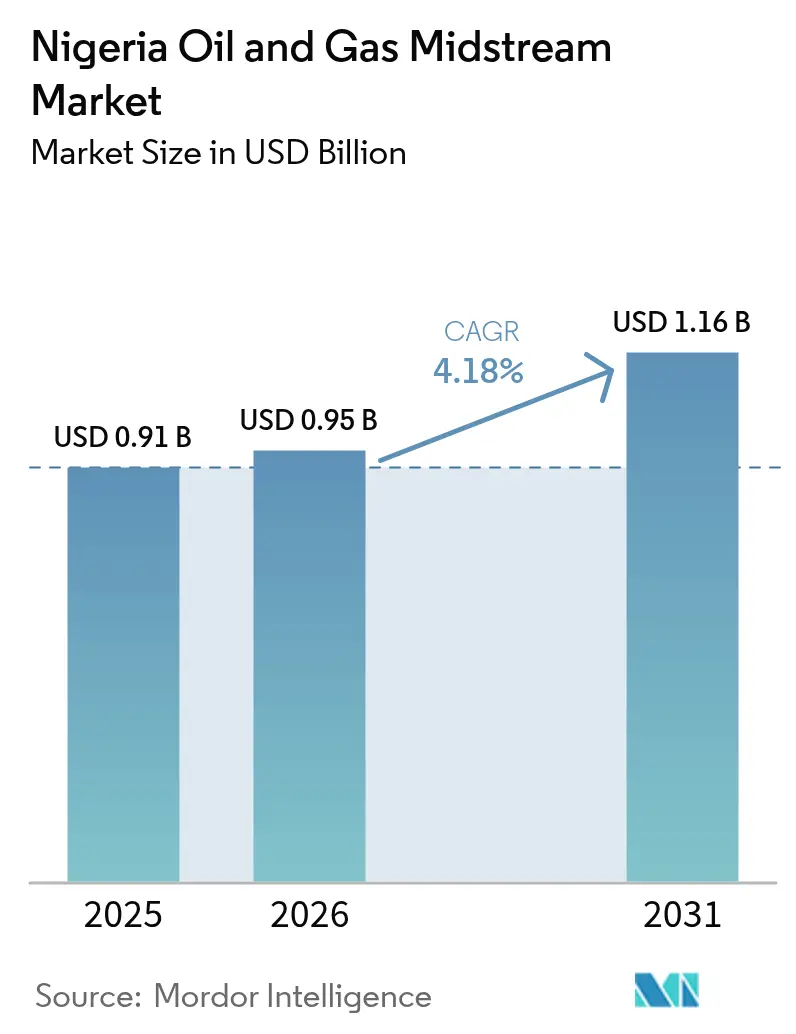
Nigeria Oil And Gas Midstream Market size in 2026 is estimated at USD 0.95 billion, growing from 2025 value of USD 0.91 billion with 2031 projections showing USD 1.16 billion, growing at 4.18% CAGR over 2026-2031.
Regulatory certainty provided by the Petroleum Industry Act (PIA) accelerates private investment, yet pipeline vandalism and foreign-exchange volatility still erode capacity utilization. The commissioning of the USD 10 billion NLNG Train 7 project, which expands liquefaction capacity from 22 million to 30 million tonnes per annum (tpa) by 2027, underscores the shift toward gas-led diversification. Meanwhile, the 650,000-barrel-per-day Dangote Refinery reconfigures domestic product flows and spurs the construction of dedicated pipelines, which trim trucking costs and reduce import dependence.
Key Report Takeaways
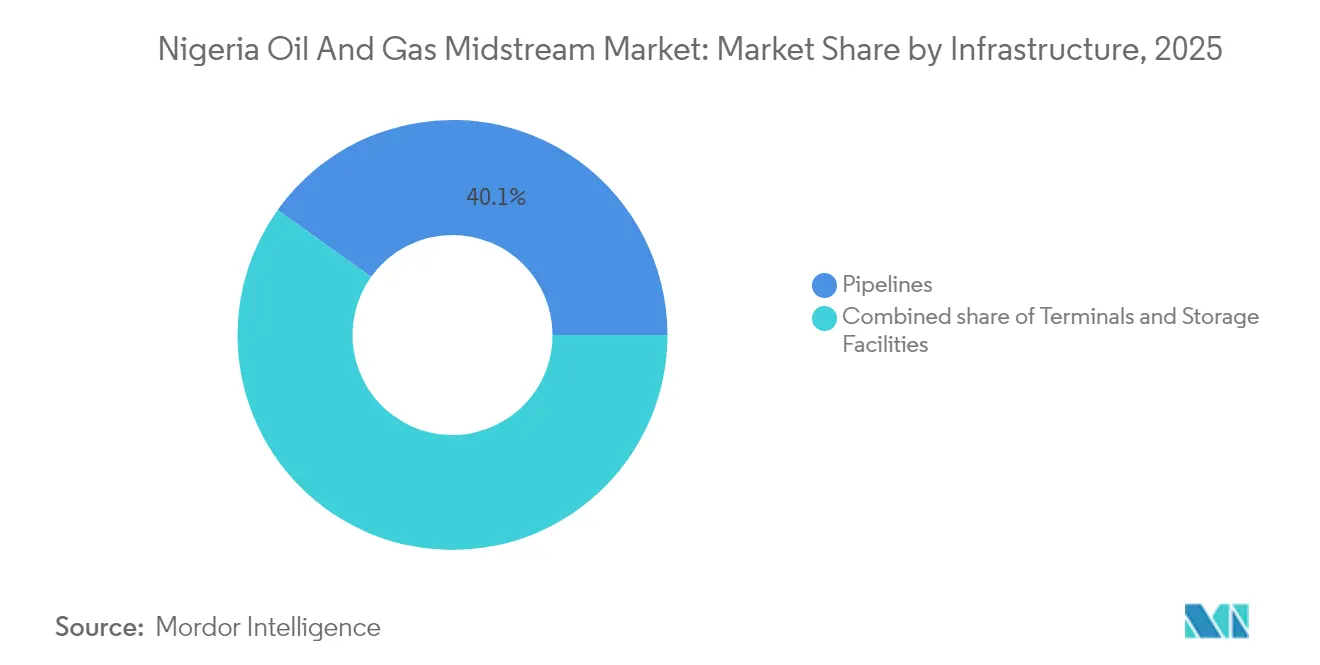
- By infrastructure, pipelines led with 40.12% of Nigeria's oil and gas midstream market share in 2025; storage facilities are projected to grow the fastest at a 5.34% CAGR through 2031.
- By product type, crude oil commanded a 44.72% share of the Nigeria oil and gas midstream market size in 2025, while LNG is expected to expand at a robust 7.18% CAGR to 2031.
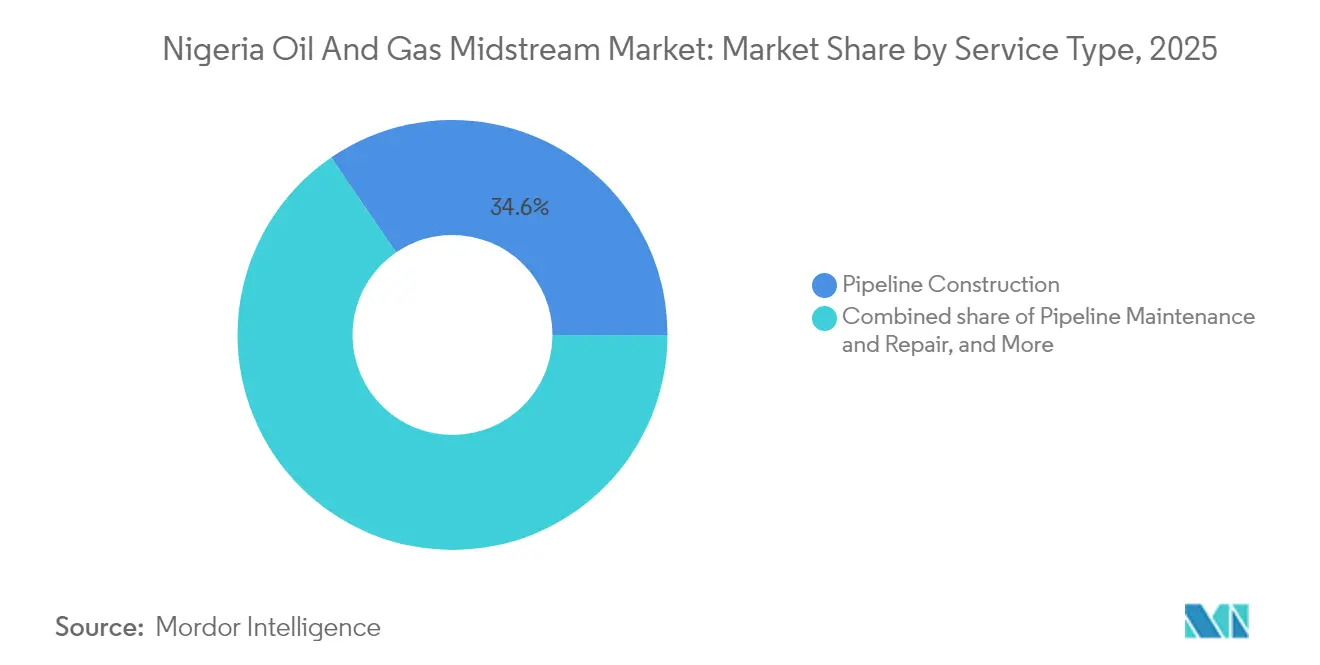
- By service type, pipeline construction accounted for 34.55% of the Nigerian oil and gas midstream market size in 2025, whereas pipeline maintenance and repair is poised for the highest growth at a 5.66% CAGR to 2031.
- Shell, TotalEnergies, Chevron, and Nigerian National Petroleum Company together controlled slightly above 54.25% of total midstream asset throughput in 2025.
Note: Market size and forecast figures in this report are generated using Mordor Intelligence’s proprietary estimation framework, updated with the latest available data and insights as of 2026.
Market Trends and Insights
Drivers Impact Analysis of Nigeria Oil And Gas Midstream Market*
| Driver | (~) % Impact on CAGR Forecast | Geographic Relevance | Impact Timeline |
|---|---|---|---|
| Regulatory clarity under PIA (2021) | +1.20% | National; early gains in Lagos, Rivers, Bayelsa | Medium term (2-4 years) |
| NLNG Train 7 and emerging FLNG projects | +0.80% | Niger Delta; coastal spillovers | Long term (≥ 4 years) |
| Dangote refinery-linked product pipelines | +0.60% | Southwest to northern corridors | Short term (≤ 2 years) |
| Domestic gas commercialization programs | +0.50% | Lagos, Kano, Kaduna clusters | Medium term (2-4 years) |
| BOT replacement of 5,000 km legacy pipelines | +0.40% | National high-traffic corridors | Long term (≥ 4 years) |
| Surge in coastal LPG storage terminals | +0.30% | Lagos to Akwa Ibom coastline | Short term (≤ 2 years) |
| Source: Mordor Intelligence | |||
Regulatory Clarity Under the PIA (2021)
The PIA establishes the Nigerian Midstream and Downstream Petroleum Regulatory Authority (NMDPRA) as a single rule-making body, ending decades of overlapping mandates that slowed project approvals. Transparent tariff-setting and guaranteed open-access provisions have slashed licensing timelines by 40% compared with pre-PIA procedures.(1) Incentives such as accelerated depreciation and reduced tax rates for gas projects lower entry barriers for domestic investors and international lenders. Early adopters include private-equity-backed pipeline operators that secured build-operate-transfer concessions on high-traffic corridors. Execution challenges persist, however, because state-level agencies interpret the Act unevenly, creating compliance gaps that delay right-of-way acquisitions. NMDPRA’s capacity-building program for subnational regulators aims to harmonize enforcement and sustain investor confidence over the medium term.
NLNG Train 7 & Emerging FLNG Projects Boost Gas Export Capacity
Nigeria LNG Limited’s USD 10 billion Train 7 expansion increases export capacity by 8 million tonnes per annum (tpa) and introduces modular construction, which shortens onshore exposure to security risks.(2)Complementary initiatives such as UTM Offshore’s 2.8 million tpa floating LNG (FLNG) unit, backed by USD 2.1 billion in Afreximbank financing, highlight the industry’s tilt toward offshore processing that circumvents vandal-prone pipelines. Together, these projects align Nigeria with Asian spot-price dynamics, which averaged USD 12 per MMBtu in 2024, four times the domestic gas pricing. Extending the offtake windows into 2050 underpins lender confidence, while sovereign guarantees ease currency exposure for imported liquefaction modules. Successful delivery could raise gas exports by 30%, cushioning federal revenues against crude-price volatility.
Dangote Refinery-Linked Product Pipelines Cut Import Bottlenecks
The Dangote refinery rewires national supply chains by channeling diesel, gasoline, and jet fuel from the Lekki Free Trade Zone to northern depots via new product pipelines. Internal estimates indicate a 35% transportation cost savings compared to coastal imports delivered by road.(3) Reverse-flow engineering allows the network to move products southward when the plant undergoes maintenance, enhancing resilience. Although product pricing negotiations constrained the initial start-up, NMDPRA’s approval of a market-linked pricing template in mid-2025 unlocked higher run rates. Community engagement programs, including health centers and road rehabilitation, strengthen social license in host localities, mitigating the protest risk that historically plagued Niger Delta assets.
Domestic Gas Commercialization (NGFCP, Network Code Roll-out)
The Nigeria Gas Flare Commercialization Programme (NGFCP) awards 42 flare sites to private developers that must install gas gathering and processing infrastructure by 2027. By mandating third-party access through the Gas Transportation Network Code, the government dissolves vertically integrated grids that previously excluded independent power producers. Industrial gas demand is expected to rise to 4 bcf/d by 2030, driven by captive plants in the Lagos, Ogun, and Kaduna manufacturing hubs. Pricing remains the pivotal variable: producers seek USD 3-4 per MMBtu to meet bankability thresholds, while the power sector pushes for tariffs below USD 3 to contain electricity costs. Consensus mechanisms, including indexed tariffs tied to Henry Hub averages, are now under stakeholder review.
Restraints Impact Analysis of Nigeria Oil And Gas Midstream Market*
| Restraint | (~)% Impact on CAGR Forecast | Geographic Relevance | Impact Timeline |
|---|---|---|---|
| Endemic pipeline vandalism & oil theft | -1.80% | Rivers, Bayelsa, Delta | Short term (≤ 2 years) |
| Ageing infrastructure & maintenance backlog | -0.90% | National onshore systems | Medium term (2-4 years) |
| FX volatility inflates CAPEX & OPEX | -0.70% | All regions using imported inputs | Short term (≤ 2 years) |
| Political flashpoints disrupt assets | -0.40% | Rivers State & environs | Short term (≤ 2 years) |
| Source: Mordor Intelligence | |||
Endemic Pipeline Vandalism & Oil Theft
Sophisticated criminal syndicates tap trunk lines, diverting up to 200,000 bpd of crude in 2024 and costing operators an estimated USD 2 billion in lost revenue. New techniques include welded bypasses buried several meters underground, complicating detection. The federal government responded by awarding a USD 130 million surveillance contract to a private security consortium that deploys drones, fiber-optic sensors, and community informants. Early evidence suggests a 20% reduction in theft incidents on monitored segments; however, the 5,000 km network still exceeds oversight capacity. Longer-term solutions—such as converting onshore pipelines to gas-powered underground lines that deter siphoning—remain capital-intensive.
Ageing Infrastructure & High Maintenance Backlog
More than half of Nigeria’s crude lines were installed before 1995, and corrosion now accounts for 60% of unplanned outages. NNPC pegs refurbishment requirements at USD 3.2 billion, competing with new-build budgets. Deferred maintenance exacerbates spill risks, which can lead to regulatory fines and community litigation. Operators are pivoting toward predictive maintenance by utilizing fiber-optic acoustic systems that pinpoint leak sounds in real-time. However, foreign-exchange shortages delay spare-part imports and raise local inflation on steel, valves, and coatings. To close the gap, NMDPRA encourages joint asset-management pools that allow smaller firms to share inventory and repair crews, thereby shortening downtime.
*Our forecasts treat driver/restraint impacts as directional, not additive. The impact forecasts reflect baseline growth, mix effects, and variable interactions.
Nigeria Oil And Gas Midstream Market Segment Analysis
By Infrastructure:
Pipelines Retain Lead as Storage AcceleratesPipelines carried 40.12% of the 2025 throughput, cementing their role at the core of Nigeria's oil and gas midstream market. The Warri-Kaduna system illustrates the operational complexity of handling multiple refined products across 600 km of restive terrain. Simultaneously, storage facilities expand at a 5.34% CAGR, buoyed by new coastal LPG terminals that cater to West African demand spikes. NMDPRA's 2024 technical code now mandates the installation of real-time overfill protection and vapor-recovery units, prompting legacy depots to upgrade. Underground caverns are gaining favor in the Niger Delta, where above-ground tanks are vulnerable to sabotage. Private investors secure 20-year concessions that bundle storage, jetty, and truck-loading racks, diversifying revenue streams.
The Nigeria oil and gas midstream market size for storage is expected to reach USD 0.23 billion by 2031, with coastal states contributing 70% of capacity additions. BOT financing reduces upfront state spending but requires transparent tariff indexing to U.S. Consumer Price Index benchmarks to offset naira depreciation. Synergies with nearby petrochemical parks shorten value chains and enhance offtake certainty. Nevertheless, slow customs clearance of cryogenic tanks prolongs construction schedules.

By Product Type:
Crude Still Dominant, LNG Fastest RisingCrude oil held a 44.72% share of the Nigerian oil and gas midstream market size in 2025, as legacy export pipelines, such as Trans-Niger and Nembe Creek, shifted volumes to offshore terminals. Yet LNG is advancing at a 7.18% CAGR, lifted by Train 7 and early-stage FLNG units that bypass vandal-prone onshore corridors. Natural gas infrastructure lags, causing 300 MMscf/d of shut-in associated gas in 2024. Dangote-driven refined-product output shifts the balance by reducing gasoline imports that once consumed USD 10 billion annually.
Emerging sulfur-removal and CO2-extraction technologies, installed at TotalEnergies’ Obite plant, enable higher-spec gas exports into European hubs starting in 2026.Downstream, low-pressure LPG lines supply micro-distribution centers that fill 6-kg cylinders for household cooking, supporting clean-energy goals. However, pipeline tariffs remain indexed to Brent prices, creating volatility for domestic users when crude markets spike.
By Service Type:
Construction Leads, Maintenance Gains MomentumPipeline construction absorbed 34.55% of 2025 service revenues as BOT contractors replaced 5,000 km of obsolete lines. The Nigeria oil and gas midstream market share for maintenance is set to climb on a 5.66% CAGR, reflecting an overdue shift from capacity expansion to asset preservation. Advanced inline inspection tools now scan 300 km per deployment, cutting outage windows by 40%. Storage and handling services benefit from LPG terminal expansion and strategic petroleum reserve plans that require 90 days of coverage.
Transportation and logistics players deploy GPS-linked truck fleets and barge operations that integrate with new pipelines emanating from Lekki. Security-enhanced routing software reduces hijack incidents by 15% year-over-year on the Benin–Lokoja corridor. Nonetheless, the naira devaluation inflates diesel costs, which account for 25% of trucking expenses, eroding margins unless operators hedge their fuel purchases.
Geography Analysis
The Niger Delta remains the operational heartland, contributing over 75% of midstream throughput in 2025. Rivers State hosts the Port Harcourt refinery complex and serves as a major pipeline hub, transporting crude and products nationwide. However, recurrent community protests and political flashpoints require 24/7 surveillance and rapid-response maintenance teams. Lagos, Ogun, and Ondo anchor coastal infrastructure, including NLNG on Bonny Island and the Dangote refinery in Lekki. Coastal deepwater ports provide easier access to international shipping lanes, fostering export-oriented projects that mitigate onshore security challenges.
Northern states such as Kano and Kaduna underpin demand expansion as industrial estates seek steady gas supplies for captive power. The Ajaokuta–Kaduna–Kano line, designed to transport 2.2 billion cubic feet per day (bcf/d), will be the largest greenfield gas pipeline once completed in 2027, although insurgent threats in the Middle Belt are hampering construction progress. Central transit corridors spanning Benue and Nasarawa require joint military escorts for pipe-string convoys, adding 8% to logistics costs.
Geographic diversification accelerates through offshore processing, where FLNG units eliminate the need for long onshore gas lines. Meanwhile, Kaduna and Kano can receive product via rehabilitated narrow-gauge rail adapted with pressurized tank cars. Harmonized regulations across Nigeria's six geopolitical zones remain critical, as uneven enforcement undermines tariff predictability and revenue assurance. Collectively, these location-specific dynamics shaped the risk-reward calculus that guides capital allocation in Nigeria's oil and gas midstream market.
Regulatory Landscape
Nigeria's oil and gas midstream market operates under the Petroleum Industry Act (PIA) 2021, which centralized midstream and downstream rulemaking, licensing, and technical oversight under the Nigerian Midstream and Downstream Petroleum Regulatory Authority (NMDPRA). The licensing-led framework covers hydrocarbon processing, storage, and transportation, with technical requirements referenced through the Petroleum Pipeline Regulations 2022 (aligned with standards such as API, ASME, ASTM, and NACE) and consolidated operating rules set out in the Midstream and Downstream Petroleum Operations Regulations 2025.
In February 2026, Presidential Executive Order 9 introduced an additional coordination mechanism by directing NMDPRA and the Nigerian Upstream Petroleum Regulatory Commission (NUPRC) to form a Joint Project Team. The objective is to align licensing and facility treatment for integrated petroleum operations and address long-standing interface issues between upstream and midstream permits. On gas infrastructure financing, the PIA-established Midstream Gas Infrastructure Fund (MDGIF), funded in part by a 0.5% levy on wholesale petroleum products and natural gas sales, provides a policy anchor for regulated gas midstream buildout and the associated compliance obligations.
Competitive Landscape
The Nigeria oil and gas midstream industry is moderately concentrated, with the top five operators handling 55–60% of transported volumes in 2024. International majors maintain strategic stakes but continue to divest onshore assets; Shell sold its subsidiary SPDC to the Renaissance Consortium for USD 2.4 billion in early 2025. Deepwater assets appeal to TotalEnergies and Chevron, which doubled down on offshore gas hubs that face fewer sabotage incidents. Local independents, such as Seplat Energy and Oando, scale up by leveraging PIA incentives and 70% local content requirements enforced by the Nigerian Content Development and Monitoring Board.
Strategic partnerships dominate: UTM Offshore teams with SBM Offshore for FLNG hull fabrication, while NNPC partners with Dangote for pipeline interconnections that optimize refinery evacuation. Technology adoption focuses on fiber-optic sensing, satellite imagery, and AI-driven leak detection to boost uptime. Funding structures are evolving toward blended finance, which combines multilateral loans, export-credit guarantees, and naira-denominated bond issues that hedge currency risk.
Regulatory transparency, combined with rising domestic demand, entices service providers in welding, corrosion control, and EPC management. Still, entry barriers persist due to security premiums, insurance surcharges, and complex community-relations frameworks. The market concentration score stands at 6, reflecting a scenario where the top five firms control just over 55% of throughput, leaving meaningful room for niche players but requiring scale to absorb security and compliance costs.
Nigeria Oil And Gas Midstream Industry Leaders
-
Duport Midstream Company Limited (DMCL)
-
Nigerian National Petroleum Corporation
-
Chevron Nigeria Limited
-
Eni SPA
-
Shell PLC
- *Disclaimer: Major Players sorted in no particular order

Nigeria Oil And Gas Midstream Market Companies Covered in this Report
- Nigerian National Petroleum Company Ltd (NNPC)
- Nigeria LNG Ltd
- Shell PLC
- TotalEnergies SE
- Eni SpA
- Chevron Nigeria Ltd
- Seplat Energy PLC
- Waltersmith Petro Ltd
- Aiteo Eastern E&P Co
- Oando PLC
- Ardova PLC
- NIPCO PLC
- Navgas Ltd
- Matrix Energy Ltd
- DuPort Midstream Co Ltd
- Gaslink Nigeria Ltd
- Falcon Corporation Ltd
- Prudent Energy & Services Ltd
- Stockgap Fuels Ltd
- Dangote Petrochemical & Refinery Ltd (midstream logistics)
Market Opportunities and Future Outlook
Gas transmission and processing interconnections open a near-term white-space for midstream operators that can bundle pipeline capacity, compression, and metering under open-access rules. A clear example is NNPC Limited's completion of the River Niger crossing on the 130-kilometer OB3 gas pipeline in April 2026, which enables 2 Bscf/d transmission capacity and tightens the physical linkage between southern supply and demand corridors tied into the national grid. Alongside this, the NNPC Gas Master Plan 2026 outlines shared infrastructure concepts (including Central Processing Facilities) and prioritizes trunkline expansions and network integration, supporting an expanded scope for EPC, integrity management, and network-code compliant gas transportation services.
A second opportunity cluster is tied to MDGIF-backed domestic gas utilization and virtual pipeline networks. The MDGIF has supported 113 projects across gas processing, CNG/LCNG mother and daughter stations, and LPG depots, signaling continuing capital allocation toward last-mile distribution infrastructure that works around immediate trunkline constraints and widens the addressable market for storage, handling, and logistics services. Regulatory consolidation through the Midstream and Downstream Petroleum Operations Regulations 2025 also increases demand for compliance-led upgrades, including pipeline integrity and terminal safety systems, and supports the case for third-party access models where throughput, storage, and evacuation services can be contracted across multiple shippers.
Recent Industry Developments in Nigeria Oil And Gas Midstream Market
- July 2026: Chevron Nigeria Limited and NNPC Gas Infrastructure Company (NGIC) signed a Network Entry Agreement to deliver 350 MMscf/d into the Escravos-Lagos Pipeline System (ELPS). The agreement standardizes gas injection and network access under the network-code framework, supporting more bankable transportation arrangements for domestic power and industrial offtakers.
- April 2026: NNPC Limited completed the River Niger crossing on the 130-kilometer Obiafu-Obrikom-Oben (OB3) Gas Pipeline, a critical construction milestone on the transmission corridor. With 2 Bscf/d capacity enabled, the project strengthens grid connectivity between gas-producing areas and demand centers, improving the commercial viability of downstream gas distribution and processing investments tied to the network.
- November 2024: The Nigerian Midstream and Downstream Petroleum Regulatory Authority (NMDPRA) approved updated technical standards for LPG storage terminals, mandating enhanced safety protocols and environmental monitoring systems. The requirements increase near-term compliance and retrofit activity for depot operators while raising the baseline for new coastal LPG terminal developments.
Nigeria Oil And Gas Midstream Market Report Scope and Research Methodology
Market Definition and Coverage
For this study, the Nigeria oil and gas midstream market is defined as revenues generated from moving and holding hydrocarbons between production sites and end markets, mainly through pipelines, terminals, storage, and related logistics services within Nigeria.
Scope exclusions: Upstream field development and downstream refining, retail fuel marketing, and petrochemicals are not counted in this market sizing.
Segments Covered in This Report
- By Infrastructure
- Pipelines
- Terminals
- Storage Facilities (Underground and Above-ground)
- By Product Type
- Crude Oil
- Natural Gas
- Refined Products
- LNG
- By Service Type
- Pipeline Construction
- Pipeline Maintenance and Repair
- Storage and Handling Services
- Transportation and Logistics
Data Sources, Market Sizing, and Validation
Desk Research
Desk work starts by collecting hard public inputs that shape midstream demand and capacity in Nigeria, then mapping them to the assets and services that earn midstream revenues. Sources used for this step include non-paywalled references such as the Nigerian Upstream Petroleum Regulatory Commission releases, the Nigerian Midstream and Downstream Petroleum Regulatory Authority publications, NNPC and other operator public updates, and international statistics from OPEC and the IEA.
We also review company annual reports, investor presentations, press releases, and project updates to understand how pipeline, terminal, and storage additions are sequenced over time. Import and export shipment level trade records and patent databases are used selectively to sanity check activity signals and technology direction, for example integrity monitoring and metering upgrades, when public data is thin. The sources listed here are illustrative only, and many other public documents and databases were also referenced for data collection, validation, and clarification.
Primary Interviews and Surveys
We conduct expert interviews and surveys in Nigeria with operators, infrastructure service providers, transport and storage specialists, regulators, and industrial gas users. Their views help validate secondary data, fill gaps on utilization and pricing, and triangulate model assumptions before final analysis.
Distribution of primary research fieldwork respondents
| Company type | Respondent position |
|---|---|
| Top tier: 28% | CXOs: 20% |
| Mid tier: 47% | Functional/Unit leaders: 30% |
| Smaller Players: 25% | Managers: 50% |
Market-Sizing & Forecasting
The model uses top-down logic, translating Nigeria hydrocarbon throughput and infrastructure activity into midstream revenue pools by applying realistic service mix and price assumptions. To avoid over-relying on a single series, the demand reconstruction is anchored on indicators such as pipeline throughput and downtime patterns, storage and terminal capacity additions, LNG and gas processing utilization where applicable, and project commissioning timelines that shift volumes from one route to another.
Totals are then corroborated through selective bottom-up approximations, such as rolling up a sampled set of pipeline, terminal, and storage service revenues, and checking implied average pricing, including tariffs, handling fees, and integrity service spend, against what practitioners describe as typical ranges. When company disclosures are incomplete, gaps are handled by using peer benchmarks for utilization and unit pricing, then re-checking those assumptions during interviews before the final number is locked.
For forecasting, we primarily use scenario analysis supported by short time series smoothing where needed, since Nigeria midstream outcomes can shift quickly with outages, regulatory steps, and project slippages. The forward view is driven by expected capacity commissioning, gas commercialization momentum, and maintenance cycles, and then adjusted using the consensus ranges received from industry respondents.
Data Validation & Update Cycle
Outputs are validated through triangulation across independent signals, including capacity additions versus implied revenue growth, volume trends versus implied pricing shifts, and year-to-year swings that could be driven by one-off events. If a variance looks too large, we re-check the input series, revisit interview notes, and, in some cases, re-contact sources to confirm whether an operational or policy change explains the move.
Before sign-off, results go through multi-step internal reviews to keep modeling choices and calculations consistent and easy to follow. Reports are refreshed annually, and interim updates are made when material events occur, for example major outages, new terminals coming online, or policy changes. Right before delivery, the analyst runs a final update pass so clients receive the latest view supported by the same repeatable steps.
Mordor Intelligence's Nigeria Oil and Gas Midstream Market Sizing Compared With Other Published Estimates
It is normal to see different published market sizes for Nigeria oil and gas midstream, even when the titles look similar. The differences usually come from what activities are counted as midstream, which year is treated as the base, and how pricing and utilization are assumed when public reporting is limited.
Some external estimates fold in broader downstream distribution and processing value, and they can also treat total hydrocarbon handling value as the market. In Mordor Intelligence's sizing, the value is limited to midstream infrastructure and services revenues in Nigeria, and it is kept tied to observable activity checks like throughput signals, capacity additions, and realistic utilization ranges.
Benchmark comparison
| Source | Market Size | Gaps in Research Methodology |
|---|---|---|
| Mordor Intelligence | USD 0.91 B (2025) | |
| Market Analytics Publisher A | USD 5.20 B (2024) | Uses an earlier base year and a wider activity scope that can include processing and broader distribution value, which inflates the revenue pool versus infrastructure and service revenues only. |
| Industry Research Publisher B | USD 5.68 B (2026) | Reports a later year and appears to include a broader set of services and assets, and the implied utilization and pricing assumptions are less clearly tied back to Nigeria throughput and capacity signals. |
The spread in the table is mainly explained by scope expansion and timing differences, followed by how utilization and pricing are treated when company reporting is patchy. By keeping the counted revenue streams specific to midstream assets and then checking them against throughput, capacity, and commissioning realities, the final figure stays practical to replicate and easier to stress test.
Key Questions Answered in the Report
What is the current value of the Nigeria oil and gas midstream market?
The Nigeria oil and gas midstream market size stands at USD 0.95 billion in 2026.
How fast is the sector expected to grow?
It is projected to reach USD 1.16 billion by 2031, reflecting a 4.18% CAGR.
Which infrastructure segment is expanding the quickest?
Coastal storage facilities lead growth at a 5.34% CAGR through 2031.
Why is LNG gaining momentum?
NLNG Train 7 and planned FLNG units boost liquefaction capacity, driving a 7.18% CAGR for the LNG segment.
How does the PIA improve investment conditions?
The PIA centralizes regulation under NMDPRA, shortens license approval times by 40%, and offers tax incentives for gas projects.
What remains the biggest operational challenge?
Pipeline vandalism still causes yearly losses of around USD 2 billion despite upgraded surveillance efforts.