
Market Overview
| Study Period | 2021 - 2031 |
|---|---|
| Forecast Data Period | 2026 - 2031 |
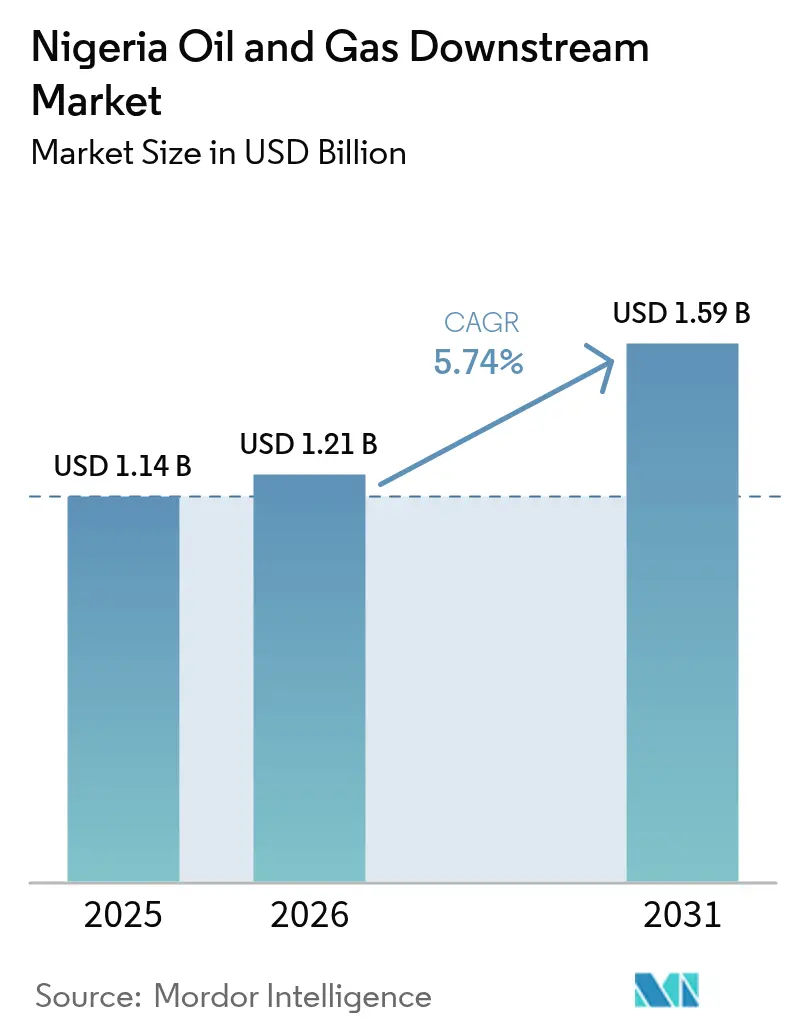
| Base Year Market Size (2025) | USD 1.14 Billion |
| Market Size (2026) | USD 1.21 Billion |
| Market Size (2031) | USD 1.59 Billion |
| Growth Rate (2026 - 2031) | 5.74 % |
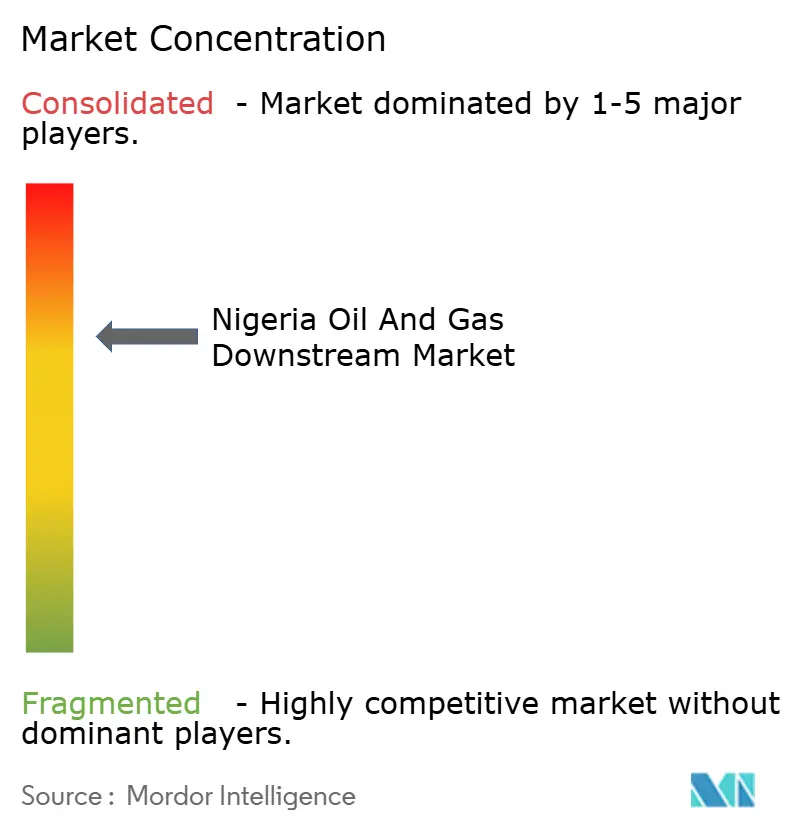
| Market Concentration | Medium |
Major Players *Disclaimer: Major Players sorted in no particular order Image © Mordor Intelligence. Reuse requires attribution under CC BY 4.0. | |
Nigeria Oil And Gas Downstream Market Analysis by Mordor Intelligence
The Nigeria Oil And Gas Downstream market size is expected to grow from USD 1.14 billion in 2025 to USD 1.21 billion in 2026 and is forecast to reach USD 1.59 billion by 2031 at 5.74% CAGR over 2026-2031.
Rising local refining capacity, policy deregulation, and growing urban fuel demand anchor this expansion. The commissioning of the 650,000 barrels-per-day Dangote Refinery sharply reduces import dependence and pushes domestic output toward regional export surpluses. Flexible pricing after subsidy removal improves margins for private operators, while modular projects unlock participation for indigenous firms. Accelerated security operations in the Niger Delta further stabilize crude supply and boost investor confidence.
Key Report Takeaways
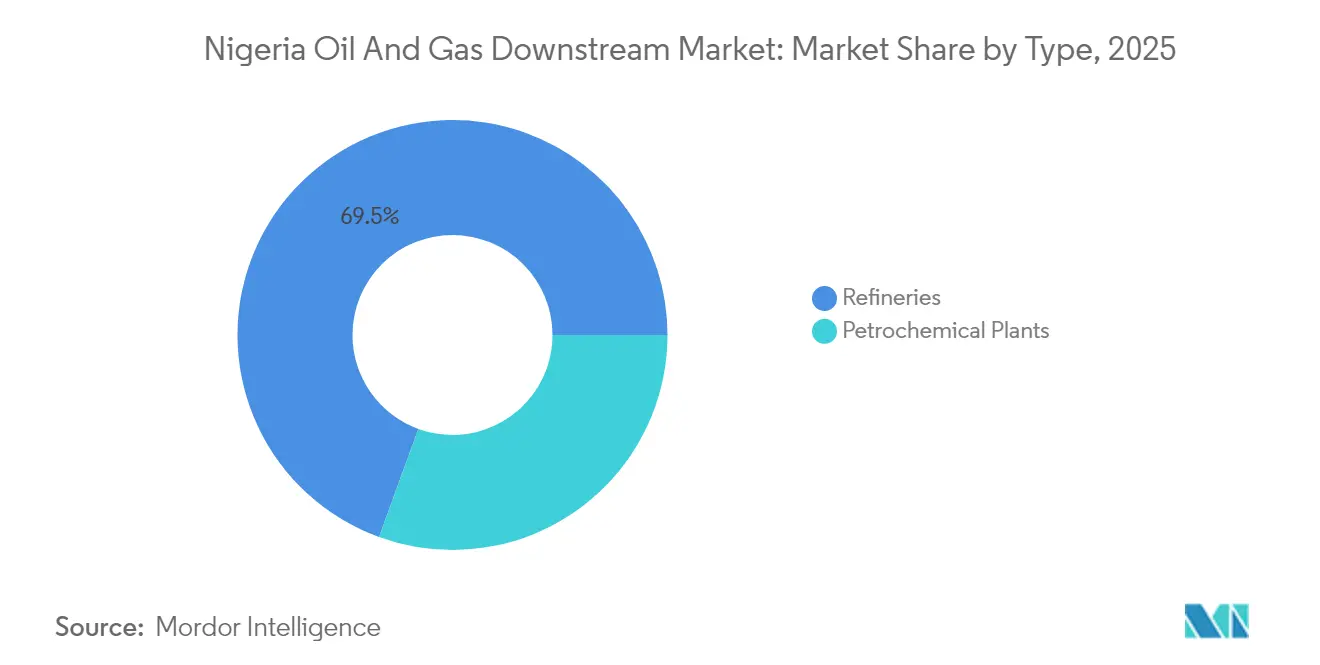
- By type, refineries led with 69.45% of Nigeria's oil & gas downstream market share in 2025; petrochemical plants are poised to expand at a 7.12% CAGR through 2031.
- By product type, refined petroleum products commanded a 74.15% share of the Nigeria oil & gas downstream market size in 2025, whereas petrochemicals recorded the fastest 6.86% CAGR to 2031.
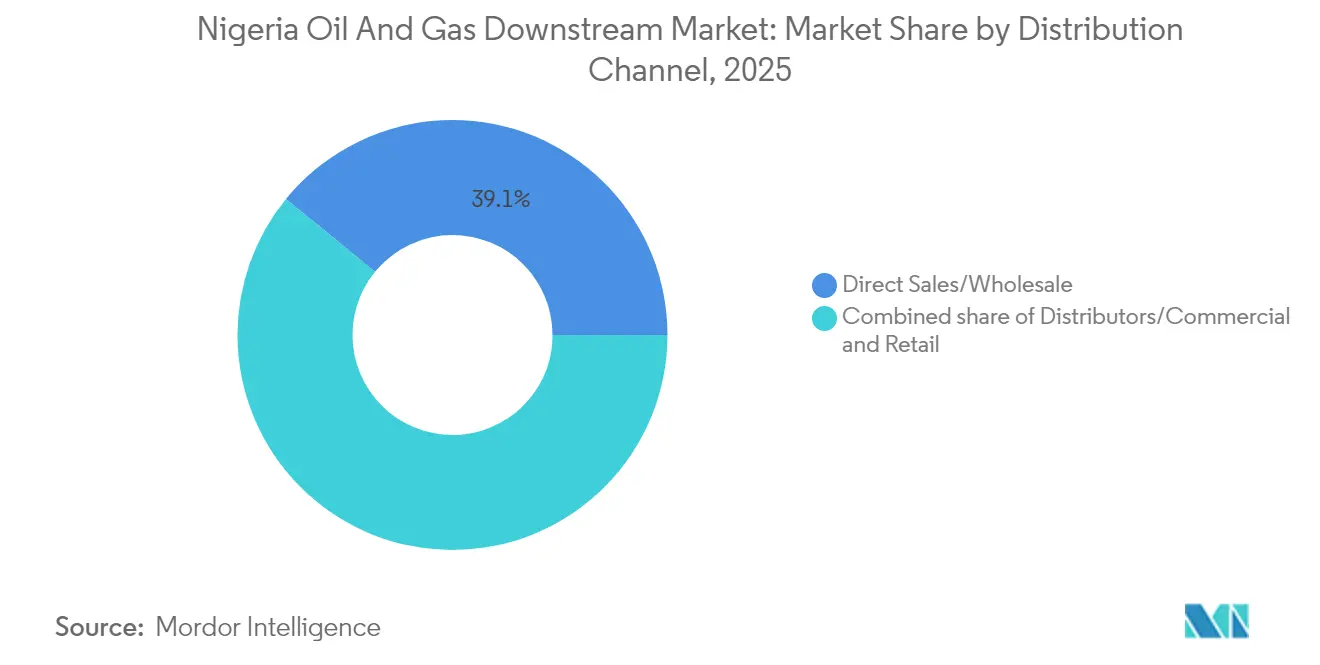
- By distribution channel, direct sales and wholesale accounted for a 39.10% revenue share in 2025, while retail distribution is projected to grow at a 6.72% CAGR through 2031.
Note: Market size and forecast figures in this report are generated using Mordor Intelligence’s proprietary estimation framework, updated with the latest available data and insights as of 2026.
Market Trends and Insights
Drivers Impact Analysis of Nigeria Oil And Gas Downstream Market*
| Driver | (~) % Impact on CAGR Forecast | Geographic Relevance | Impact Timeline |
|---|---|---|---|
| Rapid growth in domestic fuel demand | 1.2% | National, concentrated in Lagos, Abuja, Port Harcourt | Medium term (2-4 years) |
| Commissioning of Dangote Refinery boosting local supply | 1.8% | National, with export spillover to West Africa | Short term (≤ 2 years) |
| Government deregulation & subsidy removal policies | 1.0% | National, early implementation in major cities | Medium term (2-4 years) |
| Expansion of modular refinery projects in Niger Delta | 0.8% | Niger Delta states, primarily Rivers, Bayelsa, Delta | Long term (≥ 4 years) |
| Local-content law fostering indigenous participation | 0.6% | National, strongest in upstream-downstream integration | Long term (≥ 4 years) |
| Export potential to West Africa's short-supply markets | 0.7% | Regional, targeting Ghana, Benin, Togo markets | Medium term (2-4 years) |
| Source: Mordor Intelligence | |||
Commissioning of Dangote Refinery Boosting Local Supply
The start-up of full gasoline runs at Dangote’s 650,000 barrels-per-day complex in September 2024 instantly raised domestic supply and freed USD 9 billion in annual import spending. NNPC initially acquires all gasoline output, smoothing distribution while the plant ramps to nameplate capacity. A dedicated 1,100 km subsea pipeline delivers Niger Delta crude directly to the facility, cutting historic transport penalties. Co-located petrochemical and fertilizer units deepen value capture and open export channels into West Africa. A 10-year gas-supply agreement from Shell’s Iseni field guarantees 100 million scf/d of feedstock to the polypropylene and methanol trains.[1]
Government Deregulation and Subsidy Removal Policies
Executive orders issued in 2024 ended pump-price caps and transferred price setting to open market dynamics. This shift restored refinery economics, attracting USD 4.2 billion in private equity commitments within twelve months.[2] The Petroleum Industry Act 2021 now provides stable fiscal terms, while local-content directives mandate minimum indigenous equity, driving skills transfer. Although a temporary 3.3% of GDP subsidy reappeared during the 2024 election cycle, authorities reconfirmed a full rollback in early 2025, reinforcing investor confidence.
Expansion of Modular Refinery Projects in Niger Delta
Eighteen licensed modular plants, each sized 5,000-20,000 barrels per day, collectively add 215,000 barrels per day of incremental capacity by 2027. Lower capital expenditures, proximity to feedstock, and phased debottlenecking make the model attractive to local entrepreneurs. The Nigerian Content Development and Monitoring Board reports that 37,400 direct jobs have been generated to date, with an additional 72,000 anticipated during the expansion phases. State-funded gunboat patrols reduce vandalism on feeder pipelines, improving plant uptime.
Export Potential to West Africa’s Short-Supply Markets
Regional demand outstrips supply by 450,000 barrels per day, and Nigerian refiners target Ghana, Benin, and Togo, where import parities exceed domestic ex-gate prices by 12-18%. ECOWAS protocols eliminate most tariffs, while Lagos-Tema sailings average only three days, outperforming European cargoes in terms of freight cost and delivery time. Long-term offtake contracts signed in Q1 2025 secure Dangote's 5 million barrels of annual gasoline exports.
Restraints Impact Analysis of Nigeria Oil And Gas Downstream Market*
| Restraint | (~) % Impact on CAGR Forecast | Geographic Relevance | Impact Timeline |
|---|---|---|---|
| Crude-price volatility affecting refinery margins | -0.9% | National, affecting all refineries | Short term (≤ 2 years) |
| Persistent pipeline vandalism & oil theft | -1.1% | Niger Delta region, onshore operations | Medium term (2-4 years) |
| Foreign-exchange scarcity for feedstock imports | -0.7% | National, import-dependent facilities | Short term (≤ 2 years) |
| ESG-driven funding constraints for fossil projects | -0.5% | International financing, major projects | Long term (≥ 4 years) |
| Source: Mordor Intelligence | |||
Persistent Pipeline Vandalism and Oil Theft
Illicit taps on trunk lines siphon off 200,000 barrels per day, equal to USD 10 billion per year in lost revenues and deferred taxes. Multi-agency Operation Delta Safe deployed armed drones and attack helicopters in late 2024, achieving a 16.7% lift in national crude output within twelve months. Yet analysts note that dismantling the financial networks behind theft rings remains crucial for durable gains. The environmental liabilities from illegal “Kpo-fire” distillation add remediation costs that erode refinery cash flows.
Foreign-Exchange Scarcity for Feedstock Imports
Although the Nigeria oil & gas downstream market increasingly relies on local crude, legacy plants still import specialty grades. Declines in Brent prices from USD 82 to USD 65 per barrel in 2025 complicated a proposed USD 5 billion oil-backed loan, delaying cargo purchases and swelling demurrage bills. Foreign-currency regulations that require environmental bonds and license fees in USD tighten liquidity, illustrated by the aborted USD 860 million TotalEnergies asset sale when bank guarantees failed to clear.
*Our forecasts treat driver/restraint impacts as directional, not additive. The impact forecasts reflect baseline growth, mix effects, and variable interactions.
Nigeria Oil And Gas Downstream Market Segment Analysis
By Type:
Refineries Dominate Infrastructure InvestmentRefineries captured 69.45% of Nigeria's oil & gas downstream market share in 2025 as the state prioritized energy security through domestic processing. The Nigeria oil & gas downstream market size attributable to refineries is projected to climb at a 5.45% CAGR, supported by the USD 18.5 billion Dangote complex and the December 2024 restart of Warri Refinery. Integrated operators secure feedstock via joint-venture upstream stakes, buffering margin volatility. Modern process units, such as continuous catalytic regenerators, raise gasoline yields and lower sulfur, aligning products with ECOWAS specifications.
Petrochemical plants, although currently smaller, are projected to grow at the fastest 7.12% CAGR through 2031. Indorama Eleme's latest debottlenecking initiative increases urea output to 3.8 million tonnes per year, while Shell-supported propane dehydrogenation units supply polypropylene lines. Modular refineries offer a learning curve for local investors, with quick payback periods that recycle cash into second-phase expansions.

By Product Type:
Petrochemicals Drive Value AdditionRefined fuels held a 74.15% share of Nigeria's oil & gas downstream market size in 2025 as gasoline, diesel, and kerosene met transport and power demand. However, petrochemicals are expected to accelerate at a 6.86% CAGR on the back of Dangote's 900,000-tonne polypropylene train and a co-located 3 million-tonne ammonia-urea facility. Domestic fertilizer self-sufficiency reached 65% in 2025, resulting in USD 1.1 billion in savings on import costs.
Lubricants and specialty products occupy niche positions yet benefit from automotive fleet growth. International brands partner with local blenders to meet the rising demand for OEM quality grades, and synthetic lubricant penetration reaches 14% in urban centers. Government policy is increasingly rewarding value-added production through tax credits for chemical derivatives over basic fuels.
By Distribution Channel:
Retail Networks Expand Market AccessDirect sales and wholesale retained 39.10% of revenue in 2025, anchored by bulk contracts with power plants and heavy industry. The Nigerian oil & gas downstream market size booked under retail outlets is forecast to rise at a 6.72% CAGR through 2031, as private station ownership increases following the removal of subsidies.
Urban roll-outs feature multi-service stations offering convenience retail, quick-service restaurants, and EV charging bays. The Midstream and Downstream Petroleum Regulatory Authority streamlined licensing in 2024, reducing the average permit time from 90 to 35 days. Digital payment platforms reduce cash leakage and provide real-time inventory visibility, enabling operators to optimize truck dispatches and minimize stockouts.
Geography Analysis
Lagos State anchors the Nigeria oil & gas downstream market as home to the Lekki Free Zone, where Dangote’s 2,635-hectare complex operates. The region handles 60% of national refined-product sea imports and now channels rising export volumes to neighboring states. Proximity to deep-draft jetties reduces freight costs and facilitates the handling of petrochemical bulk.
The Niger Delta remains the crude heartland, driving feedstock availability for both mega and modular plants. Security operations have reduced reported vandalism incidents by 28% year-over-year, yet insurance premiums remain elevated. Warri and Port Harcourt refineries benefit from pipeline interconnections that feed both domestic and export tanks.
Northern demand centers such as Abuja and Kano rely on overland trucking and emerging rail corridors that extend 1,200 km from southern terminals. Transport margins add USD 40 per m³ on average, underpinning the economic case for a proposed 50,000 barrels-per-day Kaduna modular plant, slated for commissioning in 2027. Regional pipelines under discussion would relieve road congestion and cut product losses.
West Africa offers a natural outlet for surplus gasoline and chemicals. Ghana imported USD 48.6 million worth of Nigerian petroleum in 2022 and signed a framework agreement in 2025 for a long-term supply of 35,000 barrels per day at Tema. Benin and Togo seek similar deals under ECOWAS rules that waive import levies, giving Nigerian exporters a 4-cent-per-liter landed cost advantage over European cargoes.
Regulatory Landscape
Nigeria's downstream regulation is anchored by the Petroleum Industry Act (PIA) 2021, which reorganized sector governance and placed midstream and downstream technical and commercial oversight under the Nigerian Midstream and Downstream Petroleum Regulatory Authority (NMDPRA). Under this framework, NMDPRA administers licensing for refineries, depots, pipelines, and retail operations, and provides cost benchmarks and surveillance expectations that shape facility permitting and operating compliance.
A key recent shift is the introduction of the Midstream and Downstream Petroleum Operations Regulations 2025, issued under the NMDPRA framework in early 2026, which consolidate operating requirements and tighten compliance expectations across regulated activities. The regulations include structural separation requirements for companies engaged across different petroleum operation streams, with a stated compliance deadline of 7 July 2026 (subject to extensions granted by the Authority). This raises the importance of license mapping, internal governance, and compliance staffing for downstream operators expanding retail, storage, and processing footprints.
Competitive Landscape
The Nigeria oil & gas downstream market contains a blend of state-owned incumbents, international majors, and agile local independents. NNPC Limited retains pivotal influence through equity stakes in three legacy refineries and a 20% share in Dangote. Its trading arm markets one-third of national fuel demand and administers strategic stockpiles.
The Dangote Group commands a significant capacity but opts for a range of 5,000 to 20,000 barrels per day, serving proximate markets and catering to marine bunkering needs through an export-led model that diversifies its revenue. The integrated complex covers refining, petrochemicals, and fertilizer, capturing value across the hydrocarbon chain. Shell, TotalEnergies, and ExxonMobil are repositioning toward offshore production while maintaining branded fuel retail and LPG distribution networks. Shell’s USD 2.4 billion sale of SPDC to Renaissance Group finalizes a multi-year divestment from onshore blocks, yet keeps the company invested in the high-margin Bonga North deep-water project.[4]
Indigenous firms such as Waltersmith, Azikel, and Niger Delta Petroleum refine 5,000-20,000 barrels per day, serving proximate markets and catering to marine bunkering. Competitive focus centers on supply chain integration, digital asset monitoring, and ESG compliance to unlock more affordable financing. Operators deploying fiber-optic pipeline surveillance report 45% fewer leak incidents within the first year of installation. Retail segment rivalry intensifies as Mobil, Oando, and Ardova expand premium forecourts that bundle non-fuel services.
Nigeria Oil And Gas Downstream Industry Leaders
-
NDEP plc
-
Nigerian National Petroleum Corporation
-
Indorama Eleme Petrochemicals Limited.
-
KBR Inc.
-
Midoil Refining & Petrochemicals Company Limited
- *Disclaimer: Major Players sorted in no particular order
Nigeria Oil And Gas Downstream Market Companies Covered in this Report
- Nigerian National Petroleum Company Ltd (NNPC)
- Dangote Oil Refinery Company Ltd
- TotalEnergies Marketing Nigeria Plc
- Conoil Plc
- 11 Plc (Mobil)
- Ardova Plc
- Indorama Eleme Petrochemicals Ltd
- NDEP Plc
- Midoil Refining & Petrochemicals Ltd
- KBR Inc
- Oando Plc
- Eterna Plc
- Rainoil Ltd
- NIPCO Plc
- Sahara Group (Asharami Synergy)
- Petrocam Trading Nig Ltd
- Emadeb Energy Services Ltd
- Prudent Energy & Services Ltd
- Aiteo Eastern E&P / Downstream
- Shell Nigeria Gas Ltd (Downstream)
Market Opportunities and Future Outlook
Scaling domestic refining and improving price contestability are creating whitespace across logistics and marketing, as well as in higher-value derivatives linked to new capacity. In January 2026, Engineers India Limited (EIL) signed a USD 350 million contract related to the planned expansion of the Dangote Petroleum Refinery, pointing to demand for EPC services, brownfield integration work, and supporting midstream infrastructure around the Lekki supply cluster.
Near-term commercial opportunities are also being shaped by policy and market actions favoring local supply. In June 2026, Dangote completed a performance test reaching 700,000 bpd, above its 650,000 bpd nameplate, which reinforces the need for incremental evacuation, coastal distribution, and export-oriented storage. In July 2026, the Federal Government authorized a 15% ad-valorem import duty on petrol and diesel to support local refining, while downstream pricing interventions (including depot price reductions by Dangote and major marketers amid government pressure) shifted attention toward cost-to-serve optimization, tighter inventory management, and differentiated retail offerings in major demand centers.
Recent Industry Developments in Nigeria Oil And Gas Downstream Market
- July 2026: Dangote Petroleum Refinery began pricing some local petroleum product sales in United States dollars, citing crude supply considerations, and this drew pushback from independent marketers. The change has sharpened attention on pricing mechanisms and foreign-exchange exposure across wholesale and retail channels, affecting contracting and working-capital needs for marketers buying refined products domestically.
- March 2025: Shell completed the USD 2.4 billion divestment of Shell Petroleum Development Company of Nigeria Limited (SPDC) to Renaissance Group, alongside transition funding commitments. The transaction advanced the repositioning of international majors toward offshore portfolios while maintaining selected downstream footprints, with knock-on effects for supply relationships and domestic gas-linked feedstock strategies tied to refining and petrochemicals.
- September 2024: Dangote's 650,000 barrels-per-day refinery commenced full gasoline runs, lifting local supply availability and accelerating the shift from import dependence toward domestic sourcing. With NNPC initially acquiring gasoline output, the start-up supported changes in distribution patterns and created room for downstream operators to reconfigure storage, trucking, and retail procurement around local refinery offtake.
Nigeria Oil And Gas Downstream Market Report Scope and Research Methodology
Market Definition and Coverage
For this methodology, the Nigeria oil and gas downstream market covers the value created after crude or gas is produced, up to refined product sales and delivery to end users. It includes refining output, petrochemical plant activity tied to downstream processing, and retail and wholesale distribution within Nigeria.
Scope exclusions: Upstream exploration and production, and stand-alone midstream transportation or storage services are excluded unless they are bundled into downstream selling activity.
Segments Covered in This Report
- By Type
- Refineries
- Petrochemical Plants
- By Product Type
- Refined Petroleum Products
- Petrochemicals
- Lubricants
- By Distribution Channel
- Direct Sales/Wholesale
- Distributors/Commercial
- Retail
Data Sources, Market Sizing, and Validation
Desk Research
Desk research was used to build the factual backbone on Nigeria fuels and downstream capacity. We relied on public datasets and official references such as NNPC releases, Nigerian Midstream and Downstream Petroleum Regulatory Authority publications, Central Bank of Nigeria statistical bulletins, Nigeria Customs trade statistics, and OPEC and IEA country tables to set demand and supply context.
On top of this, we reviewed company annual reports, audited financial statements, investor presentations, and credible media coverage to track price changes, deregulation milestones, and new refinery ramp-ups. Where needed, we used paid subscriptions for company financial intelligence, shipment-level import and export checks, and patent lookups to cover gaps that are difficult to see from headlines alone. These are illustrative examples of sources used, and additional public references were also consulted for data collection, cross-checking, and clarifying assumptions.
Primary Interviews and Surveys
We interview Nigerian refiners, petrochemical producers, marketers, distributors, transport operators, and regulatory specialists. Managers and functional leaders help clarify volumes, pricing, utilization, channel movements, and supply gaps, while senior respondents test the main assumptions. Survey and interview findings are compared with secondary records and used to adjust the final analysis where evidence is incomplete.
Distribution of primary research fieldwork respondents
| Company type | Respondent position |
|---|---|
| Top tier: 28% | CXOs: 20% |
| Mid tier: 47% | Functional/Unit leaders: 30% |
| Smaller Players: 25% | Managers: 50% |
Market-Sizing & Forecasting
The main model was built using a top-down approach where downstream demand pools are reconstructed from Nigeria refining capacity signals and fuel market indicators, then converted into value using observed pricing and margin logic. To keep totals realistic, we corroborated the results with selective bottom-up approximations, such as sampled throughput and sales checks across key channels, plus simple price times volume sanity checks for major refined products.
Inputs used in the model include refinery capacity additions and ramp-up timing, implied utilization ranges, product mix shifts across fuels (for example, PMS, diesel, and LPG), policy-driven price resets and subsidy removal timing, and changes in import reliance that affect local marketing volumes. For the forecast, scenario analysis was applied because the market can swing quickly with deregulation decisions, FX availability, and supply interruptions. Interview feedback helped us pick practical base case ranges for the key drivers. Where bottom-up signals were missing for smaller distribution pockets, gaps were handled by applying conservative channel shares anchored to the broader demand pool, then rechecked against publicly observable trade and consumption patterns.
Data Validation & Update Cycle
Validation is done in layers so we do not accept one data point at face value. Model outputs are compared with independent signals such as refinery operating updates, import trends, and widely reported pump price movements, and then large variances are flagged for review.
A second analyst checks key calculations and assumption logic, followed by a final review focused on outliers and year-on-year jumps that do not match market events. If a major inconsistency is found, respondents are re-contacted and assumptions are corrected before sign-off. Reports are refreshed annually, and material events like policy changes or major capacity start-ups can trigger interim updates, with a final pre-delivery pass to ensure the latest market context is reflected.
Mordor Intelligence's Nigeria Oil and Gas Downstream Market Size Measured Against Other Published Estimates
Published market sizes for Nigeria downstream often appear far apart, even when they use similar wording in the title. The difference is usually the measurement basis and which revenue pools are included. Variations often come from whether the estimate is tied to refining capacity economics, product marketing turnover, or a broader value chain that blends midstream and downstream activities.
By tracking pricing reset points, utilization and throughput signals, and currency timing in the conversion step, Mordor Intelligence keeps the Nigeria downstream estimate anchored to the refining-capacity-led scope stated on the study page, rather than rolling up full retail fuel spending or midstream-plus-downstream totals.
Benchmark comparison
| Source | Market Size | Gaps in Research Methodology |
|---|---|---|
| Mordor Intelligence | USD 1.14 B (2025) | |
| Global Consultancy A | USD 18.20 B (2024) | This number appears to treat downstream as a full processing, distribution, and marketing value chain in value terms, which can resemble total petroleum products turnover, and it also uses a different base year. |
| Industry Association B | USD 15.00 B (2024) | The estimate is derived from domestic consumption of multiple refined products multiplied by average prices, which behaves like a fuel marketing spend measure, and it can move sharply with pump price inflation and consumption drops. |
The spread is mainly explained by what is being counted, and how value is translated from physical activity into USD. When the scope is capacity and downstream operating activity, the number stays closer to utilization and ramp-up timelines. Consumption-times-price approaches can be much larger and more sensitive to price shocks. Our method stays repeatable because the same demand signals, conversion assumptions, and review steps can be followed each year.
Key Questions Answered in the Report
What is the forecast value of the Nigeria oil & gas downstream market by 2031?
The sector is projected to reach USD 1.59 billion by 2031, expanding at a 5.74% CAGR.
How much capacity does the Dangote Refinery add to Nigeria’s system?
The plant introduces 650,000 barrels-per-day of refining capacity plus integrated petrochemical and fertilizer units.
Which product segment is growing fastest within Nigeria’s downstream sector?
Petrochemicals, driven by new integrated complexes, are forecast to grow at 6.86% CAGR through 2031.
How is subsidy removal affecting retail fuel distribution?
Market-based pricing has spurred private investment, with retail networks expected to grow at 6.72% CAGR.
What security measures are in place to curb pipeline vandalism?
Operation Delta Safe deploys drones, naval patrols, and community engagement, reducing incidents by 28% over the past year.
Which West African markets are key targets for Nigerian refined-product exports?
Ghana, Benin, and Togo are primary destinations due to close proximity and existing trade agreements.