
Nigeria Maintenance, Repair, and Overhaul Market Size and Share
Market Overview
| Study Period | 2019 - 2031 |
|---|---|
| Forecast Data Period | 2026 - 2031 |
| Base Year Market Size (2025) | USD 389.89 Million |
| Market Size (2026) | USD 420.74 Million |
| Market Size (2031) | USD 609.76 Million |
| Growth Rate (2026 - 2031) | 7.70 % |
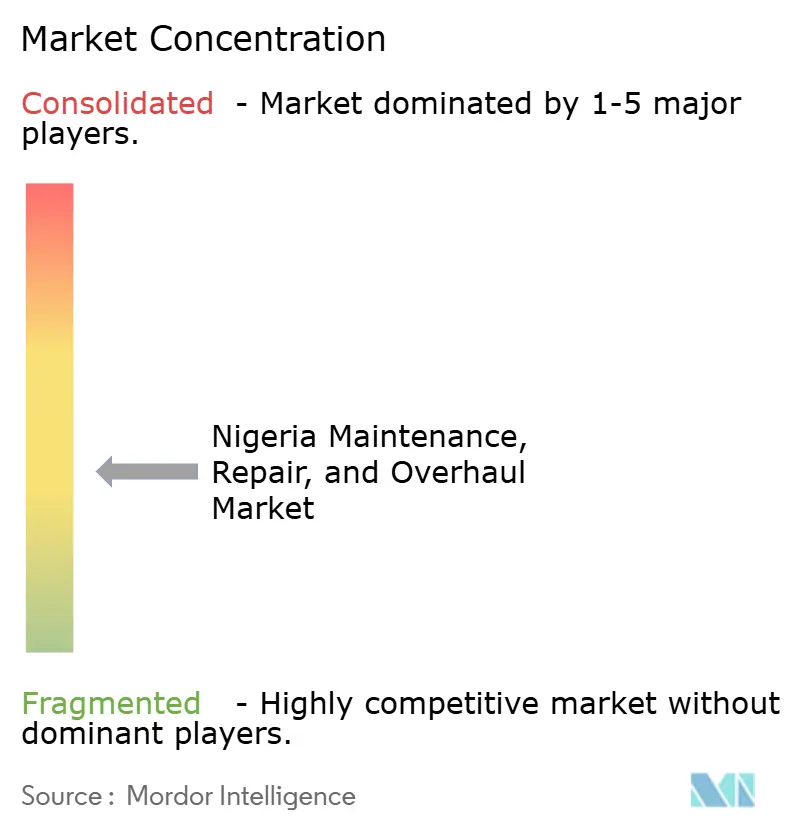
| Market Concentration | Medium |
Major Players *Disclaimer: Major Players sorted in no particular order Image © Mordor Intelligence. Reuse requires attribution under CC BY 4.0. | |
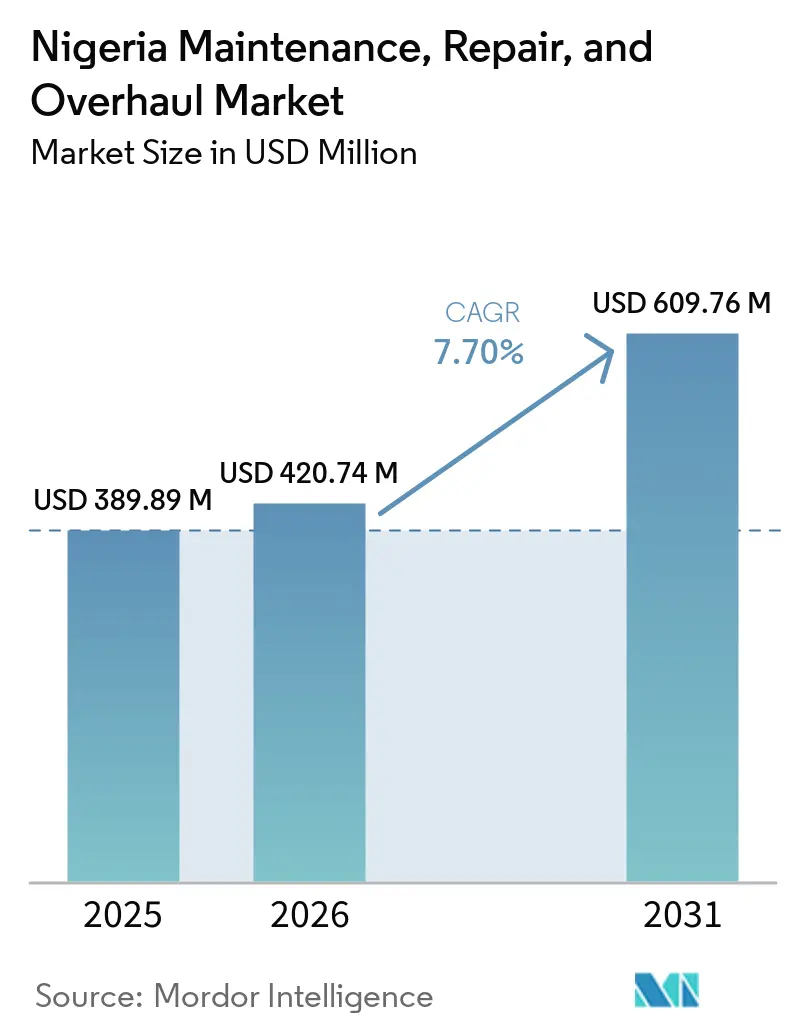
Nigeria Maintenance, Repair, and Overhaul Market Analysis by Mordor Intelligence
The Nigeria maintenance, repair, and overhaul market size was valued at USD 389.89 million in 2025, and is forecast to grow from USD 420.74 million in 2026 to reach USD 609.76 million by 2031, at a 7.70% CAGR during the forecast period (2026-2031). Civil passenger aircraft fleet expansion, higher aircraft utilization, and the age of many operating aircraft support recurring maintenance demand. Airlines also have a clear financial reason to move work into Nigeria because overseas maintenance requires foreign currency and often keeps aircraft out of service for extended periods. New local capacity can retain maintenance spending that has historically left the country, while also serving operators from neighboring markets. The need for reliable certified capacity, trained personnel, parts availability, and approvals across several aircraft types shapes the Nigeria maintenance, repair, and overhaul market. The competitive position of local providers will depend on whether they can extend their technical scope while meeting NCAA airworthiness requirements.
Key Report Takeaways
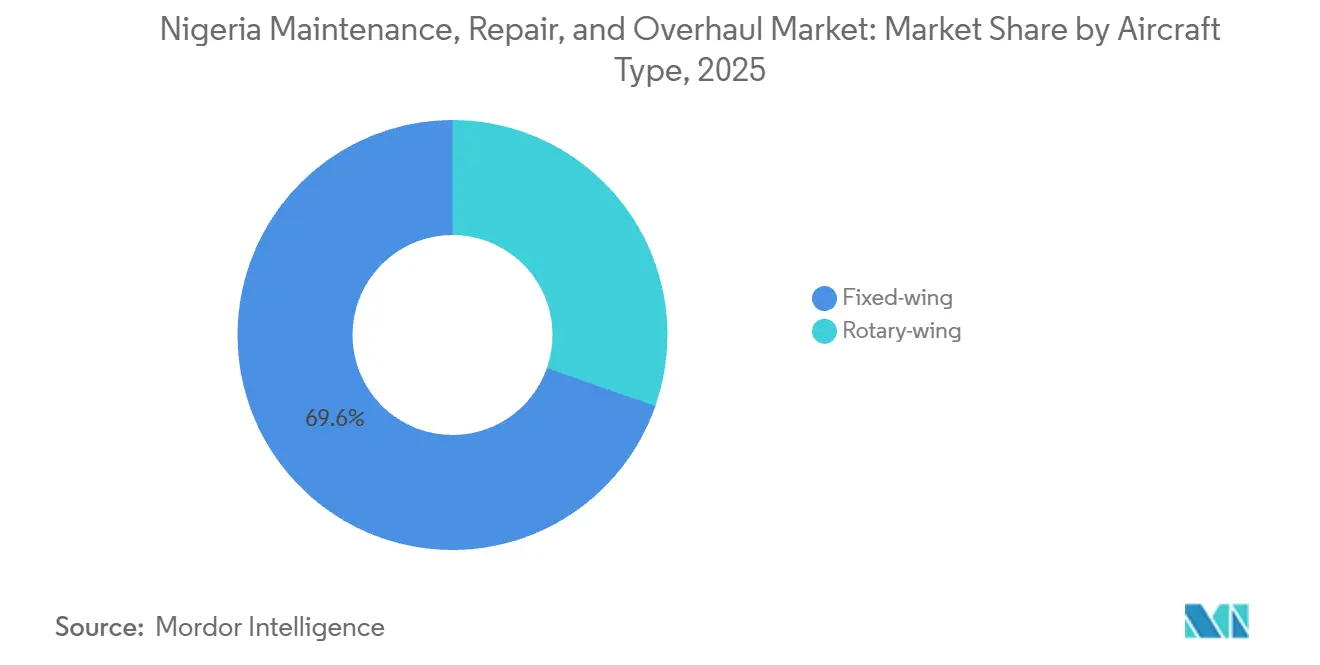
- By aircraft type, fixed-wing aircraft held 69.64% revenue share in 2025 and is forecast to grow at an 8.38% through 2031.
- By MRO type, line maintenance held 41.79% revenue share in 2025, while component MRO is forecast to grow at an 8.98% CAGR through 2031.
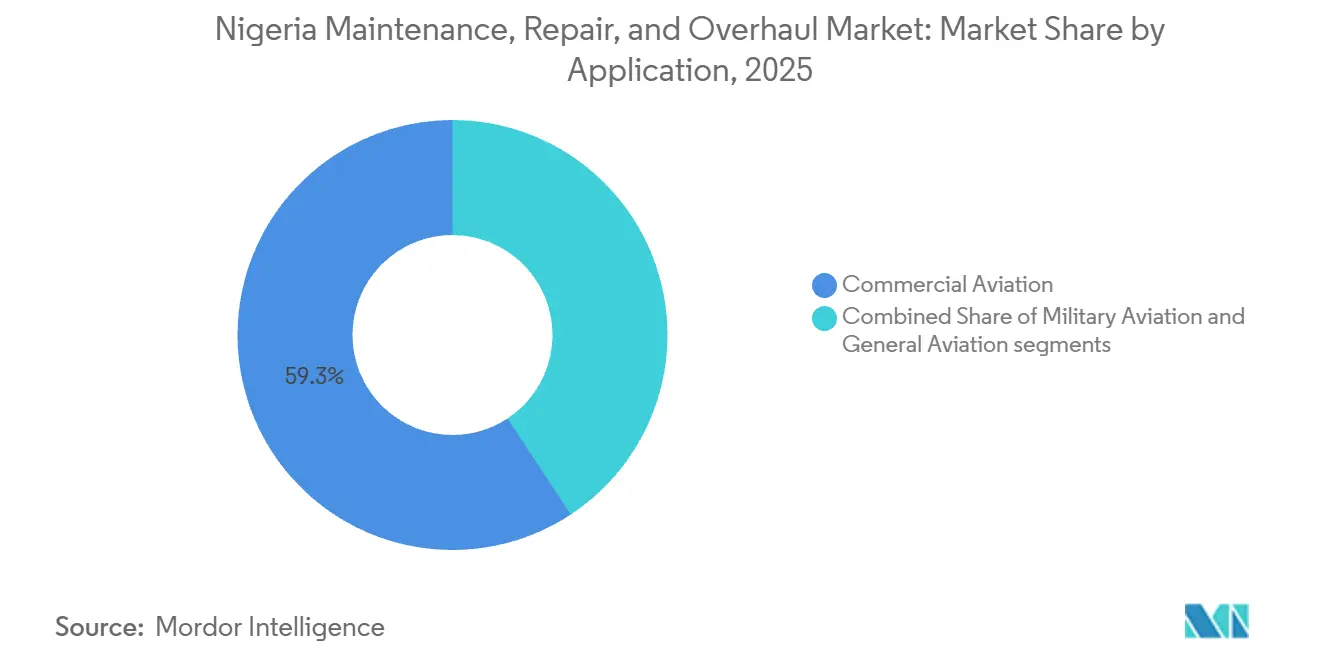
- By application, commercial aviation held 59.28% revenue share in 2025, while military aviation is forecast to grow at a 9.12% CAGR through 2031.
- By service provider, independent third-party MROs held 39.55% revenue share in 2025, while OEM-affiliated MROs are forecast to grow at a 9.02% CAGR through 2031.
Note: Market size and forecast figures in this report are generated using Mordor Intelligence’s proprietary estimation framework, updated with the latest available data and insights as of 2026.
Nigeria Maintenance, Repair, and Overhaul Market Trends and Insights
Drivers Impact Analysis*
| Driver | (~) % Impact on CAGR Forecast | Geographic Relevance | Impact Timeline |
|---|---|---|---|
| Fleet grounding and deferred heavy maintenance | +1.50% | Lagos, Port Harcourt, Abuja | Short term (≤ 2 years) |
| Rising domestic passenger traffic and fleet utilization | +1.20% | National, with primary gains in Lagos and Abuja corridors | Medium term (2-4 years) |
| Expansion of NCAA-approved local MRO capacity | +1.00% | Lagos, Abuja, Uyo | Medium term (2-4 years) |
| Military fleet readiness and indigenous sustainment | +0.90% | National, led by Nigerian Air Force bases in Lagos, Abuja, and Kaduna | Medium term (2-4 years) |
| Foreign-exchange savings from avoided overseas maintenance | +0.80% | National, with direct benefit to airline operators in Lagos | Short term (≤ 2 years) |
| West and Central African regional MRO export demand | +0.70% | Lagos and Uyo, with spillover to the ECOWAS sub-region | Long term (≥ 4 years) |
| Source: Mordor Intelligence | |||
Fleet Grounding and Deferred Heavy Maintenance
Deferred maintenance remains a direct driver of demand in the Nigeria maintenance, repair, and overhaul market because aircraft returning to service require more work than those receiving routine checks. A large share of the operating fleet is older, so airframe inspections, component replacement, and heavier scheduled work remain necessary. The 20.4-year average fleet age reported for June 2026 indicates that many aircraft are approaching major maintenance cycles. This condition favors providers with hangar capacity, type approvals, and experienced teams for deeper airframe work. Maintenance needs may be concentrated when airlines simultaneously return previously grounded aircraft to service. The market can therefore see spending rise faster than fleet numbers when operators address accumulated technical requirements.
Rising Domestic Passenger Traffic and Fleet Utilization
Passenger traffic supports the Nigeria maintenance, repair, and overhaul market because greater flight activity shortens the time between routine maintenance events. FAAN recorded total passenger traffic of 17.94 million in 2025, including 13.09 million domestic passengers and 4.85 million international passengers.[1] Higher utilization requires more frequent transit checks, line maintenance, and replacement of time-limited components. Lagos remains especially important because Murtala Muhammed International Airport handles more than 60.00% of Nigeria’s passenger and aircraft movements. International services also create opportunities for approved providers to support visiting aircraft during turnaround periods. These operating patterns give the market a recurring service base beyond the addition of new aircraft.
Expansion of Local Capacity and Foreign-Exchange Savings
Local maintenance capacity is expanding because airlines seek to reduce the foreign-currency burden of sending aircraft overseas. Air Peace began construction of an MRO facility at Murtala Muhammed International Airport in September 2025, with the project intended to serve its own fleet and third-party aircraft. The company stated that the 32,000-square-meter complex includes a 6,200-square-meter hangar designed to accommodate a B777 and five additional aircraft. Such facilities can reduce aircraft downtime and create a domestic alternative for selected maintenance events. Their value will still depend on access to parts, tooling, technical staff, and approvals for each aircraft type. This expansion supports the market by widening the local service base and strengthening the case for regional work.
Military Fleet Readiness and Indigenous Sustainment
Military requirements provide a separate demand stream for the Nigeria maintenance, repair, and overhaul market through inspection, overhaul, repair, and fleet readiness programs. The Nigerian Air Force completed a 4,800-hour Periodic Depot Maintenance event on a Dornier DO-228 in-country during 2024, demonstrating domestic capability to perform a task that had previously been outsourced. The Air Force has also emphasized indigenous maintenance solutions during its engagement with local aviation providers. A structured approach to lifecycle management can increase the regularity of maintenance work across military aircraft. Civilian providers with relevant approvals can benefit where they can meet defense requirements and offer specialized helicopter or fixed-wing services. This activity provides the market with a source of demand that is not tied solely to commercial passenger traffic.
Restraints Impact Analysis*
| Restraint | (~) % Impact on CAGR Forecast | Geographic Relevance | Impact Timeline |
|---|---|---|---|
| Shortage of licensed Aircraft Maintenance Engineers | -0.70% | National, most acute in Lagos and Abuja | Long term (≥ 4 years) |
| Inadequate hangar and heavy-maintenance capacity | -0.60% | Lagos, with residual capacity gaps at regional airports | Medium term (2-4 years) |
| Dependence on imported parts, engines and specialized tooling | -0.80% | National, magnified by naira volatility | Short term (≤ 2 years) |
| Fragmented fleet mix and limited local repair scale | -0.40% | National | Medium term (2-4 years) |
| Source: Mordor Intelligence | |||
Shortage of Licensed Aircraft Maintenance Engineers and Capacity Limits
The availability of licensed maintenance personnel limits how quickly the Nigeria maintenance, repair, and overhaul market can expand. The NCAA reported 2,061 valid Aircraft Maintenance Engineer licenses as of April 2024, but this number does not indicate how many license holders are available to local MRO organizations. Providers also need qualified supervisors and technicians with approvals for specific aircraft and components. A limited talent pool can delay facility ramp-ups even when an operator has funding, a hangar, and airline demand. Limited heavy-maintenance hangar capacity adds another constraint, particularly for larger airframe checks and work that requires specialized equipment. These limits reinforce the importance of training, retention, certification, and phased expansion across the market.
Dependence on Imported Parts, Tooling, and Multiple Fleet Types
Imported parts, engines, rotables, and specialized tooling expose local providers to foreign-currency costs and supply delays. The absence of domestic aerospace manufacturing means that even widely used components must often be sourced from overseas. This makes predictable contract pricing more difficult when local revenue is earned in naira and procurement is settled in USD. Customs clearance can also extend an aircraft-on-ground (AOG) event when required parts are not immediately available. Nigeria’s diverse fleet mix increases the costs of holding inventory, maintaining tools, and securing technical approvals across several platforms. These conditions can slow the market even as airlines increasingly prefer local maintenance.
*Our forecasts treat driver/restraint impacts as directional, not additive. The impact forecasts reflect baseline growth, mix effects, and variable interactions.
Segment Analysis
By Aircraft Type: Fixed-Wing Aircraft Drive Broad Maintenance Demand
Fixed-wing aircraft accounted for 69.64% of Nigeria maintenance, repair, and overhaul market share in 2025 and is also forecast to grow at an 8.38% CAGR through 2031. Commercial narrowbody fleets account for much of this demand, with military fixed-wing additions also supporting service requirements. Operators increasingly use several aircraft families, including B737, A220, E-series, CRJ series, and older Boeing aircraft. This fleet diversity requires providers to maintain multiple types of approvals, specialist tools, technical documentation, and trained teams. Aero Contractors states that its approvals cover B737 Classic and NG, A319, CRJ, E145, and E175, as well as several helicopter types. The range of approvals can be a barrier for smaller providers that cannot invest in multiple aircraft platforms. It also concentrates some demand with facilities that can offer credible multi-type support. The Nigeria maintenance, repair, and overhaul market will remain closely linked to the changing composition of commercial and military fixed-wing fleets.
Rotary-wing aircraft represent a smaller revenue base but are important for offshore oil and gas operations and military missions. Caverton has a long-established role in helicopter services for Nigeria’s oil and gas sector, where maintenance availability is central to contract performance. Helicopter maintenance involves specialized work that differs from scheduled fixed-wing airline maintenance. Demand can change with energy-sector activity and the timing of contracts with oil companies. Diversification into military, commercial, and adjacent aviation services can reduce reliance on one client group. The market, therefore, includes a rotary-wing segment whose value extends beyond its lower share of total maintenance revenue.

By MRO Type: Line Maintenance Leads While Component Work Gains Ground
Line maintenance accounted for 41.79% of Nigeria maintenance, repair, and overhaul market share in 2025, driven by frequent turnaround checks at Lagos, Abuja, and Port Harcourt, which support this position, as aircraft require regular technical release work between flights. The concentration of air traffic at Lagos helps maintain a steady need for transit checks and routine corrective work. Component MRO is projected to grow at an 8.98% CAGR through 2031, the highest rate among MRO types. Airlines are seeking more local capability for avionics, landing gear, auxiliary power units, wheels, brakes, and other high-value components. Aero Contractors has presented expanded MRO capabilities, including work linked to component support and airframe maintenance. EAN Aviation states that it holds NCAA approval for B777 wheel and brake maintenance, showing the commercial value of specialized component capability.[2] The market benefits when providers can complete more component work locally rather than only carrying out line checks.
Engine MRO remains the most capital-intensive area because it requires highly specialized tooling, test capability, technical approvals, and manufacturer support. Nigeria does not yet have a certified engine test cell, so many engine removal events still lead to overseas repair or overhaul. This leaves engine services as a major capacity gap in the Nigeria maintenance, repair, and overhaul market. Airframe MRO includes work from regular A-checks to deeper structural inspections, although local heavy-maintenance capacity remains limited. Aero Contractors has been identified as a local provider capable of performing D-checks on B737 Classic variants. Modifications and upgrades are smaller than line, airframe, engine, and component work, but aging aircraft require cabin refurbishment and avionics updates. NCAA airworthiness rules provide the regulatory framework for modification work and continuing airworthiness. The need for several service types means local providers must decide where to build scale rather than attempt every capability at once.
By Application: Commercial Aviation Provides the Largest Base
Commercial aviation accounted for 59.28% of revenue in 2025, making it the leading application. Scheduled domestic airlines and foreign carriers create a consistent base for line maintenance, component support, airframe inspections, and technical dispatch services. Passenger traffic is concentrated among high-frequency operators and major airports, which directs a large share of demand toward Lagos and Abuja. Air Peace provides a clear example of this concentration through its large domestic presence and current investment in local MRO capacity. Cargo and freighter activity also needs aircraft-ready maintenance support, particularly around Lagos. General Aviation includes business jets, turboprops, and light aircraft that require specialized service but have different utilization profiles. ExecuJet and EAN Aviation serve part of this segment through their business aviation and approved maintenance capabilities. Commercial activity will continue to form the broad operating base for the Nigeria maintenance, repair, and overhaul market.
Military aviation is forecast to expand at a 9.12% CAGR through 2031, the highest among applications. The rate reflects emphasis on availability, lifecycle management, local sustainment, and the maintenance needs of a mixed military fleet. The Nigerian Air Force’s in-country maintenance work on the Dornier DO-228 demonstrates the move toward domestic depot-level capability. Military maintenance is less dependent on passenger volumes, allowing it to accommodate a different demand pattern for qualified suppliers. It can also require stricter security, documentation, technical, and procurement requirements. Civilian MRO providers may participate if their capabilities match the required aircraft type and maintenance scope. The potential induction of additional military aircraft adds future sustainment work across fixed-wing and rotary-wing platforms. This makes military aviation an important growth area within the market.
By Service Provider: Independent MROs Retain the Largest Share
Independent third-party MROs held a 39.55% revenue share in 2025, as standalone organizations have formed the core of the local maintenance ecosystem by serving different airlines, business aircraft, and helicopters. Aero Contractors, EAN Aviation, ExecuJet, and smaller approved workshops illustrate the breadth of this group of providers. Their position depends on the ability to offer reliable turnaround times and retain airline confidence across aircraft types. Independent providers can support several customers, but they also face the cost of parts inventory, qualified staff, tools, and regulatory compliance. NCAA AMO certification standards create the formal threshold for providers entering or expanding in this segment. This framework protects maintenance quality while limiting the number of organizations that can quickly add new work scopes. The Nigeria maintenance, repair, and overhaul market continues to rely on independent providers because they supply flexible capacity across multiple operators.
OEM-affiliated MROs are forecast to grow at a 9.02% CAGR through 2031, the highest rate among provider types. This model is gaining relevance as airlines add new aircraft and seek technical support from the original manufacturer. Air Peace and Embraer formalized a partnership connected to Air Peace’s MRO center, with Embraer providing technical support for E-jet maintenance. Airline-affiliated MROs are also changing as airlines develop facilities that can serve third-party customers rather than only their own fleets. Military depots remain a separate provider category with work focused on military platforms and readiness requirements. The Nigerian Air Force’s maintenance activity at its 631 Aircraft Maintenance Depot shows the role of dedicated military capability. New approvals, such as provider certifications for specific business aircraft and regional jets, can broaden the formal provider pool. The Nigeria maintenance, repair, and overhaul market may therefore see stronger competition between independent, airline-linked, OEM-supported, and military maintenance models.
Geography Analysis
Lagos is the largest geographic center for the Nigeria maintenance, repair, and overhaul market because Murtala Muhammed International Airport handles more than 60% of national passenger and aircraft movements. The concentration of flights supports demand for line maintenance, urgent component replacement, turnaround checks, and heavier scheduled work. Lagos also has the country’s broadest concentration of maintenance providers, including Aero Contractors, ExecuJet, EAN Aviation, JetMS, 7Star Global Hangar, and AeroFix Nigeria. Air Peace selected Murtala Muhammed International Airport as the site of its new MRO facility, adding future hangar capacity to the city. EAN Aviation’s B777 wheel and brake approval adds a specialized capability to the Lagos service base. The depth of airline activity, staff availability, and airport infrastructure give Lagos a durable advantage. Lagos will remain the principal location for providers seeking access to the largest commercial customer base.
Abuja is the second major traffic center and plays an increasing role in Nigeria maintenance, repair, and overhaul market as airlines and policymakers consider new engineering capacity. Its national administrative role and international airport support demand from scheduled carriers, government aviation, and visiting operators. XEJet began construction of an engineering center at Nnamdi Azikiwe International Airport in 2024, according to the supplied draft. Abuja can complement Lagos rather than replace it because the two centers serve different traffic flows and airline operating networks. Port Harcourt remains relevant through helicopter activity linked to the Niger Delta and through cargo-related aviation services. Kano also supports maintenance demand from northern aviation and cargo activity. These secondary locations can reduce operational dependence on Lagos if local facilities develop the right approvals and technical scope.
Uyo is an emerging location because the Akwa Ibom State government is aligning Ibom Air’s Airbus A220 fleet expansion with maintenance capability at Victor Attah International Airport.[3] The proposed Airbus-aligned approach could build technical knowledge around a modern fleet type. Nigeria’s position in West and Central Africa also enables the market to support operators with limited nearby heavy-maintenance options. Aero Contractors has received maintenance approvals from authorities in Ghana, Morocco, Mongolia, the Democratic Republic of Congo, and Senegal, supporting its regional positioning. Regional demand will depend on competitive pricing, recognized approvals, available slots, and the ability to complete work without overseas ferrying. A widebody capable facility in Ogun State would broaden this opportunity if the reported project proceeds, but it remains a proposal in the supplied material. The geographic pattern remains centered on Lagos, with Abuja and Uyo developing distinct roles and other hubs serving narrower operational needs.
Competitive Landscape
The Nigeria maintenance, repair, and overhaul market is moderately fragmented because no provider currently offers complete heavy-maintenance coverage across the full commercial fleet mix. Aero Contractors has one of the widest local approval portfolios, covering B737 Classic and NG aircraft, A319 aircraft, CRJ aircraft, E145 and E175 aircraft, and several helicopter types. Its pursuit of EASA certification is intended to increase its ability to serve ECOWAS-registered aircraft. ExecuJet Aviation Nigeria has a focused position in business aviation and supports Bombardier, Dassault Falcon, Gulfstream, and Embraer business jets. It also entered an authorized service center agreement with Honeywell in February 2025, extending its engine and avionics service position. EAN Aviation has NCAA AMO approval and identifies B777 wheel and brake maintenance as a specialist capability. These providers compete through aircraft approvals, technical depth, customer access, and the ability to secure parts and qualified labor.
Air Peace is altering the competitive structure through its MRO facility development in Lagos. The company broke ground in September 2025 and stated that the project will include substantial hangar capacity for a B777 and five other aircraft. Its partnership with Embraer adds manufacturer-linked technical support for E-jet maintenance. This facility is intended to function as an open third-party hub rather than only as an internal airline maintenance unit. Caverton adds a different competitive profile through its helicopter support activities and its connection to military helicopter maintenance. The Nigerian Air Force inspected ongoing major work on Bell-412 helicopters at Caverton’s Lagos facility in December 2024. Caverton’s 2025 financial results also show that providers with strong specialist capabilities can face commercial pressure when major customer activity changes.
Competition also includes new providers receiving AMO certification for specific aircraft types and operators building maintenance capacity around their fleets. NCAA certification requirements remain a quality filter because they define the standards that providers must meet before offering approved maintenance services. The main gaps remain engine test capability, widebody heavy checks, and a deeper local base for avionics and component repair. Providers that close these gaps can retain more domestic work, but the required investment and certification process are substantial. The market does not disclose top-player shares that would support a concentration calculation based on combined ownership.
Nigeria Maintenance, Repair, and Overhaul Industry Leaders
-
Aero Contractors Company of Nigeria Limited
-
7Star Global Hangar Limited
-
Caverton Offshore Support Group Plc
-
Ibom Airlines Limited
-
Air Peace Limited
- *Disclaimer: Major Players sorted in no particular order
Recent Industry Developments
- September 2026: Binani Air awarded a contract to a global aviation firm to develop an MRO hangar at Abuja Airport, with a focus on heavy maintenance, including C- and D-checks. The project is expected to strengthen Nigeria's domestic MRO capacity and reduce reliance on overseas heavy maintenance facilities.
- September 2025: Air Peace broke ground on West and Central Africa’s largest MRO facility at MMIA Lagos on September 17, 2025. The 32,000-square-meter complex includes a 6,200-square-meter hangar capable of accommodating a B777 and five additional aircraft simultaneously. It is being built in partnership with Embraer of Brazil and is projected to employ more than 50,000 direct and indirect workers. The facility targets Nigeria’s annual overseas maintenance outflow.
Research Methodology Framework and Report Scope
Market Definition and Coverage
For this study, the market is defined as the revenue earned from aircraft maintenance, repair, and overhaul work carried out for commercial aircraft fleets operating in Nigeria, including activities performed on complete aircraft and on major aircraft components.
Scope exclusions: Military aviation MRO and non-aircraft industrial MRO work are excluded, and informal repair activity that is not captured in reported service revenues is not counted.
Segmentation Overview
- By Aircraft Type
- Fixed-wing
- Rotary-wing
- By MRO Type
- Engine
- Airframe
- Component
- Line Maintenance
- Modifications and Upgrades
- By Application
- Commercial Aviation
- Passenger
- Cargo/Freighter
- Military Aviation
- General Aviation
- Commercial Aviation
- By Service Provider
- Airline-affiliated MRO
- Independent Third-party MRO
- OEM-Captive MRO
- Military Depots
Data Sources, Market Sizing, and Validation
Desk Research
Desk research was used to set the facts around fleet activity and maintenance demand signals in Nigeria, and then to cross-check the reasonableness of service spending per aircraft over time. We reviewed public aviation and macro indicators from sources such as the International Civil Aviation Organization, the World Bank, IATA releases, and Nigeria Civil Aviation Authority publications where available.
To translate activity into spend, we also referenced materials such as airline annual reports and investor presentations, airport and operator press releases, customs and trade statistics for selected aircraft parts, and peer reviewed aviation maintenance literature. Patent databases were checked selectively to understand the direction of component repair and inspection methods, and a paid subscription focused on company financials and intelligence helped validate reported revenue ranges for relevant service providers. These are illustrative sources, and many other public documents were also reviewed for data collection, validation, and clarification.
Primary Interviews and Surveys
We speak with Nigerian airline engineering leaders, MRO managers, regulators, parts specialists, and aviation finance professionals through interviews and surveys. Their input checks secondary data and clarifies local capacity, outsourced work, turnaround time, and pricing in Nigeria. These responses also help triangulate the assumptions used for the final results.
Distribution of primary research fieldwork respondents
| Company type | Respondent position | Region |
|---|---|---|
| Top tier: 30% | CXOs: 20% | |
| Mid tier: 45% | Functional/Unit leaders: 30% | |
| Smaller Players: 25% | Managers: 50% |
Market-Sizing & Forecasting
Market sizing was built using a top-down approach where Nigeria fleet activity and maintenance event patterns were reconstructed into a service demand pool, and then translated into revenue using typical spend per event. Inputs used in the model include active commercial fleet size and utilization, the expected frequency of heavy checks and engine shop visits, the share of work executed domestically versus abroad, parts availability and lead times that affect deferrals, and prevailing labor and materials cost inflation (all treated as directional indicators, not a full list).
The totals were then corroborated through selective bottom-up approximations, such as sampled pricing for line maintenance events, component repair ranges, and a roll-up of accessible provider revenue disclosures where available, with gaps handled by using conservative midpoints and then re-checking them in expert calls. Forecasts were developed using scenario analysis, where passenger traffic recovery paths, fleet additions, and localized capacity improvements were stress-tested, and the final outlook was aligned to what interviewees considered realistic for Nigeria's maintenance ecosystem.
Data Validation & Update Cycle
Model outputs were validated through triangulation across at least three angles, which typically included activity signals, spend benchmarks, and what operators described as actual maintenance routing. When a data point created an unusual jump, it was flagged for a variance check, and the assumptions behind the step were reviewed again before being accepted.
A multi-step review was followed where calculations are checked by another analyst, followed by a final consistency check across segments and totals. The report is refreshed annually, and interim updates are done when material events occur, such as major fleet changes, regulatory shifts, or meaningful additions in local MRO capacity. Before delivery, a fresh pass is completed so clients receive the latest updated view.
Mordor Intelligence's Nigeria Maintenance Repair and Overhaul Market Size Compared With Other Published Estimates
Published market sizes for Nigeria aircraft MRO often differ because each source draws the line differently on what counts as MRO revenue, which year is used as the anchor, and how much overseas-performed work is attributed back to Nigeria. The table helps show how these scope choices and refresh timing create a visible spread even when everyone is describing the same broad activity.
The table points to a key gap in what gets counted as in-country service revenue versus broader spending tied to Nigeria operators, and in Mordor Intelligence's model the total is anchored to commercial aircraft fleets operating in Nigeria with revenues tied to overhaul, inspection, repair, or modification work and related component activities, rather than mixing in wider distribution channel or city-level retail style constructs. Differences can also come from how fast labor and parts costs are assumed to rise, whether the forecast assumes aggressive capacity build-out, and whether currency conversion uses a single average rate or period-weighted rates.
Benchmark comparison
| Source | Market Size | Gaps in Research Methodology |
|---|---|---|
| Mordor Intelligence | USD 338.94 M (2025) | |
| Global Research Publisher A | USD 815.20 M (2023) | Uses a broader build that appears to include alternative segment structures and channels, and its higher growth assumption can lift the base, which makes the total less comparable to an operator-and-service revenue view for Nigeria. |
| Trade Journal B | USD 339.00 M (2026) | Provides an industry estimate with limited visibility on the exact base year, inclusions, and whether work booked outside Nigeria is attributed back to the country, which can shift totals even when the headline number looks close. |
Taken together, the comparison shows that the biggest swings come from scope boundaries and how maintenance activity is converted into revenue, not from small math differences. By keeping the variables tied to fleet activity, maintenance event frequency, and realistic pricing checks from interviews, the final number stays traceable and can be repeated when new fleet and capacity signals emerge.
Key Questions Answered in the Report
What is the Nigeria maintenance, repair, and overhaul market size in 2026?
The Nigeria maintenance, repair, and overhaul market size is estimated at USD 420.74 million in 2026 and is forecast to reach USD 609.76 million by 2031.
What is the projected CAGR for aircraft maintenance in Nigeria?
The Nigeria maintenance, repair, and overhaul market is forecast to grow at a CAGR of 7.70% from 2026 to 2031.
Which MRO service leads revenue in Nigeria?
Line maintenance led with 41.79% revenue share in 2025 because routine checks are needed across high-frequency flight operations.
Which aircraft category is growing fastest in maintenance demand?
Fixed-wing aircraft are forecast to grow at an 8.38% CAGR through 2031 and held 69.64% revenue share in 2025.
Why are airlines developing local maintenance capacity in Nigeria?
Local MRO capacity can reduce foreign-currency exposure, shorten aircraft downtime, and retain maintenance work that would otherwise be sent overseas.
Which application is expected to grow fastest through 2031?
Military aviation is forecast to grow at a 9.12% CAGR through 2031, supported by local sustainment and fleet readiness requirements.