
Market Overview
| Study Period | 2020 - 2031 |
|---|---|
| Forecast Data Period | 2026 - 2031 |
| Base Year Market Size (2025) | USD 641.03 Million |
| Market Size (2026) | USD 670.8 Million |
| Market Size (2031) | USD 841.92 Million |
| Growth Rate (2026 - 2031) | 4.65 % |
| Market Concentration | Medium |
Major Players *Disclaimer: Major Players sorted in no particular order Image © Mordor Intelligence. Reuse requires attribution under CC BY 4.0. | |
Nigeria Clinical Laboratory Services Market Analysis by Mordor Intelligence
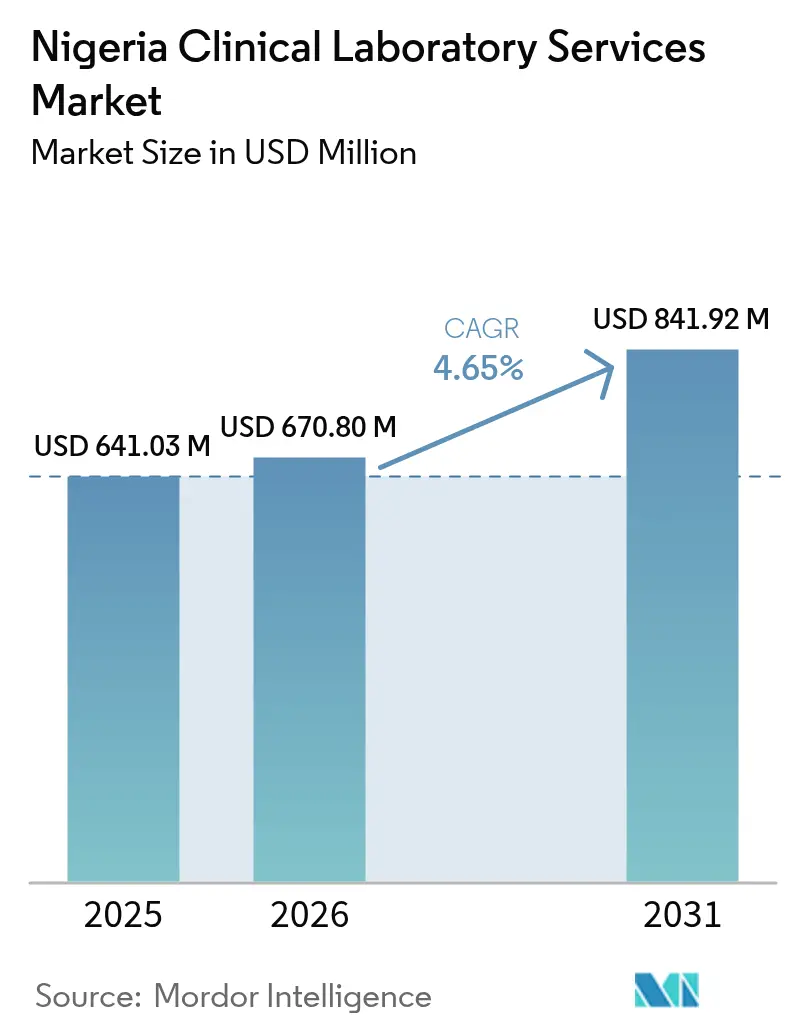
The Nigeria clinical laboratory services market size is expected to grow from USD 641.03 million in 2025 to USD 670.8 million in 2026 and is forecast to reach USD 841.92 million by 2031 at 4.65% CAGR over 2026-2031. Sustained demand stems from the dual disease burden, rising health-insurance enrollment, and continuous public–private investment that modernizes diagnostic infrastructure. Currency volatility and a 1,100% jump in antibiotic costs after multinational pharmaceutical exits compressed margins, yet testing volumes rose as clinicians intensified evidence-based care to offset drug shortages. Technology adoption, especially laboratory information systems and point-of-care platforms, improved turnaround times in urban centers while AI-enabled analytics began to penetrate diabetic-retinopathy screening workflows. Despite workforce constraints—Nigeria retains only 55,000 physicians for 220 million citizens—task-sharing, telepathology, and centralized reference networks helped laboratories maintain service continuity.
Key Report Takeaways
- By specialty, clinical chemistry led with 32.05% revenue share in 2025; genetic and molecular testing is set to advance at a 6.31% CAGR through 2031.
- By provider type, independent and reference laboratories accounted for 59.10% of the Nigeria clinical laboratory services market share in 2025, while hospital-based laboratories are expanding at 6.08% CAGR through 2031.
- By application, infectious-disease testing captured 32.10% of the Nigeria clinical laboratory services market size in 2025; non-communicable-disease testing is forecast to post a 7.14% CAGR to 2031.
- By test type, routine tests represented 55.12% share of the Nigeria clinical laboratory services market size in 2025; specialized and esoteric tests are projected to grow at 6.52% CAGR through 2031.
Note: Market size and forecast figures in this report are generated using Mordor Intelligence’s proprietary estimation framework, updated with the latest available data and insights as of 2026.
Nigeria Clinical Laboratory Services Market Trends and Insights
Drivers Impact Analysis*
| Driver | (~) % Impact on CAGR Forecast | Geographic Relevance | Impact Timeline |
|---|---|---|---|
| Rising Disease Burden and Diagnostic Demand | +1.2% | Lagos, Kano, Rivers | Medium term (2-4 years) |
| Expanding Public–Private Healthcare Investments | +0.9% | Lagos, Abuja, Port Harcourt | Long term (≥ 4 years) |
| Growing Health Insurance Coverage | +0.7% | Nationwide | Long term (≥ 4 years) |
| Adoption of Digital and Point-of-Care Technologies | +0.8% | Urban centers extending to rural areas | Medium term (2-4 years) |
| Diaspora Remittance–Driven Healthcare Spending | +0.5% | Southwest & Southeast | Short term (≤ 2 years) |
| Governmental Quality and Accreditation Initiatives | +0.6% | Tertiary facilities nationwide | Long term (≥ 4 years) |
| Source: Mordor Intelligence | |||
Rising Disease Burden and Diagnostic Demand
Nigeria’s simultaneous fight against infectious and non-communicable diseases underpins structural growth in the Nigeria clinical laboratory services market. Malaria positivity topped 52.4% in several states during 2024 while tuberculosis GeneXpert coverage soared from 7.4% in 2015 to 66% in 2023, underscoring aggressive case-finding programs. At the same time, cardiovascular-disease prevalence accelerated, yet only 31.6% of tertiary hospitals delivered cardiac-marker results within the recommended one-hour window[1]. Viral-hepatitis rates—6.9% for hepatitis B and 4.8% for hepatitis C—require continuous viral-load monitoring. Population growth toward 440 million by 2050 compounds pressure on existing laboratories, prompting network expansion and adoption of high-throughput analyzers. Collectively, these epidemiological trends translate into durable multi-specialty test demand that shields the Nigeria clinical laboratory services market from cyclical economic swings.
Expanding Public–Private Healthcare Investments
The National Health Sector Renewal Investment Initiative catalyzes USD 3 billion in blended financing, channeling funds into 3,000 planned primary-care centers equipped with basic laboratories. Federal budget allocation to health rose 41.5% in 2023, including ₦37 billion for facility upgrades. Private capital follows suit: a Lagos-based chain secured USD 2 million for network enlargement, while an international IVD manufacturer established an antimicrobial-stewardship center in 2023, bringing advanced phenotypic-testing capacity to West Africa. Cross-border partnerships lower equipment-procurement costs, enable reagent volume discounts, and accelerate ISO 15189 accreditation pursuits. Such investment momentum underwrites long-term volume growth, even as macro-risks persist.
Growing Health-Insurance Coverage
Implementation of the National Health Insurance Authority Act in 2022 reshapes payment flows across the Nigeria clinical laboratory services market. The Vulnerable Group Fund targets 83 million citizens, potentially doubling the insured base and trimming the current 76% out-of-pocket spending rate. Early deployments of the Basic Healthcare Provision Fund in northern states already lift prenatal-screen uptake and chronic-disease monitoring frequencies. Laboratories are redesigning billing interfaces to integrate claims-management modules, shortening reimbursement cycles and improving cash flow. Wider coverage encourages preventive testing and long-interval disease management panels, supporting steady volume growth over the next decade.
Adoption of Digital and Point-of-Care Technologies
Digitization progresses from isolated laboratory information systems to integrated, cloud-hosted platforms capable of bidirectional EHR connectivity in tertiary hospitals across Lagos and Abuja. A statewide readiness audit identified a 35-point improvement in LIS adoption scores between 2022 and 2024. Mobile diagnostic hubs leverage lightweight analyzers and satellite connectivity, slashing specimen transit times for rural patients. Point-of-care glucose meters and urine dipsticks are now standard in 68% of surveyed facilities, yet less than 56% maintain continuous quality-control logs. AI-enabled analyzers, such as an ophthalmic-screening platform aiming to test 5 million Nigerians by 2027, promise to offset specialist shortages and elevate diagnostic precision. Regulators have updated validation checklists to embed cybersecurity and data-privacy protocols, balancing innovation with patient-safety mandates.
Restraints Impact Analysis*
| Restraints Impact Analysis | (~) % Impact on CAGR Forecast | Geographic Relevance | Impact Timeline |
|---|---|---|---|
| Limited Skilled Workforce and Infrastructure | −0.8% | Rural & northern regions | Long term (≥ 4 years) |
| Supply Chain and Power Reliability Challenges | −0.6% | Nationwide, acute in northern states | Medium term (2-4 years) |
| Currency Fluctuations Increasing Input Costs | −0.5% | Import-dependent facilities nationwide | Short term (≤ 2 years) |
| Fragmented Regulatory and Quality Oversight | −0.4% | Multi-agency nationwide | Long term (≥ 4 years) |
| Source: Mordor Intelligence | |||
Limited Skilled Workforce and Infrastructure
Physician density stands at 1:4,000, far below the WHO target of 1:600, as 15,000–16,000 clinicians emigrated in the past five years. Laboratory technologist programs enroll fewer than 2,100 graduates annually, leaving a widening skills gap. Salary differentials—domestic pay ranges from USD 2,000 to USD 4,000 per year compared with USD 60,000 in the United Kingdom—fuel outbound migration. Equipment shortages compound workforce stress: only 55.9% of tertiary hospitals operate functional cardiac-marker analyzers, and 43% lack uninterrupted power supplies critical for cold-chain reagent storage. Rural diagnostic centers face the brunt of shortages, extending sample-to-result times beyond clinically useful windows. Without accelerated training grants and retention incentives, the Nigeria clinical laboratory services industry risks capacity bottlenecks that curb long-range growth.
Supply Chain and Power Reliability Challenges
Laboratories import 79% of analyzers, reagents, and consumables, exposing them to foreign-exchange volatility that ballooned costs when the naira depreciated 55% against the U.S. dollar in 2024[2]. The 2024 exit of multinational pharmaceutical distributors disrupted just-in-time reagent delivery pipelines, forcing laboratories to pre-order six-month stockpiles, thereby tying up working capital. National grid reliability hovered at 68% uptime, obliging facilities to rely on diesel generators that raised per-test energy costs by 11%. Cold-chain lapses led to 7.3% reagent wastage in peripheral labs during the 2023 malaria-peak season. NAFDAC has begun piloting a fast-track IVD-import channel aligned with WHO pre-qualification to cut customs delay by half, yet scale-up remains pending.
*Our forecasts treat driver/restraint impacts as directional, not additive. The impact forecasts reflect baseline growth, mix effects, and variable interactions.
Segment Analysis
By Specialty: Molecular Testing Accelerates Precision Care
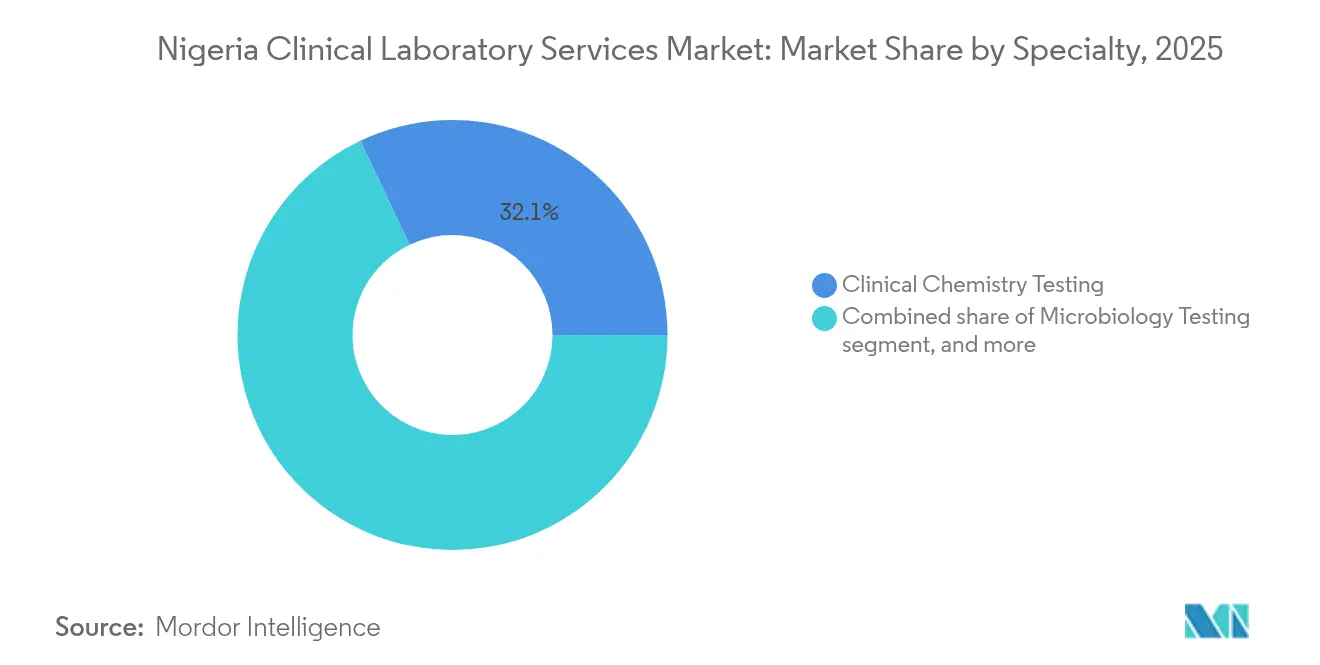
Clinical chemistry retained a 32.05% revenue lead within the Nigeria clinical laboratory services market in 2025, underscoring the category’s role in diabetes, renal, and lipid-profile management. The segment’s dominance is fueled by automated analyzers capable of running 400–600 tests per hour, minimizing per-test costs. Molecular diagnostics, however, posted a 6.31% CAGR and is reshaping high-margin growth trajectories. Genetic-screen programs for sickle-cell disease and oncology panels gained policy traction following the launch of the Centre for Human Virology & Genomics in Lagos. Federal procurement agreements cut PCR-reagent prices 18%, triggering adoption in 27 additional tertiary centers. Infectious-disease nucleic-acid testing now covers 66% of TB case detection, while emergent next-generation sequencing facilities produced Nigeria’s first pathogen genomic-surveillance dashboards in 2024. The Nigeria clinical laboratory services market size for molecular diagnostics is therefore expected to climb steadily as capacities expand and cost curves fall.
Parallel growth permeates microbiology, hematology, and immunology. Microbiology revenue ramped after a national TB-molecular expansion that lowered test turnaround to 3 hours. Hematology demand remains tethered to malaria and sickle-cell management; opening of a dedicated hemoglobinopathy lab in Awka extended specialized flow-cytometry testing beyond Lagos. Immunology growth is anchored in HIV viral-load monitoring, with reagent pack prices dropping 12% under pooled-procurement schemes. Cytology and pathology services lag due to a 1:250,000 pathologist-to-population ratio, but remote-slide-reading pilots could unlock latent demand. As disease profiles diversify, multi-disciplinary labs capable of routing samples through chemistry, immunoassay, and molecular lines will capture a premium, deepening competitive differentiation.

By Provider: Independent Networks Maintain Scale Advantage
Independent and reference laboratories commanded 59.10% Nigeria clinical laboratory services market share in 2025, leveraging hub-and-spoke logistics, brand trust, and direct-to-consumer marketing. Leading chains process upward of 2 million tests annually, offering 360-degree menus spanning hematology to high-resolution genomics. Cost efficiency stems from centralized high-throughput analyzers and reagent bulk-purchasing contracts, allowing narrow per-test margins while sustaining profitability. Hospital-based labs, historically restricted by capital budgets, now benefit from earmarked infrastructure funds under the Health-Renewal Initiative, registering a 6.08% CAGR and closing service gaps in peri-urban areas.
Partnership models multiply as private labs sign managed-service agreements with public hospitals, installing analyzers in exchange for guaranteed minimum volumes. Telepathology networks route histo-slides to reference centers, expanding service breadth without full-time on-site pathologists. The Nigeria clinical laboratory services market size attributed to hospital-embedded operations is forecast to rise as tertiary centers upgrade to ISO 15189 to improve transplant-readiness metrics. However, profit-pool migration toward hospital laboratories may remain capped until reimbursement tariffs align with real-time exchange-rate fluctuations. Independent networks counteract by integrating home-collection and digital-results portals, fortifying market position.
By Application: Chronic Disease Panels Outpace Traditional Infectious Focus
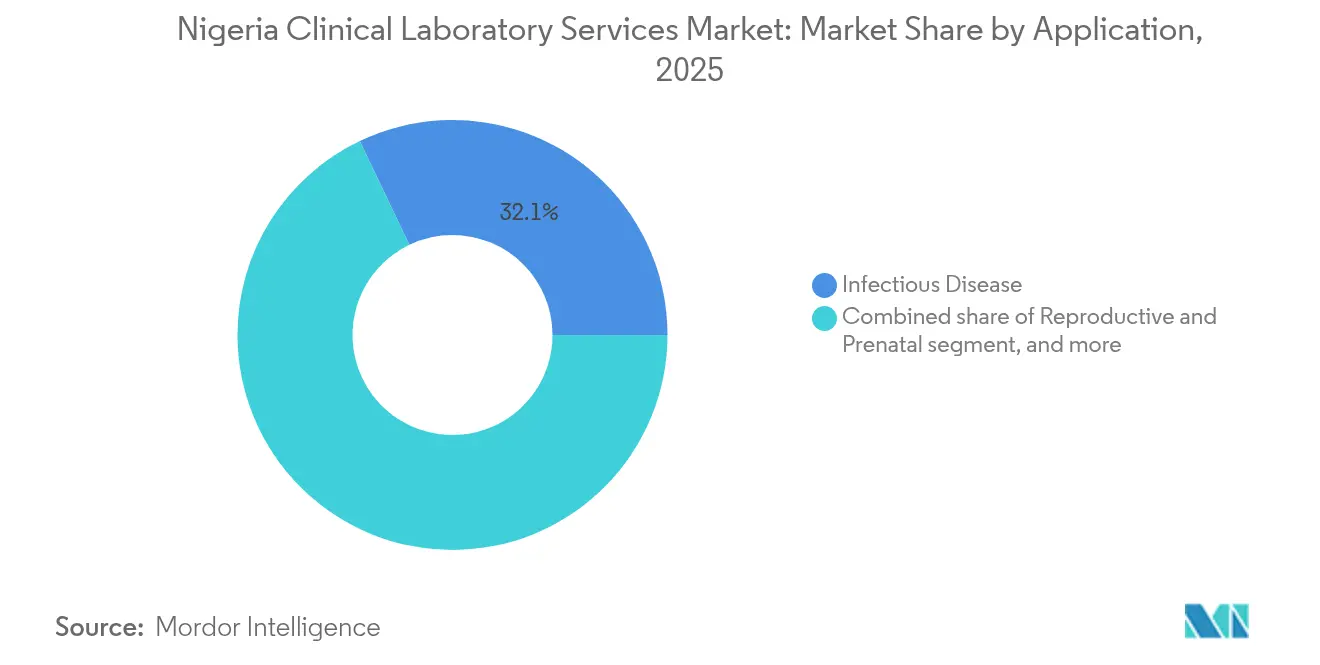
Infectious-disease testing still generated 32.10% of 2025 revenue but its share is edging downward as non-communicable-disease (NCD) panels gain traction. Urbanization and dietary shifts pushed adult diabetes prevalence past 6%, swelling HbA1c test orders by 14% in 2024. Cardiovascular-risk panels comprising lipid profiles, hs-CRP, and cardiac-marker assays grew 11% year on year despite reagent price spikes. Consequently, the Nigeria clinical laboratory services market size accruing to NCD applications is forecast to grow fastest at 7.14% CAGR. Prenatal screening volumes also climbed, linked to government-funded maternal-mortality-reduction campaigns that mandate early antenatal bloodwork.
Oncology diagnostics remain nascent but promising. An estimated 125,000 new cancer cases in 2024 spurred demand for tumor-marker panels, HER2 immunohistochemistry, and liquid-biopsy pilots, although specialist shortages continue to constrain capacity. Wellness testing packages broadened amid rising corporate-insurance coverage, embedding vitamin-D, thyroid, and hormonal profiles in routine executive health checks. Infectious-disease sub-segments are themselves evolving: multiplex respiratory-pathogen panels and dengue RT-PCR fill gaps in differential diagnosis as climate change updates vector-borne disease maps. Laboratories that diversify into comprehensive chronic-disease panels while retaining strong infectious-disease capabilities will harvest balanced revenue streams resistant to seasonal swings.
By Test Type: Specialized and Esoteric Tests Unlock Margin Upside
Routine tests made up 55.12% of total volumes in 2025, dominated by complete blood counts, electrolytes, and urinalysis. Automation of these tests reached 85% penetration in urban centers, achieving sub-$1 variable cost per assay. Yet specialized and esoteric tests—cytokine panels, pharmacogenomic assays, and next-generation sequencing—posted a 6.52% CAGR, dwarfing routine expansion. High-complexity tests carry gross margins above 45%, compared with 22% for routine panels, presenting an attractive mix-shift for profit-conscious providers. The Nigeria clinical laboratory services market size attributed to specialized tests is expected to double by 2030 as oncologists and rheumatologists integrate molecular biomarkers into treatment pathways.
Point-of-care (POC) adoption adds nuance: POC devices deliver rapid glucose and troponin readings in emergency units but can erode centralized-lab volumes if not integrated into LIS for data consolidation. Survey data show only 56% of facilities run daily POC-quality checks, risking result variability. Integration of middleware that harmonizes POC and core-lab data remains a priority to avoid diagnostic silos. Demand for specialized testing also spurs logistics evolution; cold-chain requirements and specimen-stability constraints lead reference labs to deploy regional mini-hubs equipped with −80 °C freezers. Consequently, test-type diversification shapes procurement strategies, staffing models, and capital-investment horizons.
Regulatory Landscape
Clinical laboratory services in Nigeria are regulated primarily by the Medical Laboratory Science Council of Nigeria (MLSCN), established under the MLSCN Act (Act No. 11 of 2003). MLSCN oversees registration, inspection, and accreditation of public and private medical laboratories, and regulates medical laboratory practice through practitioner registration and enforcement of professional conduct requirements (including the 2018 Rules of Professional Conduct). In market terms, premises offering medical laboratory services must be registered with MLSCN, and laboratories are required to be headed by a licensed Medical Laboratory Scientist. This creates a clear compliance gate for new facilities and network expansions.
Broader health system standards and facility oversight sit within the national framework created by the National Health Act (2014), including standards for health service delivery and mechanisms such as the Basic Health Care Provision Fund that influence testing utilization in public programs. On the inputs side, diagnostic laboratory reagents and chemicals are also covered by MLSCN oversight for production, importation, sales, and stocking. In-vitro diagnostic (IVD) validation processes are facilitated through MLSCN workflows, including fee payments via the Remita platform. Overall, laboratory growth tracks licensing, inspection cadence, and documentation requirements, alongside macro initiatives aimed at improving service quality and standardization.
Value Chain Analysis
Nigeria's clinical laboratory services value chain starts with IVD manufacturers and distributors supplying analyzers, reagents, and consumables into an import-reliant ecosystem. Procurement then flows through independent reference networks, hospital laboratories, and stand-alone facilities. Regulatory enablement is embedded upstream: MLSCN regulates laboratory practice and also oversees aspects of diagnostic reagent production, importation, sales, and stocking, which shapes vendor onboarding and the compliance burden for inventory flows.
Operationally, laboratories convert inputs into routine and specialized test services through pre-analytical steps (patient access and specimen collection), analytical steps (testing on core lab and point-of-care platforms), and post-analytical steps (result validation, reporting, and clinician or patient delivery). Laboratory information systems and digital reporting tools increasingly support these steps in urban centers. Distribution and access hinge on specimen movement and network design, with the National Integrated Specimen Referral Network (NiSRN) using third-party logistics providers to move samples between peripheral facilities and testing sites. This supports hub-and-spoke models used by independent and reference laboratories, even as fragmented supply chain management and quality management variability keep accreditation uptake uneven despite pathways such as WHO-AFRO SLIPTA. Downstream, payers and purchasing channels span out-of-pocket payments, corporate plans, and expanding national insurance mechanisms, which influence test menu mix and cash conversion cycles for providers.
Competitive Landscape
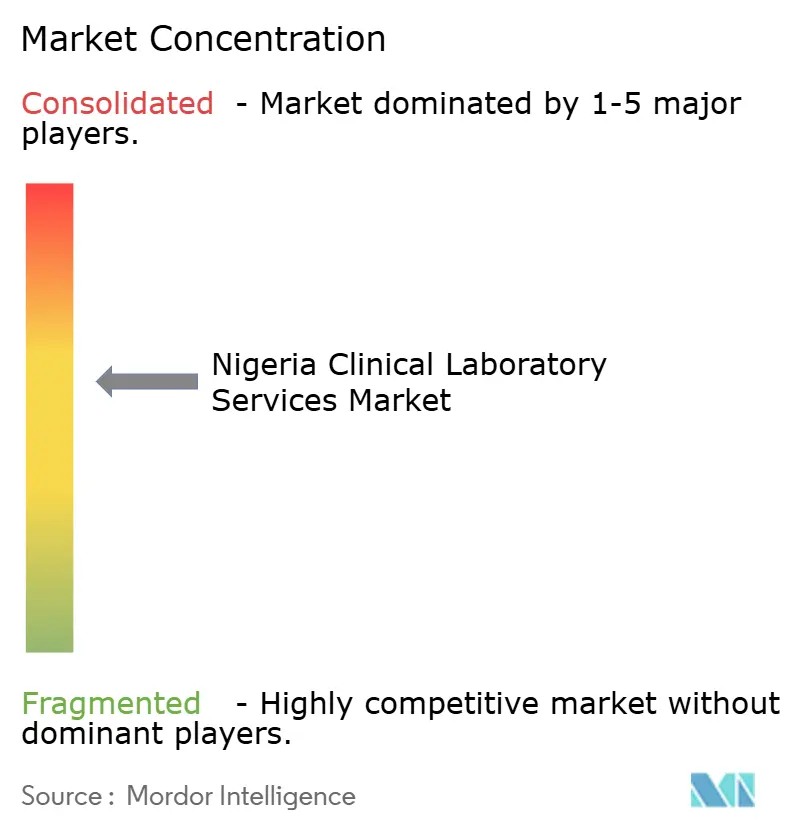
Competitive intensity is moderate, with no operator exceeding a 15% volume share nationally. Internationally backed SYNLAB leverages its global network of 600 million annual tests and centralized procurement to offer specialized panels, while Lancet Laboratories maintains strength in microbiology and oncology testing. Indigenous chain MDaaS Global employs a digital-first model that integrates home-collection, teleconsultation, and BeaconOS reporting, strategically positioning 17 hubs within 3-hour drive time for 53 million Nigerians. Independent stand-alone labs compete on convenience and rapid turnaround, but scale disadvantages limit their ability to secure reagent discounts.
Technology serves as a key differentiator. FundusAI’s diabetic-retinopathy solution is embedding retinal-image analytics into partner-lab workflows, reducing ophthalmologist referral burden by 38%. Established players invest in middleware to unify POC, core-lab, and radiology data, thereby improving clinician user experience. Accreditation status influences payer negotiations; ISO 15189-certified labs command tariff premiums of 8% under select corporate-insurance plans. Market entry barriers include MLSCN licensing requirements, NAFDAC import permits, and capital costs for automated chemistry lines, tempering the threat of new entrants.
Strategic alliances proliferate. Hospital chains outsource laboratory operations under reagent-rental agreements, guaranteeing minimum volumes that de-risk supplier investments. Equipment vendors co-locate maintenance engineers within high-volume labs, cutting mean-time-to-repair from 72 to 24 hours. Supply-chain hedging via multi-currency procurement contracts gained traction post-2024 currency swings. Competitive dynamics will likely intensify as telemedicine providers integrate on-demand lab ordering, blurring boundaries between diagnostic and primary-care ecosystems and reinforcing the centrality of data-driven service delivery in the Nigeria clinical laboratory services market.
Nigeria Clinical Laboratory Services Industry Leaders
-
Mecure Healthcare Limited
-
AfriGlobal Medicare Limited
-
Synlab Bondco PLC
-
Echolab
-
Union Diagnostic & Clinical Services PLC
- *Disclaimer: Major Players sorted in no particular order
Market Opportunities and Future Outlook
Opportunities in Nigeria's clinical laboratory services market are centered on scaling compliant capacity and improving consistency of quality across public and private testing sites. MLSCN's accreditation and inspection mandate, together with its national guidelines for setting up medical laboratories, creates whitespace for operators and managed-service partners to deliver turnkey compliant laboratories, covering facility setup, documentation, validation, and staffing under a licensed Medical Laboratory Scientist. At the system level, the National Health Act (2014) and the Basic Health Care Provision Fund provide an institutional channel for expanding basic laboratory access in primary care, aligning with report context that ties large-scale primary-care investments to laboratory readiness.
A second opportunity area involves reducing friction across the diagnostic value chain. Digitization, including LIS/LIMS integration and claims-ready billing interfaces, can help extend specialized testing reach beyond major cities when paired with specimen referral logistics. The report context also points to ongoing structural constraints, including dependence on imports for analyzers and reagents and variability in quality management, which supports demand for local service capabilities such as maintenance and calibration contracts, validated reagent supply programs, and centralized reference testing that can absorb complex workloads. Growth in preventive and wellness testing, alongside rising chronic-disease monitoring needs described in the report context, creates room for broader outpatient menus when combined with payer integration and standardized quality controls.
Recent Industry Developments
- July 2026: SYNLAB Nigeria highlighted its footprint of 43 centers nationwide, with emphasis on digital service delivery, home sample collection, and partnerships with hospitals and HMOs to widen access. The stated operating model supports broader geographic reach while concentrating complex testing and quality processes within a scaled network, reinforcing independent and reference laboratories as a key service channel.
- January 2026: African Medical Centre of Excellence opened commercial operations in Abuja, integrating advanced molecular and imaging laboratories. The facility adds high-end diagnostic capacity in-country and strengthens referral options for complex testing that is often constrained by infrastructure and specialized workforce availability.
- August 2024: HJFMRI inaugurated a modular tuberculosis laboratory in Abuja, increasing national GeneXpert capacity. This expansion supports TB case-finding workflows and raises demand for molecular testing services and related supply-chain and quality-management capabilities across the testing network.
Research Methodology Framework and Report Scope
Market Definition and Coverage
This market covers clinical laboratory testing services delivered in Nigeria, where patient samples are collected and analyzed to support screening, diagnosis, and treatment monitoring across common lab disciplines.
Scope exclusions: We exclude sales of standalone lab instruments and consumables when they are not billed as part of a testing service, and we also exclude research-only testing that is not part of routine patient care.
Segmentation Overview
- By Specialty
- Clinical Chemistry Testing
- Microbiology Testing
- Hematology Testing
- Immunology Testing
- Cytology Testing
- Genetic & Molecular Testing
- Other Specialties
- By Provider
- Independent & Reference Laboratories
- Hospital-Based Laboratories
- By Application
- Infectious Disease
- Non-Communicable / Chronic Disease
- Reproductive & Prenatal
- Oncology
- Wellness & Preventive Screening
- By Test Type
- Routine Tests
- Specialized / Esoteric Tests
Data Sources, Market Sizing, and Validation
Desk Research
Desk research helped us frame the demand pool and the operating realities for labs in Nigeria before any modeling was locked in. We reviewed public health plans and statistics such as Federal Ministry of Health releases, National Bureau of Statistics publications, and open pages from Nigeria Centre for Disease Control and Prevention that signal testing needs.
To keep assumptions practical, we also used items like customs and trade statistics for diagnostic-related imports, peer-reviewed medical journals that report testing patterns, and guidelines or publications from bodies such as the Medical Laboratory Science Council of Nigeria and the World Health Organization. On the supply side, annual reports, investor presentations, and public announcements from lab operators and healthcare providers were checked, and a paid subscription covering company financials, patents, and shipment level import data was referenced where it filled gaps. These examples are illustrative, and many other public sources were also used for collection, validation, and clarification.
Primary Interviews and Surveys
We speak with laboratory owners, hospital laboratory heads, pathologists, procurement leads, clinicians, insurers, and regulators in Nigeria. Their input clarifies utilization, referral patterns, prices, payer mix, turnaround times, and supply gaps, allowing secondary assumptions to be adjusted before final triangulation.
Distribution of primary research fieldwork respondents
| Company type | Respondent position |
|---|---|
| Top tier: 30% | CXOs: 15% |
| Mid tier: 45% | Functional/Unit leaders: 30% |
| Smaller Players: 25% | Managers: 55% |
Market-Sizing & Forecasting
Sizing starts with a top-down build that reconstructs the addressable testing services pool using Nigeria health system signals and the mix of tests typically ordered across care settings. That demand pool is then translated into service value using practical price bands for routine and specialized testing, with care taken to keep the billed service boundary consistent.
A set of market fingerprints is used to shape the totals, such as testing intensity for infectious disease and chronic disease management, growth in insured or organized care access, the split between hospital-based and independent or reference labs, the share of routine versus specialized or esoteric testing, and the availability of trained staff and basic automation that affects throughput. Results are corroborated using selective bottom-up approximations, like sampling test menu pricing across provider types and checking implied revenues against reported financial indicators for a small set of labs, before adjustments are applied for coverage gaps.
For forecasting, we rely on scenario analysis supported by simple trend fitting, where expected changes in test mix, service pricing, and utilization are stress-tested with input from interviewees. When volatility is likely, ranges are tightened only after reconciling them with near-term healthcare spending direction and observable testing demand signals.
Data Validation & Update Cycle
Validation is handled through triangulation across the modeled demand pool, implied price and volume math, and independent indicators that should move in the same direction if the estimate is reasonable. Outliers are flagged early, and the drivers behind them are rechecked. Assumptions are then reviewed again by another analyst before sign-off.
Reports are refreshed annually, and interim updates are made when material events can shift utilization or pricing, such as major policy changes, new lab capacity, or meaningful currency movement. Before delivery, we do a fresh scan of recent public releases and re-contact a small set of respondents when a variance crosses an internal threshold, so clients receive the latest updated view.
Mordor Intelligence's Nigeria Clinical Laboratory Services Market Size Versus Other Published Estimates
Published market values for Nigeria clinical laboratory services can differ because the service boundary is not always consistent, and because price and volume assumptions are handled differently across sources. In our review, differences usually show up around what gets counted as a lab service versus a product sale, and how fast test mix and pricing are assumed to change.
Evidence from specialty-level service mix checks and provider-type splits, cross-verified during interviews and aligned with public health testing signals, is what anchors the Mordor Intelligence approach to a billed testing services pool instead of a broader diagnostics basket. Other estimates can swing based on whether they include wider diagnostics categories, apply aggressive pricing inflation, or use a base year that is not aligned to current utilization patterns in hospitals and independent labs.
Benchmark comparison
| Source | Market Size | Gaps in Research Methodology |
|---|---|---|
| Mordor Intelligence | USD 641.03 M (2025) | |
| Global Consultancy A | USD 350.00 M (2024) | Uses an earlier base year and a narrower captured revenue pool in practice, which can miss out-of-pocket testing done outside major organized providers, and it also applies a high growth curve that is not reconciled to near-term capacity and staffing constraints. |
| Industry Publisher B | USD 1.50 B (2024) | Presented as a broader diagnostics and labs basket, which likely folds in adjacent diagnostics categories and channels beyond billed clinical lab services, and it can inflate totals when prices and volumes are aggregated without a clear test-mix boundary. |
Looking across the three figures, the spread is mainly explained by scope discipline and the practical handling of price and utilization, not by small math differences. When the model is tied to clear service definitions, observable test-mix signals, and repeatable checks with providers, the resulting number is easier for decision-makers to compare year to year and to use for planning.
Key Questions Answered in the Report
How large is Nigeria’s clinical laboratory services market in 2026?
The Nigeria clinical laboratory services market size is USD 670.8 million in 2026 and is forecast to reach USD 841.92 million by 2031 at a 4.65% CAGR.
Which test segment is expanding fastest nationwide?
Genetic and molecular diagnostics leads growth with a projected 6.31% CAGR as precision-medicine initiatives gain funding and equipment costs fall.
What share do independent laboratories hold?
Independent and reference laboratories captured 59.10% Nigeria clinical laboratory services market share in 2025 by leveraging centralized high-throughput hubs and home-collection services.
Why is health-insurance expansion critical for laboratories?
The National Health Insurance Authority targets coverage for 83 million citizens, which is expected to boost test utilization and stabilize reimbursement flows.
What are the major operational challenges for laboratories?
Key barriers include skilled-worker shortages, power-supply instability, foreign-exchange volatility that inflates reagent costs, and fragmented regulatory oversight.
How are laboratories addressing rural diagnostic gaps?
Providers deploy mobile testing units, adopt point-of-care devices, and integrate telepathology networks to shorten result times and expand menu reach in underserved regions.