
Market Overview
| Study Period | 2020 - 2031 |
|---|---|
| Forecast Data Period | 2026 - 2031 |
| Historical Data Period | 2020 - 2024 |
| Base Year Market Size (2025) | USD 96.20 Million |
| Market Size (2026) | USD 101.61 Million |
| Market Size (2031) | USD 133.57 Million |
| Growth Rate (2026 - 2031) | 5.63 % |
Major Players *Disclaimer: Major Players sorted in no particular order Image © Mordor Intelligence. Reuse requires attribution under CC BY 4.0. | |
Netherlands Dental Devices Market Analysis by Mordor Intelligence
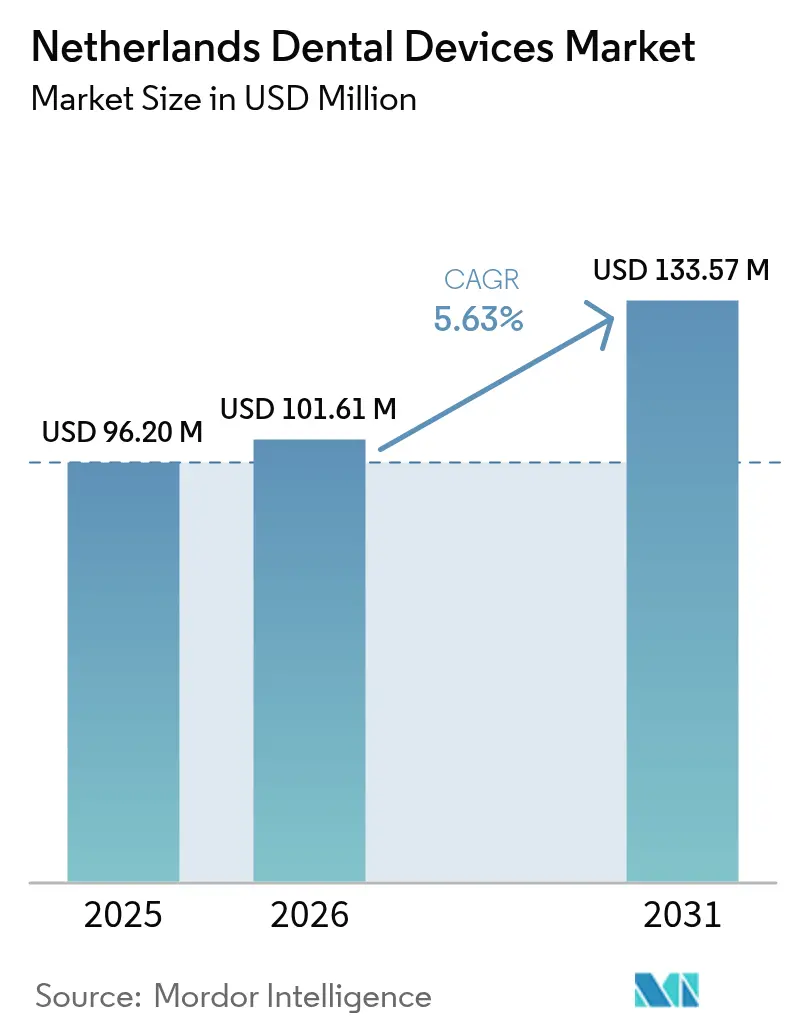
The Netherlands Dental Devices Market size was valued at USD 96.20 million in 2025 and estimated to grow from USD 101.61 million in 2026 to reach USD 133.57 million by 2031, at a CAGR of 5.63% during the forecast period (2026-2031).
The Netherlands dental devices market size stands at USD 96.20 million in 2025 and is projected to reach USD 129.47 million by 2030, recording a CAGR of 6.12% during the forecast period. Sustained public funding for basic dental insurance guarantees broad treatment access, while 84% of residents purchase supplementary coverage that reimburses higher-value procedures, thereby anchoring predictable demand across product categories. A steadily ageing population, low unmet-need ratios, and policy reforms that reward preventive care are translating into higher procedure volumes and faster turnover of consumables. Private-equity-backed corporate chains have begun buying solo practices and introducing standardised procurement, accelerating adoption of CAD/CAM systems, CBCT scanners, and chairside 3-D printers that cut chair-time and lift clinic throughput. Parallel growth in inbound cosmetic tourism centred on Amsterdam and Rotterdam is fostering specialist niches in orthodontics and aesthetic prosthodontics that favour premium clear aligners and zirconia-based restorations.
Key Report Takeaways
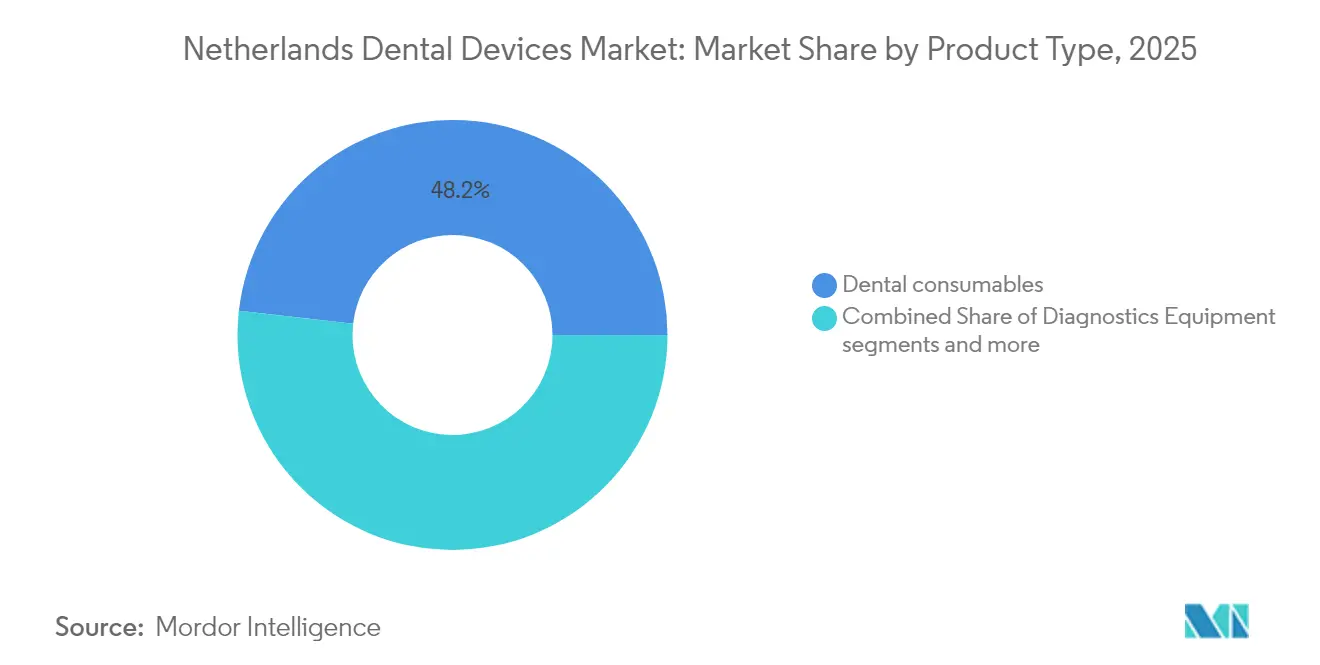
- By product type, dental consumables led with 48.21% of the Netherlands dental devices market share in 2025, while dental equipment is forecast to expand at a 6.31% CAGR to 2031.
- By treatment, prosthodontics accounted for 33.12% of the Netherlands dental devices market size in 2025 and is advancing at a 6.84% CAGR through 2031.
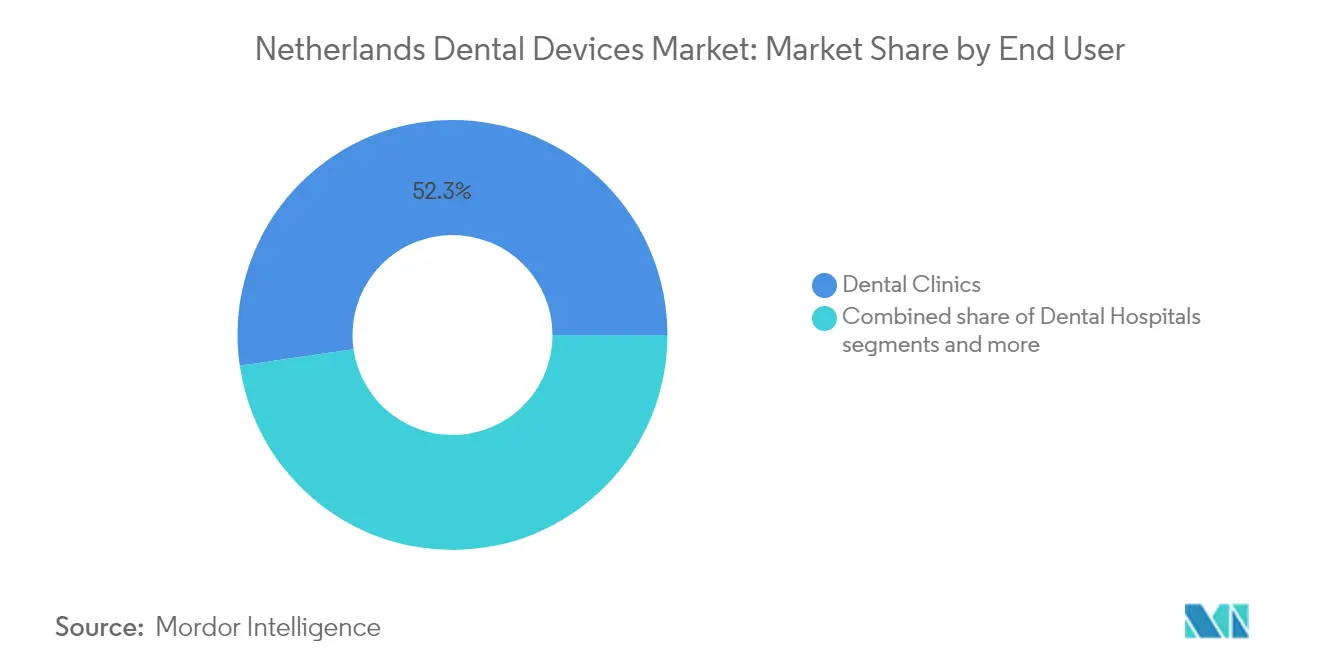
- By end user, dental clinics captured 52.29% revenue share in 2025; the segment is projected to grow at a 7.03% CAGR between 2026-2031.
Note: Market size and forecast figures in this report are generated using Mordor Intelligence’s proprietary estimation framework, updated with the latest available data and insights as of 2026.
Netherlands Dental Devices Market Trends and Insights
Drivers Impact Analysis*
| Driver | (~) % Impact on CAGR Forecast | Geographic Relevance | Impact Timeline |
|---|---|---|---|
| High Government‐funded Basic Dental Insurance Coverage | +1.8% | National, with stronger impact in urban centers | Medium term (2-4 years) |
| Ageing Population Driving Implant Demand | +1.5% | National, with concentration in provinces with higher elderly populations | Long term (≥ 4 years) |
| Expansion of Corporate Dental Chains Standardising Procurement | +1.2% | National, with early concentration in Amsterdam, Rotterdam, Utrecht | Medium term (2-4 years) |
| Cosmetic-Tourism Surge in Amsterdam & Rotterdam | +0.9% | Amsterdam & Rotterdam, with spillover to Utrecht | Short term (≤ 2 years) |
| Source: Mordor Intelligence | |||
High Government-funded Basic Dental Insurance Coverage
Comprehensive statutory insurance covers routine care for every resident, while supplementary policies reimburse advanced treatments, driving procedure frequency above the EU mean[1]Source: European Commission, “Eurostat—Unmet Dental Needs,” europa.euSource: European Commission, “Eurostat—Unmet Dental Needs,” europa.eu . The model incentivises annual check-ups, resulting in higher per-capita use of prophylactic consumables, radiology films, and disposable infection-control products. Reimbursement of digital impressions for crowns has spurred clinics to invest in intra-oral scanners that slash appointment times. Stable premium inflows give DSOs predictable cash-flows, encouraging bulk tenders for handpieces, bonding agents, and single-visit endodontic systems. Policy pilots that now refund guided implant surgery are set to widen the addressable base for high-margin surgical kits over the next three years.
Ageing Population Driving Implant Demand
People aged 65 and above will constitute 24% of Dutch residents by 2030, up from 20% in 2024, and they retain more natural teeth, necessitating complex restorations rather than full dentures[2]Source: Statistics Netherlands (CBS), “Population Forecast 2025-2030,” cbs.nl . Clinical guidelines increasingly recommend implant-supported overdentures for edentulous arches, boosting unit sales of titanium fixtures and biomimetic abutments. Manufacturers are rolling out shorter implants and surface-treated screws that osseointegrate in denser cortical bone often found in seniors. Public health surveys show 73.5% of citizens aged 65-74 visited a dentist in 2024, far above the EU average, signalling a robust pipeline for high-value regenerative materials. Geriatric demand is also lifting intra-surgical imaging uptake; CBCT scans help visualise pneumatized sinuses, reducing implant failures and supporting bundling of imaging-plus-surgery service packages.
Expansion of Corporate Dental Chains Standardising Procurement
Private-equity funds have poured capital into buy-and-build platforms such as Curaeos and Colosseum Dental, which together manage more than 350 chairs nationwide. These DSOs consolidate ordering through central warehouses, preferring vendors that supply full portfolios—from prophylaxis cups to chairside mills—under long-term agreements. Standardisation reduces SKU complexity by up to 30%, pushing clinics toward unified software ecosystems such as cloud-based practice-management tools that integrate digital radiography and billing. Vendors respond with turnkey service contracts covering installation, training, and predictive maintenance, a shift that is enlarging recurring revenue streams. Central oversight also accelerates roll-outs of new tech: Curaeos outfitted 60 locations with intra-oral scanners in 2024 within six months, a scale unattainable for solo practitioners.
Cosmetic-Tourism Surge in Amsterdam & Rotterdam
Direct flights, English-speaking clinicians, and price gaps versus UK clinics are attracting inbound patients seeking veneers, whitening, and clear aligners. Clinics advertise chairside CAD/CAM veneer delivery in one visit, leveraging 5-axis mills paired with AI smile-design software. Procedure bundles command 2-3 times domestic case values, lifting revenue per chair and stimulating procurement of zirconia blocks, high-resolution scanners, and 3-D printers for provisional crowns. Hotspot clustering boosts competitive pressure, prompting continuous equipment upgrades to differentiate on turnaround speed and digital preview quality. Spill-over benefits suppliers selling whitening gels, thermal forming units, and aligner thermoplastics, albeit within a limited geographic corridor.
Restraints Impact Analysis*
| Restraint | (~) % Impact on CAGR Forecast | Geographic Relevance | Impact Timeline |
|---|---|---|---|
| Saturated Dentist-to-Population Ratio | -0.7% | National, with higher impact in urban areas | Medium term (2-4 years) |
| Adult Orthodontic Reimbursement Caps | -0.5% | National | Short term (≤ 2 years) |
| Source: Mordor Intelligence | |||
Saturated Dentist-to-Population Ratio
Netherlands counts roughly 5.2 dentists per 10,000 inhabitants, ranking among the highest in Europe. Intense local competition compresses margins, curbing equipment refresh cycles, particularly for solo practitioners in major cities. Younger graduates favour part-time schedules, and 23% of the workforce will retire by 2030, creating asymmetry between current oversupply and future gaps. For manufacturers, the dynamic shifts the value proposition toward devices that deliver measurable productivity gains—such as rapid-cycle sterilizers and dual-use lasers—rather than incremental feature upgrades. Financing packages that spread payments over five years are increasingly pivotal to close sales.
Adult Orthodontic Reimbursement Caps
Basic insurance excludes adult braces, and most voluntary plans cap annual orthodontic benefits at EUR 500 (USD 544), covering only a fraction of EUR 3,000-5,000 comprehensive treatments. Out-of-pocket cost sensitivities pull demand toward mid-priced metal brackets or shortened aligner courses, restraining premium clear aligner uptake. Some clinics counter with subscription plans, yet conversion remains limited outside affluent cohorts. Vendors have responded by introducing tiered aligner lines featuring fewer stages, but overall unit ASPs remain under pressure. Because aligner workflows drive ancillary sales of intra-oral scanners, bonded attachments, and finishing kits, the reimbursement ceiling dampens linked revenue across multiple device categories.
*Our forecasts treat driver/restraint impacts as directional, not additive. The impact forecasts reflect baseline growth, mix effects, and variable interactions.
Segment Analysis
By Product Type: Digital Transformation Reshaping Equipment Segment
Dental consumables led demand in 2025, commanding 48.21% revenue as routine prophylaxis, restorations, and endodontic interventions require constant restocking. High visit rates—80.5% of citizens attend yearly check-ups—ensure stable throughput of composites, etchants, and single-use handpiece sleeves, a trend amplified by strict infection-control regulations. The segment also captures rising volumes of bone grafts and resorbable membranes linked to implant surgeries for elderly patients. Procurement centralisation by DSOs is steering orders toward house-brand consumables sourced under private-label contracts, disrupting legacy distributor margins yet widening price-conscious clinic adoption.
The Netherlands dental devices market size for dental equipment is projected to expand at a 6.31% CAGR, outpacing consumables as clinics digitise workflows. Adoption of chairside CAD/CAM units rose 18% in 2024 alone, driven by same-day inlay delivery that eliminates temporaries and second visits. Unified software suites now link scanners, mills, and CBCT images, enabling data-driven treatment plans that differentiate clinics competing on patient experience. Diagnostic equipment growth mirrors heightened demand for low-dose CBCT units that visualise airway dimensions for sleep-apnoea screening, adding incremental clinical services without new chair investments.


By Treatment: Demographic Shifts Elevating Implant Procedures
Prosthodontics dominated treatments with 33.12% of revenue in 2025, sustained by the implant boom among seniors retaining partial dentition. Implant-supported crowns, overdentures, and full-arch bridges utilise higher-priced components plus surgical kits, lifting average spend per case. Clinical guidelines increasingly endorse immediate-load protocols, intensifying demand for torque-controlled handpieces and high-stability biomaterials. The Netherlands dental devices market size for implant surgery kits is forecast to post high-single-digit gains, supported by insurer pilots that fund digital surgical guides.
Orthodontics is the fastest-growing treatment line, advancing at a 6.87% CAGR through 2031 despite reimbursement caps. The surge is fuelled by teen aligner demand, growing adult aesthetic awareness, and inbound cosmetic tourists. Clear aligner platforms integrate AI-driven treatment simulations that shorten chair-side consultations, enabling clinics to scale case volumes. The Netherlands dental devices market share for intra-oral scanners climbed to 65% of new orthodontic records in 2025, underscoring tight equipment-procedure linkage. Cloud portals that let patients track progress boost adherence, a selling point that DSOs include in marketing campaigns aimed at affluent urban consumers.
By End User: Consolidation Driving Clinic Segment Growth
Dental clinics captured 52.29% of 2025 revenue and post the fastest projected CAGR at 7.03% as consolidation fuels capital spending. DSOs own about 10-15% of chairs but make disproportionate equipment purchases, standardising on multi-function treatment centres that integrate imaging, suction, and digital displays. Clinic operators negotiate multi-year frame agreements bundling service contracts, which underpins predictable aftermarket revenue for manufacturers.
Dental hospitals, though smaller in number, handle complex maxillofacial surgeries and paediatric special-needs cases. They adopt advanced operating microscopes, piezosurgery units, and regenerative biomaterials earlier than clinics, acting as regional reference sites that influence procurement trends. Academic institutes remain early adopters of AI-enabled diagnostic software, publishing validation studies that accelerate broader market acceptance. Collaborative R&D projects between universities and start-ups such as Lake3D are generating multi-material 3-D printing applications for personalised prostheses, indicating a pipeline of disruptive products slated for commercial rollout by 2027.
Geography Analysis
Geography Analysis
Amsterdam, Rotterdam, and Utrecht dominate sales are the key regions, driven by dense clinic networks and cosmetic tourism traffic. DSOs cluster in these metros, enabling vendor field teams to service multiple locations within short travel radii, which lowers service-hour costs and speeds installation cycles.
Northern and eastern provinces such as Groningen, Drenthe, and Overijssel feature higher ratios of residents aged 65 plus, lifting per-capita implant and overdenture procedures. However, dentist supply gaps loom as older practitioners retire, prompting grant programmes that subsidise digital equipment for clinics willing to open satellite branches in underserved towns. Vendors offering remote training and cloud-based maintenance tools gain an edge where on-site support is less feasible.
The southern cross-border provinces North Brabant and Limburg benefit from Belgian and German patient flows seeking lower wait times or specific aesthetic treatments, creating a micro-cluster of multilingual practices. These regions adopt CE-certified equipment rapidly due to familiarity with EU regulatory updates and enjoy logistical advantages from distribution hubs in Eindhoven and Venlo. Overall, geographic disparities steer manufacturer go-to-market strategies toward metropolitan key-account teams complemented by regional partners that can navigate local insurance formularies and practice cultures.
Regulatory Landscape
Dental devices placed on the Dutch market must comply with the EU Medical Device Regulation (MDR, EU 2017/745) and be supported by national implementing legislation under the Wet medische hulpmiddelen and related decrees/regulations. The Health and Youth Care Inspectorate (IGJ) acts as the primary market-surveillance authority, overseeing manufacturer, importer, and distributor obligations around CE marking, post-market surveillance, and distribution controls. For custom-made devices used in dentistry, registration in the national NOTIS system is required for applicable categories alongside EU-level obligations such as EUDAMED registration where in scope. The Netherlands also applies Dutch-language requirements for labeling and instructions for use, which affects packaging and IFU management for consumables and equipment sold into clinics and labs.
Regulatory scrutiny has extended beyond technical compliance into governance and transparency requirements for supplier-provider relationships. In June 2026, IGJ published sector findings indicating that parts of the dental medical device field had insufficient awareness of legal requirements related to gunstbetoon (benefits/inducements), reinforcing the need for written agreements and transparent financial relations in device supply and education arrangements. For clinical investigations, the Central Committee on Research Involving Human Subjects (CCMO) is the competent authority. The Netherlands also supports coordinated submissions for combined studies involving both medicinal products and medical devices, which is relevant for manufacturers validating drug-device combination dental products and materials.
Competitive Landscape
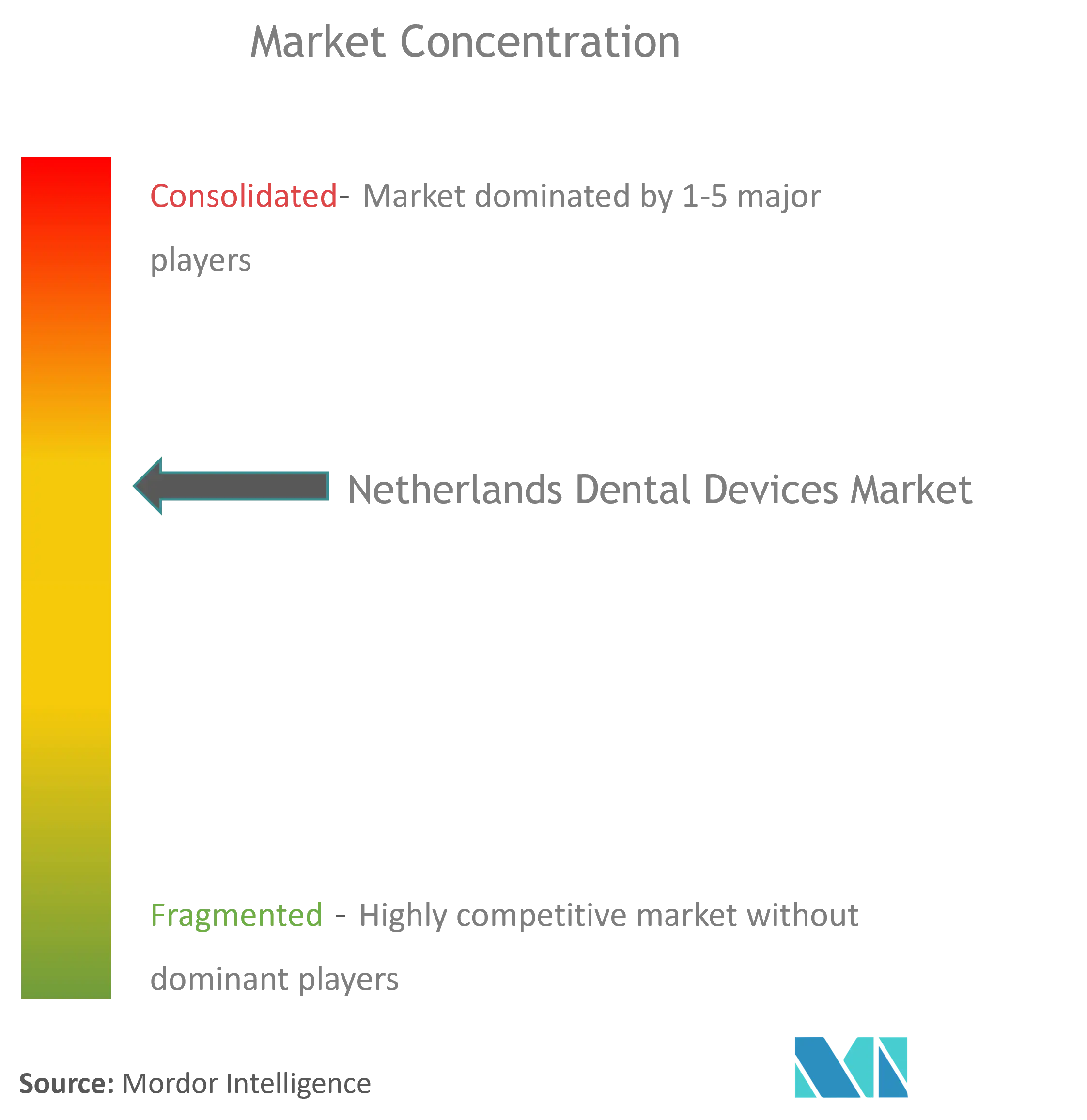
Global majors—Dentsply Sirona, Straumann, Nobel Biocare, and Envista—anchor the premium tier with expansive portfolios and bundled training. Mid-tier European suppliers such as Planmeca and W&H leverage niche leadership in imaging and rotary instruments, respectively, while local innovators like Lake3D target additive-manufacturing niches. Market concentration is edging upward as DSOs channel purchases through preferred-supplier contracts that can account for 60% of their annual spend. Vendors able to provide integrated digital workflows, financing, and continuous education strengthen lock-in effects.
In 2024 Dentsply Sirona booked a USD 910 million net loss linked to goodwill write-downs but raised R&D outlays to accelerate software-hardware integration, unveiling DS Core cloud services that synchronise imaging, milling, and patient data. Straumann opened a new Benelux training centre in Utrecht, offering implantology masterclasses that double as live product demonstrations.
Disruptive entrants focus on clear aligners, AI diagnostics, and chairside 3-D printing. Swiss-Dutch start-up Relu has partnered with several Dutch DSOs to pilot machine-learning caries-detection software, reporting 15% diagnostic-time cuts. Procurement simplification by DSOs is spurring OEM-to-OEM alliances—Planmeca and Align Technology now co-market scanner-aligner bundles targeted at consolidated groups. Vendors lacking full digital ecosystems risk displacement as chains rationalise supplier lists.
Netherlands Dental Devices Industry Leaders
Zimmer Biomet
3M
Henry Schein Inc.
Ultradent Products Inc.
Dentsply Sirona
- *Disclaimer: Major Players sorted in no particular order

Market Opportunities and Future Outlook
A near-term whitespace area is the monetization and standardization of digital dentistry workflows across clinics and dental laboratories, supported by reimbursement and coding infrastructure. In January 2026, the Nederlandse Zorgautoriteit (NZa) introduced new performance codes, including Q1109 for a digitally manufactured individual tray for an implant-supported prosthesis and Q6145 for a digitally printed model with implants. This improves clarity on registration and billing for digitally enabled dental techniques and creates room for suppliers of intra-oral scanning, CAD/CAM, milling, and dental 3D printing ecosystems, along with the associated consumables (zirconia blocks, resins, and implant prosthetic components) that DSOs and labs purchase through standardized procurement.
On the innovation and capacity side, public-private MedTech programs provide an additional pathway for device makers and digital software providers to deepen local partnerships and R&D presence. In July 2026, the Dutch government announced EUR 102.5 million of investment for strengthening the national MedTech sector through 2036, with a requirement for at least equal private matching investment; Philips committed EUR 50 million as part of this effort. While not dentistry-specific, the program points to an active funding environment for AI-enabled and infrastructure-linked medical technology, aligning with market themes already visible in Dutch dental care such as workflow automation, imaging integration, and cloud-connected software. Dental device suppliers can leverage the funding via collaborations, pilots, and training networks centered around major urban clinic groups.
Recent Industry Developments
- July 2026: The Dutch government announced EUR 102.5 million in funding to strengthen the Netherlands MedTech sector through 2036, with at least equal private matching investment required. Philips committed EUR 50 million as part of the initiative, reinforcing the momentum for digitally enabled device ecosystems and partnerships relevant to dental imaging, software, and connected workflow tools.
- January 2026: The Nederlandse Zorgautoriteit (NZa) introduced new performance codes, including Q1109 and Q6145, to support registration and billing of digitally manufactured and digitally printed dental techniques used in implant prosthetics workflows. The coding update reduces administrative friction for clinics and labs adopting CAD/CAM and dental 3D printing, supporting broader uptake of the enabling devices and materials.
- June 2024: Henry Schein Medical entered a collaboration with Philips in the Netherlands to distribute ultrasound solutions including Lumify and Affiniti systems to primary care providers. The agreement strengthens a distributor-manufacturer channel for diagnostic equipment in the country, with spillover potential into broader procurement relationships with clinics that also purchase dental devices and related imaging technology.


Research Methodology Framework and Report Scope
Market Definition and Coverage
For this methodology, the Netherlands dental devices market covers the value of devices and consumables that dental professionals use to examine, diagnose, treat, restore, and extract teeth, along with tools used to handle oral tissues in routine care.
Scope exclusions: Services (chairside treatment fees and lab service fees) are excluded, and only device and consumable sales value is counted.
Segmentation Overview
- By Product
- Diagnostics Equipment
- Dental Laser
- Soft Tissue Lasers
- Hard Tissue Lasers
- Radiology Equipment
- Extra Oral Radiology Equipment
- Intra-oral Radiology Equipment
- Dental Chair and Equipment
- Dental Laser
- Therapeutic Equipment
- Dental Hand Pieces
- Electrosurgical Systems
- CAD/CAM Systems
- Milling Equipment
- Casting Machine
- Other Therapeutic Equipments
- Dental Consumables
- Dental Biomaterial
- Dental Implants
- Crowns and Bridges
- Other Dental Consumables
- Other Dental Devices
- Diagnostics Equipment
- By Treatment
- Orthodontic
- Endodontic
- Peridontic
- Prosthodontic
- By End User
- Dental Hospitals
- Dental Clinics
- Academic & Research Institutes
Data Sources, Market Sizing, and Validation
Desk Research
Desk research was used to set the factual base for the market model before assumptions were taken into primary validation. We typically relied on public healthcare statistics and guidance that explains demand signals and care delivery in the country, such as national health statistics portals, Eurostat health datasets, and OECD health indicators.
We also reviewed official publications from regulators and standards bodies relevant to medical devices and dental materials, along with trade association sites covering oral health and dental practice activity. To connect market movement with supply and pricing, we used company annual reports, investor presentations, and reputable press, and we selectively checked a paid company financials and intelligence subscription plus a patent database to confirm product focus and innovation direction. These examples are not exhaustive, and many other sources were also referenced for data collection, cross-checking, and clarification.
Primary Interviews and Surveys
Primary work was used to pressure-test the desk assumptions and to fill gaps that do not show up clearly in public data, especially for pricing moves and channel dynamics. We spoke with a mix of manufacturers, distributors, dental clinics, and hospital procurement stakeholders to confirm what is counted as a device sale versus an attached service, and to align volume drivers with actual purchasing behavior. Since this is a single-country market, outreach emphasized nationwide coverage across major urban clusters and smaller catchment areas, so results were not skewed toward one care setting.
Distribution of primary research fieldwork respondents
| Company type | Respondent position |
|---|---|
| Top tier: 28% | CXOs: 20% |
| Mid tier: 52% | Functional/Unit leaders: 21% |
| Smaller Players: 20% | Managers: 59% |
Market-Sizing & Forecasting
Market sizing was built using a top-down approach where the Netherlands dental care activity base was reconstructed first, and then mapped into device and consumable demand using adoption and replacement rates. That demand pool was shaped using practical inputs such as dental visit levels, the active dentist and clinic footprint, procedure mix trends (for example orthodontic and prosthodontic intensity), equipment replacement cycles, and the shift toward digital diagnostics and restorative workflows.
Totals were then corroborated using selective bottom-up approximations, mainly through channel checks and sampled price-times-volume math for high-impact categories, followed by adjustments where the implied spend per clinic looked too high or too low. When product-level gaps appeared in bottom-up checks (for example, limited visibility into small clinic purchasing), the missing share was handled through calibrated uplift factors that were validated during interviews rather than being filled by a single blanket ratio.
For forecasting, we used scenario analysis supported by a simple multivariate regression view of the main demand drivers, so the forward path followed realistic changes in procedure volumes, replacement timing, and price progression rather than only extending the historical CAGR. Assumptions on average selling price movement were kept explicit, separating mix upgrades from inflation, and then confirmed with distributor and clinic feedback.
Data Validation & Update Cycle
Outputs were validated by comparing the model results with independent signals, such as implied spending per practice, category-level replacement logic, and consistency with macro health expenditure direction. Large variances triggered a step-back review where inputs were rechecked, interview notes were revisited, and assumptions were corrected before final sign-off.
A second analyst review is completed to catch scope slips, math issues, and any outlier assumptions that could distort the total, followed by a final internal pass before release. Reports are refreshed annually, and interim updates are made when material events occur, such as regulatory shifts, sharp currency moves affecting imports, or sudden pricing changes. Before delivery, we also do a quick revalidation sweep so clients receive the most current view available.
Mordor Intelligence's Netherlands Dental Devices Market Estimate Compared With Other Published Estimates
Published market values can differ even when the topic name looks the same, since the underlying counting rules are often not aligned. The biggest drivers are usually scope boundaries (devices-only versus devices plus services), how consumables are treated, and whether the estimate is anchored to a clear current-year price point or stretched using broad growth assumptions.
In this market, timing choices matter because many products are imported and pricing can shift as EUR-USD conversion timing changes, and because average selling price can rise from product mix upgrades even when unit volumes stay steady. By rechecking these pricing inputs close to publication, and by running device-only scope checks against clinic-level spend signals, the refresh cadence and currency timing used in Mordor Intelligence keeps the final 2025 value tied to the Netherlands demand pool.
Benchmark comparison
| Source | Market Size | Gaps in Research Methodology |
|---|---|---|
| Mordor Intelligence | USD 96.20 M (2025) | |
| Regional Consultancy A | USD 590.20 M (2025) | Uses a Benelux-wide total that includes Belgium and Luxembourg, which lifts the value well above a Netherlands-only view and can also blend country-level price differences. |
| Industry Publisher B | USD 1.50 B (2024) | Appears to include a wider bundle of equipment and possibly attached dental care components, and the base year is different, which can shift the number through pricing and currency timing. |
The spread across the table is mainly explained by geography and what is counted as part of the market, followed by base-year and pricing alignment. Our approach stays traceable because each step is linked to a demand driver, a replacement logic, and an explicit price assumption that can be rechecked and repeated.


Key Questions Answered in the Report
What is the current size of the Netherlands dental devices market?
The Netherlands Dental Devices Market is valued at USD 101.61 million in 2026 and is forecast to reach USD 133.57 million by 2031.
Which product segment is growing fastest?
Dental equipment, driven by CAD/CAM systems and CBCT scanners, is projected to register a 6.31% CAGR through 2031.
How large is the corporate DSO footprint in the country?
Dental Service Organizations control roughly 10-15% of Dutch chairs, a share that is expected to climb as private equity funds continue roll-ups.
Why is implant demand rising?
An ageing population retains more natural teeth, leading to complex restorative needs and increased preference for implant-supported overdentures.
Page last updated on:


 Your data is secure and never sold or shared.


