
Myanmar Lubricants Market Size and Share
Market Overview
| Study Period | 2020 - 2031 |
|---|---|
| Forecast Data Period | 2026 - 2031 |
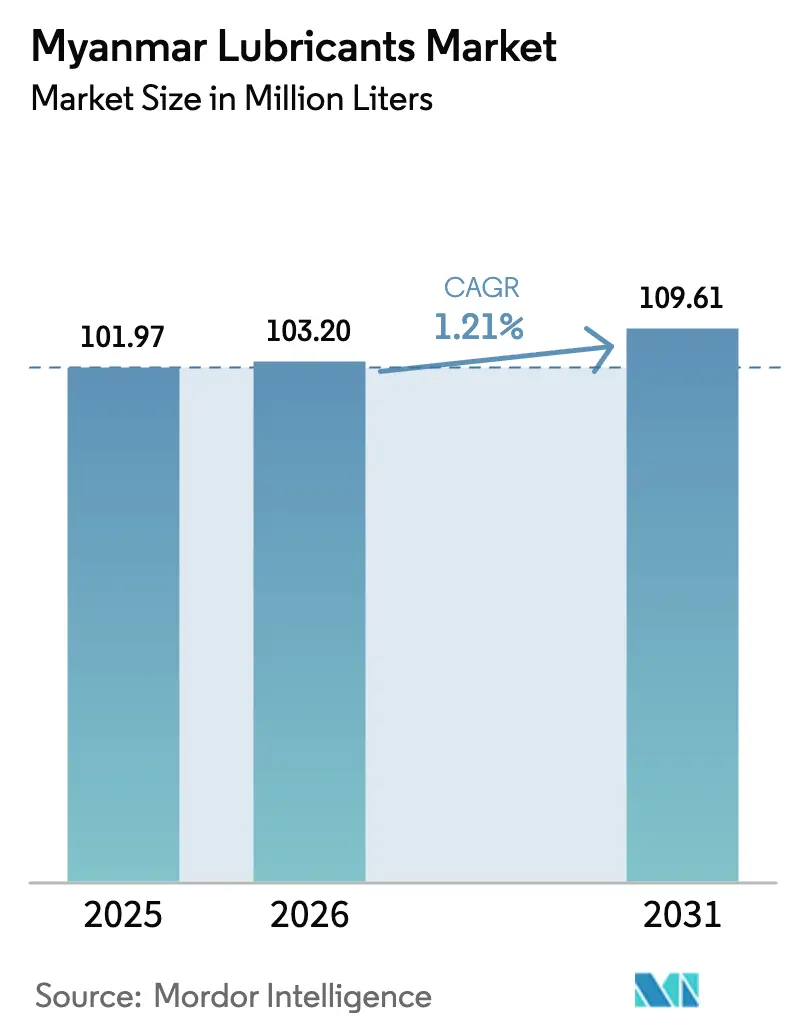
| Base Year Market Size (2025) | 101.97 Million liters |
| Market Volume (2026) | 103.2 Million liters |
| Market Volume (2031) | 109.61 Million liters |
| Growth Rate (2026 - 2031) | 1.21 % |
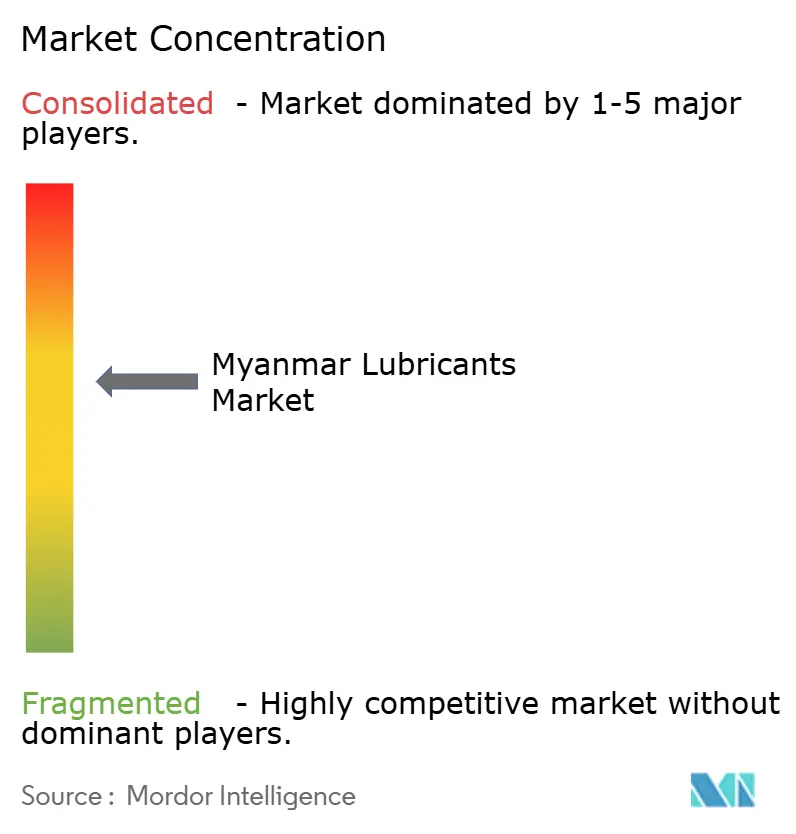
| Market Concentration | Medium |
Major Players *Disclaimer: Major Players sorted in no particular order Image © Mordor Intelligence. Reuse requires attribution under CC BY 4.0. | |
Myanmar Lubricants Market Analysis by Mordor Intelligence
The Myanmar Lubricants Market size is expected to grow from 101.97 million liters in 2025 to 103.2 million liters in 2026 and is forecast to reach 109.61 million liters by 2031 at 1.21% CAGR over 2026-2031. This steady trajectory reflects a gradual rebound in industrial activity, persistent growth of the national vehicle parc, and government-led infrastructure spending that lifts lubricant consumption across automotive, heavy equipment, and power-generation applications. Engine oils remain the core volume driver because of the country’s dependence on internal-combustion engines, while diesel-based backup power systems sustain incremental demand from utilities and commercial facilities. Parallel trends, such as agricultural mechanization and the expansion of the mining sector, diversify end-use opportunities, although foreign-exchange volatility and import licensing delays temper near-term growth prospects. International brands participate mainly through distributors, creating space for agile local suppliers to capture share in the Myanmar lubricants market.
Key Report Takeaways
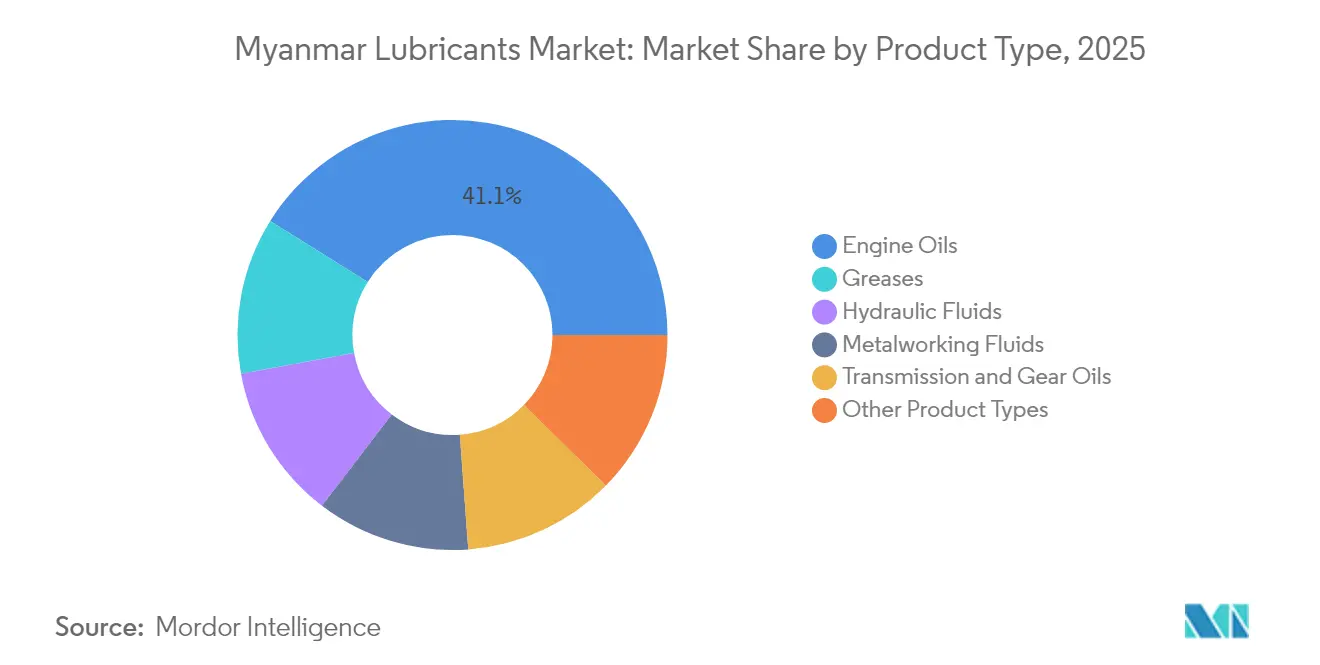
- By product type, engine oils commanded 41.10% of the Myanmar Lubricants market share in 2025, and the segment is projected to grow at a 1.72% CAGR to 2031.
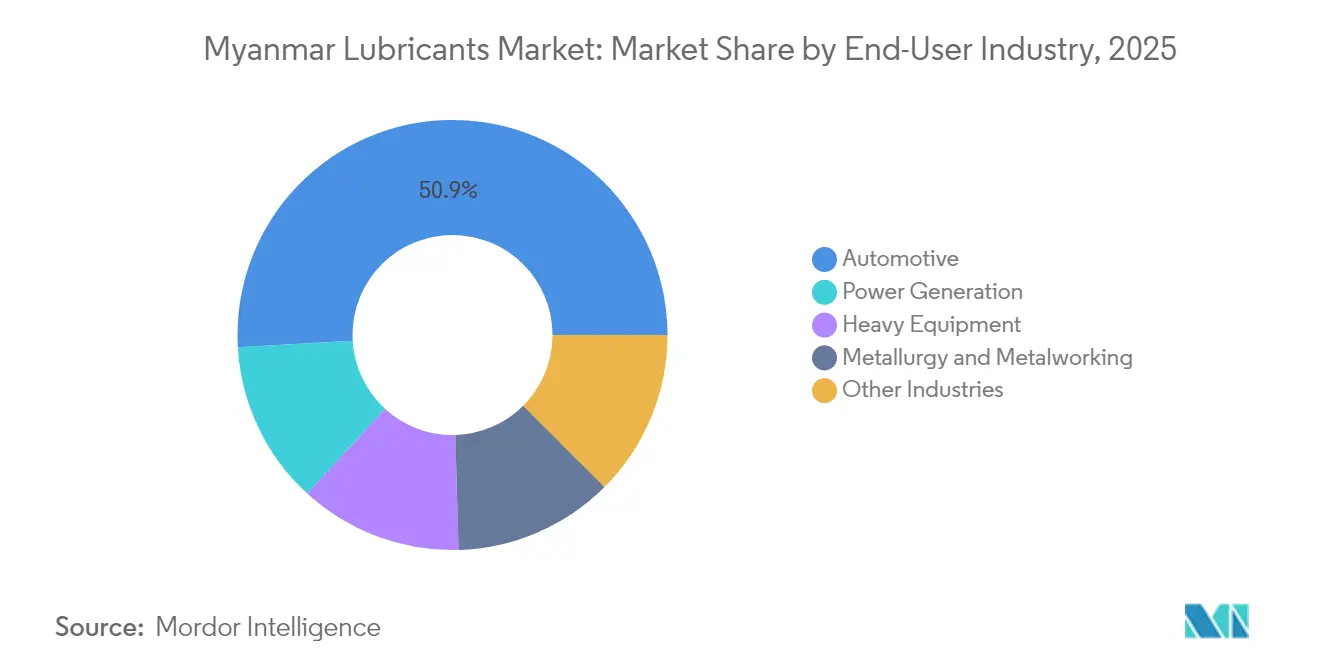
- By end-user industry, the automotive segment accounted for 50.90% of the Myanmar Lubricants market size in 2025, while power generation is set to expand at a 1.56% CAGR through 2031.
Note: Market size and forecast figures in this report are generated using Mordor Intelligence’s proprietary estimation framework, updated with the latest available data and insights as of 2026.
Myanmar Lubricants Market Trends and Insights
Drivers Impact Analysis*
| Driver | (~) % Impact on CAGR Forecast | Geographic Relevance | Impact Timeline |
|---|---|---|---|
| Rising vehicle-parc and aftermarket demand | +0.4% | Yangon and Mandalay corridors | Medium term (2-4 years) |
| Rapid mechanization of agriculture | +0.3% | Central Myanmar and Ayeyarwady Delta | Long term (≥ 4 years) |
| Expansion of mining and heavy machinery fleets | +0.2% | Kachin, Shan, coastal regions | Medium term (2-4 years) |
| Government-backed road-freight corridors | +0.2% | Cross-border routes to China, Thailand, India | Long term (≥ 4 years) |
| Re-refining incentives enlarging base-oil pool | +0.1% | Yangon industrial zones and planned refineries | Long term (≥ 4 years) |
| Source: Mordor Intelligence | |||
Rising Vehicle-Parc and Aftermarket Demand
Vehicle registrations have recovered sharply since 2024, supported by easing import rules that widen model choices and lower acquisition costs. Commercial trucks servicing the China–Myanmar Economic Corridor clock high annual mileage, accelerating oil-drain intervals and spurring repeat purchase cycles in the Myanmar lubricants market. Local workshops rely on affordable multigrade engine oils, encouraging parallel imports and private-label offerings. Growing ride-hailing fleets increase regular maintenance volumes, while the increasing density of motorcycles in peri-urban zones sustains demand for two-stroke and four-stroke oils. Aftermarket retailers utilize flexible payment terms to foster loyalty among a price-sensitive consumer base.
Rapid Mechanization of Agriculture
National mechanization programs subsidize tractor loans and harvesting equipment, thereby driving the uptake of lubricants in rural supply chains. Imported machinery operates under tropical heat and dust, necessitating premium hydraulic fluids and gear oils with robust oxidation resistance. Dealer-bundled service contracts lock in lubricant offtake and introduce farmers to higher performance grades that reduce downtime. Development agencies fund training on preventive maintenance, reinforcing awareness of the proper selection of oil. As acreage under mechanized cultivation rises, the Myanmar lubricants market benefits from predictable lubricant replenishment cycles that align with planting and harvesting seasons.
Expansion of Mining and Heavy Machinery Fleets
Mining concessions in jade, copper, and rare-earth deposits attract modern excavators, haul trucks, and stationary compressors that require specialized high-viscosity lubricants. Remote sites in Kachin and Shan States require bulk delivery and on-site storage solutions, favoring suppliers that offer drum-to-bulk conversion programs. Equipment OEMs stipulate the use of longer-life synthetic or semi-synthetic oils to meet warranty terms, nudging the product mix toward premium formulations and widening margins in the Myanmar lubricants market. Environmental regulations on waste oil disposal further encourage advanced lubricants with extended drain intervals. Rising commodity prices sustain capital inflows, anchoring lubricant demand over the medium term.
Re-Refining Incentives Enlarging Domestic Base-Oil Pool
Fiscal incentives for used-oil collection and re-refining help diversify base-oil supply and buffer against import disruptions. Planned recycling plants near Yangon target Group I and light Group II output, which can cover a portion of domestic blending needs. A stable waste-oil stream lowers feedstock costs and supports competitive local brands, potentially compressing price gaps versus foreign products. Environmental compliance strengthens brand credibility, aiding market penetration among industrial customers. Over time, re-refined base oils could supply higher-value specialties, enhancing overall self-reliance of the Myanmar lubricants market[1].
Restraints Impact Analysis*
| Restraint | (~) % Impact on CAGR Forecast | Geographic Relevance | Impact Timeline |
|---|---|---|---|
| Growing penetration of electric two-wheelers | -0.20% | Urban centers, particularly Yangon and Mandalay | Short term (≤ 2 years) |
| Crude-price volatility pressuring margins | -0.10% | National, affecting all distribution channels | Short term (≤ 2 years) |
| Import-licence delays disrupting supply continuity | -0.10% | National, concentrated at major ports and border crossings | Medium term (2-4 years) |
| Source: Mordor Intelligence | |||
Growing Penetration of Electric Two-Wheelers
Urban consumers are adopting battery-powered scooters in response to fuel price swings and municipal incentives, thereby curbing demand for conventional motorcycle engine oils. Although the electric segment currently accounts for less than 4% of two-wheeler sales, accelerated uptake could erode a key volume contributor to the Myanmar lubricants market over the next two years. Suppliers explore dielectric fluids and specialty greases for hub motors, but replacement intervals and volumes remain lower than for combustion counterparts. Workshops face revenue loss from oil-change services, hastening a pivot to broader maintenance packages. Traditional lubricant brands must adapt marketing and product portfolios to capture emerging opportunities in the e-mobility ecosystem.
Crude-Price Volatility Pressuring Margins
The country imported USD 4.53 billion worth of refined fuels in 2024, exposing distributors to fluctuating landed costs and tight working-capital cycles. Smaller players often lack hedging instruments and absorb price shocks, thereby compressing their operating margins. Import licensing bottlenecks lead to higher inventory holdings, thereby amplifying exposure. Currency depreciation inflates dollar-denominated base-oil purchases, further squeezing profitability in the Myanmar lubricants industry. Persistent volatility may trigger market exits or consolidation, altering the competitive fabric.
*Our forecasts treat driver/restraint impacts as directional, not additive. The impact forecasts reflect baseline growth, mix effects, and variable interactions.
Segment Analysis
By Product Type: Engine Oils Drive Market Leadership
Engine oils retained 41.10% of the Myanmar lubricants market share in 2025, reflecting the dominance of internal-combustion engines across automotive and industrial settings. The segment is projected to expand at a 1.72% CAGR through 2031, outpacing the broader Myanmar lubricants market. Entry-level mineral grades continue to appeal to cost-conscious vehicle owners; however, gradually rising awareness of extended-drain semi-synthetics opens up room for value migration. Greases follow as the next significant product line, supplying indispensable protection for bearings in mining and construction machinery. Hydraulic fluids are experiencing steady sales momentum as infrastructure spending increases, leading to higher excavator and loader usage. Metalworking fluids, although still niche, are benefiting from the growing machining activity at the Thilawa Special Economic Zone. Transmission and gear oils are experiencing moderate growth, constrained by longer service intervals and advancements in drivetrain technologies.
The Myanmar lubricants market size for greases is forecast to approach 16.4 million liters by 2031, advancing at around 1.22% CAGR, driven by heavy-equipment rebuild cycles and the mining sector’s high shock-load requirements. Hydraulic-fluid demand benefits from government road-building and border logistics projects, pushing the sub-segment toward 12.35 million liters by the end of the decade. Metalworking fluids could reach 4.15 million liters as local fabrication value chains deepen. While volume growth in transmission and gear oils lags, premium formulations offering fuel economy and seal compatibility give suppliers pricing leverage. Overall, product diversification shields the Myanmar lubricants market from abrupt swings in any single application area.

By End-User Industry: Automotive Sector Dominance
The automotive sector represented 50.90% of the Myanmar lubricants market size in 2025 and remains the primary consumption pillar. The country produced 2,711 motor vehicles in 2024. Commercial trucks traversing cross-border corridors undergo frequent oil changes, while rapidly expanding ride-hailing fleets create consistent demand for passenger vehicles. Motorcycles contribute sizable volumes of two-stroke and four-stroke models, despite growing electric competition. Heavy-equipment users form the second-largest end-user group, consuming hydraulic fluids, greases, and gear oils for construction and resource-extraction machines. Power generation is projected to display the fastest CAGR of 1.56% through 2031, driven by the continued reliance on diesel generators during grid expansion phases.
Metallurgy and metalworking facilities draw on neat cutting oils and water-soluble coolants on a domestic manufacturing scale. Consumer goods factories and food processors constitute additional, albeit smaller, demand centers for lubricants. Collectively, these applications diversify exposure and stabilize overall growth in the Myanmar lubricants market. Migration of automotive workshops toward preventive-maintenance packages broadens the sale of ancillary fluids and greases. Industrial customers increasingly request technical support and oil-analysis services, presenting differentiation avenues for suppliers with on-site expertise.
Geography Analysis
Yangon and Mandalay corridors together account for an estimated 61.40% of nationwide lubricant consumption, anchored by dense vehicle fleets and clustered manufacturing assets. Proximity to ports ensures regular replenishment of imported finished lubricants and base oils, supporting the Myanmar lubricants market in these regions. Special Economic Zones, such as Thilawa, house automotive assembly, packaging, and chemical industries that demand diverse fluid portfolios. Coastal areas capitalize on maritime supply chains, importing bulk products from Singapore and Malaysia for local repackaging and distribution.
Northern states, notably Kachin and Shan, exhibit above-average growth as mining investments and Chinese trade links drive the deployment of heavy equipment. Border towns evolve into logistics nodes, requiring warehouse forklifts and standby generators, which adds lubricant volume. The Ayeyarwady Delta and Central Dry Zone are experiencing a rise in mechanized farming, which underpins demand for tractor engine oils and hydraulic fluids. Government electrification targets drive persistent generator oil consumption in villages awaiting grid connections, underscoring the rural relevance of the Myanmar lubricants market.
By 2031, aggregated demand outside Yangon and Mandalay could exceed 44.3 million liters, narrowing the regional imbalance. Planned refineries in Thanlyin and Dawei may shorten supply lines and foster domestic blending clusters near feedstock sources. Improved highway networks accelerate distributor reach, reducing stock-out risk in interior townships. Localized warehouse investments by major distributors enhance delivery reliability and product freshness, supporting brand differentiation. Geographic expansion thus underpins a more balanced growth path for the Myanmar lubricants market.
Value Chain Analysis
Myanmar lubricants supply is anchored in imports of finished lubricants and base oils. International brands such as Shell, BP, TotalEnergies, ExxonMobil, and other regional suppliers typically participate through local agents and distributors. Upstream flows run from overseas refiners and blenders into Yangon-area import nodes, including terminals that support the Yangon and Thilawa supply corridors, before moving into domestic repackaging and blending operations in industrial zones, and then onward to wholesale distribution.
On the compliance and commercialization path, importers register and license lubricant imports via the Ministry of Commerce and follow Petroleum Products Regulatory Department (PPRD) requirements for petroleum products, including engine oils, gear oils, hydraulic oils, and greases. The process generally involves submission of product specifications (such as catalogues and technical details) and proforma invoices, followed by PPRD-mandated quality inspection and testing by designated officers. Downstream, separate business licenses are required for transport, storage, sale, and distribution, with aftermarket workshops and retailers handling most automotive volumes. Heavy equipment, mining, agriculture, and power-generation users also purchase directly in bulk and drums, prioritizing delivery reliability, on-site storage, and technical support services.
Competitive Landscape
The Myanmar Lubricants market is moderately concentrated. International majors—Shell, BP, TotalEnergies, and ExxonMobil—lean on exclusive agents for market access, focusing on premium automotive and industrial lines. Asian peers, such as Petronas, PTT, and Pertamina, leverage geographic proximity to supply bulk products via the Yangon and Thilawa terminals, thereby sustaining a steady presence. Strategic partnerships with equipment OEMs (original equipment manufacturers) and power-plant EPC (Engineering, Procurement, and Construction) contractors represent viable paths to secure captive volume streams in the Myanmar lubricants market.
Myanmar Lubricants Industry Leaders
-
BP p.l.c.
-
PT Pertamina Lubricants
-
Shell plc
-
TotalEnergies
-
Exxon Mobil Corporation
- *Disclaimer: Major Players sorted in no particular order
Market Opportunities and Future Outlook
Opportunity is building around tightening the import-to-distribution pathway under Ministry of Commerce licensing and PPRD quality inspection. In practice, many buyers still optimize primarily for price and availability rather than verified specifications. Suppliers that operationalize compliant documentation, including product catalogues/specifications and proforma invoices, and can produce shipment batches that are ready for testing can reduce friction at clearance points and lower stock-out risk, which is relevant in a market facing import-licence delays that disrupt supply continuity.
Product and service opportunities cluster where operating severity is high and maintenance discipline is improving, including commercial fleets on cross-border freight corridors, heavy equipment used at mining and infrastructure sites, and diesel generator users across utilities and commercial facilities. Local blending plants in Hlinethaya and Thilawa industrial zones that pursue international certification for engine oils and lubricants (reported in February 2026) support a pathway for higher-spec local supply, private-label growth, and export-oriented quality upgrades. The June 2026 entry push by Daelim Oil Inc through local distribution partnerships for fuel additives and cleaners also points to space for performance-oriented adjacent fluids in the aftermarket, particularly where engine condition and fuel quality variability affect deposit control needs and lubricant drain intervals.
Recent Industry Developments
- July 2026: BP agreed to sell a 65% stake in its Castrol lubricants business to Stonepeak, marking a major ownership shift for one of the most visible global lubricant brands. The transaction changes how Castrol may allocate capital and manage partner networks in distributor-led markets. For Myanmar, where international majors typically route sales through exclusive agents, the change can affect commercial terms, portfolio focus, and channel strategy over the near term.
- June 2026: Daelim Oil Inc expanded its automotive chemicals business in Myanmar through local distribution partnerships, with plans to introduce products such as fuel additives, cetane boosters, octane boosters, and DPF cleaners. The move broadens the performance-chemicals basket sold alongside lubricants in the aftermarket and can raise competitive pressure on premium service offerings at workshops. It also indicates continued supplier willingness to build channel presence despite operating complexity in petroleum-related trade.
- February 2026: Local lubricant blending plants, including Energetic Alliance Petroleum Products Co Ltd, Hein Engineering Co Ltd, and Pacific-PSP Syntech Co Ltd, initiated efforts to secure international certification for their engine oils and lubricants. This step supports higher assurance in locally supplied products and aligns with industrial customers that increasingly ask for quality verification and technical support. Certification pursuit can also enable broader participation in OEM-aligned service channels and export-oriented sales.
Research Methodology Framework and Report Scope
Market Definition and Coverage
For this study, the market covers finished lubricants consumed within Myanmar across automotive and industrial usage, counted as the volume of lubricant products sold into end use during the period.
Scope exclusions: This sizing does not count greases, process oils used as industrial feedstock, or fuels and additives sold as non-lubricant products.
Segmentation Overview
- By Product Type
- Engine Oils
- Greases
- Hydraulic Fluids
- Metalworking Fluids
- Transmission and Gear Oils
- Other Product Types
- By End-user Industry
- Automotive
- Heavy Equipment
- Metallurgy and Metalworking
- Power Generation
- Other Industries
Data Sources, Market Sizing, and Validation
Desk Research
We start by mapping Myanmar lubricant demand conditions using public macro and sector indicators that help explain lubricant usage intensity. Common inputs include government trade and energy statistics, such as Central Statistical Organization releases, UN Comtrade trade tables, and World Bank and IMF macro series that flag shifts in vehicle activity and industrial output.
To ground industry structure, we also review sources such as customs and port statistics where available, transport and fleet-related releases, and technical references from SAE and API on lubricant categories and performance needs. Company filings, investor presentations, and credible press are used to understand distribution patterns and price movements, while paid subscriptions for import and export shipment-level data and lubricants-specific market information are used selectively to cross-check direction and timing. These desk research sources are illustrative and not exhaustive, and many other public and paid references were used for data collection, validation, and clarification.
Primary Interviews and Surveys
We interview lubricant producers, distributors, service workshops, fleet users, and industrial maintenance managers in Myanmar. Their input helps clarify import dependence, drain intervals, product mix, prices, and unmet demand, while also showing where secondary data needs adjustment. These discussions are used to test the assumptions behind volume and channel estimates.
Distribution of primary research fieldwork respondents
| Company type | Respondent position |
|---|---|
| Top tier: 27% | CXOs: 20% |
| Mid tier: 48% | Functional/Unit leaders: 30% |
| Smaller Players: 25% | Managers: 50% |
Market-Sizing & Forecasting
Sizing is built using a top-down demand pool assessment where vehicle parc activity, industrial operating intensity, and import availability are translated into lubricant consumption, which is then reconciled to observed market volumes. To keep the model grounded, results are corroborated with selective bottom-up approximations such as sampled distributor throughput checks, workshop consumption norms, and typical drain interval assumptions by equipment type, which are then adjusted when interview feedback indicates shortfalls or stock build cycles.
Key inputs used include vehicle parc mix and utilization (two-wheelers, passenger cars, commercial vehicles), industrial output signals for construction and manufacturing, generator usage for backup power, the balance of local blending versus imports, and average pack and bulk mix that affects apparent liters sold. For forecasting, we apply scenario analysis supported by a light time-series check (exponential smoothing on volume) so near-term volatility is not overfit, and then assumptions are aligned to what channel participants expect for fleet activity and industrial maintenance schedules. When bottom-up checks are incomplete, the gap is handled by applying conservative penetration ranges and then retesting totals against trade flows and sector activity indicators.
Data Validation & Update Cycle
We validate outputs by triangulating model totals against independent signals such as import trend direction, major end-use activity indicators, and distributor commentary on stock turns, before figures are finalized. Outliers are flagged when year over year changes do not match known events (policy shifts, FX constraints, or logistics disruptions), and then the assumptions are rechecked and, if needed, respondents are re-contacted.
A multi-step internal review is followed so calculations, unit conversions, and key assumptions are checked by another analyst prior to sign-off. Reports are refreshed annually, with interim updates when material events can shift demand, pricing, or supply availability, and a final pre-delivery pass is completed so clients receive the latest updated view.
Mordor Intelligence's Myanmar Lubricants Market Size Versus Other Published Estimates
Published estimates for Myanmar lubricants can look different because the measurement basis is not always the same, and the boundary between lubricants and adjacent product groups is sometimes blurred. Differences also show up when some sources report revenue values while others report physical consumption, which can move in opposite directions when prices or pack sizes change.
By tracking import availability, channel stock turn patterns, and end-use run rate assumptions, the Mordor Intelligence estimate is kept anchored to in-country consumption in liters, while some publishers blend value proxies, include greases, or use older pre-disruption demand baselines that are not revalidated frequently.
Benchmark comparison
| Source | Market Size | Gaps in Research Methodology |
|---|---|---|
| Mordor Intelligence | USD 101.97 M (2025) | |
| Regional Consultancy A | USD 285.40 M (2026) | Uses revenue sizing with broad product coverage that can bundle lubricants with related preparations, and then projects growth using regional CAGR assumptions rather than Myanmar channel-throughput checks. |
| Trade Journal B | USD 60.00 M (2013) | Older volume point focused on automotive lubricant demand, which can undercount industrial and power-generation usage and does not reflect later changes in imports, fleet composition, or drain interval practices. |
The spread in the table is mainly explained by unit choice, time period, and what gets counted inside the boundary. When the scope is held to finished lubricants consumed in-country and aligned to current activity signals, the resulting market size stays more repeatable and easier to reconcile back to clear demand drivers.
Key Questions Answered in the Report
How large is the Myanmar lubricants market in 2026?
The Myanmar lubricants market size reached 103.2 million liters in 2026.
What CAGR is expected for lubricant demand in Myanmar through 2031?
Lubricant consumption is projected to grow at a 1.21% CAGR between 2026 and 2031.
Which product leads sales volumes?
Engine oils lead with 41.10% market share in 2025 and are expected to remain dominant.
Which end-use sector consumes the most lubricants?
Automotive applications account for 50.90% of total volume, driven by a growing commercial vehicle fleet.
What is the main growth opportunity outside automotive?
Power generation shows the fastest CAGR at 1.56% as diesel generators support grid expansion.